Communication in
the
Workplace
REPORTERS:
1.LASACA, CLARICE T.- Mat-Filipino
2.LUMINARIAS, VIOLETA P.- Mat-SocSci
3.JAICTIN, MA. ROSARIO C.- Mat-SocSci
1.To be able to understand the importance of
effective communication in the workplace.
2.Develop active listening
skills.
3.Demonstrate respect
for diverse communication styles
and perspectives.
Objectives:
Students will be able to use
appropriate communication
techniques in various
workplace situations.
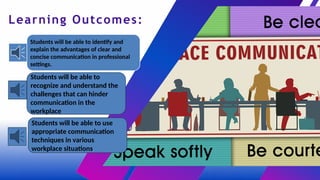
Learning Outcomes:
Students will be able to identify and
explain the advantages of clear and
concise communication in professional
settings.
Students will be able to
recognize and understand the
challenges that can hinder
communication in the
workplace
Good communication is a key
part of success in the
workplace.
Without communication skills we are unable to
let others know what we think, feel, or want to
accomplish. We are unable to build partnerships,
motivate others, or resolve conflict.
INTRODUCTION
Meet the
Authors
Jay Sullivan
Simply Said: Communicating Better at
Work and Beyond
is an award-winning author
and the
Managing Partner
at
Exec|Comm, LLC. Whether coaching individuals one-on-one or
working with groups, Jay helps professionals from global
organizations have greater impact through communication. As a
contributing writer on Forbes.com, he shares insights on leadership,
communication, and careers. He wrote The Art of Communication
column for the New York Law Journal. His work has appeared in The
New York Times, Readers Digest, Parents Magazine, Catholic Digest,
and The Golfer.
Allaya Cooks-Campbell
|
With over 15 years of content experience, Allaya Cooks Campbell has
written for outlets such as ScaryMommy, HRzone, and HuffPost. She
holds a B.A. in Psychology and is a certified yoga instructor as well as a
certified Integrative Wellness & Life Coach. Allaya is passionate about
whole-person wellness, yoga, and mental health.
MATERIALS:
PO
POWER POINT
PRESENTATION
BOOKS
INTERNET
The exchange of thoughts, messages, or
information, as by speech, signals, writing, or
behavior.
The art and technique of using words effectively
to impart information or ideas.
Acceptable communication differs from
company to company, but many aspects are
universal.
Definition Of Effective Communication
What is a
workplace?
A place, such as an office or
factory, where people are
employed.
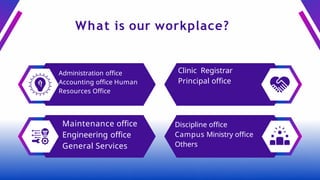
What is our workplace?
Administration office
Accounting office Human
Resources Office
Clinic Registrar
Principal office
Maintenance office
Engineering office
General Services
Discipline office
Campus Ministry office
Others
Tips to help us
communicate effectively in
the workplace
Listen
When you listen to others attentively it makes them feel good.
It also makes for a deeper and more positive connection with others.
In turn, you form an understanding and they will listen to you when it's your turn to
speak.
Poor listening happens often and results in misunderstandings and
miscommunications.
HOW GOOD A LISTENER ARE
YOU?
1.The thief was tall, dark, and broad.
2. The professor turned off the lights.
3. A tall figure demanded the examination.
4. The examination was picked up by someone
5.The examination was picked up by
the professor.
6. A tall, dark figure appeared after the
professor turned off the lights in the office.
7.The man who opened the
drawerwas the professor.
8. The professor ran down the corridor.
9. The drawer was never actually opened.
10. In this report three persons are referred to.
ANSWERS
1. TRUE
2. TRUE
3. TRUE
4. TRUE
5. FALSE
1. FALSE
2. TRUE
3. FALSE
4. FALSE
5. TRUE
A well-liked college teacher had just completed making up the final examinations and had
turned off the lights in the office. Just then a tall, dark, broad figure appeared and
demanded the examination. The professor opened the drawer. Everything in the drawer
was picked up and the individual ran down the corridor. The Dean was notified
immediately.
INTERPRETATION OF SCORES
5 PTS-7
PTS
8PTS-10 PTS
ACTIVE
LISTENE
R
AVERAGE
BELOW 5 PTS
NEEDS TO BE
MORE ATTENTIVE.
the process of exchanging
information and wisdom,
both verbal and non-verbal
between one person/group
and another person/group
within an organization.It
includes e-mails, text
messages, notes, calls, etc
WORKPLACE
COMMUNICATION
IMPORTANT OF WORKPLACE
COMMUNICATION
Effective communication is critical in getting the job
done, as well as building a sense of trust and
increasing the productivity of employees. These may
have different cultures and backgrounds, and can be
used to different norms.
Effective workplace communication ensures that all
the organizational objectives are achieved.
Workplace communication is tremendously
important to organizations because it increases
productivity and efficiency.
IMPORTANCE OF WORKPLACE
COMMUNICATION
Effective communication, also
called open communication,
prevents barriers from forming
among individuals within
companies that might impede
progress in striving to reach a
common goal.
Effective communication with
clients plays a vital role in
development of an
organization and success of
any business.
BENEFITS OF
GOOD
COMMUNICATI
ON
EFFECTIVE COMMUNICATION IN
THE WORKPLACE
It is an indispensable part of
business success as it increases
employee engagement, enhances
client relationships, and over all
effectiveness of the team.
a. Mitigates Conflict
Effective communication can resolve many workplace conflicts as it has the power to
handle a difference of opinion and prevent miscommunications with respect and civility.
c. Improves Public Relation
Workplace communication is not just for the team, but it is also helpful when
interacting with external parties like sponsorship agreements, and social media. It
helps businesses connect effectively with their sponsors,customers, and other
d. Builds Existing Skills
The open line of communication promotes motivated and engaged employees.
When the senior staff communicates openly and effectively, they can bring out the best
skills of their team.
e. Enhances Employee Satisfaction and Loyalty
When employees and senior managers communicate well, they will be engaged
with the company. And the highly motivated employees lead to improved job
satisfaction and loyalty as a result.
F. STRENGHTENED TEAM BUILDING
In order to work effectively together, team members must know they can trust the
other members of their team.
WAYS TO
DEVELOP
COMMUNICATIO
N SKILLS AT
WORK
1.
It’s important not only to listen to the words
someone is saying, but to listen for tone as
well, and what makes the speaker passionate
about the subject.
Learn How to Listen
Practice Public Speaking
In a world of email, texts and instant
messages, it’s easy to ignore your speaking
skills until you are in front of a podium.
However, employees need to know how to
speak well person-to-person and in front of
small or large groups.
2.
3.
Although a great deal of communication
now happens online, being confident while
speaking on the phone is still a vital
professional skill.
Make Phone Calls With
Confidence
4.
Collaborate Well With Remote
Teams
Employees must develop communication
skills that can help them bridge the gap
between on-site and remote workers. The
ability to work in teams is one skill that
can’t be overemphasized, as it is rare for
individuals to work in a vacuum.
5.
Team building activities often create a
dynamic working environment, where
people feel safe and build their
confidence.
Make Time for Team
Building
6.
Write More Effective Emails
Poorly written, unclear, misleading or
ineffective emails reduce productivity and
can leave a poor impression on the reader.
7.
Without good team communication, there
will be miscommunications, especially
since many organizations are now hybrid
or remote.
Communication apps include
project management tools,
video conferencing tools and
voice-over-internet-protocol services.
Get a Team Communication
App
Barriers to Communication
in the Workplace
Presenter:
Violeta P. Luminarias
Mat-SocSci
What are barriers to communication in the
workplace?
Barriers to communication in the workplace
are anything that prevent or misconstrue the
effective delivery of messages among
employees and leadership within a company
or organization.
Typical workplace communication barriers:
• Information overload
• Language barriers
• Differing communication styles
• Cultural differences
• Physical disability
• Impatient or inactive listening
• Vague or indirect message
• Mismatched verbal and nonverbal cues
Information overload
The sheer amount of information available in today's digital age can be overwhelming,
leading to increased stress and fatigue. This, in turn, leads to decreased attention spans and
difficulty in processing and retaining information, hindering effective communication.
Language barriers
When someone’s primary language differs from your own, you may have trouble understanding
one another. Idiomatic phrases or expressions, where the actual meaning differs from what it
literally says, do not translate well among languages and cause misunderstandings. Having a
multicultural and multilingual work culture is extremely beneficial, but it is necessary to be
mindful of communication difficulties.
Differing communication styles
Professionals communicate differently based on individual needs, strengths, and backgrounds.
One individual may be very direct and concise in their verbiage while another needs time to get
their message across and prefers to provide many details. Some people rely on visual stimulus
and gestures, while others are keen on the use of tone and facial expressions. These variations
can create communication obstacles when people with diverse communication styles are
unaware and don’t recognize the needs of the other party.
Cultural differences
Cultures form the foundation of how we view the world and dictate much of our
behavior and mannerisms. Because the guiding principles of cultures vary, they create
cultural barriers that can impede people from understanding one another. In some
cultures it is disrespectful to touch the hand of a stranger, while in others it is standard
practice and polite to shake hands when meeting. One culture may consider strong eye
contact a sign of aggression and disrespect, while another views consistent eye contact
as a sign of interest and engagement in a conversation.
Physical disability
Hearing impairments, speech impediments, visual impairments, or other physical or
mental differences can act as communication barriers and cause difficulty in daily tasks
and complicate teamwork. It is important to have support built into the work
environment and to educate all employees about communication modifications and
strategies available for an inclusive and productive atmosphere.
Impatient or inactive listening
One key component of effective communication is the skill of listening. A conversation is
an exchange of information, but when one entity shows disengagement or disinterest
by focusing on electronic devices or glancing away, the exchange loses substance.
Vague or indirect message
What you say and how you say it are equally important to delivering a message
effectively. Lacking confidence in your delivery and using the passive voice
affects how your audience receives the information provided.
Disinterest (disengagement or detachment)
Your ability to breakdown information relies on how active you are in receiving
information. Being distracted by a text message, engaged in a side
conversation during a presentation, or answering a call while in a meeting
distracts your attention and impedes your ability to pick up on nonverbal cues,
possibly causing you to miss valuable information. Giving others your
undivided attention is a sign of respect, is conducive to building trust in the
workplace, and establishes your high level of professionalism.
Strategies to Overcome Barriers to Communication in the Workplace
Be fully present. It takes concentration and practice to focus on others’ ideas with an
open mind. Withhold any assumptions about the information being shared with you
as you listen. Listen attentively and wait until later to provide feedback.
Be specific in your information. Share pertinent details succinctly to make
information easy to understand and remember. Be concise and give others the
opportunity to ask clarifying questions to make the exchange of information dynamic.
Use words and a tone that convey confidence. Work on eliminating words like, “um, like,”
and “ah” and phrases such as, “I think that” which don’t add to the information and may
distract your audience.
Encourage questions. Be inviting and prompt others you communicate with
consistently to ask questions. This helps you see different perspectives and can lead to
the understanding and discovery of ways to avoid communication pitfalls in the future.
Wrap Up
Effective communication in the workplace is a cornerstone of organizational success, enhancing
collaboration, reducing misunderstandings, and fostering a positive work environment. Recent training
sessions and employee feedback have highlighted both strengths and areas needing improvement in
workplace communication.
In conclusion, effective communication is vital for thriving workplace. By enhancing interpersonal
communication, improving conflict resolution skills, and elevating professional written communication,
organizations can create a more collaborative and productive work environment. Implementing these
recommendations will lead to overall organizational siccess.
FocusQuestions:
1. Why is good communication important in the work place?
2. Give an example of how clear communication can help avoid
misunderstandings at work?
3. What is one way you can improve your communication with your coworkers?
.
.
THANK YOU
“
”
References:
Workplace communication. (2024, March 28). Wikipedia.
https://shorturl.at/rYm1Z
6 Barriers to Effective Communication - Graduate College of Drexel University. (n.d.). Graduate College of Drexel University.
https://drexel.edu/graduatecollege/professional-development/blog/2018/july/6-barriers-to-effective-communication/
Improving Communication in the Workplace: Tips & Techniques. (n.d.).
https://shorturl.at/YJPoV
Barriers to Communication in the Workplace and Ways to Help
https://www.glassdoor.com/blog/guide/barriers-to-communication-in-the-workplace/
WIKIPEDIA
https://www.spiceworks.com/hr/engagement-retention/guest-article/effective-communication-in-the-workplace-how-and-why/
.
.

communication in workplace power point presentatio

  • 1.
    Communication in the Workplace REPORTERS: 1.LASACA, CLARICET.- Mat-Filipino 2.LUMINARIAS, VIOLETA P.- Mat-SocSci 3.JAICTIN, MA. ROSARIO C.- Mat-SocSci
  • 2.
    1.To be ableto understand the importance of effective communication in the workplace. 2.Develop active listening skills. 3.Demonstrate respect for diverse communication styles and perspectives. Objectives:
  • 3.
    Students will beable to use appropriate communication techniques in various workplace situations. Learning Outcomes: Students will be able to identify and explain the advantages of clear and concise communication in professional settings. Students will be able to recognize and understand the challenges that can hinder communication in the workplace
  • 4.
    Good communication isa key part of success in the workplace. Without communication skills we are unable to let others know what we think, feel, or want to accomplish. We are unable to build partnerships, motivate others, or resolve conflict. INTRODUCTION
  • 5.
    Meet the Authors Jay Sullivan SimplySaid: Communicating Better at Work and Beyond is an award-winning author and the Managing Partner at Exec|Comm, LLC. Whether coaching individuals one-on-one or working with groups, Jay helps professionals from global organizations have greater impact through communication. As a contributing writer on Forbes.com, he shares insights on leadership, communication, and careers. He wrote The Art of Communication column for the New York Law Journal. His work has appeared in The New York Times, Readers Digest, Parents Magazine, Catholic Digest, and The Golfer. Allaya Cooks-Campbell | With over 15 years of content experience, Allaya Cooks Campbell has written for outlets such as ScaryMommy, HRzone, and HuffPost. She holds a B.A. in Psychology and is a certified yoga instructor as well as a certified Integrative Wellness & Life Coach. Allaya is passionate about whole-person wellness, yoga, and mental health.
  • 6.
  • 7.
    The exchange ofthoughts, messages, or information, as by speech, signals, writing, or behavior. The art and technique of using words effectively to impart information or ideas. Acceptable communication differs from company to company, but many aspects are universal. Definition Of Effective Communication
  • 9.
    What is a workplace? Aplace, such as an office or factory, where people are employed.
  • 10.
    What is ourworkplace? Administration office Accounting office Human Resources Office Clinic Registrar Principal office Maintenance office Engineering office General Services Discipline office Campus Ministry office Others
  • 11.
    Tips to helpus communicate effectively in the workplace Listen When you listen to others attentively it makes them feel good. It also makes for a deeper and more positive connection with others. In turn, you form an understanding and they will listen to you when it's your turn to speak. Poor listening happens often and results in misunderstandings and miscommunications.
  • 12.
    HOW GOOD ALISTENER ARE YOU? 1.The thief was tall, dark, and broad. 2. The professor turned off the lights. 3. A tall figure demanded the examination. 4. The examination was picked up by someone 5.The examination was picked up by the professor. 6. A tall, dark figure appeared after the professor turned off the lights in the office. 7.The man who opened the drawerwas the professor. 8. The professor ran down the corridor. 9. The drawer was never actually opened. 10. In this report three persons are referred to.
  • 13.
    ANSWERS 1. TRUE 2. TRUE 3.TRUE 4. TRUE 5. FALSE 1. FALSE 2. TRUE 3. FALSE 4. FALSE 5. TRUE A well-liked college teacher had just completed making up the final examinations and had turned off the lights in the office. Just then a tall, dark, broad figure appeared and demanded the examination. The professor opened the drawer. Everything in the drawer was picked up and the individual ran down the corridor. The Dean was notified immediately.
  • 14.
    INTERPRETATION OF SCORES 5PTS-7 PTS 8PTS-10 PTS ACTIVE LISTENE R AVERAGE BELOW 5 PTS NEEDS TO BE MORE ATTENTIVE.
  • 15.
    the process ofexchanging information and wisdom, both verbal and non-verbal between one person/group and another person/group within an organization.It includes e-mails, text messages, notes, calls, etc WORKPLACE COMMUNICATION
  • 16.
    IMPORTANT OF WORKPLACE COMMUNICATION Effectivecommunication is critical in getting the job done, as well as building a sense of trust and increasing the productivity of employees. These may have different cultures and backgrounds, and can be used to different norms. Effective workplace communication ensures that all the organizational objectives are achieved. Workplace communication is tremendously important to organizations because it increases productivity and efficiency.
  • 17.
    IMPORTANCE OF WORKPLACE COMMUNICATION Effectivecommunication, also called open communication, prevents barriers from forming among individuals within companies that might impede progress in striving to reach a common goal. Effective communication with clients plays a vital role in development of an organization and success of any business.
  • 18.
  • 19.
    EFFECTIVE COMMUNICATION IN THEWORKPLACE It is an indispensable part of business success as it increases employee engagement, enhances client relationships, and over all effectiveness of the team.
  • 20.
    a. Mitigates Conflict Effectivecommunication can resolve many workplace conflicts as it has the power to handle a difference of opinion and prevent miscommunications with respect and civility.
  • 21.
    c. Improves PublicRelation Workplace communication is not just for the team, but it is also helpful when interacting with external parties like sponsorship agreements, and social media. It helps businesses connect effectively with their sponsors,customers, and other
  • 22.
    d. Builds ExistingSkills The open line of communication promotes motivated and engaged employees. When the senior staff communicates openly and effectively, they can bring out the best skills of their team.
  • 23.
    e. Enhances EmployeeSatisfaction and Loyalty When employees and senior managers communicate well, they will be engaged with the company. And the highly motivated employees lead to improved job satisfaction and loyalty as a result.
  • 24.
    F. STRENGHTENED TEAMBUILDING In order to work effectively together, team members must know they can trust the other members of their team.
  • 25.
  • 26.
    1. It’s important notonly to listen to the words someone is saying, but to listen for tone as well, and what makes the speaker passionate about the subject. Learn How to Listen Practice Public Speaking In a world of email, texts and instant messages, it’s easy to ignore your speaking skills until you are in front of a podium. However, employees need to know how to speak well person-to-person and in front of small or large groups. 2.
  • 27.
    3. Although a greatdeal of communication now happens online, being confident while speaking on the phone is still a vital professional skill. Make Phone Calls With Confidence 4. Collaborate Well With Remote Teams Employees must develop communication skills that can help them bridge the gap between on-site and remote workers. The ability to work in teams is one skill that can’t be overemphasized, as it is rare for individuals to work in a vacuum.
  • 28.
    5. Team building activitiesoften create a dynamic working environment, where people feel safe and build their confidence. Make Time for Team Building 6. Write More Effective Emails Poorly written, unclear, misleading or ineffective emails reduce productivity and can leave a poor impression on the reader.
  • 29.
    7. Without good teamcommunication, there will be miscommunications, especially since many organizations are now hybrid or remote. Communication apps include project management tools, video conferencing tools and voice-over-internet-protocol services. Get a Team Communication App
  • 30.
    Barriers to Communication inthe Workplace Presenter: Violeta P. Luminarias Mat-SocSci
  • 31.
    What are barriersto communication in the workplace? Barriers to communication in the workplace are anything that prevent or misconstrue the effective delivery of messages among employees and leadership within a company or organization.
  • 32.
    Typical workplace communicationbarriers: • Information overload • Language barriers • Differing communication styles • Cultural differences • Physical disability • Impatient or inactive listening • Vague or indirect message • Mismatched verbal and nonverbal cues
  • 33.
    Information overload The sheeramount of information available in today's digital age can be overwhelming, leading to increased stress and fatigue. This, in turn, leads to decreased attention spans and difficulty in processing and retaining information, hindering effective communication. Language barriers When someone’s primary language differs from your own, you may have trouble understanding one another. Idiomatic phrases or expressions, where the actual meaning differs from what it literally says, do not translate well among languages and cause misunderstandings. Having a multicultural and multilingual work culture is extremely beneficial, but it is necessary to be mindful of communication difficulties. Differing communication styles Professionals communicate differently based on individual needs, strengths, and backgrounds. One individual may be very direct and concise in their verbiage while another needs time to get their message across and prefers to provide many details. Some people rely on visual stimulus and gestures, while others are keen on the use of tone and facial expressions. These variations can create communication obstacles when people with diverse communication styles are unaware and don’t recognize the needs of the other party.
  • 34.
    Cultural differences Cultures formthe foundation of how we view the world and dictate much of our behavior and mannerisms. Because the guiding principles of cultures vary, they create cultural barriers that can impede people from understanding one another. In some cultures it is disrespectful to touch the hand of a stranger, while in others it is standard practice and polite to shake hands when meeting. One culture may consider strong eye contact a sign of aggression and disrespect, while another views consistent eye contact as a sign of interest and engagement in a conversation. Physical disability Hearing impairments, speech impediments, visual impairments, or other physical or mental differences can act as communication barriers and cause difficulty in daily tasks and complicate teamwork. It is important to have support built into the work environment and to educate all employees about communication modifications and strategies available for an inclusive and productive atmosphere. Impatient or inactive listening One key component of effective communication is the skill of listening. A conversation is an exchange of information, but when one entity shows disengagement or disinterest by focusing on electronic devices or glancing away, the exchange loses substance.
  • 35.
    Vague or indirectmessage What you say and how you say it are equally important to delivering a message effectively. Lacking confidence in your delivery and using the passive voice affects how your audience receives the information provided. Disinterest (disengagement or detachment) Your ability to breakdown information relies on how active you are in receiving information. Being distracted by a text message, engaged in a side conversation during a presentation, or answering a call while in a meeting distracts your attention and impedes your ability to pick up on nonverbal cues, possibly causing you to miss valuable information. Giving others your undivided attention is a sign of respect, is conducive to building trust in the workplace, and establishes your high level of professionalism.
  • 36.
    Strategies to OvercomeBarriers to Communication in the Workplace
  • 37.
    Be fully present.It takes concentration and practice to focus on others’ ideas with an open mind. Withhold any assumptions about the information being shared with you as you listen. Listen attentively and wait until later to provide feedback. Be specific in your information. Share pertinent details succinctly to make information easy to understand and remember. Be concise and give others the opportunity to ask clarifying questions to make the exchange of information dynamic. Use words and a tone that convey confidence. Work on eliminating words like, “um, like,” and “ah” and phrases such as, “I think that” which don’t add to the information and may distract your audience. Encourage questions. Be inviting and prompt others you communicate with consistently to ask questions. This helps you see different perspectives and can lead to the understanding and discovery of ways to avoid communication pitfalls in the future.
  • 38.
    Wrap Up Effective communicationin the workplace is a cornerstone of organizational success, enhancing collaboration, reducing misunderstandings, and fostering a positive work environment. Recent training sessions and employee feedback have highlighted both strengths and areas needing improvement in workplace communication. In conclusion, effective communication is vital for thriving workplace. By enhancing interpersonal communication, improving conflict resolution skills, and elevating professional written communication, organizations can create a more collaborative and productive work environment. Implementing these recommendations will lead to overall organizational siccess.
  • 39.
    FocusQuestions: 1. Why isgood communication important in the work place? 2. Give an example of how clear communication can help avoid misunderstandings at work? 3. What is one way you can improve your communication with your coworkers? . .
  • 40.
  • 41.
    “ ” References: Workplace communication. (2024,March 28). Wikipedia. https://shorturl.at/rYm1Z 6 Barriers to Effective Communication - Graduate College of Drexel University. (n.d.). Graduate College of Drexel University. https://drexel.edu/graduatecollege/professional-development/blog/2018/july/6-barriers-to-effective-communication/ Improving Communication in the Workplace: Tips & Techniques. (n.d.). https://shorturl.at/YJPoV Barriers to Communication in the Workplace and Ways to Help https://www.glassdoor.com/blog/guide/barriers-to-communication-in-the-workplace/ WIKIPEDIA https://www.spiceworks.com/hr/engagement-retention/guest-article/effective-communication-in-the-workplace-how-and-why/ . .

Editor's Notes

  • #12 A well-liked college teacher had just completed making up the final examinations and had turned off the lights in the office. Just then a tall, dark, broad figure appeared and demanded the examination. The professor opened the drawer. Everything in the drawer was picked up and the individual ran down the corridor. The Dean was notified immediately.
  • #15 Effective communication in the workplace is when the exchanging of information and ideas is done so in an efficient and effective manner. While information and ideas are frequently exchanged in a workplace setting, they aren't also sent and received in an accurate way. Good communication involves not just relaying information but being able to explain it in a way that ensures the recipient understands you.Communication at work includes several different methods of transmitting and receiving information. The most common forms of communication in the workplace include: • Written communication, such as memos and emails • Oral communication, such as speaking to another person • Nonverbal communication, such as nodding to show understanding • Listening skills, including active listening Additionally, an important component of workplace communication is that employees feel understood and heard by management. Employees who feel comfortable communication with their supervisors and managers are more likely to understand what's expected of them and remain productive throughout the