Good Manufacturing Practices 
Purpose and Principles of GMP 
Tony Gould
2 | PQ Workshop, Abu Dhabi | October 2010 
Why GMP? 
Provides a high level assurance that medicines 
are manufactured in a way that ensures their 
safety, efficacy and quality 
Medicines are manufactured to comply with their 
marketing authorization 
Quality is built in 
– Testing is part of GMP, but alone does not provide a 
good level of quality assurance
Why inspect? 
Verify compliance with GMP 
Verify compliance with marketing authorization 
– Dossier: "Dedicated equipment is used" 
Inspection: Observation that this means "dedicated while used 
for the product or not being used for another product" 
– Dossier: "The vials are removed from the lyophilliser and 
crimped in a grade A environment" 
Inspection: Correct, but before crimping they are stored in an 
uncontrolled corridor 
3 | PQ Workshop, Abu Dhabi | October 2010
4 | PQ Workshop, Abu Dhabi | October 2010 
WHO GMP 
Quality assurance of pharmaceuticals 
A compendium of guidelines and related materials 
Volume 2, 2nd updated edition 
Good manufacturing practices 
and inspection
Guidelines and references 
GMP applies to both Active Pharmaceutical 
Ingredients (APIs) and Finished Pharmaceutical 
Products (FPPs) 
– FPP: 
WHO Good Manufacturing Practices for pharmaceutical 
products: main principles. WHO Technical Report 
Series, No. 908, 2003, Annex 4. 
– API: 
WHO good manufacturing practices for active 
pharmaceutical ingredients - Annex 2, WHO 
Technical Report Series 957, 2010 (Based on ICH 
5 Q7) 
5 | PQ Workshop, Abu Dhabi | October 2010
Other WHO GMP Guidelines 
Pharmaceutical excipients 
Sterile pharmaceutical products 
Biological products 
Pharmaceutical products containing hazardous 
substances 
Investigational pharmaceutical products for clinical trials i 
Herbal medicinal products 
Radiopharmaceutical products 
Water for pharmaceutical use 
HVAC for non-sterile pharmaceutical dosage forms 
Validation 
6 | PQ Workshop, Abu Dhabi | October 2010
Good Manufacturing Practices (FPP): 
1. Quality assurance 
2. Good manufacturing practices for pharmaceutical 
products 
3. Sanitation and hygiene 
4. Qualification and validation 
5. Complaints 
6. Product recalls 
7. Contract production and analysis 
– General 
– The contract giver 
– The contract accepter 
– The contract 
7 | PQ Workshop, Abu Dhabi | October 2010
Good Manufacturing Practices (cont'd) 
8. Self-inspection and quality audits 
– Items for self-inspection 
– Self-inspection team 
– Frequency of self-inspection 
– Self-inspection report 
– Follow-up action 
– Quality audit 
– Suppliers’ audits and approval 
9. Personnel 
– General 
– Key personnel 
10. Training 
8 | PQ Workshop, Abu Dhabi | October 2010
Good Manufacturing Practices (cont'd) 
11. Personal hygiene 
12. Premises 
– General 
– Ancillary areas 
– Storage areas 
– Weighing areas 
– Production areas 
– Quality control area 
13. Equipment 
9 | PQ Workshop, Abu Dhabi | October 2010
Good Manufacturing Practices (cont'd) 
14. Materials 
– General 
– Starting materials 
– Packaging materials 
– Intermediate and bulk products 
– Finished products 
– Rejected, recovered, reprocessed and reworked materials 
– Recalled products 
– Returned goods 
– Reagents and culture media 
– Reference standards 
– Waste materials 
– Miscellaneous 
10 | PQ Workshop, Abu Dhabi | October 2010
Good Manufacturing Practices (cont'd) 
15. Documentation 
– General 
– Documents required: 
• Labels 
• Testing procedures 
• Specifications for starting and packaging materials, for 
intermediate and bulk products and for finished products 
• Master formulae and Batch Processing Records 
• Packaging instructions and Batch Packaging Records 
• Standard Operating procedures (SOP's) and records 
• Logbooks 
11 | PQ Workshop, Abu Dhabi | October 2010
Good Manufacturing Practices (cont'd) 
16. Good practices in production 
– General 
– Prevention of cross-contamination and bacterial 
contamination during production 
– Processing operations 
– Packaging operations 
17. Good practices in quality control 
– Control of starting materials and intermediate, bulk and 
finished products 
– Test requirements 
– Batch record review 
– Stability studies 
12 | PQ Workshop, Abu Dhabi | October 2010
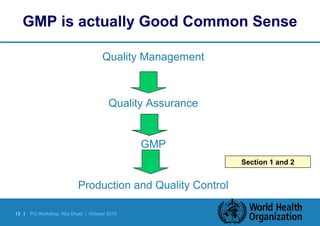
GMP is actually Good Common Sense 
Quality Management 
Quality Assurance 
13 | PQ Workshop, Abu Dhabi | October 2010 
GMP 
Production and Quality Control 
Section 1 and 2
Quality management in the drug industry 
Philosophy and essential elements: 
"The concepts of quality assurance, GMP, quality 
control and quality risk management are 
interrelated aspects of quality management, and 
should be the responsibility of all personnel. …… 
their relationship and their fundamental 
importance to the production and control of 
pharmaceutical products." 
14 | PQ Workshop, Abu Dhabi | October 2010 
Glossary
Quality Management 
 The basic elements are: 
– An appropriate infrastructure or “quality system” 
encompassing the organization structure, 
procedures, processes and resources 
– The systematic actions necessary to ensure adequate 
confidence that a product (or service) will satisfy given 
requirements for “Quality” 
The totality of these actions is referred to as “Quality 
Assurance” 
15 | PQ Workshop, Abu Dhabi | October 2010
16 | PQ Workshop, Abu Dhabi | October 2010 
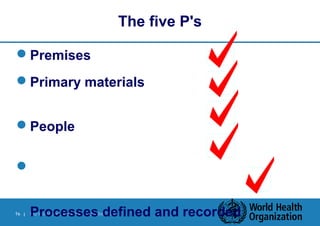
The five P's 
Premises 
Primary materials 
People 
 
Processes defined and recorded
Quality Assurance 
Quality assurance is a management tool 
In contractual situations, it also serves to generate 
confidence in a supplier 
QA, GMP and Quality Control are interrelated aspects 
of Quality Management 
– They are described on the following slides in order to 
emphasize their relationship and their fundamental 
importance to the production and control of 
pharmaceutical products 1.1 
17 | PQ Workshop, Abu Dhabi | October 2010
Quality Assurance 
Wide-ranging concept 
– covers all matters that individually or collectively 
influence the quality of a product 
Totality of the arrangements 
– to ensure that the drug is continuously of the right 
quality for the intended use 
Quality Assurance incorporates GMP 
– and also includes product design and 
development, with special focus on process 
design 1.1 
18 | PQ Workshop, Abu Dhabi | October 2010
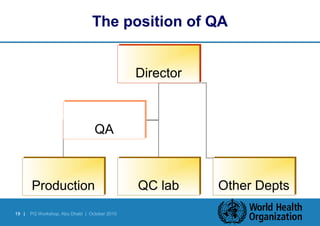
The position of QA 
19 | PQ Workshop, Abu Dhabi | October 2010 
DDiirreeccttoorr 
QQAA 
PPrroodduuccttiioonn QQCC llaabb OOtthheerr DDeeppttss
Quality Assurance means to assure: 
Products are designed and developed correctly 
– Complying with, e.g. GMP, GCP, GLP 
Production and control operations are defined 
Managerial responsibilities are defined 
– In job descriptions 
The manufacture, supply and use of correct starting 
and packaging materials 1.1 a- d 
20 | PQ Workshop, Abu Dhabi | October 2010
Quality Assurance means to assure: 
21 | PQ Workshop, Abu Dhabi | October 2010 
(cont'd) 
 Controls are performed, including 
intermediates, bulk, calibration and validation 
 Correct processing and checking of the 
finished product 
 Products are sold/supplied only after review 
by the authorized person 
– Complying with marketing authorization, 
production and QC requirements 
1.1 e - h 
 Proper storage, distribution and handling
Quality Assurance means to assure: 
22 | PQ Workshop, Abu Dhabi | October 2010 
(cont'd) 
Procedures for self-inspection and quality 
audits are applied 
Deviations are reported, investigated and 
recorded 
System for change control is applied 
Regular evaluation of product quality to 
verify consistency and continued 
improvement 
1.1 i - l
Quality Assurance includes: 
 Responsibility of the Manufacturer for the quality of the 
product 
– Fit for intended use 
– Comply with marketing authorization 
– Safety, efficacy and quality 
 Commitment of senior management and involvement of all 
staff 
 Comprehensively designed and well implemented quality 
system 
 Full documentation and monitoring of effectiveness 
 Competent personnel, sufficient premises, equipment and 
facilities 1.3 
23 | PQ Workshop, Abu Dhabi | October 2010
Good Manufacturing Practices 
That part of QA that ensures that products are 
consistently produced and controlled 
– Quality standards 
– Marketing authorization 
Aim: Diminishing risks that cannot be controlled 
by testing of product 
– Contamination and cross-contamination 
– Mix-ups (confusion) 2.1 
24 | PQ Workshop, Abu Dhabi | October 2010
Basic requirements for GMP: 
Clearly defined and systematically reviewed 
processes 
Qualification and validation is performed 
Appropriate resources are provided: 
– Qualified and trained personnel 
– Premises, space, equipment and services 
– Materials, containers, labels 
– Procedures, storage, transport 
– Laboratories and in-process control 
25 | PQ Workshop, Abu Dhabi | October 2010 
2.1 a - c
Basic requirements for GMP: (cont'd) 
Clear, written instructions and procedures 
Trained operators 
Records of actions, deviations and 
investigations 
Records for manufacture and distribution 
Proper storage and distribution 
Systems for complaints and recalls 2.1 d - j 
26 | PQ Workshop, Abu Dhabi | October 2010
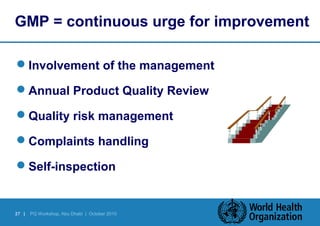
GMP = continuous urge for improvement 
Involvement of the management 
Annual Product Quality Review 
Quality risk management 
Complaints handling 
Self-inspection 
27 | PQ Workshop, Abu Dhabi | October 2010
Involvement of the management 
The senior management is responsible to attain the 
company's quality objectives 
All different departments and all levels within 
departments should be involved; and it's the senior 
management who should facilitate this 
Also suppliers and distributors should be involved 
The senior management should make available the 
required resources 
The basis of the quality system is the quality statement 
and quality policy, by the senior management 
28 | PQ Workshop, Abu Dhabi | October 2010
Product Quality Review 
Objectives of Product Quality Review: 
To review and verify the consistency and 
appropriateness of the existing process 
To identify and highlight any trends in the 
process, e.g. in analytical results, yields etc. 
To identify any possible product or process 
improvements 
29 | PQ Workshop, Abu Dhabi | October 2010
Product Quality Review (cont'd) 
Review of starting materials/ packaging 
materials, especially from new sources 
Review of in-process control results and finished 
product analytical control results 
Amount of batches and packaging units 
produced and their yields 
Reviews of: 
– Out-of-spec situations, rejections, deviations, changes 
– Plus investigations and analysis of causes 
30 | PQ Workshop, Abu Dhabi | October 2010
Annual Product Quality Review (cont'd) 
Review of Marketing Authorization variations 
submitted, granted or refused (incl. third countries) 
Review of stability programme and trends 
Review of adequacy of previous decisions on 
changes or improvements or corrective actions 
For new Marketing Authorizations (plus new 
variations) a review of post marketing commitment 
The qualification status of all relevant equipment 
and utilities (like water, HVAC, gases, etc.) 
Review of Technical Agreements (if applicable) 
31 | PQ Workshop, Abu Dhabi | October 2010
32 | PQ Workshop, Abu Dhabi | October 2010 
5.1 
Complaints handling 
Complaints: Principle 
“All complaints and other information 
concerning potentially defective products 
must be carefully reviewed according to 
written procedures and corrective action 
should be taken.”
33 | PQ Workshop, Abu Dhabi | October 2010 
5.2 – 5.3 
Complaints Procedure 
Designated responsible person: 
– To handle complaint 
– Decide on measure to be taken 
– May be authorized person - if not, must advise 
authorized person of results 
– Sufficient support staff 
– Access to records 
Written procedure (SOP): 
– Describes action to be taken 
– Includes need to consider a recall (e.g. possible 
product defect)
34 | PQ Workshop, Abu Dhabi | October 2010 
5.4 – 5.6 
Complaints Procedure – cont'd 
Thorough investigation: 
– QC involved 
– With special attention to establish whether 
"counterfeiting" may have been the cause 
– Fully recorded investigation – reflect all the details 
Due to product defect (discovered or suspected): 
– Consider checking other batches 
– Batches containing reprocessed product
Complaints Procedure – cont'd 
35 | PQ Workshop, Abu Dhabi | October 2010 
5.7 – 5.9 
Investigation and evaluation should result in 
appropriate follow-up actions 
– May include a "recall" 
All decisions and measures taken should be 
recorded 
Referenced in batch records 
Records reviewed - trends and recurring problems
Complaints - other actions 
Inform competent authorities in case of serious 
quality problems such as: 
36 | PQ Workshop, Abu Dhabi | October 2010 
5.10 
– Faulty manufacture 
– Product deterioration 
– Counterfeiting 
 Have a thorough recall procedure that is consistent 
with the complaints handling procedure 
 Trend complaints, their investigations and results
Self-Inspection 
Purpose is to evaluate whether a company’s 
operations remain compliant with GMP 
The programme should 
– cover all aspects of production and quality control 
– be designed to detect shortcomings in the implementation of 
GMP 
– recommend corrective actions 
– set a timetable for corrective action to be completed 
Should be performed routinely 
Also on special occasions such as 
– Recalls 
– Repeated rejections 8.1 
37 | PQ Workshop, Abu Dhabi | October 2010
38 | PQ Workshop, Abu Dhabi | October 2010 
8.3, 8.4 
Self-Inspection (cont'd) 
Performed by team appointed by management, with: 
– authority 
– sufficient experience, expertise in their own field. 
knowledge of GMP 
– may be from inside or outside the company 
Frequency should normally be at least once a year 
– May depend on company requirements 
– Size of the company and activities
39 | PQ Workshop, Abu Dhabi | October 2010 
8.5, 8.6 
Self-Inspection (cont'd) 
Report prepared at completion of inspection, 
including: 
– results 
– evaluation 
– conclusions 
– recommended corrective measures 
Follow-up action 
– Effective follow-up programme 
– Company management to evaluate both 
the report and corrective actions
Summary and conclusions: 
GMP compliance is not an option 
Quality should be built into the product 
GMP's are very similar and are really 
Good Common Sense 
Good Practices cover all aspects of 
manufacturing activities prior to supply 
The role and involvement of senior 
management is crucial 
40 | PQ Workshop, Abu Dhabi | October 2010
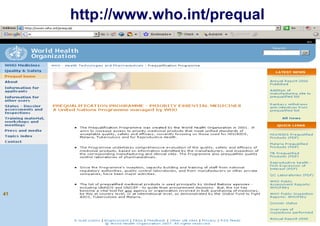
http://www.who.int/prequal 
41 | PQ Workshop, Abu Dhabi | October 2010 
41

1 3 gmp-purpose-principles-guidelines

  • 1.
    Good Manufacturing Practices Purpose and Principles of GMP Tony Gould
  • 2.
    2 | PQWorkshop, Abu Dhabi | October 2010 Why GMP? Provides a high level assurance that medicines are manufactured in a way that ensures their safety, efficacy and quality Medicines are manufactured to comply with their marketing authorization Quality is built in – Testing is part of GMP, but alone does not provide a good level of quality assurance
  • 3.
    Why inspect? Verifycompliance with GMP Verify compliance with marketing authorization – Dossier: "Dedicated equipment is used" Inspection: Observation that this means "dedicated while used for the product or not being used for another product" – Dossier: "The vials are removed from the lyophilliser and crimped in a grade A environment" Inspection: Correct, but before crimping they are stored in an uncontrolled corridor 3 | PQ Workshop, Abu Dhabi | October 2010
  • 4.
    4 | PQWorkshop, Abu Dhabi | October 2010 WHO GMP Quality assurance of pharmaceuticals A compendium of guidelines and related materials Volume 2, 2nd updated edition Good manufacturing practices and inspection
  • 5.
    Guidelines and references GMP applies to both Active Pharmaceutical Ingredients (APIs) and Finished Pharmaceutical Products (FPPs) – FPP: WHO Good Manufacturing Practices for pharmaceutical products: main principles. WHO Technical Report Series, No. 908, 2003, Annex 4. – API: WHO good manufacturing practices for active pharmaceutical ingredients - Annex 2, WHO Technical Report Series 957, 2010 (Based on ICH 5 Q7) 5 | PQ Workshop, Abu Dhabi | October 2010
  • 6.
    Other WHO GMPGuidelines Pharmaceutical excipients Sterile pharmaceutical products Biological products Pharmaceutical products containing hazardous substances Investigational pharmaceutical products for clinical trials i Herbal medicinal products Radiopharmaceutical products Water for pharmaceutical use HVAC for non-sterile pharmaceutical dosage forms Validation 6 | PQ Workshop, Abu Dhabi | October 2010
  • 7.
    Good Manufacturing Practices(FPP): 1. Quality assurance 2. Good manufacturing practices for pharmaceutical products 3. Sanitation and hygiene 4. Qualification and validation 5. Complaints 6. Product recalls 7. Contract production and analysis – General – The contract giver – The contract accepter – The contract 7 | PQ Workshop, Abu Dhabi | October 2010
  • 8.
    Good Manufacturing Practices(cont'd) 8. Self-inspection and quality audits – Items for self-inspection – Self-inspection team – Frequency of self-inspection – Self-inspection report – Follow-up action – Quality audit – Suppliers’ audits and approval 9. Personnel – General – Key personnel 10. Training 8 | PQ Workshop, Abu Dhabi | October 2010
  • 9.
    Good Manufacturing Practices(cont'd) 11. Personal hygiene 12. Premises – General – Ancillary areas – Storage areas – Weighing areas – Production areas – Quality control area 13. Equipment 9 | PQ Workshop, Abu Dhabi | October 2010
  • 10.
    Good Manufacturing Practices(cont'd) 14. Materials – General – Starting materials – Packaging materials – Intermediate and bulk products – Finished products – Rejected, recovered, reprocessed and reworked materials – Recalled products – Returned goods – Reagents and culture media – Reference standards – Waste materials – Miscellaneous 10 | PQ Workshop, Abu Dhabi | October 2010
  • 11.
    Good Manufacturing Practices(cont'd) 15. Documentation – General – Documents required: • Labels • Testing procedures • Specifications for starting and packaging materials, for intermediate and bulk products and for finished products • Master formulae and Batch Processing Records • Packaging instructions and Batch Packaging Records • Standard Operating procedures (SOP's) and records • Logbooks 11 | PQ Workshop, Abu Dhabi | October 2010
  • 12.
    Good Manufacturing Practices(cont'd) 16. Good practices in production – General – Prevention of cross-contamination and bacterial contamination during production – Processing operations – Packaging operations 17. Good practices in quality control – Control of starting materials and intermediate, bulk and finished products – Test requirements – Batch record review – Stability studies 12 | PQ Workshop, Abu Dhabi | October 2010
  • 13.
    GMP is actuallyGood Common Sense Quality Management Quality Assurance 13 | PQ Workshop, Abu Dhabi | October 2010 GMP Production and Quality Control Section 1 and 2
  • 14.
    Quality management inthe drug industry Philosophy and essential elements: "The concepts of quality assurance, GMP, quality control and quality risk management are interrelated aspects of quality management, and should be the responsibility of all personnel. …… their relationship and their fundamental importance to the production and control of pharmaceutical products." 14 | PQ Workshop, Abu Dhabi | October 2010 Glossary
  • 15.
    Quality Management The basic elements are: – An appropriate infrastructure or “quality system” encompassing the organization structure, procedures, processes and resources – The systematic actions necessary to ensure adequate confidence that a product (or service) will satisfy given requirements for “Quality” The totality of these actions is referred to as “Quality Assurance” 15 | PQ Workshop, Abu Dhabi | October 2010
  • 16.
    16 | PQWorkshop, Abu Dhabi | October 2010 The five P's Premises Primary materials People  Processes defined and recorded
  • 17.
    Quality Assurance Qualityassurance is a management tool In contractual situations, it also serves to generate confidence in a supplier QA, GMP and Quality Control are interrelated aspects of Quality Management – They are described on the following slides in order to emphasize their relationship and their fundamental importance to the production and control of pharmaceutical products 1.1 17 | PQ Workshop, Abu Dhabi | October 2010
  • 18.
    Quality Assurance Wide-rangingconcept – covers all matters that individually or collectively influence the quality of a product Totality of the arrangements – to ensure that the drug is continuously of the right quality for the intended use Quality Assurance incorporates GMP – and also includes product design and development, with special focus on process design 1.1 18 | PQ Workshop, Abu Dhabi | October 2010
  • 19.
    The position ofQA 19 | PQ Workshop, Abu Dhabi | October 2010 DDiirreeccttoorr QQAA PPrroodduuccttiioonn QQCC llaabb OOtthheerr DDeeppttss
  • 20.
    Quality Assurance meansto assure: Products are designed and developed correctly – Complying with, e.g. GMP, GCP, GLP Production and control operations are defined Managerial responsibilities are defined – In job descriptions The manufacture, supply and use of correct starting and packaging materials 1.1 a- d 20 | PQ Workshop, Abu Dhabi | October 2010
  • 21.
    Quality Assurance meansto assure: 21 | PQ Workshop, Abu Dhabi | October 2010 (cont'd)  Controls are performed, including intermediates, bulk, calibration and validation  Correct processing and checking of the finished product  Products are sold/supplied only after review by the authorized person – Complying with marketing authorization, production and QC requirements 1.1 e - h  Proper storage, distribution and handling
  • 22.
    Quality Assurance meansto assure: 22 | PQ Workshop, Abu Dhabi | October 2010 (cont'd) Procedures for self-inspection and quality audits are applied Deviations are reported, investigated and recorded System for change control is applied Regular evaluation of product quality to verify consistency and continued improvement 1.1 i - l
  • 23.
    Quality Assurance includes:  Responsibility of the Manufacturer for the quality of the product – Fit for intended use – Comply with marketing authorization – Safety, efficacy and quality  Commitment of senior management and involvement of all staff  Comprehensively designed and well implemented quality system  Full documentation and monitoring of effectiveness  Competent personnel, sufficient premises, equipment and facilities 1.3 23 | PQ Workshop, Abu Dhabi | October 2010
  • 24.
    Good Manufacturing Practices That part of QA that ensures that products are consistently produced and controlled – Quality standards – Marketing authorization Aim: Diminishing risks that cannot be controlled by testing of product – Contamination and cross-contamination – Mix-ups (confusion) 2.1 24 | PQ Workshop, Abu Dhabi | October 2010
  • 25.
    Basic requirements forGMP: Clearly defined and systematically reviewed processes Qualification and validation is performed Appropriate resources are provided: – Qualified and trained personnel – Premises, space, equipment and services – Materials, containers, labels – Procedures, storage, transport – Laboratories and in-process control 25 | PQ Workshop, Abu Dhabi | October 2010 2.1 a - c
  • 26.
    Basic requirements forGMP: (cont'd) Clear, written instructions and procedures Trained operators Records of actions, deviations and investigations Records for manufacture and distribution Proper storage and distribution Systems for complaints and recalls 2.1 d - j 26 | PQ Workshop, Abu Dhabi | October 2010
  • 27.
    GMP = continuousurge for improvement Involvement of the management Annual Product Quality Review Quality risk management Complaints handling Self-inspection 27 | PQ Workshop, Abu Dhabi | October 2010
  • 28.
    Involvement of themanagement The senior management is responsible to attain the company's quality objectives All different departments and all levels within departments should be involved; and it's the senior management who should facilitate this Also suppliers and distributors should be involved The senior management should make available the required resources The basis of the quality system is the quality statement and quality policy, by the senior management 28 | PQ Workshop, Abu Dhabi | October 2010
  • 29.
    Product Quality Review Objectives of Product Quality Review: To review and verify the consistency and appropriateness of the existing process To identify and highlight any trends in the process, e.g. in analytical results, yields etc. To identify any possible product or process improvements 29 | PQ Workshop, Abu Dhabi | October 2010
  • 30.
    Product Quality Review(cont'd) Review of starting materials/ packaging materials, especially from new sources Review of in-process control results and finished product analytical control results Amount of batches and packaging units produced and their yields Reviews of: – Out-of-spec situations, rejections, deviations, changes – Plus investigations and analysis of causes 30 | PQ Workshop, Abu Dhabi | October 2010
  • 31.
    Annual Product QualityReview (cont'd) Review of Marketing Authorization variations submitted, granted or refused (incl. third countries) Review of stability programme and trends Review of adequacy of previous decisions on changes or improvements or corrective actions For new Marketing Authorizations (plus new variations) a review of post marketing commitment The qualification status of all relevant equipment and utilities (like water, HVAC, gases, etc.) Review of Technical Agreements (if applicable) 31 | PQ Workshop, Abu Dhabi | October 2010
  • 32.
    32 | PQWorkshop, Abu Dhabi | October 2010 5.1 Complaints handling Complaints: Principle “All complaints and other information concerning potentially defective products must be carefully reviewed according to written procedures and corrective action should be taken.”
  • 33.
    33 | PQWorkshop, Abu Dhabi | October 2010 5.2 – 5.3 Complaints Procedure Designated responsible person: – To handle complaint – Decide on measure to be taken – May be authorized person - if not, must advise authorized person of results – Sufficient support staff – Access to records Written procedure (SOP): – Describes action to be taken – Includes need to consider a recall (e.g. possible product defect)
  • 34.
    34 | PQWorkshop, Abu Dhabi | October 2010 5.4 – 5.6 Complaints Procedure – cont'd Thorough investigation: – QC involved – With special attention to establish whether "counterfeiting" may have been the cause – Fully recorded investigation – reflect all the details Due to product defect (discovered or suspected): – Consider checking other batches – Batches containing reprocessed product
  • 35.
    Complaints Procedure –cont'd 35 | PQ Workshop, Abu Dhabi | October 2010 5.7 – 5.9 Investigation and evaluation should result in appropriate follow-up actions – May include a "recall" All decisions and measures taken should be recorded Referenced in batch records Records reviewed - trends and recurring problems
  • 36.
    Complaints - otheractions Inform competent authorities in case of serious quality problems such as: 36 | PQ Workshop, Abu Dhabi | October 2010 5.10 – Faulty manufacture – Product deterioration – Counterfeiting Have a thorough recall procedure that is consistent with the complaints handling procedure Trend complaints, their investigations and results
  • 37.
    Self-Inspection Purpose isto evaluate whether a company’s operations remain compliant with GMP The programme should – cover all aspects of production and quality control – be designed to detect shortcomings in the implementation of GMP – recommend corrective actions – set a timetable for corrective action to be completed Should be performed routinely Also on special occasions such as – Recalls – Repeated rejections 8.1 37 | PQ Workshop, Abu Dhabi | October 2010
  • 38.
    38 | PQWorkshop, Abu Dhabi | October 2010 8.3, 8.4 Self-Inspection (cont'd) Performed by team appointed by management, with: – authority – sufficient experience, expertise in their own field. knowledge of GMP – may be from inside or outside the company Frequency should normally be at least once a year – May depend on company requirements – Size of the company and activities
  • 39.
    39 | PQWorkshop, Abu Dhabi | October 2010 8.5, 8.6 Self-Inspection (cont'd) Report prepared at completion of inspection, including: – results – evaluation – conclusions – recommended corrective measures Follow-up action – Effective follow-up programme – Company management to evaluate both the report and corrective actions
  • 40.
    Summary and conclusions: GMP compliance is not an option Quality should be built into the product GMP's are very similar and are really Good Common Sense Good Practices cover all aspects of manufacturing activities prior to supply The role and involvement of senior management is crucial 40 | PQ Workshop, Abu Dhabi | October 2010
  • 41.
    http://www.who.int/prequal 41 |PQ Workshop, Abu Dhabi | October 2010 41

Editor's Notes

  • #33 <number> October 27, 2014 The product complaint principle is defined in the WHO GMP. The manufacturer must assume responsibility for the quality of the pharmaceutical products to ensure that they are fit for their intended use, comply with the requirements of the marketing authorization, and do not place the patient at risk because of inadequate safety, quality or efficacy. Complaints must be handled positively and carefully reviewed, and corrective actions must be taken as necessary. This can mean amending a manufacturing process as well as implementing a recall of a defective product from all markets where it has been distributed.
  • #34 <number> October 27, 2014 First of all a written complaints handling procedure should be available. The basic requirements for such a procedure are: A designated person must be appointed with authority to conduct complaints reviews in accordance with the SOPs. The person designated may be the authorized person responsible for quality control. If not, then that QC person must be kept informed of all complaints being investigated. The designated person must have sufficient staff to be able to review all the complaints received in an effective and rapid manner. They must to be able to access all the relevant records concerning the product under discussion. Required actions are described. The complaint is acknowledged and a response to the customer is provided. Written and verbal comments are recorded.
  • #35 <number> October 27, 2014 The QC department should be involved throughout the investigation. The investigation should be thorough and fully recorded– and reflect all the details of the investigation in the records. Special attention must be given to try and establish whether "counterfeiting" may have been the cause. If there is a product defect (discovered or suspected), then the company should consider checking other batches, and may have to check batches containing reprocessed product.
  • #36 <number> October 27, 2014 Investigation and evaluation should result in appropriate follow up actions taken. This may include a "recall" of the product, or batch. All decisions and measures taken should be recorded. The complaint should also be referenced in batch records – and may thus help during the review or annual product review, trend analysis etc. Complaint records should be reviewed on a regular basis as defined in the SOP. Trends and recurring problems should be identified and proper action taken to prevent recurrence of the problem/cause. As complaints are investigated and records are built up, then trends may start to become clear. A regular review of complaint records to establish whether there is a trend for a particular product, dosage form, customer, distribution channel or similar should be undertaken. This is where the true value of a good complaints handling procedure shows. It may be that a particular formulation or particular machine is giving rise to complaints. This trend analysis process is an opportunity for continuous improvement. It may be that a particular customer is engaged in fraudulent behaviour.
  • #37 <number> October 27, 2014 The competent authority must be informed of any serious quality problems that are revealed by the complaint investigation
  • #38 <number> October 27, 2014 The purpose of self-inspection is to evaluate the manufacturer’s compliance with GMP in all aspects of production and quality control. It also assists in ensuring quality improvement. There should be a programme that covers all aspects of production and quality control. It should be designed to detect shortcomings in the implementation of GMP and recommend corrective actions. The company should set a timetable for corrective action to be completed. You can verify this during your assessment.
  • #39 <number> October 27, 2014 The self-inspection team is appointed by the management of the company and is made up of a mixture of people, including experts in GMP and persons familiar with the area to be inspected. It is useful to have people from production, QC and engineering on the team, as they will bring different perspectives to the inspection. The team leader needs to be someone who has access to the resources to produce a report at the end of the process, and with the authority and experience to organize and manage a team activity. Hence it is usually, but not always, a manager or supervisor. The leader should be from a different department so that he/she can take a more impartial viewpoint. It is important that the team members are encouraged to be objective in their evaluation. The frequency with which self-inspections are carried out will depend on the company. For a small company that can cover all its operations in one inspection, a three or six-monthly review might be sufficient. However, for a larger company that needs to split the inspection into a number of sections, a programme of monthly inspections covering the whole factory in three to six months might be more appropriate.
  • #40 <number> October 27, 2014 All inspections need reports as an outcome; otherwise there is no formal record of the findings and recommendations. This report should be issued as quickly as possible while things are fresh in people’s minds. It does not need to be an elaborate, wordy document that no one will read. A simple list of findings with recommendations for corrective action is sufficient. However, it is important that responsibility for action and a time frame are agreed, either during the inspection or soon after the report is issued. A self-inspection without follow-up is unlikely to be particularly effective and it is important that the company management ensures that the corrective measures are carried out to the agreed timetable.