TOPIC- FOODSAFETY MANAGEMENTSYSTEM
SUBMITTED BY-
JAY PRAKASH
M.TECH (DAIRY TECH.)
1ST SEMESTER
DSFT, IAS, BHU
CONTENT
Definition of food safety and hazards
Difference among GMP GHP GAP
Common food safety requirement
HACCP and ISO 22000
Food safety management
ISO 14000
Food safety programs
Active managerial control
Principles of HACCP
Conclusion
Reference
DEFINATION OF FOOD SAFETY AND HOZARDS
Food safety
A food safety is the assurance that food will not cause harm to the
consumer when it is prepared and eaten according to its intend
use.
Food hazards.
Foods can become unsafe and have the potential to cause harm
through hazards.
Difference between GMP,GHP,GAP
GMP-Manufacture and process controls and includes supplier control
specification calibration of equipment design where condition for
food safety can be achieved maintained and monitored .
GHP- System measures for maintaining hygiene and sanitation and
include personal hygiene and employee health condition
maintenance of plants and equipments .
GAP- It is a particles that insure environment economical and social
sustainability for on farm particles resulting in safe and quality food
and non food agricultural products.
-
Common food safety requirements
 Prerequisite Programes (PRP)
 Good agricultural practice (GAP)
 Good hygiene practices (GHP)
 Hazard analysis and critical control point (HACCP)
HACCP AND ISO -22000
HACCP-A system which identifiles evaluates and controls hazards
which are significant for food safety.
ISO 22000- is a generic food safety management standard. It can be
used by used by any organization directly or indirectly involved in
the food chain. ISO -22000 integrates the codes elementaries
commission 7 principle of HACCP and dynamically combine it with
PRP necessary to control and reduce any food safety hazards.
8-3
Food Safety Management Systems
Food safety management system:
1. Group of practices and procedures
intended to prevent foodborne illness.
2. Actively controls risks and hazards
throughout the flow of food.
ISO 14000
ISO14000 is a family of standards related to environmental management
that exist to help organization minimize how their operations negatively
affect the environment, comply with applicable laws, regulation, and
other environmentally oriented requirements and continually improve the
above.
➢ ISO 14000 is a similar to ISO 9000 quality management.
➢ The requirement of ISO 14000 are an integral part of the European
Union’s Eco-management and audit scheme (EMAS)
▪ ISO 14012 – Qualification criteria for environmental auditors.
▪ ISO 14011 – Audit procedure.
▪ ISO 14010 – General principle for environmental auditing.
▪ ISO 14004 – Guidelines on EMS principles , systems and supporting
techniques.
▪ ISO 14001 – Environmental management systems specifications with
guidance for uses.
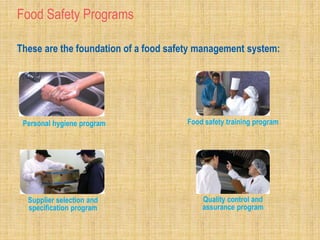
Food Safety Programs
These are the foundation of a food safety management system:
Food safety training program
Quality control and
assurance program
Supplier selection and
specification program
Personal hygiene program
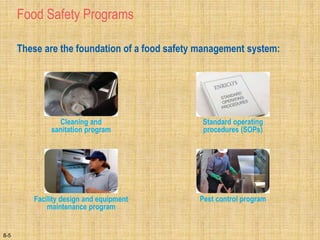
Food Safety Programs
These are the foundation of a food safety management system:
8-5
Standard operating
procedures (SOPs)
Pest control program
Facility design and equipment
maintenance program
Cleaning and
sanitation program
Active Managerial Control
Focuses on controlling the five most common risk factors for
foodborne illness:
1. Purchasing food from unsafe sources
2. Failing to cook food adequately
3. Holding food at incorrect temperatures
4. Using contaminated equipment
5. Practicing poor personal hygiene
Active Managerial Control
There are many ways to achieve active managerial control in
the operation:
 Training programs
 Manager supervision
 Incorporation of standard operating procedures (SOPs)
 HACCP
These are critical to the success of active managerial control:
 Monitoring critical activities in the operation
 Taking the necessary corrective action when required
 Verifying that the actions taken control the risks factors
Active Managerial Control
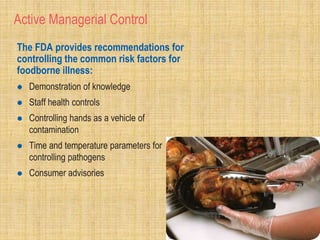
The FDA provides recommendations for
controlling the common risk factors for
foodborne illness:
 Demonstration of knowledge
 Staff health controls
 Controlling hands as a vehicle of
contamination
 Time and temperature parameters for
controlling pathogens
 Consumer advisories
HACCP THE APPROCH
 HACCP is based on identifying significant biological,
chemical, or physical hazards at specific points within
a product’s flow through an operation.
 Once identified, hazards can be prevented, eliminated,
or reduced to safe levels.
The 7 HACCP Principles
The seven HACCP principles:
1. Conduct a hazard analysis
2. Determine critical control points (CCPs)
3. Establish critical limits
4. Establish monitoring procedures
5. Identify corrective actions
6. Verify that the system works
7. Establish procedures for record keeping and documentation
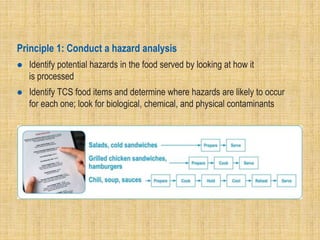
Principle 1: Conduct a hazard analysis
 Identify potential hazards in the food served by looking at how it
is processed
 Identify TCS food items and determine where hazards are likely to occur
for each one; look for biological, chemical, and physical contaminants
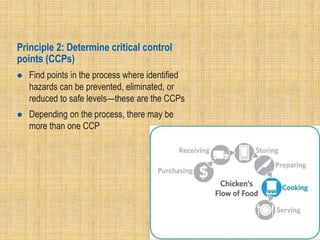
Principle 2: Determine critical control
points (CCPs)
 Find points in the process where identified
hazards can be prevented, eliminated, or
reduced to safe levels—these are the CCPs
 Depending on the process, there may be
more than one CCP
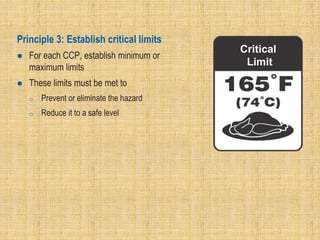
Principle 3: Establish critical limits
 For each CCP, establish minimum or
maximum limits
 These limits must be met to
o Prevent or eliminate the hazard
o Reduce it to a safe level
Critical
Limit
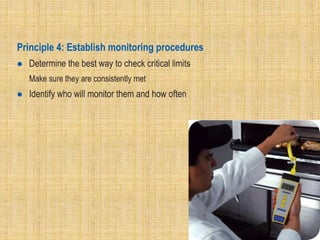
Principle 4: Establish monitoring procedures
 Determine the best way to check critical limits
Make sure they are consistently met
 Identify who will monitor them and how often
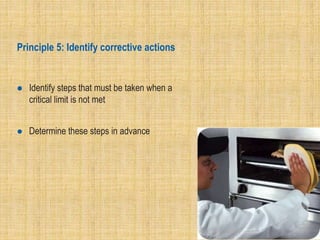
Principle 5: Identify corrective actions
 Identify steps that must be taken when a
critical limit is not met
 Determine these steps in advance
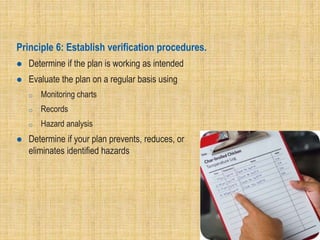
Principle 6: Establish verification procedures.
 Determine if the plan is working as intended
 Evaluate the plan on a regular basis using
o Monitoring charts
o Records
o Hazard analysis
 Determine if your plan prevents, reduces, or
eliminates identified hazards
Principle 7: Establish procedures for
record keeping and documentation
Keep records for these actions:
 Monitoring activities
 Corrective actions
 Validating equipment (checking for good
working condition)
 Working with suppliers (invoices,
specifications, etc.)
HACCP
These specialized processing methods require a
variance and may require a HACCP plan:
 Smoking food as a method to preserve it (but not to
enhance flavor)
 Using food additives or components such as vinegar to
preserve or alter food so it no longer requires time and
temperature control for safety
 Curing food
 Custom-processing animals
These specialized processing methods require a
variance and may require a HACCP plan:
 Packaging food using ROP methods including
o MAP
o Vacuum-packed
o Sous vide
 Treating (e.g. pasteurizing) juice on-site and packaging it
for later sale
 Sprouting seeds or beans
CONCLUSION
 ISO is the International Organization for Standardization, set up with
the objective to promote the developments of standards and related
activities for facilitating international exchange of goods and
services.
 The standards allow a wide flexibility, but, at the same time are
rigid too.
 They permit a supplier to formulate his own quality policy and
write the quality manual, procedures and instructions in his own
way, within the framework of the system elements, but does not
allow rendering of non- conforming products or services.
REFFERENCE
➢ Arvanitoyannis, I. S. (2009). HACCP and ISO 22000:
Application to foods of animal origin. John Wiley & Sons.
➢ De Silva, T. (2020). Integrating Business Management
Processes: Volume 2: Support and Assurance Processes. CRC
Press.
https://www.iso.org/home.html
FOOD SAFETY MANAGEMENT SYSTEM PPT.

FOOD SAFETY MANAGEMENT SYSTEM PPT.

  • 1.
    TOPIC- FOODSAFETY MANAGEMENTSYSTEM SUBMITTEDBY- JAY PRAKASH M.TECH (DAIRY TECH.) 1ST SEMESTER DSFT, IAS, BHU
  • 2.
    CONTENT Definition of foodsafety and hazards Difference among GMP GHP GAP Common food safety requirement HACCP and ISO 22000 Food safety management ISO 14000 Food safety programs Active managerial control Principles of HACCP Conclusion Reference
  • 3.
    DEFINATION OF FOODSAFETY AND HOZARDS Food safety A food safety is the assurance that food will not cause harm to the consumer when it is prepared and eaten according to its intend use. Food hazards. Foods can become unsafe and have the potential to cause harm through hazards.
  • 4.
    Difference between GMP,GHP,GAP GMP-Manufactureand process controls and includes supplier control specification calibration of equipment design where condition for food safety can be achieved maintained and monitored . GHP- System measures for maintaining hygiene and sanitation and include personal hygiene and employee health condition maintenance of plants and equipments . GAP- It is a particles that insure environment economical and social sustainability for on farm particles resulting in safe and quality food and non food agricultural products. -
  • 5.
    Common food safetyrequirements  Prerequisite Programes (PRP)  Good agricultural practice (GAP)  Good hygiene practices (GHP)  Hazard analysis and critical control point (HACCP)
  • 6.
    HACCP AND ISO-22000 HACCP-A system which identifiles evaluates and controls hazards which are significant for food safety. ISO 22000- is a generic food safety management standard. It can be used by used by any organization directly or indirectly involved in the food chain. ISO -22000 integrates the codes elementaries commission 7 principle of HACCP and dynamically combine it with PRP necessary to control and reduce any food safety hazards.
  • 7.
    8-3 Food Safety ManagementSystems Food safety management system: 1. Group of practices and procedures intended to prevent foodborne illness. 2. Actively controls risks and hazards throughout the flow of food.
  • 8.
    ISO 14000 ISO14000 isa family of standards related to environmental management that exist to help organization minimize how their operations negatively affect the environment, comply with applicable laws, regulation, and other environmentally oriented requirements and continually improve the above. ➢ ISO 14000 is a similar to ISO 9000 quality management. ➢ The requirement of ISO 14000 are an integral part of the European Union’s Eco-management and audit scheme (EMAS) ▪ ISO 14012 – Qualification criteria for environmental auditors. ▪ ISO 14011 – Audit procedure. ▪ ISO 14010 – General principle for environmental auditing. ▪ ISO 14004 – Guidelines on EMS principles , systems and supporting techniques. ▪ ISO 14001 – Environmental management systems specifications with guidance for uses.
  • 9.
    Food Safety Programs Theseare the foundation of a food safety management system: Food safety training program Quality control and assurance program Supplier selection and specification program Personal hygiene program
  • 10.
    Food Safety Programs Theseare the foundation of a food safety management system: 8-5 Standard operating procedures (SOPs) Pest control program Facility design and equipment maintenance program Cleaning and sanitation program
  • 11.
    Active Managerial Control Focuseson controlling the five most common risk factors for foodborne illness: 1. Purchasing food from unsafe sources 2. Failing to cook food adequately 3. Holding food at incorrect temperatures 4. Using contaminated equipment 5. Practicing poor personal hygiene
  • 12.
    Active Managerial Control Thereare many ways to achieve active managerial control in the operation:  Training programs  Manager supervision  Incorporation of standard operating procedures (SOPs)  HACCP These are critical to the success of active managerial control:  Monitoring critical activities in the operation  Taking the necessary corrective action when required  Verifying that the actions taken control the risks factors
  • 13.
    Active Managerial Control TheFDA provides recommendations for controlling the common risk factors for foodborne illness:  Demonstration of knowledge  Staff health controls  Controlling hands as a vehicle of contamination  Time and temperature parameters for controlling pathogens  Consumer advisories
  • 14.
    HACCP THE APPROCH HACCP is based on identifying significant biological, chemical, or physical hazards at specific points within a product’s flow through an operation.  Once identified, hazards can be prevented, eliminated, or reduced to safe levels.
  • 15.
    The 7 HACCPPrinciples The seven HACCP principles: 1. Conduct a hazard analysis 2. Determine critical control points (CCPs) 3. Establish critical limits 4. Establish monitoring procedures 5. Identify corrective actions 6. Verify that the system works 7. Establish procedures for record keeping and documentation
  • 16.
    Principle 1: Conducta hazard analysis  Identify potential hazards in the food served by looking at how it is processed  Identify TCS food items and determine where hazards are likely to occur for each one; look for biological, chemical, and physical contaminants
  • 17.
    Principle 2: Determinecritical control points (CCPs)  Find points in the process where identified hazards can be prevented, eliminated, or reduced to safe levels—these are the CCPs  Depending on the process, there may be more than one CCP
  • 18.
    Principle 3: Establishcritical limits  For each CCP, establish minimum or maximum limits  These limits must be met to o Prevent or eliminate the hazard o Reduce it to a safe level Critical Limit
  • 19.
    Principle 4: Establishmonitoring procedures  Determine the best way to check critical limits Make sure they are consistently met  Identify who will monitor them and how often
  • 20.
    Principle 5: Identifycorrective actions  Identify steps that must be taken when a critical limit is not met  Determine these steps in advance
  • 21.
    Principle 6: Establishverification procedures.  Determine if the plan is working as intended  Evaluate the plan on a regular basis using o Monitoring charts o Records o Hazard analysis  Determine if your plan prevents, reduces, or eliminates identified hazards
  • 22.
    Principle 7: Establishprocedures for record keeping and documentation Keep records for these actions:  Monitoring activities  Corrective actions  Validating equipment (checking for good working condition)  Working with suppliers (invoices, specifications, etc.)
  • 23.
    HACCP These specialized processingmethods require a variance and may require a HACCP plan:  Smoking food as a method to preserve it (but not to enhance flavor)  Using food additives or components such as vinegar to preserve or alter food so it no longer requires time and temperature control for safety  Curing food  Custom-processing animals
  • 24.
    These specialized processingmethods require a variance and may require a HACCP plan:  Packaging food using ROP methods including o MAP o Vacuum-packed o Sous vide  Treating (e.g. pasteurizing) juice on-site and packaging it for later sale  Sprouting seeds or beans
  • 25.
    CONCLUSION  ISO isthe International Organization for Standardization, set up with the objective to promote the developments of standards and related activities for facilitating international exchange of goods and services.  The standards allow a wide flexibility, but, at the same time are rigid too.  They permit a supplier to formulate his own quality policy and write the quality manual, procedures and instructions in his own way, within the framework of the system elements, but does not allow rendering of non- conforming products or services.
  • 26.
    REFFERENCE ➢ Arvanitoyannis, I.S. (2009). HACCP and ISO 22000: Application to foods of animal origin. John Wiley & Sons. ➢ De Silva, T. (2020). Integrating Business Management Processes: Volume 2: Support and Assurance Processes. CRC Press. https://www.iso.org/home.html