Awareness & Internal Auditor Training
HACCP
Awareness Training
Ashutosh Jaiswal
(Quality and Food Safety Manager| Consultant |Auditor |
Trainer)
Qualified and experienced Quality Manager having
with 9 years of solid experience in managing QHSE,
Food safety, Quality Assurance, Quality Control, Audit,
Training and Consultancy in Food manufacturing,
catering & hospitality industries across INDIA, GCC and
Africa region.
Achievements:
• Conducted 800+ batches of training and trained more
than 15,000+ candidates on Food Safety.
• Conducted more than 300+ food safety audits.
• Implemented FSSC/ ISO22000, Halal, HACCP, BRC and
AIB standards and getting the company certified in
standards.
• Implemented Food safety management system in
over 50+ food manufacturing organizations.
• Completed more than 50 + Food Safety Certified
Qualification
All measures necessary to ensure the
safety & wholesomeness of food at
every stage from the receipt of raw
materials till the sale of the product
to the customer
Food safety is about handling,
storing and preparing food to
prevent infection and help to make
sure that our food keeps enough
nutrients for us to have a healthy
diet. Unsafe food and water means
that it has been exposed to dirt and
germs, or may even be rotten, which
can cause infections or diseases such
as diarrhea, meningitis, etc..
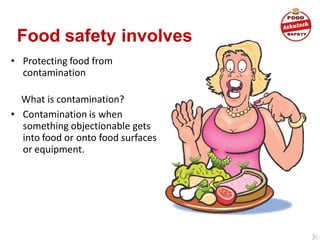
Food safety involves
• Protecting food from
contamination
What is contamination?
• Contamination is when
something objectionable gets
into food or onto food surfaces
or equipment.
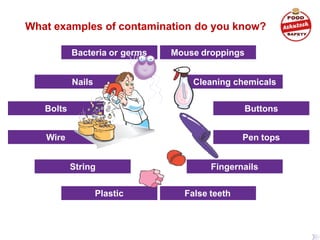
What examples of contamination do you know?
Bacteria or germs
Nails
Bolts
Wire
String
Plastic
Mouse droppings
Cleaning chemicals
Buttons
Pen tops
Fingernails
False teeth
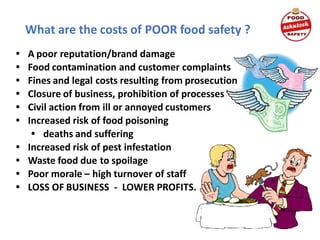
What are the costs of POOR food safety ?
• A poor reputation/brand damage
• Food contamination and customer complaints
• Fines and legal costs resulting from prosecution
• Closure of business, prohibition of processes
• Civil action from ill or annoyed customers
• Increased risk of food poisoning
• deaths and suffering
• Increased risk of pest infestation
• Waste food due to spoilage
• Poor morale – high turnover of staff
• LOSS OF BUSINESS - LOWER PROFITS.
What are the benefits of Food Safety
?
• A good reputation – customer confidence
• Brand protection
• Improved food safety standards
• Compliance with food safety legislation
• Reduced risk of food poisoning
• Longer shelf life
• Good working conditions,
higher staff morale and
reduced turnover of staff
• Increased productivity
• INCREASED BUSINESS - HIGHER PROFITS.
We are all responsible for food safety
Your responsibilities are:
• To understand how your actions could cause food poisoning
• To work in a hygienic way so that you don’t cause food poisoning
• To comply with the law and company policy
• To follow advice and instructions from your supervisor
• To report any hygiene problems to your supervisor, for example, no
soap at the wash basin, out of date food, mouldy food, signs of pests,
broken equipment
• To report if you re ill, especially if you have diarrhoea vomiting or
boils
• To wear the protective clothing provided
• To keep yourself, your protective clothing and your equipment clean
• To keep food at the correct temperature (keep it chilled or keep it
hot)
• To cook food thoroughly and cool it quickly
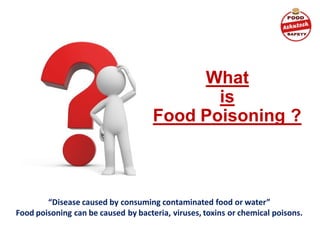
What
is
Food Poisoning ?
“Disease caused by consuming contaminated food or water”
Food poisoning can be caused by bacteria, viruses, toxins or chemical poisons.
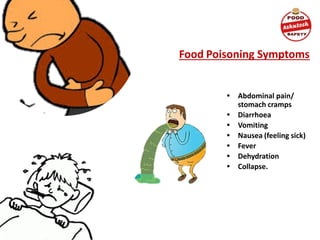
Food Poisoning Symptoms
• Abdominal pain/
stomach cramps
• Diarrhoea
• Vomiting
• Nausea (feeling sick)
• Fever
• Dehydration
• Collapse.
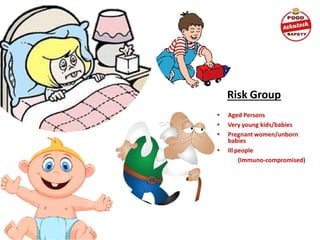
Risk Group
• Aged Persons
• Very young kids/babies
• Pregnant women/unborn
babies
• Ill people
(Immuno-compromised)
Prevent Food
Poisoning
• Hygiene Practices
• Cleaning
• Proper Handling
• Storage
• Proper Cooking
• Proper Serving
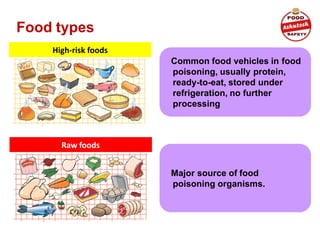
Common food vehicles in food
poisoning, usually protein,
ready-to-eat, stored under
refrigeration, no further
processing
Food types
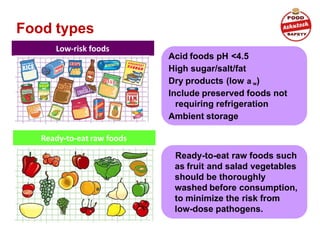
Major source of food
poisoning organisms.
High-risk foods
Raw foods
Acid foods pH <4.5
High sugar/salt/fat
Dry products (low a w)
Include preserved foods not
requiring refrigeration
Ambient storage
Food types
Ready-to-eat raw foods such
as fruit and salad vegetables
should be thoroughly
washed before consumption,
to minimize the risk from
low-dose pathogens.
Low-risk foods
Ready-to-eat raw foods
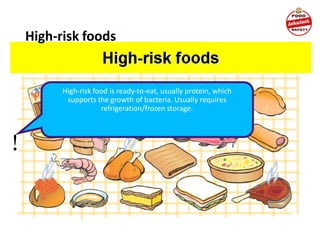
High-risk foods
High-risk food is ready-to-eat, usually protein, which
supports the growth of bacteria. Usually requires
refrigeration/frozen storage.
!
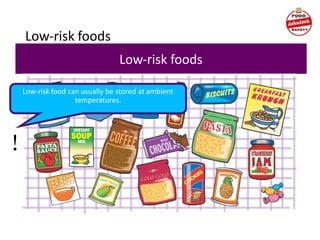
Low-risk foods
Low-risk foods
Low-risk food can usually be stored at ambient
temperatures.
!
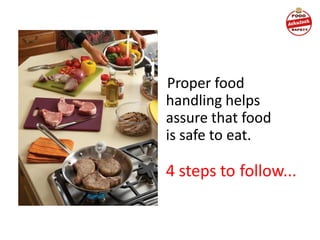
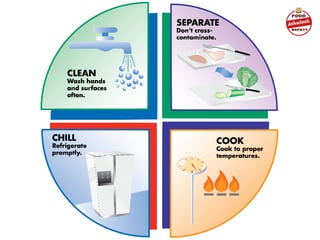
Proper food
handling helps
assure that food
is safe to eat.
4 steps to follow...
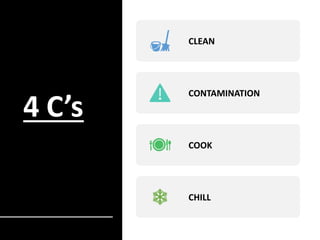
4 C’s
CLEAN
CONTAMINATION
COOK
CHILL
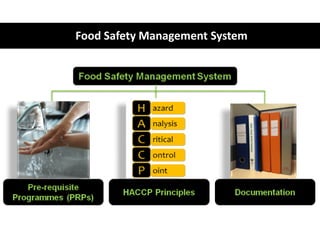
Food Safety Management System
• Group of procedures and practices intended to
prevent foodborne illness.
• Actively controls risks and hazards throughout the
flow of food.
• Active managerial control and Hazard analysis
critical control point (HACCP) are 2 ways to build this
system.
• The Food Safety Management System (FSMS) is a
preventative approach towards identifying,
preventing, and reducing food safety hazards/
contamination, to ensure food is safe for
consumption. A well-designed FSMS with
appropriate control measures can help food
establishments comply with food hygiene
regulations, so that food prepared for sale is hygienic
Food Safety Management System
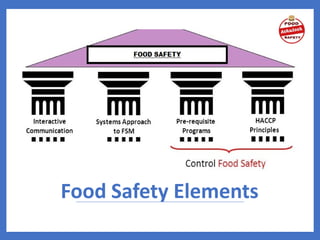
Food Safety Elements
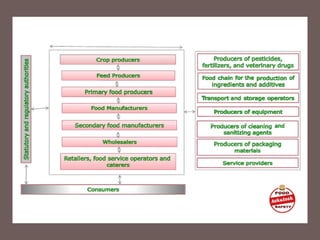
Communication
To ensure that sufficient information on issues concerning product safety
and quality is available throughout the product chain, the organization
shall establish, implement and maintain effective arrangements for
communicating with,
- Suppliers and contractors;
- Customers or consumers in relation to product information including
instructions regarding intended use, specific storage requirements and, as
appropriate, shelf life, enquiries, contracts or order handling including
amendments and customer feedback including customer complaints;
- Statutory and regulatory authorities
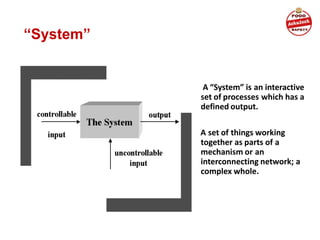
“System”
A “System” is an interactive
set of processes which has a
defined output.
A set of things working
together as parts of a
mechanism or an
interconnecting network; a
complex whole.
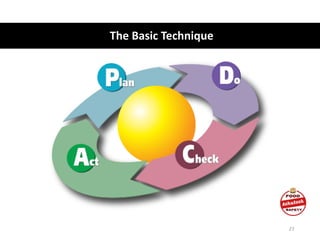
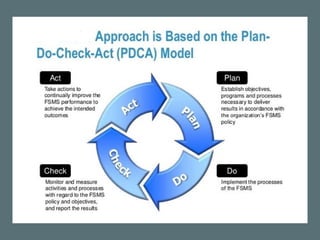
The Basic Technique
27
PLAN
It is important for the organization to suitably plan
the following prior to execution:
a) Resources
b) Processes
c) Policies
d) Objectives and
e) Compliance requirements
DO
Perform/ execute as per the planned arrangements
CHECK
Monitor the outputs of execution against the
planned arrangements and desired results
ACT
Take actions to correct the errors as detected in
check
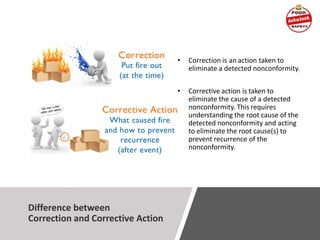
Actions are of 2 basic types:
Correction
Corrective Action
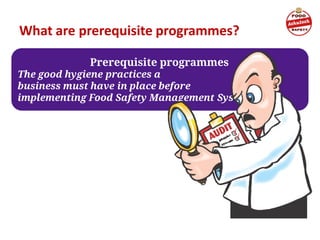
What are prerequisite programmes?
Prerequisite programmes
The good hygiene practices a
business must have in place before
implementing Food Safety Management System
Prerequisite
Programs
(PRPs)
PRPs are “procedures, including Good
Manufacturing Practices, that address
operational conditions providing the foundation
for the food safety system.” These are general
control measures applicable across all areas of
food processing and aimed at maintaining a safe
and hygienic environment. They do not control
specific hazards or steps in the process.
Examples:
• Supplier control
• Cleaning and sanitation
• Personal hygiene
• Training
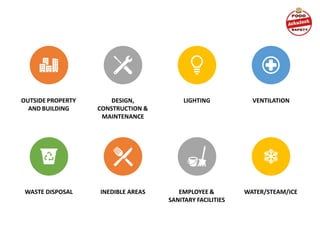
1. Premises
OUTSIDE PROPERTY
AND BUILDING
DESIGN,
CONSTRUCTION &
MAINTENANCE
LIGHTING VENTILATION
WASTE DISPOSAL INEDIBLE AREAS EMPLOYEE &
SANITARY FACILITIES
WATER/STEAM/ICE
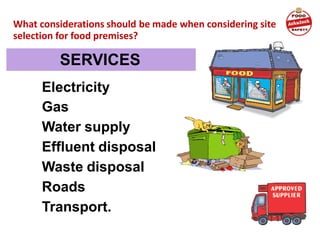
Electricity
Gas
Water supply
Effluent disposal
Waste disposal
Roads
Transport.
What considerations should be made when considering site
selection for food premises?
SERVICES
Site selection
Flooding
Chemicals
Odour
Dust
Pests.
PROBLEMS
TO AVOID
Design of food premises to reduce risk of
contamination
● Segregation of clean and dirty processes
● Linear workflow reduces cross-contamination risk
● Personal hygiene facilities
● Washing and disinfection facilities
● Temperature control facilities
● Readily cleanable surfaces.
General principles of design
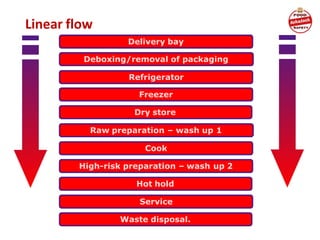
Linear flow
Deboxing/removal of packaging
Refrigerator
Dry store
Freezer
Raw preparation – wash up 1
Cook
Hot hold
High-risk preparation – wash up 2
Delivery bay
Waste disposal.
Service
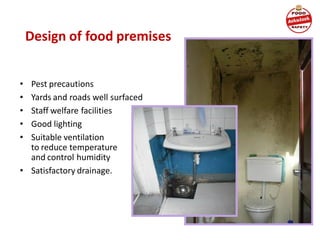
Design of food premises
● Pest precautions
● Yards and roads well surfaced
● Staff welfare facilities
● Good lighting
● Drainage
● Suitable ventilation.
What washing and welfare facilities should
be provided?
● Toilets.
● Cleaning and disinfection
● Cloakrooms and lockers
● Food
● Personal Hygiene
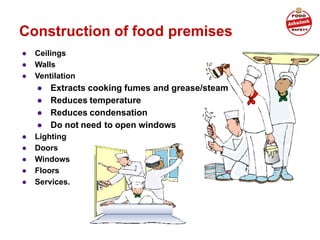
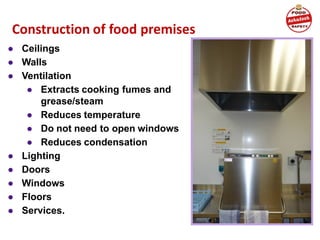
Construction of food premises
● Ceilings
● Walls
● Ventilation
● Extracts cooking fumes and grease/steam
● Reduces temperature
● Reduces condensation
● Do not need to open windows
● Lighting
● Doors
● Windows
● Floors
● Services.
• Clean, in good repair and condition
• Good design, layout and construction
• Permit cleaning and disinfection
• Protect against contamination
• Permit good food hygiene practice, especially
pest control
• Provide suitable temperature controlled
conditions
• Health & Safety legislation.
The law relating to food premises
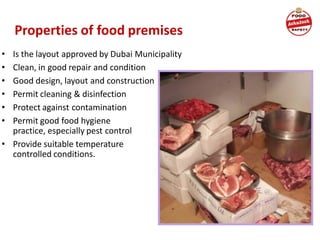
• Is the layout approved by Dubai Municipality
• Clean, in good repair and condition
• Good design, layout and construction
• Permit cleaning & disinfection
• Protect against contamination
• Permit good food hygiene
practice, especially pest control
• Provide suitable temperature
controlled conditions.
Properties of food premises
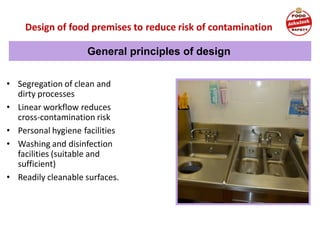
Design of food premises to reduce risk of contamination
• Segregation of clean and
dirty processes
• Linear workflow reduces
cross-contamination risk
• Personal hygiene facilities
• Washing and disinfection
facilities (suitable and
sufficient)
• Readily cleanable surfaces.
General principles of design
Design of food premises
• Pest precautions
• Yards and roads well surfaced
• Staff welfare facilities
• Good lighting
• Suitable ventilation
to reduce temperature
and control humidity
• Satisfactory drainage.
Construction of food premises
● Ceilings
● Walls
● Ventilation
● Extracts cooking fumes and
grease/steam
● Reduces temperature
● Do not need to open windows
● Reduces condensation
● Lighting
● Doors
● Windows
● Floors
● Services.
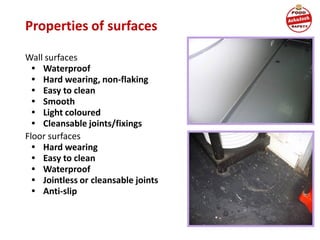
Properties of surfaces
Wall surfaces
• Waterproof
• Hard wearing, non-flaking
• Easy to clean
• Smooth
• Light coloured
• Cleansable joints/fixings
Floor surfaces
• Hard wearing
• Easy to clean
• Waterproof
• Jointless or cleansable joints
• Anti-slip
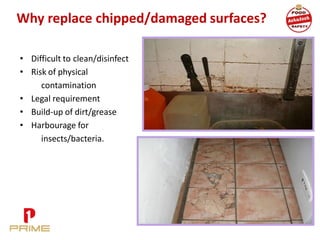
Why replace chipped/damaged surfaces?
• Difficult to clean/disinfect
• Risk of physical
contamination
• Legal requirement
• Build-up of dirt/grease
• Harbourage for
insects/bacteria.
2. Transportation & Storage
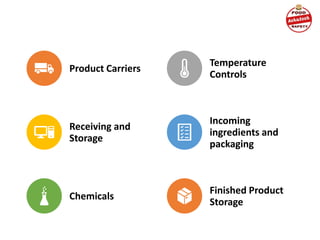
Product Carriers
Temperature
Controls
Receiving and
Storage
Incoming
ingredients and
packaging
Chemicals
Finished Product
Storage
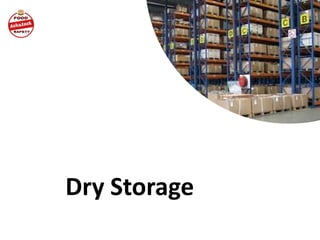
Dry Storage
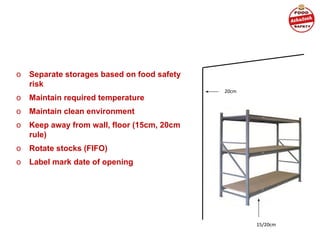
o Separate storages based on food safety
risk
o Maintain required temperature
o Maintain clean environment
o Keep away from wall, floor (15cm, 20cm
rule)
o Rotate stocks (FIFO)
o Label mark date of opening
20cm
15/20cm
Food Receiving & Delivery
✔ Food supplies need to be checked on
delivery for damage
✔ Goods that have been contaminated or damaged
should be rejected
✔ Perishable food transported under incorrect
storage conditions should be rejected
3. Equipment
DESIGN AND INSTALLATION MAINTENANCE AND CALIBRATION
• Clean, in good repair and
condition
• Minimize risk of
contamination
• Enable thorough cleaning
and, where necessary,
disinfection
• Be installed to allow
cleaning of the surrounding
area.
The law relating to food equipment
workflow
Avoid cross-contamination
Separate RAW and COOKED
Separate DIRTY and CLEAN
Create a continuous workflow.
What is the manager’s role in the maintenance of design standards and
equipment?
• Consideration of workflow and separation of raw and cooked food/dirty
and clean processes
• Provision of suitable and sufficient equipment to carry out tasks safely
and hygienically
• Facilities for personal hygiene and staff
• Procedures in place for reporting faults
• Timely maintenance (planned, preventative)
• Effective cleaning and disinfection procedures.
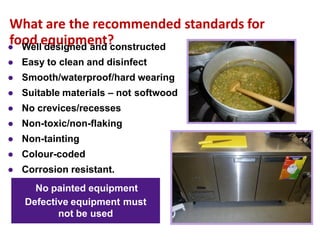
What are the recommended standards for
food equipment?
No painted equipment
Defective equipment must
not be used
● Well designed and constructed
● Easy to clean and disinfect
● Smooth/waterproof/hard wearing
● Suitable materials – not softwood
● No crevices/recesses
● Non-toxic/non-flaking
● Non-tainting
● Colour-coded
● Corrosion resistant.
4. Traceability & Recall
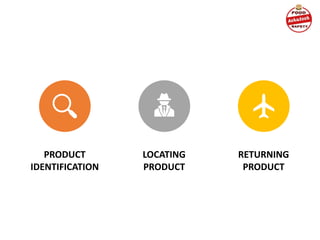
PRODUCT
IDENTIFICATION
LOCATING
PRODUCT
RETURNING
PRODUCT
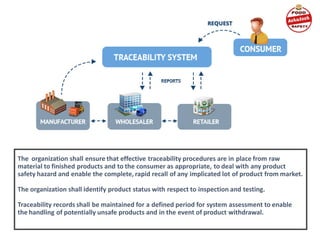
The organization shall ensure that effective traceability procedures are in place from raw
material to finished products and to the consumer as appropriate, to deal with any product
safety hazard and enable the complete, rapid recall of any implicated lot of product from market.
The organization shall identify product status with respect to inspection and testing.
Traceability records shall be maintained for a defined period for system assessment to enable
the handling of potentially unsafe products and in the event of product withdrawal.
Supplier Traceability:
The supplier traceability is the first step in the development of a traceability system.
Each and every individual incoming unit of ingredient or product should carry a means of tracing its
source of supply and history e.g. batch code.
Food inwards documents for all delivers should record all information necessary to maintain
traceability from the supplier. Examples of relevant information:
o Supplier name
o Any supplier batch codes or lot number
o The delivery date
o The production and expiry date
o Confirmation of acceptance
o The number of saleable units
o The weights of the saleable unit if applicable
o Rejection
Customer Traceability
Customer traceability is the second step in the development of a traceability system.
The important elements are:
o A list of all immediate customers, the details of the products they purchase and full
contact details should be held by the service team.
o These lists must be updated regularly.
o Any documentation accompanying product to a customer should contain all the
information necessary for traceability to be maintained through the distribution chain.
o The name, address and contact details of the customer
o The name, address and contact details of the delivery driver
o Transport vehicle
A full list of the products being purchased by the customer with details for each product
(Product Name, Product Batch Codes, quantity. Supplier details where necessary.)
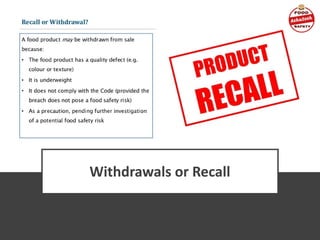
Withdrawals or Recall
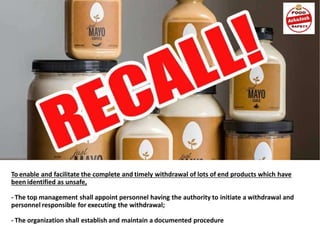
To enable and facilitate the complete and timely withdrawal of lots of end products which have
been identified as unsafe,
- The top management shall appoint personnel having the authority to initiate a withdrawal and
personnel responsible for executing the withdrawal;
- The organization shall establish and maintain a documented procedure
5. Supplier Quality Assurance
VENDOR APPROVAL
PROCESS
PRODUCT
SPECIFICATIONS
INSPECT INCOMING
MATERIALS
Purchase controls
• Supplier specifications
• Quality
• Transport conditions
• Packaging
• Delivery times
• Temperature
• Methods of assessing suppliers
• Reputation
• Self certification
• Audits.
Personal Hygiene
Personal Hygiene
refers to the
cleanliness of a
person’s body
01
To ensure that those
who come directly or
indirectly into contact
with food are not likely
to contaminate it.
02
HANDS and SKIN:
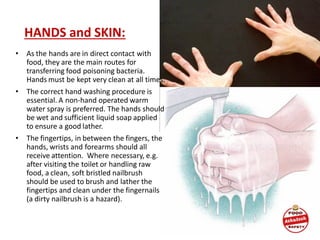
• As the hands are in direct contact with
food, they are the main routes for
transferring food poisoning bacteria.
Hands must be kept very clean at all times.
• The correct hand washing procedure is
essential. A non-hand operated warm
water spray is preferred. The hands should
be wet and sufficient liquid soap applied
to ensure a good lather.
• The fingertips, in between the fingers, the
hands, wrists and forearms should all
receive attention. Where necessary, e.g.
after visiting the toilet or handling raw
food, a clean, soft bristled nailbrush
should be used to brush and lather the
fingertips and clean under the fingernails
(a dirty nailbrush is a hazard).
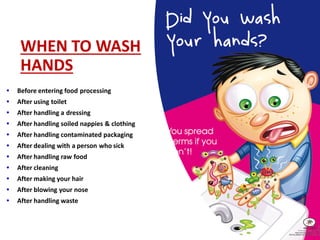
WHEN TO WASH
HANDS
• Before entering food processing
• After using toilet
• After handling a dressing
• After handling soiled nappies & clothing
• After handling contaminated packaging
• After dealing with a person who sick
• After handling raw food
• After cleaning
• After making your hair
• After blowing your nose
• After handling waste
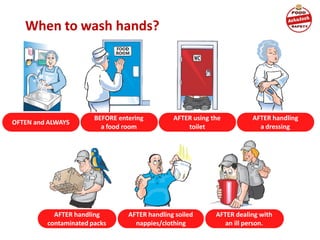
When to wash hands?
OFTEN and ALWAYS
BEFORE entering
a food room
AFTER using the
toilet
AFTER handling
a dressing
AFTER handling soiled
nappies/clothing
AFTER handling
contaminated packs
AFTER dealing with
an ill person.
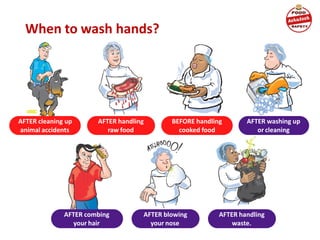
When to wash hands?
AFTER cleaning up
animal accidents
AFTER handling
raw food
BEFORE handling
cooked food
AFTER washing up
or cleaning
AFTER combing
your hair
AFTER blowing
your nose
AFTER handling
waste.
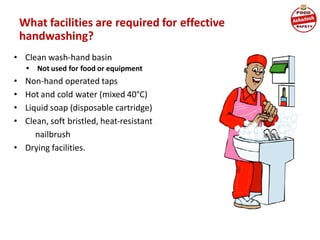
What facilities are required for effective
handwashing?
• Clean wash-hand basin
• Not used for food or equipment
• Non-hand operated taps
• Hot and cold water (mixed 40°C)
• Liquid soap (disposable cartridge)
• Clean, soft bristled, heat-resistant
nailbrush
• Drying facilities.
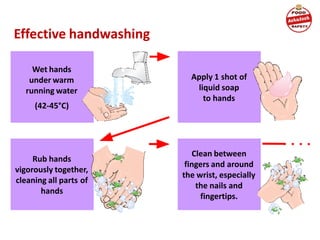
Effective handwashing
Wet hands
under warm
running water
(42-45°C)
Apply 1 shot of
liquid soap
to hands
Rub hands
vigorously together,
cleaning all parts of
hands
Clean between
fingers and around
the wrist, especially
the nails and
fingertips.
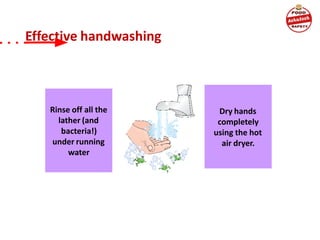
Effective handwashing
Rinse off all the
lather (and
bacteria!)
under running
water
Dry hands
completely
using the hot
air dryer.
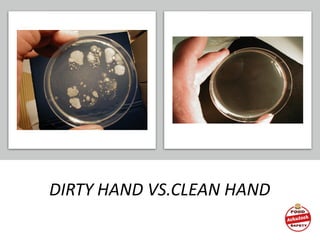
DIRTY HAND VS.CLEAN HAND
78
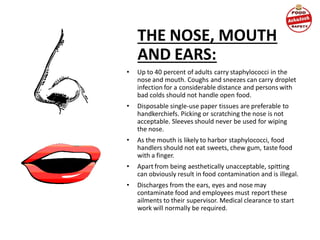
THE NOSE, MOUTH
AND EARS:
• Up to 40 percent of adults carry staphylococci in the
nose and mouth. Coughs and sneezes can carry droplet
infection for a considerable distance and persons with
bad colds should not handle open food.
• Disposable single-use paper tissues are preferable to
handkerchiefs. Picking or scratching the nose is not
acceptable. Sleeves should never be used for wiping
the nose.
• As the mouth is likely to harbor staphylococci, food
handlers should not eat sweets, chew gum, taste food
with a finger.
• Apart from being aesthetically unacceptable, spitting
can obviously result in food contamination and is illegal.
• Discharges from the ears, eyes and nose may
contaminate food and employees must report these
ailments to their supervisor. Medical clearance to start
work will normally be required.
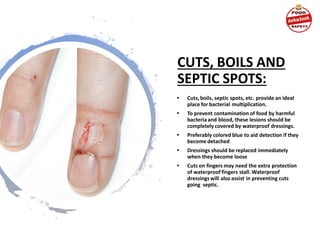
CUTS, BOILS AND
SEPTIC SPOTS:
• Cuts, boils, septic spots, etc. provide an ideal
place for bacterial multiplication.
• To prevent contamination of food by harmful
bacteria and blood, these lesions should be
completely covered by waterproof dressings.
• Preferably colored blue to aid detection if they
become detached
• Dressings should be replaced immediately
when they become loose
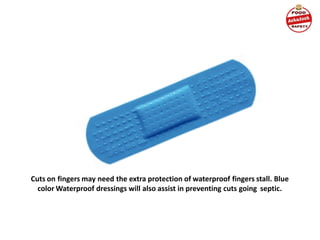
• Cuts on fingers may need the extra protection
of waterproof fingers stall. Waterproof
dressings will also assist in preventing cuts
going septic.
Cuts on fingers may need the extra protection of waterproof fingers stall. Blue
color Waterproof dressings will also assist in preventing cuts going septic.
JEWELLERY
PERFUME:
Food handlers should not wear
earrings, watches, jeweled rings or
brooches, as they carry dirt and
bacteria.
Furthermore, stones and small pieces
of metal may end up in the food and
result in a customer complaint.
Food handlers should not wear
strong- smelling perfume or
aftershave, as it may taint foods,
especially those with a high fat
content.
THE HAIR
❖ Hair fall and dandruff, can result in
contamination of food.
❖ Furthermore, the scalp often contains harmful
bacteria and must be shampooed regularly.
❖ Combing of hair and adjustments to head
Covering should only take place in cloakrooms
and should not be carried out whilst wearing
protective clothing, as hairs may end up on the
shoulders and then in the product.
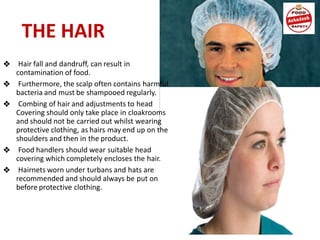
❖ Food handlers should wear suitable head
covering which completely encloses the hair.
❖ Hairnets worn under turbans and hats are
recommended and should always be put on
before protective clothing.
SMOKING
• It is illegal to expose food to risk of
contamination, by smoking in food rooms or
whilst handling open food.
• Cigarette ends and ashes can contaminate
the food and also smoking will affect the
food due to the following reason:
• People touch their lips while smoking and
they may transfer harmful bacteria to food.
• Smoking encourages coughing and droplet
infection.
• Cigarette ends contaminated with saliva are
placed on working surfaces.
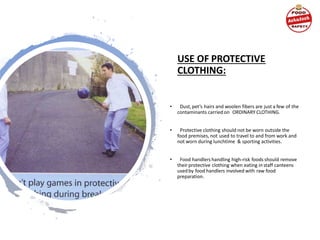
USE OF PROTECTIVE
CLOTHING:
• Dust,pet’s hairs and woolen fibers are just a few of the
contaminants carried on ORDINARY CLOTHING.
• Protective clothing should not be worn outside the
food premises, not used to travel to and from work and
not worn during lunchtime & sporting activities.
• Food handlers handling high-risk foods should remove
theirprotective clothing when eating in staff canteens
usedby food handlers involved with raw food
preparation.
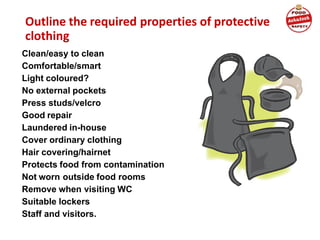
Outline the required properties of protective
clothing
Clean/easy to clean
Comfortable/smart
Light coloured?
No external pockets
Press studs/velcro
Good repair
Laundered in-house
Cover ordinary clothing
Hair covering/hairnet
Protects food from contamination
Not worn outside food rooms
Remove when visiting WC
Suitable lockers
Staff and visitors.
GENERAL
HEALTH
AND
REPORTING
OF ILLNESS:
• Food handlers should be in good health in all
aspects from oral hygiene to general fitness.
• Any food handlers suffering from diarrhea,
vomiting or a food-borne infection must not
handle food.
• They must notify their supervisor who must
exclude them from any work, which would expose
food to risks from pathogens.
• Food handlers who have consumed a meal known
to have caused food poisoning or live in the same
household as a confirmed case or have suffered
from diarrhea or vomiting, whilst abroad should
also report to the supervisor who will probably
require them to visit a doctor.
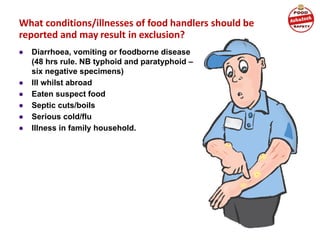
What conditions/illnesses of food handlers should be
reported and may result in exclusion?
● Diarrhoea, vomiting or foodborne disease
(48 hrs rule. NB typhoid and paratyphoid –
six negative specimens)
● Ill whilst abroad
● Eaten suspect food
● Septic cuts/boils
● Serious cold/flu
● Illness in family household.
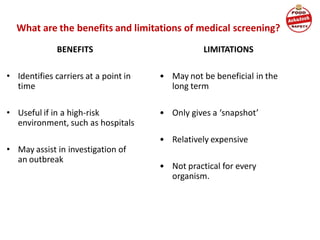
What are the benefits and limitations of medical screening?
BENEFITS
• Identifies carriers at a point in
time
• Useful if in a high-risk
environment, such as hospitals
• May assist in investigation of
an outbreak
LIMITATIONS
• May not be beneficial in the
long term
• Only gives a ‘snapshot’
• Relatively expensive
• Not practical for every
organism.
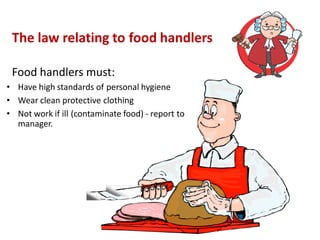
The law relating to food handlers
Food handlers must:
• Have high standards of personal hygiene
• Wear clean protective clothing
• Not work if ill (contaminate food) - report to
manager.
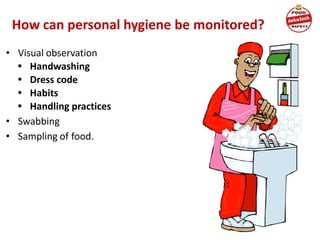
How can personal hygiene be monitored?
• Visual observation
• Handwashing
• Dress code
• Habits
• Handling practices
• Swabbing
• Sampling of food.
7. Pest Control
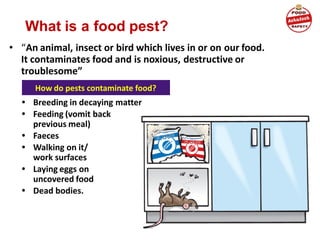
What is a food pest?
• “An animal, insect or bird which lives in or on our food.
It contaminates food and is noxious, destructive or
troublesome”
• Breeding in decaying matter
• Feeding (vomit back
previous meal)
• Faeces
• Walking on it/
work surfaces
• Laying eggs on
uncovered food
• Dead bodies.
How do pests contaminate food?
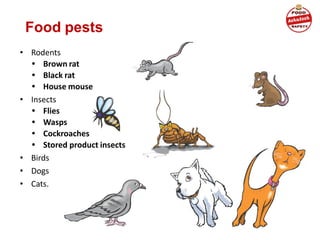
• Rodents
• Brown rat
• Black rat
• House mouse
• Insects
• Flies
• Wasps
• Cockroaches
• Stored product insects
• Birds
• Dogs
• Cats.
Food pests
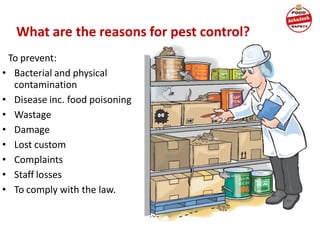
What are the reasons for pest control?
To prevent:
• Bacterial and physical
contamination
• Disease inc. food poisoning
• Wastage
• Damage
• Lost custom
• Complaints
• Staff losses
• To comply with the law.
What is meant by Integrated pest
management?
Environmental Control
Prevent access
by design, maintenance, proofing, check deliveries
Denial of food/harbourage
by good housekeeping
internal and external
clean and tidy (Clean as you go)
stock checks (correct storage)
pest-proof containers
Staff training.
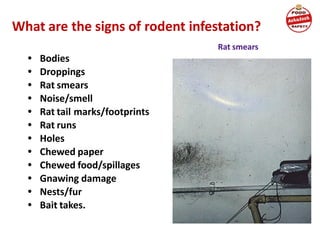
What are the signs of rodent infestation?
• Bodies
• Droppings
• Rat smears
• Noise/smell
• Rat tail marks/footprints
• Rat runs
• Holes
• Chewed paper
• Chewed food/spillages
• Gnawing damage
• Nests/fur
• Bait takes.
Rat smears
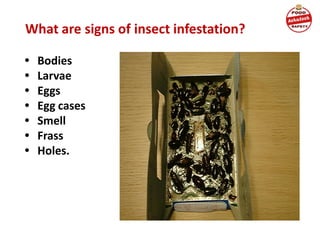
What are signs of insect infestation?
• Bodies
• Larvae
• Eggs
• Egg cases
• Smell
• Frass
• Holes.
Birds
Birds such as: starlings & pigeons
Control because of:
Feathers /nesting materials
Source of insects and mite infestation
Prevent blockage to gutters
Prevent defacement of buildings
Prevent damage/soiling of food packaging.
Sparrows
Pigeons
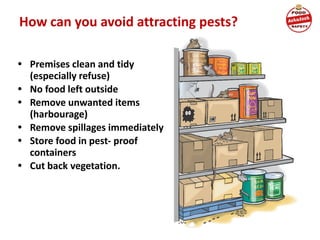
How can you avoid attracting pests?
• Premises clean and tidy
(especially refuse)
• No food left outside
• Remove unwanted items
(harbourage)
• Remove spillages immediately
• Store food in pest- proof
containers
• Cut back vegetation.
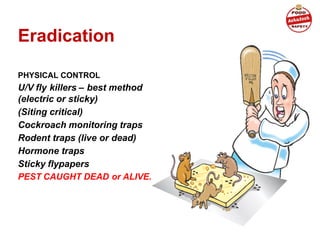
Eradication
PHYSICAL CONTROL
U/V fly killers – best method
(electric or sticky)
(Siting critical)
Cockroach monitoring traps
Rodent traps (live or dead)
Hormone traps
Sticky flypapers
PEST CAUGHT DEAD or ALIVE.
(When good housekeeping and proofing fail)
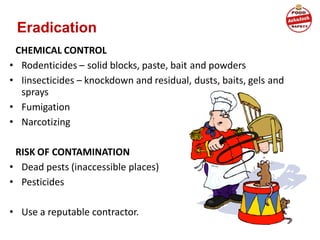
Eradication
CHEMICAL CONTROL
• Rodenticides – solid blocks, paste, bait and powders
• Iinsecticides – knockdown and residual, dusts, baits, gels and
sprays
• Fumigation
• Narcotizing
RISK OF CONTAMINATION
• Dead pests (inaccessible places)
• Pesticides
• Use a reputable contractor.
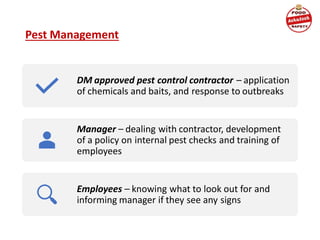
DM approved pest control contractor – application
of chemicals and baits, and response to outbreaks
Manager – dealing with contractor, development
of a policy on internal pest checks and training of
employees
Employees – knowing what to look out for and
informing manager if they see any signs
Pest Management
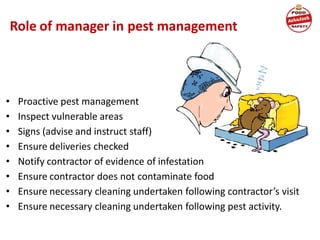
Role of manager in pest management
• Proactive pest management
• Inspect vulnerable areas
• Signs (advise and instruct staff)
• Ensure deliveries checked
• Notify contractor of evidence of infestation
• Ensure contractor does not contaminate food
• Ensure necessary cleaning undertaken following contractor’s visit
• Ensure necessary cleaning undertaken following pest activity.
Role of manager in pest management
• Act on reports of defects
• Ensure personnel accompany contractor
• Maintain high standards of hygiene
• Deal with bait/dead pests
• Follow contractor’s recommendations
• Record bait box positions
• Check bait boxes regularly
• Ensure contractor visit records are maintained.
8. Waste Management
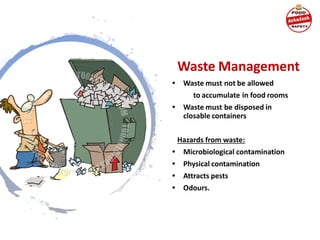
Waste Management
• Waste must not be allowed
to accumulate in food rooms
• Waste must be disposed in
closable containers
Hazards from waste:
• Microbiological contamination
• Physical contamination
• Attracts pests
• Odours.
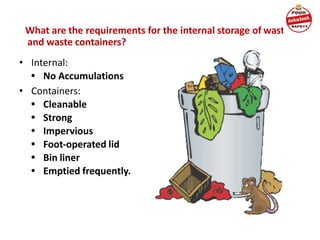
What are the requirements for the internal storage of waste
and waste containers?
• Internal:
• No Accumulations
• Containers:
• Cleanable
• Strong
• Impervious
• Foot-operated lid
• Bin liner
• Emptied frequently.
What are the requirements for the external storage of waste
and waste containers?
• External:
• Separate from food rooms
• Pest proofed
• Stored off ground
• No Accumulations
• Impervious base
• Good drainage
• Covered
• Containers:
• Cleanable/impervious
• Tight-fitting lids
• Strong/secure
• Cleaning facilities
• Emptied regularly.
What is cleaning?
“Cleaning is the systematic application of energy
to a surface or substance with the intention of
removing dirt”.
‘CLEAN AS YOU
GO’
● REDUCES THE RISK OF FOOD POISONING
● Removal of the bacteria’s food supply
● Allows disinfecting
● Removes material which encourages pests
● Removes ‘foreign matter’ contamination
● Removes dirt and grease
● Promotes a favourable image
● Complies with the law
● Will reduce customer complaints
● Provides safe and pleasant
environment for staff.
What are the benefits of cleaning?
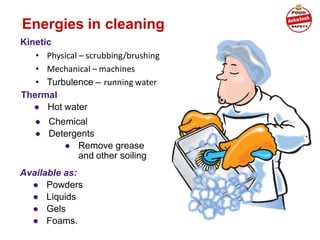
Energies in cleaning
Kinetic
• Physical – scrubbing/brushing
• Mechanical – machines
• Turbulence – running water
Thermal
● Hot water
● Chemical
● Detergents
● Remove grease
and other soiling
Available as:
● Powders
● Liquids
● Gels
● Foams.
Detergent action
Characteristics of detergent
• Surfactancy
• Reduction of surface tension to enable detergent to
penetrate dirt
• Dispersion
• Lifts dirt from the surface
• Suspension
• Dirt held in suspension and not redeposited.
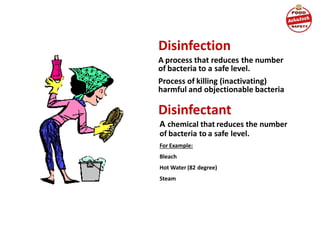
Disinfection
A process that reduces the number
of bacteria to a safe level.
Process of killing (inactivating)
harmful and objectionable bacteria
Disinfectant
A chemical that reduces the number
of bacteria to a safe level.
For Example:
Bleach
Hot Water (82 degree)
Steam
Disinfection
● Hot water
● 82°C for 30 seconds
● Steam
The reduction of micro-organisms to a safe level
can be achieved by using
● Chemicals
● Bleach (hypochlorite)
● Quaternary Ammonium
Compounds (QACs)
● Alcohols.
Sanitizing = cleaning and
disinfection.
What surfaces require cleaning and
disinfection?
Surfaces requiring disinfection:
• HAND-contact surfaces
• FOOD-contact surfaces
• Cleaning materials and equipment
• Contact time is important.
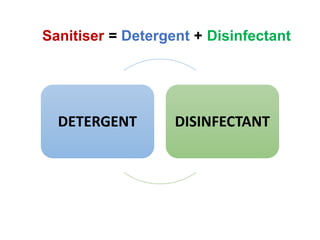
Sanitiser = Detergent + Disinfectant
DETERGENT DISINFECTANT
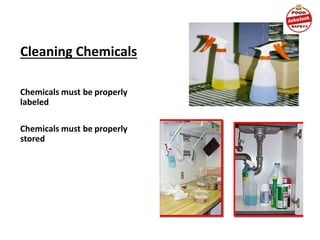
Cleaning Chemicals
Chemicals must be properly
labeled
Chemicals must be properly
stored
What safety precautions would you apply when cleaning to prevent
hazards?
● Only purchase chemicals from reputable suppliers
● Don’t use the same cloth for everything
● Use colour-coded chemicals/equipment
● Always follow manufacturers’ instructions
● Wear suitable protective clothing
● Use suitable equipment in good condition
● Don’t clean near food
● Don’t mix chemicals
● Don’t store chemicals near food
● Dilute and rinse as required
● Don’t decant chemicals into food or unlabelled containers
● Use dispensers provided by manufacturers
● Clean and store cleaning equipment properly.
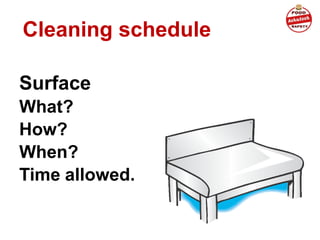
Cleaning schedule
Surface
What?
How?
When?
Time allowed.
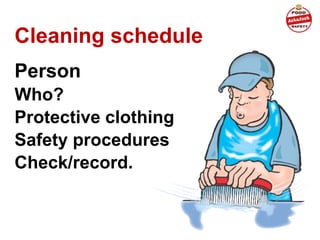
Cleaning schedule
Person
Who?
Protective clothing
Safety procedures
Check/record.
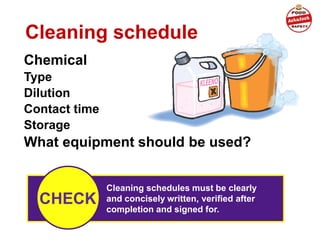
Cleaning schedule
Chemical
Type
Dilution
Contact time
Storage
What equipment should be used?
Cleaning schedules must be clearly
and concisely written, verified after
completion and signed for.
CHECK
Role of management in monitoring
satisfactory cleaning
How do we ensure cleaning procedures are effective in
practice?
• Developing effective and appropriate systems and
policies
• Providing resources (equipment, time, personnel)
• Monitoring staff undertaking cleaning activities
• How do we ensure high standards of cleanliness?
• Routine daily checks
• How do we verify effective
disinfection (safe cleaning)?
• Microbiological swabbing
• Complaint statistics.
CROSS
CONTAMINATIO
N
Cross-contamination occurs when
bacteria from one food item are
transferred to another food item, often by
way of unwashed cutting boards or
countertops, as well as knives and other
food processing tools, or even
unwashed hands.
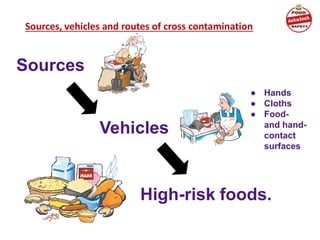
Sources, vehicles and routes of cross contamination
Sources
Vehicles
High-risk foods.
● Hands
● Cloths
● Food-
and hand-
contact
surfaces
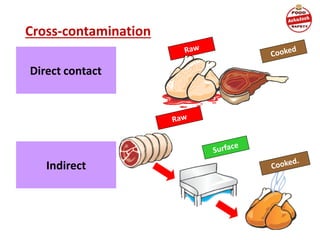
Cross-contamination
Direct contact
Indirect
Raw
Cooked
Raw
Surface
Cooked.
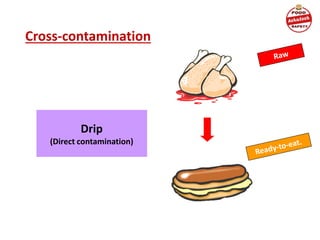
Cross-contamination
Drip
(Direct contamination)
Raw
Ready-to-eat.
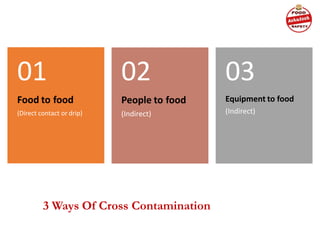
3 Ways Of Cross Contamination
Food to food
(Direct contact or drip)
01
People to food
(Indirect)
02
Equipment to food
(Indirect)
03
Cross-Contamination Control
• Training
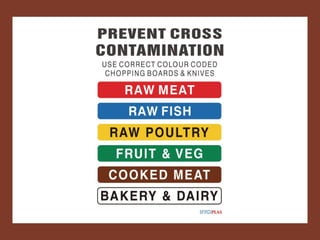
• Color code
• Separation
• Cleaning and disinfection
• Supervision
11. Allergen Control
Allergenic hazards
• Increasing problem
• Immune system reacts – minutes/hours – anaphylaxis which results from a
susceptible person eating food containing an allergen
• Symptoms
• Flushing of skin
• Swelling
• Throat
• Mouth
• Difficulty in swallowing/speaking
• Severe asthma
• Weakness
• Fall in blood pressure
• Nettle rash
• Abdominal pain/nausea/vomiting
• Collapse/unconsciousness
Allergenic foods
• Peanuts - also used as a cooking oil
• Groundnuts
• Tree nuts - also used as a cooking oil
• Walnuts
• Hazelnuts
• Brazil nuts
• Milk/lactose – including lactose and milk powders
• Eggs
• Fish
• Shellfish
• Soya – also sauces and flour
• Tofu
• Bean curd
• Cereals containing gluten
• Sesame seeds - also used as a cooking oil
• Mustard, celery and celeriac – common flavourings in many foods
• Sulphur dioxide and sulphites
• Lupin flour.
Allergenic controls
• Cannot be controlled or removed by temperature, chemicals or by
washing/filtering!
• Application of Good Practices and HACCP
• Avoid contamination
• Segregation
• Separate utensils/cloths
• Colour coding
• Clear labelling
• Effective cleaning
• Staff:
• Handwashing before preparation
• Communication
• Symptoms
• Response.
12. Training & Education
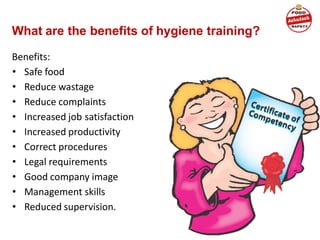
What are the benefits of hygiene training?
Benefits:
• Safe food
• Reduce wastage
• Reduce complaints
• Increased job satisfaction
• Increased productivity
• Correct procedures
• Legal requirements
• Good company image
• Management skills
• Reduced supervision.
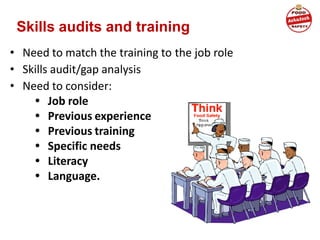
Skills audits and training
• Need to match the training to the job role
• Skills audit/gap analysis
• Need to consider:
• Job role
• Previous experience
• Previous training
• Specific needs
• Literacy
• Language.
What is the recommended training for food
handlers?
• Basics of food safety (induction training) provided before a new food
handler starts work
• Awareness training to be provided to all food handlers within a month
• Level 2 or equivalent to be provided for all high-risk
food handlers within 3 months
• Supervisors and managers higher level training dependent upon role
• Specific training for specific jobs
• HACCP training.
Objectives and benefits of hygiene training
Objectives
● Change attitudes to
hygiene positively
● Reduce risks.
Training
E XPLAIN
D EMONSTRATE
I NVOLVE
T EST.
Training
Training
Provides knowledge
Underpins competency.
Training as part of food safety policy
● Demonstration of commitment to high standards of
hygiene
● Company standards must be set
● Dangerous practices spelled out
● Legal obligations outlined
● Commitment to train staff
● Change attitudes.
What are the barriers to learning?
• Literacy
• Language
• Peer pressure
• Lack of resources
• Disinterest by supervisors/managers
• Lack of motivation
• Lack of training expertise
• Lack of supervision following
training.
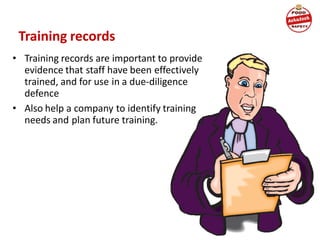
Training records
• Training records are important to provide
evidence that staff have been effectively
trained, and for use in a due-diligence
defence
• Also help a company to identify training
needs and plan future training.
HACCP
HACCP
• HACCP
• “A food safety management
system which identifies and
controls hazards which are
significant for food safety”
• Hazard analysis
• Collecting information on
hazards to determine which
are significant for food safety
(identifies critical steps).
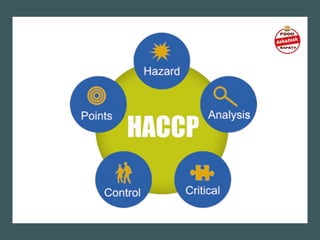
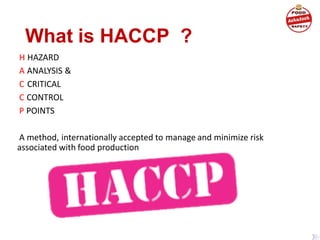
What is HACCP ?
H HAZARD
A ANALYSIS &
C CRITICAL
C CONTROL
P POINTS
A method, internationally accepted to manage and minimize risk
associated with food production
What is HACCP ?
• Applicable from farm to fork
• Common sense approach towards food safety
• Essentially a preventive system than corrective system
• Addresses chemical, physical and biological risk
• This is what we have been doing for years, we just called it
good hygiene practice
• Now it is called HACCP
History of HACCP
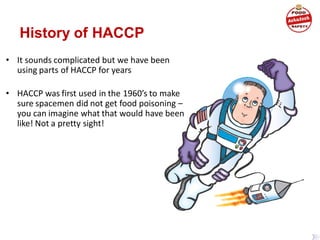
• It sounds complicated but we have been
using parts of HACCP for years
• HACCP was first used in the 1960’s to make
sure spacemen did not get food poisoning –
you can imagine what that would have been
like! Not a pretty sight!
Flexibility and HACCP
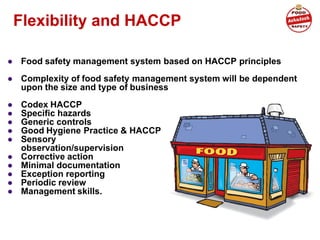
● Food safety management system based on HACCP principles
● Complexity of food safety management system will be dependent
upon the size and type of business
● Codex HACCP
● Specific hazards
● Generic controls
● Good Hygiene Practice & HACCP
● Sensory
observation/supervision
● Corrective action
● Minimal documentation
● Exception reporting
● Periodic review
● Management skills.
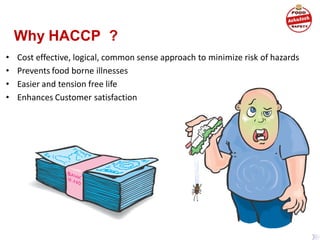
Why HACCP ?
• Cost effective, logical, common sense approach to minimize risk of hazards
• Prevents food borne illnesses
• Easier and tension free life
• Enhances Customer satisfaction
Benefits of HACCP ?
• Reduction in contamination risk
• Reduced recalls/product destruction
• Market protection
• Preferred supplier status
• Greater professionalism
• Improved marketability
• Conformance to international practice
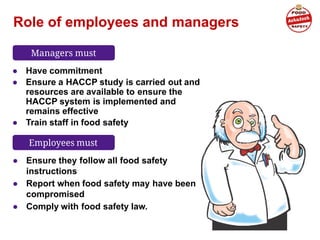
Role of employees and managers
● Have commitment
● Ensure a HACCP study is carried out and
resources are available to ensure the
HACCP system is implemented and
remains effective
● Train staff in food safety
● Ensure they follow all food safety
instructions
● Report when food safety may have been
compromised
● Comply with food safety law.
Managers must
Employees must
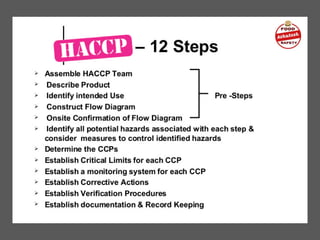
Assemble HACCP
Team
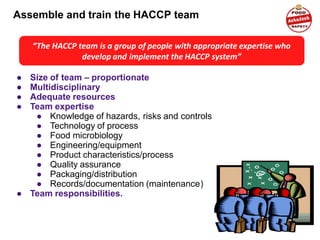
Assemble and train the HACCP team
● Size of team – proportionate
● Multidisciplinary
● Adequate resources
● Team expertise
● Knowledge of hazards, risks and controls
● Technology of process
● Food microbiology
● Engineering/equipment
● Product characteristics/process
● Quality assurance
● Packaging/distribution
● Records/documentation (maintenance)
● Team responsibilities.
“The HACCP team is a group of people with appropriate expertise who
develop and implement the HACCP system”
Describe Product
Product description
Composition
Method of preservation
Packaging
Storage conditions
Distribution
Intended use and consumers
Preparation
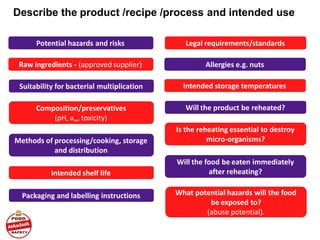
Describe the product /recipe /process and intended use
Potential hazards and risks
Raw ingredients - (approved supplier)
Suitability for bacterial multiplication
Composition/preservatives
(pH, aw, toxicity)
Methods of processing/cooking, storage
and distribution
Intended shelf life
Packaging and labelling instructions
Legal requirements/standards
Allergies e.g. nuts
Intended storage temperatures
Will the product be reheated?
Is the reheating essential to destroy
micro-organisms?
Will the food be eaten immediately
after reheating?
What potential hazards will the food
be exposed to?
(abuse potential).
Identify Intended Use
Identify the intended use of the
product, its target consumer with
reference to sensitive population
Sensitive groups in the population
o Elderly
o Infants
o Pregnant
o Sick;
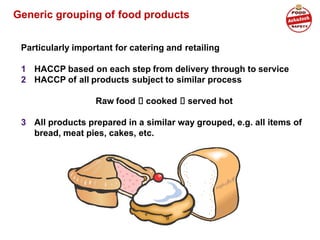
Generic grouping of food products
Particularly important for catering and retailing
1 HACCP based on each step from delivery through to service
2 HACCP of all products subject to similar process
Raw food cooked served hot
3 All products prepared in a similar way grouped, e.g. all items of
bread, meat pies, cakes, etc.
❖ Construct Flow Diagram
❖ Verify Flow Diagram on Site
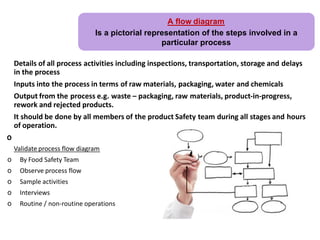
Details of all process activities including inspections, transportation, storage and delays
in the process
Inputs into the process in terms of raw materials, packaging, water and chemicals
Output from the process e.g. waste – packaging, raw materials, product-in-progress,
rework and rejected products.
It should be done by all members of the product Safety team during all stages and hours
of operation.
o
Validate process flow diagram
o By Food Safety Team
o Observe process flow
o Sample activities
o Interviews
o Routine / non-routine operations
A flow diagram
Is a pictorial representation of the steps involved in a
particular process
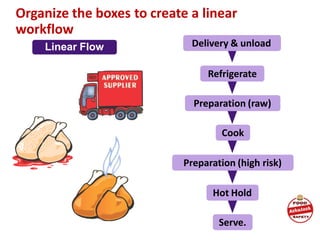
Organize the boxes to create a linear
workflow
Linear Flow Delivery & unload
Refrigerate
Preparation (raw)
Cook
Preparation (high risk)
Hot Hold
Serve.
Construct flow diagram & On-site verification
• At each step in the flow diagram we have to identify the hazards that could
occur
For example
• Could bacteria multiply or?
• Could the food be contaminated?
Having identified the hazards we must now ensure they are controlled
• For example
• Keep food Chilled
• Protect food from Contamination
• Cook food thoroughly
• Keep yourself and surfaces Clean
• Cool Food quickly
• These are all control measures
❖ Conduct Hazard Analysis
❖ Identify Control
Hazard
A biological, chemical or physical agent in, or condition
of, product with the potential to cause an adverse health
effect
Hazard analysis
The process of collecting and evaluating information on
hazards and conditions leading to their presence to
decide which are significant to food safety and therefore
should be addressed in the Food Safety/ HACCP plan
What
is
Hazard ?
Hazard
Presence of unwanted substances
that make food unfit for Hazard.
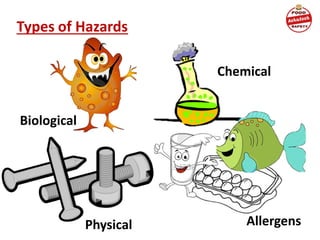
Types of Hazards
Biological
Chemical
Physical Allergens
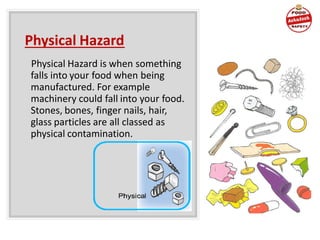
Physical Hazard
Physical Hazard is when something
falls into your food when being
manufactured. For example
machinery could fall into your food.
Stones, bones, finger nails, hair,
glass particles are all classed as
physical contamination.
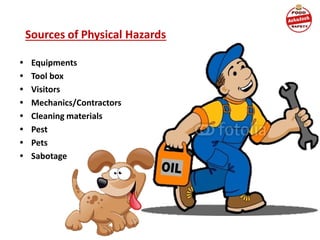
Sources of Physical Hazards
• Equipments
• Tool box
• Visitors
• Mechanics/Contractors
• Cleaning materials
• Pest
• Pets
• Sabotage
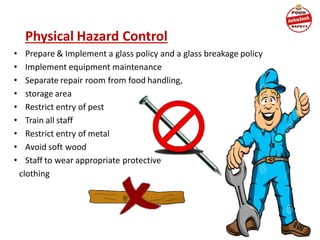
Physical Hazard Control
• Prepare & Implement a glass policy and a glass breakage policy
• Implement equipment maintenance
• Separate repair room from food handling,
• storage area
• Restrict entry of pest
• Train all staff
• Restrict entry of metal
• Avoid soft wood
• Staff to wear appropriate protective
clothing
Physical hazards – what are the control
measures?
Raw materials
Intrinsic/extrinsic
Pebbles, snails, stalks, leaves, wood, glass, metal, insects and
rodents, bone/cartilage and hide.
REPUTABLE SUPPLIERS, SPECIFICATIONS
KEEP SOURCE OF CONTAMINATION OUT
OF FOOD ROOMS
CONTROL
MEASURES
Physical hazards – what are the control
measures?
Packaging material
Staples, cardboard, string, fibres, cloth, glass, rubber, plastic,
wood, polythene and paper/cardboard
SPECIFICATION OF PACKAGING
CARE WHEN DEBOXING
CARE WITH WASTE DISPOSAL
DETECTION SYSTEMS
(METAL/MAGNET X-RAY.
CONTROL
MEASURES
Physical hazards – what are the control
measures?
Structure, equipment, notices and
cleaning
Wood, nuts and bolts, plaster, glass, paint flakes, rust, grease/oil,
drawing pins, cloths and bristles
CARE WITH MAINTENANCE
& CLEANING ACTIVITIES
GOOD DESIGN
USE NON-CORRODING MATERIALS
AVOID TEMPORARY REPAIRS
GLASS POLICY
WOOD POLICY.
CONTROL
MEASURES
Physical hazards – what are the control
measures?
Personnel/visitors
Jewellery, fingernails, buttons, combs, pen tops, sweet papers,
cigarette ends and hair
EFFECTIVE PERSONAL
HYGIENE CONTROLS.
CONTROL
MEASURES
Physical hazards – what are the control
measures?
Pests
Rodents, droppings, hair, bait, insects, eggs, larvae and nymphal
moults
INTEGRATED PEST MANAGEMENT
REPUTABLE CONTRACTOR.
CONTROL
MEASURES
Detecting physical contamination in factories
• High visibility packaging/equipment
• Spotters
• Metal detection
• Sieving/filtering
• Air and liquid separators
• Weight indicators
• X-ray machines
• Optical scanners.
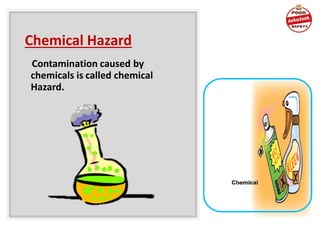
Chemical Hazard
Contamination caused by
chemicals is called chemical
Hazard.
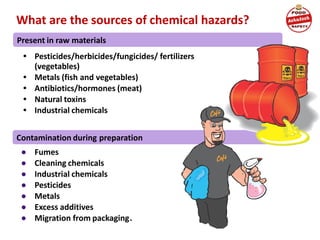
Contamination during preparation
Present in raw materials
What are the sources of chemical hazards?
• Pesticides/herbicides/fungicides/ fertilizers
(vegetables)
• Metals (fish and vegetables)
• Antibiotics/hormones (meat)
• Natural toxins
• Industrial chemicals
● Fumes
● Cleaning chemicals
● Industrial chemicals
● Pesticides
● Metals
● Excess additives
● Migration from packaging.
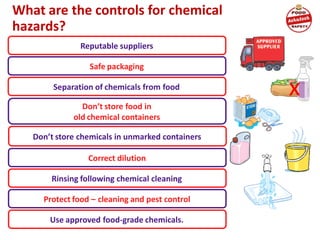
What are the controls for chemical
hazards?
Don’t store food in
old chemical containers
Separation of chemicals from food
Don’t store chemicals in unmarked containers
Correct dilution
Reputable suppliers
Safe packaging
Rinsing following chemical cleaning
Protect food – cleaning and pest control
Use approved food-grade chemicals.
x
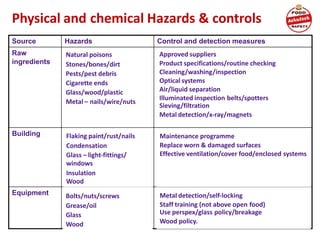
Physical and chemical Hazards & controls
Source Hazards Control and detection measures
Raw
ingredients
Natural poisons
Stones/bones/dirt
Pests/pest debris
Cigarette ends
Glass/wood/plastic
Metal – nails/wire/nuts
Approved suppliers
Product specifications/routine checking
Cleaning/washing/inspection
Optical systems
Air/liquid separation
Illuminated inspection belts/spotters
Sieving/filtration
Metal detection/x-ray/magnets
Building Flaking paint/rust/nails
Condensation
Glass – light-fittings/
windows
Insulation
Wood
Maintenance programme
Replace worn & damaged surfaces
Effective ventilation/cover food/enclosed
systems
Equipment Bolts/nuts/screws
Grease/oil
Glass
Wood
Metal detection/self-locking
Staff training (not above open food)
Use perspex/glass policy/breakage
Wood policy.
Natural poisons
Stones/bones/dirt
Pests/pest debris
Cigarette ends
Glass/wood/plastic
Metal – nails/wire/nuts
Flaking paint/rust/nails
Condensation
Glass – light-fittings/
windows
Insulation
Wood
Bolts/nuts/screws
Grease/oil
Glass
Wood
Approved suppliers
Product specifications/routine checking
Cleaning/washing/inspection
Optical systems
Air/liquid separation
Illuminated inspection belts/spotters
Sieving/filtration
Metal detection/x-ray/magnets
Maintenance programme
Replace worn & damaged surfaces
Effective ventilation/cover food/enclosed systems
Metal detection/self-locking
Staff training (not above open food)
Use perspex/glass policy/breakage
Wood policy.
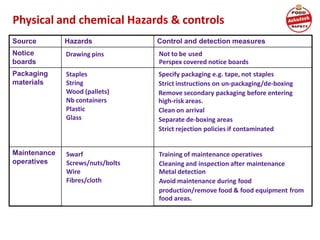
Physical and chemical Hazards & controls
Source Hazards Control and detection measures
Notice
boards
Drawing pins Not to be used
Perspex covered notice boards
Packaging
materials
Staples
String
Wood (pallets)
Nb containers
Plastic
Glass
Specify packaging e.g. tape, not staples
Strict instructions on un-packaging/de-
boxing
Remove secondary packaging before
entering high-risk areas.
Clean on arrival
Separate de-boxing areas
Strict rejection policies if contaminated
Maintenance
operatives
Swarf
Screws/nuts/bolts
Wire
Fibres/cloth
Training of maintenance operatives
Cleaning and inspection after maintenance
Metal detection
Avoid maintenance during food
Production/remove food & food equipment
from food areas.
Drawing pins
Staples
String
Wood (pallets)
Nb containers
Plastic
Glass
Swarf
Screws/nuts/bolts
Wire
Fibres/cloth
Not to be used
Perspex covered notice boards
Specify packaging e.g. tape, not staples
Strict instructions on un-packaging/de-boxing
Remove secondary packaging before entering
high-risk areas.
Clean on arrival
Separate de-boxing areas
Strict rejection policies if contaminated
Training of maintenance operatives
Cleaning and inspection after maintenance
Metal detection
Avoid maintenance during food
production/remove food & food equipment from
food areas.
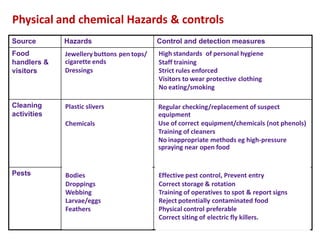
Physical and chemical Hazards & controls
Source Hazards Control and detection measures
Food
handlers &
visitors
Jewellery buttons pen
tops/cigarette ends
Dressings
High standards of personal hygiene
Staff training
Strict rules enforced
Visitors to wear protective clothing
No eating/smoking
Cleaning
activities
Plastic slivers
Chemicals
Regular checking/replacement of suspect
equipment
Use of correct equipment/chemicals (not
phenols)
Training of cleaners
No inappropriate methods eg high pressure
spraying near open food
Pests Bodies
Droppings
Webbing
Larvae/eggs
Feathers
Effective pest control, Prevent entry
Correct storage & rotation
Training of operatives to spot & report signs
Reject potentially contaminated food
Physical control preferable
Correct siting of electric fly killers.
Jewellery buttons pen tops/
cigarette ends
Dressings
Plastic slivers
Chemicals
Bodies
Droppings
Webbing
Larvae/eggs
Feathers
High standards of personal hygiene
Staff training
Strict rules enforced
Visitors to wear protective clothing
No eating/smoking
Regular checking/replacement of suspect
equipment
Use of correct equipment/chemicals (not phenols)
Training of cleaners
No inappropriate methods eg high-pressure
spraying near open food
Effective pest control, Prevent entry
Correct storage & rotation
Training of operatives to spot & report signs
Reject potentially contaminated food
Physical control preferable
Correct siting of electric fly killers.
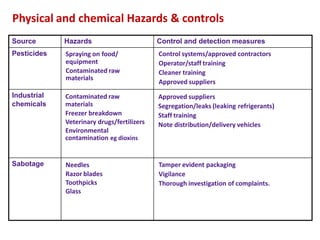
Physical and chemical Hazards & controls
Source Hazards Control and detection measures
Pesticides Spraying on food/
equipment
Contaminated raw
materials
Control systems/approved contractors
Operator/staff training
Cleaner training
Approved suppliers
Industrial
chemicals
Contaminated raw
materials
Freezer breakdown
Veterinary drugs/
fertilizers
Environmental
contamination eg dioxins
Approved suppliers
Segregation/leaks
Staff training
(leaking refrigerants)
Note distribution/delivery vehicles
Sabotage Needles
Razor blades
Toothpicks
Glass
Tamper evident packaging
Vigilance
Thorough investigation of complaints.
Spraying on food/
equipment
Contaminated raw
materials
Contaminated raw
materials
Freezer breakdown
Veterinary drugs/fertilizers
Environmental
contamination eg dioxins
Needles
Razor blades
Toothpicks
Glass
Control systems/approved contractors
Operator/staff training
Cleaner training
Approved suppliers
Approved suppliers
Segregation/leaks (leaking refrigerants)
Staff training
Note distribution/delivery vehicles
Tamper evident packaging
Vigilance
Thorough investigation of complaints.
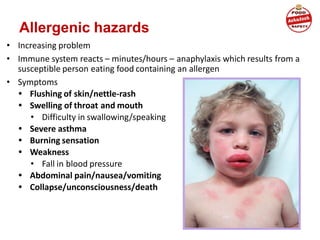
• Increasing problem
• Immune system reacts – minutes/hours – anaphylaxis which results from a
susceptible person eating food containing an allergen
• Symptoms
• Flushing of skin/nettle-rash
• Swelling of throat and mouth
• Difficulty in swallowing/speaking
• Severe asthma
• Burning sensation
• Weakness
• Fall in blood pressure
• Abdominal pain/nausea/vomiting
• Collapse/unconsciousness/death
Allergenic hazards
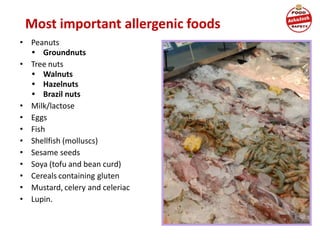
Most important allergenic foods
• Peanuts
• Groundnuts
• Tree nuts
• Walnuts
• Hazelnuts
• Brazil nuts
• Milk/lactose
• Eggs
• Fish
• Shellfish (molluscs)
• Sesame seeds
• Soya (tofu and bean curd)
• Cereals containing gluten
• Mustard, celery and celeriac
• Lupin.
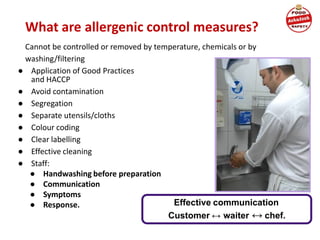
What are allergenic control measures?
Cannot be controlled or removed by temperature, chemicals or by
washing/filtering
● Application of Good Practices
and HACCP
● Avoid contamination
● Segregation
● Separate utensils/cloths
● Colour coding
● Clear labelling
● Effective cleaning
● Staff:
● Handwashing before preparation
● Communication
● Symptoms
● Response. Effective communication
Customer ↔ waiter ↔ chef.
MICROBIOLOGICAL
HAZARD
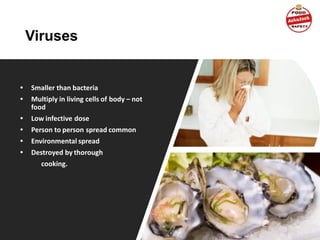
Viruses
• Smaller than bacteria
• Multiply in living cells of body – not
food
• Low infective dose
• Person to person spread common
• Environmental spread
• Destroyed by thorough
cooking.
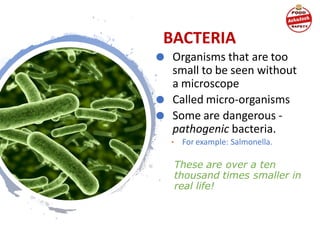
BACTERIA
⚫ Organisms that are too
small to be seen without
a microscope
⚫ Called micro-organisms
⚫ Some are dangerous -
pathogenic bacteria.
• For example: Salmonella.
These are over a ten
thousand times smaller in
real life!
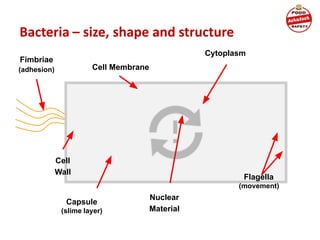
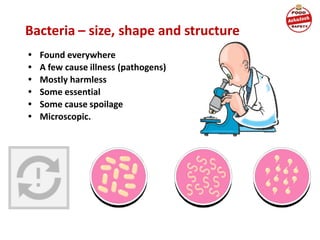
Bacteria – size, shape and structure
Cell Membrane
Cytoplasm
Cell
Wall
Nuclear
Material
Flagella
(movement)
Fimbriae
(adhesion)
Capsule
(slime layer)
Bacteria – size, shape and structure
• Found everywhere
• A few cause illness (pathogens)
• Mostly harmless
• Some essential
• Some cause spoilage
• Microscopic.
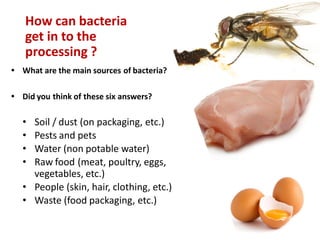
How can bacteria
get in to the
processing ?
• What are the main sources of bacteria?
• Did you think of these six answers?
• Soil / dust (on packaging, etc.)
• Pests and pets
• Water (non potable water)
• Raw food (meat, poultry, eggs,
vegetables, etc.)
• People (skin, hair, clothing, etc.)
• Waste (food packaging, etc.)
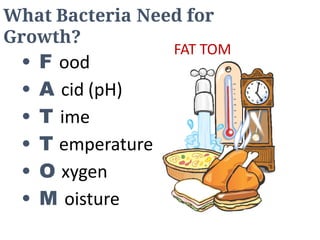
What Bacteria Need for
Growth?
• F ood
• A cid (pH)
• T ime
• T emperature
• O xygen
• M oisture
FAT TOM
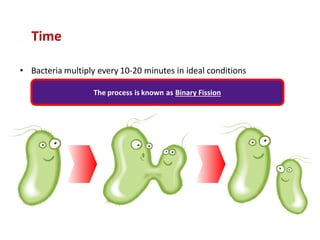
Time
• Bacteria multiply every 10-20 minutes in ideal conditions
The process is known as Binary Fission
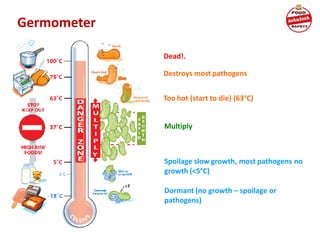
Germometer
Dead!.
Destroys most pathogens
Multiply
Spoilage slow growth, most pathogens no
growth (<5°C)
Dormant (no growth – spoilage or
pathogens)
Too hot (start to die) (63°C)
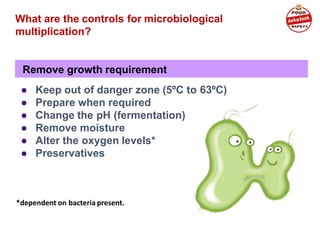
Remove growth requirement
What are the controls for microbiological
multiplication?
● Keep out of danger zone (5ºC to 63ºC)
● Prepare when required
● Change the pH (fermentation)
● Remove moisture
● Alter the oxygen levels*
● Preservatives
*dependent on bacteria present.
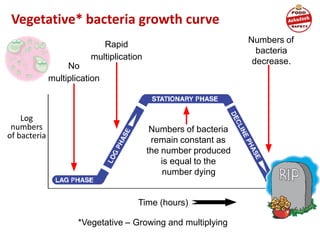
Vegetative* bacteria growth curve
Log
numbers
of bacteria
Time (hours)
No
multiplication
Rapid
multiplication
Numbers of bacteria
remain constant as
the number produced
is equal to the
number dying
Numbers of
bacteria
decrease.
*Vegetative – Growing and multiplying
Destruction of bacteria in food
HEAT
Pasteurization
(destroys pathogens)
Sterilization
(destroys all bacteria, spores and
toxins)
Canning
(commercially sterile designed to
destroy Clostridium botulinum
spores)
Effective cooking
(center temperature at least
75°C).
Destruction of bacteria in food
IRRADIATION
U/V LIGHT
Water/shellfish purification.
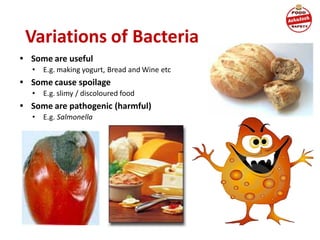
Variations of Bacteria
• Some are useful
• E.g. making yogurt, Bread and Wine etc
• Some cause spoilage
• E.g. slimy / discoloured food
• Some are pathogenic (harmful)
• E.g. Salmonella
Control Measures
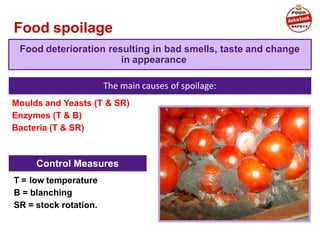
Food spoilage
The main causes of spoilage:
Moulds and Yeasts (T & SR)
Enzymes (T & B)
Bacteria (T & SR)
T = low temperature
B = blanching
SR = stock rotation.
Food deterioration resulting in bad smells, taste and change
in appearance
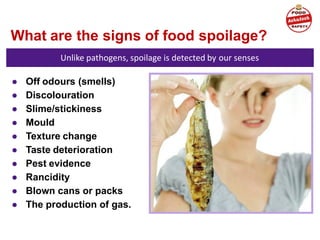
What are the signs of food spoilage?
Unlike pathogens, spoilage is detected by our senses
● Off odours (smells)
● Discolouration
● Slime/stickiness
● Mould
● Texture change
● Taste deterioration
● Pest evidence
● Rancidity
● Blown cans or packs
● The production of gas.
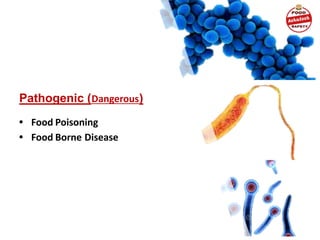
Pathogenic (Dangerous)
• Food Poisoning
• Food Borne Disease
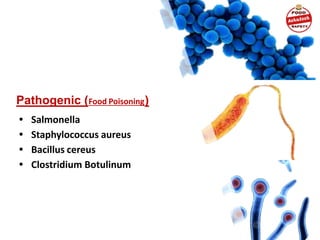
Pathogenic (Food Poisoning)
• Salmonella
• Staphylococcus aureus
• Bacillus cereus
• Clostridium Botulinum
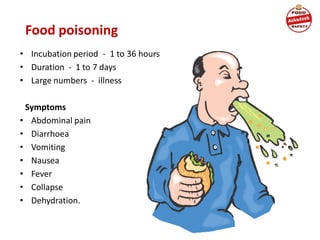
Food poisoning
• Incubation period - 1 to 36 hours
• Duration - 1 to 7 days
• Large numbers - illness
Symptoms
• Abdominal pain
• Diarrhoea
• Vomiting
• Nausea
• Fever
• Collapse
• Dehydration.
Salmonella (infectious)
Sources
● Raw poultry/eggs/milk/meat
● People/sewage/water
● Animals/birds
● Rodents/insects
● Reptiles/terrapins
Incubation period
● usually 12-36 hours
Symptoms
● Abdominal pain
● Diarrhea
● Vomiting
● Fever
Common food vehicles
• Cooked poultry
• Meat
• Raw milk
• Egg products.
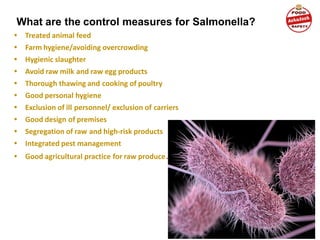
What are the control measures for Salmonella?
• Treated animal feed
• Farm hygiene/avoiding overcrowding
• Hygienic slaughter
• Avoid raw milk and raw egg products
• Thorough thawing and cooking of poultry
• Good personal hygiene
• Exclusion of ill personnel/ exclusion of carriers
• Good design of premises
• Segregation of raw and high-risk products
• Integrated pest management
• Good agricultural practice for raw produce.
Staphylococcus aureus (toxic)
Sources
● Humans – nose/mouth/skin/spots/boils
● Raw milk
● Skin/hides of animals
Onset period
● 1 to 7 hours
Symptoms
● Vomiting, abdominal pain, prostration
and some diarrhea
Features
● Heat-resistant exotoxin in food, salt
tolerant
Common food vehicles
• Milk and dairy
products
• Desserts
• Custards
• Cooked meats
• Cooked poultry
• Prawns
• Fermented sausage
• ‘buffet type food’.
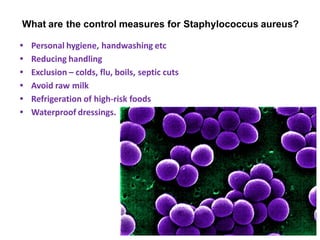
What are the control measures for Staphylococcus aureus?
• Personal hygiene, handwashing etc
• Reducing handling
• Exclusion – colds, flu, boils, septic cuts
• Avoid raw milk
• Refrigeration of high-risk foods
• Waterproof dressings.
Bacillus cereus (toxic/infectious)
Sources
● Cereals (especially rice)/spices
● Corn flour/bean sprouts
● Soil/vegetation
● Dust/dried foods
● Intestinal tract of humans
Features
● Spore former and a heat- resistant
exotoxin in food.
Symptoms
Onset period
● 1 to 6 hours
(exotoxin in food)
● 6 to 24 hours
(enterotoxin in intestine)
● Vomiting, ab pain, nausea
and some diarrhoea
● Diarrhoea, ab pain and
some vomiting
Common food vehicles
• Reheated rice
• Corn flour products
• Food containing spices
What are the control measures for Bacillus cereus?
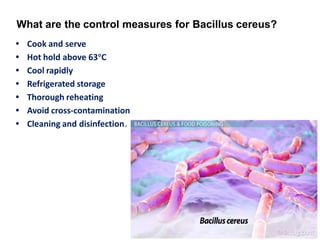
• Cook and serve
• Hot hold above 63o
C
• Cool rapidly
• Refrigerated storage
• Thorough reheating
• Avoid cross-contamination
• Cleaning and disinfection.
Clostridium botulinum (toxic)
Sources
● Intestines of fish/mammals
● Soil/vegetables
Onset period
● Usually 12 to 36 hours
Symptoms
● Difficulties in talking, breathing and
swallowing, vertigo, double vision
and paralysis of the cranial nerves
Features
● Anaerobic, spore former,
neurotoxin in food (heat sensitive).
● Botulinum cook in canning
● Can multiply at 3°C (slowly)
Common food vehicles
• Low acid processed
food
• Canned and smoked
fish
• Bottled vegetables
• Honey (infant botulism).
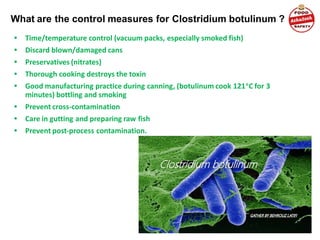
What are the control measures for Clostridium botulinum ?
• Time/temperature control (vacuum packs, especially smoked fish)
• Discard blown/damaged cans
• Preservatives (nitrates)
• Thorough cooking destroys the toxin
• Good manufacturing practice during canning, (botulinum cook 121o
C for 3
minutes) bottling and smoking
• Prevent cross-contamination
• Care in gutting and preparing raw fish
• Prevent post-process contamination.
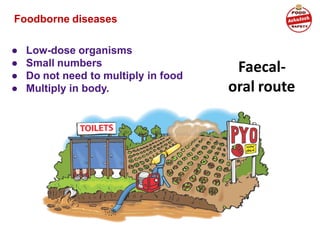
Foodborne diseases
● Low-dose organisms
● Small numbers
● Do not need to multiply in food
● Multiply in body.
Faecal-
oral route
Foodborne disease
● Campylobacter
● Escherichia coli O157
● Norovirus
● Hepatitis A
● Listeria monocytogenes
● Dysentery
● Typhoid/paratyphoid.
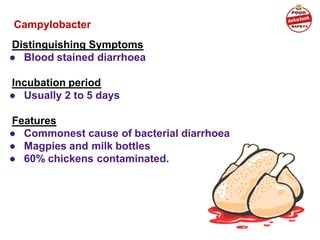
Campylobacter
Distinguishing Symptoms
● Blood stained diarrhoea
Incubation period
● Usually 2 to 5 days
Features
● Commonest cause of bacterial diarrhoea
● Magpies and milk bottles
● 60% chickens contaminated.
What are the common control measures for Campylobacter?
● Better hygiene in slaughterhouses
● Heat treatment of milk
● Thorough cooking
● Wash hands after handling raw poultry/meat
● Better hygiene awareness of consumers
● Pet hygiene – keep animals out of food rooms
● Avoid cross-contamination from farm to table
● Chlorination of water (care with irrigation).
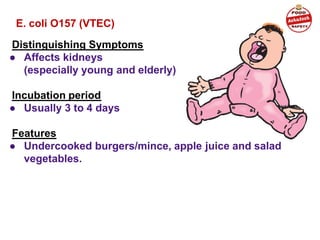
E. coli O157 (VTEC)
Distinguishing Symptoms
● Affects kidneys
(especially young and elderly)
Incubation period
● Usually 3 to 4 days
Features
● Undercooked burgers/mince, apple juice and salad
vegetables.
What are the common control measures for E. coli
O157 (VTEC)?
● Reduce contamination levels of raw meat especially
at slaughter-houses
● Better hygiene on produce farms
● Use clean vehicles/crates for transport of produce
● Prevent cross-contamination
● Thorough cooking
● Double washing of salad vegetables and fruit
● High standards of personal hygiene
● Segregation of raw and high-risk food
● Avoid untreated apple juice, milk and cheese
● Train food handlers
● Increase consumer awareness
● Use of effective HACCP system.
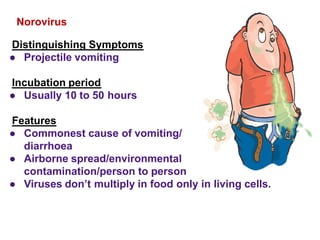
Norovirus
Distinguishing Symptoms
● Projectile vomiting
Incubation period
● Usually 10 to 50 hours
Features
● Commonest cause of vomiting/
diarrhoea
● Airborne spread/environmental
contamination/person to person
● Viruses don’t multiply in food only in living cells.
What are the common control measures for Norovirus?
● Wash/blanch fruit and vegetables
● Reputable suppliers, in particular of shellfish
● Exclude ill personnel
● Prevent cross-contamination
● Thorough cooking
● Thorough cleaning and disinfection of contaminated
surfaces (food and non-food) i.e. environmental
decontamination of public areas.
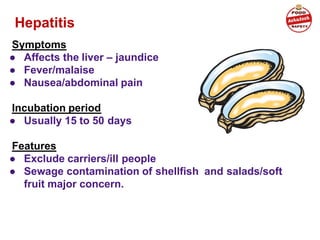
Hepatitis A (virus)
Symptoms
● Affects the liver – jaundice
● Fever/malaise
● Nausea/abdominal pain
Incubation period
● Usually 15 to 50 days
Features
● Exclude carriers/ill people
● Sewage contamination of shellfish and salads/soft
fruit major concern.
What are the control measures for Hepatitis A?
• Safe water supplies
• Satisfactory disposal of sewage
• Better hygiene of producers/transport
• Heat treatment of milk
• High standards of personal hygiene, especially hand-
washing
• Exclusion of carriers
• Avoid suspect shellfish
• Use of approved suppliers
• Careful washing of salad vegetables and soft fruit.
Listeria
Symptoms
● Flu-like, abortion in pregnant women
● Diarrhoea and mild fever
● Septicaemia/meningitis in vulnerable groups
Incubation period
● Usually 1 day to 3 months
Features
● Multiplies in fridge (-2°C)
● Soft cheese/pâté/chilled foods
● Dominates other organisms at low temperatures
● Wide temperature growth range.
What are the control measures for Listeriosis?
• Efficient sewage disposal/care with irrigation
• Use of clean vehicles/crates for transport of produce
• Avoidance of cross-contamination
• Susceptible groups to avoid soft cheese and pâté and
contact with farm animals
• Care with shelf life of chilled foods
• Thorough cooking
• Effective cleaning and disinfection (dry cleaning
preferred).
Dysentery
Symptoms
● Blood-stained diarrhoea
● Fever
● Stomach cramps
● Vomiting
Incubation period
● Usually 1 to 3 days
Features
● Cases from infected people (usually children)
● Cases from food and water (fruit and vegetables).
What are the control measures for Dysentery?
• Good personal hygiene
• Washing hands effectively after using the toilet
• Cleaning and disinfection of toilet areas
• General cleaning and disinfection
• Exclusion of carriers
• Better hygiene of producers
• Use of clean vehicles/crates for transportation of
produce
• Chlorination of water supplies/care with irrigation
• Effective disposal of sewage
• Heat treatment of milk
• Avoid raw shellfish and shellfish from suspect waters
• Use approved suppliers.
Typhoid/paratyphoid
Symptoms
● Rose spots on trunk
● Fever & headache
● Nausea
● Constipation/diarrhoea
Incubation period
● Usually 8 to 14 days
Features
● Long-term carriers
● 6 consecutive –ve faecal specimens at weekly intervals.
What are the control measures for Typhoid/paratyphoid?
• Safe water supplies
• Satisfactory disposal of sewage
• Heat treatment of milk
• Control over contaminated shellfish (approved
suppliers)
• Exclusion of carriers
• High standard of personal hygiene, especially
handwashing
• Use of effective HACCP.
Tuberculosis
Symptoms
● Chronic bacterial disease
● Affects lungs, bones, lymph nodes,
kidneys, intestines and skin
Incubation period
● Usually 4 to 6 weeks
● Later stages may take years
Features
● Infected cows via raw milk/dairy products
● Person to person (holidays abroad).
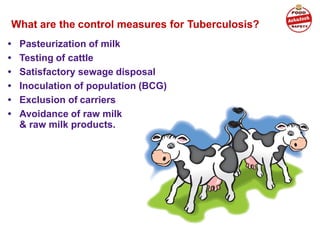
What are the control measures for Tuberculosis?
• Pasteurization of milk
• Testing of cattle
• Satisfactory sewage disposal
• Inoculation of population (BCG)
• Exclusion of carriers
• Avoidance of raw milk
& raw milk products.
Preventing Bacterial
Multiplication
• Clean catch utilities
• Clean storage
• Storage temperature
• Time control
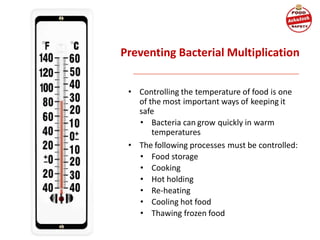
• Controlling the temperature of food is one
of the most important ways of keeping it
safe
• Bacteria can grow quickly in warm
temperatures
• The following processes must be controlled:
• Food storage
• Cooking
• Hot holding
• Re-heating
• Cooling hot food
• Thawing frozen food
Preventing Bacterial Multiplication
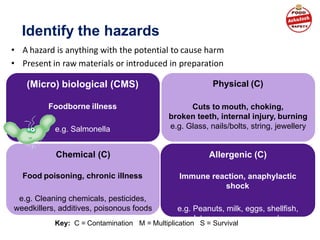
Identify the hazards
• A hazard is anything with the potential to cause harm
• Present in raw materials or introduced in preparation
(Micro) biological (CMS)
Foodborne illness
e.g. Salmonella
Chemical (C)
Food poisoning, chronic illness
e.g. Cleaning chemicals, pesticides,
weedkillers, additives, poisonous foods
Physical (C)
Cuts to mouth, choking,
broken teeth, internal injury, burning
e.g. Glass, nails/bolts, string, jewellery
Allergenic (C)
Immune reaction, anaphylactic
shock
e.g. Peanuts, milk, eggs, shellfish,
gluten, soy, sesame seeds.
Key: C = Contamination M = Multiplication S = Survival
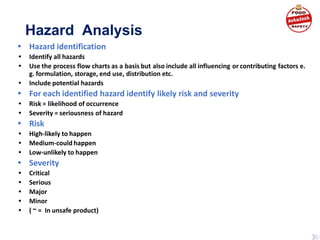
Hazard Analysis
• Hazard identification
• Identify all hazards
• Use the process flow charts as a basis but also include all influencing or contributing factors e.
g. formulation, storage, end use, distribution etc.
• Include potential hazards
• For each identified hazard identify likely risk and severity
• Risk = likelihood of occurrence
• Severity = seriousness of hazard
• Risk
• High-likely to happen
• Medium-could happen
• Low-unlikely to happen
• Severity
• Critical
• Serious
• Major
• Minor
• ( ~ = In unsafe product)
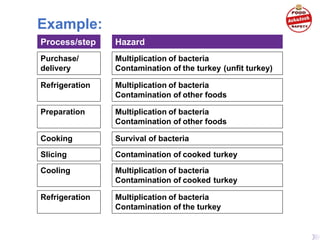
Example:
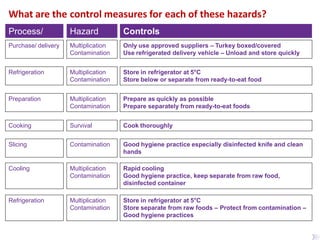
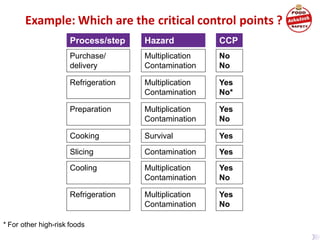
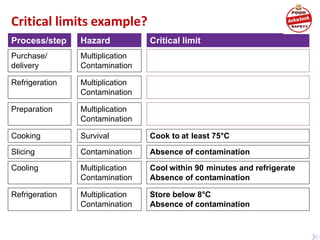
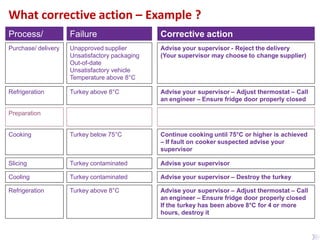
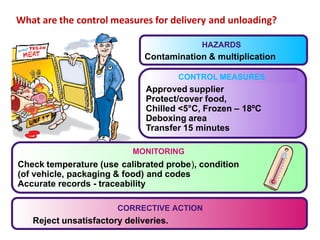
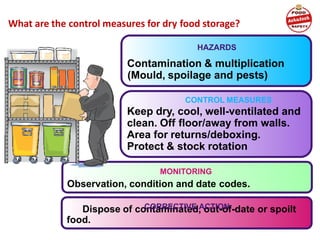
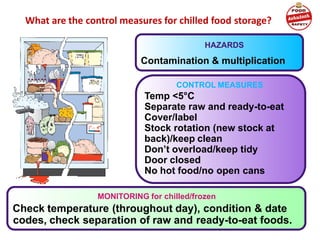
Process/step Hazard
Purchase/
delivery
Multiplication of bacteria
Contamination of the turkey (unfit turkey)
Refrigeration Multiplication of bacteria
Contamination of other foods
Preparation Multiplication of bacteria
Contamination of other foods
Cooking Survival of bacteria
Slicing Contamination of cooked turkey
Cooling Multiplication of bacteria
Contamination of cooked turkey
Refrigeration Multiplication of bacteria
Contamination of the turkey
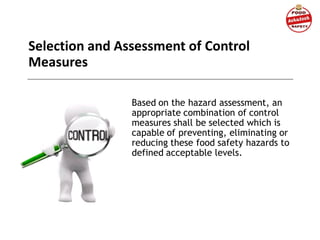
Selection and Assessment of Control
Measures
Based on the hazard assessment, an
appropriate combination of control
measures shall be selected which is
capable of preventing, eliminating or
reducing these food safety hazards to
defined acceptable levels.
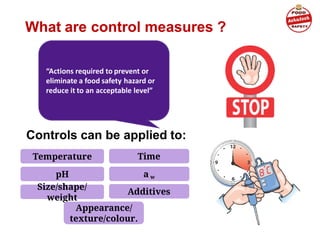
What are control measures ?
“Actions required to prevent or
eliminate a food safety hazard or
reduce it to an acceptable level”
Controls can be applied to:
pH
Temperature
Size/shape/
weight
Time
a w
Additives
Appearance/
texture/colour.
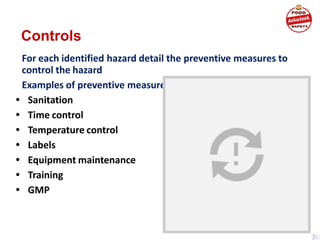
Controls
For each identified hazard detail the preventive measures to
control the hazard
Examples of preventive measures
• Sanitation
• Time control
• Temperature control
• Labels
• Equipment maintenance
• Training
• GMP
What are the control measures for each of these hazards?
Process/
step
Hazard
Purchase/ delivery Multiplication
Contamination
Refrigeration Multiplication
Contamination
Preparation Multiplication
Contamination
Cooking Survival
Slicing Contamination
Cooling Multiplication
Contamination
Refrigeration Multiplication
Contamination
Controls
Only use approved suppliers – Turkey boxed/covered
Use refrigerated delivery vehicle – Unload and store quickly
Store in refrigerator at 5°C
Store below or separate from ready-to-eat food
Prepare as quickly as possible
Prepare separately from ready-to-eat foods
Cook thoroughly
Good hygiene practice especially disinfected knife and clean
hands
Rapid cooling
Good hygiene practice, keep separate from raw food,
disinfected container
Store in refrigerator at 5°C
Store separate from raw foods – Protect from contamination –
Good hygiene practices
Determine
Critical Control Point
What is a critical control point ?
Critical control point
‘A step in a process where
control is essential to prevent
or eliminate a food safety
hazard, or reduce it to an
acceptable level’.
Effective control
procedures must be
provided at all CCPs
Critical control point
• Although it is good practice to control hazards at every step
in the process, some steps are critical to food safety
• It is essential that control are applied at steps which are
critical to food safety
• In order to determine if a step is critical to food safety, you
should ask the following question:
CCP decision tree
CRITICAL
CONTROL
POINT
Q1a
Is control necessary at this step
for safety?
Yes
Q1
Do control measures exist?
Yes
No
Modify step, process
or product
No
Q4
Will a subsequent step eliminate or
reduce the hazard to an acceptable
level?
Yes
No
Q2
Is THE STEP specifically designed to
eliminate or reduce the likely occurrence
of a hazard to an acceptable level?
No
Yes
Q3
Could contamination with
identified hazard(s) occur in
excess of acceptable level(s) or
increase to unacceptable level(s)
No
Yes
Not
a
CCP
Proceed to the next
step in the process
Control Point
(good hygienic
practice)
Yes
No
Simplified decision tree
If I lose control is it
likely that food
poisoning/injury/
harm will result?
No
Yes
Will a subsequent
step eliminate the
hazard, or reduce it to
an acceptable level?
CCP
Critical control point.
Example: Which are the critical control points ?
Process/step Hazard
Purchase/
delivery
Multiplication
Contamination
Refrigeration Multiplication
Contamination
Preparation Multiplication
Contamination
Cooking Survival
Slicing Contamination
Cooling Multiplication
Contamination
Refrigeration Multiplication
Contamination
CCP
No
No
Yes
No*
Yes
No
Yes
Yes
Yes
No
Yes
No
* For other high-risk foods
Establish Critical Limits
for each
Critical Control Point
Critical limits are the values of
monitored actions which
separate the acceptable from
the unacceptable
• For example
• Cooking to 75°C
• Storing food below 8°C in a
refrigerator
• Cooling food within 90
minutes
What are critical limits?
Critical limit
5°c
Refrigerator
Cooking temperature 75°c
Critical limits
must be unambiguous
and measurable
Critical limits
“values of monitored
actions which separate
the acceptable from the
unacceptable”.
Critical Limits
● Safety boundaries.
● Division between safe and unsafe
at a CCP is the critical limit
● Be specific! Temperature, time, ph
● Target levels can be used to take
action and reduce the risk of
deviation.
Critical limits
• Critical limits are defined as the criteria that must be met for
each preventive measure
• Should be meaningful and realistic
• Are used to reduce or eliminate hazards
• Need to validate the critical limit
• Critical limits include:
• Temperature
• Time
• Moisture level
• pH
• Water activity
• Available chlorine
• Visual appearances
and texture
Critical limits example?
Process/step Hazard
Purchase/
delivery
Multiplication
Contamination
Refrigeration Multiplication
Contamination
Preparation Multiplication
Contamination
Cooking Survival
Slicing Contamination
Cooling Multiplication
Contamination
Refrigeration Multiplication
Contamination
Critical limit
Cook to at least 75°C
Absence of contamination
Cool within 90 minutes and refrigerate
Absence of contamination
Store below 8°C
Absence of contamination
Establish Monitoring System
for each
Critical Control Point
Control
The state wherein correct procedures are being followed and
criteria are being met
Monitor
The act of conducting a planned sequence of observations or
measurements of control parameters to assess whether a CCP is
under control
Monitoring
“The observations and
measurements of control
measures to confirm the
process is under control and
critical limits are not
breached”
What is the monitoring of controls ?
Methods
Rapid detection and correction
Automatic or manual.
Types of monitoring
Observation/
supervision
Visual
inspections
Organoleptic
(senses)
Checking controls/
records.
Measuring
e.g. temperature/
pH/a w
Competency
testing
Checking and recording temperatures
● Use a clean, disinfected, calibrated tip-sensitive thermometer or infrared (not
for core temps.)
● Take the core temperature
● Allow minimum of 30 seconds contact time
(ensure dial temperature has stabilised)
● Avoid fat, bone or gristle or container sides
● Use food substitute in fridges
● Record the temperature in accordance with HACCP plan
Bimetallic coil thermometers
should not be used as they
are not tip sensitive.
Monitoring of controls
• How do we ensure that controls are working?
• We check to ensure that controls are working and that critical limits
are not breached
• This is known as monitoring
• Monitoring can involve
• Observation/inspection/audit
• Measuring temperatures or time
• Checking records
• Smelling and touching
Establish Monitoring Procedures
• Facilitates tracking of operations
• Indicates trend towards loss of control
• Action can be taken to bring the process back to control
• Apply corrective action in deviation
• Written documentation for verification
• Measurements include:
• Physical measurements
• Chemical measurements
• Sensory evaluations
• Visual observation
• Monitoring procedures should include:
• What - describe
• How - it is monitored
• Where - in the process the critical limit is monitored
• Who - is responsible
• When - continuous, scheduled, sampling
• Sampling
• Attribute sampling
• Must be statistically sound
• Continuous monitoring (100 %) is preferred where feasible -
most reliable
Establish Monitoring Procedures
What monitoring would you suggest - example?
Process/
step
Purchase/ delivery
Refrigeration
Preparation
Cooking
Slicing
Cooling
Refrigeration
Controls
Approved supplier
Suitably boxed
Refrigerator at 5°C
Cook thoroughly
Contamination
Monitoring
Check each delivery to ensure supplier is approved
Check vehicle is satisfactory
Check temperature of turkey(s)
Check packaging and date code is satisfactory
Check and record temperature at least 3 times per day
(Supervisor will audit daily/weekly)
Supervisor will audit daily/weekly)
Check temperature of each turkey in deep thigh muscle
on completion of cooking
(Supervisor will audit daily/weekly)
(Supervisor will audit each batch)
Check and record temperature at least twice per day
(Supervisor will audit daily/weekly)
Bacteriological monitoring
HACCP verification
Product quality profile
Indicating trends
Identifying poor technique
Product safety
Cleaning and disinfection efficiency
Product processing
Legal standards
Customer standards.
Interpretation of results
Pathogens
L. monocytogenes
S. aureus
C. perfringens
B. cereus.
Aerobic colony count
Indicator organisms
Enterobacteriaceae
Escherichia coli (total)
Listeria spp (total)
Salmonella
Campylobacter
E. coli O157
V. parahaemolyticus
What daily check should be undertaken by management?
Cleanliness/condition of premises/equipment
Condition/shelf life of food
Notices/instructions
Food/equipment temperatures
Absence of pests/hazards
Controls/records
Hygiene practices
Staff
Demonstrate commitment to food safety.
Establish Corrective Actions
When critical limit deviate
Planned correction and corrective
actions to be taken when critical
limits are exceeded shall be
documented.
The actions shall ensure that the
cause of nonconformity is
identified, that the parameters
controlled at the CCP is (are)
bought back under control, and
that recurrence is prevented.
Difference between
Correction and Corrective Action
• Correction is an action taken to
eliminate a detected nonconformity.
• Corrective action is taken to
eliminate the cause of a detected
nonconformity. This requires
understanding the root cause of the
detected nonconformity and acting
to eliminate the root cause(s) to
prevent recurrence of the
nonconformity.
What is corrective action?
Corrective action
The action to be taken
when a critical limit is
breached. Remedial action
should be taken before a
critical limit is breached.
If in doubt, quarantine
non- conforming products
Deal with affected product
Regain process control.
What if the monitoring shows the control is not
working?
• We take corrective action
• The corrective action must bring the process under control AND deal
with any affected product
Corrective Action
• If a critical limit is exceeded (deviation), corrective action must be
implemented
• Need to be developed for each critical limit
■ Must correct the cause of the deviation and control the actual or potential
hazard resulting from the deviation
■ Should take into consideration risks involved
Corrective Action
• Are written procedures
• Identify who is responsible
• Segregate all product since last monitoring
activity
• Determine disposition of product
• Fix the cause of the problem
• Are documented
What corrective action – Example ?
Process/
step
Purchase/ delivery
Refrigeration
Preparation
Cooking
Slicing
Cooling
Refrigeration
Failure
Unapproved supplier
Unsatisfactory packaging
Out-of-date
Unsatisfactory vehicle
Temperature above 8°C
Turkey above 8°C
Turkey below 75°C
Turkey contaminated
Turkey contaminated
Turkey above 8°C
Corrective action
Advise your supervisor - Reject the delivery
(Your supervisor may choose to change supplier)
Advise your supervisor – Adjust thermostat – Call
an engineer – Ensure fridge door properly closed
Continue cooking until 75°C or higher is achieved
– If fault on cooker suspected advise your
supervisor
Advise your supervisor
Advise your supervisor – Destroy the turkey
Advise your supervisor – Adjust thermostat – Call
an engineer – Ensure fridge door properly closed
If the turkey has been above 8°C for 4 or more
hours, destroy it
CONTROL MEASURES
Approved supplier
Protect/cover food,
Chilled <5°C, Frozen – 18ºC
Deboxing area
Transfer 15 minutes
CONTROL MEASURES
What are the control measures for delivery and unloading?
Contamination & multiplication
HAZARDS
Reject unsatisfactory deliveries.
CORRECTIVE ACTION
Check temperature (use calibrated probe), condition
(of vehicle, packaging & food) and codes
Accurate records - traceability
MONITORING
What are the control measures for dry food storage?
Contamination & multiplication
(Mould, spoilage and pests)
HAZARDS
Keep dry, cool, well-ventilated and
clean. Off floor/away from walls.
Area for returns/deboxing.
Protect & stock rotation
CONTROL MEASURES
Observation, condition and date codes.
MONITORING
Dispose of contaminated, out-of-date or spoilt
food.
CORRECTIVE ACTION
Temp <5°C
Separate raw and ready-to-eat
Cover/label
Stock rotation (new stock at
back)/keep clean
Don’t overload/keep tidy
Door closed
No hot food/no open cans
CONTROL MEASURES
What are the control measures for chilled food storage?
Contamination & multiplication
HAZARDS
Check temperature (throughout day), condition & date
codes, check separation of raw and ready-to-eat foods.
MONITORING for chilled/frozen
What are the control measures for frozen food storage?
Correct freezing
temperature stops
the multiplication of
ALL micro-organisms
Store -18°C
Load line
Packaging (freezer burn)
Segregation
Stock rotation
No hot food
Keep clean and tidy.
CONTROL MEASURES
Contamination &
multiplication
(If it thaws)
HAZARDS
What are the control measures for food preparation?
Minimize handling
Good hygiene practices
Separate raw & high-risk food
Minimize time in ‘Danger Zone’
‘Clean as you go’
Use disposable cloths
Colour coding
CONTROL MEASURES
Contamination & multiplication
HAZARDS
Discard contaminated ready-to-eat food
Discard food at ambient temperature for more than 2 hours.
CORRECTIVE ACTION
What are the control measures for cooking/reheating?
Survival and contamination
HAZARDS
Cook/reheat thoroughly > 75°C
(Reheat at 82°C in Scotland)
Protect from contamination
Only reheat once
CONTROL MEASURES
Continue cooking.
CORRECTIVE ACTION
Check temp, texture, colour and steam
MONITORING
What are the control measures for cooling of food?
Contamination & multiplication
HAZARDS
Rapid cooling (90 mins), segregate,
cold
running water, reduce bulk (<2.25kg),
protect/cover
CONTROL MEASURES
Discard contaminated food
Discard food not refrigerated within 2 hours.
CORRECTIVE ACTION
What are the control measures for hot holding?
Contamination & multiplication
HAZARDS
63°C (legal requirement)
Stir stews/sauces
Protect/cover, minimum quantities
Preheat hot cupboards etc
CONTROL MEASURES
Discard food below 63°C for more than 2
hours
Notify supervisor/call maintenance.
CORRECTIVE ACTION
Check time and temperature
MONITORING
What are the control measures for serving food?
Contamination & multiplication
HAZARDS
Minimize time at ambient temperature
No topping up, serve quickly,
Protect/cover. Minimize handling
Good hygiene practices
CONTROL MEASURES
Discard contaminated food
Discard high-risk food above 8°C for 4 hours
or below 63°C for 2 hours.
CORRECTIVE ACTION
Check time, temperature & codes
General supervision/observation
MONITORING
Establish
Verification Procedures
What is Verification ?
The use of methods, procedures or tests, in
addition to those used in monitoring, to
determine the HACCP system is in compliance
with the HACCP plan and/ or whether the plan
needs modification and revalidation
Establish procedure to verify that the HACCP system is working correctly
Trust what you verify
Verification provides a level of confidence that the HACCP
plan is based on solid scientific principles, is adequate to
control the hazards associated with the product and the
process, and is being followed.
Example: Verification activities for CCPs
• Calibration
• Calibration record review
• Target sampling and testing
• CCP record review
Verification activities of the HACCP system:
• Check the accuracy of the product description and flow
chart
• Check the CCPs are monitored as required by the HACCP
plan.
• Check the processes are operating with in established
critical limits
• Check the records are completed accurately and at the time
intervals required.
HACCP system verification frequency
• Annually
• Occurrence of a system failure
• Significant change in product or process
Establish Verification
Establish
Documentation and Record Keeping
Documentation
Documentation
• Essential to the application of the HACCP system
• Appropriate to the size and nature of the business
• Demonstrates importance of CCP monitoring to staff
Required for:
• Company policy
• Verification/internal audits
• Complaint/illness
investigation
• Due diligence
• Legal compliance
• External auditors
Documents & Record Keeping
• Records provide evidence that the food safety management system is
working
• Include:
• HACCP plan
• CCP Monitoring record
• Checklists
• Time/temperature logs etc.
• Corrective actions
• Training records
• Verification Activities
• Provide a tracking system
• Help identify problems
• Evidence of compliance to critical limits
• Evidence of corrective action
Documents & Record Keeping
• All HACCP monitoring records should be on forms that contain the
following information :
• Form Title
• Firm Name
• Time and Date
• Product identification
• Critical limits
• Signatures
• Date of Review
The Benefit of Documents
• Consistency
• A consistent standard for everyone to
follow
• Training tool
• A set of training materials for new
employees
• Reference
• A clear source of guidance if anyone
needs it
• Evidence
• Proof to customers, inspectors and
auditors
• Legal requirement
• Compliance with Municipality
requirements

HACCP .pdf

  • 1.
    Awareness & InternalAuditor Training HACCP Awareness Training
  • 2.
    Ashutosh Jaiswal (Quality andFood Safety Manager| Consultant |Auditor | Trainer) Qualified and experienced Quality Manager having with 9 years of solid experience in managing QHSE, Food safety, Quality Assurance, Quality Control, Audit, Training and Consultancy in Food manufacturing, catering & hospitality industries across INDIA, GCC and Africa region. Achievements: • Conducted 800+ batches of training and trained more than 15,000+ candidates on Food Safety. • Conducted more than 300+ food safety audits. • Implemented FSSC/ ISO22000, Halal, HACCP, BRC and AIB standards and getting the company certified in standards. • Implemented Food safety management system in over 50+ food manufacturing organizations. • Completed more than 50 + Food Safety Certified Qualification
  • 3.
    All measures necessaryto ensure the safety & wholesomeness of food at every stage from the receipt of raw materials till the sale of the product to the customer Food safety is about handling, storing and preparing food to prevent infection and help to make sure that our food keeps enough nutrients for us to have a healthy diet. Unsafe food and water means that it has been exposed to dirt and germs, or may even be rotten, which can cause infections or diseases such as diarrhea, meningitis, etc..
  • 4.
    Food safety involves •Protecting food from contamination What is contamination? • Contamination is when something objectionable gets into food or onto food surfaces or equipment.
  • 5.
    What examples ofcontamination do you know? Bacteria or germs Nails Bolts Wire String Plastic Mouse droppings Cleaning chemicals Buttons Pen tops Fingernails False teeth
  • 6.
    What are thecosts of POOR food safety ? • A poor reputation/brand damage • Food contamination and customer complaints • Fines and legal costs resulting from prosecution • Closure of business, prohibition of processes • Civil action from ill or annoyed customers • Increased risk of food poisoning • deaths and suffering • Increased risk of pest infestation • Waste food due to spoilage • Poor morale – high turnover of staff • LOSS OF BUSINESS - LOWER PROFITS.
  • 7.
    What are thebenefits of Food Safety ? • A good reputation – customer confidence • Brand protection • Improved food safety standards • Compliance with food safety legislation • Reduced risk of food poisoning • Longer shelf life • Good working conditions, higher staff morale and reduced turnover of staff • Increased productivity • INCREASED BUSINESS - HIGHER PROFITS.
  • 8.
    We are allresponsible for food safety Your responsibilities are: • To understand how your actions could cause food poisoning • To work in a hygienic way so that you don’t cause food poisoning • To comply with the law and company policy • To follow advice and instructions from your supervisor • To report any hygiene problems to your supervisor, for example, no soap at the wash basin, out of date food, mouldy food, signs of pests, broken equipment • To report if you re ill, especially if you have diarrhoea vomiting or boils • To wear the protective clothing provided • To keep yourself, your protective clothing and your equipment clean • To keep food at the correct temperature (keep it chilled or keep it hot) • To cook food thoroughly and cool it quickly
  • 9.
    What is Food Poisoning ? “Diseasecaused by consuming contaminated food or water” Food poisoning can be caused by bacteria, viruses, toxins or chemical poisons.
  • 10.
    Food Poisoning Symptoms •Abdominal pain/ stomach cramps • Diarrhoea • Vomiting • Nausea (feeling sick) • Fever • Dehydration • Collapse.
  • 11.
    Risk Group • AgedPersons • Very young kids/babies • Pregnant women/unborn babies • Ill people (Immuno-compromised)
  • 12.
    Prevent Food Poisoning • HygienePractices • Cleaning • Proper Handling • Storage • Proper Cooking • Proper Serving
  • 13.
    Common food vehiclesin food poisoning, usually protein, ready-to-eat, stored under refrigeration, no further processing Food types Major source of food poisoning organisms. High-risk foods Raw foods
  • 14.
    Acid foods pH<4.5 High sugar/salt/fat Dry products (low a w) Include preserved foods not requiring refrigeration Ambient storage Food types Ready-to-eat raw foods such as fruit and salad vegetables should be thoroughly washed before consumption, to minimize the risk from low-dose pathogens. Low-risk foods Ready-to-eat raw foods
  • 15.
    High-risk foods High-risk foodis ready-to-eat, usually protein, which supports the growth of bacteria. Usually requires refrigeration/frozen storage. !
  • 16.
    Low-risk foods Low-risk foods Low-riskfood can usually be stored at ambient temperatures. !
  • 17.
    Proper food handling helps assurethat food is safe to eat. 4 steps to follow...
  • 18.
  • 20.
    Food Safety ManagementSystem • Group of procedures and practices intended to prevent foodborne illness. • Actively controls risks and hazards throughout the flow of food. • Active managerial control and Hazard analysis critical control point (HACCP) are 2 ways to build this system. • The Food Safety Management System (FSMS) is a preventative approach towards identifying, preventing, and reducing food safety hazards/ contamination, to ensure food is safe for consumption. A well-designed FSMS with appropriate control measures can help food establishments comply with food hygiene regulations, so that food prepared for sale is hygienic
  • 21.
  • 22.
  • 23.
    Communication To ensure thatsufficient information on issues concerning product safety and quality is available throughout the product chain, the organization shall establish, implement and maintain effective arrangements for communicating with, - Suppliers and contractors; - Customers or consumers in relation to product information including instructions regarding intended use, specific storage requirements and, as appropriate, shelf life, enquiries, contracts or order handling including amendments and customer feedback including customer complaints; - Statutory and regulatory authorities
  • 25.
    “System” A “System” isan interactive set of processes which has a defined output. A set of things working together as parts of a mechanism or an interconnecting network; a complex whole.
  • 27.
  • 28.
    PLAN It is importantfor the organization to suitably plan the following prior to execution: a) Resources b) Processes c) Policies d) Objectives and e) Compliance requirements
  • 29.
    DO Perform/ execute asper the planned arrangements CHECK Monitor the outputs of execution against the planned arrangements and desired results ACT Take actions to correct the errors as detected in check Actions are of 2 basic types: Correction Corrective Action
  • 31.
    What are prerequisiteprogrammes? Prerequisite programmes The good hygiene practices a business must have in place before implementing Food Safety Management System
  • 32.
    Prerequisite Programs (PRPs) PRPs are “procedures,including Good Manufacturing Practices, that address operational conditions providing the foundation for the food safety system.” These are general control measures applicable across all areas of food processing and aimed at maintaining a safe and hygienic environment. They do not control specific hazards or steps in the process. Examples: • Supplier control • Cleaning and sanitation • Personal hygiene • Training
  • 33.
  • 34.
    OUTSIDE PROPERTY AND BUILDING DESIGN, CONSTRUCTION& MAINTENANCE LIGHTING VENTILATION WASTE DISPOSAL INEDIBLE AREAS EMPLOYEE & SANITARY FACILITIES WATER/STEAM/ICE
  • 35.
    Electricity Gas Water supply Effluent disposal Wastedisposal Roads Transport. What considerations should be made when considering site selection for food premises? SERVICES
  • 36.
  • 37.
    Design of foodpremises to reduce risk of contamination ● Segregation of clean and dirty processes ● Linear workflow reduces cross-contamination risk ● Personal hygiene facilities ● Washing and disinfection facilities ● Temperature control facilities ● Readily cleanable surfaces. General principles of design
  • 38.
    Linear flow Deboxing/removal ofpackaging Refrigerator Dry store Freezer Raw preparation – wash up 1 Cook Hot hold High-risk preparation – wash up 2 Delivery bay Waste disposal. Service
  • 39.
    Design of foodpremises ● Pest precautions ● Yards and roads well surfaced ● Staff welfare facilities ● Good lighting ● Drainage ● Suitable ventilation.
  • 40.
    What washing andwelfare facilities should be provided? ● Toilets. ● Cleaning and disinfection ● Cloakrooms and lockers ● Food ● Personal Hygiene
  • 41.
    Construction of foodpremises ● Ceilings ● Walls ● Ventilation ● Extracts cooking fumes and grease/steam ● Reduces temperature ● Reduces condensation ● Do not need to open windows ● Lighting ● Doors ● Windows ● Floors ● Services.
  • 42.
    • Clean, ingood repair and condition • Good design, layout and construction • Permit cleaning and disinfection • Protect against contamination • Permit good food hygiene practice, especially pest control • Provide suitable temperature controlled conditions • Health & Safety legislation. The law relating to food premises
  • 43.
    • Is thelayout approved by Dubai Municipality • Clean, in good repair and condition • Good design, layout and construction • Permit cleaning & disinfection • Protect against contamination • Permit good food hygiene practice, especially pest control • Provide suitable temperature controlled conditions. Properties of food premises
  • 44.
    Design of foodpremises to reduce risk of contamination • Segregation of clean and dirty processes • Linear workflow reduces cross-contamination risk • Personal hygiene facilities • Washing and disinfection facilities (suitable and sufficient) • Readily cleanable surfaces. General principles of design
  • 45.
    Design of foodpremises • Pest precautions • Yards and roads well surfaced • Staff welfare facilities • Good lighting • Suitable ventilation to reduce temperature and control humidity • Satisfactory drainage.
  • 46.
    Construction of foodpremises ● Ceilings ● Walls ● Ventilation ● Extracts cooking fumes and grease/steam ● Reduces temperature ● Do not need to open windows ● Reduces condensation ● Lighting ● Doors ● Windows ● Floors ● Services.
  • 47.
    Properties of surfaces Wallsurfaces • Waterproof • Hard wearing, non-flaking • Easy to clean • Smooth • Light coloured • Cleansable joints/fixings Floor surfaces • Hard wearing • Easy to clean • Waterproof • Jointless or cleansable joints • Anti-slip
  • 48.
    Why replace chipped/damagedsurfaces? • Difficult to clean/disinfect • Risk of physical contamination • Legal requirement • Build-up of dirt/grease • Harbourage for insects/bacteria.
  • 49.
  • 50.
  • 51.
  • 52.
    o Separate storagesbased on food safety risk o Maintain required temperature o Maintain clean environment o Keep away from wall, floor (15cm, 20cm rule) o Rotate stocks (FIFO) o Label mark date of opening 20cm 15/20cm
  • 53.
    Food Receiving &Delivery ✔ Food supplies need to be checked on delivery for damage ✔ Goods that have been contaminated or damaged should be rejected ✔ Perishable food transported under incorrect storage conditions should be rejected
  • 54.
  • 55.
    DESIGN AND INSTALLATIONMAINTENANCE AND CALIBRATION
  • 56.
    • Clean, ingood repair and condition • Minimize risk of contamination • Enable thorough cleaning and, where necessary, disinfection • Be installed to allow cleaning of the surrounding area. The law relating to food equipment
  • 57.
    workflow Avoid cross-contamination Separate RAWand COOKED Separate DIRTY and CLEAN Create a continuous workflow.
  • 58.
    What is themanager’s role in the maintenance of design standards and equipment? • Consideration of workflow and separation of raw and cooked food/dirty and clean processes • Provision of suitable and sufficient equipment to carry out tasks safely and hygienically • Facilities for personal hygiene and staff • Procedures in place for reporting faults • Timely maintenance (planned, preventative) • Effective cleaning and disinfection procedures.
  • 59.
    What are therecommended standards for food equipment? No painted equipment Defective equipment must not be used ● Well designed and constructed ● Easy to clean and disinfect ● Smooth/waterproof/hard wearing ● Suitable materials – not softwood ● No crevices/recesses ● Non-toxic/non-flaking ● Non-tainting ● Colour-coded ● Corrosion resistant.
  • 60.
  • 61.
  • 62.
    The organization shallensure that effective traceability procedures are in place from raw material to finished products and to the consumer as appropriate, to deal with any product safety hazard and enable the complete, rapid recall of any implicated lot of product from market. The organization shall identify product status with respect to inspection and testing. Traceability records shall be maintained for a defined period for system assessment to enable the handling of potentially unsafe products and in the event of product withdrawal.
  • 63.
    Supplier Traceability: The suppliertraceability is the first step in the development of a traceability system. Each and every individual incoming unit of ingredient or product should carry a means of tracing its source of supply and history e.g. batch code. Food inwards documents for all delivers should record all information necessary to maintain traceability from the supplier. Examples of relevant information: o Supplier name o Any supplier batch codes or lot number o The delivery date o The production and expiry date o Confirmation of acceptance o The number of saleable units o The weights of the saleable unit if applicable o Rejection
  • 64.
    Customer Traceability Customer traceabilityis the second step in the development of a traceability system. The important elements are: o A list of all immediate customers, the details of the products they purchase and full contact details should be held by the service team. o These lists must be updated regularly. o Any documentation accompanying product to a customer should contain all the information necessary for traceability to be maintained through the distribution chain. o The name, address and contact details of the customer o The name, address and contact details of the delivery driver o Transport vehicle A full list of the products being purchased by the customer with details for each product (Product Name, Product Batch Codes, quantity. Supplier details where necessary.)
  • 65.
  • 66.
    To enable andfacilitate the complete and timely withdrawal of lots of end products which have been identified as unsafe, - The top management shall appoint personnel having the authority to initiate a withdrawal and personnel responsible for executing the withdrawal; - The organization shall establish and maintain a documented procedure
  • 67.
  • 68.
  • 69.
    Purchase controls • Supplierspecifications • Quality • Transport conditions • Packaging • Delivery times • Temperature • Methods of assessing suppliers • Reputation • Self certification • Audits.
  • 70.
    Personal Hygiene Personal Hygiene refersto the cleanliness of a person’s body 01 To ensure that those who come directly or indirectly into contact with food are not likely to contaminate it. 02
  • 71.
    HANDS and SKIN: •As the hands are in direct contact with food, they are the main routes for transferring food poisoning bacteria. Hands must be kept very clean at all times. • The correct hand washing procedure is essential. A non-hand operated warm water spray is preferred. The hands should be wet and sufficient liquid soap applied to ensure a good lather. • The fingertips, in between the fingers, the hands, wrists and forearms should all receive attention. Where necessary, e.g. after visiting the toilet or handling raw food, a clean, soft bristled nailbrush should be used to brush and lather the fingertips and clean under the fingernails (a dirty nailbrush is a hazard).
  • 72.
    WHEN TO WASH HANDS •Before entering food processing • After using toilet • After handling a dressing • After handling soiled nappies & clothing • After handling contaminated packaging • After dealing with a person who sick • After handling raw food • After cleaning • After making your hair • After blowing your nose • After handling waste
  • 73.
    When to washhands? OFTEN and ALWAYS BEFORE entering a food room AFTER using the toilet AFTER handling a dressing AFTER handling soiled nappies/clothing AFTER handling contaminated packs AFTER dealing with an ill person.
  • 74.
    When to washhands? AFTER cleaning up animal accidents AFTER handling raw food BEFORE handling cooked food AFTER washing up or cleaning AFTER combing your hair AFTER blowing your nose AFTER handling waste.
  • 75.
    What facilities arerequired for effective handwashing? • Clean wash-hand basin • Not used for food or equipment • Non-hand operated taps • Hot and cold water (mixed 40°C) • Liquid soap (disposable cartridge) • Clean, soft bristled, heat-resistant nailbrush • Drying facilities.
  • 76.
    Effective handwashing Wet hands underwarm running water (42-45°C) Apply 1 shot of liquid soap to hands Rub hands vigorously together, cleaning all parts of hands Clean between fingers and around the wrist, especially the nails and fingertips.
  • 77.
    Effective handwashing Rinse offall the lather (and bacteria!) under running water Dry hands completely using the hot air dryer.
  • 78.
  • 79.
    THE NOSE, MOUTH ANDEARS: • Up to 40 percent of adults carry staphylococci in the nose and mouth. Coughs and sneezes can carry droplet infection for a considerable distance and persons with bad colds should not handle open food. • Disposable single-use paper tissues are preferable to handkerchiefs. Picking or scratching the nose is not acceptable. Sleeves should never be used for wiping the nose. • As the mouth is likely to harbor staphylococci, food handlers should not eat sweets, chew gum, taste food with a finger. • Apart from being aesthetically unacceptable, spitting can obviously result in food contamination and is illegal. • Discharges from the ears, eyes and nose may contaminate food and employees must report these ailments to their supervisor. Medical clearance to start work will normally be required.
  • 80.
    CUTS, BOILS AND SEPTICSPOTS: • Cuts, boils, septic spots, etc. provide an ideal place for bacterial multiplication. • To prevent contamination of food by harmful bacteria and blood, these lesions should be completely covered by waterproof dressings. • Preferably colored blue to aid detection if they become detached • Dressings should be replaced immediately when they become loose • Cuts on fingers may need the extra protection of waterproof fingers stall. Waterproof dressings will also assist in preventing cuts going septic.
  • 81.
    Cuts on fingersmay need the extra protection of waterproof fingers stall. Blue color Waterproof dressings will also assist in preventing cuts going septic.
  • 82.
    JEWELLERY PERFUME: Food handlers shouldnot wear earrings, watches, jeweled rings or brooches, as they carry dirt and bacteria. Furthermore, stones and small pieces of metal may end up in the food and result in a customer complaint. Food handlers should not wear strong- smelling perfume or aftershave, as it may taint foods, especially those with a high fat content.
  • 83.
    THE HAIR ❖ Hairfall and dandruff, can result in contamination of food. ❖ Furthermore, the scalp often contains harmful bacteria and must be shampooed regularly. ❖ Combing of hair and adjustments to head Covering should only take place in cloakrooms and should not be carried out whilst wearing protective clothing, as hairs may end up on the shoulders and then in the product. ❖ Food handlers should wear suitable head covering which completely encloses the hair. ❖ Hairnets worn under turbans and hats are recommended and should always be put on before protective clothing.
  • 84.
    SMOKING • It isillegal to expose food to risk of contamination, by smoking in food rooms or whilst handling open food. • Cigarette ends and ashes can contaminate the food and also smoking will affect the food due to the following reason: • People touch their lips while smoking and they may transfer harmful bacteria to food. • Smoking encourages coughing and droplet infection. • Cigarette ends contaminated with saliva are placed on working surfaces.
  • 85.
    USE OF PROTECTIVE CLOTHING: •Dust,pet’s hairs and woolen fibers are just a few of the contaminants carried on ORDINARY CLOTHING. • Protective clothing should not be worn outside the food premises, not used to travel to and from work and not worn during lunchtime & sporting activities. • Food handlers handling high-risk foods should remove theirprotective clothing when eating in staff canteens usedby food handlers involved with raw food preparation.
  • 86.
    Outline the requiredproperties of protective clothing Clean/easy to clean Comfortable/smart Light coloured? No external pockets Press studs/velcro Good repair Laundered in-house Cover ordinary clothing Hair covering/hairnet Protects food from contamination Not worn outside food rooms Remove when visiting WC Suitable lockers Staff and visitors.
  • 87.
    GENERAL HEALTH AND REPORTING OF ILLNESS: • Foodhandlers should be in good health in all aspects from oral hygiene to general fitness. • Any food handlers suffering from diarrhea, vomiting or a food-borne infection must not handle food. • They must notify their supervisor who must exclude them from any work, which would expose food to risks from pathogens. • Food handlers who have consumed a meal known to have caused food poisoning or live in the same household as a confirmed case or have suffered from diarrhea or vomiting, whilst abroad should also report to the supervisor who will probably require them to visit a doctor.
  • 88.
    What conditions/illnesses offood handlers should be reported and may result in exclusion? ● Diarrhoea, vomiting or foodborne disease (48 hrs rule. NB typhoid and paratyphoid – six negative specimens) ● Ill whilst abroad ● Eaten suspect food ● Septic cuts/boils ● Serious cold/flu ● Illness in family household.
  • 89.
    What are thebenefits and limitations of medical screening? BENEFITS • Identifies carriers at a point in time • Useful if in a high-risk environment, such as hospitals • May assist in investigation of an outbreak LIMITATIONS • May not be beneficial in the long term • Only gives a ‘snapshot’ • Relatively expensive • Not practical for every organism.
  • 90.
    The law relatingto food handlers Food handlers must: • Have high standards of personal hygiene • Wear clean protective clothing • Not work if ill (contaminate food) - report to manager.
  • 91.
    How can personalhygiene be monitored? • Visual observation • Handwashing • Dress code • Habits • Handling practices • Swabbing • Sampling of food.
  • 92.
  • 93.
    What is afood pest? • “An animal, insect or bird which lives in or on our food. It contaminates food and is noxious, destructive or troublesome” • Breeding in decaying matter • Feeding (vomit back previous meal) • Faeces • Walking on it/ work surfaces • Laying eggs on uncovered food • Dead bodies. How do pests contaminate food?
  • 94.
    • Rodents • Brownrat • Black rat • House mouse • Insects • Flies • Wasps • Cockroaches • Stored product insects • Birds • Dogs • Cats. Food pests
  • 95.
    What are thereasons for pest control? To prevent: • Bacterial and physical contamination • Disease inc. food poisoning • Wastage • Damage • Lost custom • Complaints • Staff losses • To comply with the law.
  • 96.
    What is meantby Integrated pest management? Environmental Control Prevent access by design, maintenance, proofing, check deliveries Denial of food/harbourage by good housekeeping internal and external clean and tidy (Clean as you go) stock checks (correct storage) pest-proof containers Staff training.
  • 97.
    What are thesigns of rodent infestation? • Bodies • Droppings • Rat smears • Noise/smell • Rat tail marks/footprints • Rat runs • Holes • Chewed paper • Chewed food/spillages • Gnawing damage • Nests/fur • Bait takes. Rat smears
  • 98.
    What are signsof insect infestation? • Bodies • Larvae • Eggs • Egg cases • Smell • Frass • Holes.
  • 99.
    Birds Birds such as:starlings & pigeons Control because of: Feathers /nesting materials Source of insects and mite infestation Prevent blockage to gutters Prevent defacement of buildings Prevent damage/soiling of food packaging. Sparrows Pigeons
  • 100.
    How can youavoid attracting pests? • Premises clean and tidy (especially refuse) • No food left outside • Remove unwanted items (harbourage) • Remove spillages immediately • Store food in pest- proof containers • Cut back vegetation.
  • 101.
    Eradication PHYSICAL CONTROL U/V flykillers – best method (electric or sticky) (Siting critical) Cockroach monitoring traps Rodent traps (live or dead) Hormone traps Sticky flypapers PEST CAUGHT DEAD or ALIVE. (When good housekeeping and proofing fail)
  • 102.
    Eradication CHEMICAL CONTROL • Rodenticides– solid blocks, paste, bait and powders • Iinsecticides – knockdown and residual, dusts, baits, gels and sprays • Fumigation • Narcotizing RISK OF CONTAMINATION • Dead pests (inaccessible places) • Pesticides • Use a reputable contractor.
  • 103.
    DM approved pestcontrol contractor – application of chemicals and baits, and response to outbreaks Manager – dealing with contractor, development of a policy on internal pest checks and training of employees Employees – knowing what to look out for and informing manager if they see any signs Pest Management
  • 104.
    Role of managerin pest management • Proactive pest management • Inspect vulnerable areas • Signs (advise and instruct staff) • Ensure deliveries checked • Notify contractor of evidence of infestation • Ensure contractor does not contaminate food • Ensure necessary cleaning undertaken following contractor’s visit • Ensure necessary cleaning undertaken following pest activity.
  • 105.
    Role of managerin pest management • Act on reports of defects • Ensure personnel accompany contractor • Maintain high standards of hygiene • Deal with bait/dead pests • Follow contractor’s recommendations • Record bait box positions • Check bait boxes regularly • Ensure contractor visit records are maintained.
  • 106.
  • 107.
    Waste Management • Wastemust not be allowed to accumulate in food rooms • Waste must be disposed in closable containers Hazards from waste: • Microbiological contamination • Physical contamination • Attracts pests • Odours.
  • 108.
    What are therequirements for the internal storage of waste and waste containers? • Internal: • No Accumulations • Containers: • Cleanable • Strong • Impervious • Foot-operated lid • Bin liner • Emptied frequently.
  • 109.
    What are therequirements for the external storage of waste and waste containers? • External: • Separate from food rooms • Pest proofed • Stored off ground • No Accumulations • Impervious base • Good drainage • Covered • Containers: • Cleanable/impervious • Tight-fitting lids • Strong/secure • Cleaning facilities • Emptied regularly.
  • 110.
    What is cleaning? “Cleaningis the systematic application of energy to a surface or substance with the intention of removing dirt”. ‘CLEAN AS YOU GO’
  • 111.
    ● REDUCES THERISK OF FOOD POISONING ● Removal of the bacteria’s food supply ● Allows disinfecting ● Removes material which encourages pests ● Removes ‘foreign matter’ contamination ● Removes dirt and grease ● Promotes a favourable image ● Complies with the law ● Will reduce customer complaints ● Provides safe and pleasant environment for staff. What are the benefits of cleaning?
  • 112.
    Energies in cleaning Kinetic •Physical – scrubbing/brushing • Mechanical – machines • Turbulence – running water Thermal ● Hot water ● Chemical ● Detergents ● Remove grease and other soiling Available as: ● Powders ● Liquids ● Gels ● Foams.
  • 113.
    Detergent action Characteristics ofdetergent • Surfactancy • Reduction of surface tension to enable detergent to penetrate dirt • Dispersion • Lifts dirt from the surface • Suspension • Dirt held in suspension and not redeposited.
  • 114.
    Disinfection A process thatreduces the number of bacteria to a safe level. Process of killing (inactivating) harmful and objectionable bacteria Disinfectant A chemical that reduces the number of bacteria to a safe level. For Example: Bleach Hot Water (82 degree) Steam
  • 115.
    Disinfection ● Hot water ●82°C for 30 seconds ● Steam The reduction of micro-organisms to a safe level can be achieved by using ● Chemicals ● Bleach (hypochlorite) ● Quaternary Ammonium Compounds (QACs) ● Alcohols.
  • 116.
    Sanitizing = cleaningand disinfection. What surfaces require cleaning and disinfection? Surfaces requiring disinfection: • HAND-contact surfaces • FOOD-contact surfaces • Cleaning materials and equipment • Contact time is important.
  • 117.
    Sanitiser = Detergent+ Disinfectant DETERGENT DISINFECTANT
  • 118.
    Cleaning Chemicals Chemicals mustbe properly labeled Chemicals must be properly stored
  • 119.
    What safety precautionswould you apply when cleaning to prevent hazards? ● Only purchase chemicals from reputable suppliers ● Don’t use the same cloth for everything ● Use colour-coded chemicals/equipment ● Always follow manufacturers’ instructions ● Wear suitable protective clothing ● Use suitable equipment in good condition ● Don’t clean near food ● Don’t mix chemicals ● Don’t store chemicals near food ● Dilute and rinse as required ● Don’t decant chemicals into food or unlabelled containers ● Use dispensers provided by manufacturers ● Clean and store cleaning equipment properly.
  • 120.
  • 121.
  • 122.
    Cleaning schedule Chemical Type Dilution Contact time Storage Whatequipment should be used? Cleaning schedules must be clearly and concisely written, verified after completion and signed for. CHECK
  • 123.
    Role of managementin monitoring satisfactory cleaning How do we ensure cleaning procedures are effective in practice? • Developing effective and appropriate systems and policies • Providing resources (equipment, time, personnel) • Monitoring staff undertaking cleaning activities • How do we ensure high standards of cleanliness? • Routine daily checks • How do we verify effective disinfection (safe cleaning)? • Microbiological swabbing • Complaint statistics.
  • 124.
    CROSS CONTAMINATIO N Cross-contamination occurs when bacteriafrom one food item are transferred to another food item, often by way of unwashed cutting boards or countertops, as well as knives and other food processing tools, or even unwashed hands.
  • 125.
    Sources, vehicles androutes of cross contamination Sources Vehicles High-risk foods. ● Hands ● Cloths ● Food- and hand- contact surfaces
  • 126.
  • 127.
  • 128.
    3 Ways OfCross Contamination Food to food (Direct contact or drip) 01 People to food (Indirect) 02 Equipment to food (Indirect) 03
  • 130.
    Cross-Contamination Control • Training •Color code • Separation • Cleaning and disinfection • Supervision
  • 131.
  • 132.
    Allergenic hazards • Increasingproblem • Immune system reacts – minutes/hours – anaphylaxis which results from a susceptible person eating food containing an allergen • Symptoms • Flushing of skin • Swelling • Throat • Mouth • Difficulty in swallowing/speaking • Severe asthma • Weakness • Fall in blood pressure • Nettle rash • Abdominal pain/nausea/vomiting • Collapse/unconsciousness
  • 133.
    Allergenic foods • Peanuts- also used as a cooking oil • Groundnuts • Tree nuts - also used as a cooking oil • Walnuts • Hazelnuts • Brazil nuts • Milk/lactose – including lactose and milk powders • Eggs • Fish • Shellfish • Soya – also sauces and flour • Tofu • Bean curd • Cereals containing gluten • Sesame seeds - also used as a cooking oil • Mustard, celery and celeriac – common flavourings in many foods • Sulphur dioxide and sulphites • Lupin flour.
  • 134.
    Allergenic controls • Cannotbe controlled or removed by temperature, chemicals or by washing/filtering! • Application of Good Practices and HACCP • Avoid contamination • Segregation • Separate utensils/cloths • Colour coding • Clear labelling • Effective cleaning • Staff: • Handwashing before preparation • Communication • Symptoms • Response.
  • 135.
    12. Training &Education
  • 136.
    What are thebenefits of hygiene training? Benefits: • Safe food • Reduce wastage • Reduce complaints • Increased job satisfaction • Increased productivity • Correct procedures • Legal requirements • Good company image • Management skills • Reduced supervision.
  • 137.
    Skills audits andtraining • Need to match the training to the job role • Skills audit/gap analysis • Need to consider: • Job role • Previous experience • Previous training • Specific needs • Literacy • Language.
  • 138.
    What is therecommended training for food handlers? • Basics of food safety (induction training) provided before a new food handler starts work • Awareness training to be provided to all food handlers within a month • Level 2 or equivalent to be provided for all high-risk food handlers within 3 months • Supervisors and managers higher level training dependent upon role • Specific training for specific jobs • HACCP training.
  • 139.
    Objectives and benefitsof hygiene training Objectives ● Change attitudes to hygiene positively ● Reduce risks.
  • 140.
  • 141.
  • 142.
    Training as partof food safety policy ● Demonstration of commitment to high standards of hygiene ● Company standards must be set ● Dangerous practices spelled out ● Legal obligations outlined ● Commitment to train staff ● Change attitudes.
  • 143.
    What are thebarriers to learning? • Literacy • Language • Peer pressure • Lack of resources • Disinterest by supervisors/managers • Lack of motivation • Lack of training expertise • Lack of supervision following training.
  • 144.
    Training records • Trainingrecords are important to provide evidence that staff have been effectively trained, and for use in a due-diligence defence • Also help a company to identify training needs and plan future training.
  • 145.
  • 146.
    HACCP • HACCP • “Afood safety management system which identifies and controls hazards which are significant for food safety” • Hazard analysis • Collecting information on hazards to determine which are significant for food safety (identifies critical steps).
  • 148.
    What is HACCP? H HAZARD A ANALYSIS & C CRITICAL C CONTROL P POINTS A method, internationally accepted to manage and minimize risk associated with food production
  • 149.
    What is HACCP? • Applicable from farm to fork • Common sense approach towards food safety • Essentially a preventive system than corrective system • Addresses chemical, physical and biological risk
  • 150.
    • This iswhat we have been doing for years, we just called it good hygiene practice • Now it is called HACCP
  • 151.
    History of HACCP •It sounds complicated but we have been using parts of HACCP for years • HACCP was first used in the 1960’s to make sure spacemen did not get food poisoning – you can imagine what that would have been like! Not a pretty sight!
  • 152.
    Flexibility and HACCP ●Food safety management system based on HACCP principles ● Complexity of food safety management system will be dependent upon the size and type of business ● Codex HACCP ● Specific hazards ● Generic controls ● Good Hygiene Practice & HACCP ● Sensory observation/supervision ● Corrective action ● Minimal documentation ● Exception reporting ● Periodic review ● Management skills.
  • 153.
    Why HACCP ? •Cost effective, logical, common sense approach to minimize risk of hazards • Prevents food borne illnesses • Easier and tension free life • Enhances Customer satisfaction
  • 154.
    Benefits of HACCP? • Reduction in contamination risk • Reduced recalls/product destruction • Market protection • Preferred supplier status • Greater professionalism • Improved marketability • Conformance to international practice
  • 155.
    Role of employeesand managers ● Have commitment ● Ensure a HACCP study is carried out and resources are available to ensure the HACCP system is implemented and remains effective ● Train staff in food safety ● Ensure they follow all food safety instructions ● Report when food safety may have been compromised ● Comply with food safety law. Managers must Employees must
  • 158.
  • 159.
    Assemble and trainthe HACCP team ● Size of team – proportionate ● Multidisciplinary ● Adequate resources ● Team expertise ● Knowledge of hazards, risks and controls ● Technology of process ● Food microbiology ● Engineering/equipment ● Product characteristics/process ● Quality assurance ● Packaging/distribution ● Records/documentation (maintenance) ● Team responsibilities. “The HACCP team is a group of people with appropriate expertise who develop and implement the HACCP system”
  • 160.
  • 161.
    Product description Composition Method ofpreservation Packaging Storage conditions Distribution Intended use and consumers Preparation
  • 162.
    Describe the product/recipe /process and intended use Potential hazards and risks Raw ingredients - (approved supplier) Suitability for bacterial multiplication Composition/preservatives (pH, aw, toxicity) Methods of processing/cooking, storage and distribution Intended shelf life Packaging and labelling instructions Legal requirements/standards Allergies e.g. nuts Intended storage temperatures Will the product be reheated? Is the reheating essential to destroy micro-organisms? Will the food be eaten immediately after reheating? What potential hazards will the food be exposed to? (abuse potential).
  • 163.
  • 164.
    Identify the intendeduse of the product, its target consumer with reference to sensitive population Sensitive groups in the population o Elderly o Infants o Pregnant o Sick;
  • 165.
    Generic grouping offood products Particularly important for catering and retailing 1 HACCP based on each step from delivery through to service 2 HACCP of all products subject to similar process Raw food cooked served hot 3 All products prepared in a similar way grouped, e.g. all items of bread, meat pies, cakes, etc.
  • 166.
    ❖ Construct FlowDiagram ❖ Verify Flow Diagram on Site
  • 167.
    Details of allprocess activities including inspections, transportation, storage and delays in the process Inputs into the process in terms of raw materials, packaging, water and chemicals Output from the process e.g. waste – packaging, raw materials, product-in-progress, rework and rejected products. It should be done by all members of the product Safety team during all stages and hours of operation. o Validate process flow diagram o By Food Safety Team o Observe process flow o Sample activities o Interviews o Routine / non-routine operations A flow diagram Is a pictorial representation of the steps involved in a particular process
  • 168.
    Organize the boxesto create a linear workflow Linear Flow Delivery & unload Refrigerate Preparation (raw) Cook Preparation (high risk) Hot Hold Serve.
  • 169.
    Construct flow diagram& On-site verification • At each step in the flow diagram we have to identify the hazards that could occur For example • Could bacteria multiply or? • Could the food be contaminated? Having identified the hazards we must now ensure they are controlled • For example • Keep food Chilled • Protect food from Contamination • Cook food thoroughly • Keep yourself and surfaces Clean • Cool Food quickly • These are all control measures
  • 170.
    ❖ Conduct HazardAnalysis ❖ Identify Control
  • 171.
    Hazard A biological, chemicalor physical agent in, or condition of, product with the potential to cause an adverse health effect Hazard analysis The process of collecting and evaluating information on hazards and conditions leading to their presence to decide which are significant to food safety and therefore should be addressed in the Food Safety/ HACCP plan
  • 172.
  • 173.
    Hazard Presence of unwantedsubstances that make food unfit for Hazard.
  • 174.
  • 175.
    Physical Hazard Physical Hazardis when something falls into your food when being manufactured. For example machinery could fall into your food. Stones, bones, finger nails, hair, glass particles are all classed as physical contamination.
  • 176.
    Sources of PhysicalHazards • Equipments • Tool box • Visitors • Mechanics/Contractors • Cleaning materials • Pest • Pets • Sabotage
  • 177.
    Physical Hazard Control •Prepare & Implement a glass policy and a glass breakage policy • Implement equipment maintenance • Separate repair room from food handling, • storage area • Restrict entry of pest • Train all staff • Restrict entry of metal • Avoid soft wood • Staff to wear appropriate protective clothing
  • 178.
    Physical hazards –what are the control measures? Raw materials Intrinsic/extrinsic Pebbles, snails, stalks, leaves, wood, glass, metal, insects and rodents, bone/cartilage and hide. REPUTABLE SUPPLIERS, SPECIFICATIONS KEEP SOURCE OF CONTAMINATION OUT OF FOOD ROOMS CONTROL MEASURES
  • 179.
    Physical hazards –what are the control measures? Packaging material Staples, cardboard, string, fibres, cloth, glass, rubber, plastic, wood, polythene and paper/cardboard SPECIFICATION OF PACKAGING CARE WHEN DEBOXING CARE WITH WASTE DISPOSAL DETECTION SYSTEMS (METAL/MAGNET X-RAY. CONTROL MEASURES
  • 180.
    Physical hazards –what are the control measures? Structure, equipment, notices and cleaning Wood, nuts and bolts, plaster, glass, paint flakes, rust, grease/oil, drawing pins, cloths and bristles CARE WITH MAINTENANCE & CLEANING ACTIVITIES GOOD DESIGN USE NON-CORRODING MATERIALS AVOID TEMPORARY REPAIRS GLASS POLICY WOOD POLICY. CONTROL MEASURES
  • 181.
    Physical hazards –what are the control measures? Personnel/visitors Jewellery, fingernails, buttons, combs, pen tops, sweet papers, cigarette ends and hair EFFECTIVE PERSONAL HYGIENE CONTROLS. CONTROL MEASURES
  • 182.
    Physical hazards –what are the control measures? Pests Rodents, droppings, hair, bait, insects, eggs, larvae and nymphal moults INTEGRATED PEST MANAGEMENT REPUTABLE CONTRACTOR. CONTROL MEASURES
  • 183.
    Detecting physical contaminationin factories • High visibility packaging/equipment • Spotters • Metal detection • Sieving/filtering • Air and liquid separators • Weight indicators • X-ray machines • Optical scanners.
  • 184.
    Chemical Hazard Contamination causedby chemicals is called chemical Hazard.
  • 185.
    Contamination during preparation Presentin raw materials What are the sources of chemical hazards? • Pesticides/herbicides/fungicides/ fertilizers (vegetables) • Metals (fish and vegetables) • Antibiotics/hormones (meat) • Natural toxins • Industrial chemicals ● Fumes ● Cleaning chemicals ● Industrial chemicals ● Pesticides ● Metals ● Excess additives ● Migration from packaging.
  • 186.
    What are thecontrols for chemical hazards? Don’t store food in old chemical containers Separation of chemicals from food Don’t store chemicals in unmarked containers Correct dilution Reputable suppliers Safe packaging Rinsing following chemical cleaning Protect food – cleaning and pest control Use approved food-grade chemicals. x
  • 187.
    Physical and chemicalHazards & controls Source Hazards Control and detection measures Raw ingredients Natural poisons Stones/bones/dirt Pests/pest debris Cigarette ends Glass/wood/plastic Metal – nails/wire/nuts Approved suppliers Product specifications/routine checking Cleaning/washing/inspection Optical systems Air/liquid separation Illuminated inspection belts/spotters Sieving/filtration Metal detection/x-ray/magnets Building Flaking paint/rust/nails Condensation Glass – light-fittings/ windows Insulation Wood Maintenance programme Replace worn & damaged surfaces Effective ventilation/cover food/enclosed systems Equipment Bolts/nuts/screws Grease/oil Glass Wood Metal detection/self-locking Staff training (not above open food) Use perspex/glass policy/breakage Wood policy. Natural poisons Stones/bones/dirt Pests/pest debris Cigarette ends Glass/wood/plastic Metal – nails/wire/nuts Flaking paint/rust/nails Condensation Glass – light-fittings/ windows Insulation Wood Bolts/nuts/screws Grease/oil Glass Wood Approved suppliers Product specifications/routine checking Cleaning/washing/inspection Optical systems Air/liquid separation Illuminated inspection belts/spotters Sieving/filtration Metal detection/x-ray/magnets Maintenance programme Replace worn & damaged surfaces Effective ventilation/cover food/enclosed systems Metal detection/self-locking Staff training (not above open food) Use perspex/glass policy/breakage Wood policy.
  • 188.
    Physical and chemicalHazards & controls Source Hazards Control and detection measures Notice boards Drawing pins Not to be used Perspex covered notice boards Packaging materials Staples String Wood (pallets) Nb containers Plastic Glass Specify packaging e.g. tape, not staples Strict instructions on un-packaging/de- boxing Remove secondary packaging before entering high-risk areas. Clean on arrival Separate de-boxing areas Strict rejection policies if contaminated Maintenance operatives Swarf Screws/nuts/bolts Wire Fibres/cloth Training of maintenance operatives Cleaning and inspection after maintenance Metal detection Avoid maintenance during food Production/remove food & food equipment from food areas. Drawing pins Staples String Wood (pallets) Nb containers Plastic Glass Swarf Screws/nuts/bolts Wire Fibres/cloth Not to be used Perspex covered notice boards Specify packaging e.g. tape, not staples Strict instructions on un-packaging/de-boxing Remove secondary packaging before entering high-risk areas. Clean on arrival Separate de-boxing areas Strict rejection policies if contaminated Training of maintenance operatives Cleaning and inspection after maintenance Metal detection Avoid maintenance during food production/remove food & food equipment from food areas.
  • 189.
    Physical and chemicalHazards & controls Source Hazards Control and detection measures Food handlers & visitors Jewellery buttons pen tops/cigarette ends Dressings High standards of personal hygiene Staff training Strict rules enforced Visitors to wear protective clothing No eating/smoking Cleaning activities Plastic slivers Chemicals Regular checking/replacement of suspect equipment Use of correct equipment/chemicals (not phenols) Training of cleaners No inappropriate methods eg high pressure spraying near open food Pests Bodies Droppings Webbing Larvae/eggs Feathers Effective pest control, Prevent entry Correct storage & rotation Training of operatives to spot & report signs Reject potentially contaminated food Physical control preferable Correct siting of electric fly killers. Jewellery buttons pen tops/ cigarette ends Dressings Plastic slivers Chemicals Bodies Droppings Webbing Larvae/eggs Feathers High standards of personal hygiene Staff training Strict rules enforced Visitors to wear protective clothing No eating/smoking Regular checking/replacement of suspect equipment Use of correct equipment/chemicals (not phenols) Training of cleaners No inappropriate methods eg high-pressure spraying near open food Effective pest control, Prevent entry Correct storage & rotation Training of operatives to spot & report signs Reject potentially contaminated food Physical control preferable Correct siting of electric fly killers.
  • 190.
    Physical and chemicalHazards & controls Source Hazards Control and detection measures Pesticides Spraying on food/ equipment Contaminated raw materials Control systems/approved contractors Operator/staff training Cleaner training Approved suppliers Industrial chemicals Contaminated raw materials Freezer breakdown Veterinary drugs/ fertilizers Environmental contamination eg dioxins Approved suppliers Segregation/leaks Staff training (leaking refrigerants) Note distribution/delivery vehicles Sabotage Needles Razor blades Toothpicks Glass Tamper evident packaging Vigilance Thorough investigation of complaints. Spraying on food/ equipment Contaminated raw materials Contaminated raw materials Freezer breakdown Veterinary drugs/fertilizers Environmental contamination eg dioxins Needles Razor blades Toothpicks Glass Control systems/approved contractors Operator/staff training Cleaner training Approved suppliers Approved suppliers Segregation/leaks (leaking refrigerants) Staff training Note distribution/delivery vehicles Tamper evident packaging Vigilance Thorough investigation of complaints.
  • 191.
    • Increasing problem •Immune system reacts – minutes/hours – anaphylaxis which results from a susceptible person eating food containing an allergen • Symptoms • Flushing of skin/nettle-rash • Swelling of throat and mouth • Difficulty in swallowing/speaking • Severe asthma • Burning sensation • Weakness • Fall in blood pressure • Abdominal pain/nausea/vomiting • Collapse/unconsciousness/death Allergenic hazards
  • 192.
    Most important allergenicfoods • Peanuts • Groundnuts • Tree nuts • Walnuts • Hazelnuts • Brazil nuts • Milk/lactose • Eggs • Fish • Shellfish (molluscs) • Sesame seeds • Soya (tofu and bean curd) • Cereals containing gluten • Mustard, celery and celeriac • Lupin.
  • 193.
    What are allergeniccontrol measures? Cannot be controlled or removed by temperature, chemicals or by washing/filtering ● Application of Good Practices and HACCP ● Avoid contamination ● Segregation ● Separate utensils/cloths ● Colour coding ● Clear labelling ● Effective cleaning ● Staff: ● Handwashing before preparation ● Communication ● Symptoms ● Response. Effective communication Customer ↔ waiter ↔ chef.
  • 194.
  • 195.
    Viruses • Smaller thanbacteria • Multiply in living cells of body – not food • Low infective dose • Person to person spread common • Environmental spread • Destroyed by thorough cooking.
  • 196.
    BACTERIA ⚫ Organisms thatare too small to be seen without a microscope ⚫ Called micro-organisms ⚫ Some are dangerous - pathogenic bacteria. • For example: Salmonella. These are over a ten thousand times smaller in real life!
  • 197.
    Bacteria – size,shape and structure Cell Membrane Cytoplasm Cell Wall Nuclear Material Flagella (movement) Fimbriae (adhesion) Capsule (slime layer)
  • 198.
    Bacteria – size,shape and structure • Found everywhere • A few cause illness (pathogens) • Mostly harmless • Some essential • Some cause spoilage • Microscopic.
  • 199.
    How can bacteria getin to the processing ? • What are the main sources of bacteria? • Did you think of these six answers? • Soil / dust (on packaging, etc.) • Pests and pets • Water (non potable water) • Raw food (meat, poultry, eggs, vegetables, etc.) • People (skin, hair, clothing, etc.) • Waste (food packaging, etc.)
  • 200.
    What Bacteria Needfor Growth? • F ood • A cid (pH) • T ime • T emperature • O xygen • M oisture FAT TOM
  • 201.
    Time • Bacteria multiplyevery 10-20 minutes in ideal conditions The process is known as Binary Fission
  • 202.
    Germometer Dead!. Destroys most pathogens Multiply Spoilageslow growth, most pathogens no growth (<5°C) Dormant (no growth – spoilage or pathogens) Too hot (start to die) (63°C)
  • 203.
    Remove growth requirement Whatare the controls for microbiological multiplication? ● Keep out of danger zone (5ºC to 63ºC) ● Prepare when required ● Change the pH (fermentation) ● Remove moisture ● Alter the oxygen levels* ● Preservatives *dependent on bacteria present.
  • 204.
    Vegetative* bacteria growthcurve Log numbers of bacteria Time (hours) No multiplication Rapid multiplication Numbers of bacteria remain constant as the number produced is equal to the number dying Numbers of bacteria decrease. *Vegetative – Growing and multiplying
  • 205.
    Destruction of bacteriain food HEAT Pasteurization (destroys pathogens) Sterilization (destroys all bacteria, spores and toxins) Canning (commercially sterile designed to destroy Clostridium botulinum spores) Effective cooking (center temperature at least 75°C).
  • 206.
    Destruction of bacteriain food IRRADIATION U/V LIGHT Water/shellfish purification.
  • 207.
    Variations of Bacteria •Some are useful • E.g. making yogurt, Bread and Wine etc • Some cause spoilage • E.g. slimy / discoloured food • Some are pathogenic (harmful) • E.g. Salmonella
  • 208.
    Control Measures Food spoilage Themain causes of spoilage: Moulds and Yeasts (T & SR) Enzymes (T & B) Bacteria (T & SR) T = low temperature B = blanching SR = stock rotation. Food deterioration resulting in bad smells, taste and change in appearance
  • 209.
    What are thesigns of food spoilage? Unlike pathogens, spoilage is detected by our senses ● Off odours (smells) ● Discolouration ● Slime/stickiness ● Mould ● Texture change ● Taste deterioration ● Pest evidence ● Rancidity ● Blown cans or packs ● The production of gas.
  • 210.
    Pathogenic (Dangerous) • FoodPoisoning • Food Borne Disease
  • 211.
    Pathogenic (Food Poisoning) •Salmonella • Staphylococcus aureus • Bacillus cereus • Clostridium Botulinum
  • 212.
    Food poisoning • Incubationperiod - 1 to 36 hours • Duration - 1 to 7 days • Large numbers - illness Symptoms • Abdominal pain • Diarrhoea • Vomiting • Nausea • Fever • Collapse • Dehydration.
  • 213.
    Salmonella (infectious) Sources ● Rawpoultry/eggs/milk/meat ● People/sewage/water ● Animals/birds ● Rodents/insects ● Reptiles/terrapins Incubation period ● usually 12-36 hours Symptoms ● Abdominal pain ● Diarrhea ● Vomiting ● Fever Common food vehicles • Cooked poultry • Meat • Raw milk • Egg products.
  • 214.
    What are thecontrol measures for Salmonella? • Treated animal feed • Farm hygiene/avoiding overcrowding • Hygienic slaughter • Avoid raw milk and raw egg products • Thorough thawing and cooking of poultry • Good personal hygiene • Exclusion of ill personnel/ exclusion of carriers • Good design of premises • Segregation of raw and high-risk products • Integrated pest management • Good agricultural practice for raw produce.
  • 215.
    Staphylococcus aureus (toxic) Sources ●Humans – nose/mouth/skin/spots/boils ● Raw milk ● Skin/hides of animals Onset period ● 1 to 7 hours Symptoms ● Vomiting, abdominal pain, prostration and some diarrhea Features ● Heat-resistant exotoxin in food, salt tolerant Common food vehicles • Milk and dairy products • Desserts • Custards • Cooked meats • Cooked poultry • Prawns • Fermented sausage • ‘buffet type food’.
  • 216.
    What are thecontrol measures for Staphylococcus aureus? • Personal hygiene, handwashing etc • Reducing handling • Exclusion – colds, flu, boils, septic cuts • Avoid raw milk • Refrigeration of high-risk foods • Waterproof dressings.
  • 217.
    Bacillus cereus (toxic/infectious) Sources ●Cereals (especially rice)/spices ● Corn flour/bean sprouts ● Soil/vegetation ● Dust/dried foods ● Intestinal tract of humans Features ● Spore former and a heat- resistant exotoxin in food. Symptoms Onset period ● 1 to 6 hours (exotoxin in food) ● 6 to 24 hours (enterotoxin in intestine) ● Vomiting, ab pain, nausea and some diarrhoea ● Diarrhoea, ab pain and some vomiting Common food vehicles • Reheated rice • Corn flour products • Food containing spices
  • 218.
    What are thecontrol measures for Bacillus cereus? • Cook and serve • Hot hold above 63o C • Cool rapidly • Refrigerated storage • Thorough reheating • Avoid cross-contamination • Cleaning and disinfection.
  • 219.
    Clostridium botulinum (toxic) Sources ●Intestines of fish/mammals ● Soil/vegetables Onset period ● Usually 12 to 36 hours Symptoms ● Difficulties in talking, breathing and swallowing, vertigo, double vision and paralysis of the cranial nerves Features ● Anaerobic, spore former, neurotoxin in food (heat sensitive). ● Botulinum cook in canning ● Can multiply at 3°C (slowly) Common food vehicles • Low acid processed food • Canned and smoked fish • Bottled vegetables • Honey (infant botulism).
  • 220.
    What are thecontrol measures for Clostridium botulinum ? • Time/temperature control (vacuum packs, especially smoked fish) • Discard blown/damaged cans • Preservatives (nitrates) • Thorough cooking destroys the toxin • Good manufacturing practice during canning, (botulinum cook 121o C for 3 minutes) bottling and smoking • Prevent cross-contamination • Care in gutting and preparing raw fish • Prevent post-process contamination.
  • 221.
    Foodborne diseases ● Low-doseorganisms ● Small numbers ● Do not need to multiply in food ● Multiply in body. Faecal- oral route
  • 222.
    Foodborne disease ● Campylobacter ●Escherichia coli O157 ● Norovirus ● Hepatitis A ● Listeria monocytogenes ● Dysentery ● Typhoid/paratyphoid.
  • 223.
    Campylobacter Distinguishing Symptoms ● Bloodstained diarrhoea Incubation period ● Usually 2 to 5 days Features ● Commonest cause of bacterial diarrhoea ● Magpies and milk bottles ● 60% chickens contaminated.
  • 224.
    What are thecommon control measures for Campylobacter? ● Better hygiene in slaughterhouses ● Heat treatment of milk ● Thorough cooking ● Wash hands after handling raw poultry/meat ● Better hygiene awareness of consumers ● Pet hygiene – keep animals out of food rooms ● Avoid cross-contamination from farm to table ● Chlorination of water (care with irrigation).
  • 225.
    E. coli O157(VTEC) Distinguishing Symptoms ● Affects kidneys (especially young and elderly) Incubation period ● Usually 3 to 4 days Features ● Undercooked burgers/mince, apple juice and salad vegetables.
  • 226.
    What are thecommon control measures for E. coli O157 (VTEC)? ● Reduce contamination levels of raw meat especially at slaughter-houses ● Better hygiene on produce farms ● Use clean vehicles/crates for transport of produce ● Prevent cross-contamination ● Thorough cooking ● Double washing of salad vegetables and fruit ● High standards of personal hygiene ● Segregation of raw and high-risk food ● Avoid untreated apple juice, milk and cheese ● Train food handlers ● Increase consumer awareness ● Use of effective HACCP system.
  • 227.
    Norovirus Distinguishing Symptoms ● Projectilevomiting Incubation period ● Usually 10 to 50 hours Features ● Commonest cause of vomiting/ diarrhoea ● Airborne spread/environmental contamination/person to person ● Viruses don’t multiply in food only in living cells.
  • 228.
    What are thecommon control measures for Norovirus? ● Wash/blanch fruit and vegetables ● Reputable suppliers, in particular of shellfish ● Exclude ill personnel ● Prevent cross-contamination ● Thorough cooking ● Thorough cleaning and disinfection of contaminated surfaces (food and non-food) i.e. environmental decontamination of public areas.
  • 229.
    Hepatitis A (virus) Symptoms ●Affects the liver – jaundice ● Fever/malaise ● Nausea/abdominal pain Incubation period ● Usually 15 to 50 days Features ● Exclude carriers/ill people ● Sewage contamination of shellfish and salads/soft fruit major concern.
  • 230.
    What are thecontrol measures for Hepatitis A? • Safe water supplies • Satisfactory disposal of sewage • Better hygiene of producers/transport • Heat treatment of milk • High standards of personal hygiene, especially hand- washing • Exclusion of carriers • Avoid suspect shellfish • Use of approved suppliers • Careful washing of salad vegetables and soft fruit.
  • 231.
    Listeria Symptoms ● Flu-like, abortionin pregnant women ● Diarrhoea and mild fever ● Septicaemia/meningitis in vulnerable groups Incubation period ● Usually 1 day to 3 months Features ● Multiplies in fridge (-2°C) ● Soft cheese/pâté/chilled foods ● Dominates other organisms at low temperatures ● Wide temperature growth range.
  • 232.
    What are thecontrol measures for Listeriosis? • Efficient sewage disposal/care with irrigation • Use of clean vehicles/crates for transport of produce • Avoidance of cross-contamination • Susceptible groups to avoid soft cheese and pâté and contact with farm animals • Care with shelf life of chilled foods • Thorough cooking • Effective cleaning and disinfection (dry cleaning preferred).
  • 233.
    Dysentery Symptoms ● Blood-stained diarrhoea ●Fever ● Stomach cramps ● Vomiting Incubation period ● Usually 1 to 3 days Features ● Cases from infected people (usually children) ● Cases from food and water (fruit and vegetables).
  • 234.
    What are thecontrol measures for Dysentery? • Good personal hygiene • Washing hands effectively after using the toilet • Cleaning and disinfection of toilet areas • General cleaning and disinfection • Exclusion of carriers • Better hygiene of producers • Use of clean vehicles/crates for transportation of produce • Chlorination of water supplies/care with irrigation • Effective disposal of sewage • Heat treatment of milk • Avoid raw shellfish and shellfish from suspect waters • Use approved suppliers.
  • 235.
    Typhoid/paratyphoid Symptoms ● Rose spotson trunk ● Fever & headache ● Nausea ● Constipation/diarrhoea Incubation period ● Usually 8 to 14 days Features ● Long-term carriers ● 6 consecutive –ve faecal specimens at weekly intervals.
  • 236.
    What are thecontrol measures for Typhoid/paratyphoid? • Safe water supplies • Satisfactory disposal of sewage • Heat treatment of milk • Control over contaminated shellfish (approved suppliers) • Exclusion of carriers • High standard of personal hygiene, especially handwashing • Use of effective HACCP.
  • 237.
    Tuberculosis Symptoms ● Chronic bacterialdisease ● Affects lungs, bones, lymph nodes, kidneys, intestines and skin Incubation period ● Usually 4 to 6 weeks ● Later stages may take years Features ● Infected cows via raw milk/dairy products ● Person to person (holidays abroad).
  • 238.
    What are thecontrol measures for Tuberculosis? • Pasteurization of milk • Testing of cattle • Satisfactory sewage disposal • Inoculation of population (BCG) • Exclusion of carriers • Avoidance of raw milk & raw milk products.
  • 239.
    Preventing Bacterial Multiplication • Cleancatch utilities • Clean storage • Storage temperature • Time control
  • 240.
    • Controlling thetemperature of food is one of the most important ways of keeping it safe • Bacteria can grow quickly in warm temperatures • The following processes must be controlled: • Food storage • Cooking • Hot holding • Re-heating • Cooling hot food • Thawing frozen food Preventing Bacterial Multiplication
  • 241.
    Identify the hazards •A hazard is anything with the potential to cause harm • Present in raw materials or introduced in preparation (Micro) biological (CMS) Foodborne illness e.g. Salmonella Chemical (C) Food poisoning, chronic illness e.g. Cleaning chemicals, pesticides, weedkillers, additives, poisonous foods Physical (C) Cuts to mouth, choking, broken teeth, internal injury, burning e.g. Glass, nails/bolts, string, jewellery Allergenic (C) Immune reaction, anaphylactic shock e.g. Peanuts, milk, eggs, shellfish, gluten, soy, sesame seeds. Key: C = Contamination M = Multiplication S = Survival
  • 242.
    Hazard Analysis • Hazardidentification • Identify all hazards • Use the process flow charts as a basis but also include all influencing or contributing factors e. g. formulation, storage, end use, distribution etc. • Include potential hazards • For each identified hazard identify likely risk and severity • Risk = likelihood of occurrence • Severity = seriousness of hazard • Risk • High-likely to happen • Medium-could happen • Low-unlikely to happen • Severity • Critical • Serious • Major • Minor • ( ~ = In unsafe product)
  • 243.
    Example: Process/step Hazard Purchase/ delivery Multiplication ofbacteria Contamination of the turkey (unfit turkey) Refrigeration Multiplication of bacteria Contamination of other foods Preparation Multiplication of bacteria Contamination of other foods Cooking Survival of bacteria Slicing Contamination of cooked turkey Cooling Multiplication of bacteria Contamination of cooked turkey Refrigeration Multiplication of bacteria Contamination of the turkey
  • 244.
    Selection and Assessmentof Control Measures Based on the hazard assessment, an appropriate combination of control measures shall be selected which is capable of preventing, eliminating or reducing these food safety hazards to defined acceptable levels.
  • 245.
    What are controlmeasures ? “Actions required to prevent or eliminate a food safety hazard or reduce it to an acceptable level” Controls can be applied to: pH Temperature Size/shape/ weight Time a w Additives Appearance/ texture/colour.
  • 246.
    Controls For each identifiedhazard detail the preventive measures to control the hazard Examples of preventive measures • Sanitation • Time control • Temperature control • Labels • Equipment maintenance • Training • GMP
  • 247.
    What are thecontrol measures for each of these hazards? Process/ step Hazard Purchase/ delivery Multiplication Contamination Refrigeration Multiplication Contamination Preparation Multiplication Contamination Cooking Survival Slicing Contamination Cooling Multiplication Contamination Refrigeration Multiplication Contamination Controls Only use approved suppliers – Turkey boxed/covered Use refrigerated delivery vehicle – Unload and store quickly Store in refrigerator at 5°C Store below or separate from ready-to-eat food Prepare as quickly as possible Prepare separately from ready-to-eat foods Cook thoroughly Good hygiene practice especially disinfected knife and clean hands Rapid cooling Good hygiene practice, keep separate from raw food, disinfected container Store in refrigerator at 5°C Store separate from raw foods – Protect from contamination – Good hygiene practices
  • 248.
  • 249.
    What is acritical control point ? Critical control point ‘A step in a process where control is essential to prevent or eliminate a food safety hazard, or reduce it to an acceptable level’. Effective control procedures must be provided at all CCPs
  • 250.
    Critical control point •Although it is good practice to control hazards at every step in the process, some steps are critical to food safety • It is essential that control are applied at steps which are critical to food safety • In order to determine if a step is critical to food safety, you should ask the following question:
  • 251.
    CCP decision tree CRITICAL CONTROL POINT Q1a Iscontrol necessary at this step for safety? Yes Q1 Do control measures exist? Yes No Modify step, process or product No Q4 Will a subsequent step eliminate or reduce the hazard to an acceptable level? Yes No Q2 Is THE STEP specifically designed to eliminate or reduce the likely occurrence of a hazard to an acceptable level? No Yes Q3 Could contamination with identified hazard(s) occur in excess of acceptable level(s) or increase to unacceptable level(s) No Yes Not a CCP Proceed to the next step in the process
  • 252.
    Control Point (good hygienic practice) Yes No Simplifieddecision tree If I lose control is it likely that food poisoning/injury/ harm will result? No Yes Will a subsequent step eliminate the hazard, or reduce it to an acceptable level? CCP Critical control point.
  • 253.
    Example: Which arethe critical control points ? Process/step Hazard Purchase/ delivery Multiplication Contamination Refrigeration Multiplication Contamination Preparation Multiplication Contamination Cooking Survival Slicing Contamination Cooling Multiplication Contamination Refrigeration Multiplication Contamination CCP No No Yes No* Yes No Yes Yes Yes No Yes No * For other high-risk foods
  • 254.
    Establish Critical Limits foreach Critical Control Point
  • 255.
    Critical limits arethe values of monitored actions which separate the acceptable from the unacceptable • For example • Cooking to 75°C • Storing food below 8°C in a refrigerator • Cooling food within 90 minutes
  • 256.
    What are criticallimits? Critical limit 5°c Refrigerator Cooking temperature 75°c Critical limits must be unambiguous and measurable Critical limits “values of monitored actions which separate the acceptable from the unacceptable”.
  • 257.
    Critical Limits ● Safetyboundaries. ● Division between safe and unsafe at a CCP is the critical limit ● Be specific! Temperature, time, ph ● Target levels can be used to take action and reduce the risk of deviation.
  • 258.
    Critical limits • Criticallimits are defined as the criteria that must be met for each preventive measure • Should be meaningful and realistic • Are used to reduce or eliminate hazards • Need to validate the critical limit • Critical limits include: • Temperature • Time • Moisture level • pH • Water activity • Available chlorine • Visual appearances and texture
  • 259.
    Critical limits example? Process/stepHazard Purchase/ delivery Multiplication Contamination Refrigeration Multiplication Contamination Preparation Multiplication Contamination Cooking Survival Slicing Contamination Cooling Multiplication Contamination Refrigeration Multiplication Contamination Critical limit Cook to at least 75°C Absence of contamination Cool within 90 minutes and refrigerate Absence of contamination Store below 8°C Absence of contamination
  • 260.
    Establish Monitoring System foreach Critical Control Point
  • 261.
    Control The state whereincorrect procedures are being followed and criteria are being met Monitor The act of conducting a planned sequence of observations or measurements of control parameters to assess whether a CCP is under control
  • 262.
    Monitoring “The observations and measurementsof control measures to confirm the process is under control and critical limits are not breached” What is the monitoring of controls ? Methods Rapid detection and correction Automatic or manual.
  • 263.
    Types of monitoring Observation/ supervision Visual inspections Organoleptic (senses) Checkingcontrols/ records. Measuring e.g. temperature/ pH/a w Competency testing
  • 264.
    Checking and recordingtemperatures ● Use a clean, disinfected, calibrated tip-sensitive thermometer or infrared (not for core temps.) ● Take the core temperature ● Allow minimum of 30 seconds contact time (ensure dial temperature has stabilised) ● Avoid fat, bone or gristle or container sides ● Use food substitute in fridges ● Record the temperature in accordance with HACCP plan Bimetallic coil thermometers should not be used as they are not tip sensitive.
  • 265.
    Monitoring of controls •How do we ensure that controls are working? • We check to ensure that controls are working and that critical limits are not breached • This is known as monitoring • Monitoring can involve • Observation/inspection/audit • Measuring temperatures or time • Checking records • Smelling and touching
  • 266.
    Establish Monitoring Procedures •Facilitates tracking of operations • Indicates trend towards loss of control • Action can be taken to bring the process back to control • Apply corrective action in deviation • Written documentation for verification • Measurements include: • Physical measurements • Chemical measurements • Sensory evaluations • Visual observation
  • 267.
    • Monitoring proceduresshould include: • What - describe • How - it is monitored • Where - in the process the critical limit is monitored • Who - is responsible • When - continuous, scheduled, sampling • Sampling • Attribute sampling • Must be statistically sound • Continuous monitoring (100 %) is preferred where feasible - most reliable Establish Monitoring Procedures
  • 268.
    What monitoring wouldyou suggest - example? Process/ step Purchase/ delivery Refrigeration Preparation Cooking Slicing Cooling Refrigeration Controls Approved supplier Suitably boxed Refrigerator at 5°C Cook thoroughly Contamination Monitoring Check each delivery to ensure supplier is approved Check vehicle is satisfactory Check temperature of turkey(s) Check packaging and date code is satisfactory Check and record temperature at least 3 times per day (Supervisor will audit daily/weekly) Supervisor will audit daily/weekly) Check temperature of each turkey in deep thigh muscle on completion of cooking (Supervisor will audit daily/weekly) (Supervisor will audit each batch) Check and record temperature at least twice per day (Supervisor will audit daily/weekly)
  • 269.
    Bacteriological monitoring HACCP verification Productquality profile Indicating trends Identifying poor technique Product safety Cleaning and disinfection efficiency Product processing Legal standards Customer standards.
  • 270.
    Interpretation of results Pathogens L.monocytogenes S. aureus C. perfringens B. cereus. Aerobic colony count Indicator organisms Enterobacteriaceae Escherichia coli (total) Listeria spp (total) Salmonella Campylobacter E. coli O157 V. parahaemolyticus
  • 271.
    What daily checkshould be undertaken by management? Cleanliness/condition of premises/equipment Condition/shelf life of food Notices/instructions Food/equipment temperatures Absence of pests/hazards Controls/records Hygiene practices Staff Demonstrate commitment to food safety.
  • 272.
    Establish Corrective Actions Whencritical limit deviate
  • 273.
    Planned correction andcorrective actions to be taken when critical limits are exceeded shall be documented. The actions shall ensure that the cause of nonconformity is identified, that the parameters controlled at the CCP is (are) bought back under control, and that recurrence is prevented.
  • 274.
    Difference between Correction andCorrective Action • Correction is an action taken to eliminate a detected nonconformity. • Corrective action is taken to eliminate the cause of a detected nonconformity. This requires understanding the root cause of the detected nonconformity and acting to eliminate the root cause(s) to prevent recurrence of the nonconformity.
  • 275.
    What is correctiveaction? Corrective action The action to be taken when a critical limit is breached. Remedial action should be taken before a critical limit is breached. If in doubt, quarantine non- conforming products Deal with affected product Regain process control.
  • 276.
    What if themonitoring shows the control is not working? • We take corrective action • The corrective action must bring the process under control AND deal with any affected product
  • 277.
    Corrective Action • Ifa critical limit is exceeded (deviation), corrective action must be implemented • Need to be developed for each critical limit ■ Must correct the cause of the deviation and control the actual or potential hazard resulting from the deviation ■ Should take into consideration risks involved
  • 278.
    Corrective Action • Arewritten procedures • Identify who is responsible • Segregate all product since last monitoring activity • Determine disposition of product • Fix the cause of the problem • Are documented
  • 279.
    What corrective action– Example ? Process/ step Purchase/ delivery Refrigeration Preparation Cooking Slicing Cooling Refrigeration Failure Unapproved supplier Unsatisfactory packaging Out-of-date Unsatisfactory vehicle Temperature above 8°C Turkey above 8°C Turkey below 75°C Turkey contaminated Turkey contaminated Turkey above 8°C Corrective action Advise your supervisor - Reject the delivery (Your supervisor may choose to change supplier) Advise your supervisor – Adjust thermostat – Call an engineer – Ensure fridge door properly closed Continue cooking until 75°C or higher is achieved – If fault on cooker suspected advise your supervisor Advise your supervisor Advise your supervisor – Destroy the turkey Advise your supervisor – Adjust thermostat – Call an engineer – Ensure fridge door properly closed If the turkey has been above 8°C for 4 or more hours, destroy it
  • 280.
    CONTROL MEASURES Approved supplier Protect/coverfood, Chilled <5°C, Frozen – 18ºC Deboxing area Transfer 15 minutes CONTROL MEASURES What are the control measures for delivery and unloading? Contamination & multiplication HAZARDS Reject unsatisfactory deliveries. CORRECTIVE ACTION Check temperature (use calibrated probe), condition (of vehicle, packaging & food) and codes Accurate records - traceability MONITORING
  • 281.
    What are thecontrol measures for dry food storage? Contamination & multiplication (Mould, spoilage and pests) HAZARDS Keep dry, cool, well-ventilated and clean. Off floor/away from walls. Area for returns/deboxing. Protect & stock rotation CONTROL MEASURES Observation, condition and date codes. MONITORING Dispose of contaminated, out-of-date or spoilt food. CORRECTIVE ACTION
  • 282.
    Temp <5°C Separate rawand ready-to-eat Cover/label Stock rotation (new stock at back)/keep clean Don’t overload/keep tidy Door closed No hot food/no open cans CONTROL MEASURES What are the control measures for chilled food storage? Contamination & multiplication HAZARDS Check temperature (throughout day), condition & date codes, check separation of raw and ready-to-eat foods. MONITORING for chilled/frozen
  • 283.
    What are thecontrol measures for frozen food storage? Correct freezing temperature stops the multiplication of ALL micro-organisms Store -18°C Load line Packaging (freezer burn) Segregation Stock rotation No hot food Keep clean and tidy. CONTROL MEASURES Contamination & multiplication (If it thaws) HAZARDS
  • 284.
    What are thecontrol measures for food preparation? Minimize handling Good hygiene practices Separate raw & high-risk food Minimize time in ‘Danger Zone’ ‘Clean as you go’ Use disposable cloths Colour coding CONTROL MEASURES Contamination & multiplication HAZARDS Discard contaminated ready-to-eat food Discard food at ambient temperature for more than 2 hours. CORRECTIVE ACTION
  • 285.
    What are thecontrol measures for cooking/reheating? Survival and contamination HAZARDS Cook/reheat thoroughly > 75°C (Reheat at 82°C in Scotland) Protect from contamination Only reheat once CONTROL MEASURES Continue cooking. CORRECTIVE ACTION Check temp, texture, colour and steam MONITORING
  • 286.
    What are thecontrol measures for cooling of food? Contamination & multiplication HAZARDS Rapid cooling (90 mins), segregate, cold running water, reduce bulk (<2.25kg), protect/cover CONTROL MEASURES Discard contaminated food Discard food not refrigerated within 2 hours. CORRECTIVE ACTION
  • 287.
    What are thecontrol measures for hot holding? Contamination & multiplication HAZARDS 63°C (legal requirement) Stir stews/sauces Protect/cover, minimum quantities Preheat hot cupboards etc CONTROL MEASURES Discard food below 63°C for more than 2 hours Notify supervisor/call maintenance. CORRECTIVE ACTION Check time and temperature MONITORING
  • 288.
    What are thecontrol measures for serving food? Contamination & multiplication HAZARDS Minimize time at ambient temperature No topping up, serve quickly, Protect/cover. Minimize handling Good hygiene practices CONTROL MEASURES Discard contaminated food Discard high-risk food above 8°C for 4 hours or below 63°C for 2 hours. CORRECTIVE ACTION Check time, temperature & codes General supervision/observation MONITORING
  • 289.
  • 290.
    What is Verification? The use of methods, procedures or tests, in addition to those used in monitoring, to determine the HACCP system is in compliance with the HACCP plan and/ or whether the plan needs modification and revalidation Establish procedure to verify that the HACCP system is working correctly
  • 291.
    Trust what youverify Verification provides a level of confidence that the HACCP plan is based on solid scientific principles, is adequate to control the hazards associated with the product and the process, and is being followed. Example: Verification activities for CCPs • Calibration • Calibration record review • Target sampling and testing • CCP record review
  • 292.
    Verification activities ofthe HACCP system: • Check the accuracy of the product description and flow chart • Check the CCPs are monitored as required by the HACCP plan. • Check the processes are operating with in established critical limits • Check the records are completed accurately and at the time intervals required. HACCP system verification frequency • Annually • Occurrence of a system failure • Significant change in product or process
  • 293.
  • 294.
  • 295.
    Documentation Documentation • Essential tothe application of the HACCP system • Appropriate to the size and nature of the business • Demonstrates importance of CCP monitoring to staff Required for: • Company policy • Verification/internal audits • Complaint/illness investigation • Due diligence • Legal compliance • External auditors
  • 296.
    Documents & RecordKeeping • Records provide evidence that the food safety management system is working • Include: • HACCP plan • CCP Monitoring record • Checklists • Time/temperature logs etc. • Corrective actions • Training records • Verification Activities • Provide a tracking system • Help identify problems • Evidence of compliance to critical limits • Evidence of corrective action
  • 297.
    Documents & RecordKeeping • All HACCP monitoring records should be on forms that contain the following information : • Form Title • Firm Name • Time and Date • Product identification • Critical limits • Signatures • Date of Review
  • 298.
    The Benefit ofDocuments • Consistency • A consistent standard for everyone to follow • Training tool • A set of training materials for new employees • Reference • A clear source of guidance if anyone needs it • Evidence • Proof to customers, inspectors and auditors • Legal requirement • Compliance with Municipality requirements