Impact of Intellectual
Property Rights


         IPR

                         MOEZ
Assignment on

         Impact of Intellectual Property Rights


Course Code: MGT – 315

Course Title: Fundamentals of MIS


Prepared For: Mr. Md. Rahimullah Miah

              Lecturer in MIS


Prepared by: Moez Al Azim Ansary

             ID. No.: 1101010183

             Section: D

             Semester: 7th

             Batch: BBA - 27th


                   Department of Business Administration
                   Leading University, Sylhet, Bangladesh


Date of Submission: March 30, 2013
March 30, 2013


Lecturer in MIS
Mr. Md. Rahimullah Miah


Department of Business Administration
Leading University, Sylhet

Subject: Submission of Assignment Paper on “Impact of Intellectual
Property Rights”.


Dear Sir,


It is an enormous pleasure to submit my Assignment Paper on “Impact of
Intellectual Property Rights”, which is assigned as a requirement of our course
related.
In preparing this assignment paper I have acquired good experience and
knowledge about intellectual property rights and its impacts. I have tried to my
best to furnish the assignment with relevant data, which I had collected from
online, fieldwork and other related sources. I think my assignment paper will
clearly express the concept of intellectual property rights and its impacts and
relevant problems. And I hope this assignment paper will helps to make the IP
laws more enforceable and to take proper steps to protect intellectual property.

I would like to convey my tributes to you and thank you for giving me the
opportunity to preparing the Assignment Paper. Your queries in this aspect will
highly be expected.

Thanking you.
Sincerely yours,


__________________________
Moez Al Azim Ansary

Section: D
ID: 1101010183

7th Semester
BBA -27th Batch
Department of Business Administration
Leading University, Sylhet, Bangladesh
iv


     Dedication
         To
All of My Friends and
 Honorable Teachers
v


                             Declaration

This research paper has been prepared by myself which the title

“Impact of Intellectual Property Rights” under the supervision of

Mr. Md. Rahimullah Miah, Lecturer in MIS, Leading University, Sylhet,

Bangladesh. The duplication of this paper is prohibited without the

permission of Author.


__________________________

Moez Al Azim Ansary


Section: D
ID: 1101010183


7th Semester
BBA -27th Batch
Department of Business Administration
Leading University, Sylhet, Bangladesh
vi


                             Acknowledgement

I am grateful to Allah for giving me the ability to complete the research paper.
Now I acknowledge the persons who support and help me to complete the
research. These persons are my honorable teachers, parents, friends and the
persons who response to the question of my assessment.

At first I thank to my department head Dr. Bashir Ahmed Bhuiyan for offering me
the course. Then I thank to my honorable course teacher and my instructor
Mr. Md. Rahimullah Miah, lecturer of Leading University for giving me the
opportunity to research on such topic and directing me during the research
work. Now I thank to all friends of my class, family members and the persons
who co-operated with me and provided me the information through various
sources.


Author


Moez Al Azim Ansary

Student of Business Administration

Leading University, Sylhet, Bangladesh
vii


                            Table of Content
Chapter       Title                                             Page No.
            Abstract                                                 viii


       1.1 Origin of the Report                                        1
Chapter - 1 Introduction                                             1-6


       1.2 History of IPR                                              1
       1.3 Relevant Problems Identified                                3
       1.4 Objectives                                                  4
       1.5 Limitations                                                 5


       2.1 Previous Research work                                      7
Chapter - 2 General Context of the Study                            7-15


       2.2 Literature Review                                           9
       2.3 Direction of Existing way and Present perspectives         14


       3.1 Background of Study Area                                   16
Chapter - 3 Methodology of the Study                               16-19


       3.2 Reconnaissance Survey                                      16
       3.3 Research Design                                            16
       3.4 Site Selection                                             17
       3.5 Questionnaire Preparation                                  17
       3.6 Data Collection Method                                     17
       3.7 Key Information Interview                                  18
       3.8 Data Analysis and Preparing Model                          18
Chapter - 4 Result and Discussion                                  20-21
Chapter - 5 Recommendations and Conclusion                         22-23
Chapter - 6 References                                             24-25
Chapter - 7 Appendices                                             26-32
            Profile of Author                                        33
viii


                                   Abstract

Intellectual property refers the creation of mind which depends on one’s
intellectual ability. Intellectual Property Right is a right that is had by a person
or by a company to have exclusive rights to use its own plans, ideas, or other
intangible assets without the worry of competition, at least for a specific period
of time. Patent, Copyright, Industrial Design Rights and Trademark are being
used in Bangladesh as intellectual property rights. IPR provides security to one’s
intellectual property and protects one’s exclusive innovation from illegal usages.
It encourages people to new innovations and ensures the consumers to get
original products. IPR helps to economic and social developments. But, many
people in Bangladesh are disobeying the IP rights because of immorality and
unconsciousness about the effect of intellectual property rights. So, we should
make conscious the people of Bangladesh about the IP rights. The government
should take proper steps to protect intellectual properties and should make the
IP laws more enforceable, and should make easy the processes of applying for IP
rights.
Impact of Intellectual Property
Rights
                                  Chapter- 1
                                Introduction
Intellectual property (IP) is a legal concept which refers to creations of the mind
for which exclusive rights are recognized.[1] Under intellectual property law,
owners are granted certain exclusive rights to a variety of intangible assets, such
as musical, literary, and artistic works; discoveries and inventions; and words,
phrases, symbols, and designs. Common types of intellectual property rights
include copyright, trademarks, patents, industrial design rights, trade dress, and
in some jurisdictions trade secrets.


   In the era of globalization and digitalization the Intellectual Property Rights
1.1: Origin of the Report:


   becomes a burning question. Electronic media like internet make easy to copy
   one’s intellectual property by another. The imitation of intellectual property
   makes concern the author of the new innovation. For protecting the rights of
   intellectual property copyright, trademarks, patents, industrial design rights,
   trade dress, and in some jurisdictions trade secrets are established.
   My report is prepared for analysis how the intellectual properties are
   exposed and copying, how the laws for protecting intellectual property are
   implemented and can be made more effective, and the impacts of intellectual
   property rights. This report on “Impact of Intellectual Property Rights” has
   been prepared as a partial requirement for the completion of the course titled
   “Fundamentals of MIS” for the BBA program of the Leading University, Sylhet.
   The preparation of this report was supervised by Mr. Md. Rahimullah Miah,
   Lecturer in MIS, Leading University, Sylhet, Bangladesh.


   Although many of the legal principles governing intellectual property rights
1.2: History of IPR:


   have evolved over centuries, it was not until the 19th century that the term
Impact of Intellectual Property Rights | 2


intellectual property began to be used, and not until the late 20th century
that it became commonplace in the majority of the world.[2] The British
Statute of Anne 1710 and the Statute of Monopolies 1623 are now seen as the
origins of copyright and patent law respectively.[3]
Modern usage of the term intellectual property goes back at least as far as
1867 with the founding of the North German Confederation whose
constitution granted legislative power over the protection of intellectual
property (Schutz des geistigen Eigentums) to the confederation. [4] When the
administrative secretariats established by the Paris Convention (1883) and
the Berne Convention (1886) merged in 1893, they located in Berne, and also
adopted the term intellectual property in their new combined title, the United
International Bureaux for the Protection of Intellectual Property. The
organization subsequently relocated to Geneva in 1960, and was succeeded
in 1967 with the establishment of the World Intellectual Property
Organization (WIPO) by treaty as an agency of the United Nations. According
to Lemley, it was only at this point that the term really began to be used in
the United States (which had not been a party to the Berne Convention), [2]
and it did not enter popular usage until passage of the Bayh-Dole Act in
1980.[5]
"The history of patents does not begin with inventions, but rather with royal
grants     by Queen   Elizabeth   I (1558–1603)    for    monopoly        privileges.
Approximately 200 years after the end of Elizabeth's reign, however, a patent
represents a legal [right] obtained by an inventor providing for exclusive
control over the production and sale of his mechanical or scientific
invention...[demonstrating] the evolution of patents from royal prerogative to
common law doctrine.”[6]
In an 1818 collection of his writings, the French liberal theorist, Benjamin
Constant, argued against the recently introduced idea of "property which has
been called intellectual."[7] The term intellectual property can be found used
in an October 1845 Massachusetts Circuit Court ruling in the patent
case Davoll et al. v. Brown., in which Justice Charles L. Woodbury wrote that
"only in this way can we protect intellectual property, the labors of the mind,
productions and interests are as much a man's own as the wheat he
Impact of Intellectual Property Rights | 3


  cultivates, or the flocks he rears."[8] The statement that "discoveries are
  property" goes back earlier. Section 1 of the French law of 1791 stated, "All
  new discoveries are the property of the author; to assure the inventor the
  property and temporary enjoyment of his discovery, there shall be delivered
  to him a patent for five, ten or fifteen years." [9] In Europe, French author A.
  Nion mentioned propriete intellectuelle in his Droits civils des auteurs, artistes
  et inventeurs, published in 1846.
  Until recently, the purpose of intellectual property law was to give as little
  protection possible in order to encourage innovation. Historically, therefore,
  they were granted only when they were necessary to encourage invention,
  limited in time and scope.[10]
  The concept's origins can potentially be traced back further. Jewish
  law includes several considerations whose effects are similar to those of
  modern intellectual property laws, though the notion of intellectual creations
  as property does not seem to exist – notably the principle of Hasagat Ge'vul
  (unfair encroachment) was used to justify limited-term publisher (but not
  author) copyright in the 16th century.[11] In 500 BCE, the government of the
  Greek state of Sybaris offered one year's patent "to all who should discover
  any new refinement in luxury." [12]


  It is assumed that there is a positive correlation between both the IPR system
1.3: Relevant Problems Identified:


  and innovation, and between innovation and economic growth. In addition, it
  is assumed that the IPR system has a positive effect on, or at least doesn‘t
  inhibit economic growth, and so overall has a positive influence on the
  societal economic growth. However, the transition from industrial to
  knowledge society has led to a series of significant changes in innovation
  patterns and market conditions which in turn has led to new criteria within
  the IPR system. There is a risk that the ongoing adjustments of the IPR
  system could fall behind the rapid development of technology, making the
  system become characterized by inertia.
Impact of Intellectual Property Rights | 4


I find out two types of problems related to intellectual property rights - one is
the threat to protecting IPR and another is problems created by IPR. Now I
discuss both of them below.
1.3.1: The major problems/threats to Intellectual Property Rights are
discussed below.
    Piracy: (a) Piracy is the act of illegally copying someone's product or
    invention without permission. (b)Piracy refers the unauthorized use of



    another's production, invention, or conception especially in infringement
    of a copyright.
    Piracy is the major threat for protecting intellectual property. Books,
    music, software, videos are vastly pirated in Bangladesh.
    Internet Challenges: Some software, monitoring tools, cookies, web bugs
    are used to monitoring and scanning one’s personal computer and



    capture, snatching information from the computer by using internet. That
    enhances piracy or copying one’s intellectual property.
    Immorality: Immoral persons publish other’s innovation or work as their
    own innovation or work. This problem is mainly occurs in literature and



    scientific innovations like as new theory or formula.
    Tendency to Make Profits: Some dishonest business men copying or
    pirate the products without permission of author or inventor for making



    profits. This tendency deprives the original organizations or inventors
    from the actual profits which they could earn.
    Cost for IPR: In most jurisdictions the IPR holder must bear the cost for
    enforcing rights. This will usually involve engaging legal representation,



    administrative and / or court costs. These costs including time should be
    taken into consideration when evaluating the benefits of enforcing the
    rights.

Besides these problems the Intellectual Property laws in Bangladesh are not
rich and strong. The existing laws are not implemented properly. So the
Intellectual Property Rights are broken many ways. Now, Copying is become
a common business in Bangladesh.
Impact of Intellectual Property Rights | 5


  1.3.2: The problems created by the intellectual property rights are discuss
  below.

           Monopoly Business: IPR helps the persons to do monopoly business.
           By providing all of the control over a product to a person, IPR
     


           increases the price of the product. For this reasons many people
           become unable to purchase the product and deprived from the
           benefits of the products or services. For example, the high prized


           Hindering Development: Intellectual property rights hinder the
           software could not be use by the people of least developed countries.


           educational and technological development of low economic and
     


           underdeveloped countries. The original software and books are very
           costly which are unbearable for poor people.


    1.4.1: General Objective: The general objective is to prepare a report on
1.4: Objectives:


     “Intellectual Property Rights” and identifying the relevant problems, ways
     to solve the problems and impact of IPR.


    1.4.2: Specific Objectives: Specific objectives are......
           Analysis the present condition of IPR in Bangladesh comparing with
           other countries in the world.
      


           Analysis of the effectiveness of implemented laws.
           Discuss the different types of IPRs.
      
      


  Since this research is only for academic purpose, there were some limitations
1.5: Limitations:


  in this study. These are mentioned below:
           Discussion about the Intellectual Property Rights is a complicated
           subject.
     


           Time was enough but it was not possible to give full concentration in
           this regard due to continuous pressure from other courses.
     
Impact of Intellectual Property Rights | 6


    Due to political condition of the country and strikes make the
    situations too hard to do survey or conduct field work. So, most of the



    data are collected from secondary sources.
    The study is basically based on secondary data, because primary data
    collection method is costly and needs huge time.

Impact of Intellectual Property Rights | 7


                                    Chapter- 2
                    General Context of the Study

 The previous research works on Intellectual Property Rights are very few in
2.1: Previous Research work:

 the context of Bangladesh. One of these research works is provided by Md.
 Milan Hossain, a Senior Lecturer of Law Department in Northern University
 Bangladesh. His research has provided the following information about IPR.
 The cultural, industrial, and economical development of a country depends
 on the progress of intellectual properties. Intellectual property is the things
 that are created by the human thought; it is the result of intellectual activities.
 Simply it refers copyright, trademark, patent design, trade secrets and
 geographical indications etc. Very broadly, it means the legal rights which
 result from intellectual activity in the industrial, scientific, literary and
 artistic fields. The World Intellectual Property Organization (WIPO)
 Convention provides that “intellectual property shall include rights relating
 to:
 1. Literary, artistic and scientific works,
 2. Performances of performing artists, phonograms and broadcasts,
 3. Inventions in all fields of human endeavor,
 4. Scientific discoveries,
 5. Industrial designs,
 6. Trademarks, service marks and commercial names and designations,
 7. Protection against unfair competition, and
 8. All other rights resulting from intellectual activity in the industrial,
 scientific, literary or artistic fields.”[13]


 Mr. Md. Milan Hossain’s Findings and Recommendation through his research
 work are mention now.
            Intellectual properties laws in Bangladesh are not very rich. Some
 of them are not compatible with international treaties and conventions. Some
 of them are not maintainable with the digital based society. We have no laws
 on trade secrets, unfair competition, and geographical indication and lay out
Impact of Intellectual Property Rights | 8


design (topographies) of integrated circuits still today. Administrative
capacity of DPDT (Department of Patents, Designs and Trademarks) and
Copyright Office are very poor due to manual system, shortage of number of
officers and staff, expert on intellectual property. Besides, here awareness
among the people is very little. Copyright piracy is very frequent; here its rate
is the highest amongst the world.       Under the above circumstances, the
following steps should be taken:
1. Introducing basic concept on IP laws to the undergraduates and post
graduates courses in colleges and universities;
2. Creating awareness through seminar, symposiums and national workshops
among the all classes’ educated people of the country;
3. Establishing IP Protection courts, at least, in the divisional level and
training the judges and advocates and thus making the experts;
4. Developing mechanism to ensure speedy and cheap resolution of disputes
and litigation by infringement;
5. Employing special teams of the members of law forces for the
implementation of the IP laws and training them.
6. Introducing new laws on trade secrets, unfair competition, geographical
indication and lay out design (topographies) of integrated circuits;
7. Updating or introducing a new Patents and Designs Act; as the 1911 Act is
not compatible with international treaties and convention;
8. Updating Trademark Rules; because Trademark Rules 1963 are unable to
meet the IP demand of 2012. Besides, under the 2009 Act, new provision of
collective mark has been inserted but the procedure of registration of it has
not been mentioned in the Act, 2009. The procedure of publication of
trademark journal is not specified in the present law; it should be determined
by the new rules. Different forms of trademark, service mark, certification
mark or collective mark should be updated to maintain the consistency of the
digital based society. So, the replacement of 1963 Rules with a new one is a
must; and,
9. Recruiting necessary officers and staff for the DPDT and Copyright office
and training them on IP laws at home and abroad.
Impact of Intellectual Property Rights | 9


  Intellectual Property Right is a right that is had by a person or by a company
2.2: Literature Review:


  to have exclusive rights to use its own plans, ideas, or other intangible assets
  without the worry of competition, at least for a specific period of time. These
  rights can include copyrights, patents, trademarks, and trade secrets. These
  rights may be enforced by a court via a lawsuit. The reasoning for intellectual
  property is to encourage innovation without the fear that a competitor will
  steal the idea and / or take the credit for it.
  Here we discuss about the laws are using in Bangladesh for Intellectual
  Property Rights. The common types of intellectual property rights include
  patents, copyright, industrial design rights, trademarks, trade dress, and in
  some jurisdictions trade secrets are used.


  Patents: A patent grants an inventor exclusive rights to make, use, sell, and
  import an invention for a limited period of time, in exchange for the public
  disclosure of the invention. An invention is a solution to a specific
  technological problem, which may be a product or a process.
  The procedure for granting patents, requirements placed on the patentee,
  and the extent of the exclusive rights vary widely between countries
  according to national laws and international agreements. Typically, however,
  a patent application must include one or more claims that define the
  invention. These claims must meet relevant patentability requirements, such
  as novelty and non-obviousness. The exclusive right granted to a patentee in
  most countries is the right to prevent others from making, using, selling, or
  distributing the patented invention without permission. The right is given to
  the owner of exclusive innovation for 20 years.


  Copyright: Copyright is a legal concept, enacted by most governments, giving
  the creator of original work exclusive rights to it, usually for a limited time.
  Generally, it is "the right to copy", but also gives the copyright holder the
  right to be credited for the work, to determine who may adapt the work to
  other forms, which may perform the work, which may financially benefit
  from it, and other related rights. It is a form of intellectual property (like the
Impact of Intellectual Property Rights | 10


patent, the trademark, and the trade secret) applicable to any expressible
form of an idea or information that is substantive and discrete.


Copyright may apply to a wide range of creative, intellectual, or artistic forms,
or works. Specifics vary by jurisdiction, but these can include poems, theses,
plays, other literary works, movies, dances, musical compositions, audio
recordings, paintings, drawings, sculptures, photographs, software, radio and
television broadcasts, and industrial designs. Graphic designs and industrial
designs may have separate or overlapping laws applied to them in some
jurisdictions.
Copyright does not cover ideas and information themselves, only the form or
manner in which they are expressed.


Industrial Design Rights: An industrial design right is an intellectual
property right that protects the visual design of objects that are not purely
utilitarian. An industrial design consists of the creation of a shape,
configuration or composition of pattern or color, or combination of pattern
and color in three dimensional forms containing aesthetic value. An industrial
design can be a two or three dimensional pattern used to produce a product,
industrial commodity or handicraft.


Trademark: A trademark is a recognizable sign, design or expression which
identifies products or services of a particular source from those of others.
The trademark owner can be an individual, business organization, or any
legal entity. A trademark may be located on a package, a label, a voucher or
on the product itself.
Trademarks are used to claim exclusive properties of products or services. A
trademark may be located on a package, a label, a voucher or on the product
itself. The usage of trademarks by its owner can cause legal issues if this
usage makes him guilty of false advertising or if the trademark is offensive.
Trademarks can be owned, but also licensed. Licenses can be bought from
trademark owners and brokers. For example, Banoful & Co. Ltd. is licensing
many suppliers as licensee to trade by using its name and logo.
Impact of Intellectual Property Rights | 11


The unauthorized usage of trademarks by producing and trading counterfeit
consumer goods is known as brand piracy.
The owner of a trademark may pursue legal action against trademark
infringement. Most countries require formal registration of a trademark as a
precondition for pursuing this type of action. In Bangladesh trademark is
registered by DPDT (Department of Patents, Designs and Trademarks).


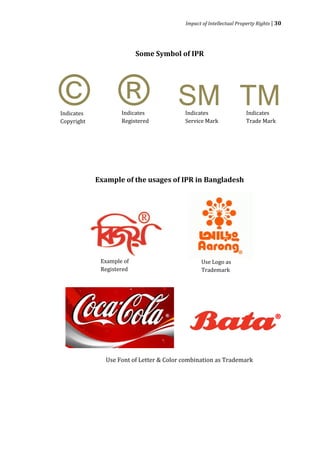
A trademark may be designated by the following symbols:
    TM (the "trademark   symbol", which is the letters "TM", for an unregistered
    trademark, a mark used to promote or brand goods)



    SM(which   is the letters "SM" in superscript, for an unregistered service
    mark, a mark used to promote or brand services)



   ® (the letter "R" surrounded by a circle, for a registered trademark).

A trademark is typically a name, word, phrase, logo, symbol, design, image, or
a combination of these elements. There is also a range of non-conventional
trademarks comprising marks which do not fall into these standard
categories, such as those based on color, smell, or sound (like jingles).

The term trademark is also used informally to refer to any distinguishing
attribute by which an individual is readily identified, such as the well-known
characteristics of celebrities. When a trademark is used in relation to services
rather than products, it may sometimes be called a service mark.


Trade Dress: Trade dress is a legal term of art that generally refers to
characteristics of the visual appearance of a product or its packaging (or even
the design of a building) that signify the source of the product to consumers.

Trade dress may be registered with the United States Patent and Trademark
Office (PTO) in either the Principal Register or the Supplemental Register.[15]
Although registration is not required for legal protection, registration offers
several advantages. In the Principal Register, a registrant gains nationwide
constructive use and constructive notice, which prevent others from using or
Impact of Intellectual Property Rights | 12


    registering    that   registrant’s   trade   dress    (without     contesting      the
    registration).[16] Further, a registrant in the Principal Register gains
    incontestable status after five years, which eliminates many of the ways for
    another party to challenge the registration. [17] Registration under the
    Supplemental Register allows the registrant to protect its trade dress in
    foreign countries, although the protections are much more limited than
    protections under the Principal Register in the U.S. [18]


    Trade Secrets: A trade secret is a formula, practice, process, design,
    instrument, pattern, or compilation of information which is not generally
    known or reasonably ascertainable, by which a business can obtain an
    economic advantage over competitors or customers. In some jurisdictions,
    such secrets are referred to as "confidential information", but should not be
    referred to as "classified information", due to the nature of the word
    "classified" in the USA. [19]

Above are the common types of Intellectual Property Rights. Patents, copyright,
industrial design rights and trademarks are now using in Bangladesh. All of the
four rights are registered by DPDT (Department of Patents, Designs and
Trademarks.) in Bangladesh.


                    Impacts of Intellectual Property Rights

For why IP rights or laws are established? The stated answer will be that the most
intellectual property laws are established for promoting progress in innovation
and competition. That accelerates the industrial wheel and economy. The
impacts of intellectual property rights are as follows.

    Motivating the individuals for new creations: Intellectual property rights
    encourage individuals for new inventions. IPR ensures that the exclusive



    inventions of an individual will not be copied without permission.
Impact of Intellectual Property Rights | 13


    Providing due recognition to the creators and inventors: IPR provides
    the total control over a new innovation to its creator and permits to use



    inventor’s name on the invention.
    Ensuring material reward for intellectual property: IPR has rewarded the
    intellectual property of an individual. IPR provides the facility to the inventor



    to do monopoly business of his exclusive innovation or creation.
    Ensuring the availability of the genuine and original products: IP rights
    are facilitating the user or consumers to get / buy the genuine and original



    products.
    Maintaining differentiation: Trademark, logo, simple etc. common elements
    of IPR are ensuring to differentiate an individual’s or organization’s products



    from the competitors’ products. Customers can easily identify the preferred
    source’s products.
    Financial incentive: The exclusive rights allow owners of intellectual
    property to enjoy benefits from the property they have created and providing



    a financial incentive for the creation of an investment in intellectual property.
    Economic growth: The WIPO treaty and several related international
    agreements are premised on the notion that the protections of intellectual



    property rights are essential to maintaining economic growth.[20] IPR
    influences the individuals to new invention that ensure the society to get new
    products, services, ideas, theories which will increase the economic growth.
    To stop copying: IP rights restrict copying other’s design, idea, product and
    conducts business by copying other’s intellectual property. That diverse one



    to new creations.


Though IPR has many advantages, it has criticized from some angle. IPRs ensure
Criticisms of IPR:


a person to conduct monopoly business which may be a cause of high price of a
particular product or service or any other intellectual things. That may affect the
economy of a country. IPR makes the inventions personalized and that serves to
a certain region for that most of the people deprived from its benefits.
Impact of Intellectual Property Rights | 14


It is impossible to the people of list developed countries such as Bangladesh to
buy or import original books and software from foreign countries with
unbearable price. So, if prohibited to piracy of foreign books and software, the
higher education will become dream to the students of LDCs, and the
technological and medical development will be deadlock.


    For protecting intellectual properties four ways of intellectual property
2.3: Direction of Existing way and Present perspectives:


    rights are applying in Bangladesh. Those are Patents, Trademark, Copyright,
    and Industrial Design Rights which have discussed in chapter 2.2.


        The Patents and Designs Act -1911;
    Following IP related laws are prevailing in Bangladesh:


        The Trademarks Act – 2009;
    


        The Copyrights Act – 2000 (Amended in 2005).
    

    


In the perspectives of Bangladesh how the IP rights are defined and applied
under the above Acts are given below.

    A patent is an exclusive right granted for an invention, which is a product or
    a process that provides, in general, a new way of doing something, or offers a



    new technical solution to a problem. Under the Patents and Designs Act -
    1911 patents are granted. Patents provide 16 years protection from the date of


    An industrial design is the ornamental or artistic aspect of an article. The
    filing of the application.


    design may consist of three-dimensional features, such as the shape or



    surface of an article, or of two-dimensional features, such as patterns, lines or
    color. Industrial designs are protected under The Patents and Designs Act -
    1911. Registration of assign is given for 5 years. It could be renewed twice; each


    A trademark is a distinctive sign which identifies certain goods or services as
    renewal remains valid for 5 years.


    those produced or provided by a specific person or enterprise. The



    trademarks system helps consumers identify and purchase a product or
Impact of Intellectual Property Rights | 15


    service because its nature and quality, indicated by its unique trademark,
    meets their needs. A registered trademark provides protection to the owner
    of the mark by ensuring the exclusive right to use it to identify goods or
    services, or to authorize another to use it in return for payment. In
    Bangladesh trademarks and service marks are registered under The
    Trademarks Act- 2009. Registration provides 7 years protection; it can be


    Copyrights are protected for original intellectual work of literature, art,
    renewed every after 10 year on payment of renewal fees.


    music, software, etc. under the Copyrights Act – 2000 (Amended in 2005).



    Copyright exist up to 60 years after the death of copyright owner.

These laws are not applying strongly in Bangladesh for that piracy any copying
are not be prevented. So, the existing laws in Bangladesh for protecting
intellectual property should be made more enforceable and applicable. The
systems and conditions for applying IP rights should be easy and flexible.
Impact of Intellectual Property Rights | 16


                                   Chapter- 3
                        Methodology of the Study
A methodology is usually a guideline system for solving a problem, with specific
components such as phases, tasks, methods, techniques and tools. It can be
defined also as follows:
   1. "the analysis of the principles of methods, rules, and postulates employed
       by a discipline";[21]

   2. "the systematic study of methods that are, can be, or have been applied
       within a discipline";[21]

   3. "the study or description of methods".[21]


   My research’s background area is Bangladesh which is a least developed
3.1: Background of Study Area:


   country. Here I try to focus the Intellectual Property Rights of Bangladesh
   comparing with the international intellectual property rights.


   My initial survey was conducted over internet, library, some CD shops and
3.2: Reconnaissance Survey:


   university going students.


   Research design is a logical and systematic planning in directing a research.
3.3: Research Design:


   There are three types of research design. These are...
       i) Exploratory research design
      ii) Descriptive research design
      iii) Experimental research design

I follow the descriptive research design in my research work. Descriptive
research design is a scientific method which involves observing and describing
Impact of Intellectual Property Rights | 17


the behavior of a subject without influencing it in any way. As my research topic
is observable and describable, I follow this research design.


   The topic chosen for assignment is “Impact of Intellectual Property Rights”.
3.4: Site Selection:


   As most of the data are collected from secondary sources, field observation
3.5: Questionnaire Preparation:


   and internet, I prepare a very simple and short open-ended questionnaire. I
   prepare the questionnaire for inventors and users.


   Data are generally two types. These are Primary data and Secondary data.
3.6: Data Collection Method:


        3.6.1: Primary Data: Primary data means original data that has been
           collected specially for the purpose in mind. It means someone
           collected the data from the original source first hand. Data collected
           this way is called primary data.
           Primary data has not been published yet and is more reliable,
           authentic and objective. Its validity is greater than secondary data.
           The people who gather primary data may be an authorized
           organization, investigator, enumerator or they may be just someone
           with a clipboard. These people are acting as a witness so primary
           dada is only considered as reliable as the people who gathered it.


       3.6.2: Secondary Data: Secondary data is the data that has been already
           collected by and ready available from other sources. When we use
           statistical method with primary data from another purpose for our
           purpose we refer to it as secondary data. It means that one purpose’s
           primary data is another purpose’s secondary data. So that secondary
Impact of Intellectual Property Rights | 18


            data is data that is being reused. Such data are cheaper and more
            quickly obtainable than primary data.

 In my research work both primary and secondary data are used. But here I give
 preference on secondary data. Most of the data are collected from secondary
 sources.


   For collecting data by face to face contact, I have selected university going
3.7: Key Information Interview:


   students, library keepers, computer stores and CD stores. And for collecting
   data via email contact, I contact with some website authorities who are
   providing the free software and music, some fashion design house and
   garments.


3.8: Data Analysis and Preparing Model:

The data I have collected from various sources are both on the behalf of IPR and
against IPR. In this case most of them are on the behalf of IPR. Most of the people
express their opinion about intellectual property rights positively. Authors,
designers, business and industrial entrepreneurs, and other inventors mention
that the IPR encourages them to new innovation and provides security to their
exclusive creation that helps them to do long time monopoly business and earn
high / maximum profit for a certain period of time.

Small classes of people express their opinion against IPR in few cases. They are
university students, some website owners, software users and some consumers.
University students are said that it is not necessary to obey the rules of IPR in the
case of books written by foreign authors for LDCs. Both university students and
software users said that the foreign books and software cost high price which is
unbearable for the people of LDCs like Bangladesh. The mentioned, in these cases
piracy should be permitted. Consumers provide the information that an exclusive
product or exclusive designed product of single owner needs high cost because
Impact of Intellectual Property Rights | 19


they can do monopoly business, if his product or design is copied by others then
the cost will be fewer.

After the above discussion, we can say that the intellectual properties of national
people of a country should be strongly protected by enforcing laws of IPR.


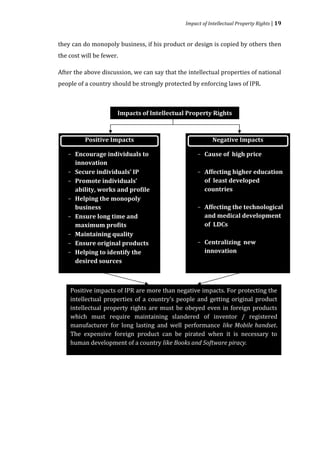
                      Impacts of Intellectual Property Rights


          Positive Impacts                                 Negative Impacts

    Encourage individuals to                        Cause of high price
     innovation
    Secure individuals’ IP                          Affecting higher education
    Promote individuals’                             of least developed
     ability, works and profile                       countries
    Helping the monopoly
     business                                        Affecting the technological
    Ensure long time and                             and medical development
     maximum profits                                  of LDCs
    Maintaining quality
    Ensure original products                        Centralizing new
    Helping to identify the                          innovation
     desired sources


    Positive impacts of IPR are more than negative impacts. For protecting the
    intellectual properties of a country’s people and getting original product
    intellectual property rights are must be obeyed even in foreign products
    which must require maintaining slandered of inventor / registered
    manufacturer for long lasting and well performance like Mobile handset.
    The expensive foreign product can be pirated when it is necessary to
    human development of a country like Books and Software piracy.
Impact of Intellectual Property Rights | 20


                                  Chapter- 4
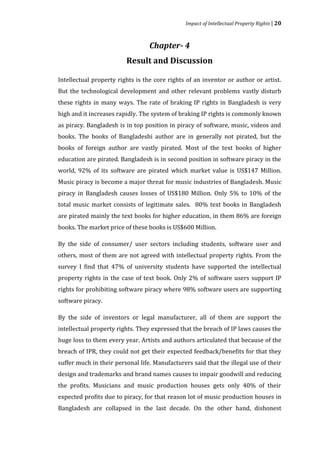
                         Result and Discussion

Intellectual property rights is the core rights of an inventor or author or artist.
But the technological development and other relevant problems vastly disturb
these rights in many ways. The rate of braking IP rights in Bangladesh is very
high and it increases rapidly. The system of braking IP rights is commonly known
as piracy. Bangladesh is in top position in piracy of software, music, videos and
books. The books of Bangladeshi author are in generally not pirated, but the
books of foreign author are vastly pirated. Most of the text books of higher
education are pirated. Bangladesh is in second position in software piracy in the
world, 92% of its software are pirated which market value is US$147 Million.
Music piracy is become a major threat for music industries of Bangladesh. Music
piracy in Bangladesh causes losses of US$180 Million. Only 5% to 10% of the
total music market consists of legitimate sales. 80% text books in Bangladesh
are pirated mainly the text books for higher education, in them 86% are foreign
books. The market price of these books is US$600 Million.

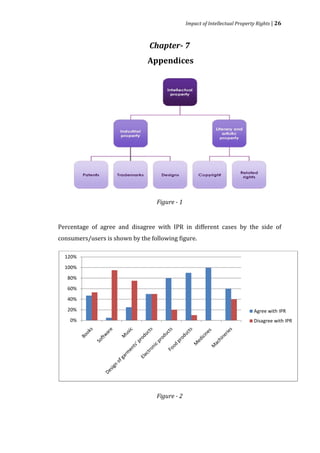
By the side of consumer/ user sectors including students, software user and
others, most of them are not agreed with intellectual property rights. From the
survey I find that 47% of university students have supported the intellectual
property rights in the case of text book. Only 2% of software users support IP
rights for prohibiting software piracy where 98% software users are supporting
software piracy.

By the side of inventors or legal manufacturer, all of them are support the
intellectual property rights. They expressed that the breach of IP laws causes the
huge loss to them every year. Artists and authors articulated that because of the
breach of IPR, they could not get their expected feedback/benefits for that they
suffer much in their personal life. Manufacturers said that the illegal use of their
design and trademarks and brand names causes to impair goodwill and reducing
the profits. Musicians and music production houses gets only 40% of their
expected profits due to piracy, for that reason lot of music production houses in
Bangladesh are collapsed in the last decade. On the other hand, dishonest
Impact of Intellectual Property Rights | 21


persons are illegally using the design, name, trademarks and symbols of many
well-known companies which affect the companies’ feedback, customer
satisfaction and deprived from their actual obtaining as well as it deprives
customers from real products.

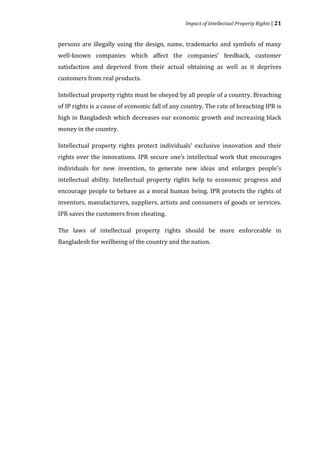
Intellectual property rights must be obeyed by all people of a country. Breaching
of IP rights is a cause of economic fall of any country. The rate of breaching IPR is
high in Bangladesh which decreases our economic growth and increasing black
money in the country.

Intellectual property rights protect individuals’ exclusive innovation and their
rights over the innovations. IPR secure one’s intellectual work that encourages
individuals for new invention, to generate new ideas and enlarges people’s
intellectual ability. Intellectual property rights help to economic progress and
encourage people to behave as a moral human being. IPR protects the rights of
inventors, manufacturers, suppliers, artists and consumers of goods or services.
IPR saves the customers from cheating.

The laws of intellectual property rights should be more enforceable in
Bangladesh for wellbeing of the country and the nation.
Impact of Intellectual Property Rights | 22


                                   Chapter- 5
                 Recommendations and Conclusion

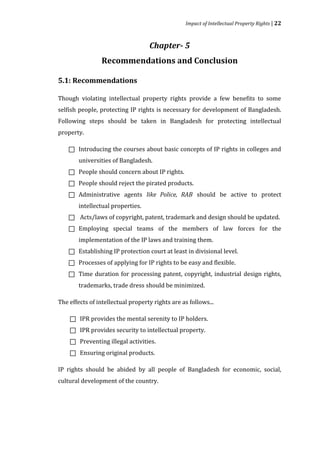
5.1: Recommendations

Though violating intellectual property rights provide a few benefits to some
selfish people, protecting IP rights is necessary for development of Bangladesh.
Following steps should be taken in Bangladesh for protecting intellectual
property.

        Introducing the courses about basic concepts of IP rights in colleges and
        universities of Bangladesh.
    


        People should concern about IP rights.
        People should reject the pirated products.
    


        Administrative agents like Police, RAB should be active to protect
    


        intellectual properties.
    


        Acts/laws of copyright, patent, trademark and design should be updated.
        Employing special teams of the members of law forces for the
    


        implementation of the IP laws and training them.
    


        Establishing IP protection court at least in divisional level.
        Processes of applying for IP rights to be easy and flexible.
    


        Time duration for processing patent, copyright, industrial design rights,
    


        trademarks, trade dress should be minimized.
    


The effects of intellectual property rights are as follows...

        IPR provides the mental serenity to IP holders.
        IPR provides security to intellectual property.
    


        Preventing illegal activities.
    


        Ensuring original products.
    

    


IP rights should be abided by all people of Bangladesh for economic, social,
cultural development of the country.
Impact of Intellectual Property Rights | 23


5.2: Conclusion

The intellectual property is implicated with individuals’ interest as well as a
country’s economical, cultural and historical interests. In Bangladesh, the laws of
intellectual property rights are not applying and abide by properly. So, the piracy
rate is high in Bangladesh.

The government of Bangladesh is committed to the protection and for that
matter to the enforcement of the rights of IP holders. With this end, it has
undertaken several measures to strengthen the IP system in Bangladesh. On the
one hand, it has taken measures to strengthen the IP Office; on the other it has
almost finalized updating the existing IP legislating. Work on framing IP laws on
utility model and geographical indications have been undertaken.

In any initiative to protect and enforce the rights of IP holders, the importance of
public awareness and training of the officials of the concerned department can
hardly be exaggerated.

The preference of IP rights varies in difference cases but, the benefits of IP rights
are much and the protection for intellectual property is a fundamental right of a
person. So, we should obey the intellectual property rights and make them more
enforceable. Bangladesh government should take proper steps for enforcing IP
laws at any situation.
Impact of Intellectual Property Rights | 24


                               Chapter- 6
                               References
Reference:
   1. Intellectual Property Licensing: Forms and Analysis, by Richard
      Raysman, Edward A. Pisacreta and Kenneth A. Adler. Law Journal Press,
      1998–2008. ISBN 973-58852-086-9[verification needed]

   2. "property as a common descriptor of the field probably traces to the
      foundation of the World Intellectual Property Organization (WIPO) by
      the United Nations." in Mark A. Lemley, Property, Intellectual Property,
      and Free Riding, Texas Law Review, 2005, Vol. 83:1031, page 1033,
      footnote 4.
   3. Brad, Sherman; Lionel Bently (1999). The making of modern intellectual
      property law: the British experience, 1760–1911. Cambridge University
      Press. pp. 207. ISBN 9780521563635.
   4. Article 4 No. 6 of the Constitution of 1867 (German)' Hastings Law
      Journal, Vol. 52, p. 1255, 2001
   5. Mark     A.   Lemley, "Property,    Intellectual       Property,      and     Free
      Riding"(Abstract); see Table 1: 4–5.
   6. Mossoff, A. 'Rethinking the Development of Patents: An Intellectual
      History, 1550–1800,' Hastings Law Journal, Vol. 52, p. 1255, 2001
   7. (French) Benjamin de Constant de Rebecque, Collection complète des
      ouvrages publiés sur le gouvernement représentatif et la constitution


      constitutionnelle, P. Plancher, 1818, p. 296.
      actuelle de la France: formant une espèce de cours de politique


   8. 1 Woodb. & M. 53, 3 West.L.J. 151, 7 F.Cas. 197, No. 3662, 2 Robb.Pat.Cas.


   9. A Brief History of the Patent Law of the United States
      303, Merw.Pat.Inv. 414


   10. "Property,   Intellectual   Property,    and     Free     Riding",    Mark      A.
      Lemley, Texas Law Review 2007
   11. Jewish Law and Copyright
Impact of Intellectual Property Rights | 25


12. Charles Anthon, A Classical Dictionary: Containing an Account of the
   Principal Proper Names Mentioned in Ancient Authors, and Intended to
   Elucidate All the Important Points Connected with the Geography,
   History, Biography, Mythology, and Fine Arts of the Greek and Romans.
   Together with an Account of Coins, Weights, and Measures, with
   Tabular Values of the Same 1273 (Harper & Brothers 1841).
13. Art. 2(viii), The Convention Establishing the World Intellectual Property
   Organization (WIPO), 1967
14. INTELLECTUAL PROPERTIES: BANGLADESH APPROACH by Md. Milan
   Hossain. Senior Lecturer, Department of Law, Northern University
   Bangladesh (NUB, Holding No-13, Road No-17, Banani C/A, Dhaka-1213,
   Bangladesh.
15. PTO website, http://www.uspto.gov/
16. Lanham Act - 7(c), 15 U.S.C. - 1057(c)
17. Lanham Act - 15, 15 U.S.C. - 1057(c)
18. Menell at 696
19. http://en.wikipedia.org/wiki/Trade_secret
20. http://en.wikipedia.org/wiki/Intellectual_property
21. Methodologist (Business model- and startup methodology)
22. http://www.dpdt.gov.bd/
23. http://www.nationmaster.com/graph/cri_sof_pir_rat-crime-software-
   piracy-rate
24. http://www.weeklyblitz.net/2058/pirated-cd-dvd-selling-openly-in-
   bangladesh
Impact of Intellectual Property Rights | 26


                                Chapter- 7
                               Appendices


                                  Figure - 1


Percentage of agree and disagree with IPR in different cases by the side of
consumers/users is shown by the following figure.

  120%
  100%
   80%
   60%
   40%
   20%                                                                       Agree with IPR
    0%                                                                       Disagree with IPR


                                  Figure - 2
Impact of Intellectual Property Rights | 27


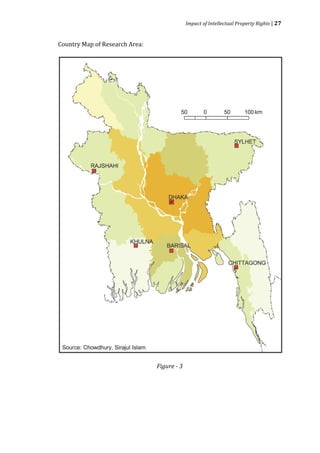
Country Map of Research Area:


                                Figure - 3
Impact of Intellectual Property Rights | 28

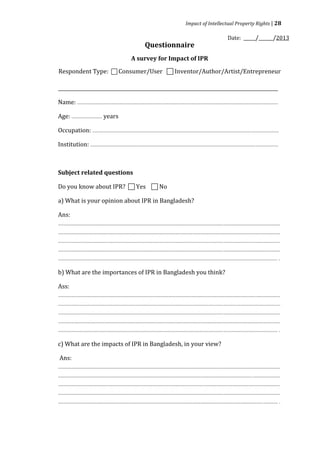
                                                                                                                                Date: _____/______/2013
                                                                 Questionnaire


Respondent Type:  Consumer/User  Inventor/Author/Artist/Entrepreneur
                                                       A survey for Impact of IPR


____________________________________________________________________________________________

Name: ........................................................................................................................................................

Age: ....................... years

Occupation: .............................................................................................................................................

Institution: ..............................................................................................................................................


Subject related questions

Do you know about IPR?  Yes  No

a) What is your opinion about IPR in Bangladesh?

Ans:
........................................................................................................................................................................
........................................................................................................................................................................
........................................................................................................................................................................
........................................................................................................................................................................
...................................................................................................................................................................... .

b) What are the importances of IPR in Bangladesh you think?

Ass:
........................................................................................................................................................................
........................................................................................................................................................................
........................................................................................................................................................................
........................................................................................................................................................................
...................................................................................................................................................................... .

c) What are the impacts of IPR in Bangladesh, in your view?

 Ans:
........................................................................................................................................................................
........................................................................................................................................................................
........................................................................................................................................................................
........................................................................................................................................................................
...................................................................................................................................................................... .
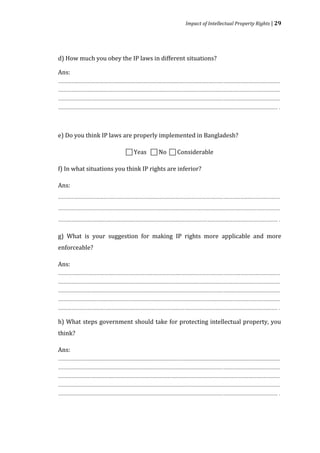
Impact of Intellectual Property Rights | 29


d) How much you obey the IP laws in different situations?

Ans:
........................................................................................................................................................................
........................................................................................................................................................................
........................................................................................................................................................................
...................................................................................................................................................................... .


e) Do you think IP laws are properly implemented in Bangladesh?

                                                    Yeas  No  Considerable

f) In what situations you think IP rights are inferior?

Ans:
........................................................................................................................................................................
........................................................................................................................................................................
...................................................................................................................................................................... .

g) What is your suggestion for making IP rights more applicable and more
enforceable?

Ans:
........................................................................................................................................................................
........................................................................................................................................................................
........................................................................................................................................................................
........................................................................................................................................................................
...................................................................................................................................................................... .

h) What steps government should take for protecting intellectual property, you
think?

Ans:
........................................................................................................................................................................
........................................................................................................................................................................
........................................................................................................................................................................
........................................................................................................................................................................
...................................................................................................................................................................... .
Impact of Intellectual Property Rights | 30


                          Some Symbol of IPR


© ®
Indicates
Copyright
                    Indicates
                    Registered
                                        SM TM
                                          Indicates
                                          Service Mark
                                                                     Indicates
                                                                     Trade Mark


            Example of the usages of IPR in Bangladesh


             Example of                          Use Logo as
             Registered                          Trademark


                                                                                  ®


               Use Font of Letter & Color combination as Trademark
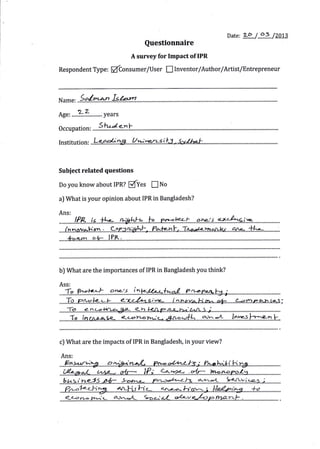
Daj.€.   zp / 6s            /ZOI3
                                              Questionnaire
                                       A survey for Impact'of IPR

Respondent Typ",            ffConsu."t/User               !    Inventor/Author/Artist/Entrepreneur


           So/r,r-^n        Isb.n
Age, ....-?.3.........; years

0ccupation:          StuJe-nF

Institution:


Subiect related questions

Do you    know abciut IPR?           PfYes        I    No

al iVhat is your opinion about IPR in Bangladesh?

Ans:


....Ih.nov..a.Hp.:r .,.....92r..a*&h.L,..?..+!**.1'..1f.w,n**m.4.r=y';.....1tY=...1**'---..........:.
    *^o'n         oi.- l?k,


b) iVhat are the importances of IPR in Bangladesh you think?


                           br12!t       i
                                  ^
.....T.p...p...p-k*.k.......*-.--4ki^i.i.r..e=......i..**p.vz.Hmr'...*.!:.......4*{rr-.%r-,.ie-.}.;
.....i!-o-......?-1..-*e-!**.q#...*?t-F.-e/J'E.*+^tt*t".t4rrs..;................................:....................
........-1.e....i.nra*a-cs-..-*.t*3::f lro:.+,..4n*''i.*1,......3f:.'.=*......*Ll=t-h:::*n.f-


cJ iVhat are     the impacts of IPR in Bangladesh, in your view?

 Ans:

                                                   : La-qaz-
  bt.<in-e-55 o,/r* S-oar-,', Pn-ofu)3                                      az..-1, t-<ruvi. ^ s j
d) How much you obey the IP laws in different situations?

Ans:


e] Do you think IP laws are properly implemented in Bangladesh?

                        lYeas ENo ffonsiderable

0 In what situations you think   IP rights are   inferior?

Ans:


g) What is your suggestion for making IP rights more applicable and more
enforceable?

Ans:


  ba-    c-oh3L:d?g1
   1p ,,--ra<-)e.-el /-a-ws        .


hJ What steps government should take for protecting intellectual property, you

think?

Ans:
   q:?4t4Tu-t4:        9b.--*4-'.,.*n*rl}-.-'......f.5-*".....1.P.n*l*lf.*X..........
PROFILE OF AUTHOR


Name: Moez Al Azim Ansary

Date of Birth: November 13, 1991

Father’s Name: Abdul Hannan Ansary

Mother’s Name: Napsun Nahar Chowdhury


Present and Permanent Address: 68 Payra, Jharnarpar, Dargamahallah, Sylhet,
......                             .Bangladesh.

Occupation: Student

ID No: 1101010183

Section: D

Semester: 7th

Batch No: BBA-27th

Department: Business Administration

Name of Institution: Leading University, Sylhet, Bangladesh

Contact No: +88-01686377284

Email: moez.ansary@yahoo.com


                                   Thank you

Impact of IPR

  • 1.
  • 2.
    Assignment on Impact of Intellectual Property Rights Course Code: MGT – 315 Course Title: Fundamentals of MIS Prepared For: Mr. Md. Rahimullah Miah Lecturer in MIS Prepared by: Moez Al Azim Ansary ID. No.: 1101010183 Section: D Semester: 7th Batch: BBA - 27th Department of Business Administration Leading University, Sylhet, Bangladesh Date of Submission: March 30, 2013
  • 3.
    March 30, 2013 Lecturerin MIS Mr. Md. Rahimullah Miah Department of Business Administration Leading University, Sylhet Subject: Submission of Assignment Paper on “Impact of Intellectual Property Rights”. Dear Sir, It is an enormous pleasure to submit my Assignment Paper on “Impact of Intellectual Property Rights”, which is assigned as a requirement of our course related. In preparing this assignment paper I have acquired good experience and knowledge about intellectual property rights and its impacts. I have tried to my best to furnish the assignment with relevant data, which I had collected from online, fieldwork and other related sources. I think my assignment paper will clearly express the concept of intellectual property rights and its impacts and relevant problems. And I hope this assignment paper will helps to make the IP laws more enforceable and to take proper steps to protect intellectual property. I would like to convey my tributes to you and thank you for giving me the opportunity to preparing the Assignment Paper. Your queries in this aspect will highly be expected. Thanking you. Sincerely yours, __________________________ Moez Al Azim Ansary Section: D ID: 1101010183 7th Semester BBA -27th Batch Department of Business Administration Leading University, Sylhet, Bangladesh
  • 4.
    iv Dedication To All of My Friends and Honorable Teachers
  • 5.
    v Declaration This research paper has been prepared by myself which the title “Impact of Intellectual Property Rights” under the supervision of Mr. Md. Rahimullah Miah, Lecturer in MIS, Leading University, Sylhet, Bangladesh. The duplication of this paper is prohibited without the permission of Author. __________________________ Moez Al Azim Ansary Section: D ID: 1101010183 7th Semester BBA -27th Batch Department of Business Administration Leading University, Sylhet, Bangladesh
  • 6.
    vi Acknowledgement I am grateful to Allah for giving me the ability to complete the research paper. Now I acknowledge the persons who support and help me to complete the research. These persons are my honorable teachers, parents, friends and the persons who response to the question of my assessment. At first I thank to my department head Dr. Bashir Ahmed Bhuiyan for offering me the course. Then I thank to my honorable course teacher and my instructor Mr. Md. Rahimullah Miah, lecturer of Leading University for giving me the opportunity to research on such topic and directing me during the research work. Now I thank to all friends of my class, family members and the persons who co-operated with me and provided me the information through various sources. Author Moez Al Azim Ansary Student of Business Administration Leading University, Sylhet, Bangladesh
  • 7.
    vii Table of Content Chapter Title Page No. Abstract viii 1.1 Origin of the Report 1 Chapter - 1 Introduction 1-6 1.2 History of IPR 1 1.3 Relevant Problems Identified 3 1.4 Objectives 4 1.5 Limitations 5 2.1 Previous Research work 7 Chapter - 2 General Context of the Study 7-15 2.2 Literature Review 9 2.3 Direction of Existing way and Present perspectives 14 3.1 Background of Study Area 16 Chapter - 3 Methodology of the Study 16-19 3.2 Reconnaissance Survey 16 3.3 Research Design 16 3.4 Site Selection 17 3.5 Questionnaire Preparation 17 3.6 Data Collection Method 17 3.7 Key Information Interview 18 3.8 Data Analysis and Preparing Model 18 Chapter - 4 Result and Discussion 20-21 Chapter - 5 Recommendations and Conclusion 22-23 Chapter - 6 References 24-25 Chapter - 7 Appendices 26-32 Profile of Author 33
  • 8.
    viii Abstract Intellectual property refers the creation of mind which depends on one’s intellectual ability. Intellectual Property Right is a right that is had by a person or by a company to have exclusive rights to use its own plans, ideas, or other intangible assets without the worry of competition, at least for a specific period of time. Patent, Copyright, Industrial Design Rights and Trademark are being used in Bangladesh as intellectual property rights. IPR provides security to one’s intellectual property and protects one’s exclusive innovation from illegal usages. It encourages people to new innovations and ensures the consumers to get original products. IPR helps to economic and social developments. But, many people in Bangladesh are disobeying the IP rights because of immorality and unconsciousness about the effect of intellectual property rights. So, we should make conscious the people of Bangladesh about the IP rights. The government should take proper steps to protect intellectual properties and should make the IP laws more enforceable, and should make easy the processes of applying for IP rights.
  • 9.
    Impact of IntellectualProperty Rights Chapter- 1 Introduction Intellectual property (IP) is a legal concept which refers to creations of the mind for which exclusive rights are recognized.[1] Under intellectual property law, owners are granted certain exclusive rights to a variety of intangible assets, such as musical, literary, and artistic works; discoveries and inventions; and words, phrases, symbols, and designs. Common types of intellectual property rights include copyright, trademarks, patents, industrial design rights, trade dress, and in some jurisdictions trade secrets. In the era of globalization and digitalization the Intellectual Property Rights 1.1: Origin of the Report: becomes a burning question. Electronic media like internet make easy to copy one’s intellectual property by another. The imitation of intellectual property makes concern the author of the new innovation. For protecting the rights of intellectual property copyright, trademarks, patents, industrial design rights, trade dress, and in some jurisdictions trade secrets are established. My report is prepared for analysis how the intellectual properties are exposed and copying, how the laws for protecting intellectual property are implemented and can be made more effective, and the impacts of intellectual property rights. This report on “Impact of Intellectual Property Rights” has been prepared as a partial requirement for the completion of the course titled “Fundamentals of MIS” for the BBA program of the Leading University, Sylhet. The preparation of this report was supervised by Mr. Md. Rahimullah Miah, Lecturer in MIS, Leading University, Sylhet, Bangladesh. Although many of the legal principles governing intellectual property rights 1.2: History of IPR: have evolved over centuries, it was not until the 19th century that the term
  • 10.
    Impact of IntellectualProperty Rights | 2 intellectual property began to be used, and not until the late 20th century that it became commonplace in the majority of the world.[2] The British Statute of Anne 1710 and the Statute of Monopolies 1623 are now seen as the origins of copyright and patent law respectively.[3] Modern usage of the term intellectual property goes back at least as far as 1867 with the founding of the North German Confederation whose constitution granted legislative power over the protection of intellectual property (Schutz des geistigen Eigentums) to the confederation. [4] When the administrative secretariats established by the Paris Convention (1883) and the Berne Convention (1886) merged in 1893, they located in Berne, and also adopted the term intellectual property in their new combined title, the United International Bureaux for the Protection of Intellectual Property. The organization subsequently relocated to Geneva in 1960, and was succeeded in 1967 with the establishment of the World Intellectual Property Organization (WIPO) by treaty as an agency of the United Nations. According to Lemley, it was only at this point that the term really began to be used in the United States (which had not been a party to the Berne Convention), [2] and it did not enter popular usage until passage of the Bayh-Dole Act in 1980.[5] "The history of patents does not begin with inventions, but rather with royal grants by Queen Elizabeth I (1558–1603) for monopoly privileges. Approximately 200 years after the end of Elizabeth's reign, however, a patent represents a legal [right] obtained by an inventor providing for exclusive control over the production and sale of his mechanical or scientific invention...[demonstrating] the evolution of patents from royal prerogative to common law doctrine.”[6] In an 1818 collection of his writings, the French liberal theorist, Benjamin Constant, argued against the recently introduced idea of "property which has been called intellectual."[7] The term intellectual property can be found used in an October 1845 Massachusetts Circuit Court ruling in the patent case Davoll et al. v. Brown., in which Justice Charles L. Woodbury wrote that "only in this way can we protect intellectual property, the labors of the mind, productions and interests are as much a man's own as the wheat he
  • 11.
    Impact of IntellectualProperty Rights | 3 cultivates, or the flocks he rears."[8] The statement that "discoveries are property" goes back earlier. Section 1 of the French law of 1791 stated, "All new discoveries are the property of the author; to assure the inventor the property and temporary enjoyment of his discovery, there shall be delivered to him a patent for five, ten or fifteen years." [9] In Europe, French author A. Nion mentioned propriete intellectuelle in his Droits civils des auteurs, artistes et inventeurs, published in 1846. Until recently, the purpose of intellectual property law was to give as little protection possible in order to encourage innovation. Historically, therefore, they were granted only when they were necessary to encourage invention, limited in time and scope.[10] The concept's origins can potentially be traced back further. Jewish law includes several considerations whose effects are similar to those of modern intellectual property laws, though the notion of intellectual creations as property does not seem to exist – notably the principle of Hasagat Ge'vul (unfair encroachment) was used to justify limited-term publisher (but not author) copyright in the 16th century.[11] In 500 BCE, the government of the Greek state of Sybaris offered one year's patent "to all who should discover any new refinement in luxury." [12] It is assumed that there is a positive correlation between both the IPR system 1.3: Relevant Problems Identified: and innovation, and between innovation and economic growth. In addition, it is assumed that the IPR system has a positive effect on, or at least doesn‘t inhibit economic growth, and so overall has a positive influence on the societal economic growth. However, the transition from industrial to knowledge society has led to a series of significant changes in innovation patterns and market conditions which in turn has led to new criteria within the IPR system. There is a risk that the ongoing adjustments of the IPR system could fall behind the rapid development of technology, making the system become characterized by inertia.
  • 12.
    Impact of IntellectualProperty Rights | 4 I find out two types of problems related to intellectual property rights - one is the threat to protecting IPR and another is problems created by IPR. Now I discuss both of them below. 1.3.1: The major problems/threats to Intellectual Property Rights are discussed below. Piracy: (a) Piracy is the act of illegally copying someone's product or invention without permission. (b)Piracy refers the unauthorized use of  another's production, invention, or conception especially in infringement of a copyright. Piracy is the major threat for protecting intellectual property. Books, music, software, videos are vastly pirated in Bangladesh. Internet Challenges: Some software, monitoring tools, cookies, web bugs are used to monitoring and scanning one’s personal computer and  capture, snatching information from the computer by using internet. That enhances piracy or copying one’s intellectual property. Immorality: Immoral persons publish other’s innovation or work as their own innovation or work. This problem is mainly occurs in literature and  scientific innovations like as new theory or formula. Tendency to Make Profits: Some dishonest business men copying or pirate the products without permission of author or inventor for making  profits. This tendency deprives the original organizations or inventors from the actual profits which they could earn. Cost for IPR: In most jurisdictions the IPR holder must bear the cost for enforcing rights. This will usually involve engaging legal representation,  administrative and / or court costs. These costs including time should be taken into consideration when evaluating the benefits of enforcing the rights. Besides these problems the Intellectual Property laws in Bangladesh are not rich and strong. The existing laws are not implemented properly. So the Intellectual Property Rights are broken many ways. Now, Copying is become a common business in Bangladesh.
  • 13.
    Impact of IntellectualProperty Rights | 5 1.3.2: The problems created by the intellectual property rights are discuss below. Monopoly Business: IPR helps the persons to do monopoly business. By providing all of the control over a product to a person, IPR  increases the price of the product. For this reasons many people become unable to purchase the product and deprived from the benefits of the products or services. For example, the high prized Hindering Development: Intellectual property rights hinder the software could not be use by the people of least developed countries. educational and technological development of low economic and  underdeveloped countries. The original software and books are very costly which are unbearable for poor people. 1.4.1: General Objective: The general objective is to prepare a report on 1.4: Objectives: “Intellectual Property Rights” and identifying the relevant problems, ways to solve the problems and impact of IPR. 1.4.2: Specific Objectives: Specific objectives are...... Analysis the present condition of IPR in Bangladesh comparing with other countries in the world.  Analysis of the effectiveness of implemented laws. Discuss the different types of IPRs.   Since this research is only for academic purpose, there were some limitations 1.5: Limitations: in this study. These are mentioned below: Discussion about the Intellectual Property Rights is a complicated subject.  Time was enough but it was not possible to give full concentration in this regard due to continuous pressure from other courses. 
  • 14.
    Impact of IntellectualProperty Rights | 6 Due to political condition of the country and strikes make the situations too hard to do survey or conduct field work. So, most of the  data are collected from secondary sources. The study is basically based on secondary data, because primary data collection method is costly and needs huge time. 
  • 15.
    Impact of IntellectualProperty Rights | 7 Chapter- 2 General Context of the Study The previous research works on Intellectual Property Rights are very few in 2.1: Previous Research work: the context of Bangladesh. One of these research works is provided by Md. Milan Hossain, a Senior Lecturer of Law Department in Northern University Bangladesh. His research has provided the following information about IPR. The cultural, industrial, and economical development of a country depends on the progress of intellectual properties. Intellectual property is the things that are created by the human thought; it is the result of intellectual activities. Simply it refers copyright, trademark, patent design, trade secrets and geographical indications etc. Very broadly, it means the legal rights which result from intellectual activity in the industrial, scientific, literary and artistic fields. The World Intellectual Property Organization (WIPO) Convention provides that “intellectual property shall include rights relating to: 1. Literary, artistic and scientific works, 2. Performances of performing artists, phonograms and broadcasts, 3. Inventions in all fields of human endeavor, 4. Scientific discoveries, 5. Industrial designs, 6. Trademarks, service marks and commercial names and designations, 7. Protection against unfair competition, and 8. All other rights resulting from intellectual activity in the industrial, scientific, literary or artistic fields.”[13] Mr. Md. Milan Hossain’s Findings and Recommendation through his research work are mention now. Intellectual properties laws in Bangladesh are not very rich. Some of them are not compatible with international treaties and conventions. Some of them are not maintainable with the digital based society. We have no laws on trade secrets, unfair competition, and geographical indication and lay out
  • 16.
    Impact of IntellectualProperty Rights | 8 design (topographies) of integrated circuits still today. Administrative capacity of DPDT (Department of Patents, Designs and Trademarks) and Copyright Office are very poor due to manual system, shortage of number of officers and staff, expert on intellectual property. Besides, here awareness among the people is very little. Copyright piracy is very frequent; here its rate is the highest amongst the world. Under the above circumstances, the following steps should be taken: 1. Introducing basic concept on IP laws to the undergraduates and post graduates courses in colleges and universities; 2. Creating awareness through seminar, symposiums and national workshops among the all classes’ educated people of the country; 3. Establishing IP Protection courts, at least, in the divisional level and training the judges and advocates and thus making the experts; 4. Developing mechanism to ensure speedy and cheap resolution of disputes and litigation by infringement; 5. Employing special teams of the members of law forces for the implementation of the IP laws and training them. 6. Introducing new laws on trade secrets, unfair competition, geographical indication and lay out design (topographies) of integrated circuits; 7. Updating or introducing a new Patents and Designs Act; as the 1911 Act is not compatible with international treaties and convention; 8. Updating Trademark Rules; because Trademark Rules 1963 are unable to meet the IP demand of 2012. Besides, under the 2009 Act, new provision of collective mark has been inserted but the procedure of registration of it has not been mentioned in the Act, 2009. The procedure of publication of trademark journal is not specified in the present law; it should be determined by the new rules. Different forms of trademark, service mark, certification mark or collective mark should be updated to maintain the consistency of the digital based society. So, the replacement of 1963 Rules with a new one is a must; and, 9. Recruiting necessary officers and staff for the DPDT and Copyright office and training them on IP laws at home and abroad.
  • 17.
    Impact of IntellectualProperty Rights | 9 Intellectual Property Right is a right that is had by a person or by a company 2.2: Literature Review: to have exclusive rights to use its own plans, ideas, or other intangible assets without the worry of competition, at least for a specific period of time. These rights can include copyrights, patents, trademarks, and trade secrets. These rights may be enforced by a court via a lawsuit. The reasoning for intellectual property is to encourage innovation without the fear that a competitor will steal the idea and / or take the credit for it. Here we discuss about the laws are using in Bangladesh for Intellectual Property Rights. The common types of intellectual property rights include patents, copyright, industrial design rights, trademarks, trade dress, and in some jurisdictions trade secrets are used. Patents: A patent grants an inventor exclusive rights to make, use, sell, and import an invention for a limited period of time, in exchange for the public disclosure of the invention. An invention is a solution to a specific technological problem, which may be a product or a process. The procedure for granting patents, requirements placed on the patentee, and the extent of the exclusive rights vary widely between countries according to national laws and international agreements. Typically, however, a patent application must include one or more claims that define the invention. These claims must meet relevant patentability requirements, such as novelty and non-obviousness. The exclusive right granted to a patentee in most countries is the right to prevent others from making, using, selling, or distributing the patented invention without permission. The right is given to the owner of exclusive innovation for 20 years. Copyright: Copyright is a legal concept, enacted by most governments, giving the creator of original work exclusive rights to it, usually for a limited time. Generally, it is "the right to copy", but also gives the copyright holder the right to be credited for the work, to determine who may adapt the work to other forms, which may perform the work, which may financially benefit from it, and other related rights. It is a form of intellectual property (like the
  • 18.
    Impact of IntellectualProperty Rights | 10 patent, the trademark, and the trade secret) applicable to any expressible form of an idea or information that is substantive and discrete. Copyright may apply to a wide range of creative, intellectual, or artistic forms, or works. Specifics vary by jurisdiction, but these can include poems, theses, plays, other literary works, movies, dances, musical compositions, audio recordings, paintings, drawings, sculptures, photographs, software, radio and television broadcasts, and industrial designs. Graphic designs and industrial designs may have separate or overlapping laws applied to them in some jurisdictions. Copyright does not cover ideas and information themselves, only the form or manner in which they are expressed. Industrial Design Rights: An industrial design right is an intellectual property right that protects the visual design of objects that are not purely utilitarian. An industrial design consists of the creation of a shape, configuration or composition of pattern or color, or combination of pattern and color in three dimensional forms containing aesthetic value. An industrial design can be a two or three dimensional pattern used to produce a product, industrial commodity or handicraft. Trademark: A trademark is a recognizable sign, design or expression which identifies products or services of a particular source from those of others. The trademark owner can be an individual, business organization, or any legal entity. A trademark may be located on a package, a label, a voucher or on the product itself. Trademarks are used to claim exclusive properties of products or services. A trademark may be located on a package, a label, a voucher or on the product itself. The usage of trademarks by its owner can cause legal issues if this usage makes him guilty of false advertising or if the trademark is offensive. Trademarks can be owned, but also licensed. Licenses can be bought from trademark owners and brokers. For example, Banoful & Co. Ltd. is licensing many suppliers as licensee to trade by using its name and logo.
  • 19.
    Impact of IntellectualProperty Rights | 11 The unauthorized usage of trademarks by producing and trading counterfeit consumer goods is known as brand piracy. The owner of a trademark may pursue legal action against trademark infringement. Most countries require formal registration of a trademark as a precondition for pursuing this type of action. In Bangladesh trademark is registered by DPDT (Department of Patents, Designs and Trademarks). A trademark may be designated by the following symbols: TM (the "trademark symbol", which is the letters "TM", for an unregistered trademark, a mark used to promote or brand goods)  SM(which is the letters "SM" in superscript, for an unregistered service mark, a mark used to promote or brand services)   ® (the letter "R" surrounded by a circle, for a registered trademark). A trademark is typically a name, word, phrase, logo, symbol, design, image, or a combination of these elements. There is also a range of non-conventional trademarks comprising marks which do not fall into these standard categories, such as those based on color, smell, or sound (like jingles). The term trademark is also used informally to refer to any distinguishing attribute by which an individual is readily identified, such as the well-known characteristics of celebrities. When a trademark is used in relation to services rather than products, it may sometimes be called a service mark. Trade Dress: Trade dress is a legal term of art that generally refers to characteristics of the visual appearance of a product or its packaging (or even the design of a building) that signify the source of the product to consumers. Trade dress may be registered with the United States Patent and Trademark Office (PTO) in either the Principal Register or the Supplemental Register.[15] Although registration is not required for legal protection, registration offers several advantages. In the Principal Register, a registrant gains nationwide constructive use and constructive notice, which prevent others from using or
  • 20.
    Impact of IntellectualProperty Rights | 12 registering that registrant’s trade dress (without contesting the registration).[16] Further, a registrant in the Principal Register gains incontestable status after five years, which eliminates many of the ways for another party to challenge the registration. [17] Registration under the Supplemental Register allows the registrant to protect its trade dress in foreign countries, although the protections are much more limited than protections under the Principal Register in the U.S. [18] Trade Secrets: A trade secret is a formula, practice, process, design, instrument, pattern, or compilation of information which is not generally known or reasonably ascertainable, by which a business can obtain an economic advantage over competitors or customers. In some jurisdictions, such secrets are referred to as "confidential information", but should not be referred to as "classified information", due to the nature of the word "classified" in the USA. [19] Above are the common types of Intellectual Property Rights. Patents, copyright, industrial design rights and trademarks are now using in Bangladesh. All of the four rights are registered by DPDT (Department of Patents, Designs and Trademarks.) in Bangladesh. Impacts of Intellectual Property Rights For why IP rights or laws are established? The stated answer will be that the most intellectual property laws are established for promoting progress in innovation and competition. That accelerates the industrial wheel and economy. The impacts of intellectual property rights are as follows. Motivating the individuals for new creations: Intellectual property rights encourage individuals for new inventions. IPR ensures that the exclusive  inventions of an individual will not be copied without permission.
  • 21.
    Impact of IntellectualProperty Rights | 13 Providing due recognition to the creators and inventors: IPR provides the total control over a new innovation to its creator and permits to use  inventor’s name on the invention. Ensuring material reward for intellectual property: IPR has rewarded the intellectual property of an individual. IPR provides the facility to the inventor  to do monopoly business of his exclusive innovation or creation. Ensuring the availability of the genuine and original products: IP rights are facilitating the user or consumers to get / buy the genuine and original  products. Maintaining differentiation: Trademark, logo, simple etc. common elements of IPR are ensuring to differentiate an individual’s or organization’s products  from the competitors’ products. Customers can easily identify the preferred source’s products. Financial incentive: The exclusive rights allow owners of intellectual property to enjoy benefits from the property they have created and providing  a financial incentive for the creation of an investment in intellectual property. Economic growth: The WIPO treaty and several related international agreements are premised on the notion that the protections of intellectual  property rights are essential to maintaining economic growth.[20] IPR influences the individuals to new invention that ensure the society to get new products, services, ideas, theories which will increase the economic growth. To stop copying: IP rights restrict copying other’s design, idea, product and conducts business by copying other’s intellectual property. That diverse one  to new creations. Though IPR has many advantages, it has criticized from some angle. IPRs ensure Criticisms of IPR: a person to conduct monopoly business which may be a cause of high price of a particular product or service or any other intellectual things. That may affect the economy of a country. IPR makes the inventions personalized and that serves to a certain region for that most of the people deprived from its benefits.
  • 22.
    Impact of IntellectualProperty Rights | 14 It is impossible to the people of list developed countries such as Bangladesh to buy or import original books and software from foreign countries with unbearable price. So, if prohibited to piracy of foreign books and software, the higher education will become dream to the students of LDCs, and the technological and medical development will be deadlock. For protecting intellectual properties four ways of intellectual property 2.3: Direction of Existing way and Present perspectives: rights are applying in Bangladesh. Those are Patents, Trademark, Copyright, and Industrial Design Rights which have discussed in chapter 2.2. The Patents and Designs Act -1911; Following IP related laws are prevailing in Bangladesh: The Trademarks Act – 2009;  The Copyrights Act – 2000 (Amended in 2005).   In the perspectives of Bangladesh how the IP rights are defined and applied under the above Acts are given below. A patent is an exclusive right granted for an invention, which is a product or a process that provides, in general, a new way of doing something, or offers a  new technical solution to a problem. Under the Patents and Designs Act - 1911 patents are granted. Patents provide 16 years protection from the date of An industrial design is the ornamental or artistic aspect of an article. The filing of the application. design may consist of three-dimensional features, such as the shape or  surface of an article, or of two-dimensional features, such as patterns, lines or color. Industrial designs are protected under The Patents and Designs Act - 1911. Registration of assign is given for 5 years. It could be renewed twice; each A trademark is a distinctive sign which identifies certain goods or services as renewal remains valid for 5 years. those produced or provided by a specific person or enterprise. The  trademarks system helps consumers identify and purchase a product or
  • 23.
    Impact of IntellectualProperty Rights | 15 service because its nature and quality, indicated by its unique trademark, meets their needs. A registered trademark provides protection to the owner of the mark by ensuring the exclusive right to use it to identify goods or services, or to authorize another to use it in return for payment. In Bangladesh trademarks and service marks are registered under The Trademarks Act- 2009. Registration provides 7 years protection; it can be Copyrights are protected for original intellectual work of literature, art, renewed every after 10 year on payment of renewal fees. music, software, etc. under the Copyrights Act – 2000 (Amended in 2005).  Copyright exist up to 60 years after the death of copyright owner. These laws are not applying strongly in Bangladesh for that piracy any copying are not be prevented. So, the existing laws in Bangladesh for protecting intellectual property should be made more enforceable and applicable. The systems and conditions for applying IP rights should be easy and flexible.
  • 24.
    Impact of IntellectualProperty Rights | 16 Chapter- 3 Methodology of the Study A methodology is usually a guideline system for solving a problem, with specific components such as phases, tasks, methods, techniques and tools. It can be defined also as follows: 1. "the analysis of the principles of methods, rules, and postulates employed by a discipline";[21] 2. "the systematic study of methods that are, can be, or have been applied within a discipline";[21] 3. "the study or description of methods".[21] My research’s background area is Bangladesh which is a least developed 3.1: Background of Study Area: country. Here I try to focus the Intellectual Property Rights of Bangladesh comparing with the international intellectual property rights. My initial survey was conducted over internet, library, some CD shops and 3.2: Reconnaissance Survey: university going students. Research design is a logical and systematic planning in directing a research. 3.3: Research Design: There are three types of research design. These are... i) Exploratory research design ii) Descriptive research design iii) Experimental research design I follow the descriptive research design in my research work. Descriptive research design is a scientific method which involves observing and describing
  • 25.
    Impact of IntellectualProperty Rights | 17 the behavior of a subject without influencing it in any way. As my research topic is observable and describable, I follow this research design. The topic chosen for assignment is “Impact of Intellectual Property Rights”. 3.4: Site Selection: As most of the data are collected from secondary sources, field observation 3.5: Questionnaire Preparation: and internet, I prepare a very simple and short open-ended questionnaire. I prepare the questionnaire for inventors and users. Data are generally two types. These are Primary data and Secondary data. 3.6: Data Collection Method: 3.6.1: Primary Data: Primary data means original data that has been collected specially for the purpose in mind. It means someone collected the data from the original source first hand. Data collected this way is called primary data. Primary data has not been published yet and is more reliable, authentic and objective. Its validity is greater than secondary data. The people who gather primary data may be an authorized organization, investigator, enumerator or they may be just someone with a clipboard. These people are acting as a witness so primary dada is only considered as reliable as the people who gathered it. 3.6.2: Secondary Data: Secondary data is the data that has been already collected by and ready available from other sources. When we use statistical method with primary data from another purpose for our purpose we refer to it as secondary data. It means that one purpose’s primary data is another purpose’s secondary data. So that secondary
  • 26.
    Impact of IntellectualProperty Rights | 18 data is data that is being reused. Such data are cheaper and more quickly obtainable than primary data. In my research work both primary and secondary data are used. But here I give preference on secondary data. Most of the data are collected from secondary sources. For collecting data by face to face contact, I have selected university going 3.7: Key Information Interview: students, library keepers, computer stores and CD stores. And for collecting data via email contact, I contact with some website authorities who are providing the free software and music, some fashion design house and garments. 3.8: Data Analysis and Preparing Model: The data I have collected from various sources are both on the behalf of IPR and against IPR. In this case most of them are on the behalf of IPR. Most of the people express their opinion about intellectual property rights positively. Authors, designers, business and industrial entrepreneurs, and other inventors mention that the IPR encourages them to new innovation and provides security to their exclusive creation that helps them to do long time monopoly business and earn high / maximum profit for a certain period of time. Small classes of people express their opinion against IPR in few cases. They are university students, some website owners, software users and some consumers. University students are said that it is not necessary to obey the rules of IPR in the case of books written by foreign authors for LDCs. Both university students and software users said that the foreign books and software cost high price which is unbearable for the people of LDCs like Bangladesh. The mentioned, in these cases piracy should be permitted. Consumers provide the information that an exclusive product or exclusive designed product of single owner needs high cost because
  • 27.
    Impact of IntellectualProperty Rights | 19 they can do monopoly business, if his product or design is copied by others then the cost will be fewer. After the above discussion, we can say that the intellectual properties of national people of a country should be strongly protected by enforcing laws of IPR. Impacts of Intellectual Property Rights Positive Impacts Negative Impacts  Encourage individuals to  Cause of high price innovation  Secure individuals’ IP  Affecting higher education  Promote individuals’ of least developed ability, works and profile countries  Helping the monopoly business  Affecting the technological  Ensure long time and and medical development maximum profits of LDCs  Maintaining quality  Ensure original products  Centralizing new  Helping to identify the innovation desired sources Positive impacts of IPR are more than negative impacts. For protecting the intellectual properties of a country’s people and getting original product intellectual property rights are must be obeyed even in foreign products which must require maintaining slandered of inventor / registered manufacturer for long lasting and well performance like Mobile handset. The expensive foreign product can be pirated when it is necessary to human development of a country like Books and Software piracy.
  • 28.
    Impact of IntellectualProperty Rights | 20 Chapter- 4 Result and Discussion Intellectual property rights is the core rights of an inventor or author or artist. But the technological development and other relevant problems vastly disturb these rights in many ways. The rate of braking IP rights in Bangladesh is very high and it increases rapidly. The system of braking IP rights is commonly known as piracy. Bangladesh is in top position in piracy of software, music, videos and books. The books of Bangladeshi author are in generally not pirated, but the books of foreign author are vastly pirated. Most of the text books of higher education are pirated. Bangladesh is in second position in software piracy in the world, 92% of its software are pirated which market value is US$147 Million. Music piracy is become a major threat for music industries of Bangladesh. Music piracy in Bangladesh causes losses of US$180 Million. Only 5% to 10% of the total music market consists of legitimate sales. 80% text books in Bangladesh are pirated mainly the text books for higher education, in them 86% are foreign books. The market price of these books is US$600 Million. By the side of consumer/ user sectors including students, software user and others, most of them are not agreed with intellectual property rights. From the survey I find that 47% of university students have supported the intellectual property rights in the case of text book. Only 2% of software users support IP rights for prohibiting software piracy where 98% software users are supporting software piracy. By the side of inventors or legal manufacturer, all of them are support the intellectual property rights. They expressed that the breach of IP laws causes the huge loss to them every year. Artists and authors articulated that because of the breach of IPR, they could not get their expected feedback/benefits for that they suffer much in their personal life. Manufacturers said that the illegal use of their design and trademarks and brand names causes to impair goodwill and reducing the profits. Musicians and music production houses gets only 40% of their expected profits due to piracy, for that reason lot of music production houses in Bangladesh are collapsed in the last decade. On the other hand, dishonest
  • 29.
    Impact of IntellectualProperty Rights | 21 persons are illegally using the design, name, trademarks and symbols of many well-known companies which affect the companies’ feedback, customer satisfaction and deprived from their actual obtaining as well as it deprives customers from real products. Intellectual property rights must be obeyed by all people of a country. Breaching of IP rights is a cause of economic fall of any country. The rate of breaching IPR is high in Bangladesh which decreases our economic growth and increasing black money in the country. Intellectual property rights protect individuals’ exclusive innovation and their rights over the innovations. IPR secure one’s intellectual work that encourages individuals for new invention, to generate new ideas and enlarges people’s intellectual ability. Intellectual property rights help to economic progress and encourage people to behave as a moral human being. IPR protects the rights of inventors, manufacturers, suppliers, artists and consumers of goods or services. IPR saves the customers from cheating. The laws of intellectual property rights should be more enforceable in Bangladesh for wellbeing of the country and the nation.
  • 30.
    Impact of IntellectualProperty Rights | 22 Chapter- 5 Recommendations and Conclusion 5.1: Recommendations Though violating intellectual property rights provide a few benefits to some selfish people, protecting IP rights is necessary for development of Bangladesh. Following steps should be taken in Bangladesh for protecting intellectual property. Introducing the courses about basic concepts of IP rights in colleges and universities of Bangladesh.  People should concern about IP rights. People should reject the pirated products.  Administrative agents like Police, RAB should be active to protect  intellectual properties.  Acts/laws of copyright, patent, trademark and design should be updated. Employing special teams of the members of law forces for the  implementation of the IP laws and training them.  Establishing IP protection court at least in divisional level. Processes of applying for IP rights to be easy and flexible.  Time duration for processing patent, copyright, industrial design rights,  trademarks, trade dress should be minimized.  The effects of intellectual property rights are as follows... IPR provides the mental serenity to IP holders. IPR provides security to intellectual property.  Preventing illegal activities.  Ensuring original products.   IP rights should be abided by all people of Bangladesh for economic, social, cultural development of the country.
  • 31.
    Impact of IntellectualProperty Rights | 23 5.2: Conclusion The intellectual property is implicated with individuals’ interest as well as a country’s economical, cultural and historical interests. In Bangladesh, the laws of intellectual property rights are not applying and abide by properly. So, the piracy rate is high in Bangladesh. The government of Bangladesh is committed to the protection and for that matter to the enforcement of the rights of IP holders. With this end, it has undertaken several measures to strengthen the IP system in Bangladesh. On the one hand, it has taken measures to strengthen the IP Office; on the other it has almost finalized updating the existing IP legislating. Work on framing IP laws on utility model and geographical indications have been undertaken. In any initiative to protect and enforce the rights of IP holders, the importance of public awareness and training of the officials of the concerned department can hardly be exaggerated. The preference of IP rights varies in difference cases but, the benefits of IP rights are much and the protection for intellectual property is a fundamental right of a person. So, we should obey the intellectual property rights and make them more enforceable. Bangladesh government should take proper steps for enforcing IP laws at any situation.
  • 32.
    Impact of IntellectualProperty Rights | 24 Chapter- 6 References Reference: 1. Intellectual Property Licensing: Forms and Analysis, by Richard Raysman, Edward A. Pisacreta and Kenneth A. Adler. Law Journal Press, 1998–2008. ISBN 973-58852-086-9[verification needed] 2. "property as a common descriptor of the field probably traces to the foundation of the World Intellectual Property Organization (WIPO) by the United Nations." in Mark A. Lemley, Property, Intellectual Property, and Free Riding, Texas Law Review, 2005, Vol. 83:1031, page 1033, footnote 4. 3. Brad, Sherman; Lionel Bently (1999). The making of modern intellectual property law: the British experience, 1760–1911. Cambridge University Press. pp. 207. ISBN 9780521563635. 4. Article 4 No. 6 of the Constitution of 1867 (German)' Hastings Law Journal, Vol. 52, p. 1255, 2001 5. Mark A. Lemley, "Property, Intellectual Property, and Free Riding"(Abstract); see Table 1: 4–5. 6. Mossoff, A. 'Rethinking the Development of Patents: An Intellectual History, 1550–1800,' Hastings Law Journal, Vol. 52, p. 1255, 2001 7. (French) Benjamin de Constant de Rebecque, Collection complète des ouvrages publiés sur le gouvernement représentatif et la constitution constitutionnelle, P. Plancher, 1818, p. 296. actuelle de la France: formant une espèce de cours de politique 8. 1 Woodb. & M. 53, 3 West.L.J. 151, 7 F.Cas. 197, No. 3662, 2 Robb.Pat.Cas. 9. A Brief History of the Patent Law of the United States 303, Merw.Pat.Inv. 414 10. "Property, Intellectual Property, and Free Riding", Mark A. Lemley, Texas Law Review 2007 11. Jewish Law and Copyright
  • 33.
    Impact of IntellectualProperty Rights | 25 12. Charles Anthon, A Classical Dictionary: Containing an Account of the Principal Proper Names Mentioned in Ancient Authors, and Intended to Elucidate All the Important Points Connected with the Geography, History, Biography, Mythology, and Fine Arts of the Greek and Romans. Together with an Account of Coins, Weights, and Measures, with Tabular Values of the Same 1273 (Harper & Brothers 1841). 13. Art. 2(viii), The Convention Establishing the World Intellectual Property Organization (WIPO), 1967 14. INTELLECTUAL PROPERTIES: BANGLADESH APPROACH by Md. Milan Hossain. Senior Lecturer, Department of Law, Northern University Bangladesh (NUB, Holding No-13, Road No-17, Banani C/A, Dhaka-1213, Bangladesh. 15. PTO website, http://www.uspto.gov/ 16. Lanham Act - 7(c), 15 U.S.C. - 1057(c) 17. Lanham Act - 15, 15 U.S.C. - 1057(c) 18. Menell at 696 19. http://en.wikipedia.org/wiki/Trade_secret 20. http://en.wikipedia.org/wiki/Intellectual_property 21. Methodologist (Business model- and startup methodology) 22. http://www.dpdt.gov.bd/ 23. http://www.nationmaster.com/graph/cri_sof_pir_rat-crime-software- piracy-rate 24. http://www.weeklyblitz.net/2058/pirated-cd-dvd-selling-openly-in- bangladesh
  • 34.
    Impact of IntellectualProperty Rights | 26 Chapter- 7 Appendices Figure - 1 Percentage of agree and disagree with IPR in different cases by the side of consumers/users is shown by the following figure. 120% 100% 80% 60% 40% 20% Agree with IPR 0% Disagree with IPR Figure - 2
  • 35.
    Impact of IntellectualProperty Rights | 27 Country Map of Research Area: Figure - 3
  • 36.
    Impact of IntellectualProperty Rights | 28 Date: _____/______/2013 Questionnaire Respondent Type:  Consumer/User  Inventor/Author/Artist/Entrepreneur A survey for Impact of IPR ____________________________________________________________________________________________ Name: ........................................................................................................................................................ Age: ....................... years Occupation: ............................................................................................................................................. Institution: .............................................................................................................................................. Subject related questions Do you know about IPR?  Yes  No a) What is your opinion about IPR in Bangladesh? Ans: ........................................................................................................................................................................ ........................................................................................................................................................................ ........................................................................................................................................................................ ........................................................................................................................................................................ ...................................................................................................................................................................... . b) What are the importances of IPR in Bangladesh you think? Ass: ........................................................................................................................................................................ ........................................................................................................................................................................ ........................................................................................................................................................................ ........................................................................................................................................................................ ...................................................................................................................................................................... . c) What are the impacts of IPR in Bangladesh, in your view? Ans: ........................................................................................................................................................................ ........................................................................................................................................................................ ........................................................................................................................................................................ ........................................................................................................................................................................ ...................................................................................................................................................................... .
  • 37.
    Impact of IntellectualProperty Rights | 29 d) How much you obey the IP laws in different situations? Ans: ........................................................................................................................................................................ ........................................................................................................................................................................ ........................................................................................................................................................................ ...................................................................................................................................................................... . e) Do you think IP laws are properly implemented in Bangladesh?  Yeas  No  Considerable f) In what situations you think IP rights are inferior? Ans: ........................................................................................................................................................................ ........................................................................................................................................................................ ...................................................................................................................................................................... . g) What is your suggestion for making IP rights more applicable and more enforceable? Ans: ........................................................................................................................................................................ ........................................................................................................................................................................ ........................................................................................................................................................................ ........................................................................................................................................................................ ...................................................................................................................................................................... . h) What steps government should take for protecting intellectual property, you think? Ans: ........................................................................................................................................................................ ........................................................................................................................................................................ ........................................................................................................................................................................ ........................................................................................................................................................................ ...................................................................................................................................................................... .
  • 38.
    Impact of IntellectualProperty Rights | 30 Some Symbol of IPR © ® Indicates Copyright Indicates Registered SM TM Indicates Service Mark Indicates Trade Mark Example of the usages of IPR in Bangladesh Example of Use Logo as Registered Trademark ® Use Font of Letter & Color combination as Trademark
  • 39.
    Daj.€. zp / 6s /ZOI3 Questionnaire A survey for Impact'of IPR Respondent Typ", ffConsu."t/User ! Inventor/Author/Artist/Entrepreneur So/r,r-^n Isb.n Age, ....-?.3.........; years 0ccupation: StuJe-nF Institution: Subiect related questions Do you know abciut IPR? PfYes I No al iVhat is your opinion about IPR in Bangladesh? Ans: ....Ih.nov..a.Hp.:r .,.....92r..a*&h.L,..?..+!**.1'..1f.w,n**m.4.r=y';.....1tY=...1**'---..........:. *^o'n oi.- l?k, b) iVhat are the importances of IPR in Bangladesh you think? br12!t i ^ .....T.p...p...p-k*.k.......*-.--4ki^i.i.r..e=......i..**p.vz.Hmr'...*.!:.......4*{rr-.%r-,.ie-.}.; .....i!-o-......?-1..-*e-!**.q#...*?t-F.-e/J'E.*+^tt*t".t4rrs..;................................:.................... ........-1.e....i.nra*a-cs-..-*.t*3::f lro:.+,..4n*''i.*1,......3f:.'.=*......*Ll=t-h:::*n.f- cJ iVhat are the impacts of IPR in Bangladesh, in your view? Ans: : La-qaz- bt.<in-e-55 o,/r* S-oar-,', Pn-ofu)3 az..-1, t-<ruvi. ^ s j
  • 40.
    d) How muchyou obey the IP laws in different situations? Ans: e] Do you think IP laws are properly implemented in Bangladesh? lYeas ENo ffonsiderable 0 In what situations you think IP rights are inferior? Ans: g) What is your suggestion for making IP rights more applicable and more enforceable? Ans: ba- c-oh3L:d?g1 1p ,,--ra<-)e.-el /-a-ws . hJ What steps government should take for protecting intellectual property, you think? Ans: q:?4t4Tu-t4: 9b.--*4-'.,.*n*rl}-.-'......f.5-*".....1.P.n*l*lf.*X..........
  • 41.
    PROFILE OF AUTHOR Name:Moez Al Azim Ansary Date of Birth: November 13, 1991 Father’s Name: Abdul Hannan Ansary Mother’s Name: Napsun Nahar Chowdhury Present and Permanent Address: 68 Payra, Jharnarpar, Dargamahallah, Sylhet, ...... .Bangladesh. Occupation: Student ID No: 1101010183 Section: D Semester: 7th Batch No: BBA-27th Department: Business Administration Name of Institution: Leading University, Sylhet, Bangladesh Contact No: +88-01686377284 Email: moez.ansary@yahoo.com Thank you