Hypertension Update: JNC8 
Dr. Mansij Biswas 
SYR, Dept. of Pharmacology & Therapeutics 
Seth GS Medical College & KEM Hospital
“The greatest danger to 
a man with high blood pressure 
lies in its discovery because then 
some fool is certain to try his hand 
and reduce it” 
Hay J, “A british medical association lecture on the significance of a raised blood pressure,” British 
Medical Journal, vol. 2, no. 3679, pp. 43–47, 1931 
09/08/14 2
At a glance… 
 Eighth Joint National Committee 
 Evidence- based Guidelines 
 Not just JNC 7 “Renovated” BUT “Demolished & 
Reconstructed” 
 Destination is important and not the journey!! 
09/08/14 3
Introduction: 
 Hypertension remains one of the most important preventable 
contributors to disease and death 
 Guidelines are at the intersection between research evidence and 
clinical actions that can improve patient outcomes 
 The panel members appointed to the JNC 8 used evidence-based 
methods, developing statements and recommendations for high 
blood pressure management 
 Recommendations are based on a systematic review of literature 
to meet the need of the primary care physicians 
09/08/14 4
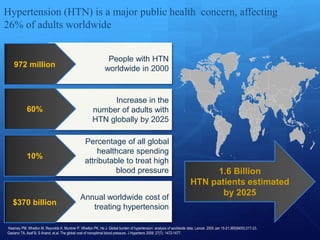
Hypertension (HTN) is a major public health concern, affecting 
26% of adults worldwide 
People with HTN 
worldwide in 2000 
972 million 
Increase in the 
number of adults with 
HTN globally by 2025 
60% 
Percentage of all global 
healthcare spending 
attributable to treat high 
blood pressure 
10% 
Annual worldwide cost of 
treating hypertension 
$370 billion 
1.6 Billion 
HTN patients estimated 
by 2025 
Kearney PM, Whelton M, Reynolds K, Muntner P, Whelton PK, He J. Global burden of hypertension: analysis of worldwide data. Lancet. 2005 Jan 15-21;365(9455):217-23. 
Gaziano TA, Asaf B, S Anand, et.al. The global cost of nonoptimal blood pressure. J Hypertens 2009; 27(7): 1472-1477.
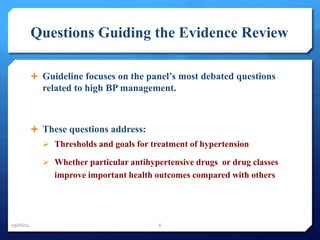
Questions Guiding the Evidence Review 
 Guideline focuses on the panel’s most debated questions 
related to high BP management. 
 These questions address: 
 Thresholds and goals for treatment of hypertension 
 Whether particular antihypertensive drugs or drug classes 
improve important health outcomes compared with others 
09/08/14 6
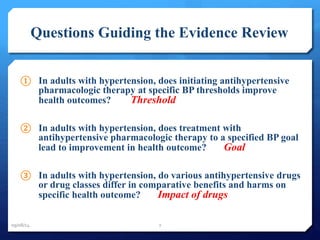
Questions Guiding the Evidence Review 
① In adults with hypertension, does initiating antihypertensive 
pharmacologic therapy at specific BP thresholds improve 
health outcomes? Threshold 
② In adults with hypertension, does treatment with 
antihypertensive pharmacologic therapy to a specified BP goal 
lead to improvement in health outcome? Goal 
③ In adults with hypertension, do various antihypertensive drugs 
or drug classes differ in comparative benefits and harms on 
specific health outcome? Impact of drugs 
09/08/14 7
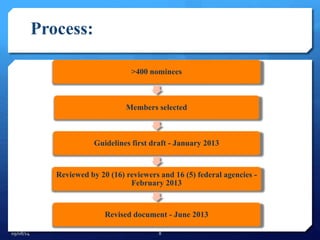
Process: 
>400 nominees 
Members selected 
Guidelines first draft - January 2013 
Reviewed by 20 (16) reviewers and 16 (5) federal agencies - 
February 2013 
Revised document - June 2013 
09/08/14 8
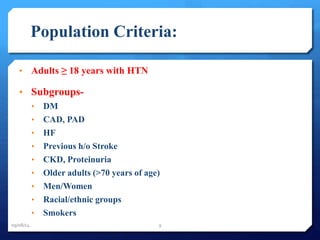
Population Criteria: 
• Adults ≥ 18 years with HTN 
• Subgroups- 
• DM 
• CAD, PAD 
• HF 
• Previous h/o Stroke 
• CKD, Proteinuria 
• Older adults (>70 years of age) 
• Men/Women 
• Racial/ethnic groups 
• Smokers 
09/08/14 9
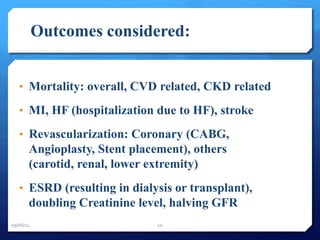
Outcomes considered: 
• Mortality: overall, CVD related, CKD related 
• MI, HF (hospitalization due to HF), stroke 
• Revascularization: Coronary (CABG, 
Angioplasty, Stent placement), others 
(carotid, renal, lower extremity) 
• ESRD (resulting in dialysis or transplant), 
doubling Creatinine level, halving GFR 
09/08/14 10
Trials: 
 Only RCTs (well executed or with minor limitations 
only- rated as ‘good’ or ‘fair’) 
 Period January 1, 1966 to December 31, 2009 
 Secondary search: (with same MeSH terms) 
 PubMed & CINAHL 
 December 2009 – August 2013 
 Major study in HTN (like ACCORD), ≥ 2000 
subjects, multi-centric, met inclusion/exclusion 
criteria 
09/08/14 11
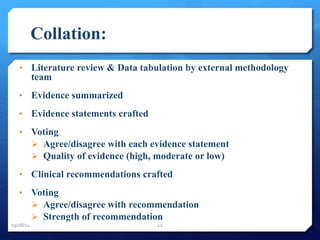
Collation: 
• Literature review & Data tabulation by external methodology 
team 
• Evidence summarized 
• Evidence statements crafted 
• Voting 
 Agree/disagree with each evidence statement 
 Quality of evidence (high, moderate or low) 
• Clinical recommendations crafted 
• Voting 
 Agree/disagree with recommendation 
 Strength of recommendation 
09/08/14 12
09/08/14 
Copyright © 2012 American Medical Association. All rights reserved. 
JAMA. 2013; doi:10.1001/jama.2013.284427 
13
Recommendations: 
 Recommendations 1-5: 
Threshold and goals for HTN treatment 
 Recommendations 6-8: 
Selection of anti-HTN drugs 
 Recommendation 9: 
Summary of strategies (expert opinion) 
09/08/14 14
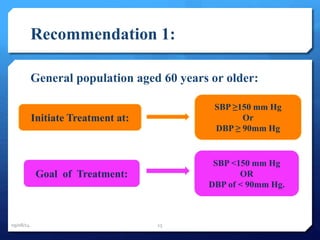
Recommendation 1: 
General population aged 60 years or older: 
SBP ≥150 mm Hg 
Or 
DBP ≥ 90mm Hg 
Goal of Treatment: 
SBP <150 mm Hg 
OR 
DBP of < 90mm Hg. 
Initiate Treatment at: 
09/08/14 15
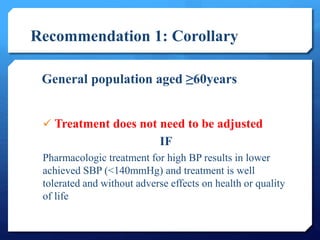
Recommendation 1: Corollary 
General population aged ≥60years 
 Treatment does not need to be adjusted 
IF 
Pharmacologic treatment for high BP results in lower 
achieved SBP (<140mmHg) and treatment is well 
tolerated and without adverse effects on health or quality 
of life
Recommendation 2: 
General population < 60 years: 
Initiate Treatment at: DBP ≥ 90mm Hg 
Goal of Treatment: DBP of < 90mm Hg 
09/08/14 17
Recommendation 3: 
General population < 60 years: 
SBP ≥ 140 mm Hg 
Initiate Treatment at: 
Goal of Treatment: SBP of < 140 mm Hg 
09/08/14 18
Recommendation 4: 
Population aged 18 years or older with CKD: 
Initiate Treatment at: 
SBP ≥ 140 mm Hg 
Or 
DBP ≥ 90 mm Hg 
Goal of Treatment: 
SBP < 140 mm Hg 
Or 
DBP < 90 mm Hg 
09/08/14 19
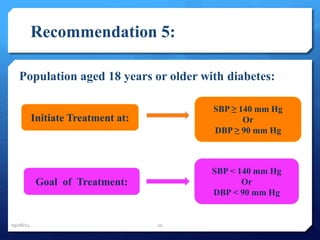
Recommendation 5: 
Population aged 18 years or older with diabetes: 
Initiate Treatment at: 
SBP ≥ 140 mm Hg 
Or 
DBP ≥ 90 mm Hg 
Goal of Treatment: 
SBP < 140 mm Hg 
Or 
DBP < 90 mm Hg 
09/08/14 20
Recommendation 6: 
In General non black population, including those with 
diabetes, initial anti-HTN therapy should include any of the 
following: 
 Thiazide-type diuretic 
 Calcium channel blocker (CCB) 
 Angiotensin-converting enzyme inhibitor (ACEI) 
 Angiotensin receptor blocker (ARB) 
09/08/14 21
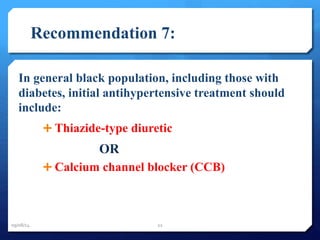
Recommendation 7: 
In general black population, including those with 
diabetes, initial antihypertensive treatment should 
include: 
 Thiazide-type diuretic 
OR 
 Calcium channel blocker (CCB) 
09/08/14 22
Recommendation 8: 
Population aged 18 years or more with CKD ± DM 
 Initial (or add-on) antihypertensive treatment should include an 
ACEI or ARB to improve kidney outcomes 
 This applies to all CKD patients with hypertension regardless of 
race or diabetes status 
09/08/14 23
Recommendation 9: 
 The main aim is to attain and maintain a goal BP 
 If goal BP is not reached within a month of treatment: 
 Increase the dose of the initial drug 
OR 
 Add a second drug from one of the classes in recommendation 6 
(thiazide-type diuretic, CCB, ACEI, or ARB) 
 The clinician should continue to assess BP and adjust the 
treatment regimen until goal BP is reached 
09/08/14 24
Recommendation 9: contd… 
 If goal BP cannot be reached with 2 drugs: 
 Add and titrate a third drug from the list provided 
Do not use an ACEI and an ARB together in the same patient!! 
 If goal BP cannot be reached using the drugs in recommendation 6 
because of a contraindication or due to adverse reactions or the need 
to use more than 3 drugs to reach goal BP: Anti- HTN drugs from 
other classes can be used 
09/08/14 25
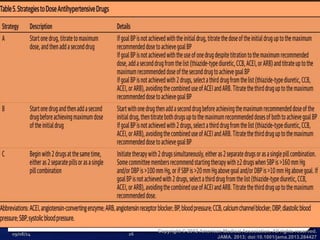
Strategies to Dose Antihypertensive Drugs 
Figure Legend: 
09/08/14 
Copyright © 2012 American Medical Association. All rights reserved. 
JAMA. 2013; doi:10.1001/jama.2013.284427 
26
Recommendation 9: contd… 
 For patients in whom goal BP cannot be attained using the 
above strategy 
OR 
 The management of complicated patients for whom 
additional clinical consultation is needed 
 Referral to a hypertension specialist may be indicated 
09/08/14 27
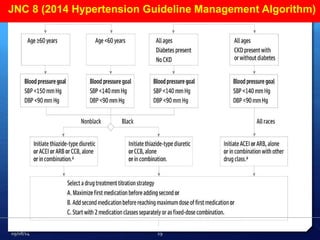
JNC 8 (2014 Hypertension Guideline Management Algorithm) 
JAMA. 2013;():. doi:1 09/08/14 28 0.1001/jama.2013.284427
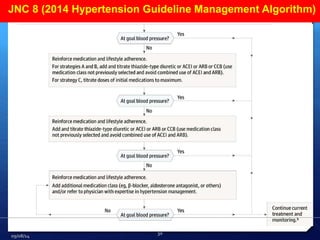
JNC 8 (2014 Hypertension Guideline Management Algorithm) 
09/08/14 29
JNC 8 (2014 Hypertension Guideline Management Algorithm) 
09/08/14 
30
Copyright © 2012 American Medical Association. All rights 
reserved. JAMA. 2013; doi:10.1001/jama.2013.284427 
Figure Legend: 
09/08/14 31
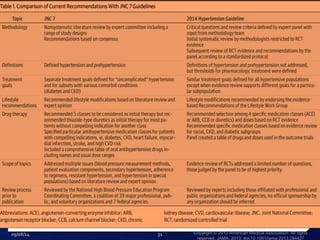
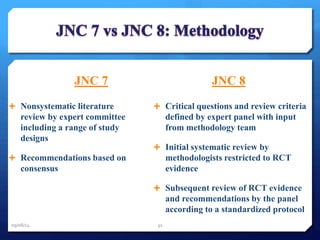
JNC 7 
 Nonsystematic literature 
review by expert committee 
including a range of study 
designs 
 Recommendations based on 
consensus 
JNC 8 
 Critical questions and review criteria 
defined by expert panel with input 
from methodology team 
 Initial systematic review by 
methodologists restricted to RCT 
evidence 
 Subsequent review of RCT evidence 
and recommendations by the panel 
according to a standardized protocol 
09/08/14 32
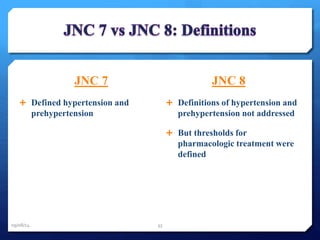
JNC 7 
 Defined hypertension and 
prehypertension 
JNC 8 
 Definitions of hypertension and 
prehypertension not addressed 
 But thresholds for 
pharmacologic treatment were 
defined 
09/08/14 33
JNC 7 
 Separate treatment goals 
defined for 
 “uncomplicated” hypertension 
 Subsets with various comorbid 
conditions (diabetes and CKD) 
JNC 8 
 Similar treatment goals defined 
for all hypertensive populations 
 Except when evidence review 
supports different goals for a 
particular subpopulation 
09/08/14 34
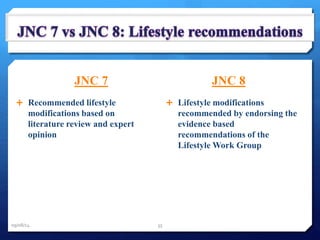
JNC 7 
 Recommended lifestyle 
modifications based on 
literature review and expert 
opinion 
JNC 8 
 Lifestyle modifications 
recommended by endorsing the 
evidence based 
recommendations of the 
Lifestyle Work Group 
09/08/14 35
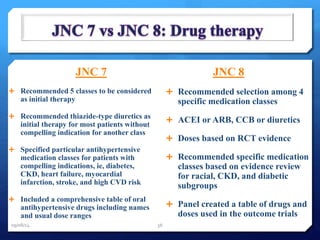
JNC 7 
 Recommended 5 classes to be considered 
as initial therapy 
 Recommended thiazide-type diuretics as 
initial therapy for most patients without 
compelling indication for another class 
 Specified particular antihypertensive 
medication classes for patients with 
compelling indications, ie, diabetes, 
CKD, heart failure, myocardial 
infarction, stroke, and high CVD risk 
 Included a comprehensive table of oral 
antihypertensive drugs including names 
and usual dose ranges 
JNC 8 
 Recommended selection among 4 
specific medication classes 
 ACEI or ARB, CCB or diuretics 
 Doses based on RCT evidence 
 Recommended specific medication 
classes based on evidence review 
for racial, CKD, and diabetic 
subgroups 
 Panel created a table of drugs and 
doses used in the outcome trials 
09/08/14 36
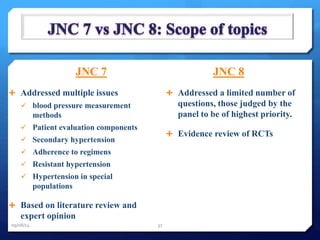
JNC 7 
 Addressed multiple issues 
 blood pressure measurement 
methods 
 Patient evaluation components 
 Secondary hypertension 
 Adherence to regimens 
 Resistant hypertension 
 Hypertension in special 
populations 
 Based on literature review and 
expert opinion 
JNC 8 
 Addressed a limited number of 
questions, those judged by the 
panel to be of highest priority. 
 Evidence review of RCTs 
09/08/14 37
JNC 7 
 Reviewed by the National High 
Blood Pressure Education 
Program 
 Coordinating Committee 
 a coalition of 39 major professional 
 Public and voluntary 
organizations and 7 federal 
agencies 
JNC 8 
 Reviewed by experts including 
those affiliated with 
 Professional 
 Public organizations 
 Federal agencies 
 No official sponsorship by any 
organization should be inferred 
09/08/14 38
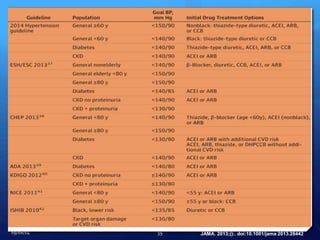
09/08/14 JAMA. 2013;():. 39 doi:10.1001/jama 2013.28442
Limitations: 
 Focused to address 3 specific questions: clinicians often provide 
care for patients with numerous co-morbidities 
 Treatment adherence and medication costs were thought to be 
beyond the scope of this guideline 
 Did not include observational studies or systematic reviews and 
did not perform its own meta-analysis 
 Many of the reviewed studies were conducted when the overall 
CV morbidity and mortality were much higher than today- effect 
size might have been over-estimated 
09/08/14 40
Conclusion: 
 Guidelines Offer clinicians an analysis of what is known and not 
known about BP treatment thresholds, goals and drug treatment 
strategies. 
 Provides evidence-based recommendations for the management 
of high BP. 
 Should meet the clinical needs of most patients. 
 However, these recommendations are not a substitute for clinical 
judgment and decisions must be carefully considered and 
incorporate the clinical characteristics of each individual. 
09/08/14 41
ANIMATED SLIDE

JNC 8 _Dr. Mansij Biswas

  • 1.
    Hypertension Update: JNC8 Dr. Mansij Biswas SYR, Dept. of Pharmacology & Therapeutics Seth GS Medical College & KEM Hospital
  • 2.
    “The greatest dangerto a man with high blood pressure lies in its discovery because then some fool is certain to try his hand and reduce it” Hay J, “A british medical association lecture on the significance of a raised blood pressure,” British Medical Journal, vol. 2, no. 3679, pp. 43–47, 1931 09/08/14 2
  • 3.
    At a glance…  Eighth Joint National Committee  Evidence- based Guidelines  Not just JNC 7 “Renovated” BUT “Demolished & Reconstructed”  Destination is important and not the journey!! 09/08/14 3
  • 4.
    Introduction:  Hypertensionremains one of the most important preventable contributors to disease and death  Guidelines are at the intersection between research evidence and clinical actions that can improve patient outcomes  The panel members appointed to the JNC 8 used evidence-based methods, developing statements and recommendations for high blood pressure management  Recommendations are based on a systematic review of literature to meet the need of the primary care physicians 09/08/14 4
  • 5.
    Hypertension (HTN) isa major public health concern, affecting 26% of adults worldwide People with HTN worldwide in 2000 972 million Increase in the number of adults with HTN globally by 2025 60% Percentage of all global healthcare spending attributable to treat high blood pressure 10% Annual worldwide cost of treating hypertension $370 billion 1.6 Billion HTN patients estimated by 2025 Kearney PM, Whelton M, Reynolds K, Muntner P, Whelton PK, He J. Global burden of hypertension: analysis of worldwide data. Lancet. 2005 Jan 15-21;365(9455):217-23. Gaziano TA, Asaf B, S Anand, et.al. The global cost of nonoptimal blood pressure. J Hypertens 2009; 27(7): 1472-1477.
  • 6.
    Questions Guiding theEvidence Review  Guideline focuses on the panel’s most debated questions related to high BP management.  These questions address:  Thresholds and goals for treatment of hypertension  Whether particular antihypertensive drugs or drug classes improve important health outcomes compared with others 09/08/14 6
  • 7.
    Questions Guiding theEvidence Review ① In adults with hypertension, does initiating antihypertensive pharmacologic therapy at specific BP thresholds improve health outcomes? Threshold ② In adults with hypertension, does treatment with antihypertensive pharmacologic therapy to a specified BP goal lead to improvement in health outcome? Goal ③ In adults with hypertension, do various antihypertensive drugs or drug classes differ in comparative benefits and harms on specific health outcome? Impact of drugs 09/08/14 7
  • 8.
    Process: >400 nominees Members selected Guidelines first draft - January 2013 Reviewed by 20 (16) reviewers and 16 (5) federal agencies - February 2013 Revised document - June 2013 09/08/14 8
  • 9.
    Population Criteria: •Adults ≥ 18 years with HTN • Subgroups- • DM • CAD, PAD • HF • Previous h/o Stroke • CKD, Proteinuria • Older adults (>70 years of age) • Men/Women • Racial/ethnic groups • Smokers 09/08/14 9
  • 10.
    Outcomes considered: •Mortality: overall, CVD related, CKD related • MI, HF (hospitalization due to HF), stroke • Revascularization: Coronary (CABG, Angioplasty, Stent placement), others (carotid, renal, lower extremity) • ESRD (resulting in dialysis or transplant), doubling Creatinine level, halving GFR 09/08/14 10
  • 11.
    Trials:  OnlyRCTs (well executed or with minor limitations only- rated as ‘good’ or ‘fair’)  Period January 1, 1966 to December 31, 2009  Secondary search: (with same MeSH terms)  PubMed & CINAHL  December 2009 – August 2013  Major study in HTN (like ACCORD), ≥ 2000 subjects, multi-centric, met inclusion/exclusion criteria 09/08/14 11
  • 12.
    Collation: • Literaturereview & Data tabulation by external methodology team • Evidence summarized • Evidence statements crafted • Voting  Agree/disagree with each evidence statement  Quality of evidence (high, moderate or low) • Clinical recommendations crafted • Voting  Agree/disagree with recommendation  Strength of recommendation 09/08/14 12
  • 13.
    09/08/14 Copyright ©2012 American Medical Association. All rights reserved. JAMA. 2013; doi:10.1001/jama.2013.284427 13
  • 14.
    Recommendations:  Recommendations1-5: Threshold and goals for HTN treatment  Recommendations 6-8: Selection of anti-HTN drugs  Recommendation 9: Summary of strategies (expert opinion) 09/08/14 14
  • 15.
    Recommendation 1: Generalpopulation aged 60 years or older: SBP ≥150 mm Hg Or DBP ≥ 90mm Hg Goal of Treatment: SBP <150 mm Hg OR DBP of < 90mm Hg. Initiate Treatment at: 09/08/14 15
  • 16.
    Recommendation 1: Corollary General population aged ≥60years  Treatment does not need to be adjusted IF Pharmacologic treatment for high BP results in lower achieved SBP (<140mmHg) and treatment is well tolerated and without adverse effects on health or quality of life
  • 17.
    Recommendation 2: Generalpopulation < 60 years: Initiate Treatment at: DBP ≥ 90mm Hg Goal of Treatment: DBP of < 90mm Hg 09/08/14 17
  • 18.
    Recommendation 3: Generalpopulation < 60 years: SBP ≥ 140 mm Hg Initiate Treatment at: Goal of Treatment: SBP of < 140 mm Hg 09/08/14 18
  • 19.
    Recommendation 4: Populationaged 18 years or older with CKD: Initiate Treatment at: SBP ≥ 140 mm Hg Or DBP ≥ 90 mm Hg Goal of Treatment: SBP < 140 mm Hg Or DBP < 90 mm Hg 09/08/14 19
  • 20.
    Recommendation 5: Populationaged 18 years or older with diabetes: Initiate Treatment at: SBP ≥ 140 mm Hg Or DBP ≥ 90 mm Hg Goal of Treatment: SBP < 140 mm Hg Or DBP < 90 mm Hg 09/08/14 20
  • 21.
    Recommendation 6: InGeneral non black population, including those with diabetes, initial anti-HTN therapy should include any of the following:  Thiazide-type diuretic  Calcium channel blocker (CCB)  Angiotensin-converting enzyme inhibitor (ACEI)  Angiotensin receptor blocker (ARB) 09/08/14 21
  • 22.
    Recommendation 7: Ingeneral black population, including those with diabetes, initial antihypertensive treatment should include:  Thiazide-type diuretic OR  Calcium channel blocker (CCB) 09/08/14 22
  • 23.
    Recommendation 8: Populationaged 18 years or more with CKD ± DM  Initial (or add-on) antihypertensive treatment should include an ACEI or ARB to improve kidney outcomes  This applies to all CKD patients with hypertension regardless of race or diabetes status 09/08/14 23
  • 24.
    Recommendation 9: The main aim is to attain and maintain a goal BP  If goal BP is not reached within a month of treatment:  Increase the dose of the initial drug OR  Add a second drug from one of the classes in recommendation 6 (thiazide-type diuretic, CCB, ACEI, or ARB)  The clinician should continue to assess BP and adjust the treatment regimen until goal BP is reached 09/08/14 24
  • 25.
    Recommendation 9: contd…  If goal BP cannot be reached with 2 drugs:  Add and titrate a third drug from the list provided Do not use an ACEI and an ARB together in the same patient!!  If goal BP cannot be reached using the drugs in recommendation 6 because of a contraindication or due to adverse reactions or the need to use more than 3 drugs to reach goal BP: Anti- HTN drugs from other classes can be used 09/08/14 25
  • 26.
    Strategies to DoseAntihypertensive Drugs Figure Legend: 09/08/14 Copyright © 2012 American Medical Association. All rights reserved. JAMA. 2013; doi:10.1001/jama.2013.284427 26
  • 27.
    Recommendation 9: contd…  For patients in whom goal BP cannot be attained using the above strategy OR  The management of complicated patients for whom additional clinical consultation is needed  Referral to a hypertension specialist may be indicated 09/08/14 27
  • 28.
    JNC 8 (2014Hypertension Guideline Management Algorithm) JAMA. 2013;():. doi:1 09/08/14 28 0.1001/jama.2013.284427
  • 29.
    JNC 8 (2014Hypertension Guideline Management Algorithm) 09/08/14 29
  • 30.
    JNC 8 (2014Hypertension Guideline Management Algorithm) 09/08/14 30
  • 31.
    Copyright © 2012American Medical Association. All rights reserved. JAMA. 2013; doi:10.1001/jama.2013.284427 Figure Legend: 09/08/14 31
  • 32.
    JNC 7 Nonsystematic literature review by expert committee including a range of study designs  Recommendations based on consensus JNC 8  Critical questions and review criteria defined by expert panel with input from methodology team  Initial systematic review by methodologists restricted to RCT evidence  Subsequent review of RCT evidence and recommendations by the panel according to a standardized protocol 09/08/14 32
  • 33.
    JNC 7 Defined hypertension and prehypertension JNC 8  Definitions of hypertension and prehypertension not addressed  But thresholds for pharmacologic treatment were defined 09/08/14 33
  • 34.
    JNC 7 Separate treatment goals defined for  “uncomplicated” hypertension  Subsets with various comorbid conditions (diabetes and CKD) JNC 8  Similar treatment goals defined for all hypertensive populations  Except when evidence review supports different goals for a particular subpopulation 09/08/14 34
  • 35.
    JNC 7 Recommended lifestyle modifications based on literature review and expert opinion JNC 8  Lifestyle modifications recommended by endorsing the evidence based recommendations of the Lifestyle Work Group 09/08/14 35
  • 36.
    JNC 7 Recommended 5 classes to be considered as initial therapy  Recommended thiazide-type diuretics as initial therapy for most patients without compelling indication for another class  Specified particular antihypertensive medication classes for patients with compelling indications, ie, diabetes, CKD, heart failure, myocardial infarction, stroke, and high CVD risk  Included a comprehensive table of oral antihypertensive drugs including names and usual dose ranges JNC 8  Recommended selection among 4 specific medication classes  ACEI or ARB, CCB or diuretics  Doses based on RCT evidence  Recommended specific medication classes based on evidence review for racial, CKD, and diabetic subgroups  Panel created a table of drugs and doses used in the outcome trials 09/08/14 36
  • 37.
    JNC 7 Addressed multiple issues  blood pressure measurement methods  Patient evaluation components  Secondary hypertension  Adherence to regimens  Resistant hypertension  Hypertension in special populations  Based on literature review and expert opinion JNC 8  Addressed a limited number of questions, those judged by the panel to be of highest priority.  Evidence review of RCTs 09/08/14 37
  • 38.
    JNC 7 Reviewed by the National High Blood Pressure Education Program  Coordinating Committee  a coalition of 39 major professional  Public and voluntary organizations and 7 federal agencies JNC 8  Reviewed by experts including those affiliated with  Professional  Public organizations  Federal agencies  No official sponsorship by any organization should be inferred 09/08/14 38
  • 39.
    09/08/14 JAMA. 2013;():.39 doi:10.1001/jama 2013.28442
  • 40.
    Limitations:  Focusedto address 3 specific questions: clinicians often provide care for patients with numerous co-morbidities  Treatment adherence and medication costs were thought to be beyond the scope of this guideline  Did not include observational studies or systematic reviews and did not perform its own meta-analysis  Many of the reviewed studies were conducted when the overall CV morbidity and mortality were much higher than today- effect size might have been over-estimated 09/08/14 40
  • 41.
    Conclusion:  GuidelinesOffer clinicians an analysis of what is known and not known about BP treatment thresholds, goals and drug treatment strategies.  Provides evidence-based recommendations for the management of high BP.  Should meet the clinical needs of most patients.  However, these recommendations are not a substitute for clinical judgment and decisions must be carefully considered and incorporate the clinical characteristics of each individual. 09/08/14 41
  • 42.