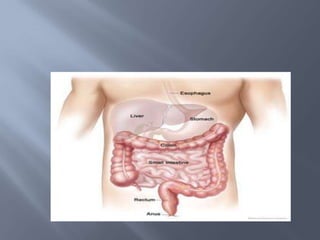
COLON CANCERDr. Tanuj Paul Bhatia
COLON CANCEREPIDEMIOLOGY Colon cancer has 4th highest incidence after prostate , breast & lung cancers Second leading cause for death after lung cancerMean age at diagnosis is 5th decade
COLON CANCERETIOLOGYSporadic colon ca accounts for 70%> Adenomas> Tobacco> Inflammatory bowel diseases> Dietary factors> Pyrolysis products – benzo (a) pyrene> Micronutrients deficiency
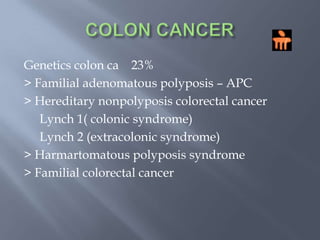
COLON CANCERGenetics colon ca    23%> Familial adenomatous polyposis – APC > Hereditary nonpolyposis colorectal cancer     Lynch 1( colonic syndrome)     Lynch 2 (extracolonic syndrome)> Harmartomatous polyposis syndrome> Familial colorectal cancer
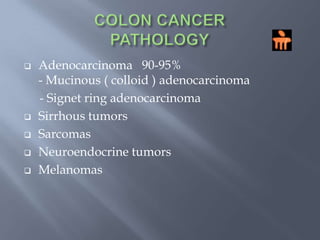
COLON CANCER PATHOLOGYAdenocarcinoma   90-95%                                          - Mucinous ( colloid ) adenocarcinoma - Signet ring adenocarcinomaSirrhous tumors
Sarcomas
Neuroendocrine tumors
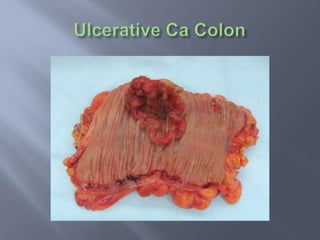
MelanomasUlcerative Ca Colon
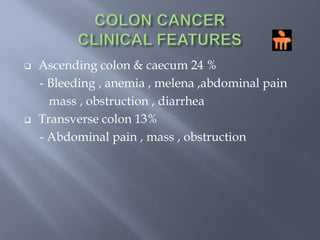
COLON CANCERCLINICAL FEATURESAscending colon & caecum24 %     - Bleeding , anemia , melena ,abdominal pain        mass , obstruction , diarrheaTransverse colon 13%     - Abdominal pain , mass , obstruction
Clinical features Descending & Sigmoid colon 34%     - Changing bowel habits / stool caliber ,         mucous & blood in stools ,adbominal pain         mass obstruction / perforation Metastatic disease      - Cachexia , wt loss , jaundice , mass , ascites ,hepatomegaly, bloomer’s shelf , virchow’s nodes
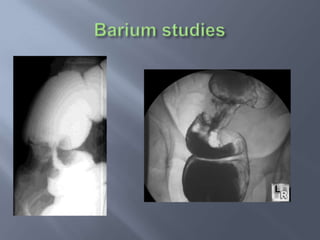
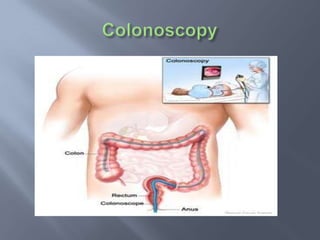
COLON CANCER INVESTIGATIONSClinical ExaminationDouble contrast barium enemaColonoscopy & biopsyC T scan abdomen & pelvisChest x-rayLiver function testCarcinoembryonic AntigenPET & PET-CT         - Role is emerging
Barium studies
Colonoscopy
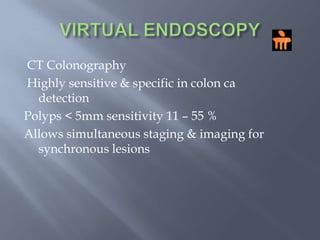
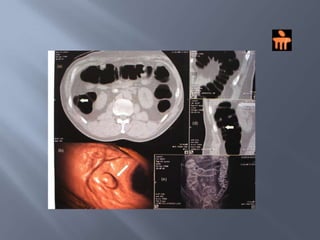
VIRTUAL ENDOSCOPY CT Colonography Highly sensitive & specific in colon ca      detection Polyps < 5mm sensitivity 11 – 55 %Allows simultaneous staging & imaging for synchronous lesions
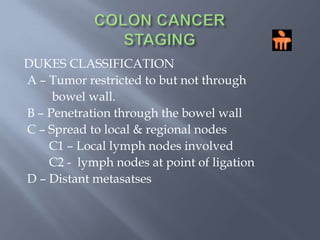
COLON CANCER STAGINGDUKES CLASSIFICATION A – Tumor restricted to but not through            bowel wall. B – Penetration through the bowel wall C – Spread to local & regional nodes        C1 – Local lymph nodes involved        C2 -  lymph nodes at point of ligation  D – Distant metasatses
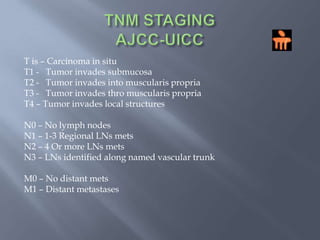
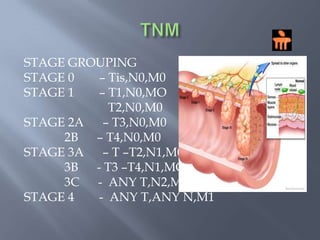
TNM STAGING  AJCC-UICC T is – Carcinoma in situT1 -   Tumor invades submucosaT2 -   Tumor invades into muscularis propriaT3 -   Tumor invades thro muscularis propriaT4 – Tumor invades local structuresN0 – No lymph nodesN1 – 1-3 Regional LNs metsN2 – 4 Or more LNs metsN3 – LNs identified along named vascular trunkM0 – No distant metsM1 – Distant metastases
TNMSTAGE GROUPINGSTAGE 0        – Tis,N0,M0STAGE 1        – T1,N0,MO                           T2,N0,M0STAGE 2A      – T3,N0,M0             2B      – T4,N0,M0STAGE 3A      – T –T2,N1,M0             3B      - T3 –T4,N1,MO             3C      -  ANY T,N2,M0STAGE 4        -  ANY T,ANY N,M1
PROGNOSTIC FACTORSAdvance stageSerosal penetrationHigh tumor gradeMore than 4 LNs involvedBowel obstn or perforationCEA levels >5ng/ml
MANAGEMENT OF MALIGNANT COLON POLYPS1. Pedunculated malignant polyps colon         - Management by complete excision or            snaring2. Sessile malignant polyps           < 2cms            - Snaring via colonoscopy with 2mm                free margins
PROPHYLACTIC SURGERY POLYPSFirst consider non surgical management options before surgeryEndoscopic polypectomy         reduces the incidence of subsequent         cancer 50 – 70 %
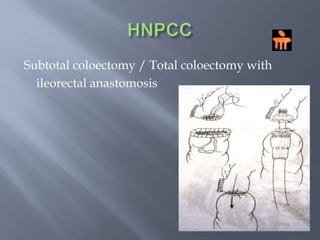
HNPCCSubtotal coloectomy / Total coloectomy with      ileorectal anastomosis
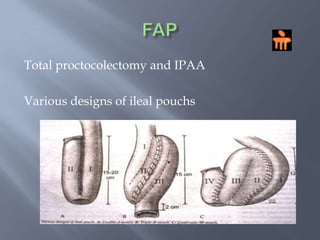
FAPTotal proctocolectomy and IPAAVarious designs of ileal pouchs
MANAGEMENTSURGERYThe extent of resection is determined by location of primary ,presence / absence of invasion into adjacent structures & distant mets
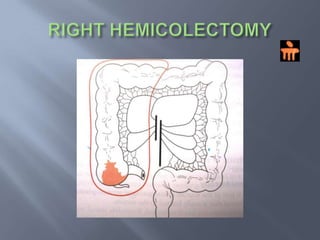
RIGHT HEMICOLECTOMY
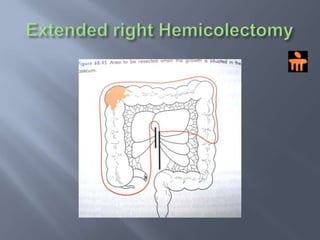
Extended right Hemicolectomy
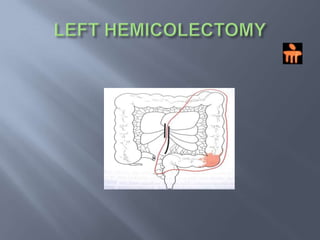
LEFT HEMICOLECTOMY
LAPAROSCOPY VS OPEN TECHNIQUESRecent studies confirmed technically     feasible ,safe, yielding an equivalent no of lymph nodes and lengths of resected bowel when compared with open colectomy.
MANAGEMENT OF LIVER METASTASISAppx 15 – 25 %  at initial presentation Appx 25 – 50 % will develop liver mets in 3 years following primary resectionCurative hepatic resection has a survival advantage 25 – 50 % at 5 yearsIndications  . Stage 1 and 2  . Less than 4 hepatic lesions none > 5 cms without evidence of extrahepatic disease  . CEA level < 5ng/ml  . Disease free interval atleast 2 years
ALTERNATIVE MODALITIES FOR UNRESECTABLE LESIONRFA -Thermal energyCryo ablation – Rapid freezingMicrowave ablationPercutaneous enthanol infiltration USG guidedAdjuvant / pallivative hepatic artery infusionsInterstitial radiotherapy
STAGEWISE TREATMENT
STAGE 0 COLON CANCERTREATMENT OPTIONSLocal excision or simple polypectomy with clear marginsColon resection for larger lesions not  amenable to local excision
STAGE 1 COLON CANCERSurgical resection and anastomosisAdjuvant chemotherpy is not indicated other than controlled clinical trials
STAGE 2 COLON CANCERWide surgical resection and anastomosisAdjuvant therapy is not indicated other than  controlled clinical trials
STAGE 3 COLON CANCERWide surgical resection and anastomosisAdjuvant chemotherapy with 5-F.U and leucovorin for 6 monthsMOSAIC TRIAL – FOLFOX 4Oxaliplatin , leucovorin , 5 FU demonstrated  prolonged 3 yrs survival
STAGE 4 & RECURRENT COLON CANCERSurgical resection of locally recurrent cancerSurgical resection & anastomosis or Bypass of obstruction or bleeding primary in selected metastatic casesResection of liver metastases in selected pt   ( 5yr cure rate for solitary/ combination mets exceeds 20%)Resection of isolated pulmonary / ovarian mets in selected ptPalliative RadiotherapyPalliative chemotherapy

Colon Cancer 9th Sem

  • 1.
  • 3.
    COLON CANCEREPIDEMIOLOGY Coloncancer has 4th highest incidence after prostate , breast & lung cancers Second leading cause for death after lung cancerMean age at diagnosis is 5th decade
  • 4.
    COLON CANCERETIOLOGYSporadic colonca accounts for 70%> Adenomas> Tobacco> Inflammatory bowel diseases> Dietary factors> Pyrolysis products – benzo (a) pyrene> Micronutrients deficiency
  • 5.
    COLON CANCERGenetics colonca 23%> Familial adenomatous polyposis – APC > Hereditary nonpolyposis colorectal cancer Lynch 1( colonic syndrome) Lynch 2 (extracolonic syndrome)> Harmartomatous polyposis syndrome> Familial colorectal cancer
  • 6.
    COLON CANCER PATHOLOGYAdenocarcinoma 90-95% - Mucinous ( colloid ) adenocarcinoma - Signet ring adenocarcinomaSirrhous tumors
  • 7.
  • 8.
  • 9.
  • 10.
    COLON CANCERCLINICAL FEATURESAscendingcolon & caecum24 % - Bleeding , anemia , melena ,abdominal pain mass , obstruction , diarrheaTransverse colon 13% - Abdominal pain , mass , obstruction
  • 11.
    Clinical features Descending& Sigmoid colon 34% - Changing bowel habits / stool caliber , mucous & blood in stools ,adbominal pain mass obstruction / perforation Metastatic disease - Cachexia , wt loss , jaundice , mass , ascites ,hepatomegaly, bloomer’s shelf , virchow’s nodes
  • 12.
    COLON CANCER INVESTIGATIONSClinicalExaminationDouble contrast barium enemaColonoscopy & biopsyC T scan abdomen & pelvisChest x-rayLiver function testCarcinoembryonic AntigenPET & PET-CT - Role is emerging
  • 13.
  • 14.
  • 15.
    VIRTUAL ENDOSCOPY CTColonography Highly sensitive & specific in colon ca detection Polyps < 5mm sensitivity 11 – 55 %Allows simultaneous staging & imaging for synchronous lesions
  • 17.
    COLON CANCER STAGINGDUKESCLASSIFICATION A – Tumor restricted to but not through bowel wall. B – Penetration through the bowel wall C – Spread to local & regional nodes C1 – Local lymph nodes involved C2 - lymph nodes at point of ligation D – Distant metasatses
  • 18.
    TNM STAGING AJCC-UICC T is – Carcinoma in situT1 - Tumor invades submucosaT2 - Tumor invades into muscularis propriaT3 - Tumor invades thro muscularis propriaT4 – Tumor invades local structuresN0 – No lymph nodesN1 – 1-3 Regional LNs metsN2 – 4 Or more LNs metsN3 – LNs identified along named vascular trunkM0 – No distant metsM1 – Distant metastases
  • 19.
    TNMSTAGE GROUPINGSTAGE 0 – Tis,N0,M0STAGE 1 – T1,N0,MO T2,N0,M0STAGE 2A – T3,N0,M0 2B – T4,N0,M0STAGE 3A – T –T2,N1,M0 3B - T3 –T4,N1,MO 3C - ANY T,N2,M0STAGE 4 - ANY T,ANY N,M1
  • 20.
    PROGNOSTIC FACTORSAdvance stageSerosalpenetrationHigh tumor gradeMore than 4 LNs involvedBowel obstn or perforationCEA levels >5ng/ml
  • 21.
    MANAGEMENT OF MALIGNANTCOLON POLYPS1. Pedunculated malignant polyps colon - Management by complete excision or snaring2. Sessile malignant polyps < 2cms - Snaring via colonoscopy with 2mm free margins
  • 22.
    PROPHYLACTIC SURGERY POLYPSFirstconsider non surgical management options before surgeryEndoscopic polypectomy reduces the incidence of subsequent cancer 50 – 70 %
  • 23.
    HNPCCSubtotal coloectomy /Total coloectomy with ileorectal anastomosis
  • 24.
    FAPTotal proctocolectomy andIPAAVarious designs of ileal pouchs
  • 25.
    MANAGEMENTSURGERYThe extent ofresection is determined by location of primary ,presence / absence of invasion into adjacent structures & distant mets
  • 26.
  • 27.
  • 28.
  • 29.
    LAPAROSCOPY VS OPENTECHNIQUESRecent studies confirmed technically feasible ,safe, yielding an equivalent no of lymph nodes and lengths of resected bowel when compared with open colectomy.
  • 30.
    MANAGEMENT OF LIVERMETASTASISAppx 15 – 25 % at initial presentation Appx 25 – 50 % will develop liver mets in 3 years following primary resectionCurative hepatic resection has a survival advantage 25 – 50 % at 5 yearsIndications . Stage 1 and 2 . Less than 4 hepatic lesions none > 5 cms without evidence of extrahepatic disease . CEA level < 5ng/ml . Disease free interval atleast 2 years
  • 31.
    ALTERNATIVE MODALITIES FORUNRESECTABLE LESIONRFA -Thermal energyCryo ablation – Rapid freezingMicrowave ablationPercutaneous enthanol infiltration USG guidedAdjuvant / pallivative hepatic artery infusionsInterstitial radiotherapy
  • 32.
  • 33.
    STAGE 0 COLONCANCERTREATMENT OPTIONSLocal excision or simple polypectomy with clear marginsColon resection for larger lesions not amenable to local excision
  • 34.
    STAGE 1 COLONCANCERSurgical resection and anastomosisAdjuvant chemotherpy is not indicated other than controlled clinical trials
  • 35.
    STAGE 2 COLONCANCERWide surgical resection and anastomosisAdjuvant therapy is not indicated other than controlled clinical trials
  • 36.
    STAGE 3 COLONCANCERWide surgical resection and anastomosisAdjuvant chemotherapy with 5-F.U and leucovorin for 6 monthsMOSAIC TRIAL – FOLFOX 4Oxaliplatin , leucovorin , 5 FU demonstrated prolonged 3 yrs survival
  • 37.
    STAGE 4 &RECURRENT COLON CANCERSurgical resection of locally recurrent cancerSurgical resection & anastomosis or Bypass of obstruction or bleeding primary in selected metastatic casesResection of liver metastases in selected pt ( 5yr cure rate for solitary/ combination mets exceeds 20%)Resection of isolated pulmonary / ovarian mets in selected ptPalliative RadiotherapyPalliative chemotherapy