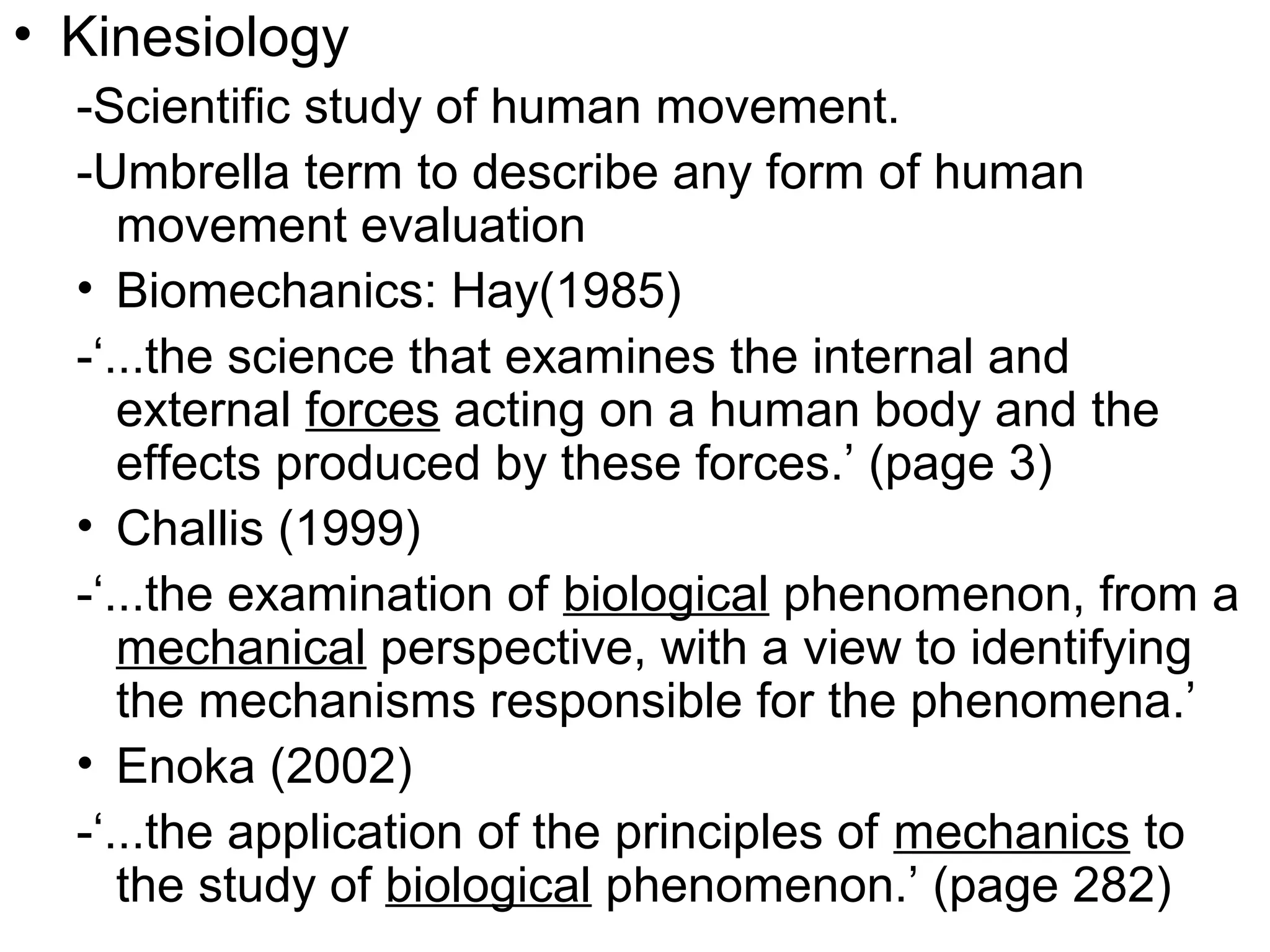
• Kinesiology
-Scientific study of human movement.
-Umbrella term to describe any form of human
movement evaluation
• Biomechanics: Hay(1985)
-‘...the science that examines the internal and
external forces acting on a human body and the
effects produced by these forces.’ (page 3)
• Challis (1999)
-‘...the examination of biological phenomenon, from a
mechanical perspective, with a view to identifying
the mechanisms responsible for the phenomena.’
• Enoka (2002)
-‘...the application of the principles of mechanics to
the study of biological phenomenon.’ (page 282)
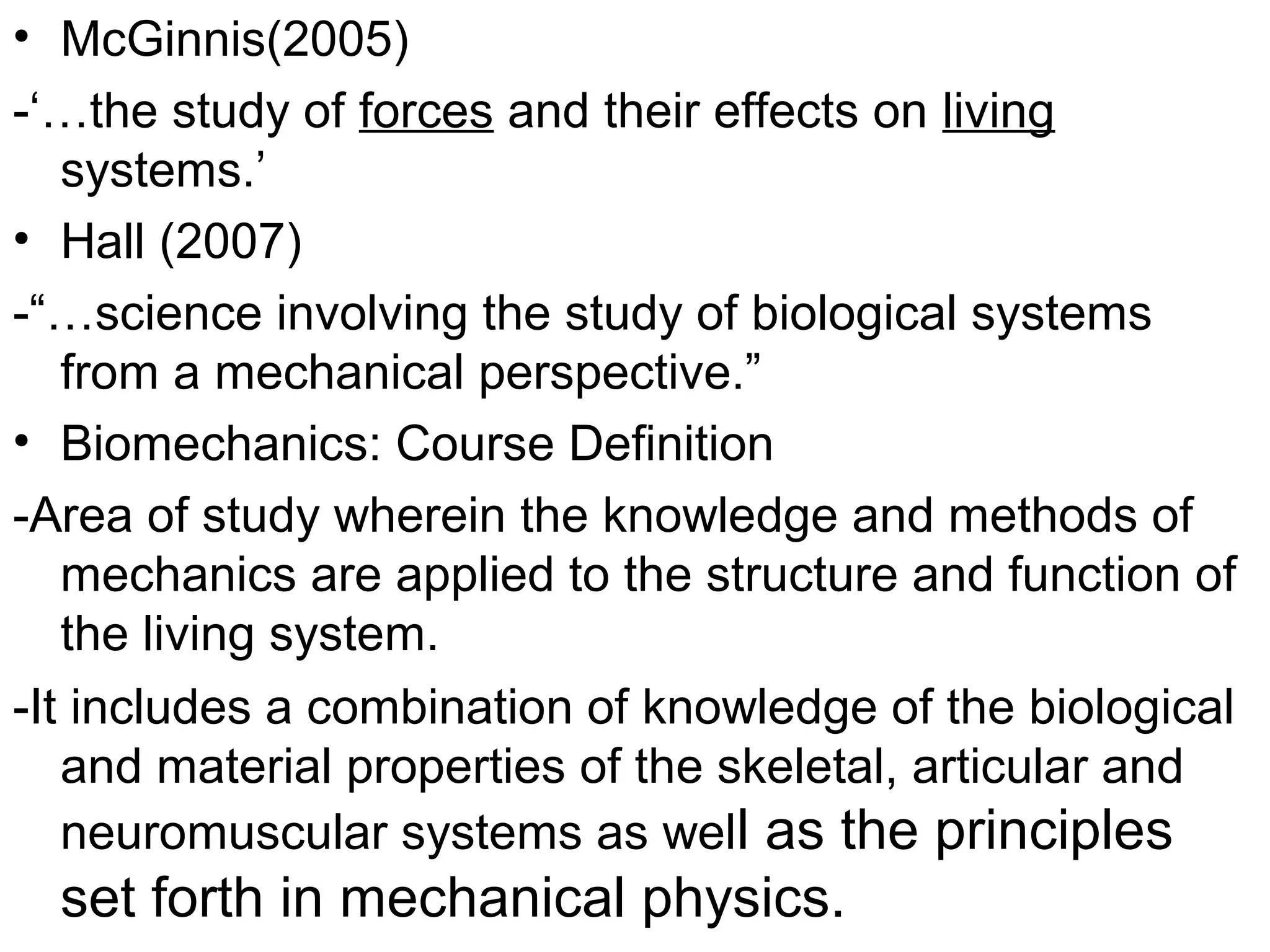
• McGinnis(2005)
-‘…the study of forces and their effects on living
systems.’
• Hall (2007)
-“…science involving the study of biological systems
from a mechanical perspective.”
• Biomechanics: Course Definition
-Area of study wherein the knowledge and methods of
mechanics are applied to the structure and function of
the living system.
-It includes a combination of knowledge of the biological
and material properties of the skeletal, articular and
neuromuscular systems as well as the principles
set forth in mechanical physics.
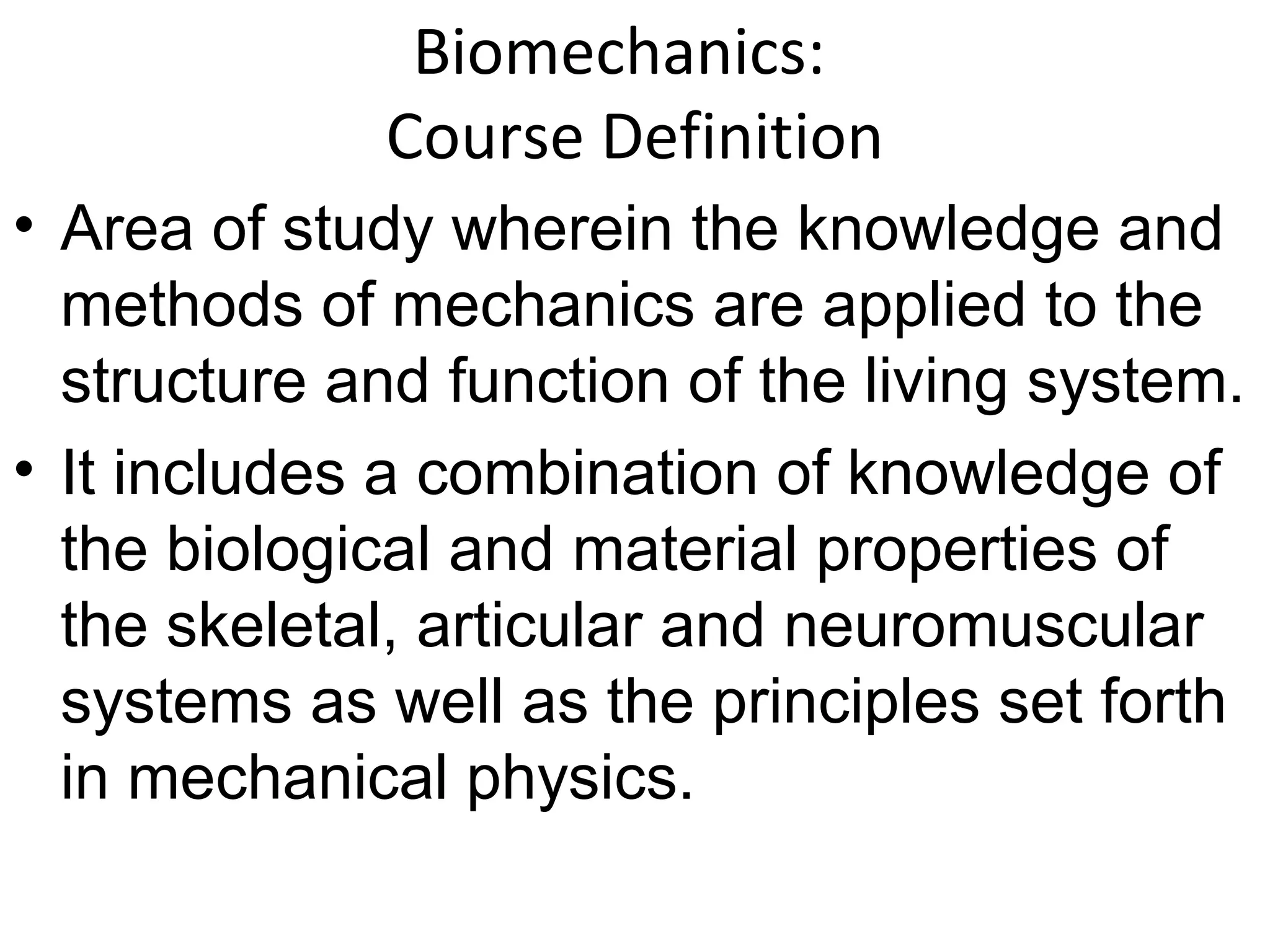
Biomechanics:
Course Definition
• Area of study wherein the knowledge and
methods of mechanics are applied to the
structure and function of the living system.
• It includes a combination of knowledge of
the biological and material properties of
the skeletal, articular and neuromuscular
systems as well as the principles set forth
in mechanical physics.
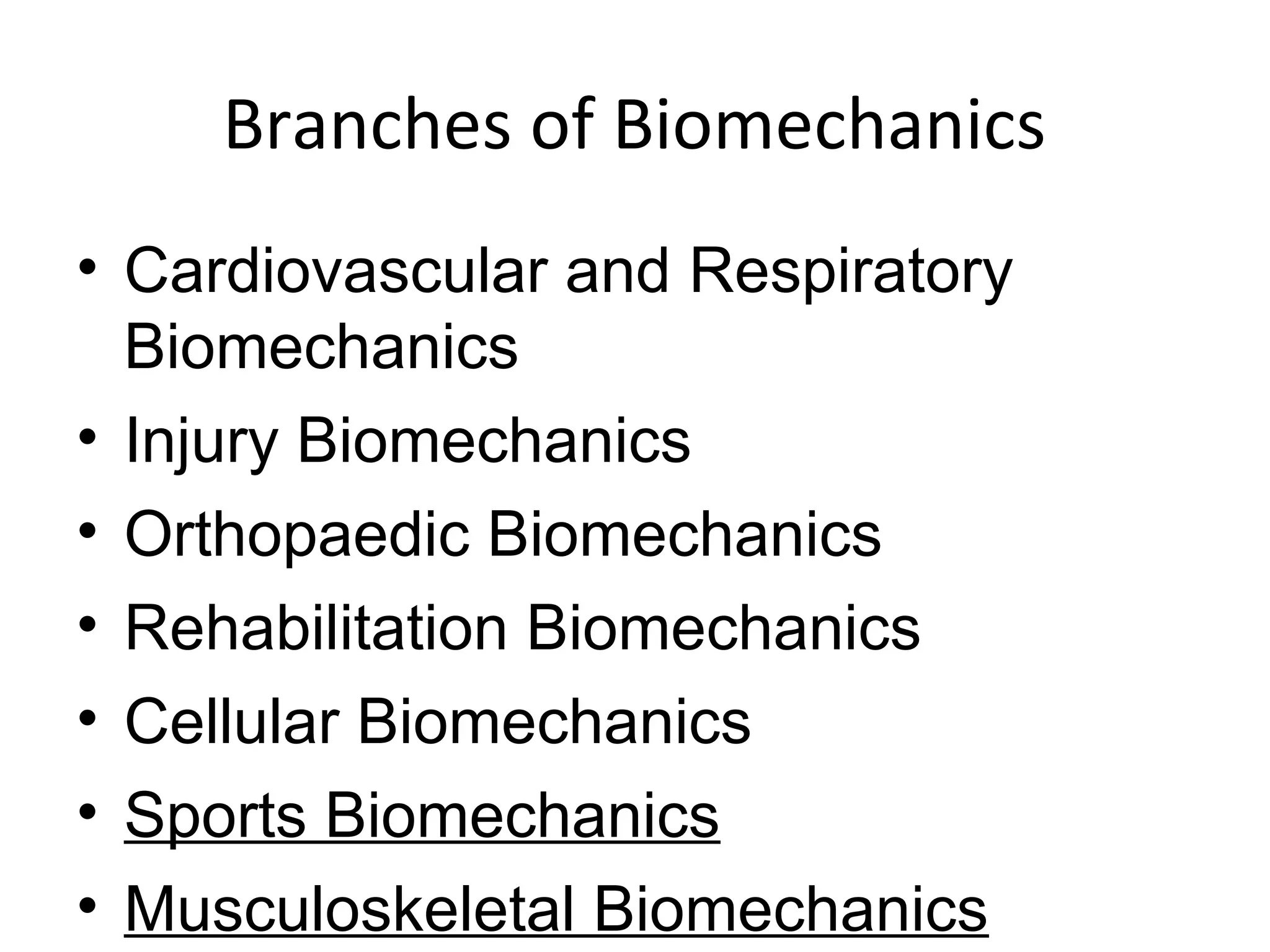
Branches of Biomechanics
• Cardiovascular and Respiratory
Biomechanics
• Injury Biomechanics
• Orthopaedic Biomechanics
• Rehabilitation Biomechanics
• Cellular Biomechanics
• Sports Biomechanics
• Musculoskeletal Biomechanics
• Performance Improvement
– Technique Improvement
– Equipment Improvement
– Training Improvement
• Injury Prevention and Rehabilitation
– Reduce Injury
– Equipment Design
• Cadaver simulation
Dr. Andy Hoskins/Dr. Neil Sharkey
Lateral Far
Lateral Near
Medial Near
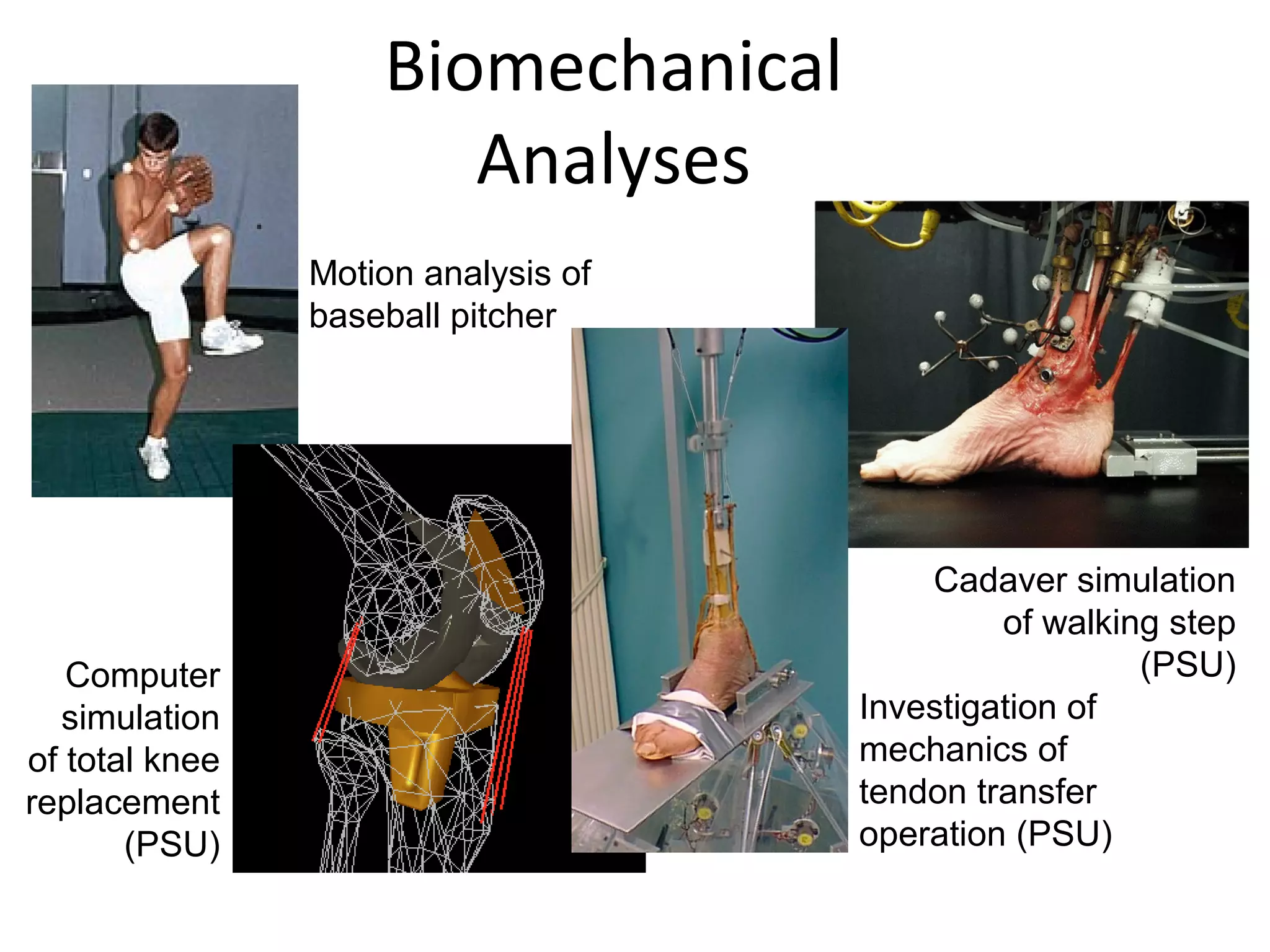
Biomechanical
Analyses
Motion analysis of
baseball pitcher
Computer
simulation
of total knee
replacement
(PSU)
Cadaver simulation
of walking step
(PSU)
Investigation of
mechanics of
tendon transfer
operation (PSU)
Historical Perspective
• Leonardo da Vinci (1452-1519)
– Considered anatomical structure and function
• Galileo (1564-1643)
– Projectile motion and effects of scale
• Jules Marey (1830-1904) and Eadweard Muybridge (1831-
1904)
• Muybridge:Recording of Animal Motion(Galloping horse)
(1879)
• Marey:Biomechanical Measurements
• Braune and Fischer
– Anthropometry and walking mechanics
– Army and backpacks-8 years to reduce data
• A. V. Hill (1886-1977)
– Most famous for
• Force vs. velocity properties of muscle
• Muscle energetics
Types of Analysis
• Qualitative: deals with the nature of
an activity, but does not deal with
measurement.
-Approach used by coaches and
scientists initially.
• Quantitative: involves measurement
as well as considers the nature of the
activity.
-Approach taken by scientists.
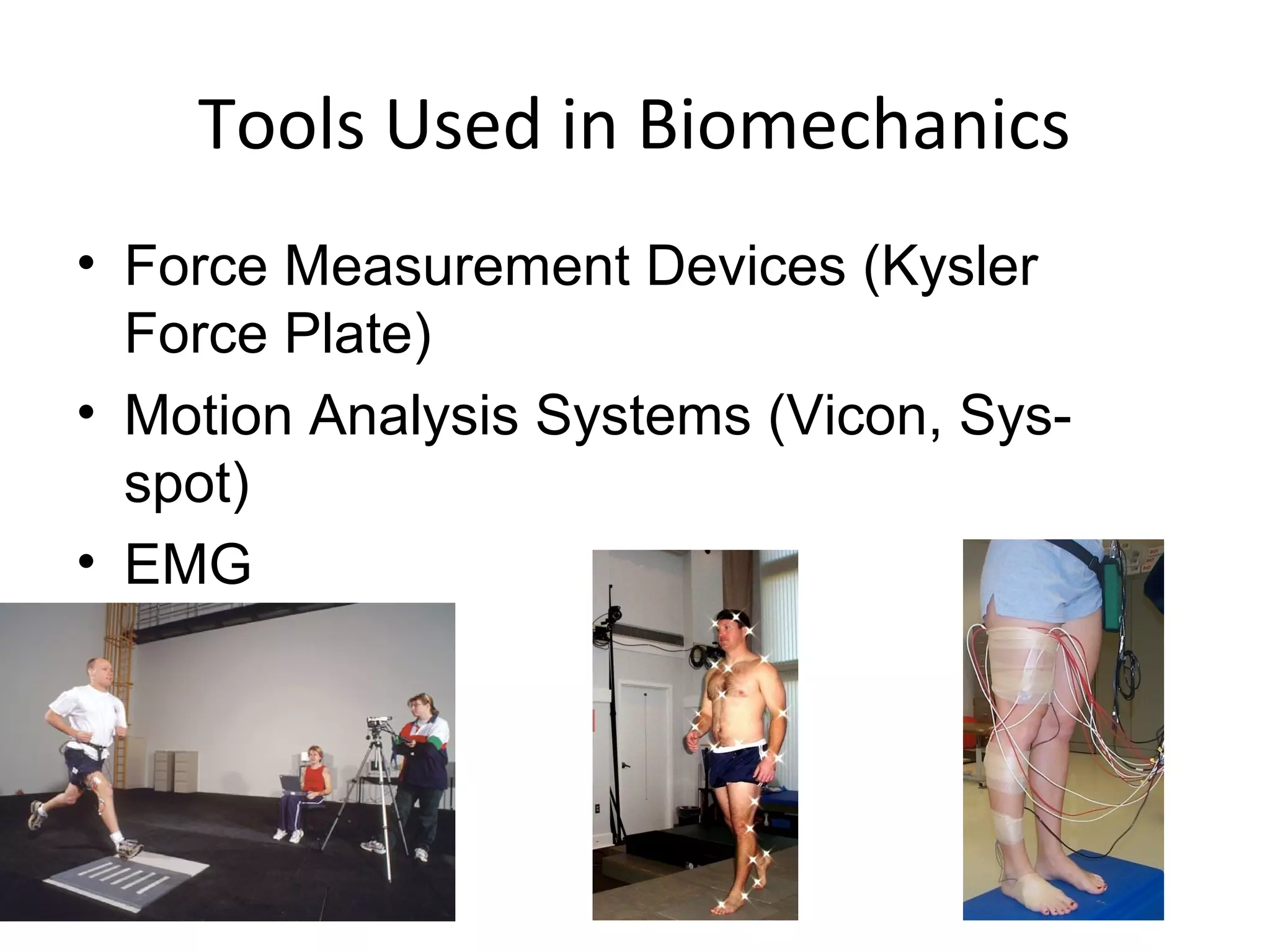
Tools Used in Biomechanics
• Force Measurement Devices (Kysler
Force Plate)
• Motion Analysis Systems (Vicon, Sys-
spot)
• EMG
Challenges in Biomechanics
• Humans cannot be measured
or tested in the same way that
machines can.
• “Design objectives” for human
bodies are not always clear.
• Human bodies are different
from one another.

What is biomechanics?

  • 1.
    • Kinesiology -Scientific studyof human movement. -Umbrella term to describe any form of human movement evaluation • Biomechanics: Hay(1985) -‘...the science that examines the internal and external forces acting on a human body and the effects produced by these forces.’ (page 3) • Challis (1999) -‘...the examination of biological phenomenon, from a mechanical perspective, with a view to identifying the mechanisms responsible for the phenomena.’ • Enoka (2002) -‘...the application of the principles of mechanics to the study of biological phenomenon.’ (page 282)
  • 2.
    • McGinnis(2005) -‘…the studyof forces and their effects on living systems.’ • Hall (2007) -“…science involving the study of biological systems from a mechanical perspective.” • Biomechanics: Course Definition -Area of study wherein the knowledge and methods of mechanics are applied to the structure and function of the living system. -It includes a combination of knowledge of the biological and material properties of the skeletal, articular and neuromuscular systems as well as the principles set forth in mechanical physics.
  • 3.
    Biomechanics: Course Definition • Areaof study wherein the knowledge and methods of mechanics are applied to the structure and function of the living system. • It includes a combination of knowledge of the biological and material properties of the skeletal, articular and neuromuscular systems as well as the principles set forth in mechanical physics.
  • 4.
    Branches of Biomechanics •Cardiovascular and Respiratory Biomechanics • Injury Biomechanics • Orthopaedic Biomechanics • Rehabilitation Biomechanics • Cellular Biomechanics • Sports Biomechanics • Musculoskeletal Biomechanics
  • 5.
    • Performance Improvement –Technique Improvement – Equipment Improvement – Training Improvement • Injury Prevention and Rehabilitation – Reduce Injury – Equipment Design • Cadaver simulation Dr. Andy Hoskins/Dr. Neil Sharkey Lateral Far Lateral Near Medial Near
  • 6.
    Biomechanical Analyses Motion analysis of baseballpitcher Computer simulation of total knee replacement (PSU) Cadaver simulation of walking step (PSU) Investigation of mechanics of tendon transfer operation (PSU)
  • 7.
    Historical Perspective • Leonardoda Vinci (1452-1519) – Considered anatomical structure and function • Galileo (1564-1643) – Projectile motion and effects of scale • Jules Marey (1830-1904) and Eadweard Muybridge (1831- 1904) • Muybridge:Recording of Animal Motion(Galloping horse) (1879) • Marey:Biomechanical Measurements • Braune and Fischer – Anthropometry and walking mechanics – Army and backpacks-8 years to reduce data • A. V. Hill (1886-1977) – Most famous for • Force vs. velocity properties of muscle • Muscle energetics
  • 8.
    Types of Analysis •Qualitative: deals with the nature of an activity, but does not deal with measurement. -Approach used by coaches and scientists initially. • Quantitative: involves measurement as well as considers the nature of the activity. -Approach taken by scientists.
  • 9.
    Tools Used inBiomechanics • Force Measurement Devices (Kysler Force Plate) • Motion Analysis Systems (Vicon, Sys- spot) • EMG
  • 10.
    Challenges in Biomechanics •Humans cannot be measured or tested in the same way that machines can. • “Design objectives” for human bodies are not always clear. • Human bodies are different from one another.