Chapter 1:
An Introduction to the
Human Body

Copyright 2009, John Wiley & Sons, Inc.


Overview


Meaning of anatomy and physiology



Organization of the human body and properties



Regulation of internal environment



Basic vocabulary

Copyright 2009, John Wiley & Sons, Inc.
Anatomy and Physiology Defined


Two branches of science that deal with
body’s parts and function


Anatomy






The science of body structures and relationships
First studies by dissection (cutting apart)
Imaging techniques

Physiology


The science of body functions

Copyright 2009, John Wiley & Sons, Inc.
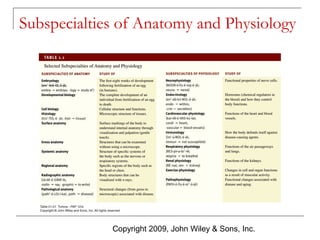
Subspecialties of Anatomy and Physiology

Copyright 2009, John Wiley & Sons, Inc.
Structure and Function




Structure and function of the body are closely
related
Structure of a part of the body allows
performance of certain functions


Examples:



Bones of the skull provide protection for the brain
Thin air sacs of the lungs permit movement of oxygen

Copyright 2009, John Wiley & Sons, Inc.
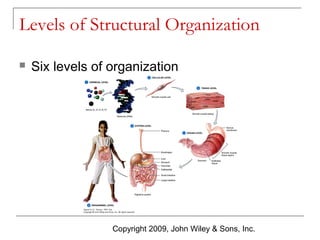
Levels of Structural Organization


Six levels of organization

Copyright 2009, John Wiley & Sons, Inc.
Levels of structural organization


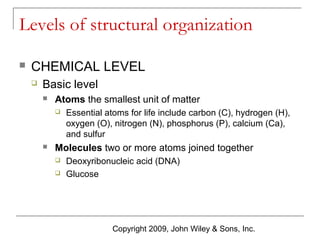
CHEMICAL LEVEL


Basic level


Atoms the smallest unit of matter




Essential atoms for life include carbon (C), hydrogen (H),
oxygen (O), nitrogen (N), phosphorus (P), calcium (Ca),
and sulfur

Molecules two or more atoms joined together



Deoxyribonucleic acid (DNA)
Glucose

Copyright 2009, John Wiley & Sons, Inc.
Levels of structural organization


CELLULAR LEVEL


Molecules combine to form cells





Cells are the basic structural and functional units of an
organism
Many kinds of cells in the body
Muscle cells, nerve cells, epithelial cells, etc.

Copyright 2009, John Wiley & Sons, Inc.
Levels of structural organization


TISSUE LEVEL


Tissues are groups of cells and materials
surrounding them


Four basic types of tissues:





Epithelial
Connective
Muscular
Nervous

Copyright 2009, John Wiley & Sons, Inc.
Levels of structural organization


ORGAN LEVEL


Tissues are joined together to form organs




Organs are structures that are composed of two or more
different types of tissues
Specific functions and recognizable shapes





Examples:
Heart, lungs, kidneys
Stomach is made of several tissues
Serous membrane, smooth muscle and epithelial layers for
digestion

Copyright 2009, John Wiley & Sons, Inc.
Levels of structural organization


SYSTEM LEVEL




A system consists of related organs with a
common function
Organ-system level





Digestive system breaks down and absorbs food
It includes organs such as the mouth, small and large
intestines, liver, gallbladder, and pancreas
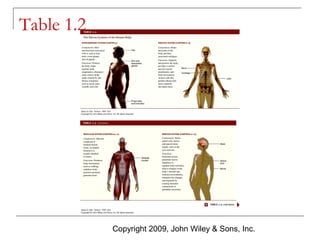
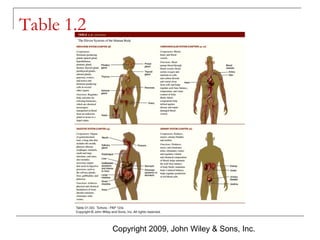
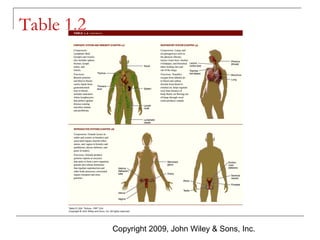
Eleven systems of the human body

Copyright 2009, John Wiley & Sons, Inc.
Table 1.2

Copyright 2009, John Wiley & Sons, Inc.
Table 1.2

Copyright 2009, John Wiley & Sons, Inc.
Table 1.2

Copyright 2009, John Wiley & Sons, Inc.
Levels of structural organization


ORGANISMAL LEVEL



An organism or any living individual
All parts of the body functioning together

Copyright 2009, John Wiley & Sons, Inc.
Clinical Connection: Noninvasive
Diagnostic Techniques


Used to assess aspects of body structure and
function


Inspection of the body to observe any changes


Palpation




Auscultation or




Gently touching body surfaces with hands
listening to body sounds (stethoscope)

Percussion


Tapping on the body surface with fingertips and listening to
echoes

Copyright 2009, John Wiley & Sons, Inc.
Characteristics of Living Human
Organism


Basic Life Processes



Distinguish living from non-living things
Six important life process







Metabolism
Responsiveness
Movement
Growth
Differentiation
Reproduction

Copyright 2009, John Wiley & Sons, Inc.
Metabolism and Responsiveness


Metabolism


Sum of all the chemical process that occur in the body






Catabolism or the breakdown of complex chemical
substances into simpler components
Anabolism or the building up of complex chemical
substances from smaller, simpler components

Responsiveness


Body’s ability to detect and respond to changes




Decrease in body temperature
Responding to sound
Nerve (electrical signals) and muscle cells (contracting)
Copyright 2009, John Wiley & Sons, Inc.
Movement and Growth


Movement


Motion of the whole body





Organs, cells, and tiny subcellular structures
Leg muscles move the body from one place to another

Growth


Increase in body size




Due to an increase in existing cells, number of cells, or
both
In bone growth materials between cells increase

Copyright 2009, John Wiley & Sons, Inc.
Differentiation and Reproduction


Differentiation


Development of a cell from an unspecialized to
specialized state






Cells have specialized structures and functions that
differ from precursor cells
Stem cells give rise to cells that undergo differentiation

Reproduction




Formation of new cells (growth, repair, or
replacement)
Production of a new individual
Copyright 2009, John Wiley & Sons, Inc.
Homeostasis


A condition of equilibrium (balance) in the
body’s internal environment




Dynamic condition
Narrow range is compatible with maintaining life
Example




Blood glucose levels range between 70 and 110 mg of
glucose/dL of blood
Whole body contributes to maintain the internal
environment within normal limits

Copyright 2009, John Wiley & Sons, Inc.
Homeostasis and Body Fluids


Maintaining the volume and composition of
body fluids are important




Body fluids are defined as dilute, watery
solutions containing dissolved chemicals inside or
outside of the cell
Intracellular Fluid (ICF)




Fluid within cells

Extracellular Fluid (ECF)



Fluid outside cells
Interstitial fluid is ECF between cells and tissues
Copyright 2009, John Wiley & Sons, Inc.
ECF and Body Location


Blood Plasma




Lymph




ECF in the brain and spinal cord

Synovial fluid




ECF within lymphatic vessels

Cerebrospinal fluid (CSF)




ECF within blood vessels

ECF in joints

Aqueous humor and vitreous body


ECF in eyes

Copyright 2009, John Wiley & Sons, Inc.
Interstitial Fluid and Body Function





Cellular function depends on the regulation of
composition of interstitial fluid
Body’s internal environment
Composition of interstitial fluid changes as it
moves


Movement back and forth across capillary walls
provide nutrients (glucose, oxygen, ions) to tissue
cells and removes waste (carbon dioxide)

Copyright 2009, John Wiley & Sons, Inc.
Control of Homeostasis


Homeostasis is constantly being disrupted


Physical insults




Changes in the internal environment




Drop in blood glucose due to lack of food

Physiological stress




Intense heat or lack of oxygen

Demands of work or school

Disruptions



Mild and temporary (balance is quickly restored)
Intense and Prolonged (poisoning or severe infections)
Copyright 2009, John Wiley & Sons, Inc.
Feedback System (insert figure 1.2)


Cycle of events






Body is monitored and
re-monitored
Each monitored variable
is termed a controlled
condition

Three Basic
components




Receptor
Control center
Effector

Copyright 2009, John Wiley & Sons, Inc.
Feedback Systems


Receptor




Body structure that monitors changes in a
controlled condition
Sends input to the control center


Nerve ending of the skin in response to temperature
change

Copyright 2009, John Wiley & Sons, Inc.
Feedback Systems


Control Center






Brain
Sets the range of values to be maintained
Evaluates input received from receptors and
generates output command
Nerve impulses, hormones


Brains acts as a control center receiving nerve impulses
from skin temperature receptors

Copyright 2009, John Wiley & Sons, Inc.
Feedback Systems


Effector



Receives output from the control center
Produces a response or effect that changes the
controlled condition





Found in nearly every organ or tissue
Body temperature drops the brain sends and impulse to
the skeletal muscles to contract
Shivering to generate heat

Copyright 2009, John Wiley & Sons, Inc.
Negative and Positive Feedback systems


Negative Feedback systems


Reverses a change in a controlled condition




Regulation of blood pressure (force exerted by blood as
it presses again the walls of the blood vessels)

Positive Feedback systems


Strengthen or reinforce a change in one of the
body’s controlled conditions


Normal child birth

Copyright 2009, John Wiley & Sons, Inc.
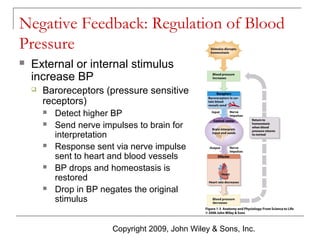
Negative Feedback: Regulation of Blood
Pressure


External or internal stimulus
increase BP


Baroreceptors (pressure sensitive
receptors)









Detect higher BP
Send nerve impulses to brain for
interpretation
Response sent via nerve impulse
sent to heart and blood vessels
BP drops and homeostasis is
restored
Drop in BP negates the original
stimulus
Copyright 2009, John Wiley & Sons, Inc.
Positive Feedback Systems: Normal
Childbirth










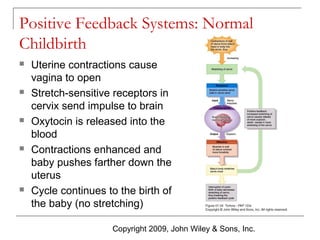
Uterine contractions cause
vagina to open
Stretch-sensitive receptors in
cervix send impulse to brain
Oxytocin is released into the
blood
Contractions enhanced and
baby pushes farther down the
uterus
Cycle continues to the birth of
the baby (no stretching)
Copyright 2009, John Wiley & Sons, Inc.
Homeostatic Imbalances


Normal equilibrium of body processes are
disrupted


Moderate imbalance








Disorder or abnormality of structure and function
Disease specific for an illness with recognizable signs
and symptoms
Signs are objective changes such as a fever or swelling
Symptoms are subjective changes such as headache

Severe imbalance


Death
Copyright 2009, John Wiley & Sons, Inc.
Clinical Connection: Autopsy




Postmortem (after death) examination of the
body and internal organs
Several uses:






Determine the cause of death
Identify diseases not detected during life
Determine the extent of injuries and contribution
to death
Hereditary conditions

Copyright 2009, John Wiley & Sons, Inc.
Homeostatic Imbalances:
Areas of Science


Epidemiology





Occurrence of diseases
Transmission in a community

Pharmacology



Effects and uses of drugs
Treatment of disease

Copyright 2009, John Wiley & Sons, Inc.
Clinical Connection: Diagnosis of Disease


Distinguishing one disorder or disease from
another



Signs and symptoms
Medical history





Collecting information about event
Present illnesses and past medical problems

Physical examination



Orderly evaluation of the body and its function
Noninvasive techniques and other vital signs (pulse)

Copyright 2009, John Wiley & Sons, Inc.
Basic Anatomical Terminology




Common language referring to body
structures and their functions
Anatomists use standard anatomical position
and special vocabulary in relating body parts

Copyright 2009, John Wiley & Sons, Inc.
Body Positions




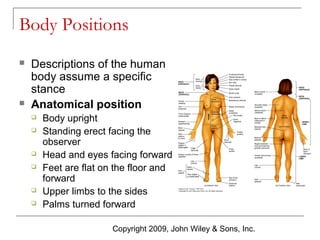
Descriptions of the human
body assume a specific
stance
Anatomical position









Body upright
Standing erect facing the
observer
Head and eyes facing forward
Feet are flat on the floor and
forward
Upper limbs to the sides
Palms turned forward
Copyright 2009, John Wiley & Sons, Inc.
Anatomical position



Body is upright
Terms for a reclining body


Prone position




Body is lying face down

Supine position


Body is lying face up

Copyright 2009, John Wiley & Sons, Inc.
Regional Names


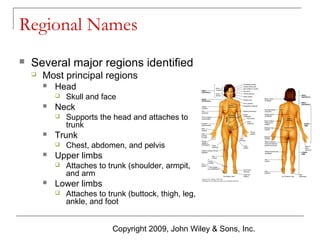
Several major regions identified


Most principal regions


Head




Neck




Chest, abdomen, and pelvis

Upper limbs




Supports the head and attaches to
trunk

Trunk




Skull and face

Attaches to trunk (shoulder, armpit,
and arm

Lower limbs


Attaches to trunk (buttock, thigh, leg,
ankle, and foot
Copyright 2009, John Wiley & Sons, Inc.
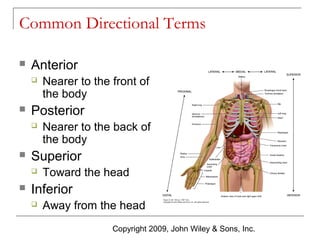
Directional Terms


Describe the position of one body part
relative to another


Group in pairs with opposite meaning




Anterior (front) and posterior (back)

Only make sense when used to describe a
position of one structure relative to another



The esophagus is posterior to the trachea
Knee is superior to the ankle

Copyright 2009, John Wiley & Sons, Inc.
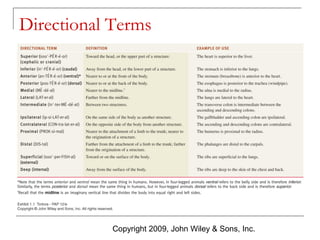
Directional Terms

Copyright 2009, John Wiley & Sons, Inc.
Common Directional Terms


Anterior




Posterior




Nearer to the back of
the body

Superior




Nearer to the front of
the body

Toward the head

Inferior


Away from the head
Copyright 2009, John Wiley & Sons, Inc.
Common Directional Terms


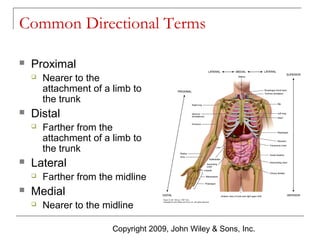
Proximal




Distal




Farther from the
attachment of a limb to
the trunk

Lateral




Nearer to the
attachment of a limb to
the trunk

Farther from the midline

Medial


Nearer to the midline
Copyright 2009, John Wiley & Sons, Inc.
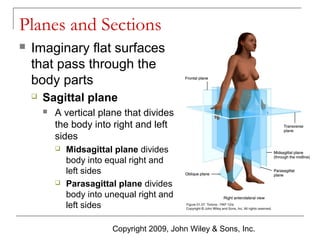
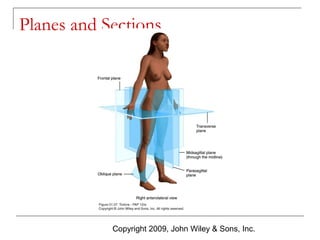
Planes and Sections


Imaginary flat surfaces
that pass through the
body parts


Sagittal plane


A vertical plane that divides
the body into right and left
sides




Midsagittal plane divides
body into equal right and
left sides
Parasagittal plane divides
body into unequal right and
left sides
Copyright 2009, John Wiley & Sons, Inc.
Planes and Sections


Frontal or coronal plane




Divides the body or an organ into anterior (front)
and posterior (back) portions

Transverse plane




Divides the body or an organ into superior (upper)
and inferior (lower) portions
Also called cross-sectional or horizontal plane

Copyright 2009, John Wiley & Sons, Inc.
Planes and Sections

Copyright 2009, John Wiley & Sons, Inc.
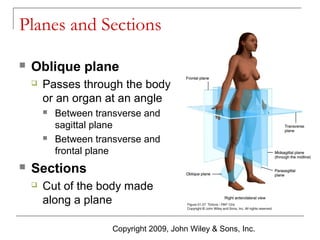
Planes and Sections


Oblique plane


Passes through the body
or an organ at an angle






Between transverse and
sagittal plane
Between transverse and
frontal plane

Sections


Cut of the body made
along a plane
Copyright 2009, John Wiley & Sons, Inc.
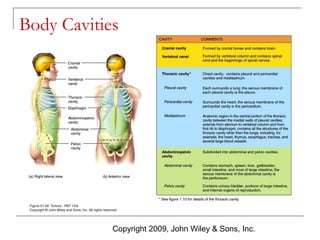
Body Cavities


Spaces within the body that help protect,
separate, and support internal organs




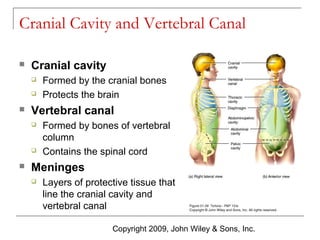
Cranial cavity
Thoracic cavity
Abdominopelvic cavity

Copyright 2009, John Wiley & Sons, Inc.
Body Cavities

Copyright 2009, John Wiley & Sons, Inc.
Cranial Cavity and Vertebral Canal


Cranial cavity





Vertebral canal






Formed by the cranial bones
Protects the brain
Formed by bones of vertebral
column
Contains the spinal cord

Meninges


Layers of protective tissue that
line the cranial cavity and
vertebral canal
Copyright 2009, John Wiley & Sons, Inc.
Thoracic Cavity




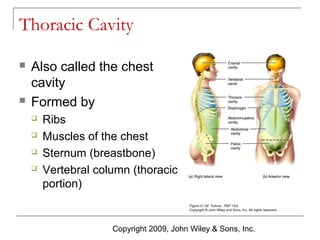
Also called the chest
cavity
Formed by





Ribs
Muscles of the chest
Sternum (breastbone)
Vertebral column (thoracic
portion)

Copyright 2009, John Wiley & Sons, Inc.
Thoracic Cavity


Within the thoracic
cavity


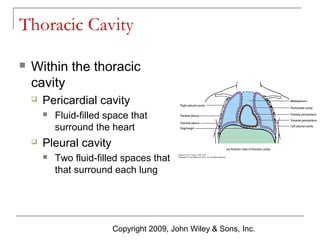
Pericardial cavity




Fluid-filled space that
surround the heart

Pleural cavity


Two fluid-filled spaces that
that surround each lung

Copyright 2009, John Wiley & Sons, Inc.
Thoracic Cavity


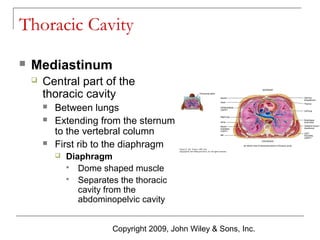
Mediastinum


Central part of the
thoracic cavity





Between lungs
Extending from the sternum
to the vertebral column
First rib to the diaphragm


Diaphragm
 Dome shaped muscle
 Separates the thoracic
cavity from the
abdominopelvic cavity
Copyright 2009, John Wiley & Sons, Inc.
Abdominopelvic Cavity





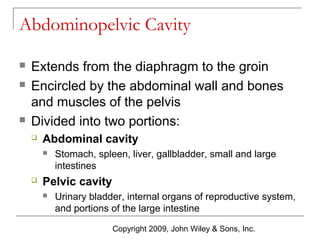
Extends from the diaphragm to the groin
Encircled by the abdominal wall and bones
and muscles of the pelvis
Divided into two portions:


Abdominal cavity




Stomach, spleen, liver, gallbladder, small and large
intestines

Pelvic cavity


Urinary bladder, internal organs of reproductive system,
and portions of the large intestine
Copyright 2009, John Wiley & Sons, Inc.
Thoracic and Abdominal Cavity
Membranes


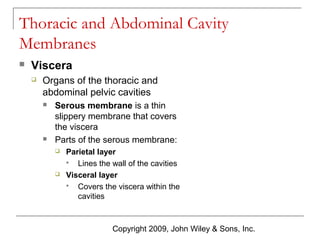
Viscera


Organs of the thoracic and
abdominal pelvic cavities




Serous membrane is a thin
slippery membrane that covers
the viscera
Parts of the serous membrane:




Parietal layer

Lines the wall of the cavities
Visceral layer

Covers the viscera within the
cavities

Copyright 2009, John Wiley & Sons, Inc.
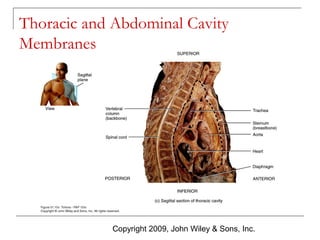
Thoracic and Abdominal Cavity
Membranes

Copyright 2009, John Wiley & Sons, Inc.
Thoracic and Abdominal Cavity
Membranes


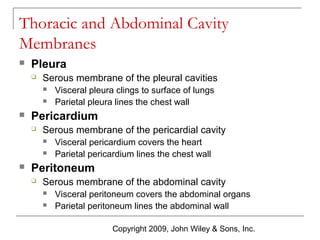
Pleura


Serous membrane of the pleural cavities





Pericardium


Serous membrane of the pericardial cavity





Visceral pleura clings to surface of lungs
Parietal pleura lines the chest wall

Visceral pericardium covers the heart
Parietal pericardium lines the chest wall

Peritoneum


Serous membrane of the abdominal cavity



Visceral peritoneum covers the abdominal organs
Parietal peritoneum lines the abdominal wall
Copyright 2009, John Wiley & Sons, Inc.
Other Cavities


Oral (mouth) cavity




Nasal cavity




eyeball

Middle ear cavities




nose

Orbital cavities




Tongue and teeth

Small bones of the middle ear

Synovial cavities


Joints
Copyright 2009, John Wiley & Sons, Inc.
Abdominopelvic Regions


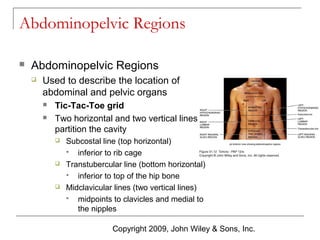
Abdominopelvic Regions


Used to describe the location of
abdominal and pelvic organs



Tic-Tac-Toe grid
Two horizontal and two vertical lines
partition the cavity






Subcostal line (top horizontal)

inferior to rib cage
Transtubercular line (bottom horizontal)

inferior to top of the hip bone
Midclavicular lines (two vertical lines)

midpoints to clavicles and medial to
the nipples
Copyright 2009, John Wiley & Sons, Inc.
Nine Abdominopelvic Regions






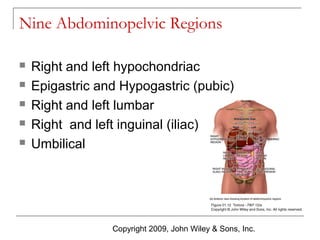
Right and left hypochondriac
Epigastric and Hypogastric (pubic)
Right and left lumbar
Right and left inguinal (iliac)
Umbilical

Copyright 2009, John Wiley & Sons, Inc.
Quadrants


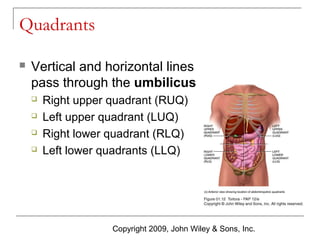
Vertical and horizontal lines
pass through the umbilicus





Right upper quadrant (RUQ)
Left upper quadrant (LUQ)
Right lower quadrant (RLQ)
Left lower quadrants (LLQ)

Copyright 2009, John Wiley & Sons, Inc.
Medical Imaging


Techniques and procedures used to create
images of the human body





Allow visualization of structures inside the body
Diagnosis of anatomical and physiological
disorders
Conventional radiography (X-rays) have been in
use since the late 1940’s

Copyright 2009, John Wiley & Sons, Inc.
Radiography (insert figures for each image
in following slides)


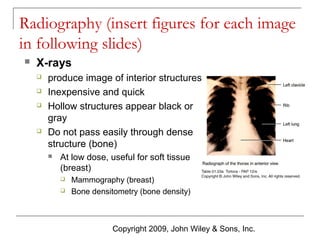
X-rays






produce image of interior structures
Inexpensive and quick
Hollow structures appear black or
gray
Do not pass easily through dense
structure (bone)


At low dose, useful for soft tissue
(breast)



Mammography (breast)
Bone densitometry (bone density)

Copyright 2009, John Wiley & Sons, Inc.
Magnetic Resonance Imaging (MRI)


High energy magnetic field




Color image on a video
monitor




2D and 3D blueprint

Relatively safe procedure




Protons in body fluid align with
field

Not used on patients containing
metal

Used for differentiating
normal and abnormal tissues


Tumors, brain abnormalities,
blood flow
Copyright 2009, John Wiley & Sons, Inc.
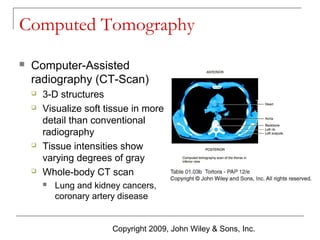
Computed Tomography


Computer-Assisted
radiography (CT-Scan)







3-D structures
Visualize soft tissue in more
detail than conventional
radiography
Tissue intensities show
varying degrees of gray
Whole-body CT scan


Lung and kidney cancers,
coronary artery disease

Copyright 2009, John Wiley & Sons, Inc.
Ultrasound Scanning


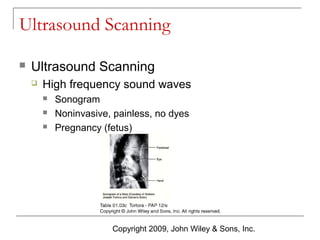
Ultrasound Scanning


High frequency sound waves




Sonogram
Noninvasive, painless, no dyes
Pregnancy (fetus)

Copyright 2009, John Wiley & Sons, Inc.
Radionuclide Scanning


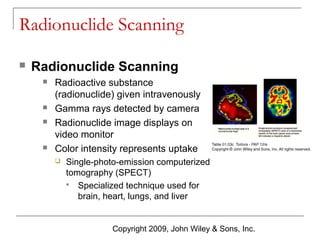
Radionuclide Scanning







Radioactive substance
(radionuclide) given intravenously
Gamma rays detected by camera
Radionuclide image displays on
video monitor
Color intensity represents uptake


Single-photo-emission computerized
tomography (SPECT)
 Specialized technique used for
brain, heart, lungs, and liver

Copyright 2009, John Wiley & Sons, Inc.
Positron Emission Tomography (PET)


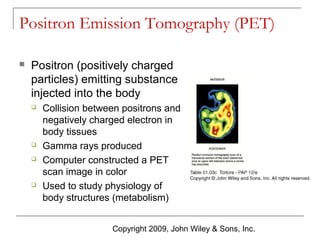
Positron (positively charged
particles) emitting substance
injected into the body







Collision between positrons and
negatively charged electron in
body tissues
Gamma rays produced
Computer constructed a PET
scan image in color
Used to study physiology of
body structures (metabolism)
Copyright 2009, John Wiley & Sons, Inc.
Endoscopy


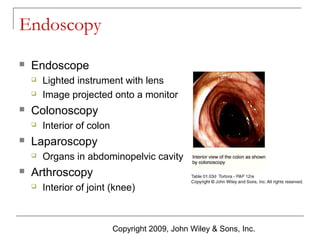
Endoscope





Colonoscopy




Interior of colon

Laparoscopy




Lighted instrument with lens
Image projected onto a monitor

Organs in abdominopelvic cavity

Arthroscopy


Interior of joint (knee)

Copyright 2009, John Wiley & Sons, Inc.
End of Chapter 1
Copyright 2009 John Wiley & Sons, Inc.
All rights reserved. Reproduction or translation of this
work beyond that permitted in section 117 of the 1976
United States Copyright Act without express permission
of the copyright owner is unlawful. Request for further
information should be addressed to the Permission
Department, John Wiley & Sons, Inc. The purchaser may
make back-up copies for his/her own use only and not
for distribution or resale. The Publishers assumes no
responsibility for errors, omissions, or damages caused
by the use of theses programs or from the use of the
information herein.

Copyright 2009, John Wiley & Sons, Inc.

Anatomy and Physiology

  • 1.
    Chapter 1: An Introductionto the Human Body Copyright 2009, John Wiley & Sons, Inc.
  • 2.
     Overview  Meaning of anatomyand physiology  Organization of the human body and properties  Regulation of internal environment  Basic vocabulary Copyright 2009, John Wiley & Sons, Inc.
  • 3.
    Anatomy and PhysiologyDefined  Two branches of science that deal with body’s parts and function  Anatomy     The science of body structures and relationships First studies by dissection (cutting apart) Imaging techniques Physiology  The science of body functions Copyright 2009, John Wiley & Sons, Inc.
  • 4.
    Subspecialties of Anatomyand Physiology Copyright 2009, John Wiley & Sons, Inc.
  • 5.
    Structure and Function   Structureand function of the body are closely related Structure of a part of the body allows performance of certain functions  Examples:   Bones of the skull provide protection for the brain Thin air sacs of the lungs permit movement of oxygen Copyright 2009, John Wiley & Sons, Inc.
  • 6.
    Levels of StructuralOrganization  Six levels of organization Copyright 2009, John Wiley & Sons, Inc.
  • 7.
    Levels of structuralorganization  CHEMICAL LEVEL  Basic level  Atoms the smallest unit of matter   Essential atoms for life include carbon (C), hydrogen (H), oxygen (O), nitrogen (N), phosphorus (P), calcium (Ca), and sulfur Molecules two or more atoms joined together   Deoxyribonucleic acid (DNA) Glucose Copyright 2009, John Wiley & Sons, Inc.
  • 8.
    Levels of structuralorganization  CELLULAR LEVEL  Molecules combine to form cells    Cells are the basic structural and functional units of an organism Many kinds of cells in the body Muscle cells, nerve cells, epithelial cells, etc. Copyright 2009, John Wiley & Sons, Inc.
  • 9.
    Levels of structuralorganization  TISSUE LEVEL  Tissues are groups of cells and materials surrounding them  Four basic types of tissues:     Epithelial Connective Muscular Nervous Copyright 2009, John Wiley & Sons, Inc.
  • 10.
    Levels of structuralorganization  ORGAN LEVEL  Tissues are joined together to form organs   Organs are structures that are composed of two or more different types of tissues Specific functions and recognizable shapes     Examples: Heart, lungs, kidneys Stomach is made of several tissues Serous membrane, smooth muscle and epithelial layers for digestion Copyright 2009, John Wiley & Sons, Inc.
  • 11.
    Levels of structuralorganization  SYSTEM LEVEL   A system consists of related organs with a common function Organ-system level    Digestive system breaks down and absorbs food It includes organs such as the mouth, small and large intestines, liver, gallbladder, and pancreas Eleven systems of the human body Copyright 2009, John Wiley & Sons, Inc.
  • 12.
    Table 1.2 Copyright 2009,John Wiley & Sons, Inc.
  • 13.
    Table 1.2 Copyright 2009,John Wiley & Sons, Inc.
  • 14.
    Table 1.2 Copyright 2009,John Wiley & Sons, Inc.
  • 15.
    Levels of structuralorganization  ORGANISMAL LEVEL   An organism or any living individual All parts of the body functioning together Copyright 2009, John Wiley & Sons, Inc.
  • 16.
    Clinical Connection: Noninvasive DiagnosticTechniques  Used to assess aspects of body structure and function  Inspection of the body to observe any changes  Palpation   Auscultation or   Gently touching body surfaces with hands listening to body sounds (stethoscope) Percussion  Tapping on the body surface with fingertips and listening to echoes Copyright 2009, John Wiley & Sons, Inc.
  • 17.
    Characteristics of LivingHuman Organism  Basic Life Processes   Distinguish living from non-living things Six important life process       Metabolism Responsiveness Movement Growth Differentiation Reproduction Copyright 2009, John Wiley & Sons, Inc.
  • 18.
    Metabolism and Responsiveness  Metabolism  Sumof all the chemical process that occur in the body    Catabolism or the breakdown of complex chemical substances into simpler components Anabolism or the building up of complex chemical substances from smaller, simpler components Responsiveness  Body’s ability to detect and respond to changes    Decrease in body temperature Responding to sound Nerve (electrical signals) and muscle cells (contracting) Copyright 2009, John Wiley & Sons, Inc.
  • 19.
    Movement and Growth  Movement  Motionof the whole body    Organs, cells, and tiny subcellular structures Leg muscles move the body from one place to another Growth  Increase in body size   Due to an increase in existing cells, number of cells, or both In bone growth materials between cells increase Copyright 2009, John Wiley & Sons, Inc.
  • 20.
    Differentiation and Reproduction  Differentiation  Developmentof a cell from an unspecialized to specialized state    Cells have specialized structures and functions that differ from precursor cells Stem cells give rise to cells that undergo differentiation Reproduction   Formation of new cells (growth, repair, or replacement) Production of a new individual Copyright 2009, John Wiley & Sons, Inc.
  • 21.
    Homeostasis  A condition ofequilibrium (balance) in the body’s internal environment    Dynamic condition Narrow range is compatible with maintaining life Example   Blood glucose levels range between 70 and 110 mg of glucose/dL of blood Whole body contributes to maintain the internal environment within normal limits Copyright 2009, John Wiley & Sons, Inc.
  • 22.
    Homeostasis and BodyFluids  Maintaining the volume and composition of body fluids are important   Body fluids are defined as dilute, watery solutions containing dissolved chemicals inside or outside of the cell Intracellular Fluid (ICF)   Fluid within cells Extracellular Fluid (ECF)   Fluid outside cells Interstitial fluid is ECF between cells and tissues Copyright 2009, John Wiley & Sons, Inc.
  • 23.
    ECF and BodyLocation  Blood Plasma   Lymph   ECF in the brain and spinal cord Synovial fluid   ECF within lymphatic vessels Cerebrospinal fluid (CSF)   ECF within blood vessels ECF in joints Aqueous humor and vitreous body  ECF in eyes Copyright 2009, John Wiley & Sons, Inc.
  • 24.
    Interstitial Fluid andBody Function    Cellular function depends on the regulation of composition of interstitial fluid Body’s internal environment Composition of interstitial fluid changes as it moves  Movement back and forth across capillary walls provide nutrients (glucose, oxygen, ions) to tissue cells and removes waste (carbon dioxide) Copyright 2009, John Wiley & Sons, Inc.
  • 25.
    Control of Homeostasis  Homeostasisis constantly being disrupted  Physical insults   Changes in the internal environment   Drop in blood glucose due to lack of food Physiological stress   Intense heat or lack of oxygen Demands of work or school Disruptions   Mild and temporary (balance is quickly restored) Intense and Prolonged (poisoning or severe infections) Copyright 2009, John Wiley & Sons, Inc.
  • 26.
    Feedback System (insertfigure 1.2)  Cycle of events    Body is monitored and re-monitored Each monitored variable is termed a controlled condition Three Basic components    Receptor Control center Effector Copyright 2009, John Wiley & Sons, Inc.
  • 27.
    Feedback Systems  Receptor   Body structurethat monitors changes in a controlled condition Sends input to the control center  Nerve ending of the skin in response to temperature change Copyright 2009, John Wiley & Sons, Inc.
  • 28.
    Feedback Systems  Control Center     Brain Setsthe range of values to be maintained Evaluates input received from receptors and generates output command Nerve impulses, hormones  Brains acts as a control center receiving nerve impulses from skin temperature receptors Copyright 2009, John Wiley & Sons, Inc.
  • 29.
    Feedback Systems  Effector   Receives outputfrom the control center Produces a response or effect that changes the controlled condition    Found in nearly every organ or tissue Body temperature drops the brain sends and impulse to the skeletal muscles to contract Shivering to generate heat Copyright 2009, John Wiley & Sons, Inc.
  • 30.
    Negative and PositiveFeedback systems  Negative Feedback systems  Reverses a change in a controlled condition   Regulation of blood pressure (force exerted by blood as it presses again the walls of the blood vessels) Positive Feedback systems  Strengthen or reinforce a change in one of the body’s controlled conditions  Normal child birth Copyright 2009, John Wiley & Sons, Inc.
  • 31.
    Negative Feedback: Regulationof Blood Pressure  External or internal stimulus increase BP  Baroreceptors (pressure sensitive receptors)      Detect higher BP Send nerve impulses to brain for interpretation Response sent via nerve impulse sent to heart and blood vessels BP drops and homeostasis is restored Drop in BP negates the original stimulus Copyright 2009, John Wiley & Sons, Inc.
  • 32.
    Positive Feedback Systems:Normal Childbirth      Uterine contractions cause vagina to open Stretch-sensitive receptors in cervix send impulse to brain Oxytocin is released into the blood Contractions enhanced and baby pushes farther down the uterus Cycle continues to the birth of the baby (no stretching) Copyright 2009, John Wiley & Sons, Inc.
  • 33.
    Homeostatic Imbalances  Normal equilibriumof body processes are disrupted  Moderate imbalance      Disorder or abnormality of structure and function Disease specific for an illness with recognizable signs and symptoms Signs are objective changes such as a fever or swelling Symptoms are subjective changes such as headache Severe imbalance  Death Copyright 2009, John Wiley & Sons, Inc.
  • 34.
    Clinical Connection: Autopsy   Postmortem(after death) examination of the body and internal organs Several uses:     Determine the cause of death Identify diseases not detected during life Determine the extent of injuries and contribution to death Hereditary conditions Copyright 2009, John Wiley & Sons, Inc.
  • 35.
    Homeostatic Imbalances: Areas ofScience  Epidemiology    Occurrence of diseases Transmission in a community Pharmacology   Effects and uses of drugs Treatment of disease Copyright 2009, John Wiley & Sons, Inc.
  • 36.
    Clinical Connection: Diagnosisof Disease  Distinguishing one disorder or disease from another   Signs and symptoms Medical history    Collecting information about event Present illnesses and past medical problems Physical examination   Orderly evaluation of the body and its function Noninvasive techniques and other vital signs (pulse) Copyright 2009, John Wiley & Sons, Inc.
  • 37.
    Basic Anatomical Terminology   Commonlanguage referring to body structures and their functions Anatomists use standard anatomical position and special vocabulary in relating body parts Copyright 2009, John Wiley & Sons, Inc.
  • 38.
    Body Positions   Descriptions ofthe human body assume a specific stance Anatomical position       Body upright Standing erect facing the observer Head and eyes facing forward Feet are flat on the floor and forward Upper limbs to the sides Palms turned forward Copyright 2009, John Wiley & Sons, Inc.
  • 39.
    Anatomical position   Body isupright Terms for a reclining body  Prone position   Body is lying face down Supine position  Body is lying face up Copyright 2009, John Wiley & Sons, Inc.
  • 40.
    Regional Names  Several majorregions identified  Most principal regions  Head   Neck   Chest, abdomen, and pelvis Upper limbs   Supports the head and attaches to trunk Trunk   Skull and face Attaches to trunk (shoulder, armpit, and arm Lower limbs  Attaches to trunk (buttock, thigh, leg, ankle, and foot Copyright 2009, John Wiley & Sons, Inc.
  • 41.
    Directional Terms  Describe theposition of one body part relative to another  Group in pairs with opposite meaning   Anterior (front) and posterior (back) Only make sense when used to describe a position of one structure relative to another   The esophagus is posterior to the trachea Knee is superior to the ankle Copyright 2009, John Wiley & Sons, Inc.
  • 42.
    Directional Terms Copyright 2009,John Wiley & Sons, Inc.
  • 43.
    Common Directional Terms  Anterior   Posterior   Nearerto the back of the body Superior   Nearer to the front of the body Toward the head Inferior  Away from the head Copyright 2009, John Wiley & Sons, Inc.
  • 44.
    Common Directional Terms  Proximal   Distal   Fartherfrom the attachment of a limb to the trunk Lateral   Nearer to the attachment of a limb to the trunk Farther from the midline Medial  Nearer to the midline Copyright 2009, John Wiley & Sons, Inc.
  • 45.
    Planes and Sections  Imaginaryflat surfaces that pass through the body parts  Sagittal plane  A vertical plane that divides the body into right and left sides   Midsagittal plane divides body into equal right and left sides Parasagittal plane divides body into unequal right and left sides Copyright 2009, John Wiley & Sons, Inc.
  • 46.
    Planes and Sections  Frontalor coronal plane   Divides the body or an organ into anterior (front) and posterior (back) portions Transverse plane   Divides the body or an organ into superior (upper) and inferior (lower) portions Also called cross-sectional or horizontal plane Copyright 2009, John Wiley & Sons, Inc.
  • 47.
    Planes and Sections Copyright2009, John Wiley & Sons, Inc.
  • 48.
    Planes and Sections  Obliqueplane  Passes through the body or an organ at an angle    Between transverse and sagittal plane Between transverse and frontal plane Sections  Cut of the body made along a plane Copyright 2009, John Wiley & Sons, Inc.
  • 49.
    Body Cavities  Spaces withinthe body that help protect, separate, and support internal organs    Cranial cavity Thoracic cavity Abdominopelvic cavity Copyright 2009, John Wiley & Sons, Inc.
  • 50.
    Body Cavities Copyright 2009,John Wiley & Sons, Inc.
  • 51.
    Cranial Cavity andVertebral Canal  Cranial cavity    Vertebral canal    Formed by the cranial bones Protects the brain Formed by bones of vertebral column Contains the spinal cord Meninges  Layers of protective tissue that line the cranial cavity and vertebral canal Copyright 2009, John Wiley & Sons, Inc.
  • 52.
    Thoracic Cavity   Also calledthe chest cavity Formed by     Ribs Muscles of the chest Sternum (breastbone) Vertebral column (thoracic portion) Copyright 2009, John Wiley & Sons, Inc.
  • 53.
    Thoracic Cavity  Within thethoracic cavity  Pericardial cavity   Fluid-filled space that surround the heart Pleural cavity  Two fluid-filled spaces that that surround each lung Copyright 2009, John Wiley & Sons, Inc.
  • 54.
    Thoracic Cavity  Mediastinum  Central partof the thoracic cavity    Between lungs Extending from the sternum to the vertebral column First rib to the diaphragm  Diaphragm  Dome shaped muscle  Separates the thoracic cavity from the abdominopelvic cavity Copyright 2009, John Wiley & Sons, Inc.
  • 55.
    Abdominopelvic Cavity    Extends fromthe diaphragm to the groin Encircled by the abdominal wall and bones and muscles of the pelvis Divided into two portions:  Abdominal cavity   Stomach, spleen, liver, gallbladder, small and large intestines Pelvic cavity  Urinary bladder, internal organs of reproductive system, and portions of the large intestine Copyright 2009, John Wiley & Sons, Inc.
  • 56.
    Thoracic and AbdominalCavity Membranes  Viscera  Organs of the thoracic and abdominal pelvic cavities   Serous membrane is a thin slippery membrane that covers the viscera Parts of the serous membrane:   Parietal layer  Lines the wall of the cavities Visceral layer  Covers the viscera within the cavities Copyright 2009, John Wiley & Sons, Inc.
  • 57.
    Thoracic and AbdominalCavity Membranes Copyright 2009, John Wiley & Sons, Inc.
  • 58.
    Thoracic and AbdominalCavity Membranes  Pleura  Serous membrane of the pleural cavities    Pericardium  Serous membrane of the pericardial cavity    Visceral pleura clings to surface of lungs Parietal pleura lines the chest wall Visceral pericardium covers the heart Parietal pericardium lines the chest wall Peritoneum  Serous membrane of the abdominal cavity   Visceral peritoneum covers the abdominal organs Parietal peritoneum lines the abdominal wall Copyright 2009, John Wiley & Sons, Inc.
  • 59.
    Other Cavities  Oral (mouth)cavity   Nasal cavity   eyeball Middle ear cavities   nose Orbital cavities   Tongue and teeth Small bones of the middle ear Synovial cavities  Joints Copyright 2009, John Wiley & Sons, Inc.
  • 60.
    Abdominopelvic Regions  Abdominopelvic Regions  Usedto describe the location of abdominal and pelvic organs   Tic-Tac-Toe grid Two horizontal and two vertical lines partition the cavity    Subcostal line (top horizontal)  inferior to rib cage Transtubercular line (bottom horizontal)  inferior to top of the hip bone Midclavicular lines (two vertical lines)  midpoints to clavicles and medial to the nipples Copyright 2009, John Wiley & Sons, Inc.
  • 61.
    Nine Abdominopelvic Regions      Rightand left hypochondriac Epigastric and Hypogastric (pubic) Right and left lumbar Right and left inguinal (iliac) Umbilical Copyright 2009, John Wiley & Sons, Inc.
  • 62.
    Quadrants  Vertical and horizontallines pass through the umbilicus     Right upper quadrant (RUQ) Left upper quadrant (LUQ) Right lower quadrant (RLQ) Left lower quadrants (LLQ) Copyright 2009, John Wiley & Sons, Inc.
  • 63.
    Medical Imaging  Techniques andprocedures used to create images of the human body    Allow visualization of structures inside the body Diagnosis of anatomical and physiological disorders Conventional radiography (X-rays) have been in use since the late 1940’s Copyright 2009, John Wiley & Sons, Inc.
  • 64.
    Radiography (insert figuresfor each image in following slides)  X-rays     produce image of interior structures Inexpensive and quick Hollow structures appear black or gray Do not pass easily through dense structure (bone)  At low dose, useful for soft tissue (breast)   Mammography (breast) Bone densitometry (bone density) Copyright 2009, John Wiley & Sons, Inc.
  • 65.
    Magnetic Resonance Imaging(MRI)  High energy magnetic field   Color image on a video monitor   2D and 3D blueprint Relatively safe procedure   Protons in body fluid align with field Not used on patients containing metal Used for differentiating normal and abnormal tissues  Tumors, brain abnormalities, blood flow Copyright 2009, John Wiley & Sons, Inc.
  • 66.
    Computed Tomography  Computer-Assisted radiography (CT-Scan)     3-Dstructures Visualize soft tissue in more detail than conventional radiography Tissue intensities show varying degrees of gray Whole-body CT scan  Lung and kidney cancers, coronary artery disease Copyright 2009, John Wiley & Sons, Inc.
  • 67.
    Ultrasound Scanning  Ultrasound Scanning  Highfrequency sound waves    Sonogram Noninvasive, painless, no dyes Pregnancy (fetus) Copyright 2009, John Wiley & Sons, Inc.
  • 68.
    Radionuclide Scanning  Radionuclide Scanning     Radioactivesubstance (radionuclide) given intravenously Gamma rays detected by camera Radionuclide image displays on video monitor Color intensity represents uptake  Single-photo-emission computerized tomography (SPECT)  Specialized technique used for brain, heart, lungs, and liver Copyright 2009, John Wiley & Sons, Inc.
  • 69.
    Positron Emission Tomography(PET)  Positron (positively charged particles) emitting substance injected into the body     Collision between positrons and negatively charged electron in body tissues Gamma rays produced Computer constructed a PET scan image in color Used to study physiology of body structures (metabolism) Copyright 2009, John Wiley & Sons, Inc.
  • 70.
    Endoscopy  Endoscope    Colonoscopy   Interior of colon Laparoscopy   Lightedinstrument with lens Image projected onto a monitor Organs in abdominopelvic cavity Arthroscopy  Interior of joint (knee) Copyright 2009, John Wiley & Sons, Inc.
  • 71.
    End of Chapter1 Copyright 2009 John Wiley & Sons, Inc. All rights reserved. Reproduction or translation of this work beyond that permitted in section 117 of the 1976 United States Copyright Act without express permission of the copyright owner is unlawful. Request for further information should be addressed to the Permission Department, John Wiley & Sons, Inc. The purchaser may make back-up copies for his/her own use only and not for distribution or resale. The Publishers assumes no responsibility for errors, omissions, or damages caused by the use of theses programs or from the use of the information herein. Copyright 2009, John Wiley & Sons, Inc.