Sumit Kumar Das
PhD Student
Dept of Biostatistics
NIMHANS
Non-Parametric Statistics
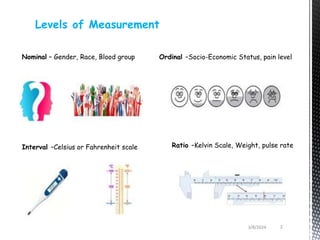
Levels of Measurement
Nominal – Gender, Race, Blood group Ordinal –Socio-Economic Status, pain level
Interval –Celsius or Fahrenheit scale Ratio –Kelvin Scale, Weight, pulse rate
3/8/2024 2
Statistical Inference
STEPS in testing of a hypothesis
 Form a null hypothesis (Ex: No difference between two groups)
 Collect data
 Compute a test statistic (Ex: t test)
 Compute p value (critical value) for the test statistic
 Decision on the hypothesis (Ex: p ≤ .05 reject null hypothesis)
Assumptions –Normality, homogeneity of variances etc.
Descriptive Statistics
 Summarizing and organizing data and provide a more general ‘picture’
about the data
Inferential statistics
 Make inferences about the population using the sample data
3/8/2024 3
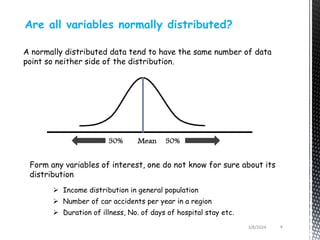
Are all variables normally distributed?
A normally distributed data tend to have the same number of data
point so neither side of the distribution.
Form any variables of interest, one do not know for sure about its
distribution
 Income distribution in general population
 Number of car accidents per year in a region
 Duration of illness, No. of days of hospital stay etc.
3/8/2024 4
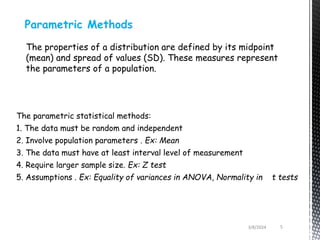
Parametric Methods
The properties of a distribution are defined by its midpoint
(mean) and spread of values (SD). These measures represent
the parameters of a population.
The parametric statistical methods:
1. The data must be random and independent
2. Involve population parameters . Ex: Mean
3. The data must have at least interval level of measurement
4. Require larger sample size. Ex: Z test
5. Assumptions . Ex: Equality of variances in ANOVA, Normality in t tests
3/8/2024 5
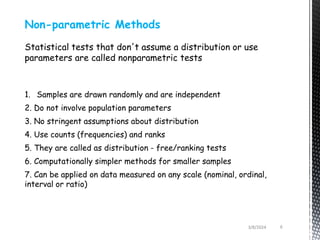
Non-parametric Methods
Statistical tests that don't assume a distribution or use
parameters are called nonparametric tests
1. Samples are drawn randomly and are independent
2. Do not involve population parameters
3. No stringent assumptions about distribution
4. Use counts (frequencies) and ranks
5. They are called as distribution - free/ranking tests
6. Computationally simpler methods for smaller samples
7. Can be applied on data measured on any scale (nominal, ordinal,
interval or ratio)
3/8/2024 6
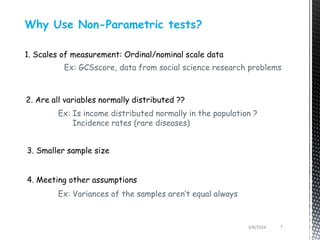
Why Use Non-Parametric tests?
1. Scales of measurement: Ordinal/nominal scale data
Ex: GCSscore, data from social science research problems
2. Are all variables normally distributed ??
Ex: Is income distributed normally in the population ?
Incidence rates (rare diseases)
3. Smaller sample size
4. Meeting other assumptions
Ex: Variances of the samples aren’t equal always
3/8/2024 7
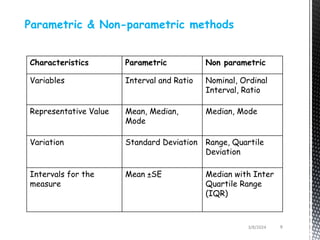
Parametric & Non-parametric methods
Characteristics Parametric Non parametric
Variables Interval and Ratio Nominal, Ordinal
Interval, Ratio
Representative Value Mean, Median,
Mode
Median, Mode
Variation Standard Deviation Range, Quartile
Deviation
Intervals for the
measure
Mean ±SE Median with Inter
Quartile Range
(IQR)
3/8/2024 8
3/8/2024 9
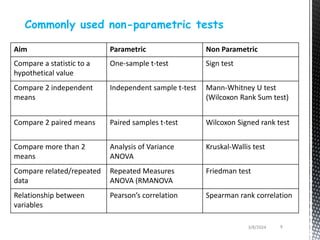
Commonly used non-parametric tests
Aim Parametric Non Parametric
Compare a statistic to a
hypothetical value
One-sample t-test Sign test
Compare 2 independent
means
Independent sample t-test Mann-Whitney U test
(Wilcoxon Rank Sum test)
Compare 2 paired means Paired samples t-test Wilcoxon Signed rank test
Compare more than 2
means
Analysis of Variance
ANOVA
Kruskal-Wallis test
Compare related/repeated
data
Repeated Measures
ANOVA (RMANOVA
Friedman test
Relationship between
variables
Pearson’s correlation Spearman rank correlation
3/8/2024 10
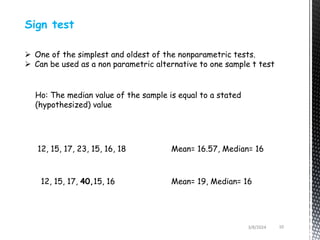
Sign test
 One of the simplest and oldest of the nonparametric tests.
 Can be used as a non parametric alternative to one sample t test
Ho: The median value of the sample is equal to a stated
(hypothesized) value
12, 15, 17, 23, 15, 16, 18
12, 15, 17, 40,15, 16
Mean= 16.57, Median= 16
Mean= 19, Median= 16
3/8/2024 11
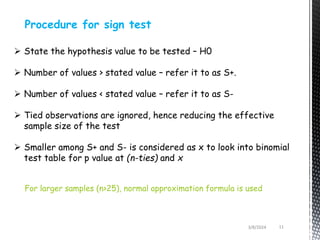
Procedure for sign test
 State the hypothesis value to be tested – H0
 Number of values > stated value – refer it to as S+.
 Number of values < stated value – refer it to as S-
 Tied observations are ignored, hence reducing the effective
sample size of the test
 Smaller among S+ and S- is considered as x to look into binomial
test table for p value at (n-ties) and x
For larger samples (n>25), normal approximation formula is used
3/8/2024 12
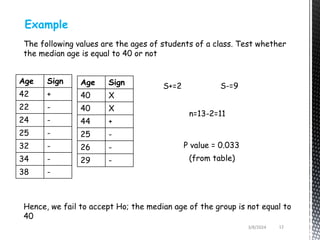
Example
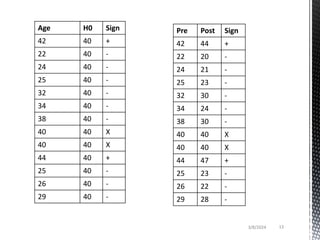
The following values are the ages of students of a class. Test whether
the median age is equal to 40 or not
Age Sign
42 +
22 -
24 -
25 -
32 -
34 -
38 -
Age Sign
40 X
40 X
44 +
25 -
26 -
29 -
S+=2 S-=9
n=13-2=11
P value = 0.033
(from table)
Hence, we fail to accept Ho; the median age of the group is not equal to
40
3/8/2024 13
Age H0 Sign
42 40 +
22 40 -
24 40 -
25 40 -
32 40 -
34 40 -
38 40 -
40 40 X
40 40 X
44 40 +
25 40 -
26 40 -
29 40 -
Pre Post Sign
42 44 +
22 20 -
24 21 -
25 23 -
32 30 -
34 24 -
38 30 -
40 40 X
40 40 X
44 47 +
25 23 -
26 22 -
29 28 -
3/8/2024 14
Sign test for paired samples
One sample sign test is a special case of a paired sample sign test
used for paired/matched samples
Ho: The median difference between pairs is zero
Under Ho we would expect that,
No of Xpre> Xpost= No ofXpre< Xpost
i.e. half of the differences will be
positive and half will be positive
Only signs are considered for
calculations but not the magnitude of
difference. Hence, it’s a less powerful
test.
Pre Post Difference
42 45 +
22 20 -
24 21 -
25 20 -
32 31 -
34 48 +
38 25 -
25 26 +
18 28 +
26 26 X
3/8/2024 15
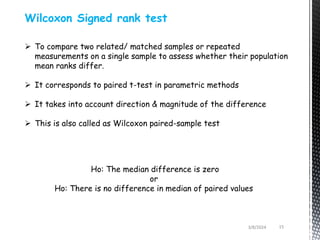
Wilcoxon Signed rank test
 To compare two related/ matched samples or repeated
measurements on a single sample to assess whether their population
mean ranks differ.
 It corresponds to paired t-test in parametric methods
 It takes into account direction & magnitude of the difference
 This is also called as Wilcoxon paired-sample test
Ho: The median difference is zero
or
Ho: There is no difference in median of paired values
3/8/2024 16
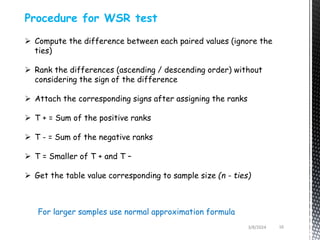
Procedure for WSR test
 Compute the difference between each paired values (ignore the
ties)
 Rank the differences (ascending / descending order) without
considering the sign of the difference
 Attach the corresponding signs after assigning the ranks
 T + = Sum of the positive ranks
 T - = Sum of the negative ranks
 T = Smaller of T + and T –
 Get the table value corresponding to sample size (n - ties)
For larger samples use normal approximation formula
3/8/2024 17
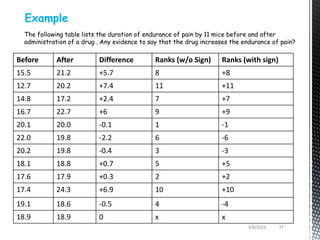
Example
The following table lists the duration of endurance of pain by 11 mice before and after
administration of a drug . Any evidence to say that the drug increases the endurance of pain?
Before After Difference Ranks (w/o Sign) Ranks (with sign)
15.5 21.2 +5.7 8 +8
12.7 20.2 +7.4 11 +11
14.8 17.2 +2.4 7 +7
16.7 22.7 +6 9 +9
20.1 20.0 -0.1 1 -1
22.0 19.8 -2.2 6 -6
20.2 19.8 -0.4 3 -3
18.1 18.8 +0.7 5 +5
17.6 17.9 +0.3 2 +2
17.4 24.3 +6.9 10 +10
19.1 18.6 -0.5 4 -4
18.9 18.9 0 x x
3/8/2024 18
Example (contd.)
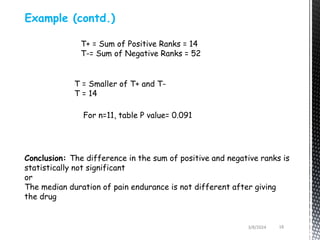
T+ = Sum of Positive Ranks = 14
T-= Sum of Negative Ranks = 52
T = Smaller of T+ and T-
T = 14
For n=11, table P value= 0.091
Conclusion: The difference in the sum of positive and negative ranks is
statistically not significant
or
The median duration of pain endurance is not different after giving
the drug
3/8/2024 19
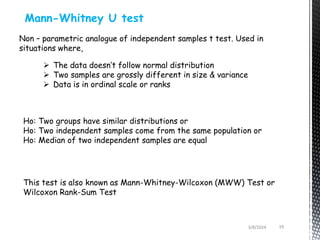
Mann-Whitney U test
Non – parametric analogue of independent samples t test. Used in
situations where,
 The data doesn’t follow normal distribution
 Two samples are grossly different in size & variance
 Data is in ordinal scale or ranks
Ho: Two groups have similar distributions or
Ho: Two independent samples come from the same population or
Ho: Median of two independent samples are equal
This test is also known as Mann-Whitney-Wilcoxon (MWW) Test or
Wilcoxon Rank-Sum Test
3/8/2024 20
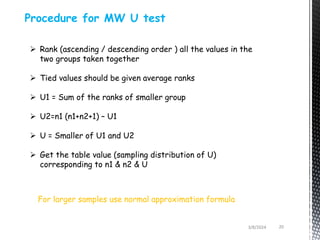
Procedure for MW U test
 Rank (ascending / descending order ) all the values in the
two groups taken together
 Tied values should be given average ranks
 U1 = Sum of the ranks of smaller group
 U2=n1 (n1+n2+1) – U1
 U = Smaller of U1 and U2
 Get the table value (sampling distribution of U)
corresponding to n1 & n2 & U
For larger samples use normal approximation formula
3/8/2024 21
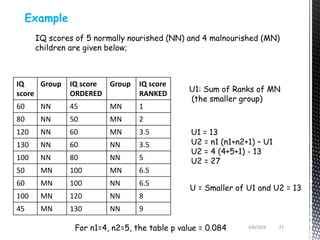
Example
IQ scores of 5 normally nourished (NN) and 4 malnourished (MN)
children are given below;
IQ
score
Group IQ score
ORDERED
Group IQ score
RANKED
60 NN 45 MN 1
80 NN 50 MN 2
120 NN 60 MN 3.5
130 NN 60 NN 3.5
100 NN 80 NN 5
50 MN 100 MN 6.5
60 MN 100 NN 6.5
100 MN 120 NN 8
45 MN 130 NN 9
U1: Sum of Ranks of MN
(the smaller group)
U1 = 13
U2 = n1 (n1+n2+1) – U1
U2 = 4 (4+5+1) - 13
U2 = 27
For n1=4, n2=5, the table p value = 0.084
U = Smaller of U1 and U2 = 13
3/8/2024 22
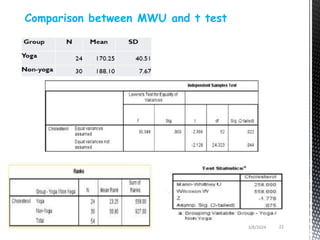
Comparison between MWU and t test
3/8/2024 23
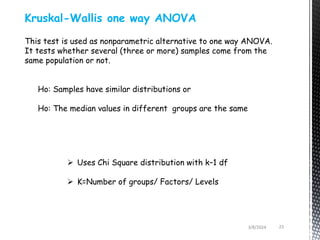
Kruskal-Wallis one way ANOVA
This test is used as nonparametric alternative to one way ANOVA.
It tests whether several (three or more) samples come from the
same population or not.
Ho: Samples have similar distributions or
Ho: The median values in different groups are the same
 Uses Chi Square distribution with k–1 df
 K=Number of groups/ Factors/ Levels
3/8/2024 24
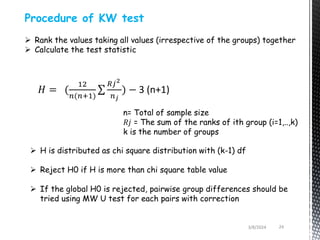
Procedure of KW test
 Rank the values taking all values (irrespective of the groups) together
 Calculate the test statistic
𝐻 = (
12
𝑛(𝑛+1)
𝑅𝑗2
𝑛𝑗
) − 3 (n+1)
n= Total of sample size
𝑅𝑗 = The sum of the ranks of ith group (i=1,..,k)
k is the number of groups
 H is distributed as chi square distribution with (k-1) df
 Reject H0 if H is more than chi square table value
 If the global H0 is rejected, pairwise group differences should be
tried using MW U test for each pairs with correction
3/8/2024 25
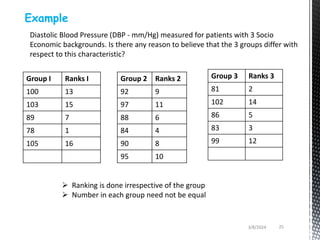
Example
Diastolic Blood Pressure (DBP - mm/Hg) measured for patients with 3 Socio
Economic backgrounds. Is there any reason to believe that the 3 groups differ with
respect to this characteristic?
Group I Ranks I
100 13
103 15
89 7
78 1
105 16
Group 2 Ranks 2
92 9
97 11
88 6
84 4
90 8
95 10
Group 3 Ranks 3
81 2
102 14
86 5
83 3
99 12
 Ranking is done irrespective of the group
 Number in each group need not be equal
3/8/2024 26
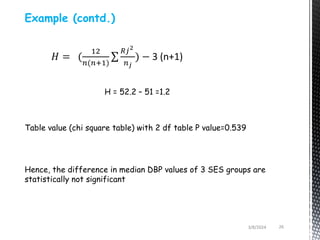
Example (contd.)
𝐻 = (
12
𝑛(𝑛+1)
𝑅𝑗2
𝑛𝑗
) − 3 (n+1)
H = 52.2 – 51 =1.2
Hence, the difference in median DBP values of 3 SES groups are
statistically not significant
Table value (chi square table) with 2 df table P value=0.539
3/8/2024 27
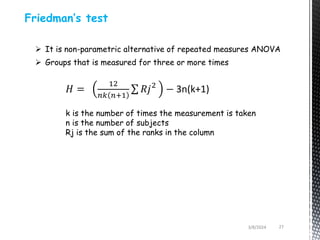
Friedman’s test
 It is non-parametric alternative of repeated measures ANOVA
 Groups that is measured for three or more times
𝐻 =
12
𝑛𝑘 𝑛+1
𝑅𝑗2
− 3n(k+1)
k is the number of times the measurement is taken
n is the number of subjects
Rj is the sum of the ranks in the column
3/8/2024 28
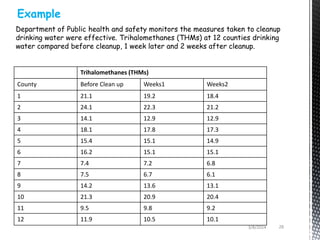
Example
Trihalomethanes (THMs)
County Before Clean up Weeks1 Weeks2
1 21.1 19.2 18.4
2 24.1 22.3 21.2
3 14.1 12.9 12.9
4 18.1 17.8 17.3
5 15.4 15.1 14.9
6 16.2 15.1 15.1
7 7.4 7.2 6.8
8 7.5 6.7 6.1
9 14.2 13.6 13.1
10 21.3 20.9 20.4
11 9.5 9.8 9.2
12 11.9 10.5 10.1
Department of Public health and safety monitors the measures taken to cleanup
drinking water were effective. Trihalomethanes (THMs) at 12 counties drinking
water compared before cleanup, 1 week later and 2 weeks after cleanup.
3/8/2024 29
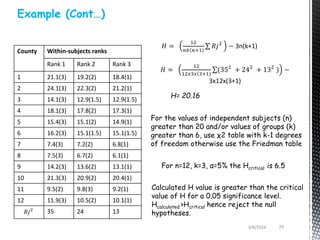
County Within-subjects ranks
Rank 1 Rank 2 Rank 3
1 21.1(3) 19.2(2) 18.4(1)
2 24.1(3) 22.3(2) 21.2(1)
3 14.1(3) 12.9(1.5) 12.9(1.5)
4 18.1(3) 17.8(2) 17.3(1)
5 15.4(3) 15.1(2) 14.9(1)
6 16.2(3) 15.1(1.5) 15.1(1.5)
7 7.4(3) 7.2(2) 6.8(1)
8 7.5(3) 6.7(2) 6.1(1)
9 14.2(3) 13.6(2) 13.1(1)
10 21.3(3) 20.9(2) 20.4(1)
11 9.5(2) 9.8(3) 9.2(1)
12 11.9(3) 10.5(2) 10.1(1)
𝑅𝑗2
35 24 13
Example (Cont…)
𝐻 =
12
𝑛𝑘 𝑛+1
𝑅𝑗2
− 3n(k+1)
𝐻 =
12
12𝑥3𝑥 3+1
(352
+ 242
+ 132
) −
3x12x(3+1)
For the values of independent subjects (n)
greater than 20 and/or values of groups (k)
greater than 6, use χ2 table with k-1 degrees
of freedom otherwise use the Friedman table
Calculated H value is greater than the critical
value of H for a 0.05 significance level.
Hcalculated >Hcritical hence reject the null
hypotheses.
For n=12, k=3, α=5% the Hcritical is 6.5
H= 20.16
3/8/2024 30
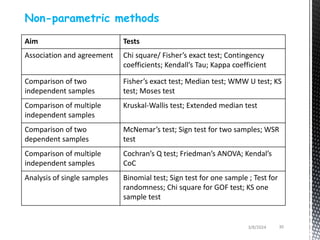
Non-parametric methods
Aim Tests
Association and agreement Chi square/ Fisher’s exact test; Contingency
coefficients; Kendall’s Tau; Kappa coefficient
Comparison of two
independent samples
Fisher’s exact test; Median test; WMW U test; KS
test; Moses test
Comparison of multiple
independent samples
Kruskal-Wallis test; Extended median test
Comparison of two
dependent samples
McNemar’s test; Sign test for two samples; WSR
test
Comparison of multiple
independent samples
Cochran’s Q test; Friedman’s ANOVA; Kendal’s
CoC
Analysis of single samples Binomial test; Sign test for one sample ; Test for
randomness; Chi square for GOF test; KS one
sample test
3/8/2024 31
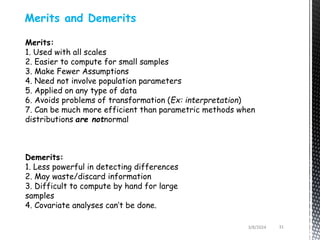
Merits and Demerits
Merits:
1. Used with all scales
2. Easier to compute for small samples
3. Make Fewer Assumptions
4. Need not involve population parameters
5. Applied on any type of data
6. Avoids problems of transformation (Ex: interpretation)
7. Can be much more efficient than parametric methods when
distributions are notnormal
Demerits:
1. Less powerful in detecting differences
2. May waste/discard information
3. Difficult to compute by hand for large
samples
4. Covariate analyses can’t be done.
3/8/2024 32
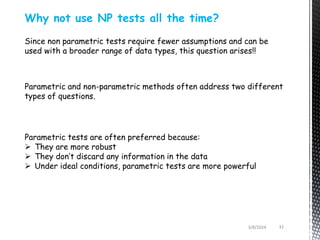
Why not use NP tests all the time?
Since non parametric tests require fewer assumptions and can be
used with a broader range of data types, this question arises!!
Parametric and non-parametric methods often address two different
types of questions.
Parametric tests are often preferred because:
 They are more robust
 They don’t discard any information in the data
 Under ideal conditions, parametric tests are more powerful
3/8/2024 33
THANK YOU

MPhil clinical psy Non-parametric statistics.pptx

  • 1.
    Sumit Kumar Das PhDStudent Dept of Biostatistics NIMHANS Non-Parametric Statistics
  • 2.
    Levels of Measurement Nominal– Gender, Race, Blood group Ordinal –Socio-Economic Status, pain level Interval –Celsius or Fahrenheit scale Ratio –Kelvin Scale, Weight, pulse rate 3/8/2024 2
  • 3.
    Statistical Inference STEPS intesting of a hypothesis  Form a null hypothesis (Ex: No difference between two groups)  Collect data  Compute a test statistic (Ex: t test)  Compute p value (critical value) for the test statistic  Decision on the hypothesis (Ex: p ≤ .05 reject null hypothesis) Assumptions –Normality, homogeneity of variances etc. Descriptive Statistics  Summarizing and organizing data and provide a more general ‘picture’ about the data Inferential statistics  Make inferences about the population using the sample data 3/8/2024 3
  • 4.
    Are all variablesnormally distributed? A normally distributed data tend to have the same number of data point so neither side of the distribution. Form any variables of interest, one do not know for sure about its distribution  Income distribution in general population  Number of car accidents per year in a region  Duration of illness, No. of days of hospital stay etc. 3/8/2024 4
  • 5.
    Parametric Methods The propertiesof a distribution are defined by its midpoint (mean) and spread of values (SD). These measures represent the parameters of a population. The parametric statistical methods: 1. The data must be random and independent 2. Involve population parameters . Ex: Mean 3. The data must have at least interval level of measurement 4. Require larger sample size. Ex: Z test 5. Assumptions . Ex: Equality of variances in ANOVA, Normality in t tests 3/8/2024 5
  • 6.
    Non-parametric Methods Statistical teststhat don't assume a distribution or use parameters are called nonparametric tests 1. Samples are drawn randomly and are independent 2. Do not involve population parameters 3. No stringent assumptions about distribution 4. Use counts (frequencies) and ranks 5. They are called as distribution - free/ranking tests 6. Computationally simpler methods for smaller samples 7. Can be applied on data measured on any scale (nominal, ordinal, interval or ratio) 3/8/2024 6
  • 7.
    Why Use Non-Parametrictests? 1. Scales of measurement: Ordinal/nominal scale data Ex: GCSscore, data from social science research problems 2. Are all variables normally distributed ?? Ex: Is income distributed normally in the population ? Incidence rates (rare diseases) 3. Smaller sample size 4. Meeting other assumptions Ex: Variances of the samples aren’t equal always 3/8/2024 7
  • 8.
    Parametric & Non-parametricmethods Characteristics Parametric Non parametric Variables Interval and Ratio Nominal, Ordinal Interval, Ratio Representative Value Mean, Median, Mode Median, Mode Variation Standard Deviation Range, Quartile Deviation Intervals for the measure Mean ±SE Median with Inter Quartile Range (IQR) 3/8/2024 8
  • 9.
    3/8/2024 9 Commonly usednon-parametric tests Aim Parametric Non Parametric Compare a statistic to a hypothetical value One-sample t-test Sign test Compare 2 independent means Independent sample t-test Mann-Whitney U test (Wilcoxon Rank Sum test) Compare 2 paired means Paired samples t-test Wilcoxon Signed rank test Compare more than 2 means Analysis of Variance ANOVA Kruskal-Wallis test Compare related/repeated data Repeated Measures ANOVA (RMANOVA Friedman test Relationship between variables Pearson’s correlation Spearman rank correlation
  • 10.
    3/8/2024 10 Sign test One of the simplest and oldest of the nonparametric tests.  Can be used as a non parametric alternative to one sample t test Ho: The median value of the sample is equal to a stated (hypothesized) value 12, 15, 17, 23, 15, 16, 18 12, 15, 17, 40,15, 16 Mean= 16.57, Median= 16 Mean= 19, Median= 16
  • 11.
    3/8/2024 11 Procedure forsign test  State the hypothesis value to be tested – H0  Number of values > stated value – refer it to as S+.  Number of values < stated value – refer it to as S-  Tied observations are ignored, hence reducing the effective sample size of the test  Smaller among S+ and S- is considered as x to look into binomial test table for p value at (n-ties) and x For larger samples (n>25), normal approximation formula is used
  • 12.
    3/8/2024 12 Example The followingvalues are the ages of students of a class. Test whether the median age is equal to 40 or not Age Sign 42 + 22 - 24 - 25 - 32 - 34 - 38 - Age Sign 40 X 40 X 44 + 25 - 26 - 29 - S+=2 S-=9 n=13-2=11 P value = 0.033 (from table) Hence, we fail to accept Ho; the median age of the group is not equal to 40
  • 13.
    3/8/2024 13 Age H0Sign 42 40 + 22 40 - 24 40 - 25 40 - 32 40 - 34 40 - 38 40 - 40 40 X 40 40 X 44 40 + 25 40 - 26 40 - 29 40 - Pre Post Sign 42 44 + 22 20 - 24 21 - 25 23 - 32 30 - 34 24 - 38 30 - 40 40 X 40 40 X 44 47 + 25 23 - 26 22 - 29 28 -
  • 14.
    3/8/2024 14 Sign testfor paired samples One sample sign test is a special case of a paired sample sign test used for paired/matched samples Ho: The median difference between pairs is zero Under Ho we would expect that, No of Xpre> Xpost= No ofXpre< Xpost i.e. half of the differences will be positive and half will be positive Only signs are considered for calculations but not the magnitude of difference. Hence, it’s a less powerful test. Pre Post Difference 42 45 + 22 20 - 24 21 - 25 20 - 32 31 - 34 48 + 38 25 - 25 26 + 18 28 + 26 26 X
  • 15.
    3/8/2024 15 Wilcoxon Signedrank test  To compare two related/ matched samples or repeated measurements on a single sample to assess whether their population mean ranks differ.  It corresponds to paired t-test in parametric methods  It takes into account direction & magnitude of the difference  This is also called as Wilcoxon paired-sample test Ho: The median difference is zero or Ho: There is no difference in median of paired values
  • 16.
    3/8/2024 16 Procedure forWSR test  Compute the difference between each paired values (ignore the ties)  Rank the differences (ascending / descending order) without considering the sign of the difference  Attach the corresponding signs after assigning the ranks  T + = Sum of the positive ranks  T - = Sum of the negative ranks  T = Smaller of T + and T –  Get the table value corresponding to sample size (n - ties) For larger samples use normal approximation formula
  • 17.
    3/8/2024 17 Example The followingtable lists the duration of endurance of pain by 11 mice before and after administration of a drug . Any evidence to say that the drug increases the endurance of pain? Before After Difference Ranks (w/o Sign) Ranks (with sign) 15.5 21.2 +5.7 8 +8 12.7 20.2 +7.4 11 +11 14.8 17.2 +2.4 7 +7 16.7 22.7 +6 9 +9 20.1 20.0 -0.1 1 -1 22.0 19.8 -2.2 6 -6 20.2 19.8 -0.4 3 -3 18.1 18.8 +0.7 5 +5 17.6 17.9 +0.3 2 +2 17.4 24.3 +6.9 10 +10 19.1 18.6 -0.5 4 -4 18.9 18.9 0 x x
  • 18.
    3/8/2024 18 Example (contd.) T+= Sum of Positive Ranks = 14 T-= Sum of Negative Ranks = 52 T = Smaller of T+ and T- T = 14 For n=11, table P value= 0.091 Conclusion: The difference in the sum of positive and negative ranks is statistically not significant or The median duration of pain endurance is not different after giving the drug
  • 19.
    3/8/2024 19 Mann-Whitney Utest Non – parametric analogue of independent samples t test. Used in situations where,  The data doesn’t follow normal distribution  Two samples are grossly different in size & variance  Data is in ordinal scale or ranks Ho: Two groups have similar distributions or Ho: Two independent samples come from the same population or Ho: Median of two independent samples are equal This test is also known as Mann-Whitney-Wilcoxon (MWW) Test or Wilcoxon Rank-Sum Test
  • 20.
    3/8/2024 20 Procedure forMW U test  Rank (ascending / descending order ) all the values in the two groups taken together  Tied values should be given average ranks  U1 = Sum of the ranks of smaller group  U2=n1 (n1+n2+1) – U1  U = Smaller of U1 and U2  Get the table value (sampling distribution of U) corresponding to n1 & n2 & U For larger samples use normal approximation formula
  • 21.
    3/8/2024 21 Example IQ scoresof 5 normally nourished (NN) and 4 malnourished (MN) children are given below; IQ score Group IQ score ORDERED Group IQ score RANKED 60 NN 45 MN 1 80 NN 50 MN 2 120 NN 60 MN 3.5 130 NN 60 NN 3.5 100 NN 80 NN 5 50 MN 100 MN 6.5 60 MN 100 NN 6.5 100 MN 120 NN 8 45 MN 130 NN 9 U1: Sum of Ranks of MN (the smaller group) U1 = 13 U2 = n1 (n1+n2+1) – U1 U2 = 4 (4+5+1) - 13 U2 = 27 For n1=4, n2=5, the table p value = 0.084 U = Smaller of U1 and U2 = 13
  • 22.
  • 23.
    3/8/2024 23 Kruskal-Wallis oneway ANOVA This test is used as nonparametric alternative to one way ANOVA. It tests whether several (three or more) samples come from the same population or not. Ho: Samples have similar distributions or Ho: The median values in different groups are the same  Uses Chi Square distribution with k–1 df  K=Number of groups/ Factors/ Levels
  • 24.
    3/8/2024 24 Procedure ofKW test  Rank the values taking all values (irrespective of the groups) together  Calculate the test statistic 𝐻 = ( 12 𝑛(𝑛+1) 𝑅𝑗2 𝑛𝑗 ) − 3 (n+1) n= Total of sample size 𝑅𝑗 = The sum of the ranks of ith group (i=1,..,k) k is the number of groups  H is distributed as chi square distribution with (k-1) df  Reject H0 if H is more than chi square table value  If the global H0 is rejected, pairwise group differences should be tried using MW U test for each pairs with correction
  • 25.
    3/8/2024 25 Example Diastolic BloodPressure (DBP - mm/Hg) measured for patients with 3 Socio Economic backgrounds. Is there any reason to believe that the 3 groups differ with respect to this characteristic? Group I Ranks I 100 13 103 15 89 7 78 1 105 16 Group 2 Ranks 2 92 9 97 11 88 6 84 4 90 8 95 10 Group 3 Ranks 3 81 2 102 14 86 5 83 3 99 12  Ranking is done irrespective of the group  Number in each group need not be equal
  • 26.
    3/8/2024 26 Example (contd.) 𝐻= ( 12 𝑛(𝑛+1) 𝑅𝑗2 𝑛𝑗 ) − 3 (n+1) H = 52.2 – 51 =1.2 Hence, the difference in median DBP values of 3 SES groups are statistically not significant Table value (chi square table) with 2 df table P value=0.539
  • 27.
    3/8/2024 27 Friedman’s test It is non-parametric alternative of repeated measures ANOVA  Groups that is measured for three or more times 𝐻 = 12 𝑛𝑘 𝑛+1 𝑅𝑗2 − 3n(k+1) k is the number of times the measurement is taken n is the number of subjects Rj is the sum of the ranks in the column
  • 28.
    3/8/2024 28 Example Trihalomethanes (THMs) CountyBefore Clean up Weeks1 Weeks2 1 21.1 19.2 18.4 2 24.1 22.3 21.2 3 14.1 12.9 12.9 4 18.1 17.8 17.3 5 15.4 15.1 14.9 6 16.2 15.1 15.1 7 7.4 7.2 6.8 8 7.5 6.7 6.1 9 14.2 13.6 13.1 10 21.3 20.9 20.4 11 9.5 9.8 9.2 12 11.9 10.5 10.1 Department of Public health and safety monitors the measures taken to cleanup drinking water were effective. Trihalomethanes (THMs) at 12 counties drinking water compared before cleanup, 1 week later and 2 weeks after cleanup.
  • 29.
    3/8/2024 29 County Within-subjectsranks Rank 1 Rank 2 Rank 3 1 21.1(3) 19.2(2) 18.4(1) 2 24.1(3) 22.3(2) 21.2(1) 3 14.1(3) 12.9(1.5) 12.9(1.5) 4 18.1(3) 17.8(2) 17.3(1) 5 15.4(3) 15.1(2) 14.9(1) 6 16.2(3) 15.1(1.5) 15.1(1.5) 7 7.4(3) 7.2(2) 6.8(1) 8 7.5(3) 6.7(2) 6.1(1) 9 14.2(3) 13.6(2) 13.1(1) 10 21.3(3) 20.9(2) 20.4(1) 11 9.5(2) 9.8(3) 9.2(1) 12 11.9(3) 10.5(2) 10.1(1) 𝑅𝑗2 35 24 13 Example (Cont…) 𝐻 = 12 𝑛𝑘 𝑛+1 𝑅𝑗2 − 3n(k+1) 𝐻 = 12 12𝑥3𝑥 3+1 (352 + 242 + 132 ) − 3x12x(3+1) For the values of independent subjects (n) greater than 20 and/or values of groups (k) greater than 6, use χ2 table with k-1 degrees of freedom otherwise use the Friedman table Calculated H value is greater than the critical value of H for a 0.05 significance level. Hcalculated >Hcritical hence reject the null hypotheses. For n=12, k=3, α=5% the Hcritical is 6.5 H= 20.16
  • 30.
    3/8/2024 30 Non-parametric methods AimTests Association and agreement Chi square/ Fisher’s exact test; Contingency coefficients; Kendall’s Tau; Kappa coefficient Comparison of two independent samples Fisher’s exact test; Median test; WMW U test; KS test; Moses test Comparison of multiple independent samples Kruskal-Wallis test; Extended median test Comparison of two dependent samples McNemar’s test; Sign test for two samples; WSR test Comparison of multiple independent samples Cochran’s Q test; Friedman’s ANOVA; Kendal’s CoC Analysis of single samples Binomial test; Sign test for one sample ; Test for randomness; Chi square for GOF test; KS one sample test
  • 31.
    3/8/2024 31 Merits andDemerits Merits: 1. Used with all scales 2. Easier to compute for small samples 3. Make Fewer Assumptions 4. Need not involve population parameters 5. Applied on any type of data 6. Avoids problems of transformation (Ex: interpretation) 7. Can be much more efficient than parametric methods when distributions are notnormal Demerits: 1. Less powerful in detecting differences 2. May waste/discard information 3. Difficult to compute by hand for large samples 4. Covariate analyses can’t be done.
  • 32.
    3/8/2024 32 Why notuse NP tests all the time? Since non parametric tests require fewer assumptions and can be used with a broader range of data types, this question arises!! Parametric and non-parametric methods often address two different types of questions. Parametric tests are often preferred because:  They are more robust  They don’t discard any information in the data  Under ideal conditions, parametric tests are more powerful
  • 33.

Editor's Notes

  • #31 The median test is a non-parametric test that is used to test whether two (or more) independent groups differ in central tendency - specifically whether the groups have been drawn from a population with the same median.