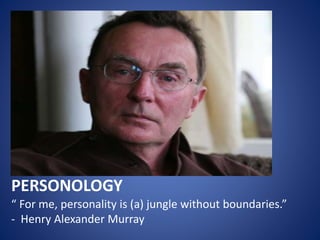
PERSONOLOGY
“ For me, personality is (a) jungle without boundaries.”
- Henry Alexander Murray
”
”
CHILDHOOD
• Born into a wealthy family on May 23, 1893 in New York City to Henry Alexander
Murray Sr. and Fannie Morris Babcock
• Had a warm relationship with his father but was not close to his mother
• Caused his lifelong depression that formed his personality
• Suffered being cross-eyed and underwent surgery but the operation made him lose
his stereoscopic vision and from stuttering (speech difficulty)
• Took up football and boxing. He was successful in boxing and won the local
featherweight championship
• EDUCATION
• Attended Pre-school at Groton School
• Studied at Harvard College from 1911 to 1915, earning his AB major in History
• Graduated from Columbia University Medical School (1919) at the top of his class
and earned an MA in Biology.
• In 1927,he obtained his Ph.D in Biochemistry from Cambridge University, same year
he joined Harvard University as an instructor in Psychology.
THE LIFE OF MURRAY (1893-1988)
• EDUCATION
• In 1927,he obtained his Ph.D in Biochemistry from Cambridge University, same year
he joined Harvard University as an instructor in Psychology.
• Headed the Harvard Psychological Clinic for 15 years and became emeritus
professor in 1962
• He was awarded the Distinguished Scientific Contribution Award by the American
Psychological Association and by the American Psychological Foundation for his
lifetime of contribution to psychology
• LOVE STORY
• Married Josephine Rantaul, heiress to the Dupont family fortune in 1916
• Had one daughter, born in 1921
• While married to Josephine, he fell in love with Christina Morgan but refused to
leave his wife.
• In 1930, Murray and Morgan collaborated on the Thematic Apperception Test (TAT)
• Murray’s wife died in 1962, his severe depression threatened to overcome him.
• Five years later Christina Morgan also died.
• Two years after, at the age of 76, he remarried.
• He died of pneumonia on June 23, 1988 at the age of 95 at Cambridge,
Massachusetts
THE LIFE OF MURRAY (1893-1988)
• Persuaded by Christiana Morgan, Murray met Carl Jung in 1925, in Zurich, an
experience that changed his life. Jung's advice to Murray concerning his personal
life was to continue openly with both relationships. After his meeting with Jung,
Murray decided to shift his career toward depth psychology.
• Like Carl Jung, Murray believed that human personality could be better
understood by investigating the unconscious mind.
• In 1927, Murray became assistant director and in 1937, the director of the
Harvard Psychological Clinic. In 1930, he developed, with help from Christiana
Morgan, his famous Thematic Apperception Test (TAT). In 1938, he published the
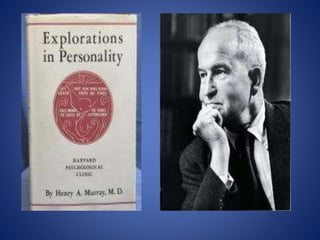
now classic Explorations in Personality.
• During World War II, Murray left Harvard and joined the Army Medical Corps to
help with the war effort. He worked as lieutenant colonel, establishing the Office
of Strategic Services (OSS). The goal of the agency was to find and train men for
special tasks.
• After the war, Murray returned to Harvard, lecturing part-time and establishing,
with others, the Psychological Clinic Annex in 1949. He also served as a chief
researcher. Murray retired in 1962. He became emeritus professor, receiving the
Distinguished Scientific Contribution Award from the American Psychological
Association and the Gold Medal Award for lifetime achievement from the
American Psychological Foundation. He continued to lecture, and also furthered
his study of the works of author Herman Melville.
Murray’s Life Work
PERSONOLOGY
• Shortened form of “PERSONALITY
PSYCHOLOGY”
• Personology is simple in structure but complex
in detail
• Murray used the term “personology” to
describe his study of human lives and
individual differences in personality.
• No brain, No personality
Murray’s Life Work
• PRINCIPLES OF PERSONOLOGY
• 1st Principle – Our personality is rooted in the brain. (No brain,
No Personality.)
• 2nd Principle- people act to reduce physiological and
psychological tension; but does not mean that they strive for a
tension free state
• 3rd Principle- an individual’s personality continues to develop
over time and is constructed of all the events that occur during
the course of that person’s life.
• 4th Principle- personality changes and progresses; it is not fixed
or static
• 5th Principle- each person is unique but there are similarities
among all people. An individual human being is like no other
person, like some other people, and like every other person.
Divisions of Personology
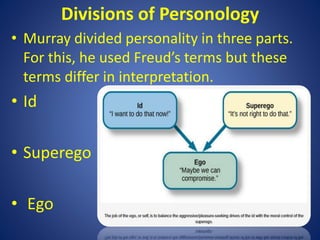
• Murray divided personality in three parts.
For this, he used Freud’s terms but these
terms differ in interpretation.
• Id
• Superego
• Ego
Divisions of Personology
• Id
• Murray was influenced by Jung’s Shadow Archetype which has
good impulses as well as bad ones.
• The strength of Id impulse varies among individuals.
• Id
• Freud:
• Freud said, Id contains primitive, amoral & lustful impulses.
• Murray:
• Murray believed, Id contains socially acceptable impulses like
empathy and love.
Divisions of Personology
• Superego
• Freud:
• Freud was of the view that superego stems out
after the child identifies with his/her parents.
Superego acts as the parental voice.
• Murray:
• Murray defined superego as the internalization
of the culture’s values and norms by which we
come to evaluate and judge our behavior and
that of others.
Divisions of Personology
• Superego
• FREUD:
• Freud said that at the age of 5, the superego is
• crystallized.
• Murray:
• Murray suggested that Superego continuously develop
• throughout lifetime.
• Freud:
• The superego is in constant conflict with Id.
• Murray:
• Murray opposed the Freud's this concept and said that superego is
not in constant conflict with id because the Id contains bad and
good impulses.
Divisions of Personology
• Ego
• Ego is the rational governor of personality.
• He opposes Freud’s contention that ego is the slave of id,
superego and the reality.
• A strong ego can mediate effectively between the two but a weak
ego leads the personality a battleground.
• Ego organizes our behaviors coming from the id impulse whether
good or bad.
• Ego is the central organizer of all behaviors. It plan courses of
action. It suppress unaccepted id impulses and promote accepted
id impulses pleasure.
Divisions of Personology
EGO
It is called the arbiter of the two contenders, id and
superego. It may favor one over the other.
• Example
• Ego supports id. This support leads the personality towards a
life of crime.
• Ego
• Sometimes ego may ay favors both, the id and the superego.
• Example
• Ego supports both. This thing leads to the harmony between
what a person wants to do and what the society expects from
person.
Stages of Personality
Murray focused on the importance of genetic &
maturational factors in development of personality
• Childhood, Adolescence & Young adult- new
structural compositions emerge and multiply
• Middle years- are marked by conservative
recompositions of the already emerged
structures and functions
• Senescence (Final Era)- new compositions and
recompositions decreases, while the atrophy of
existing forms and functions increases.
COMPLEX
Definition of Complex:
• A normal pattern of childhood development
that influences the adult personality
• According to Murray, everyone passes through
5 developmental stages and also experiences
5 complexes associated with these.
The Five Complexes
The Claustral Complex
 The fetus in the womb is secure, serene, and dependent, conditions we may all occasionally
wish to reinstate.
 Represents residuals of the uterine or prenatal experiences of the individual
a) Simple claustral complex
 is experienced as a desire to be in small, warm, dark places that are safe and secluded
 People with this complex tend to be dependent on others, passive, and oriented toward
safe, familiar behaviors that worked in the past.
 Revolves around the wish to reinstate the conditions similar to those prevailing before
birth.
b) Fear of insupport complex
 centers on feelings of insecurity and helplessness that cause the person to fear open
spaces, falling, drowning, fires, earthquakes, or simply any situation involving novelty
and change.
 spaces, fresh air, travel, movement, change, and novelty
 Centers around the anxiety of insupport and helplessness
c) Anti-claustral or agression complex
 is based on a need to escape from restraining womblike conditions.
 It includes a fear of suffocation and confinement and manifests itself in a preference for
open spaces, fresh air, travel, movement, change, and novelty.
The Five Complexes
The Oral Complex
a) Oral succorance complex
 features a combination of mouth activities, passive and dependent
tendencies, and the need to be supported and protected.
 Behavioral manifestations include sucking, kissing, eating, drinking,
and a hunger for affection, sympathy, protection, and love.
b) Oral aggression complex
 combines oral and aggressive behaviors, including biting, spitting,
shouting, and verbal aggression such as sarcasm.
 Strong aggressive needs; ambivalence toward authority figures;
projection of oral aggression; need for harm avoidance; phobia for
biting objects and stuttering.
c) Oral rejection complex
 Behaviors characteristic include vomiting, being picky about food,
eating little, fearing oral contamination (such as from kissing), desiring
seclusion, and avoiding dependence on others.
 Involves spitting and disgust over oral activities and objects.
The Five Complexes
The Anal stage
Derived from events associated with the act of
defecating and bowel training
a) Anal rejection complex
 there is a preoccupation with defecation, anal humor, and feces-like material such
as dirt, mud, plaster, and clay.
 Aggression is often part of this complex and is shown in dropping and throwing
things, firing guns, and setting off explosives.
 Persons with this complex may be dirty and disorganized.
 Includes diarrhea and cathexis for feces; involves need for aggression, particularly
dirtying or smearing; anal theory of birth, need for autonomy , anal sexuality
b) Anal retention complex
 manifested in accumulating, saving, and collecting things, and in cleanliness,
neatness, and orderliness.
 Involves an underlying cathexis for feces but is concealed behind an apparent
disgust, prudishness, and negative reaction to defecation.
The Five Complexes
• The Urethral Complex
 associated with excessive ambition, a distorted sense of self-esteem,
exhibitionism, bedwetting, sexual cravings, and self-love.
 It is sometimes called the Icarus complex, after the mythical Greek figure that
flew so close to the sun that the wax holding his wings melted.
 Like Icarus, persons with this complex aim too high, and their dreams are
shattered by failure.
• The Genital or Castration Complex
 Murray disagreed with Freud’s contention that fear of castration is
the core of anxiety in adult males.
 He interpreted the castration complex in narrower and more literal
fashion as a boy’s fantasy that his penis might be cut off.
 Murray believed such a fear grows out of childhood masturbation
and the parental punishment that may have accompanied it.
PRESS
The PRESS is an environment force that interacts with needs to determine
behavior. Pres is linked to persons or objects that have direct implications on
an individual’s effort to satisfy his or her striving.
• childhood events can affect the development of specific needs and, later in
life, can activate those needs because an environmental object or event
presses or pressures the individual to act a certain way.
Two Kinds of Press
1. Alpha Press-environmental objects as they exist in reality or as objective
inquiry discloses them.
2. Beta Press-environmental objects as they are perceived and interpreted
by the individual
TENSION REDUCTION
When a need is aroused, the individual is in a state of
tension. Satisfaction of the need results in reduction of
the tension. Individuals learn to attend to the objects
and perform acts that were in the past associated with
tension reduction. Paradoxically, a tension-free
situation is a source of distress.
Press-Need Pattern
Need and Press are the behavioral units of personality
(actones)
Produce tension (energy) to create an action
The interaction between the press and a need produces
an OPTIONAL BEHAVIOR.
Characters of Needs
THEMA
 combines personal factors (needs) with the environmental factors that
pressure or compel our behavior (presses).
 The thema is formed through early childhood experiences and becomes a
powerful force in determining personality
 Largely unconscious, the thema relates needs and presses in a pattern
that gives coherence, unity, order, and uniqueness to our behavior
 Is a molar and interactive behavioral unit that involves the interaction
between the investigating situation (press) and the need that is operating.
PROCEEDINGS-period of time required for complexion of an
important pattern of behavior.
SERIAL-Succession of proceedings related to the same function or
purpose
NEEDS- explain the motivation and direction of behavior. It is
physiological, based on hypothetical constructs.
NEEDS: The Motivators of Behavior
• Murray’s most important contribution to theory
and research in personality is his use of the
concept of needs to explain the motivation and
direction of behavior.
• Needs involves a physiochemical force in the
brain that organizes and directs intellectual and
perceptual abilities.
• May arise either from internal processes such as
hunger or thirst, or from events in the
environment.
TYPES OF NEEDS
a. Primary and Secondary Needs
b. Overt and Convert Needs
c. Focal needs and Diffused Needs
d. Proactive and Reactive Needs
e. Modal and Effect Needs
TYPES OF NEEDS
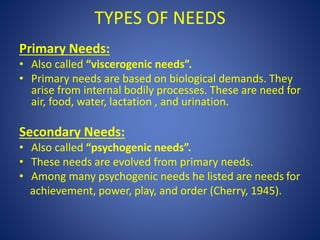
Primary Needs:
• Also called “viscerogenic needs”.
• Primary needs are based on biological demands. They
arise from internal bodily processes. These are need for
air, food, water, lactation , and urination.
Secondary Needs:
• Also called “psychogenic needs”.
• These needs are evolved from primary needs.
• Among many psychogenic needs he listed are needs for
achievement, power, play, and order (Cherry, 1945).
TYPES OF NEEDS
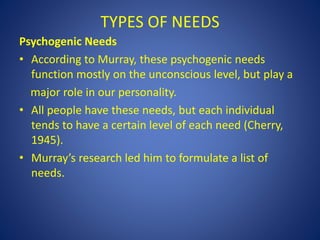
Psychogenic Needs
• According to Murray, these psychogenic needs
function mostly on the unconscious level, but play a
major role in our personality.
• All people have these needs, but each individual
tends to have a certain level of each need (Cherry,
1945).
• Murray’s research led him to formulate a list of
needs.
TYPES OF NEEDS
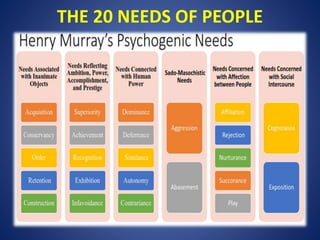
THE 20 NEEDS OF PEOPLE
TYPES OF NEEDS
• Overt and Convert Needs
• (MANIFEST NEEDS AND LATENT NEEDS)-overt are typically expressed in motor behavior,
while convert needs usually belong to the world of fantasy or dreams
• Focal and Diffused Needs
Needs there are focal needs and diffuse needs. Some needs are closely Iinked to limited cl
asses of environmental objects whereas others are so generalized as to be applicable in
almost any environmental setting. If the need is firmly attached to an unsuitable object,
this is called a fixation and
is customarily considered pathological. However, as Murray indicated, the inability of
the need to
show any enduring object preference, jumping from object to object, may be just as
pathological as a fixation
• Proactive and Reactive Needs-needs are those from within and become
“spontaneously kinetic” as the result of something in the person rather that something in
the environment. Reactive needs are activated as a result of, or in response to, some
environmental event
• Modal and Effect Needs- needs involve doing something with a certain degree of
excellence or quality. Effect needs are those that lead to a desired state or end
NEEDS OF PEOPLE
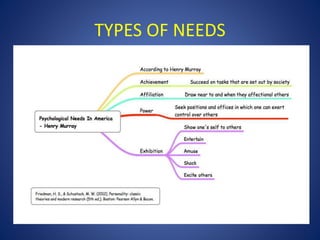
• Abasement: To surrender and accept punishment, self-depreciation, low self
regard
• Achievement: To overcome obstacles and succeed
• Acquisition: To obtain possessions
• Affiliation: To make associations and friendships, to draw near and enjoyably
cooperate or reciprocate with an allied other
• Aggression: To injure others, to fight, to overcome opposition forcefully
• Autonomy: To resist others and stand strong, to get free, strive for
independence, break out of confinement
• Blame avoidance: To avoid blame and obey the rules
• Construction: To build or create
• Contrariance: To be unique
• Counteraction: To defend honor, to overcome weakness and repress fear
• Defendance: To justify actions
• Deference: To follow a superior, to serve, to honor and serve gladly
NEEDS OF PEOPLE
• Dominance: To control and lead others
• Exhibition: To attract attention
• Exposition: To provide information, educate
• Harm avoidance: To avoid pain
• Infavoidance: To avoid failure, shame and humiliation, or to conceal a
weakness
• Nurturance: To protect the helpless
• Order: To arrange, organize, and be precise
• Play: To relieve tension, have fun, or relax
• Recognition: To gain approval and social status
• Rejection: To exclude another, to separate oneself
• Sentience: To seek and enjoy sensuous impressions
• Sex: To form and enjoy an erotic relationship
• Similance: To empathize
• Succorance: To seek protection or sympathy, dependent
• Understanding: To analyze experiences, to seek knowledge, to ask or
answer general questions
NEEDS OF PEOPLE
• Murray believed that stronger needs are expressed more often over time and
lead to more intense behavior.
• The main contribution from Murray was that he understand personality as being
driven by the secondary needs: Achievement, Dominance, Affiliation and
Nurturance. The extent to which each of these needs was felt by an individual
shaped their personality and behavior.
• Since the 60s and 70s the main needs studies have examined Achievement,
Power, Affiliation and Intimacy.
• For example, the need for achievement (or Achievement Motivation) was
studied extensively by
David McLelland in the 70s, and is the single most researched
need. Achievement motivation refers to the desire to do things well, overcome
obstacles, to do things better. A person high in achievement motivation tends to
choose more difficult tasks than a person low in achievement motivation,
because they want to find out more about their ability to achieve.
NEEDS OF PEOPLE
• The need for power was studied intensely by David Winter in the 70s. The
need for power is the desire to have dominance, impact on others,
prestige, position, and influence over others. Those who have a need for
power are often concerned about controlling the image of themselves
that is portrayed to others. If the need for power can be combined with
taking on responsibility, then "acceptable" displays of power can be
experienced.
• The need for affiliation has been studied by McAdam in the 80s. The
need for affiliation refers to the desire to desire to spend time with other
people. It can be more useful to look at subcomponents such as social
comparison, emotional support, positive stimulation, and attention from
others.
• The need for intimacy is the desire to experience warm, close, and
communicative exchanges with
another person. Ultimately, it is the desire to merge self with
another. The need for intimacy correlates .58 (medium correlation) with
the need for affiliation, but focuses more on one to one interactions,
particularly self-disclosure and listening.
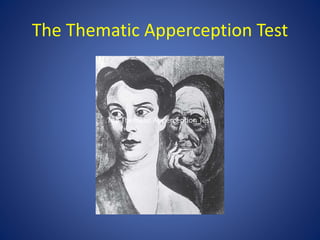
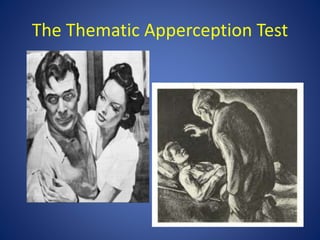
The Thematic Apperception Test
• a projective test designed to reveal a person's
social drives or needs by their interpretation of a
series of pictures of emotionally ambiguous
situations.
• The person taking the test is asked to compose a
story that describes the people and objects in the
picture, including what might have led up to the
situation and what the people are thinking and
feeling.
The Thematic Apperception Test
• Murray derived the TAT from Freud’s defense
mechanism of projection.
• In the TAT, the person projects those feelings
onto the characters in the pictures and
thereby reveals his or her troubling thoughts
to the researcher or therapist. Thus, the TAT is
a device for assessing unconscious thoughts,
feelings, and fears.
The Thematic Apperception Test
Evaluation for Murrays Theory
• Strengths
1. Murray’s theory and his research have played a
crucial role in promoting a more serious interest
in psychoanalytic theory among academic
psychologists.
2. Is theory simultaneously emphasizes the
importance of the person’s past and the present
context within which behavior takes place.
3. He conducted intensive study of small numbers
of normal people.
Evaluation for Murrays Theory
• Weakness
1. Some critics think his theory is so broad it loses the
power or vigor attached to a more limited and
specialized point of view.
2. Murray’s patience and skill as a taxonomist led him
to create so many fine distinctions and detailed
classifications that made his studies in behavior
unnecessarily complex
3. In general, Murray’s writing and his research are not
fashionable in the current psychological world.
SUMMARY
Murray believed that human behavior may be
understood through the processes of satisfying
motives and needs. Personality can be described
generally in terms of these needs and the ways
they interact with environmental forces.
Murray’s ideas are similar to Freud’s
developmental stages of personality; he even
adapted the id, ego, and super-ego. His most
extensive contribution is the Thematic
Apperception Test (TAT) and his taxonomies of
need, press and thema.

Henry Murray

  • 1.
    PERSONOLOGY “ For me,personality is (a) jungle without boundaries.” - Henry Alexander Murray
  • 2.
  • 3.
    CHILDHOOD • Born intoa wealthy family on May 23, 1893 in New York City to Henry Alexander Murray Sr. and Fannie Morris Babcock • Had a warm relationship with his father but was not close to his mother • Caused his lifelong depression that formed his personality • Suffered being cross-eyed and underwent surgery but the operation made him lose his stereoscopic vision and from stuttering (speech difficulty) • Took up football and boxing. He was successful in boxing and won the local featherweight championship • EDUCATION • Attended Pre-school at Groton School • Studied at Harvard College from 1911 to 1915, earning his AB major in History • Graduated from Columbia University Medical School (1919) at the top of his class and earned an MA in Biology. • In 1927,he obtained his Ph.D in Biochemistry from Cambridge University, same year he joined Harvard University as an instructor in Psychology. THE LIFE OF MURRAY (1893-1988)
  • 4.
    THE LIFE OFMURRAY (1893-1988) • EDUCATION • In 1927,he obtained his Ph.D in Biochemistry from Cambridge University, same year he joined Harvard University as an instructor in Psychology. • Headed the Harvard Psychological Clinic for 15 years and became emeritus professor in 1962 • He was awarded the Distinguished Scientific Contribution Award by the American Psychological Association and by the American Psychological Foundation for his lifetime of contribution to psychology • LOVE STORY • Married Josephine Rantaul, heiress to the Dupont family fortune in 1916 • Had one daughter, born in 1921 • While married to Josephine, he fell in love with Christina Morgan but refused to leave his wife. • In 1930, Murray and Morgan collaborated on the Thematic Apperception Test (TAT) • Murray’s wife died in 1962, his severe depression threatened to overcome him. • Five years later Christina Morgan also died. • Two years after, at the age of 76, he remarried. • He died of pneumonia on June 23, 1988 at the age of 95 at Cambridge, Massachusetts
  • 5.
    THE LIFE OFMURRAY (1893-1988) • Persuaded by Christiana Morgan, Murray met Carl Jung in 1925, in Zurich, an experience that changed his life. Jung's advice to Murray concerning his personal life was to continue openly with both relationships. After his meeting with Jung, Murray decided to shift his career toward depth psychology. • Like Carl Jung, Murray believed that human personality could be better understood by investigating the unconscious mind. • In 1927, Murray became assistant director and in 1937, the director of the Harvard Psychological Clinic. In 1930, he developed, with help from Christiana Morgan, his famous Thematic Apperception Test (TAT). In 1938, he published the now classic Explorations in Personality. • During World War II, Murray left Harvard and joined the Army Medical Corps to help with the war effort. He worked as lieutenant colonel, establishing the Office of Strategic Services (OSS). The goal of the agency was to find and train men for special tasks. • After the war, Murray returned to Harvard, lecturing part-time and establishing, with others, the Psychological Clinic Annex in 1949. He also served as a chief researcher. Murray retired in 1962. He became emeritus professor, receiving the Distinguished Scientific Contribution Award from the American Psychological Association and the Gold Medal Award for lifetime achievement from the American Psychological Foundation. He continued to lecture, and also furthered his study of the works of author Herman Melville.
  • 6.
    Murray’s Life Work PERSONOLOGY •Shortened form of “PERSONALITY PSYCHOLOGY” • Personology is simple in structure but complex in detail • Murray used the term “personology” to describe his study of human lives and individual differences in personality. • No brain, No personality
  • 7.
    Murray’s Life Work •PRINCIPLES OF PERSONOLOGY • 1st Principle – Our personality is rooted in the brain. (No brain, No Personality.) • 2nd Principle- people act to reduce physiological and psychological tension; but does not mean that they strive for a tension free state • 3rd Principle- an individual’s personality continues to develop over time and is constructed of all the events that occur during the course of that person’s life. • 4th Principle- personality changes and progresses; it is not fixed or static • 5th Principle- each person is unique but there are similarities among all people. An individual human being is like no other person, like some other people, and like every other person.
  • 8.
    Divisions of Personology •Murray divided personality in three parts. For this, he used Freud’s terms but these terms differ in interpretation. • Id • Superego • Ego
  • 9.
    Divisions of Personology •Id • Murray was influenced by Jung’s Shadow Archetype which has good impulses as well as bad ones. • The strength of Id impulse varies among individuals. • Id • Freud: • Freud said, Id contains primitive, amoral & lustful impulses. • Murray: • Murray believed, Id contains socially acceptable impulses like empathy and love.
  • 10.
    Divisions of Personology •Superego • Freud: • Freud was of the view that superego stems out after the child identifies with his/her parents. Superego acts as the parental voice. • Murray: • Murray defined superego as the internalization of the culture’s values and norms by which we come to evaluate and judge our behavior and that of others.
  • 11.
    Divisions of Personology •Superego • FREUD: • Freud said that at the age of 5, the superego is • crystallized. • Murray: • Murray suggested that Superego continuously develop • throughout lifetime. • Freud: • The superego is in constant conflict with Id. • Murray: • Murray opposed the Freud's this concept and said that superego is not in constant conflict with id because the Id contains bad and good impulses.
  • 12.
    Divisions of Personology •Ego • Ego is the rational governor of personality. • He opposes Freud’s contention that ego is the slave of id, superego and the reality. • A strong ego can mediate effectively between the two but a weak ego leads the personality a battleground. • Ego organizes our behaviors coming from the id impulse whether good or bad. • Ego is the central organizer of all behaviors. It plan courses of action. It suppress unaccepted id impulses and promote accepted id impulses pleasure.
  • 13.
    Divisions of Personology EGO Itis called the arbiter of the two contenders, id and superego. It may favor one over the other. • Example • Ego supports id. This support leads the personality towards a life of crime. • Ego • Sometimes ego may ay favors both, the id and the superego. • Example • Ego supports both. This thing leads to the harmony between what a person wants to do and what the society expects from person.
  • 14.
    Stages of Personality Murrayfocused on the importance of genetic & maturational factors in development of personality • Childhood, Adolescence & Young adult- new structural compositions emerge and multiply • Middle years- are marked by conservative recompositions of the already emerged structures and functions • Senescence (Final Era)- new compositions and recompositions decreases, while the atrophy of existing forms and functions increases.
  • 15.
    COMPLEX Definition of Complex: •A normal pattern of childhood development that influences the adult personality • According to Murray, everyone passes through 5 developmental stages and also experiences 5 complexes associated with these.
  • 16.
    The Five Complexes TheClaustral Complex  The fetus in the womb is secure, serene, and dependent, conditions we may all occasionally wish to reinstate.  Represents residuals of the uterine or prenatal experiences of the individual a) Simple claustral complex  is experienced as a desire to be in small, warm, dark places that are safe and secluded  People with this complex tend to be dependent on others, passive, and oriented toward safe, familiar behaviors that worked in the past.  Revolves around the wish to reinstate the conditions similar to those prevailing before birth. b) Fear of insupport complex  centers on feelings of insecurity and helplessness that cause the person to fear open spaces, falling, drowning, fires, earthquakes, or simply any situation involving novelty and change.  spaces, fresh air, travel, movement, change, and novelty  Centers around the anxiety of insupport and helplessness c) Anti-claustral or agression complex  is based on a need to escape from restraining womblike conditions.  It includes a fear of suffocation and confinement and manifests itself in a preference for open spaces, fresh air, travel, movement, change, and novelty.
  • 17.
    The Five Complexes TheOral Complex a) Oral succorance complex  features a combination of mouth activities, passive and dependent tendencies, and the need to be supported and protected.  Behavioral manifestations include sucking, kissing, eating, drinking, and a hunger for affection, sympathy, protection, and love. b) Oral aggression complex  combines oral and aggressive behaviors, including biting, spitting, shouting, and verbal aggression such as sarcasm.  Strong aggressive needs; ambivalence toward authority figures; projection of oral aggression; need for harm avoidance; phobia for biting objects and stuttering. c) Oral rejection complex  Behaviors characteristic include vomiting, being picky about food, eating little, fearing oral contamination (such as from kissing), desiring seclusion, and avoiding dependence on others.  Involves spitting and disgust over oral activities and objects.
  • 18.
    The Five Complexes TheAnal stage Derived from events associated with the act of defecating and bowel training a) Anal rejection complex  there is a preoccupation with defecation, anal humor, and feces-like material such as dirt, mud, plaster, and clay.  Aggression is often part of this complex and is shown in dropping and throwing things, firing guns, and setting off explosives.  Persons with this complex may be dirty and disorganized.  Includes diarrhea and cathexis for feces; involves need for aggression, particularly dirtying or smearing; anal theory of birth, need for autonomy , anal sexuality b) Anal retention complex  manifested in accumulating, saving, and collecting things, and in cleanliness, neatness, and orderliness.  Involves an underlying cathexis for feces but is concealed behind an apparent disgust, prudishness, and negative reaction to defecation.
  • 19.
    The Five Complexes •The Urethral Complex  associated with excessive ambition, a distorted sense of self-esteem, exhibitionism, bedwetting, sexual cravings, and self-love.  It is sometimes called the Icarus complex, after the mythical Greek figure that flew so close to the sun that the wax holding his wings melted.  Like Icarus, persons with this complex aim too high, and their dreams are shattered by failure. • The Genital or Castration Complex  Murray disagreed with Freud’s contention that fear of castration is the core of anxiety in adult males.  He interpreted the castration complex in narrower and more literal fashion as a boy’s fantasy that his penis might be cut off.  Murray believed such a fear grows out of childhood masturbation and the parental punishment that may have accompanied it.
  • 20.
    PRESS The PRESS isan environment force that interacts with needs to determine behavior. Pres is linked to persons or objects that have direct implications on an individual’s effort to satisfy his or her striving. • childhood events can affect the development of specific needs and, later in life, can activate those needs because an environmental object or event presses or pressures the individual to act a certain way. Two Kinds of Press 1. Alpha Press-environmental objects as they exist in reality or as objective inquiry discloses them. 2. Beta Press-environmental objects as they are perceived and interpreted by the individual
  • 21.
    TENSION REDUCTION When aneed is aroused, the individual is in a state of tension. Satisfaction of the need results in reduction of the tension. Individuals learn to attend to the objects and perform acts that were in the past associated with tension reduction. Paradoxically, a tension-free situation is a source of distress. Press-Need Pattern Need and Press are the behavioral units of personality (actones) Produce tension (energy) to create an action The interaction between the press and a need produces an OPTIONAL BEHAVIOR.
  • 22.
    Characters of Needs THEMA combines personal factors (needs) with the environmental factors that pressure or compel our behavior (presses).  The thema is formed through early childhood experiences and becomes a powerful force in determining personality  Largely unconscious, the thema relates needs and presses in a pattern that gives coherence, unity, order, and uniqueness to our behavior  Is a molar and interactive behavioral unit that involves the interaction between the investigating situation (press) and the need that is operating. PROCEEDINGS-period of time required for complexion of an important pattern of behavior. SERIAL-Succession of proceedings related to the same function or purpose NEEDS- explain the motivation and direction of behavior. It is physiological, based on hypothetical constructs.
  • 23.
    NEEDS: The Motivatorsof Behavior • Murray’s most important contribution to theory and research in personality is his use of the concept of needs to explain the motivation and direction of behavior. • Needs involves a physiochemical force in the brain that organizes and directs intellectual and perceptual abilities. • May arise either from internal processes such as hunger or thirst, or from events in the environment.
  • 24.
    TYPES OF NEEDS a.Primary and Secondary Needs b. Overt and Convert Needs c. Focal needs and Diffused Needs d. Proactive and Reactive Needs e. Modal and Effect Needs
  • 25.
    TYPES OF NEEDS PrimaryNeeds: • Also called “viscerogenic needs”. • Primary needs are based on biological demands. They arise from internal bodily processes. These are need for air, food, water, lactation , and urination. Secondary Needs: • Also called “psychogenic needs”. • These needs are evolved from primary needs. • Among many psychogenic needs he listed are needs for achievement, power, play, and order (Cherry, 1945).
  • 26.
    TYPES OF NEEDS PsychogenicNeeds • According to Murray, these psychogenic needs function mostly on the unconscious level, but play a major role in our personality. • All people have these needs, but each individual tends to have a certain level of each need (Cherry, 1945). • Murray’s research led him to formulate a list of needs.
  • 27.
  • 28.
    THE 20 NEEDSOF PEOPLE
  • 29.
    TYPES OF NEEDS •Overt and Convert Needs • (MANIFEST NEEDS AND LATENT NEEDS)-overt are typically expressed in motor behavior, while convert needs usually belong to the world of fantasy or dreams • Focal and Diffused Needs Needs there are focal needs and diffuse needs. Some needs are closely Iinked to limited cl asses of environmental objects whereas others are so generalized as to be applicable in almost any environmental setting. If the need is firmly attached to an unsuitable object, this is called a fixation and is customarily considered pathological. However, as Murray indicated, the inability of the need to show any enduring object preference, jumping from object to object, may be just as pathological as a fixation • Proactive and Reactive Needs-needs are those from within and become “spontaneously kinetic” as the result of something in the person rather that something in the environment. Reactive needs are activated as a result of, or in response to, some environmental event • Modal and Effect Needs- needs involve doing something with a certain degree of excellence or quality. Effect needs are those that lead to a desired state or end
  • 30.
    NEEDS OF PEOPLE •Abasement: To surrender and accept punishment, self-depreciation, low self regard • Achievement: To overcome obstacles and succeed • Acquisition: To obtain possessions • Affiliation: To make associations and friendships, to draw near and enjoyably cooperate or reciprocate with an allied other • Aggression: To injure others, to fight, to overcome opposition forcefully • Autonomy: To resist others and stand strong, to get free, strive for independence, break out of confinement • Blame avoidance: To avoid blame and obey the rules • Construction: To build or create • Contrariance: To be unique • Counteraction: To defend honor, to overcome weakness and repress fear • Defendance: To justify actions • Deference: To follow a superior, to serve, to honor and serve gladly
  • 31.
    NEEDS OF PEOPLE •Dominance: To control and lead others • Exhibition: To attract attention • Exposition: To provide information, educate • Harm avoidance: To avoid pain • Infavoidance: To avoid failure, shame and humiliation, or to conceal a weakness • Nurturance: To protect the helpless • Order: To arrange, organize, and be precise • Play: To relieve tension, have fun, or relax • Recognition: To gain approval and social status • Rejection: To exclude another, to separate oneself • Sentience: To seek and enjoy sensuous impressions • Sex: To form and enjoy an erotic relationship • Similance: To empathize • Succorance: To seek protection or sympathy, dependent • Understanding: To analyze experiences, to seek knowledge, to ask or answer general questions
  • 32.
    NEEDS OF PEOPLE •Murray believed that stronger needs are expressed more often over time and lead to more intense behavior. • The main contribution from Murray was that he understand personality as being driven by the secondary needs: Achievement, Dominance, Affiliation and Nurturance. The extent to which each of these needs was felt by an individual shaped their personality and behavior. • Since the 60s and 70s the main needs studies have examined Achievement, Power, Affiliation and Intimacy. • For example, the need for achievement (or Achievement Motivation) was studied extensively by David McLelland in the 70s, and is the single most researched need. Achievement motivation refers to the desire to do things well, overcome obstacles, to do things better. A person high in achievement motivation tends to choose more difficult tasks than a person low in achievement motivation, because they want to find out more about their ability to achieve.
  • 33.
    NEEDS OF PEOPLE •The need for power was studied intensely by David Winter in the 70s. The need for power is the desire to have dominance, impact on others, prestige, position, and influence over others. Those who have a need for power are often concerned about controlling the image of themselves that is portrayed to others. If the need for power can be combined with taking on responsibility, then "acceptable" displays of power can be experienced. • The need for affiliation has been studied by McAdam in the 80s. The need for affiliation refers to the desire to desire to spend time with other people. It can be more useful to look at subcomponents such as social comparison, emotional support, positive stimulation, and attention from others. • The need for intimacy is the desire to experience warm, close, and communicative exchanges with another person. Ultimately, it is the desire to merge self with another. The need for intimacy correlates .58 (medium correlation) with the need for affiliation, but focuses more on one to one interactions, particularly self-disclosure and listening.
  • 34.
    The Thematic ApperceptionTest The Thematic Apperception Test
  • 35.
    The Thematic ApperceptionTest • a projective test designed to reveal a person's social drives or needs by their interpretation of a series of pictures of emotionally ambiguous situations. • The person taking the test is asked to compose a story that describes the people and objects in the picture, including what might have led up to the situation and what the people are thinking and feeling.
  • 36.
    The Thematic ApperceptionTest • Murray derived the TAT from Freud’s defense mechanism of projection. • In the TAT, the person projects those feelings onto the characters in the pictures and thereby reveals his or her troubling thoughts to the researcher or therapist. Thus, the TAT is a device for assessing unconscious thoughts, feelings, and fears.
  • 37.
  • 38.
    Evaluation for MurraysTheory • Strengths 1. Murray’s theory and his research have played a crucial role in promoting a more serious interest in psychoanalytic theory among academic psychologists. 2. Is theory simultaneously emphasizes the importance of the person’s past and the present context within which behavior takes place. 3. He conducted intensive study of small numbers of normal people.
  • 39.
    Evaluation for MurraysTheory • Weakness 1. Some critics think his theory is so broad it loses the power or vigor attached to a more limited and specialized point of view. 2. Murray’s patience and skill as a taxonomist led him to create so many fine distinctions and detailed classifications that made his studies in behavior unnecessarily complex 3. In general, Murray’s writing and his research are not fashionable in the current psychological world.
  • 40.
    SUMMARY Murray believed thathuman behavior may be understood through the processes of satisfying motives and needs. Personality can be described generally in terms of these needs and the ways they interact with environmental forces. Murray’s ideas are similar to Freud’s developmental stages of personality; he even adapted the id, ego, and super-ego. His most extensive contribution is the Thematic Apperception Test (TAT) and his taxonomies of need, press and thema.