STEREOTYPES
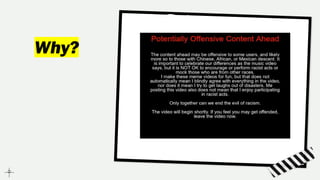
Why?
Stereotypes
• A stereotype is the social perception of a person
in terms of group membership or physical
attributes.
• This is a form of categorization and
generalization, and a stereotype can be negative
or positive.
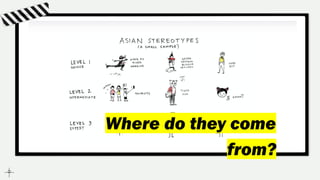
Where do they come
from?
The formation
of stereotypes
• Schneider (2004): stereotypes develop in two ways:
indirectly, as a product of culture or society, or
directly, a result of our personal experiences.
• Campbell (1967): there are two key sources of
stereotypes: personal experience with individuals and
groups, and gatekeepers, that can include the media,
parents, and other members of our culture. He argues that
stereotypes are based in reality in his Grain of Truth
Hypothesis.
• Hamilton and Gifford (1976): stereotypes are a result of
the illusory correlation bias. This is when people form
false associations between two variables.
HAMILTON AND GIFFORD (1976)
• Hamilton and Gifford were investigating the illusory correlation bias in this
experiment.
• 70 American undergraduates were shown a series of slides containing a statement about
members of a fictious Group A or B. Group A had 26 members, and Group B had 13.
• Each statement was either positive or negative, and the ratio of negative behaviour
to positive behaviour was the same in both groups
• Participants were then asked to rank each member of the groups on 20 traits: popular,
social, intelligent. After this, they were given a booklet in which either a positive
or negative statement was given, and participants were asked the member of which
group was more likely to do it.
• Lastly, they were asked which how many of the statements provided for each group were
negative
• When the participants were ranking traits, Group A was
ranked higher than Group B for positive traits, and vice
versa.
• In the booklet, participants assigned more positive
traits for Group A members, and more negative traits for
Group B members.
• Hamilton and Gifford conclude that because minority
groups are smaller in number, the negative behaviours
stand out and become a more distinctive trait of the
group. This conclusion can be used to explain why
negative stereotypes might be more common for minority
groups.
Cognitive bias and their role
• Availability heuristic: Using easily recalled pairings of people and
behaviour to make rapid judgements. This cognitive shortcut is used to
quickly make judgements about people based on the readily available
information you can recall about them.
• Confirmation bias: Expectancy-based illusory correlation is when we
mistakenly see relationships that confirm our pre-existing expectations.
Redelmeier and Tversky (1996) performed an experiment that showed people
making correlations that reaffirmed their belief that change in weather
leads to arthritic pain.
SNYDER AND SWANN (1978)
• Female undergraduate participants were asked to prepare questions for a
person they were going to meet, either introverted or extroverted.
• It was found that their questions were consistent with the pre-existing
conceptions they had about introverts and extroverts
• The researchers concluded that the questions confirmed the stereotypes of
each personality.
• This is again an example of confirmation bias playing a role with
stereotyoes.
The effects of
stereotypes
Do positive stereotypes exist?
• We may think that positive stereotypes are beneficial for the group’s
self-esteem, however, there are effects of the positive stereotypes that
people have as well.
• You may think that the stereotype that Asians are good at math would be
helpful for their self-esteem, but as we all know, stereotypes create more
harm than good.
Stereotype threat
• Stereotype threat is the fear of confirming the beliefs that people have
about the group that one belongs to.
• Self-fulfilling prophecy, that we will end up conforming to the stereoypes
people have about us leads to spotlight anxiety.
• Spotlight anxiety creates undue distress that inadvertently creates the
atmosphere of failure, and may undermine performance.
STEELE AND ARONSON (1995)
• The conducted an experiment to see whether stereotype threat had an effect on
the performance of a frequently stereotyped group.
• African American students and European American students were pt into two exam
conditions, one where they were told it’s a test of their abilities, and one
where they were told it is not diagnostic of their abilities. To ensure that
knowledge of race wasn’t a confounding variable one group was made to fill out a
survey where they had to identify their race
• It was noted that African American students performed worse than their European
American peers when they were told it was a test of their abilities, and there
was no significant difference in their scores when they were told it’s not
diagnostic of their abilities. African American students that were made aware of
their race prior to the test also performed significantly worse than their
European American peers.
SPENCER ET AL (1999)
• Spencer et al tested the effect of spotlight anxiety on performance.
• Women and men who were good at mathematics were made to take a math test
in an examination setting. Spencer et al hypothesized that the women would
perform worse in the test since they considered mathematics to be an
important determinant of their self-esteem, and therefore performing would
be of great importance to them.
• Their hypothesis was proven true, the women performed significantly worse
than the men giving the test, even though participants often similar
mathematical ability.
Memory distortion
• Another effect of stereotypes is memory distortion.
• This often occurs hand-in hand with conformation bias,
where if something we see is not perceived to be conforming
to our pre-existing stereotypes, we forget or distort the
memory of said occurrence.
ALLPORT AND POSTMAN (1947)
• Allport and Postman conducted an experiment that tested how stereotypes
affected recall, using the process of serial reproduction
• Participants were shown a picture of a white man threatening a black man
on the subway, and then participants were asked to describe it to another
participant. At some stage, the story was distorted so that the black man
was threatening the white man, which conforms to the commonly held
stereotype people have of black people being more violent.

STEREOTYPES IB curriculum formation and effects

  • 1.
  • 2.
  • 3.
    Stereotypes • A stereotypeis the social perception of a person in terms of group membership or physical attributes. • This is a form of categorization and generalization, and a stereotype can be negative or positive.
  • 4.
    Where do theycome from?
  • 5.
  • 6.
    • Schneider (2004):stereotypes develop in two ways: indirectly, as a product of culture or society, or directly, a result of our personal experiences. • Campbell (1967): there are two key sources of stereotypes: personal experience with individuals and groups, and gatekeepers, that can include the media, parents, and other members of our culture. He argues that stereotypes are based in reality in his Grain of Truth Hypothesis. • Hamilton and Gifford (1976): stereotypes are a result of the illusory correlation bias. This is when people form false associations between two variables.
  • 7.
    HAMILTON AND GIFFORD(1976) • Hamilton and Gifford were investigating the illusory correlation bias in this experiment. • 70 American undergraduates were shown a series of slides containing a statement about members of a fictious Group A or B. Group A had 26 members, and Group B had 13. • Each statement was either positive or negative, and the ratio of negative behaviour to positive behaviour was the same in both groups • Participants were then asked to rank each member of the groups on 20 traits: popular, social, intelligent. After this, they were given a booklet in which either a positive or negative statement was given, and participants were asked the member of which group was more likely to do it. • Lastly, they were asked which how many of the statements provided for each group were negative
  • 8.
    • When theparticipants were ranking traits, Group A was ranked higher than Group B for positive traits, and vice versa. • In the booklet, participants assigned more positive traits for Group A members, and more negative traits for Group B members. • Hamilton and Gifford conclude that because minority groups are smaller in number, the negative behaviours stand out and become a more distinctive trait of the group. This conclusion can be used to explain why negative stereotypes might be more common for minority groups.
  • 9.
    Cognitive bias andtheir role • Availability heuristic: Using easily recalled pairings of people and behaviour to make rapid judgements. This cognitive shortcut is used to quickly make judgements about people based on the readily available information you can recall about them. • Confirmation bias: Expectancy-based illusory correlation is when we mistakenly see relationships that confirm our pre-existing expectations. Redelmeier and Tversky (1996) performed an experiment that showed people making correlations that reaffirmed their belief that change in weather leads to arthritic pain.
  • 10.
    SNYDER AND SWANN(1978) • Female undergraduate participants were asked to prepare questions for a person they were going to meet, either introverted or extroverted. • It was found that their questions were consistent with the pre-existing conceptions they had about introverts and extroverts • The researchers concluded that the questions confirmed the stereotypes of each personality. • This is again an example of confirmation bias playing a role with stereotyoes.
  • 11.
  • 12.
    Do positive stereotypesexist? • We may think that positive stereotypes are beneficial for the group’s self-esteem, however, there are effects of the positive stereotypes that people have as well. • You may think that the stereotype that Asians are good at math would be helpful for their self-esteem, but as we all know, stereotypes create more harm than good.
  • 13.
    Stereotype threat • Stereotypethreat is the fear of confirming the beliefs that people have about the group that one belongs to. • Self-fulfilling prophecy, that we will end up conforming to the stereoypes people have about us leads to spotlight anxiety. • Spotlight anxiety creates undue distress that inadvertently creates the atmosphere of failure, and may undermine performance.
  • 14.
    STEELE AND ARONSON(1995) • The conducted an experiment to see whether stereotype threat had an effect on the performance of a frequently stereotyped group. • African American students and European American students were pt into two exam conditions, one where they were told it’s a test of their abilities, and one where they were told it is not diagnostic of their abilities. To ensure that knowledge of race wasn’t a confounding variable one group was made to fill out a survey where they had to identify their race • It was noted that African American students performed worse than their European American peers when they were told it was a test of their abilities, and there was no significant difference in their scores when they were told it’s not diagnostic of their abilities. African American students that were made aware of their race prior to the test also performed significantly worse than their European American peers.
  • 15.
    SPENCER ET AL(1999) • Spencer et al tested the effect of spotlight anxiety on performance. • Women and men who were good at mathematics were made to take a math test in an examination setting. Spencer et al hypothesized that the women would perform worse in the test since they considered mathematics to be an important determinant of their self-esteem, and therefore performing would be of great importance to them. • Their hypothesis was proven true, the women performed significantly worse than the men giving the test, even though participants often similar mathematical ability.
  • 16.
    Memory distortion • Anothereffect of stereotypes is memory distortion. • This often occurs hand-in hand with conformation bias, where if something we see is not perceived to be conforming to our pre-existing stereotypes, we forget or distort the memory of said occurrence.
  • 17.
    ALLPORT AND POSTMAN(1947) • Allport and Postman conducted an experiment that tested how stereotypes affected recall, using the process of serial reproduction • Participants were shown a picture of a white man threatening a black man on the subway, and then participants were asked to describe it to another participant. At some stage, the story was distorted so that the black man was threatening the white man, which conforms to the commonly held stereotype people have of black people being more violent.