Welding Processes.
Brazing and Soldering
Prof. Yagnesh J Gambhava.
Assistant Professor
Automobile Engineering Department
A.D.Patel Institute of Technology, Gujarat
Introduction to Welding
– Welding is a materials joining process which produces
coalescence (joint) of materials by heating them to suitable
temperatures with or without the application of pressure or by the
application of pressure alone, and with or without the use of filler
material.
– Welding is used for making permanent joints.
– It is used in the manufacture of automobile bodies, aircraft
frames, railway wagons, machine frames, structural works, tanks,
furniture, boilers, general repair work and ship building.
TYPES
Plastic Welding or Pressure Welding
The piece of metal to be joined are heated to a
plastic state and forced together by external
pressure
(Ex) Resistance welding
Fusion Welding or Non-Pressure Welding
The material at the joint is heated to a molten state and allowed
to solidify
(Ex) Gas welding, Arc welding
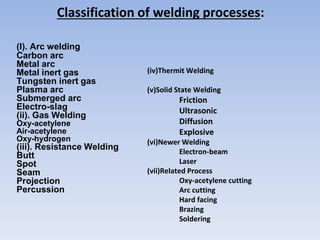
Classification of welding processes:
(I). Arc welding
Carbon arc
Metal arc
Metal inert gas
Tungsten inert gas
Plasma arc
Submerged arc
Electro-slag
(ii). Gas Welding
Oxy-acetylene
Air-acetylene
Oxy-hydrogen
(iii). Resistance Welding
Butt
Spot
Seam
Projection
Percussion
(iv)Thermit Welding
(v)Solid State Welding
Friction
Ultrasonic
Diffusion
Explosive
(vi)Newer Welding
Electron-beam
Laser
(vii)Related Process
Oxy-acetylene cutting
Arc cutting
Hard facing
Brazing
Soldering
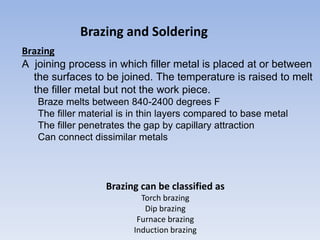
Brazing and Soldering
Brazing
A joining process in which filler metal is placed at or between
the surfaces to be joined. The temperature is raised to melt
the filler metal but not the work piece.
Braze melts between 840-2400 degrees F
The filler material is in thin layers compared to base metal
The filler penetrates the gap by capillary attraction
Can connect dissimilar metals
Brazing can be classified as
Torch brazing
Dip brazing
Furnace brazing
Induction brazing
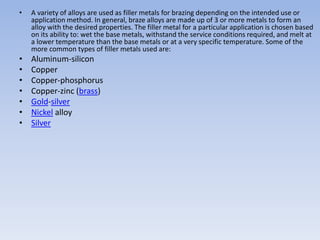
• A variety of alloys are used as filler metals for brazing depending on the intended use or
application method. In general, braze alloys are made up of 3 or more metals to form an
alloy with the desired properties. The filler metal for a particular application is chosen based
on its ability to: wet the base metals, withstand the service conditions required, and melt at
a lower temperature than the base metals or at a very specific temperature. Some of the
more common types of filler metals used are:
• Aluminum-silicon
• Copper
• Copper-phosphorus
• Copper-zinc (brass)
• Gold-silver
• Nickel alloy
• Silver
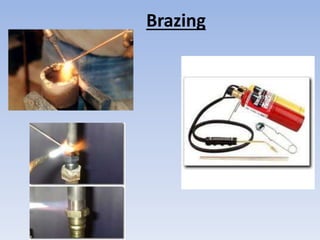
Brazing
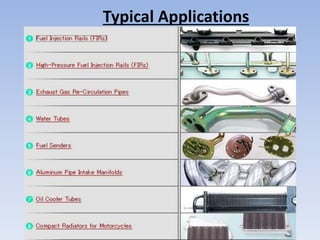
Typical Applications
Advantages
& Disadvantages
Advantages
Dissimilar metals which cannot be welded can be joined by brazing
Very thin metals can be joined
Metals with different thickness can be joined easily
In brazing thermal stresses are not produced in the work piece. Hence there
is no distortion
Using this process, carbides tips are brazed on the steel tool holders
Disadvantages
Brazed joints have lesser strength compared to welding
Joint preparation cost is more
Can be used for thin sheet metal sections
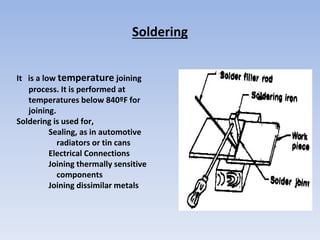
Soldering
It is a low temperature joining
process. It is performed at
temperatures below 840ºF for
joining.
Soldering is used for,
Sealing, as in automotive
radiators or tin cans
Electrical Connections
Joining thermally sensitive
components
Joining dissimilar metals
Thank You

Welding processes-Brazing & Soldering

  • 1.
    Welding Processes. Brazing andSoldering Prof. Yagnesh J Gambhava. Assistant Professor Automobile Engineering Department A.D.Patel Institute of Technology, Gujarat
  • 2.
    Introduction to Welding –Welding is a materials joining process which produces coalescence (joint) of materials by heating them to suitable temperatures with or without the application of pressure or by the application of pressure alone, and with or without the use of filler material. – Welding is used for making permanent joints. – It is used in the manufacture of automobile bodies, aircraft frames, railway wagons, machine frames, structural works, tanks, furniture, boilers, general repair work and ship building.
  • 3.
    TYPES Plastic Welding orPressure Welding The piece of metal to be joined are heated to a plastic state and forced together by external pressure (Ex) Resistance welding Fusion Welding or Non-Pressure Welding The material at the joint is heated to a molten state and allowed to solidify (Ex) Gas welding, Arc welding
  • 4.
    Classification of weldingprocesses: (I). Arc welding Carbon arc Metal arc Metal inert gas Tungsten inert gas Plasma arc Submerged arc Electro-slag (ii). Gas Welding Oxy-acetylene Air-acetylene Oxy-hydrogen (iii). Resistance Welding Butt Spot Seam Projection Percussion (iv)Thermit Welding (v)Solid State Welding Friction Ultrasonic Diffusion Explosive (vi)Newer Welding Electron-beam Laser (vii)Related Process Oxy-acetylene cutting Arc cutting Hard facing Brazing Soldering
  • 5.
    Brazing and Soldering Brazing Ajoining process in which filler metal is placed at or between the surfaces to be joined. The temperature is raised to melt the filler metal but not the work piece. Braze melts between 840-2400 degrees F The filler material is in thin layers compared to base metal The filler penetrates the gap by capillary attraction Can connect dissimilar metals Brazing can be classified as Torch brazing Dip brazing Furnace brazing Induction brazing
  • 6.
    • A varietyof alloys are used as filler metals for brazing depending on the intended use or application method. In general, braze alloys are made up of 3 or more metals to form an alloy with the desired properties. The filler metal for a particular application is chosen based on its ability to: wet the base metals, withstand the service conditions required, and melt at a lower temperature than the base metals or at a very specific temperature. Some of the more common types of filler metals used are: • Aluminum-silicon • Copper • Copper-phosphorus • Copper-zinc (brass) • Gold-silver • Nickel alloy • Silver
  • 7.
  • 8.
  • 9.
    Advantages & Disadvantages Advantages Dissimilar metalswhich cannot be welded can be joined by brazing Very thin metals can be joined Metals with different thickness can be joined easily In brazing thermal stresses are not produced in the work piece. Hence there is no distortion Using this process, carbides tips are brazed on the steel tool holders Disadvantages Brazed joints have lesser strength compared to welding Joint preparation cost is more Can be used for thin sheet metal sections
  • 10.
    Soldering It is alow temperature joining process. It is performed at temperatures below 840ºF for joining. Soldering is used for, Sealing, as in automotive radiators or tin cans Electrical Connections Joining thermally sensitive components Joining dissimilar metals
  • 12.