POWER POINT
PRESENTATION
SECONDARY
STORAGE
DEVICES
AND THEIR CHARACTERISTICS
BY:
PRATIKSHA MESHRAM &
SUPRIYA CHIMANKAR
INDEX
 Introduction
 List of Storage Devices
1]Magnetic Tapes
2] Magnetic Disk
3]Floppy Disk
4]Optical Disk
5]Memory card
6]DVD
7]Pendrive/Flash drive
INTRODUCTION
 Computer data storage, often called storage or
memory, is a technology consisting of computer
components and recording media used to retain digital
data. It is a core function and fundamental component
of computers. The central processing unit (CPU) of a
computer is what manipulates data by performing
computations. In practice, almost all computers use a
storage hierarchy, which puts fast but expensive and
small storage options close to the CPU.
 There are three types of storage:
i. Primary Storage
ii. Secondary storage
iii. Tertiary storage
TYPES OF STORAGE
 Primary Storage
Primary storage, often referred to simply as memory, is the only one
directly accessible to the CPU. The CPU continuously reads
instructions stored there and executes them as required.
 Secondary Storage
Secondary storage is not directly accessible by the CPU. The
computer usually uses its input/output channels to access
secondary storage.It don’t loose the data when computer is
powered down.
 Tertiary Storage
Tertiary storage, provides a third level of storage. It involves a
robotic mechanism which will mount (insert) and dismount
removable mass storage media into a storage device according to
the system's demands.
GDD MAGNETIC TAPES
This storage devices is used where sequential
data and processing is used .The tapes have
high durability power and can be erased and
refused again and again.
Advantages:-
Economical in nature, gives fast
input and output,its reusable,long term storage.
Disadvantages:-Only sequently recording &
accessing.
Inconvenient for storing large number of small
records.
For drives it makes compatibility difficult.
STRUCTURE
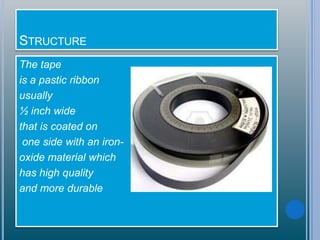
The tape
is a pastic ribbon
usually
½ inch wide
that is coated on
one side with an iron-
oxide material which
has high quality
and more durable
MAGNETIC DISK
 It is a memory device in which a number of disk
make a disk pack.The surface of each recording
surfaces in a 6 disk pack.
It’s a read/write disk.
The disk when loaded is drive
at a high number of revolute
And acess is made on surface
when the disk revolve.
There are two types:
1]Hard disk
2]Removable disk
ADV. & DISADV. OF MAGNETIC DISKS
 Advantages
i. Large capacity
storage.
ii. Reusuable disks.
iii. Have ability to store
data.
 Disadvantages
i. Costlier than tapes.
ii. More susceptional to
errors.
FLOPPY DISK
 Magnetic disk[floppy disk] is also used as an
auxilary storage medium.Its use is limited to small
computer based system.
 Advantages :
Floppy disks are-
Compact ,reusable and cheap.
 Disadvantages :
Floppy disks are more prone to data loss and it is
difficult to handle
STRUCTURE OF FLOPPY DISK
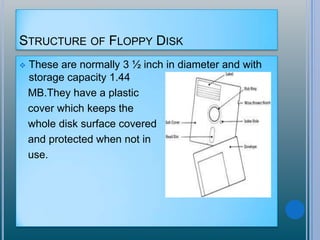
 These are normally 3 ½ inch in diameter and with
storage capacity 1.44
MB.They have a plastic
cover which keeps the
whole disk surface covered
and protected when not in
use.
OPTICAL DISK
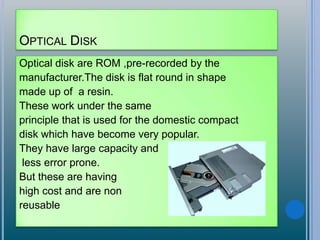
Optical disk are ROM ,pre-recorded by the
manufacturer.The disk is flat round in shape
made up of a resin.
These work under the same
principle that is used for the domestic compact
disk which have become very popular.
They have large capacity and
less error prone.
But these are having
high cost and are non
reusable
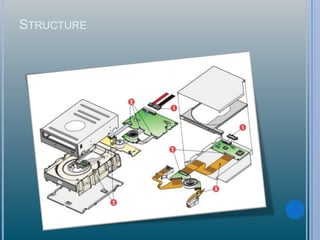
STRUCTURE
DVD
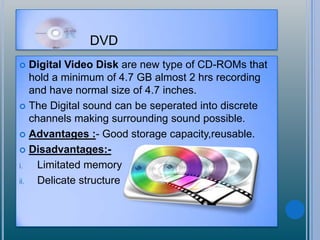
 Digital Video Disk are new type of CD-ROMs that
hold a minimum of 4.7 GB almost 2 hrs recording
and have normal size of 4.7 inches.
 The Digital sound can be seperated into discrete
channels making surrounding sound possible.
 Advantages :- Good storage capacity,reusable.
 Disadvantages:-
i. Limitated memory
ii. Delicate structure
MEMORY CARDS/FLASH CARD
 A memory card or flash card is an electronic flash
memory data storage device used for storing digital
information. They are commonly used in many
electronic devices, including digital cameras, mobile
phones, laptop computers, MP3 players and video
game consoles. They are small in size.
 Adv. :-Re-recordable, and able to retain data
without power.
 Disadv. :- Limitated memory and
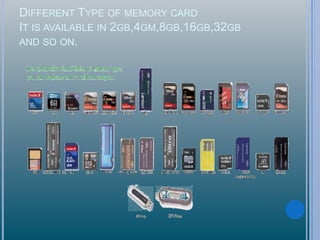
DIFFERENT TYPE OF MEMORY CARD
IT IS AVAILABLE IN 2GB,4GM,8GB,16GB,32GB
AND SO ON.
PEN/FLASH DRIVE
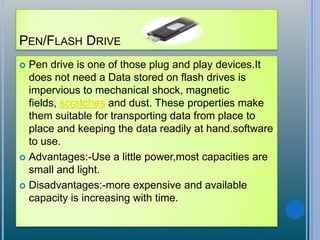
 Pen drive is one of those plug and play devices.It
does not need a Data stored on flash drives is
impervious to mechanical shock, magnetic
fields, scratches and dust. These properties make
them suitable for transporting data from place to
place and keeping the data readily at hand.software
to use.
 Advantages:-Use a little power,most capacities are
small and light.
 Disadvantages:-more expensive and available
capacity is increasing with time.
PENDRIVE
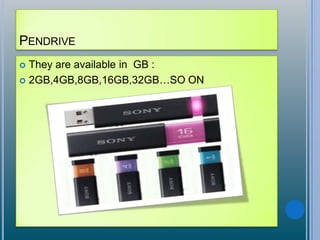
 They are available in GB :
 2GB,4GB,8GB,16GB,32GB…SO ON
THANK YOU

Welcome

  • 1.
  • 2.
  • 3.
  • 4.
    INDEX  Introduction  Listof Storage Devices 1]Magnetic Tapes 2] Magnetic Disk 3]Floppy Disk 4]Optical Disk 5]Memory card 6]DVD 7]Pendrive/Flash drive
  • 5.
    INTRODUCTION  Computer datastorage, often called storage or memory, is a technology consisting of computer components and recording media used to retain digital data. It is a core function and fundamental component of computers. The central processing unit (CPU) of a computer is what manipulates data by performing computations. In practice, almost all computers use a storage hierarchy, which puts fast but expensive and small storage options close to the CPU.  There are three types of storage: i. Primary Storage ii. Secondary storage iii. Tertiary storage
  • 6.
    TYPES OF STORAGE Primary Storage Primary storage, often referred to simply as memory, is the only one directly accessible to the CPU. The CPU continuously reads instructions stored there and executes them as required.  Secondary Storage Secondary storage is not directly accessible by the CPU. The computer usually uses its input/output channels to access secondary storage.It don’t loose the data when computer is powered down.  Tertiary Storage Tertiary storage, provides a third level of storage. It involves a robotic mechanism which will mount (insert) and dismount removable mass storage media into a storage device according to the system's demands.
  • 7.
    GDD MAGNETIC TAPES Thisstorage devices is used where sequential data and processing is used .The tapes have high durability power and can be erased and refused again and again. Advantages:- Economical in nature, gives fast input and output,its reusable,long term storage. Disadvantages:-Only sequently recording & accessing. Inconvenient for storing large number of small records. For drives it makes compatibility difficult.
  • 8.
    STRUCTURE The tape is apastic ribbon usually ½ inch wide that is coated on one side with an iron- oxide material which has high quality and more durable
  • 9.
    MAGNETIC DISK  Itis a memory device in which a number of disk make a disk pack.The surface of each recording surfaces in a 6 disk pack. It’s a read/write disk. The disk when loaded is drive at a high number of revolute And acess is made on surface when the disk revolve. There are two types: 1]Hard disk 2]Removable disk
  • 10.
    ADV. & DISADV.OF MAGNETIC DISKS  Advantages i. Large capacity storage. ii. Reusuable disks. iii. Have ability to store data.  Disadvantages i. Costlier than tapes. ii. More susceptional to errors.
  • 11.
    FLOPPY DISK  Magneticdisk[floppy disk] is also used as an auxilary storage medium.Its use is limited to small computer based system.  Advantages : Floppy disks are- Compact ,reusable and cheap.  Disadvantages : Floppy disks are more prone to data loss and it is difficult to handle
  • 12.
    STRUCTURE OF FLOPPYDISK  These are normally 3 ½ inch in diameter and with storage capacity 1.44 MB.They have a plastic cover which keeps the whole disk surface covered and protected when not in use.
  • 13.
    OPTICAL DISK Optical diskare ROM ,pre-recorded by the manufacturer.The disk is flat round in shape made up of a resin. These work under the same principle that is used for the domestic compact disk which have become very popular. They have large capacity and less error prone. But these are having high cost and are non reusable
  • 14.
  • 15.
    DVD  Digital VideoDisk are new type of CD-ROMs that hold a minimum of 4.7 GB almost 2 hrs recording and have normal size of 4.7 inches.  The Digital sound can be seperated into discrete channels making surrounding sound possible.  Advantages :- Good storage capacity,reusable.  Disadvantages:- i. Limitated memory ii. Delicate structure
  • 16.
    MEMORY CARDS/FLASH CARD A memory card or flash card is an electronic flash memory data storage device used for storing digital information. They are commonly used in many electronic devices, including digital cameras, mobile phones, laptop computers, MP3 players and video game consoles. They are small in size.  Adv. :-Re-recordable, and able to retain data without power.  Disadv. :- Limitated memory and
  • 17.
    DIFFERENT TYPE OFMEMORY CARD IT IS AVAILABLE IN 2GB,4GM,8GB,16GB,32GB AND SO ON.
  • 18.
    PEN/FLASH DRIVE  Pendrive is one of those plug and play devices.It does not need a Data stored on flash drives is impervious to mechanical shock, magnetic fields, scratches and dust. These properties make them suitable for transporting data from place to place and keeping the data readily at hand.software to use.  Advantages:-Use a little power,most capacities are small and light.  Disadvantages:-more expensive and available capacity is increasing with time.
  • 19.
    PENDRIVE  They areavailable in GB :  2GB,4GB,8GB,16GB,32GB…SO ON
  • 20.