

Disk storage devices
Group number 5
Advance Database Management Systems
What is disk storage device?
 Disk storage is a general category of storage mechanisms where data are
recorded by various magnetic, optical, or mechanical changes to a surface layer of
one or more rotating disks.
 A disk drive is a device implementing such a storage mechanism.
 The first commercial digital disk storage device was the IBM 350 which shipped in
1956 as a part of the IBM 305 RAMAC computing system.
 Disk storage is now used in both computer storage and consumer electronic
storage, e.g., audio CDs and video discs (standard DVD and Blu-ray).
Advantages of disk storage devices
 Speed with which data can be accessed
 Control over the data
The data can be easily manipulated when stored
 Cost per unit of data is lower
 Reliability
data loss on power failure or system crash
physical failure of the storage device
 Availability
High availability comparing with file access storages
Storage Access
 A database file is partitioned into fixed-length storage units
called blocks. Blocks are units of both storage allocation and
data transfer.
 Database system seeks to minimize the number of block
transfers between the disk and memory. We can reduce the
number of disk accesses by keeping as many blocks as
possible in main memory.
 Buffer – portion of main memory available to store copies of
disk blocks.
 Buffer manager – subsystem responsible for allocating buffer
space in main memory.
Types of disk storage devices
 Hard disk drive
 Optical storage devices
 Magnetic tape drive
 Floppy disk
 Portable hard disk
Hard Disk Drive
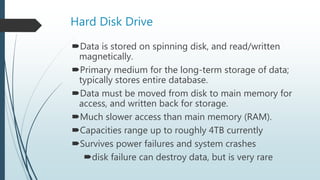
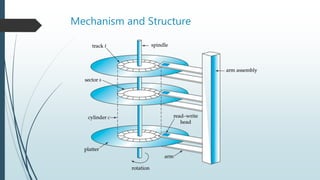
Data is stored on spinning disk, and read/written
magnetically.
Primary medium for the long-term storage of data;
typically stores entire database.
Data must be moved from disk to main memory for
access, and written back for storage.
Much slower access than main memory (RAM).
Capacities range up to roughly 4TB currently
Survives power failures and system crashes
disk failure can destroy data, but is very rare
Mechanism and Structure
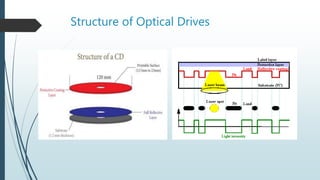
Optical storage devices
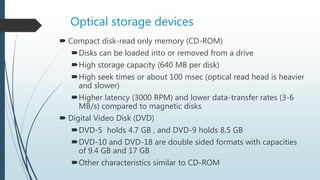
 Compact disk-read only memory (CD-ROM)
Disks can be loaded into or removed from a drive
High storage capacity (640 MB per disk)
High seek times or about 100 msec (optical read head is heavier
and slower)
Higher latency (3000 RPM) and lower data-transfer rates (3-6
MB/s) compared to magnetic disks
 Digital Video Disk (DVD)
DVD-5 holds 4.7 GB , and DVD-9 holds 8.5 GB
DVD-10 and DVD-18 are double sided formats with capacities
of 9.4 GB and 17 GB
Other characteristics similar to CD-ROM
Structure of Optical Drives
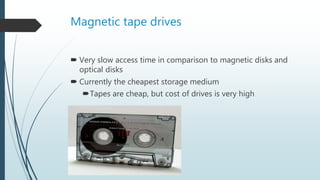
Magnetic tape drives
 Very slow access time in comparison to magnetic disks and
optical disks
 Currently the cheapest storage medium
Tapes are cheap, but cost of drives is very high
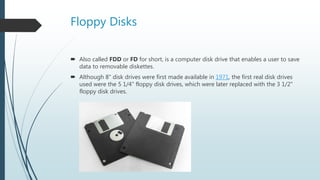
Floppy Disks
 Also called FDD or FD for short, is a computer disk drive that enables a user to save
data to removable diskettes.
 Although 8" disk drives were first made available in 1971, the first real disk drives
used were the 5 1/4" floppy disk drives, which were later replaced with the 3 1/2"
floppy disk drives.
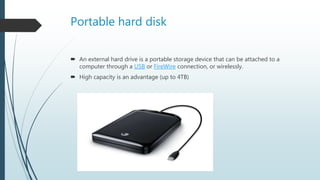
Portable hard disk
 An external hard drive is a portable storage device that can be attached to a
computer through a USB or FireWire connection, or wirelessly.
 High capacity is an advantage (up to 4TB)
Modern storage devices
 Disk storage devices usage is currently not widely used
 Memory chips are the modern way of storage devices with high
speed data access time ,increased security and reliability.
 Modern storage devices examples
 1.Solid State Drives (SSD)
 2.Memory Chips
 3.USB drives
 4.Cloud Storages
Thank you
Disk storage devices

Disk storage devices

  • 1.
    Disk storage devices Groupnumber 5 Advance Database Management Systems
  • 2.
    What is diskstorage device?  Disk storage is a general category of storage mechanisms where data are recorded by various magnetic, optical, or mechanical changes to a surface layer of one or more rotating disks.  A disk drive is a device implementing such a storage mechanism.  The first commercial digital disk storage device was the IBM 350 which shipped in 1956 as a part of the IBM 305 RAMAC computing system.  Disk storage is now used in both computer storage and consumer electronic storage, e.g., audio CDs and video discs (standard DVD and Blu-ray).
  • 3.
    Advantages of diskstorage devices  Speed with which data can be accessed  Control over the data The data can be easily manipulated when stored  Cost per unit of data is lower  Reliability data loss on power failure or system crash physical failure of the storage device  Availability High availability comparing with file access storages
  • 4.
    Storage Access  Adatabase file is partitioned into fixed-length storage units called blocks. Blocks are units of both storage allocation and data transfer.  Database system seeks to minimize the number of block transfers between the disk and memory. We can reduce the number of disk accesses by keeping as many blocks as possible in main memory.  Buffer – portion of main memory available to store copies of disk blocks.  Buffer manager – subsystem responsible for allocating buffer space in main memory.
  • 5.
    Types of diskstorage devices  Hard disk drive  Optical storage devices  Magnetic tape drive  Floppy disk  Portable hard disk
  • 6.
    Hard Disk Drive Datais stored on spinning disk, and read/written magnetically. Primary medium for the long-term storage of data; typically stores entire database. Data must be moved from disk to main memory for access, and written back for storage. Much slower access than main memory (RAM). Capacities range up to roughly 4TB currently Survives power failures and system crashes disk failure can destroy data, but is very rare
  • 7.
  • 8.
    Optical storage devices Compact disk-read only memory (CD-ROM) Disks can be loaded into or removed from a drive High storage capacity (640 MB per disk) High seek times or about 100 msec (optical read head is heavier and slower) Higher latency (3000 RPM) and lower data-transfer rates (3-6 MB/s) compared to magnetic disks  Digital Video Disk (DVD) DVD-5 holds 4.7 GB , and DVD-9 holds 8.5 GB DVD-10 and DVD-18 are double sided formats with capacities of 9.4 GB and 17 GB Other characteristics similar to CD-ROM
  • 9.
  • 10.
    Magnetic tape drives Very slow access time in comparison to magnetic disks and optical disks  Currently the cheapest storage medium Tapes are cheap, but cost of drives is very high
  • 11.
    Floppy Disks  Alsocalled FDD or FD for short, is a computer disk drive that enables a user to save data to removable diskettes.  Although 8" disk drives were first made available in 1971, the first real disk drives used were the 5 1/4" floppy disk drives, which were later replaced with the 3 1/2" floppy disk drives.
  • 12.
    Portable hard disk An external hard drive is a portable storage device that can be attached to a computer through a USB or FireWire connection, or wirelessly.  High capacity is an advantage (up to 4TB)
  • 13.
    Modern storage devices Disk storage devices usage is currently not widely used  Memory chips are the modern way of storage devices with high speed data access time ,increased security and reliability.  Modern storage devices examples  1.Solid State Drives (SSD)  2.Memory Chips  3.USB drives  4.Cloud Storages
  • 14.