 AIMS, GOALS AND
OBJECTIVES.
 BLOOM’S TAXANOMY.
AIMS
Aims give direction to an
activities or motivates
behavior.
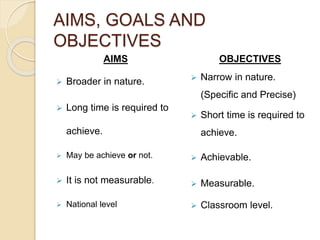
AIMS, GOALS AND
OBJECTIVES
AIMS
 Broader in nature.
 Long time is required to
achieve.
 May be achieve or not.
 It is not measurable.
 National level
OBJECTIVES
 Narrow in nature.
(Specific and Precise)
 Short time is required to
achieve.
 Achievable.
 Measurable.
 Classroom level.
EXAMPLE
 AIMS TO PROMOTE SCIENCE
AND TECHNOLOGY.
 GOALS TO IMPART COMPUTER
EDUCATION.
 OBJECTIVES TO IDENTIFY THE PARTS
OF COMPUTER.
BLOOM’S TAXANOMY
o BENJAMIN BLOOM:
 An Educational Psychologist working at the
University of Chicago.
 His taxonomy has a key tool in
structuring and understanding the
learning process.
Taxonomy
Taxonomy means the classification
of something.
BLOOM’S TAXONOMY
The educational objectives are
divided into three domains according to
this taxonomy. These are
 Cognitive domain H
(Knowing)
 Affective domain H
(Feeling)
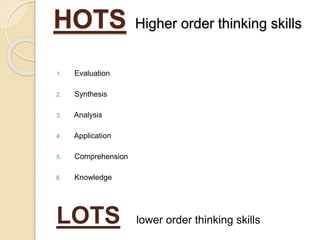
HOTS Higher order thinking skills
1. Evaluation
2. Synthesis
3. Analysis
4. Application
5. Comprehension
6. Knowledge
LOTS lower order thinking skills
1. COGNITIVE DOMAIN
It deals with thinking process and mental
faculties. It is further divided in sis sub group by Bloom
in 1956.
 Knowledge (Define, Write, Recall, Know)
 Comprehension (Explain, Discuss, Describe,
Conclude)
 Application (Apply, Organize Relate, Use)
 Analysis (Analysis, Separate, Differentiate,
Discriminate)
 Synthesis (Design, Produce, Generalize,
Knowledge
Defined as the remembering,
recalling and recognition of previously
learned material.
• This is the lower level of learning
COMPREHENSION
Define as the ability to grasp the
meaning, translation and interpretation of
material.
 Level of learning is one step higher to
the knowledge level.
APPLICATION
Refers to the ability to use learned
material and general principle in new
and concrete situation.
 This requires higher level of
understanding
ANALYSIS
Refers to the ability to break down
material in to its components or parts.
and Separation of complex ideas.
This includes
 Identification of parts
 Relationship between parts.
SYNTHESIS
Refers to the ability to put
parts together to form a new whole.
 This may also involve creativity.
EVALUATION
Refers to the ability to judge
the value of material.
 Judgments are based on definite
criteria.
ACTIVITY FOR YOU
• Select the most effective solution.
• Design a machine to perform a specific
task.
• Troubleshoot a piece of equipments by
using logical deduction.
• Apply laws of statistics to evaluate the
reliability of a written test.
• Explain in one’s own words the steps for
performing a complex task.
• Know the safety rules.
2. AFFECTIVE DOMAIN
It deals attitudes, liking, disliking,
values and feeling. It is further divided in to
five sub groups by Krathwohl in 1964.
 Attending (Identify, Points to, Names, Selects)
 Responding (Answer, Conforms, Discusses)
 Valuing (Justifies, Forms, Proposes)
 Organization (Combines, Arranges,
Compares)
 Characterization (Discriminates, Modifies,
Receiving / Attending
Willingness to attend a particular
phenomenon
Responding
Active participation on the part of the
students.
Valuing
Worth or value to a particular object or
phenomenon)
Organization
Organization is concerned with
Bringing together different values.
Resolving conflicts b/w them
Characterization
The individual has a system that
controls the behavior to develop a
characteristics life.
ACTIVITY FOR YOU
 Maintaining good health habits.
 Recognizing for balance between freedom and
responsibility in democracy.
 Appreciating good literature.
 Participates classroom discussion.
 Listen to other with respect.
3. PSYCHOMOTOR DOMAIN
It deals with the development of
psychomotor skills. It is further divided in
to seven sub groups by Simpson in
1972.
o Perception
o Set
o Guided Response
o Mechanism
o Complex Overt Response
o Adaptation
o Origination
THANKS
Any Question
? ? ? ?
QUESTIONS FOR YOU
1. What is Action Verb?
2. Can our Education Exam System
Evaluate all Domain or Not?

Domains of Learning.pptx

  • 1.
     AIMS, GOALSAND OBJECTIVES.  BLOOM’S TAXANOMY.
  • 2.
    AIMS Aims give directionto an activities or motivates behavior.
  • 3.
    AIMS, GOALS AND OBJECTIVES AIMS Broader in nature.  Long time is required to achieve.  May be achieve or not.  It is not measurable.  National level OBJECTIVES  Narrow in nature. (Specific and Precise)  Short time is required to achieve.  Achievable.  Measurable.  Classroom level.
  • 4.
    EXAMPLE  AIMS TOPROMOTE SCIENCE AND TECHNOLOGY.  GOALS TO IMPART COMPUTER EDUCATION.  OBJECTIVES TO IDENTIFY THE PARTS OF COMPUTER.
  • 5.
    BLOOM’S TAXANOMY o BENJAMINBLOOM:  An Educational Psychologist working at the University of Chicago.  His taxonomy has a key tool in structuring and understanding the learning process.
  • 6.
    Taxonomy Taxonomy means theclassification of something.
  • 7.
    BLOOM’S TAXONOMY The educationalobjectives are divided into three domains according to this taxonomy. These are  Cognitive domain H (Knowing)  Affective domain H (Feeling)
  • 8.
    HOTS Higher orderthinking skills 1. Evaluation 2. Synthesis 3. Analysis 4. Application 5. Comprehension 6. Knowledge LOTS lower order thinking skills
  • 9.
    1. COGNITIVE DOMAIN Itdeals with thinking process and mental faculties. It is further divided in sis sub group by Bloom in 1956.  Knowledge (Define, Write, Recall, Know)  Comprehension (Explain, Discuss, Describe, Conclude)  Application (Apply, Organize Relate, Use)  Analysis (Analysis, Separate, Differentiate, Discriminate)  Synthesis (Design, Produce, Generalize,
  • 10.
    Knowledge Defined as theremembering, recalling and recognition of previously learned material. • This is the lower level of learning COMPREHENSION Define as the ability to grasp the meaning, translation and interpretation of material.  Level of learning is one step higher to the knowledge level.
  • 11.
    APPLICATION Refers to theability to use learned material and general principle in new and concrete situation.  This requires higher level of understanding
  • 12.
    ANALYSIS Refers to theability to break down material in to its components or parts. and Separation of complex ideas. This includes  Identification of parts  Relationship between parts.
  • 13.
    SYNTHESIS Refers to theability to put parts together to form a new whole.  This may also involve creativity.
  • 14.
    EVALUATION Refers to theability to judge the value of material.  Judgments are based on definite criteria.
  • 15.
    ACTIVITY FOR YOU •Select the most effective solution. • Design a machine to perform a specific task. • Troubleshoot a piece of equipments by using logical deduction. • Apply laws of statistics to evaluate the reliability of a written test. • Explain in one’s own words the steps for performing a complex task. • Know the safety rules.
  • 16.
    2. AFFECTIVE DOMAIN Itdeals attitudes, liking, disliking, values and feeling. It is further divided in to five sub groups by Krathwohl in 1964.  Attending (Identify, Points to, Names, Selects)  Responding (Answer, Conforms, Discusses)  Valuing (Justifies, Forms, Proposes)  Organization (Combines, Arranges, Compares)  Characterization (Discriminates, Modifies,
  • 17.
    Receiving / Attending Willingnessto attend a particular phenomenon Responding Active participation on the part of the students. Valuing Worth or value to a particular object or phenomenon)
  • 18.
    Organization Organization is concernedwith Bringing together different values. Resolving conflicts b/w them Characterization The individual has a system that controls the behavior to develop a characteristics life.
  • 19.
    ACTIVITY FOR YOU Maintaining good health habits.  Recognizing for balance between freedom and responsibility in democracy.  Appreciating good literature.  Participates classroom discussion.  Listen to other with respect.
  • 20.
    3. PSYCHOMOTOR DOMAIN Itdeals with the development of psychomotor skills. It is further divided in to seven sub groups by Simpson in 1972. o Perception o Set o Guided Response o Mechanism o Complex Overt Response o Adaptation o Origination
  • 21.
  • 22.
    QUESTIONS FOR YOU 1.What is Action Verb? 2. Can our Education Exam System Evaluate all Domain or Not?