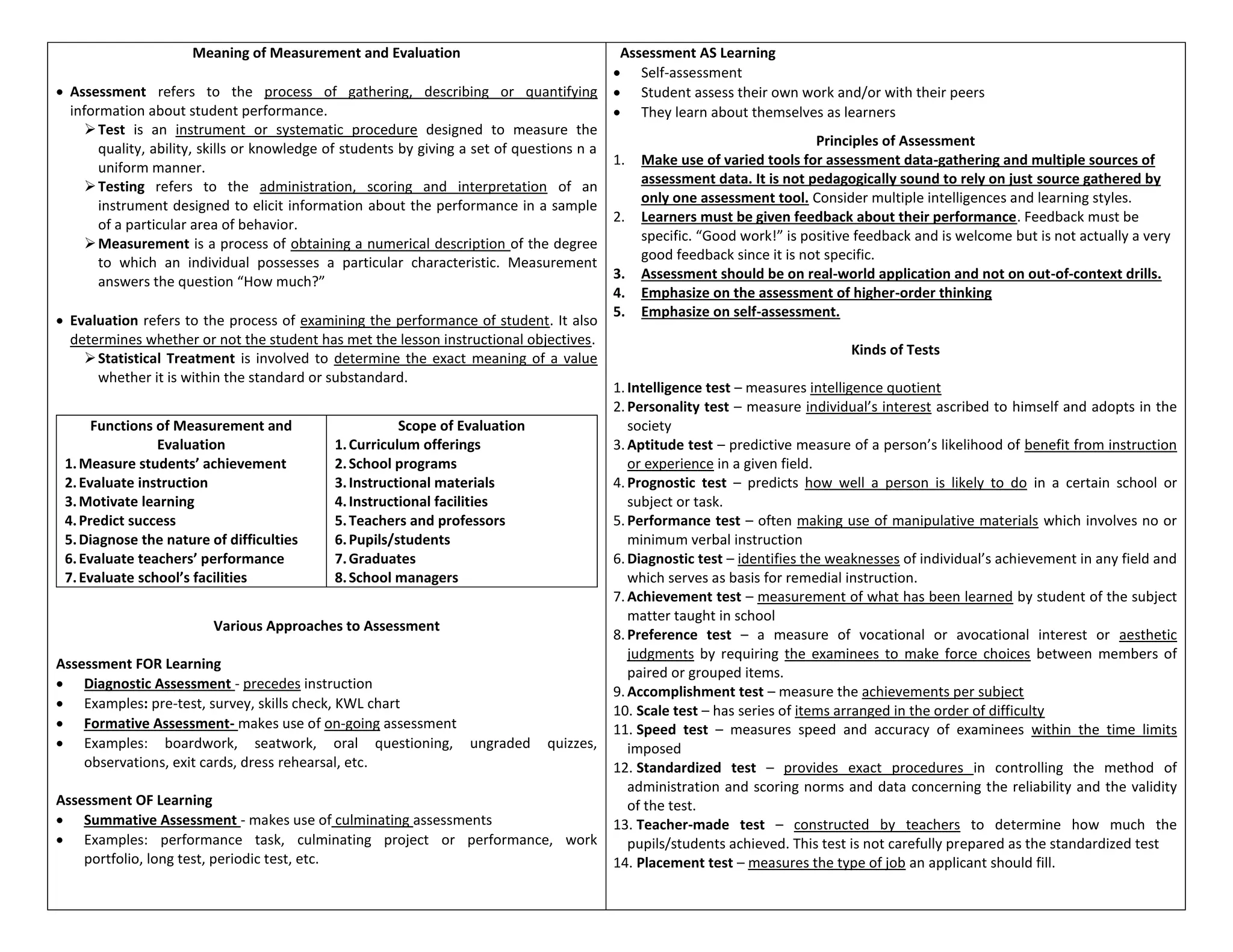
Meaning of Measurement and Evaluation
• Assessment refers to the process of gathering, describing or quantifying
information about student performance.
➢Test is an instrument or systematic procedure designed to measure the
quality, ability, skills or knowledge of students by giving a set of questions n a
uniform manner.
➢Testing refers to the administration, scoring and interpretation of an
instrument designed to elicit information about the performance in a sample
of a particular area of behavior.
➢Measurement is a process of obtaining a numerical description of the degree
to which an individual possesses a particular characteristic. Measurement
answers the question “How much?”
• Evaluation refers to the process of examining the performance of student. It also
determines whether or not the student has met the lesson instructional objectives.
➢Statistical Treatment is involved to determine the exact meaning of a value
whether it is within the standard or substandard.
Functions of Measurement and
Evaluation
1.Measure students’ achievement
2.Evaluate instruction
3.Motivate learning
4.Predict success
5.Diagnose the nature of difficulties
6.Evaluate teachers’ performance
7.Evaluate school’s facilities
Scope of Evaluation
1.Curriculum offerings
2.School programs
3.Instructional materials
4.Instructional facilities
5.Teachers and professors
6.Pupils/students
7.Graduates
8.School managers
Various Approaches to Assessment
Assessment FOR Learning
• Diagnostic Assessment - precedes instruction
• Examples: pre-test, survey, skills check, KWL chart
• Formative Assessment- makes use of on-going assessment
• Examples: boardwork, seatwork, oral questioning, ungraded quizzes,
observations, exit cards, dress rehearsal, etc.
Assessment OF Learning
• Summative Assessment - makes use of culminating assessments
• Examples: performance task, culminating project or performance, work
portfolio, long test, periodic test, etc.
Assessment AS Learning
• Self-assessment
• Student assess their own work and/or with their peers
• They learn about themselves as learners
Principles of Assessment
1. Make use of varied tools for assessment data-gathering and multiple sources of
assessment data. It is not pedagogically sound to rely on just source gathered by
only one assessment tool. Consider multiple intelligences and learning styles.
2. Learners must be given feedback about their performance. Feedback must be
specific. “Good work!” is positive feedback and is welcome but is not actually a very
good feedback since it is not specific.
3. Assessment should be on real-world application and not on out-of-context drills.
4. Emphasize on the assessment of higher-order thinking
5. Emphasize on self-assessment.
Kinds of Tests
1.Intelligence test – measures intelligence quotient
2.Personality test – measure individual’s interest ascribed to himself and adopts in the
society
3.Aptitude test – predictive measure of a person’s likelihood of benefit from instruction
or experience in a given field.
4.Prognostic test – predicts how well a person is likely to do in a certain school or
subject or task.
5.Performance test – often making use of manipulative materials which involves no or
minimum verbal instruction
6.Diagnostic test – identifies the weaknesses of individual’s achievement in any field and
which serves as basis for remedial instruction.
7.Achievement test – measurement of what has been learned by student of the subject
matter taught in school
8.Preference test – a measure of vocational or avocational interest or aesthetic
judgments by requiring the examinees to make force choices between members of
paired or grouped items.
9.Accomplishment test – measure the achievements per subject
10. Scale test – has series of items arranged in the order of difficulty
11. Speed test – measures speed and accuracy of examinees within the time limits
imposed
12. Standardized test – provides exact procedures in controlling the method of
administration and scoring norms and data concerning the reliability and the validity
of the test.
13. Teacher-made test – constructed by teachers to determine how much the
pupils/students achieved. This test is not carefully prepared as the standardized test
14. Placement test – measures the type of job an applicant should fill.
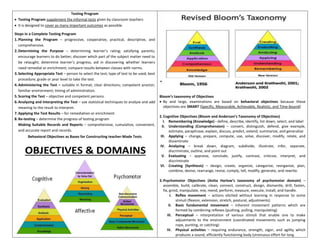
Testing Program
• Testing Program supplement the informal tests given by classroom teachers
• It is designed to cover as many important outcomes as possible.
Steps in a Complete Testing Program
1.Planning the Program – progressive, cooperative, practical, descriptive, and
comprehensive.
2.Determining the Purpose – determining learner’s rating; satisfying parents;
encourage learners to do better; discover which part of the subject matter need to
be retaught; determine learner’s progress; aid in discovering whether learners
need remedial or enrichment; compare results between classes with norms.
3.Selecting Appropriate Test – person to select the test; type of test to be used; best
procedure; grade or year level to take the test.
4.Administering the Test – suitable in format; clear directions; competent proctor;
familiar environment; timing of administration.
5.Scoring the Test – objective and competent persons.
6.Analyzing and Interpreting the Test – use statistical techniques to analyze and add
meaning to the result to interpret.
7.Applying the Test Results – for remediation or enrichment
8.Re-testing – determine the progress of testing program
9. Making Suitable Records and Reports – comprehensive, cumulative, convenient,
and accurate report and records.
Behavioral Objectives as Bases for Constructing teacher-Made Tests
Bloom’s taxonomy of Objectives
• By and large, examinations are based on behavioral objectives because these
objectives are SMART (Specific, Measurable, Achievable, Realistic, and Time-bound)
2.Cognitive Objectives (Bloom and Anderson’s Taxonomy of Objectives)
I. Remembering (Knowledge) - define, describe, identify, list down, select, and label
II. Understanding (Comprehension) – convert, distinguish, defend, give example,
estimate, paraphrase, explain, discuss, predict, extend, summarize, and generalize
III. Applying – change, prepare, compute, use, solve, discover, modify, relate, and
disseminate
IV. Analyzing – break down, diagram, subdivide, illustrate, infer, separate,
discriminate, outline, and point out
V. Evaluating – appraise, conclude, justify, contrast, criticize, interpret, and
discriminate
VI. Creating (Synthesis) – design, create, organize, categorize, reorganize, plan,
combine, devise, rearrange, revise, comply, tell, modify, generate, and rewrite.
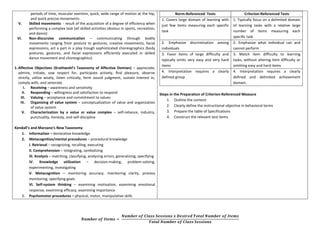
3.Psychomotor Objectives (Anita Harlow’s taxonomy of psychomotor domain) –
assemble, build, calibrate, clean, connect, construct, design, dismantle, drill, fasten,
fix, grind, manipulate, mix, mend, perform, measure, execute, install, and handle.
I. Reflex movement – actions elicited without learning in response to some
stimuli (flexion, extension, stretch, postural, adjustments)
II. Basic fundamental movement – inherent movement patterns which are
formed by combining reflexes (pushing, pulling, manipulating)
III. Perceptual – interpretation of various stimuli that enable one to make
adjustments to the environment (coordinated movements such as jumping
rope, punting, or catching)
IV. Physical activities – requiring endurance, strength, vigor, and agility which
produces a sound, efficiently functioning body (strenuous effort for long
periods of time, muscular exertion, quick, wide range of motion at the hip,
and quick precise movements
V. Skilled movements - result of the acquisition of a degree of efficiency when
performing a complex task (all skilled activities obvious in sports, recreation,
and dance)
VI. Non-discursive communication – communicating through bodily
movements ranging from posture to gestures, creative movements, facial
expressions, act a part in a play trough sophisticated choreographics (body
postures, gestures, and facial expressions efficiently executed in skilled
dance movement and choreographics)
1.Affective Objectives (Krathwohl’s Taxonomy of Affective Domian) – appreciate,
admire, initiate, sow respect for, participate actively, find pleasure, observe
strictly, utilize wisely, listen critically, form sound judgment, sustain interest in,
comply with, and venerate.
I. Receiving – awareness and sensitivity
II. Responding – willingness and satisfaction to respond
III. Valuing – acceptance and commitment to values
IV. Organizing of value system – conceptualization of value and organization
of value system
V. Characterization by a value or value complex – self-reliance, industry,
punctuality, honesty, and self-discipline
Kendall’s and Marzano’s New Taxonomy
1. Information – declarative knowledge
2. Metacognitive/mental procedures – procedural knowledge
I. Retrieval – recognizing, recalling, executing
II. Comprehension – integrating, symbolizing
III. Analysis – matching, classifying, analyzing errors, generalizing, specifying
IV. Knowledge utilization – decision-making, problem-solving,
experimenting, investigating
V. Metacognition – monitoring accuracy, monitoring clarity, process
monitoring, specifying goals
VI. Self-system thinking – examining motivation, examining emotional
response, examining efficacy, examining importance
3. Psychomotor procedures – physical, motor, manipulative skills
Norm-Referenced Tests Criterion-Referenced Tests
1. Covers large domain of learning with
just few items measuring each specific
task
1. Typically focus on a delimited domain
of learning tasks with a relative large
number of items measuring each
specific task
2. Emphasize discrimination among
individuals
2. Emphasize what individual can and
cannot perform
3. Favor items of large difficulty and
typically omits very easy and very hard
items
3. Match item difficulty to learning
tasks, without altering item difficulty or
omitting easy and hard items
4. Interpretation requires a clearly
defined group
4. Interpretation requires a clearly
defined and delimited achievement
domain.
Steps in the Preparation of Criterion-Referenced Measure
1. Outline the content
2. Clearly define the instructional objective in behavioral terms
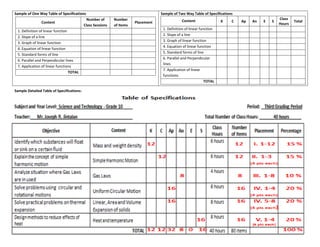
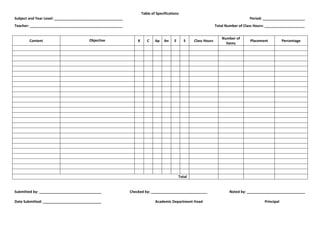
3. Prepare the table of Specifications
4. Construct the relevant test items
𝑵𝒖𝒎𝒃𝒆𝒓 𝒐𝒇 𝑰𝒕𝒆𝒎𝒔 =
𝑵𝒖𝒎𝒃𝒆𝒓 𝒐𝒇 𝑪𝒍𝒂𝒔𝒔 𝑺𝒆𝒔𝒔𝒊𝒐𝒏𝒔 𝒙 𝑫𝒆𝒔𝒊𝒓𝒆𝒅 𝑻𝒐𝒕𝒂𝒍 𝑵𝒖𝒎𝒃𝒆𝒓 𝒐𝒇 𝑰𝒕𝒆𝒎𝒔
𝑻𝒐𝒕𝒂𝒍 𝑵𝒖𝒎𝒃𝒆𝒓 𝒐𝒇 𝑪𝒍𝒂𝒔𝒔 𝑺𝒆𝒔𝒔𝒊𝒐𝒏𝒔
Sample of One Way Table of Specifications
Content
Number of
Class Sessions
Number
of Items
Placement
1. Definition of linear function
2. Slope of a line
3. Graph of linear function
4. Equation of linear function
5. Standard forms of line
6. Parallel and Perpendicular lines
7. Application of linear functions
TOTAL
Sample of Two Way Table of Specifications
Content K C Ap An E S
Class
Hours
Total
1. Definition of linear function
2. Slope of a line
3. Graph of linear function
4. Equation of linear function
5. Standard forms of line
6. Parallel and Perpendicular
lines
7. Application of linear
functions
TOTAL
Sample Detailed Table of Specifications:
Table of Specifications
Subject and Year Level: __________________________________ Period: _____________________
Teacher: ______________________________________________ Total Number of Class Hours: ____________________
Content Objective K C Ap An E S Class Hours
Number of
Items
Placement Percentage
Total
Submitted by: _______________________________ Checked by: ____________________________ Noted by: _____________________________
Date Submitted: _____________________________ Academic Department Head Principal
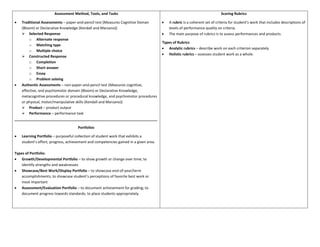
Assessment Method, Tools, and Tasks
• Traditional Assessments – paper-and-pencil test (Measures Cognitive Doman
(Bloom) or Declarative Knowledge (Kendall and Marzano))
➢ Selected Response
o Alternate response
o Matching type
o Multiple choice
➢ Constructed Response
o Completion
o Short answer
o Essay
o Problem solving
• Authentic Assessments – non-paper-and-pencil test (Measures cognitive,
affective, and psychomotor domain (Bloom) or Declarative Knowledge,
metacognitive procedures or procedural knowledge, and psychomotor procedures
or physical, motor/manipulative skills (Kendall and Marzano))
➢ Product – product output
➢ Performance – performance task
_______________________________________________________________________
Portfolios
• Learning Portfolio – purposeful collection of student work that exhibits a
student’s effort, progress, achievement and competencies gained in a given area.
Types of Portfolio:
• Growth/Developmental Portfolio – to show growth or change over time; to
identify strengths and weaknesses
• Showcase/Best Work/Display Portfolio – to showcase end-of-year/term
accomplishments; to showcase student’s perceptions of favorite best work or
most important
• Assessment/Evaluation Portfolio – to document achievement for grading; to
document progress towards standards; to place students appropriately.
Scoring Rubrics
• A rubric is a coherent set of criteria for student’s work that includes descriptions of
levels of performance quality on criteria.
• The main purpose of rubrics is to assess performances and products.
Types of Rubrics
• Analytic rubrics – describe work on each criterion separately
• Holistic rubrics – assesses student work as a whole.
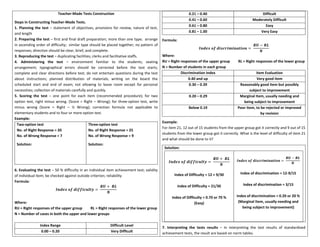
Teacher-Made Tests Construction
Steps in Constructing Teacher-Made Tests.
1. Planning the test – statement of objectives, provisions for review, nature of test,
and length
2. Preparing the test – first and final draft preparation; more than one type; arrange
in ascending order of difficulty; similar type should be placed together; no pattern of
responses; direction should be clear, brief, and complete.
3. Reproducing the test – duplicating facilities; clerks and facilitative staffs.
4. Administering the test – environment familiar to the students; seating
arrangement; typographical errors should be corrected before the test starts;
complete and clear directions before test; do not entertain questions during the test
about instructions; planned distribution of materials; writing on the board the
scheduled start and end of exam; not allowing to leave room except for personal
necessities; collection of materials carefully and quickly.
5. Scoring the test – one point for each item (recommended procedure); for two
option test, right minus wrong. (Score = Right – Wrong); for three-option test, write
minus wrong (Score = Right – ½ Wrong); correction formula not applicable to
elementary students and to four or more option test.
Example:
Two-option test
No. of Right Response = 20
No. of Wrong Response = 7
Solution:
Three-option test
No. of Right Response = 25
No. of Wrong Response = 9
Solution:
6. Evaluating the test – 50 % difficulty in an individual item achievement test; validity
of individual item; be checked against outside criterion; reliability
Formula:
𝑰𝒏𝒅𝒆𝒙 𝒐𝒇 𝒅𝒊𝒇𝒇𝒊𝒄𝒖𝒍𝒕𝒚 =
𝑹𝑼 + 𝑹𝑳
𝑵
Where:
RU = Right responses of the upper group RL = Right responses of the lower group
N = Number of cases in both the upper and lower groups
Index Range Difficult Level
0.00 – 0.20 Very Difficult
0.21 – 0.40 Difficult
0.41 – 0.60 Moderately Difficult
0.61 – 0.80 Easy
0.81 – 1.00 Very Easy
Formula:
𝑰𝒏𝒅𝒆𝒙 𝒐𝒇 𝒅𝒊𝒔𝒄𝒓𝒊𝒎𝒊𝒏𝒂𝒕𝒊𝒐𝒏 =
𝑹𝑼 − 𝑹𝑳
𝑵
Where:
RU = Right responses of the upper group RL = Right responses of the lower group
N = Number of students in each group
Discrimination Index Item Evaluation
0.40 and up Very good item
0.30 – 0.39 Reasonably good item but possibly
subject to improvement
0.20 – 0.29 Marginal Item, usually needing and
being subject to improvement
Below 0.19 Poor item, to be rejected or improved
by revision
Example:
For item 21, 12 out of 15 students from the upper group got it correctly and 9 out of 15
students from the lower group got it correctly. What is the level of difficulty of item 21
and what should be done to it?
Solution:
𝑰𝒏𝒅𝒆𝒙 𝒐𝒇 𝒅𝒊𝒇𝒇𝒊𝒄𝒖𝒍𝒕𝒚 =
𝑹𝑼 + 𝑹𝑳
𝑵
Index of Difficulty = 12 + 9/30
Index of Difficulty = 21/30
Index of Difficulty = 0.70 or 70 %
(Easy)
𝑰𝒏𝒅𝒆𝒙 𝒐𝒇 𝒅𝒊𝒔𝒄𝒓𝒊𝒎𝒊𝒏𝒂𝒕𝒊𝒐𝒏 =
𝑹𝑼 − 𝑹𝑳
𝑵
Index of discrimination = 12-9/15
Index of discrimination = 3/15
Index of discrimination = 0.20 or 20 %
(Marginal Item, usually needing and
being subject to improvement)
7. Interpreting the tests results – In interpreting the test results of standardized
achievement tests, the result are based on norm tables.
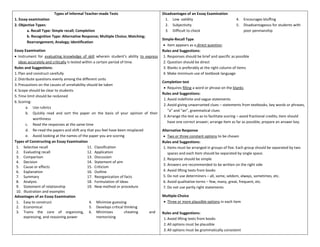
Types of Informal Teacher-made Tests
1. Essay examination
2. Objective Types:
a. Recall Type: Simple recall; Completion
b. Recognition Type: Alternative Response; Multiple Choice; Matching;
Rearrangement; Analogy; Identification
Essay Examination
• Instrument for evaluating knowledge of skill wherein student’s ability to express
ideas accurately and critically is tested within a certain period of time.
Rules and Suggestions:
1.Plan and construct carefully
2.Distribute questions evenly among the different units
3.Precautions on the causes of unreliability should be taken
4.Scope should be clear to students
5.Time limit should be reckoned
6.Scoring:
a. Use rubrics
b. Quickly read and sort the paper on the basis of your opinion of their
worthiness
c. Read the responses at the same time
d. Re-read the papers and shift any that you feel have been misplaced
e. Avoid looking at the names of the paper you are scoring
Types of Constructing an Essay Examination
1. Selective recall
2. Evaluating recall
3. Comparison
4. Decision
5. Cause or effects
6. Explanation
7. Summary
8. Analysis
9. Statement of relationship
10. Illustration and examples
11. Classification
12. Application
13. Discussion
14. Statement of aim
15. Criticism
16. Outline
17. Reorganization of facts
18. Formulation of ideas
19. New method or procedure
Advantages of an Essay Examination
1. Easy to construct
2. Economical
3. Trains the core of organizing,
expressing, and reasoning power
4. Minimize guessing
5. Develops critical thinking
6. Minimizes cheating and
memorizing
Disadvantages of an Essay Examination
1. Low validity
2. Subjectivity
3. Difficult to check
4. Encourages bluffing
5. Disadvantageous for students with
poor penmanship
Simple-Recall Type
• item appears as a direct question.
Rules and Suggestions:
1. Responses should be brief and specific as possible
2. Question should be direct
3. Blanks is preferably at the right column of items
4. Make minimum use of textbook language
Completion test
• Requires filling a word or phrase on the blanks
Rules and Suggestions:
1.Avoid indefinite and vague statements
2.Avoid giving unwarranted clues – statements from textbooks, key words or phrases,
“a” and “an”, grammatical clues
3.Arrange the test so as to facilitate scoring – avoid fractional credits; item should
have one correct answer; arrange item as far as possible; prepare an answer key.
Alternative Response
• Two or three constant options to be chosen
Rules and Suggestions:
1. Items must be arranged in groups of five. Each group should be separated by two
spaces and each item should be separated by single space.
2. Response should be simple
3. Answers are recommended to be written on the right side
4. Avoid lifting texts from books
5. Do not use determiners – all, some, seldom, always, sometimes, etc.
6. Avoid qualitative terms – few, many, great, frequent, etc.
7. Do not use partly right statements
Multiple-Choice
• Three or more plausible options in each item
Rules and Suggestions:
1.Avoid lifting texts from books
2.All options must be plausible
3.All options must be grammatically consistent
4.Avoid the use of article “a” and “an”
5.No pattern on the correct answers
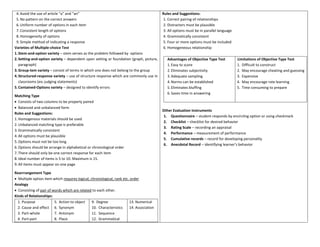
6.Uniform number of options in each item
7.Consistent length of options
8.Homogeneity of options
9.Simple method of indicating a response
Varieties of Multiple-choice Test
1.Stem-and-option variety – stem serves as the problem followed by options
2.Setting-and-option variety – dependent upon setting or foundation (graph, picture,
paragraph)
3.Group-tem variety – consist of terms in which one does not belong to the group
4.Structured-response variety – use of structure response which are commonly use in
classrooms (ex: judging statements)
5.Contained-Options variety – designed to identify errors
Matching Type
• Consists of two columns to be properly paired
• Balanced and unbalanced form
Rules and Suggestions:
1.Homogenous materials should be used
2.Unbalanced matching type is preferable
3.Grammatically consistent
4.All options must be plausible
5.Options must not be too long
6.Options should be arrange in alphabetical or chronological order
7.There should only be one correct response for each item
8.Ideal number of items is 5 to 10. Maximum is 15.
9.All items must appear on one page
Rearrrangement Type
• Multiple option item which requires logical, chronological, rank etc. order
Analogy
• Consisting of pair of words which are related to each other.
Kinds of Relationships:
1. Purpose
2. Cause and effect
3. Part-whole
4. Part-part
5. Action to object
6. Synonym
7. Antonym
8. Place
9. Degree
10. Characteristics
11. Sequence
12. Grammatical
13. Numerical
14. Association
Rules and Suggestions:
1. Correct pairing of relationships
2. Distracters must be plausible
3. All options must be in parallel language
4. Grammatically consistent
5. Four or more options must be included
6. Homogeneous relationship
Advantages of Objective Type Test
1.Easy to score
2.Eliminates subjectivity
3.Adequate sampling
4.Norms can be established
5.Eliminates bluffing
6.Saves time in answering
Limitations of Objective Type Test
1. Difficult to construct
2. May encourage cheating and guessing
3. Expensive
4. May encourage rote learning
5. Time consuming to prepare
Other Evaluation Instruments
1. Questionnaire – student responds by encircling option or using checkmark
2. Checklist – checklist for desired behavior
3. Rating Scale – recording an appraisal
4. Performance – measurement of performance
5. Cumulative records – record for developing personality
6. Anecdotal Record – identifying learner’s behavior
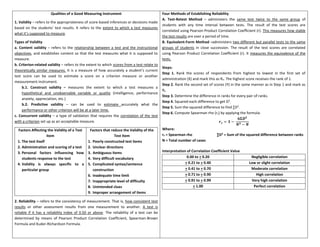
Qualities of a Good Measuring Instrument
1. Validity – refers to the appropriateness of score-based inferences or decisions made
based on the students’ test results. It refers to the extent to which a test measures
what it’s supposed to measure.
Types of Validity
a. Content validity – refers to the relationship between a test and the instructional
objectives, and establishes content so that the test measures what it is supposed to
measure.
b. Criterion-related validity – refers to the extent to which scores from a test relate to
theoretically similar measures. It is a measure of how accurately a student’s current
test score can be used to estimate a score on a criterion measure or another
measurement instrument.
b.1. Construct validity – measures the extent to which a test measures a
hypothetical and unobservable variable or quality (intelligence, performance
anxiety, appreciation, etc.)
b.2. Predictive validity – can be used to estimate accurately what the
performance or other criterion will be at a later time.
c. Concurrent validity – a type of validation that requires the correlation of the test
with a criterion set up as an acceptable measure.
Factors Affecting the Validity of a Test
Item
1. The test itself
2. Administration and scoring of a test
3. Personal factors influencing how
students response to the test
4. Validity is always specific to a
particular group
Factors that reduce the Validity of the
Test Item
1. Poorly constructed test items
2. Unclear directions
3. Ambiguous items
4. Very difficult vocabulary
5. Complicated syntax/sentence
construction
6. Inadequate time limit
7. Inappropriate level of difficulty
8. Unintended clues
9. Improper arrangement of items
2. Reliability – refers to the consistency of measurement. That is, how consistent test
results or other assessment results from one measurement to another. A test is
reliable if it has a reliability index of 0.50 or above. The reliability of a test can be
determined by means of Pearson Product Correlation Coefficient, Spearman-Brown
Formula and Kuder-Richardson Formula.
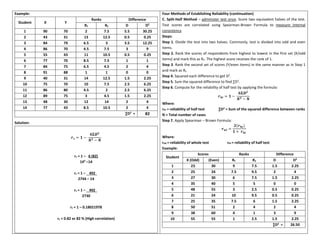
Four Methods of Establishing Reliability
A. Test-Retest Method – administers the same test twice to the same group of
students with any time interval between tests. The result of the test scores are
correlated using Pearson Product Correlation Coefficient (r). This measures how stable
the test results are over a period of time.
B. Equivalent-Form Method –administers two different but parallel tests to the same
groups of students in close succession. The result of the test scores are correlated
using Pearson Product Correlation Coefficient (r). It measures the equivalence of the
tests.
Steps:
Step 1. Rank the scores of respondents from highest to lowest in the first set of
administration (X) and mark this as Rx. The highest score receives the rank of 1.
Step 2. Rank the second set of scores (Y) in the same manner as in Step 1 and mark as
Ry
Step 3. Determine the difference in ranks for every pair of ranks.
Step 4. Squared each difference to get D2
.
Step 5. Sum the squared difference to find ∑D2
.
Step 6. Compute Spearman rho (rs) by applying the formula:
𝒓𝒔 = 𝟏 −
𝟔𝚺𝑫𝟐
𝑵𝟑 − 𝑵
Where:
rs = Spearman rho ∑D2
= Sum of the squared difference between ranks
N = Total number of cases
Interpretation of Correlation Coefficient Value
0.00 to + 0.20 Negligible correlation
+ 0.21 to + 0.40 Low or slight correlation
+ 0.41 to + 0.70 Moderate correlation
+ 0.71 to + 0.90 High correlation
+ 0.91 to + 0.99 Very high correlation
+ 1.00 Perfect correlation
Example:
Student X Y
Ranks Difference
Rx Ry D D2
1 90 70 2 7.5 5.5 30.25
2 43 31 13 12.5 0.5 0.25
3 84 79 6.5 3 3.5 12.25
4 86 70 4.5 7.5 3 9
5 55 43 11 10.5 0.5 0.25
6 77 70 8.5 7.5 1 1
7 84 75 6.5 4.5 2 4
8 91 88 1 1 0 0
9 40 31 14 12.5 1.5 2.25
10 75 70 10 7.5 2.5 6.25
11 86 80 4.5 2 2.5 6.25
12 89 75 3 4.5 1.5 2.25
13 48 30 12 14 2 4
14 77 43 8.5 10.5 2 4
∑D2
= 82
Solution:
𝒓𝒔 = 𝟏 −
𝟔𝚺𝑫𝟐
𝑵𝟑 − 𝑵
rs = 1 – 6 (82)
143
–14
rs = 1 – 492 .
2744 – 14
rs = 1 – 492 .
2730
rs = 1 – 0.18021978
rs = 0.82 or 82 % (High correlation)
Four Methods of Establishing Reliability (continuation)
C. Split-Half Method – administer test once. Score two equivalent halves of the test.
Test scores are correlated using Spearman-Brown Formula to measure internal
consistency.
Steps:
Step 1. Divide the test into two halves. Commonly, test is divided into odd and even
items.
Step 2. Rank the scores of respondents from highest to lowest in the first set (X/odd
items) and mark this as Rx. The highest score receives the rank of 1.
Step 3. Rank the second set of scores (Y/even items) in the same manner as in Step 1
and mark as Ry
Step 4. Squared each difference to get D2
.
Step 5. Sum the squared difference to find ∑D2
.
Step 6. Compute for the reliability of half test by applying the formula:
𝒓𝒉𝒕 = 𝟏 −
𝟔𝚺𝑫𝟐
𝑵𝟑 − 𝑵
Where:
rht = reliability of half test ∑D2
= Sum of the squared difference between ranks
N = Total number of cases
Step 7. Apply Spearman – Brown Formula:
𝒓𝒘𝒕 =
𝟐(𝒓𝒉𝒕)
𝟏 + 𝒓𝒉𝒕
Where:
rwt = reliability of whole test rht = reliability of half test
Example:
Student
Scores Ranks Difference
X (Odd) (Even) Rx Ry D D2
1 23 30 9 7.5 1.5 2.25
2 25 24 7.5 9.5 2 4
3 27 30 6 7.5 1.5 2.25
4 35 40 5 5 0 0
5 48 55 3 2.5 0.5 0.25
6 21 24 10 9.5 0.5 0.25
7 25 35 7.5 6 1.5 2.25
8 50 51 2 4 2 4
9 38 60 4 1 3 9
10 55 55 1 2.5 1.5 2.25
∑D2
= 26.50
Solutions:
𝒓𝒉𝒕 = 𝟏 −
𝟔𝚺𝑫𝟐
𝑵𝟑 − 𝑵
rht = 1 – 6 (26.50)
103
–10
rht = 1 – 159
1000 –10
rht = 1 – 159
990
rht = 1 – 0.16060606
rht = 0.84 (reliability of half of the test)
𝒓𝒘𝒕 =
𝟐(𝒓𝒉𝒕)
𝟏 + 𝒓𝒉𝒕
rwt = 2 (0.84)
1 + 0.84
rwt = 1.68
1.84
rwt = 0.91 or 91 5 (Reliability of the whole test: Very high correlation)
Four Methods of Establishing Reliability (continuation)
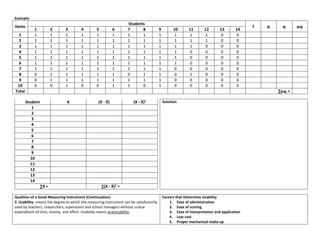
D. Kuder-Richardson Formula – administer test once. This method is used with
psychological test which consists of dichotomously scored items. The examinee either
passes or fails in an item. It measures internal consistency of homogeneity of the
measuring instrument.
Steps:
Step 1. Find the proportion passing each item (pi) and the proportion failing each item
(qi).
Step 2. Multiply pi and qi for each item and sum for all items.
Step 3. Compute for the variance (SD2
) of the test scores for the whole group using the
formula:
Ẋ =
∑𝑿
𝑵
𝑺𝑫𝟐
=
∑(𝑿 − Ẋ)𝟐
𝑵 − 𝟏
Where:
Ẋ = mean ∑X = Summation of scores SD2
= Variance N = Number of cases
Step 4. Substitute the calculated values in the Kunder-Richardson 20 formula:
𝒓𝒙𝒙 = [
𝑵
𝑵 − 𝟏
] [
𝑺𝑫𝟐
− ∑𝒑𝒊𝒒𝒊
𝑺𝑫𝟐
]
Where:
N = number of items SD2
= variance of scores
piqi = product of proportion passing and failing item i
Example:
Items
Students
f pi qi piqi
1 2 3 4 5 6 7 8 9 10 11 12 13 14
1 1 1 1 1 1 1 1 1 1 1 1 1 0 0
2 1 1 1 1 1 1 1 1 1 1 1 1 0 0
3 1 1 1 1 1 1 1 1 1 1 1 0 0 0
4 1 1 1 1 1 1 1 1 1 1 0 0 0 0
5 1 1 1 1 1 1 1 1 1 1 0 0 0 0
6 1 1 1 1 1 1 1 1 1 1 0 0 0 0
7 1 1 1 1 1 1 1 1 1 0 0 0 0 0
8 0 1 1 1 1 1 0 1 1 0 1 0 0 0
9 0 1 1 1 1 1 1 1 1 0 0 0 0 0
10 0 0 1 0 0 1 1 0 1 0 0 0 0 0
Total ∑piqi =
Student X (X - Ẋ) (X - Ẋ)2
1
2
3
4
5
6
7
8
9
10
11
12
13
14
∑X = ∑(X - Ẋ)2
=
Solution:
Qualities of a Good Measuring Instrument (Continuation)
3. Usability- means the degree to which the measuring instrument can be satisfactorily
used by teachers, researchers, supervisors and school managers without undue
expenditure of time, money, and effort. Usability means practicability.
Factors that Determine Usability
1. Ease of administration
2. Ease of scoring
3. Ease of interpretation and application
4. Low cost
5. Proper mechanical make-up
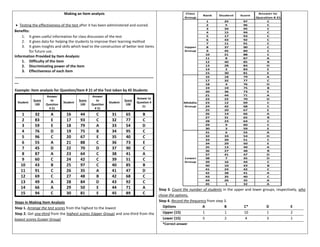
Making an Item analysis
• Testing the effectiveness of the test after it has been administered and scored.
Benefits:
1. It gives useful information for class discussion of the test
2. It gives data for helping the students to improve their learning method
3. It gives insights and skills which lead to the construction of better test items
for future use.
Information Provided by Item Analysis:
1. Difficulty of the item
2. Discriminating power of the item
3. Effectiveness of each item
_____________________________________________________________________
__
Example: Item analysis for Question/Item # 21 of the Test taken by 45 Students
Student
Score
100
Answer
to
Question
# 21
Student
Score
100
Answer
to
Question
# 21
Student
Score
100
Answer to
Question #
21
1 32 A 16 44 C 31 65 B
2 83 E 17 93 C 32 77 C
3 59 E 18 79 A 33 54 D
4 76 D 19 75 B 34 95 C
5 96 C 20 67 E 35 40 C
6 55 A 21 88 C 36 73 E
7 45 D 22 70 D 37 90 C
8 87 A 23 64 C 38 41 A
9 60 C 24 42 C 39 51 C
10 43 B 25 97 C 40 85 B
11 91 C 26 35 A 41 47 D
12 69 C 27 48 B 42 68 C
13 49 A 28 84 D 43 92 C
14 66 A 29 50 E 44 71 A
15 94 C 30 81 E 45 89 C
Steps in Making Item Analysis
Step 1. Arrange the test scores from the highest to the lowest
Step 2. Get one-third from the highest scores (Upper Group) and one-third from the
lowest scores (Lower Group)
Step 3. Count the number of students in the upper and lower groups, respectively, who
chose the options.
Step 4. Record the frequency from step 3.
Options A B C* D E
Upper (15) 1 1 10 1 2
Lower (15) 5 2 4 3 1
*Correct answer
Class Answer to
Group Question # 21
1 25 97 C
2 5 96 C
3 34 95 C
4 15 94 C
5 17 93 C
6 43 92 C
7 11 91 C
Upper 8 37 90 C
Group 9 45 89 C
10 21 88 C
11 8 87 A
12 40 85 B
13 28 84 D
14 2 83 E
15 30 81 E
16 18 79 A
17 32 77 C
18 4 76 D
19 19 75 B
20 36 73 E
21 44 71 A
22 22 70 D
Middle 23 12 69 C
Group 24 42 68 C
25 20 67 E
26 14 66 A
27 31 65 B
28 23 64 C
29 9 60 C
30 3 59 E
31 6 55 A
32 33 54 D
33 39 51 C
34 29 50 E
35 13 49 A
36 27 48 B
37 41 47 D
Lower 38 7 45 D
Group 39 16 44 C
40 10 43 B
41 24 42 C
42 38 41 A
43 35 40 C
44 26 35 A
45 1 32 A
Score
Rank Student
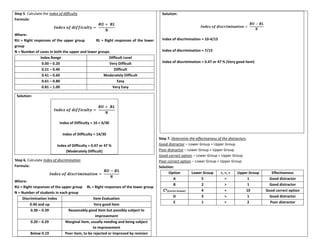
Step 5. Calculate the index of difficulty
Formula:
𝑰𝒏𝒅𝒆𝒙 𝒐𝒇 𝒅𝒊𝒇𝒇𝒊𝒄𝒖𝒍𝒕𝒚 =
𝑹𝑼 + 𝑹𝑳
𝑵
Where:
RU = Right responses of the upper group RL = Right responses of the lower
group
N = Number of cases in both the upper and lower groups
Index Range Difficult Level
0.00 – 0.20 Very Difficult
0.21 – 0.40 Difficult
0.41 – 0.60 Moderately Difficult
0.61 – 0.80 Easy
0.81 – 1.00 Very Easy
Solution:
𝑰𝒏𝒅𝒆𝒙 𝒐𝒇 𝒅𝒊𝒇𝒇𝒊𝒄𝒖𝒍𝒕𝒚 =
𝑹𝑼 + 𝑹𝑳
𝑵
Index of Difficulty = 10 + 4/30
Index of Difficulty = 14/30
Index of Difficulty = 0.47 or 47 %
(Moderately Difficult)
Step 6. Calculate Index of discrimination
Formula:
𝑰𝒏𝒅𝒆𝒙 𝒐𝒇 𝒅𝒊𝒔𝒄𝒓𝒊𝒎𝒊𝒏𝒂𝒕𝒊𝒐𝒏 =
𝑹𝑼 − 𝑹𝑳
𝑵
Where:
RU = Right responses of the upper group RL = Right responses of the lower group
N = Number of students in each group
Discrimination Index Item Evaluation
0.40 and up Very good item
0.30 – 0.39 Reasonably good item but possibly subject to
improvement
0.20 – 0.29 Marginal Item, usually needing and being subject
to improvement
Below 0.19 Poor item, to be rejected or improved by revision
Solution:
𝑰𝒏𝒅𝒆𝒙 𝒐𝒇 𝒅𝒊𝒔𝒄𝒓𝒊𝒎𝒊𝒏𝒂𝒕𝒊𝒐𝒏 =
𝑹𝑼 − 𝑹𝑳
𝑵
Index of discrimination = 10-4/15
Index of discrimination = 7/15
Index of discrimination = 0.47 or 47 % (Very good item)
Step 7. Determine the effectiveness of the distractors.
Good distractor – Lower Group > Upper Group
Poor distractor – Lower Group < Upper Group
Good correct option – Lower Group < Upper Group
Poor correct option – Lower Group > Upper Group
Solution:
Option Lower Group >, <, = Upper Group Effectiveness
A 5 > 1 Good distractor
B 2 > 1 Good distractor
C*(Correct Answer) 4 < 10 Good correct option
D 3 > 1 Good distractor
E 1 < 2 Poor distractor
Authentic Assessment
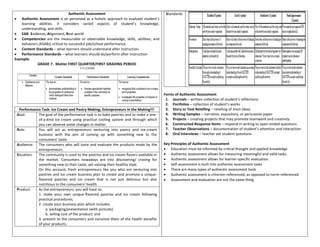
• Authentic Assessment is an perceived as a holistic approach to evaluate student’s
learning abilities. It considers varied aspects of student’s knowledge,
understanding, and skills.
• EAR: Evidence, Alignment, Real world
• Competencies are the measurable or observable knowledge, skills, abilities, and
behaviors (KSABs) critical to successful job/school performance.
• Content Standards – what learners should understand after instruction
• Performance Standards – what learners should do/perform after instruction
Example:
GRADE 7 - Matter FIRST QUARTER/FIRST GRADING PERIOD
Performance Task: Ice Cream and Pastry Making; Entrepreneurs in the Making!!!
Goal: The goal of the performance task is to bake pastries and to make a one-
of-a-kind ice cream using practical cooling system and through which
you can observe some changes in matter.
Role: You will act as entrepreneurs venturing into pastry and ice-cream
business with the aim of coming up with something new to the
consumers’ taste.
Audience: The consumers who will taste and evaluate the products made by the
entrepreneurs.
Situation: The community is used to the pastries and ice cream flavors available in
the market. Consumers nowadays are into discovering/ craving for
something new to their taste, yet valuing their healthy style.
On this account, fresh entrepreneurs like you who are venturing into
pastries and ice cream business plan to create and promote a unique-
flavored pastries and ice cream that is not just delicious but also
nutritious to the consumers’ health.
Product: As the entrepreneurs, you will have to:
1. make your own unique-flavored pastries and ice cream following
practical procedures;
2. create your business plan which includes:
a. packaging/presentation (with pictures)
b. selling cost of the product; and
3. present to the consumers and convince them of the health benefits
of your products.
Standards
:
Forms of Authentic Assessment
1. Journals – written collection of student’s reflections
2. Portfolios – collection of student’s works
3. Story or Text Retelling – retelling of main ideas
4. Writing Samples – narrative, expository, or persuasive paper
5. Projects – creating projects that may promote teamwork and creativity
6. Constructed-Response Items – respond in writing to open-ended questions
7. Teacher Observations – documentation of student’s attention and interaction
8. Oral Interviews – teacher ask student questions
Key Principles of Authentic Assessment
• Education must be informed by critical thought and applied knowledge
• Authentic assessment allows for measuring meaningful and valid tasks
• Authentic assessment allows for learner-specific evaluation
• Self-assessment is built into authentic assessment tasks
• There are many types of authentic assessment tools
• Authentic assessment is criterion-referenced, as opposed to norm-referenced
• Assessment and evaluation are not the same thing
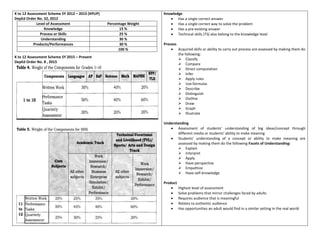
K to 12 Assessment Scheme SY 2012 – 2015 (KPUP)
DepEd Order No. 32, 2012
Level of Assessment Percentage Weight
Knowledge 15 %
Process or Skills 25 %
Understanding 30 %
Products/Performances 30 %
100 %
K to 12 Assessment Scheme SY 2015 – Present
DepEd Order No. 8 , 2015
Knowledge
• Has a single correct answer
• Has a single correct way to solve the problem
• Has a pre-existing answer
• Technical skills (TS) also belong to the knowledge level
Process
• Acquired skills or ability to carry out process are assessed by making them do
the following:
➢ Classify
➢ Compare
➢ Direct computation
➢ Infer
➢ Apply rules
➢ Use formulas
➢ Describe
➢ Distinguish
➢ Outline
➢ Draw
➢ Graph
➢ Illustrate
Understanding
• Assessment of students’ understanding of big ideas/concept through
different media or students’ ability to make meaning
• Students’ understanding of a concept or ability to make meaning are
assessed by making them do the following Facets of Understanding:
➢ Explain
➢ Interpret
➢ Apply
➢ Have perspective
➢ Empathize
➢ Have self-knowledge
Product
• Highest level of assessment
• Solve problems that mirror challenges faced by adults
• Requires audience that is meaningful
• Relates to authentic audience
• Has opportunities an adult would find in a similar setting in the real world
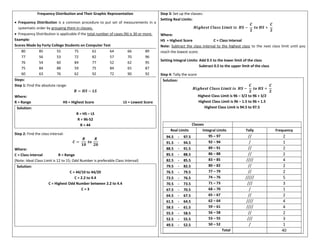
Frequency Distribution and Their Graphic Representation
• Frequency Distribution is a common procedure to put set of measurements in a
systematic order by grouping them in classes.
• Frequency Distribution is applicable if the total number of cases (N) is 30 or more.
Example:
Scores Made by Forty College Students on Computer Test
80 85 55 75 61 64 66 89
77 56 53 72 82 57 70 96
76 54 60 84 77 52 62 95
75 84 88 59 75 84 65 87
60 63 76 62 92 72 90 92
Steps:
Step 1: Find the absolute range:
𝑹 = 𝑯𝑺 − 𝑳𝑺
Where:
R = Range HS = Highest Score LS = Lowest Score
Solution:
R = HS – LS
R = 96-52
R = 44
Step 2: Find the class interval:
𝑪 =
𝑹
𝟏𝟎
𝒕𝒐
𝑹
𝟐𝟎
Where:
C = Class interval R = Range
(Note: Ideal Class Limit is 12 to 15; Odd Number is preferable Class Interval)
Solution:
C = 44/10 to 44/20
C = 2.2 to 4.4
C = Highest Odd Number between 2.2 to 4.4
C = 3
Step 3: Set up the classes:
Setting Real Limits:
𝑯𝒊𝒈𝒉𝒆𝒔𝒕 𝑪𝒍𝒂𝒔𝒔 𝑳𝒊𝒎𝒊𝒕 𝒊𝒔 𝑯𝑺 −
𝑪
𝟐
𝒕𝒐 𝑯𝑺 +
𝑪
𝟐
Where:
HS = Highest Score C = Class Interval
Note: Subtract the class interval to the highest class to the next class limit until you
reach the lowest score.
Setting Integral Limits: Add 0.5 to the lower limit of the class
Subtract 0.5 to the upper limit of the class
Step 4: Tally the score
Solution:
𝑯𝒊𝒈𝒉𝒆𝒔𝒕 𝑪𝒍𝒂𝒔𝒔 𝑳𝒊𝒎𝒊𝒕 𝒊𝒔 𝑯𝑺 −
𝑪
𝟐
𝒕𝒐 𝑯𝑺 +
𝑪
𝟐
Highest Class Limit is 96 – 3/2 to 96 + 3/2
Highest Class Limit is 96 – 1.5 to 96 + 1.5
Highest Class Limit is 94.5 to 97.5
Classes
Real Limits Integral Limits Tally Frequency
94.5 - 97.5 95 – 97 // 2
91.5 - 94.5 92 – 94 / 1
88.5 - 91.5 89 – 91 // 2
85.5 - 88.5 86 – 88 // 2
82.5 - 85.5 83 – 85 //// 4
79.5 - 82.5 80 – 82 // 2
76.5 - 79.5 77 – 79 // 2
73.5 - 76.5 74 – 76 ///// 5
70.5 - 73.5 71 – 73 /// 3
67.5 - 70.5 68 – 70 / 1
64.5 - 67.5 65 – 67 // 2
61.5 - 64.5 62 – 64 //// 4
58.5 - 61.5 59 – 61 //// 4
55.5 - 58.5 56 – 58 // 2
52.5 - 55.5 53 – 55 /// 3
49.5 - 52.5 50 – 52 / 1
Total 40
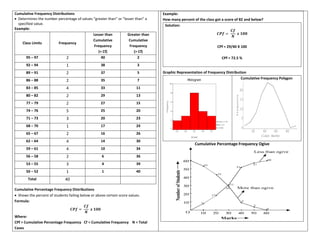
Cumulative Frequency Distributions
• Determines the number percentage of values “greater than” or “lesser than” a
specified value.
Example:
Class Limits Frequency
Lesser than
Cumulative
Frequency
(< Cf)
Greater than
Cumulative
Frequency
(> Cf)
95 – 97 2 40 2
92 – 94 1 38 3
89 – 91 2 37 5
86 – 88 2 35 7
83 – 85 4 33 11
80 – 82 2 29 13
77 – 79 2 27 15
74 – 76 5 25 20
71 – 73 3 20 23
68 – 70 1 17 24
65 – 67 2 16 26
62 – 64 4 14 30
59 – 61 4 10 34
56 – 58 2 6 36
53 – 55 3 4 39
50 – 52 1 1 40
Total 40
Cumulative Percentage Frequency Distributions
• Shows the percent of students failing below or above certain score values.
Formula:
𝑪𝑷𝒇 =
𝑪𝒇
𝑵
𝒙 𝟏𝟎𝟎
Where:
CPf = Cumulative Percentage Frequency Cf = Cumulative Frequency N = Total
Cases
Example:
How many percent of the class got a score of 82 and below?
Solution:
𝑪𝑷𝒇 =
𝑪𝒇
𝑵
𝒙 𝟏𝟎𝟎
CPf = 29/40 X 100
CPf = 72.5 %
Graphic Representation of Frequency Distribution
Cumulative Frequency Polygon
Cumulative Percentage Frequency Ogive
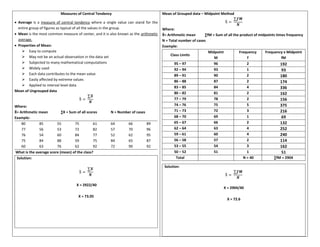
Measures of Central Tendency
• Average is a measure of central tendency where a single value can stand for the
entire group of figures as typical of all the values in the group.
• Mean is the most common measure of center, and it is also known as the arithmetic
average.
• Properties of Mean:
➢ Easy to compute
➢ May not be an actual observation in the data set
➢ Subjected to many mathematical computations
➢ Widely used
➢ Each data contributes to the mean value
➢ Easily affected by extreme values
➢ Applied to interval level data
Mean of Ungrouped data
Ẋ =
∑𝑿
𝑵
Where:
X̄= Arithmetic mean ∑X = Sum of all scores N = Number of cases
Example:
80 85 55 75 61 64 66 89
77 56 53 72 82 57 70 96
76 54 60 84 77 52 62 95
75 84 88 59 75 84 65 87
60 63 76 62 92 72 90 92
What is the average score (mean) of the class?
Solution:
Ẋ =
∑𝑿
𝑵
X = 2922/40
X = 73.05
Mean of Grouped data – Midpoint Method
Ẋ =
∑𝒇𝑴
𝑵
Where:
X̄= Arithmetic mean ∑fM = Sum of all the product of midpoints times frequency
N = Total number of cases
Example:
Class Limits
Midpoint
M
Frequency
f
Frequency x Midpoint
fM
95 – 97 96 2 192
92 – 94 93 1 93
89 – 91 90 2 180
86 – 88 87 2 174
83 – 85 84 4 336
80 – 82 81 2 162
77 – 79 78 2 156
74 – 76 75 5 375
71 – 73 72 3 216
68 – 70 69 1 69
65 – 67 66 2 132
62 – 64 63 4 252
59 – 61 60 4 240
56 – 58 57 2 114
53 – 55 54 3 162
50 – 52 51 1 51
Total N = 40 ∑fM = 2904
Solution:
Ẋ =
∑𝒇𝑴
𝑵
X = 2904/40
X = 72.6
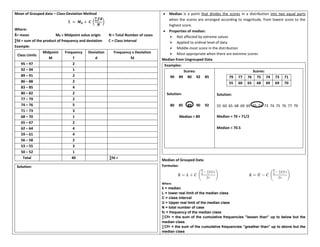
Mean of Grouped data – Class-Deviation Method
Ẋ = 𝑴𝟎 + 𝑪 (
∑𝒇𝒅
𝑵
)
Where:
X̄= mean M0 = Midpoint value origin N = Total Number of cases
∑fd = sum of the product of frequency and deviation C = Class interval
Example:
Class Limits
Midpoint
M
Frequency
f
Deviation
d
Frequency x Deviation
fd
95 – 97 2
92 – 94 1
89 – 91 2
86 – 88 2
83 – 85 4
80 – 82 2
77 – 79 2
74 – 76 5
71 – 73 3
68 – 70 1
65 – 67 2
62 – 64 4
59 – 61 4
56 – 58 2
53 – 55 3
50 – 52 1
Total 40 ∑fd =
Solution:
• Median is a point that divides the scores in a distribution into two equal parts
when the scores are arranged according to magnitude, from lowest score to the
highest score.
• Properties of median:
➢ Not affected by extreme values
➢ Applied to ordinal level of data
➢ Middle-most score in the distribution
➢ Most appropriate when there are extreme scores
Median from Ungrouped Data
Examples:
Scores:
90 89 80 92 85
Solution:
80 85 89 90 92
Median = 89
Scores:
79 77 76 75 74 73 71
55 60 65 68 69 69 70
Solution:
55 60 65 68 69 69 70 71 73 74 75 76 77 79
Median = 70 + 71/2
Median = 70.5
Median of Grouped Data
Formulas:
x
͂ = 𝑳 + 𝑪 (
𝑵
𝟐
− ∑𝑪𝒇<
𝒇𝒄
) x
͂ = 𝑼 − 𝑪 (
𝑵
𝟐
− ∑𝑪𝒇>
𝒇𝒄
)
Where:
x
͂ = median
L = lower real limit of the median class
C = class interval
U = Upper real limit of the median class
N = total number of case
fc = frequency of the median class
∑Cf< = the sum of the cumulative frequencies ”lessen than” up to below but the
median class
∑Cf> = the sum of the cumulative frequencies ”greather than” up to above but the
median class
Class Limits Frequency
Lesser than
Cumulative
Frequency
(< Cf)
Greater than
Cumulative
Frequency
(> Cf)
95 – 97 2 40 2
92 – 94 1 38 3
89 – 91 2 37 5
86 – 88 2 35 7
83 – 85 4 33 11
80 – 82 2 29 13
77 – 79 2 27 15
74 – 76 5 25 20
71 – 73 3 20 23
68 – 70 1 17 24
65 – 67 2 16 26
62 – 64 4 14 30
59 – 61 4 10 34
56 – 58 2 6 36
53 – 55 3 4 39
50 – 52 1 1 40
Total 40
Solution:
fc = 3
∑Cf< = 17
x
͂ = 𝑳 + 𝑪 (
𝑵
𝟐
− ∑𝑪𝒇<
𝒇𝒄
)
x
͂ = 70.5 + 3 (40/2 – 17/3)
x
͂ = 73.5 (20-17/3)
x
͂ = 73.5 (3/3)
x
͂ - 73.5 (1)
x
͂ = 73.5
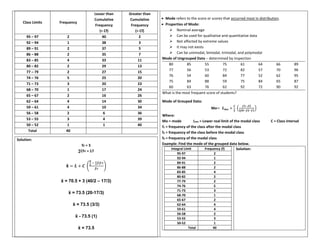
• Mode refers to the score or scores that occurred most in distribution.
• Properties of Mode:
➢ Nominal average
➢ Can be used for qualitative and quantitative data
➢ Not affected by extreme values
➢ It may not exists
➢ Can be unimodal, bimodal, trimodal, and polymodal
Mode of Ungrouped Data – determined by inspection
80 85 55 75 61 64 66 89
77 56 53 72 82 57 70 96
76 54 60 84 77 52 62 95
75 84 88 59 75 84 65 87
60 63 76 62 92 72 90 92
What is the most frequent score of students?
Mode of Grouped Data:
Mo= 𝑳𝒎𝒐 +
𝑪
𝟐
(
𝒇𝟏−𝒇𝟐
𝟐𝒇𝟎−𝒇𝟐−𝒇𝟏
)
Where:
Mo = mode Lmo = Lower real limit of the modal class C = Class interval
f1 = frequency of the class after the modal class
f2 = frequency of the class before the modal class
f0 = frequency of the modal class
Example: Find the mode of the grouped data below.
Integral Limit Frequency (f)
95-97 2
92-94 1
89-91 2
86-88 2
83-85 4
80-82 2
77-79 2
74-76 5
71-73 3
68-70 1
65-67 2
62-64 4
59-61 4
56-58 2
53-55 3
50-52 1
Total 40
Solution:
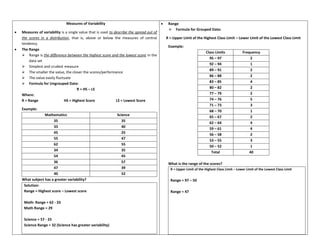
Measures of Variability
• Measures of variability is a single value that is used to describe the spread out of
the scores in a distribution, that is, above or below the measures of central
tendency.
• The Range
➢ Range is the difference between the highest score and the lowest score in the
data set
➢ Simplest and crudest measure
➢ The smaller the value, the closer the scores/performance
➢ The value easily fluctuate
➢ Formula for Ungrouped Data:
R = HS – LS
Where:
R = Range HS = Highest Score LS = Lowest Score
Example:
Mathematics Science
35 35
33 40
45 25
55 47
62 55
34 35
54 45
36 57
47 39
40 52
What subject has a greater variability?
Solution:
Range = Highest score – Lowest score
Math: Range = 62 - 33
Math Range = 29
Science = 57 - 25
Science Range = 32 (Science has greater variability)
• Range
➢ Formula for Grouped Data:
R = Upper Limit of the Highest Class Limit – Lower Limit of the Lowest Class Limit
Example:
Class Limits Frequency
95 – 97 2
92 – 94 1
89 – 91 2
86 – 88 2
83 – 85 4
80 – 82 2
77 – 79 2
74 – 76 5
71 – 73 3
68 – 70 1
65 – 67 2
62 – 64 4
59 – 61 4
56 – 58 2
53 – 55 3
50 – 52 1
Total 40
What is the range of the scores?
R = Upper Limit of the Highest Class Limit – Lower Limit of the Lowest Class Limit
Range = 97 – 50
Range = 47
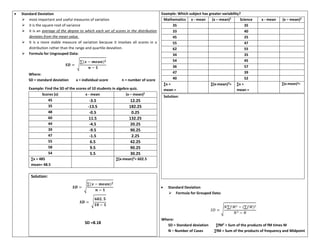
• Standard Deviation
➢ most important and useful measures of variation
➢ it is the square root of variance
➢ it is an average of the degree to which each set of scores in the distribution
deviates from the mean value.
➢ It is a more stable measure of variation because it involves all scores in a
distribution rather than the range and quartile deviation.
➢ Formula for Ungrouped Data:
𝑺𝑫 = √
∑(𝒙 − 𝒎𝒆𝒂𝒏)𝟐
𝒏 − 𝟏
Where:
SD = standard deviation x = individual score n = number of score
Example: Find the SD of the scores of 10 students in algebra quiz.
Scores (x) x - mean (x – mean)2
45 -3.5 12.25
35 -13.5 182.25
48 -0.5 0.25
60 11.5 132.25
44 -4.5 20.25
39 -9.5 90.25
47 -1.5 2.25
55 6.5 42.25
58 9.5 90.25
54 5.5 30.25
∑x = 485
mean= 48.5
∑(x-mean)2
= 602.5
Solution:
𝑺𝑫 = √
∑(𝒙 − 𝒎𝒆𝒂𝒏)𝟐
𝒏 − 𝟏
𝑺𝑫 = √
𝟔𝟎𝟐. 𝟓
𝟏𝟎 − 𝟏
SD =8.18
Example: Which subject has greater variability?
Mathematics x - mean (x – mean)2
Science x - mean (x – mean)2
35 35
33 40
45 25
55 47
62 55
34 35
54 45
36 57
47 39
40 52
∑x =
mean =
∑(x-mean)2
= ∑x =
mean =
∑(x-mean)2=
Solution:
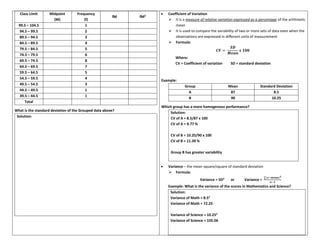
• Standard Deviation
➢ Formula for Grouped Data:
𝑆𝐷 = √
𝑁∑𝑓𝑀2 − (∑𝑓𝑀)2
𝑁2 − 𝑁
Where:
SD = Standard deviation ∑fM2
= Sum of the products of fM times M
N – Number of Cases ∑fM = Sum of the products of frequency and Midpoint
Class Limit Midpoint
(M)
Frequency
(f)
fM fM2
99.5 – 104.5 1
94.5 – 99.5 2
89.5 – 94.5 3
84.5 – 89.5 4
79.5 – 84.5 5
74.5 – 79.5 6
69.5 – 74.5 8
64.5 – 69.5 7
59.5 – 64.5 5
54.5 – 59.5 4
49.5 – 54.5 3
44.5 – 49.5 1
39.5 – 44.5 1
Total
What is the standard deviation of the Grouped data above?
Solution:
• Coefficient of Variation
➢ It is a measure of relative variation expressed as a percentage of the arithmetic
mean
➢ It is used to compare the variability of two or more sets of data even when the
observations are expressed in different units of measurement
➢ Formula:
𝑪𝑽 =
𝑺𝑫
𝑴𝒆𝒂𝒏
𝒙 𝟏𝟎𝟎
Where:
CV = Coefficient of variation SD = standard deviation
Example:
Group Mean Standard Deviation
A 87 8.5
B 90 10.25
Which group has a more homogenous performance?
Solution:
CV of A = 8.5/87 x 100
CV of A = 9.77 %
CV of B = 10.25/90 x 100
CV of B = 11.39 %
Group B has greater variability
• Variance – the mean square/square of standard deviation
➢ Formula:
Variance = SD2
or Variance =
∑(𝒙−𝒎𝒆𝒂𝒏)𝟐
𝒏−𝟏
Example: What is the variance of the scores in Mathematics and Science?
Solution:
Variance of Math = 8.52
Variance of Math = 72.25
Variance of Science = 10.252
Variance of Science = 105.06
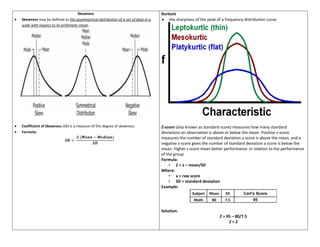
Skewness
• Skewness may be defined as the asymmetrical distribution of a set of data in a
scale with respect to its arithmetic mean.
• Coefficient of Skewness (SK) is a measure of the degree of skewness.
• Formula:
𝑺𝑲 =
𝟑 (𝑴𝒆𝒂𝒏 − 𝑴𝒆𝒅𝒊𝒂𝒏)
𝑺𝑫
Kurtosis
• the sharpness of the peak of a frequency-distribution curve.
Z-score (also known as standard score) measures how many standard
deviations an observation is above or below the mean. Positive z-score
measures the number of standard deviation a score is above the mean, and a
negative z-score gives the number of standard deviation a score is below the
mean. Higher z score mean better performance in relation to the performance
of the group
Formula:
• Z = x – mean/SD
Where:
• x = raw score
• SD = standard deviation
Example:
Subject Mean SD Carl’s Score
Math 80 7.5 95
Solution:
Z = 95 – 80/7.5
Z = 2

Measurement and Evaluation.pdf

  • 1.
    Meaning of Measurementand Evaluation • Assessment refers to the process of gathering, describing or quantifying information about student performance. ➢Test is an instrument or systematic procedure designed to measure the quality, ability, skills or knowledge of students by giving a set of questions n a uniform manner. ➢Testing refers to the administration, scoring and interpretation of an instrument designed to elicit information about the performance in a sample of a particular area of behavior. ➢Measurement is a process of obtaining a numerical description of the degree to which an individual possesses a particular characteristic. Measurement answers the question “How much?” • Evaluation refers to the process of examining the performance of student. It also determines whether or not the student has met the lesson instructional objectives. ➢Statistical Treatment is involved to determine the exact meaning of a value whether it is within the standard or substandard. Functions of Measurement and Evaluation 1.Measure students’ achievement 2.Evaluate instruction 3.Motivate learning 4.Predict success 5.Diagnose the nature of difficulties 6.Evaluate teachers’ performance 7.Evaluate school’s facilities Scope of Evaluation 1.Curriculum offerings 2.School programs 3.Instructional materials 4.Instructional facilities 5.Teachers and professors 6.Pupils/students 7.Graduates 8.School managers Various Approaches to Assessment Assessment FOR Learning • Diagnostic Assessment - precedes instruction • Examples: pre-test, survey, skills check, KWL chart • Formative Assessment- makes use of on-going assessment • Examples: boardwork, seatwork, oral questioning, ungraded quizzes, observations, exit cards, dress rehearsal, etc. Assessment OF Learning • Summative Assessment - makes use of culminating assessments • Examples: performance task, culminating project or performance, work portfolio, long test, periodic test, etc. Assessment AS Learning • Self-assessment • Student assess their own work and/or with their peers • They learn about themselves as learners Principles of Assessment 1. Make use of varied tools for assessment data-gathering and multiple sources of assessment data. It is not pedagogically sound to rely on just source gathered by only one assessment tool. Consider multiple intelligences and learning styles. 2. Learners must be given feedback about their performance. Feedback must be specific. “Good work!” is positive feedback and is welcome but is not actually a very good feedback since it is not specific. 3. Assessment should be on real-world application and not on out-of-context drills. 4. Emphasize on the assessment of higher-order thinking 5. Emphasize on self-assessment. Kinds of Tests 1.Intelligence test – measures intelligence quotient 2.Personality test – measure individual’s interest ascribed to himself and adopts in the society 3.Aptitude test – predictive measure of a person’s likelihood of benefit from instruction or experience in a given field. 4.Prognostic test – predicts how well a person is likely to do in a certain school or subject or task. 5.Performance test – often making use of manipulative materials which involves no or minimum verbal instruction 6.Diagnostic test – identifies the weaknesses of individual’s achievement in any field and which serves as basis for remedial instruction. 7.Achievement test – measurement of what has been learned by student of the subject matter taught in school 8.Preference test – a measure of vocational or avocational interest or aesthetic judgments by requiring the examinees to make force choices between members of paired or grouped items. 9.Accomplishment test – measure the achievements per subject 10. Scale test – has series of items arranged in the order of difficulty 11. Speed test – measures speed and accuracy of examinees within the time limits imposed 12. Standardized test – provides exact procedures in controlling the method of administration and scoring norms and data concerning the reliability and the validity of the test. 13. Teacher-made test – constructed by teachers to determine how much the pupils/students achieved. This test is not carefully prepared as the standardized test 14. Placement test – measures the type of job an applicant should fill.
  • 2.
    Testing Program • TestingProgram supplement the informal tests given by classroom teachers • It is designed to cover as many important outcomes as possible. Steps in a Complete Testing Program 1.Planning the Program – progressive, cooperative, practical, descriptive, and comprehensive. 2.Determining the Purpose – determining learner’s rating; satisfying parents; encourage learners to do better; discover which part of the subject matter need to be retaught; determine learner’s progress; aid in discovering whether learners need remedial or enrichment; compare results between classes with norms. 3.Selecting Appropriate Test – person to select the test; type of test to be used; best procedure; grade or year level to take the test. 4.Administering the Test – suitable in format; clear directions; competent proctor; familiar environment; timing of administration. 5.Scoring the Test – objective and competent persons. 6.Analyzing and Interpreting the Test – use statistical techniques to analyze and add meaning to the result to interpret. 7.Applying the Test Results – for remediation or enrichment 8.Re-testing – determine the progress of testing program 9. Making Suitable Records and Reports – comprehensive, cumulative, convenient, and accurate report and records. Behavioral Objectives as Bases for Constructing teacher-Made Tests Bloom’s taxonomy of Objectives • By and large, examinations are based on behavioral objectives because these objectives are SMART (Specific, Measurable, Achievable, Realistic, and Time-bound) 2.Cognitive Objectives (Bloom and Anderson’s Taxonomy of Objectives) I. Remembering (Knowledge) - define, describe, identify, list down, select, and label II. Understanding (Comprehension) – convert, distinguish, defend, give example, estimate, paraphrase, explain, discuss, predict, extend, summarize, and generalize III. Applying – change, prepare, compute, use, solve, discover, modify, relate, and disseminate IV. Analyzing – break down, diagram, subdivide, illustrate, infer, separate, discriminate, outline, and point out V. Evaluating – appraise, conclude, justify, contrast, criticize, interpret, and discriminate VI. Creating (Synthesis) – design, create, organize, categorize, reorganize, plan, combine, devise, rearrange, revise, comply, tell, modify, generate, and rewrite. 3.Psychomotor Objectives (Anita Harlow’s taxonomy of psychomotor domain) – assemble, build, calibrate, clean, connect, construct, design, dismantle, drill, fasten, fix, grind, manipulate, mix, mend, perform, measure, execute, install, and handle. I. Reflex movement – actions elicited without learning in response to some stimuli (flexion, extension, stretch, postural, adjustments) II. Basic fundamental movement – inherent movement patterns which are formed by combining reflexes (pushing, pulling, manipulating) III. Perceptual – interpretation of various stimuli that enable one to make adjustments to the environment (coordinated movements such as jumping rope, punting, or catching) IV. Physical activities – requiring endurance, strength, vigor, and agility which produces a sound, efficiently functioning body (strenuous effort for long
  • 3.
    periods of time,muscular exertion, quick, wide range of motion at the hip, and quick precise movements V. Skilled movements - result of the acquisition of a degree of efficiency when performing a complex task (all skilled activities obvious in sports, recreation, and dance) VI. Non-discursive communication – communicating through bodily movements ranging from posture to gestures, creative movements, facial expressions, act a part in a play trough sophisticated choreographics (body postures, gestures, and facial expressions efficiently executed in skilled dance movement and choreographics) 1.Affective Objectives (Krathwohl’s Taxonomy of Affective Domian) – appreciate, admire, initiate, sow respect for, participate actively, find pleasure, observe strictly, utilize wisely, listen critically, form sound judgment, sustain interest in, comply with, and venerate. I. Receiving – awareness and sensitivity II. Responding – willingness and satisfaction to respond III. Valuing – acceptance and commitment to values IV. Organizing of value system – conceptualization of value and organization of value system V. Characterization by a value or value complex – self-reliance, industry, punctuality, honesty, and self-discipline Kendall’s and Marzano’s New Taxonomy 1. Information – declarative knowledge 2. Metacognitive/mental procedures – procedural knowledge I. Retrieval – recognizing, recalling, executing II. Comprehension – integrating, symbolizing III. Analysis – matching, classifying, analyzing errors, generalizing, specifying IV. Knowledge utilization – decision-making, problem-solving, experimenting, investigating V. Metacognition – monitoring accuracy, monitoring clarity, process monitoring, specifying goals VI. Self-system thinking – examining motivation, examining emotional response, examining efficacy, examining importance 3. Psychomotor procedures – physical, motor, manipulative skills Norm-Referenced Tests Criterion-Referenced Tests 1. Covers large domain of learning with just few items measuring each specific task 1. Typically focus on a delimited domain of learning tasks with a relative large number of items measuring each specific task 2. Emphasize discrimination among individuals 2. Emphasize what individual can and cannot perform 3. Favor items of large difficulty and typically omits very easy and very hard items 3. Match item difficulty to learning tasks, without altering item difficulty or omitting easy and hard items 4. Interpretation requires a clearly defined group 4. Interpretation requires a clearly defined and delimited achievement domain. Steps in the Preparation of Criterion-Referenced Measure 1. Outline the content 2. Clearly define the instructional objective in behavioral terms 3. Prepare the table of Specifications 4. Construct the relevant test items 𝑵𝒖𝒎𝒃𝒆𝒓 𝒐𝒇 𝑰𝒕𝒆𝒎𝒔 = 𝑵𝒖𝒎𝒃𝒆𝒓 𝒐𝒇 𝑪𝒍𝒂𝒔𝒔 𝑺𝒆𝒔𝒔𝒊𝒐𝒏𝒔 𝒙 𝑫𝒆𝒔𝒊𝒓𝒆𝒅 𝑻𝒐𝒕𝒂𝒍 𝑵𝒖𝒎𝒃𝒆𝒓 𝒐𝒇 𝑰𝒕𝒆𝒎𝒔 𝑻𝒐𝒕𝒂𝒍 𝑵𝒖𝒎𝒃𝒆𝒓 𝒐𝒇 𝑪𝒍𝒂𝒔𝒔 𝑺𝒆𝒔𝒔𝒊𝒐𝒏𝒔
  • 4.
    Sample of OneWay Table of Specifications Content Number of Class Sessions Number of Items Placement 1. Definition of linear function 2. Slope of a line 3. Graph of linear function 4. Equation of linear function 5. Standard forms of line 6. Parallel and Perpendicular lines 7. Application of linear functions TOTAL Sample of Two Way Table of Specifications Content K C Ap An E S Class Hours Total 1. Definition of linear function 2. Slope of a line 3. Graph of linear function 4. Equation of linear function 5. Standard forms of line 6. Parallel and Perpendicular lines 7. Application of linear functions TOTAL Sample Detailed Table of Specifications:
  • 5.
    Table of Specifications Subjectand Year Level: __________________________________ Period: _____________________ Teacher: ______________________________________________ Total Number of Class Hours: ____________________ Content Objective K C Ap An E S Class Hours Number of Items Placement Percentage Total Submitted by: _______________________________ Checked by: ____________________________ Noted by: _____________________________ Date Submitted: _____________________________ Academic Department Head Principal
  • 6.
    Assessment Method, Tools,and Tasks • Traditional Assessments – paper-and-pencil test (Measures Cognitive Doman (Bloom) or Declarative Knowledge (Kendall and Marzano)) ➢ Selected Response o Alternate response o Matching type o Multiple choice ➢ Constructed Response o Completion o Short answer o Essay o Problem solving • Authentic Assessments – non-paper-and-pencil test (Measures cognitive, affective, and psychomotor domain (Bloom) or Declarative Knowledge, metacognitive procedures or procedural knowledge, and psychomotor procedures or physical, motor/manipulative skills (Kendall and Marzano)) ➢ Product – product output ➢ Performance – performance task _______________________________________________________________________ Portfolios • Learning Portfolio – purposeful collection of student work that exhibits a student’s effort, progress, achievement and competencies gained in a given area. Types of Portfolio: • Growth/Developmental Portfolio – to show growth or change over time; to identify strengths and weaknesses • Showcase/Best Work/Display Portfolio – to showcase end-of-year/term accomplishments; to showcase student’s perceptions of favorite best work or most important • Assessment/Evaluation Portfolio – to document achievement for grading; to document progress towards standards; to place students appropriately. Scoring Rubrics • A rubric is a coherent set of criteria for student’s work that includes descriptions of levels of performance quality on criteria. • The main purpose of rubrics is to assess performances and products. Types of Rubrics • Analytic rubrics – describe work on each criterion separately • Holistic rubrics – assesses student work as a whole.
  • 7.
    Teacher-Made Tests Construction Stepsin Constructing Teacher-Made Tests. 1. Planning the test – statement of objectives, provisions for review, nature of test, and length 2. Preparing the test – first and final draft preparation; more than one type; arrange in ascending order of difficulty; similar type should be placed together; no pattern of responses; direction should be clear, brief, and complete. 3. Reproducing the test – duplicating facilities; clerks and facilitative staffs. 4. Administering the test – environment familiar to the students; seating arrangement; typographical errors should be corrected before the test starts; complete and clear directions before test; do not entertain questions during the test about instructions; planned distribution of materials; writing on the board the scheduled start and end of exam; not allowing to leave room except for personal necessities; collection of materials carefully and quickly. 5. Scoring the test – one point for each item (recommended procedure); for two option test, right minus wrong. (Score = Right – Wrong); for three-option test, write minus wrong (Score = Right – ½ Wrong); correction formula not applicable to elementary students and to four or more option test. Example: Two-option test No. of Right Response = 20 No. of Wrong Response = 7 Solution: Three-option test No. of Right Response = 25 No. of Wrong Response = 9 Solution: 6. Evaluating the test – 50 % difficulty in an individual item achievement test; validity of individual item; be checked against outside criterion; reliability Formula: 𝑰𝒏𝒅𝒆𝒙 𝒐𝒇 𝒅𝒊𝒇𝒇𝒊𝒄𝒖𝒍𝒕𝒚 = 𝑹𝑼 + 𝑹𝑳 𝑵 Where: RU = Right responses of the upper group RL = Right responses of the lower group N = Number of cases in both the upper and lower groups Index Range Difficult Level 0.00 – 0.20 Very Difficult 0.21 – 0.40 Difficult 0.41 – 0.60 Moderately Difficult 0.61 – 0.80 Easy 0.81 – 1.00 Very Easy Formula: 𝑰𝒏𝒅𝒆𝒙 𝒐𝒇 𝒅𝒊𝒔𝒄𝒓𝒊𝒎𝒊𝒏𝒂𝒕𝒊𝒐𝒏 = 𝑹𝑼 − 𝑹𝑳 𝑵 Where: RU = Right responses of the upper group RL = Right responses of the lower group N = Number of students in each group Discrimination Index Item Evaluation 0.40 and up Very good item 0.30 – 0.39 Reasonably good item but possibly subject to improvement 0.20 – 0.29 Marginal Item, usually needing and being subject to improvement Below 0.19 Poor item, to be rejected or improved by revision Example: For item 21, 12 out of 15 students from the upper group got it correctly and 9 out of 15 students from the lower group got it correctly. What is the level of difficulty of item 21 and what should be done to it? Solution: 𝑰𝒏𝒅𝒆𝒙 𝒐𝒇 𝒅𝒊𝒇𝒇𝒊𝒄𝒖𝒍𝒕𝒚 = 𝑹𝑼 + 𝑹𝑳 𝑵 Index of Difficulty = 12 + 9/30 Index of Difficulty = 21/30 Index of Difficulty = 0.70 or 70 % (Easy) 𝑰𝒏𝒅𝒆𝒙 𝒐𝒇 𝒅𝒊𝒔𝒄𝒓𝒊𝒎𝒊𝒏𝒂𝒕𝒊𝒐𝒏 = 𝑹𝑼 − 𝑹𝑳 𝑵 Index of discrimination = 12-9/15 Index of discrimination = 3/15 Index of discrimination = 0.20 or 20 % (Marginal Item, usually needing and being subject to improvement) 7. Interpreting the tests results – In interpreting the test results of standardized achievement tests, the result are based on norm tables.
  • 8.
    Types of InformalTeacher-made Tests 1. Essay examination 2. Objective Types: a. Recall Type: Simple recall; Completion b. Recognition Type: Alternative Response; Multiple Choice; Matching; Rearrangement; Analogy; Identification Essay Examination • Instrument for evaluating knowledge of skill wherein student’s ability to express ideas accurately and critically is tested within a certain period of time. Rules and Suggestions: 1.Plan and construct carefully 2.Distribute questions evenly among the different units 3.Precautions on the causes of unreliability should be taken 4.Scope should be clear to students 5.Time limit should be reckoned 6.Scoring: a. Use rubrics b. Quickly read and sort the paper on the basis of your opinion of their worthiness c. Read the responses at the same time d. Re-read the papers and shift any that you feel have been misplaced e. Avoid looking at the names of the paper you are scoring Types of Constructing an Essay Examination 1. Selective recall 2. Evaluating recall 3. Comparison 4. Decision 5. Cause or effects 6. Explanation 7. Summary 8. Analysis 9. Statement of relationship 10. Illustration and examples 11. Classification 12. Application 13. Discussion 14. Statement of aim 15. Criticism 16. Outline 17. Reorganization of facts 18. Formulation of ideas 19. New method or procedure Advantages of an Essay Examination 1. Easy to construct 2. Economical 3. Trains the core of organizing, expressing, and reasoning power 4. Minimize guessing 5. Develops critical thinking 6. Minimizes cheating and memorizing Disadvantages of an Essay Examination 1. Low validity 2. Subjectivity 3. Difficult to check 4. Encourages bluffing 5. Disadvantageous for students with poor penmanship Simple-Recall Type • item appears as a direct question. Rules and Suggestions: 1. Responses should be brief and specific as possible 2. Question should be direct 3. Blanks is preferably at the right column of items 4. Make minimum use of textbook language Completion test • Requires filling a word or phrase on the blanks Rules and Suggestions: 1.Avoid indefinite and vague statements 2.Avoid giving unwarranted clues – statements from textbooks, key words or phrases, “a” and “an”, grammatical clues 3.Arrange the test so as to facilitate scoring – avoid fractional credits; item should have one correct answer; arrange item as far as possible; prepare an answer key. Alternative Response • Two or three constant options to be chosen Rules and Suggestions: 1. Items must be arranged in groups of five. Each group should be separated by two spaces and each item should be separated by single space. 2. Response should be simple 3. Answers are recommended to be written on the right side 4. Avoid lifting texts from books 5. Do not use determiners – all, some, seldom, always, sometimes, etc. 6. Avoid qualitative terms – few, many, great, frequent, etc. 7. Do not use partly right statements Multiple-Choice • Three or more plausible options in each item Rules and Suggestions: 1.Avoid lifting texts from books 2.All options must be plausible 3.All options must be grammatically consistent
  • 9.
    4.Avoid the useof article “a” and “an” 5.No pattern on the correct answers 6.Uniform number of options in each item 7.Consistent length of options 8.Homogeneity of options 9.Simple method of indicating a response Varieties of Multiple-choice Test 1.Stem-and-option variety – stem serves as the problem followed by options 2.Setting-and-option variety – dependent upon setting or foundation (graph, picture, paragraph) 3.Group-tem variety – consist of terms in which one does not belong to the group 4.Structured-response variety – use of structure response which are commonly use in classrooms (ex: judging statements) 5.Contained-Options variety – designed to identify errors Matching Type • Consists of two columns to be properly paired • Balanced and unbalanced form Rules and Suggestions: 1.Homogenous materials should be used 2.Unbalanced matching type is preferable 3.Grammatically consistent 4.All options must be plausible 5.Options must not be too long 6.Options should be arrange in alphabetical or chronological order 7.There should only be one correct response for each item 8.Ideal number of items is 5 to 10. Maximum is 15. 9.All items must appear on one page Rearrrangement Type • Multiple option item which requires logical, chronological, rank etc. order Analogy • Consisting of pair of words which are related to each other. Kinds of Relationships: 1. Purpose 2. Cause and effect 3. Part-whole 4. Part-part 5. Action to object 6. Synonym 7. Antonym 8. Place 9. Degree 10. Characteristics 11. Sequence 12. Grammatical 13. Numerical 14. Association Rules and Suggestions: 1. Correct pairing of relationships 2. Distracters must be plausible 3. All options must be in parallel language 4. Grammatically consistent 5. Four or more options must be included 6. Homogeneous relationship Advantages of Objective Type Test 1.Easy to score 2.Eliminates subjectivity 3.Adequate sampling 4.Norms can be established 5.Eliminates bluffing 6.Saves time in answering Limitations of Objective Type Test 1. Difficult to construct 2. May encourage cheating and guessing 3. Expensive 4. May encourage rote learning 5. Time consuming to prepare Other Evaluation Instruments 1. Questionnaire – student responds by encircling option or using checkmark 2. Checklist – checklist for desired behavior 3. Rating Scale – recording an appraisal 4. Performance – measurement of performance 5. Cumulative records – record for developing personality 6. Anecdotal Record – identifying learner’s behavior
  • 10.
    Qualities of aGood Measuring Instrument 1. Validity – refers to the appropriateness of score-based inferences or decisions made based on the students’ test results. It refers to the extent to which a test measures what it’s supposed to measure. Types of Validity a. Content validity – refers to the relationship between a test and the instructional objectives, and establishes content so that the test measures what it is supposed to measure. b. Criterion-related validity – refers to the extent to which scores from a test relate to theoretically similar measures. It is a measure of how accurately a student’s current test score can be used to estimate a score on a criterion measure or another measurement instrument. b.1. Construct validity – measures the extent to which a test measures a hypothetical and unobservable variable or quality (intelligence, performance anxiety, appreciation, etc.) b.2. Predictive validity – can be used to estimate accurately what the performance or other criterion will be at a later time. c. Concurrent validity – a type of validation that requires the correlation of the test with a criterion set up as an acceptable measure. Factors Affecting the Validity of a Test Item 1. The test itself 2. Administration and scoring of a test 3. Personal factors influencing how students response to the test 4. Validity is always specific to a particular group Factors that reduce the Validity of the Test Item 1. Poorly constructed test items 2. Unclear directions 3. Ambiguous items 4. Very difficult vocabulary 5. Complicated syntax/sentence construction 6. Inadequate time limit 7. Inappropriate level of difficulty 8. Unintended clues 9. Improper arrangement of items 2. Reliability – refers to the consistency of measurement. That is, how consistent test results or other assessment results from one measurement to another. A test is reliable if it has a reliability index of 0.50 or above. The reliability of a test can be determined by means of Pearson Product Correlation Coefficient, Spearman-Brown Formula and Kuder-Richardson Formula. Four Methods of Establishing Reliability A. Test-Retest Method – administers the same test twice to the same group of students with any time interval between tests. The result of the test scores are correlated using Pearson Product Correlation Coefficient (r). This measures how stable the test results are over a period of time. B. Equivalent-Form Method –administers two different but parallel tests to the same groups of students in close succession. The result of the test scores are correlated using Pearson Product Correlation Coefficient (r). It measures the equivalence of the tests. Steps: Step 1. Rank the scores of respondents from highest to lowest in the first set of administration (X) and mark this as Rx. The highest score receives the rank of 1. Step 2. Rank the second set of scores (Y) in the same manner as in Step 1 and mark as Ry Step 3. Determine the difference in ranks for every pair of ranks. Step 4. Squared each difference to get D2 . Step 5. Sum the squared difference to find ∑D2 . Step 6. Compute Spearman rho (rs) by applying the formula: 𝒓𝒔 = 𝟏 − 𝟔𝚺𝑫𝟐 𝑵𝟑 − 𝑵 Where: rs = Spearman rho ∑D2 = Sum of the squared difference between ranks N = Total number of cases Interpretation of Correlation Coefficient Value 0.00 to + 0.20 Negligible correlation + 0.21 to + 0.40 Low or slight correlation + 0.41 to + 0.70 Moderate correlation + 0.71 to + 0.90 High correlation + 0.91 to + 0.99 Very high correlation + 1.00 Perfect correlation
  • 11.
    Example: Student X Y RanksDifference Rx Ry D D2 1 90 70 2 7.5 5.5 30.25 2 43 31 13 12.5 0.5 0.25 3 84 79 6.5 3 3.5 12.25 4 86 70 4.5 7.5 3 9 5 55 43 11 10.5 0.5 0.25 6 77 70 8.5 7.5 1 1 7 84 75 6.5 4.5 2 4 8 91 88 1 1 0 0 9 40 31 14 12.5 1.5 2.25 10 75 70 10 7.5 2.5 6.25 11 86 80 4.5 2 2.5 6.25 12 89 75 3 4.5 1.5 2.25 13 48 30 12 14 2 4 14 77 43 8.5 10.5 2 4 ∑D2 = 82 Solution: 𝒓𝒔 = 𝟏 − 𝟔𝚺𝑫𝟐 𝑵𝟑 − 𝑵 rs = 1 – 6 (82) 143 –14 rs = 1 – 492 . 2744 – 14 rs = 1 – 492 . 2730 rs = 1 – 0.18021978 rs = 0.82 or 82 % (High correlation) Four Methods of Establishing Reliability (continuation) C. Split-Half Method – administer test once. Score two equivalent halves of the test. Test scores are correlated using Spearman-Brown Formula to measure internal consistency. Steps: Step 1. Divide the test into two halves. Commonly, test is divided into odd and even items. Step 2. Rank the scores of respondents from highest to lowest in the first set (X/odd items) and mark this as Rx. The highest score receives the rank of 1. Step 3. Rank the second set of scores (Y/even items) in the same manner as in Step 1 and mark as Ry Step 4. Squared each difference to get D2 . Step 5. Sum the squared difference to find ∑D2 . Step 6. Compute for the reliability of half test by applying the formula: 𝒓𝒉𝒕 = 𝟏 − 𝟔𝚺𝑫𝟐 𝑵𝟑 − 𝑵 Where: rht = reliability of half test ∑D2 = Sum of the squared difference between ranks N = Total number of cases Step 7. Apply Spearman – Brown Formula: 𝒓𝒘𝒕 = 𝟐(𝒓𝒉𝒕) 𝟏 + 𝒓𝒉𝒕 Where: rwt = reliability of whole test rht = reliability of half test Example: Student Scores Ranks Difference X (Odd) (Even) Rx Ry D D2 1 23 30 9 7.5 1.5 2.25 2 25 24 7.5 9.5 2 4 3 27 30 6 7.5 1.5 2.25 4 35 40 5 5 0 0 5 48 55 3 2.5 0.5 0.25 6 21 24 10 9.5 0.5 0.25 7 25 35 7.5 6 1.5 2.25 8 50 51 2 4 2 4 9 38 60 4 1 3 9 10 55 55 1 2.5 1.5 2.25 ∑D2 = 26.50
  • 12.
    Solutions: 𝒓𝒉𝒕 = 𝟏− 𝟔𝚺𝑫𝟐 𝑵𝟑 − 𝑵 rht = 1 – 6 (26.50) 103 –10 rht = 1 – 159 1000 –10 rht = 1 – 159 990 rht = 1 – 0.16060606 rht = 0.84 (reliability of half of the test) 𝒓𝒘𝒕 = 𝟐(𝒓𝒉𝒕) 𝟏 + 𝒓𝒉𝒕 rwt = 2 (0.84) 1 + 0.84 rwt = 1.68 1.84 rwt = 0.91 or 91 5 (Reliability of the whole test: Very high correlation) Four Methods of Establishing Reliability (continuation) D. Kuder-Richardson Formula – administer test once. This method is used with psychological test which consists of dichotomously scored items. The examinee either passes or fails in an item. It measures internal consistency of homogeneity of the measuring instrument. Steps: Step 1. Find the proportion passing each item (pi) and the proportion failing each item (qi). Step 2. Multiply pi and qi for each item and sum for all items. Step 3. Compute for the variance (SD2 ) of the test scores for the whole group using the formula: Ẋ = ∑𝑿 𝑵 𝑺𝑫𝟐 = ∑(𝑿 − Ẋ)𝟐 𝑵 − 𝟏 Where: Ẋ = mean ∑X = Summation of scores SD2 = Variance N = Number of cases Step 4. Substitute the calculated values in the Kunder-Richardson 20 formula: 𝒓𝒙𝒙 = [ 𝑵 𝑵 − 𝟏 ] [ 𝑺𝑫𝟐 − ∑𝒑𝒊𝒒𝒊 𝑺𝑫𝟐 ] Where: N = number of items SD2 = variance of scores piqi = product of proportion passing and failing item i
  • 13.
    Example: Items Students f pi qipiqi 1 2 3 4 5 6 7 8 9 10 11 12 13 14 1 1 1 1 1 1 1 1 1 1 1 1 1 0 0 2 1 1 1 1 1 1 1 1 1 1 1 1 0 0 3 1 1 1 1 1 1 1 1 1 1 1 0 0 0 4 1 1 1 1 1 1 1 1 1 1 0 0 0 0 5 1 1 1 1 1 1 1 1 1 1 0 0 0 0 6 1 1 1 1 1 1 1 1 1 1 0 0 0 0 7 1 1 1 1 1 1 1 1 1 0 0 0 0 0 8 0 1 1 1 1 1 0 1 1 0 1 0 0 0 9 0 1 1 1 1 1 1 1 1 0 0 0 0 0 10 0 0 1 0 0 1 1 0 1 0 0 0 0 0 Total ∑piqi = Student X (X - Ẋ) (X - Ẋ)2 1 2 3 4 5 6 7 8 9 10 11 12 13 14 ∑X = ∑(X - Ẋ)2 = Solution: Qualities of a Good Measuring Instrument (Continuation) 3. Usability- means the degree to which the measuring instrument can be satisfactorily used by teachers, researchers, supervisors and school managers without undue expenditure of time, money, and effort. Usability means practicability. Factors that Determine Usability 1. Ease of administration 2. Ease of scoring 3. Ease of interpretation and application 4. Low cost 5. Proper mechanical make-up
  • 14.
    Making an Itemanalysis • Testing the effectiveness of the test after it has been administered and scored. Benefits: 1. It gives useful information for class discussion of the test 2. It gives data for helping the students to improve their learning method 3. It gives insights and skills which lead to the construction of better test items for future use. Information Provided by Item Analysis: 1. Difficulty of the item 2. Discriminating power of the item 3. Effectiveness of each item _____________________________________________________________________ __ Example: Item analysis for Question/Item # 21 of the Test taken by 45 Students Student Score 100 Answer to Question # 21 Student Score 100 Answer to Question # 21 Student Score 100 Answer to Question # 21 1 32 A 16 44 C 31 65 B 2 83 E 17 93 C 32 77 C 3 59 E 18 79 A 33 54 D 4 76 D 19 75 B 34 95 C 5 96 C 20 67 E 35 40 C 6 55 A 21 88 C 36 73 E 7 45 D 22 70 D 37 90 C 8 87 A 23 64 C 38 41 A 9 60 C 24 42 C 39 51 C 10 43 B 25 97 C 40 85 B 11 91 C 26 35 A 41 47 D 12 69 C 27 48 B 42 68 C 13 49 A 28 84 D 43 92 C 14 66 A 29 50 E 44 71 A 15 94 C 30 81 E 45 89 C Steps in Making Item Analysis Step 1. Arrange the test scores from the highest to the lowest Step 2. Get one-third from the highest scores (Upper Group) and one-third from the lowest scores (Lower Group) Step 3. Count the number of students in the upper and lower groups, respectively, who chose the options. Step 4. Record the frequency from step 3. Options A B C* D E Upper (15) 1 1 10 1 2 Lower (15) 5 2 4 3 1 *Correct answer Class Answer to Group Question # 21 1 25 97 C 2 5 96 C 3 34 95 C 4 15 94 C 5 17 93 C 6 43 92 C 7 11 91 C Upper 8 37 90 C Group 9 45 89 C 10 21 88 C 11 8 87 A 12 40 85 B 13 28 84 D 14 2 83 E 15 30 81 E 16 18 79 A 17 32 77 C 18 4 76 D 19 19 75 B 20 36 73 E 21 44 71 A 22 22 70 D Middle 23 12 69 C Group 24 42 68 C 25 20 67 E 26 14 66 A 27 31 65 B 28 23 64 C 29 9 60 C 30 3 59 E 31 6 55 A 32 33 54 D 33 39 51 C 34 29 50 E 35 13 49 A 36 27 48 B 37 41 47 D Lower 38 7 45 D Group 39 16 44 C 40 10 43 B 41 24 42 C 42 38 41 A 43 35 40 C 44 26 35 A 45 1 32 A Score Rank Student
  • 15.
    Step 5. Calculatethe index of difficulty Formula: 𝑰𝒏𝒅𝒆𝒙 𝒐𝒇 𝒅𝒊𝒇𝒇𝒊𝒄𝒖𝒍𝒕𝒚 = 𝑹𝑼 + 𝑹𝑳 𝑵 Where: RU = Right responses of the upper group RL = Right responses of the lower group N = Number of cases in both the upper and lower groups Index Range Difficult Level 0.00 – 0.20 Very Difficult 0.21 – 0.40 Difficult 0.41 – 0.60 Moderately Difficult 0.61 – 0.80 Easy 0.81 – 1.00 Very Easy Solution: 𝑰𝒏𝒅𝒆𝒙 𝒐𝒇 𝒅𝒊𝒇𝒇𝒊𝒄𝒖𝒍𝒕𝒚 = 𝑹𝑼 + 𝑹𝑳 𝑵 Index of Difficulty = 10 + 4/30 Index of Difficulty = 14/30 Index of Difficulty = 0.47 or 47 % (Moderately Difficult) Step 6. Calculate Index of discrimination Formula: 𝑰𝒏𝒅𝒆𝒙 𝒐𝒇 𝒅𝒊𝒔𝒄𝒓𝒊𝒎𝒊𝒏𝒂𝒕𝒊𝒐𝒏 = 𝑹𝑼 − 𝑹𝑳 𝑵 Where: RU = Right responses of the upper group RL = Right responses of the lower group N = Number of students in each group Discrimination Index Item Evaluation 0.40 and up Very good item 0.30 – 0.39 Reasonably good item but possibly subject to improvement 0.20 – 0.29 Marginal Item, usually needing and being subject to improvement Below 0.19 Poor item, to be rejected or improved by revision Solution: 𝑰𝒏𝒅𝒆𝒙 𝒐𝒇 𝒅𝒊𝒔𝒄𝒓𝒊𝒎𝒊𝒏𝒂𝒕𝒊𝒐𝒏 = 𝑹𝑼 − 𝑹𝑳 𝑵 Index of discrimination = 10-4/15 Index of discrimination = 7/15 Index of discrimination = 0.47 or 47 % (Very good item) Step 7. Determine the effectiveness of the distractors. Good distractor – Lower Group > Upper Group Poor distractor – Lower Group < Upper Group Good correct option – Lower Group < Upper Group Poor correct option – Lower Group > Upper Group Solution: Option Lower Group >, <, = Upper Group Effectiveness A 5 > 1 Good distractor B 2 > 1 Good distractor C*(Correct Answer) 4 < 10 Good correct option D 3 > 1 Good distractor E 1 < 2 Poor distractor
  • 16.
    Authentic Assessment • AuthenticAssessment is an perceived as a holistic approach to evaluate student’s learning abilities. It considers varied aspects of student’s knowledge, understanding, and skills. • EAR: Evidence, Alignment, Real world • Competencies are the measurable or observable knowledge, skills, abilities, and behaviors (KSABs) critical to successful job/school performance. • Content Standards – what learners should understand after instruction • Performance Standards – what learners should do/perform after instruction Example: GRADE 7 - Matter FIRST QUARTER/FIRST GRADING PERIOD Performance Task: Ice Cream and Pastry Making; Entrepreneurs in the Making!!! Goal: The goal of the performance task is to bake pastries and to make a one- of-a-kind ice cream using practical cooling system and through which you can observe some changes in matter. Role: You will act as entrepreneurs venturing into pastry and ice-cream business with the aim of coming up with something new to the consumers’ taste. Audience: The consumers who will taste and evaluate the products made by the entrepreneurs. Situation: The community is used to the pastries and ice cream flavors available in the market. Consumers nowadays are into discovering/ craving for something new to their taste, yet valuing their healthy style. On this account, fresh entrepreneurs like you who are venturing into pastries and ice cream business plan to create and promote a unique- flavored pastries and ice cream that is not just delicious but also nutritious to the consumers’ health. Product: As the entrepreneurs, you will have to: 1. make your own unique-flavored pastries and ice cream following practical procedures; 2. create your business plan which includes: a. packaging/presentation (with pictures) b. selling cost of the product; and 3. present to the consumers and convince them of the health benefits of your products. Standards : Forms of Authentic Assessment 1. Journals – written collection of student’s reflections 2. Portfolios – collection of student’s works 3. Story or Text Retelling – retelling of main ideas 4. Writing Samples – narrative, expository, or persuasive paper 5. Projects – creating projects that may promote teamwork and creativity 6. Constructed-Response Items – respond in writing to open-ended questions 7. Teacher Observations – documentation of student’s attention and interaction 8. Oral Interviews – teacher ask student questions Key Principles of Authentic Assessment • Education must be informed by critical thought and applied knowledge • Authentic assessment allows for measuring meaningful and valid tasks • Authentic assessment allows for learner-specific evaluation • Self-assessment is built into authentic assessment tasks • There are many types of authentic assessment tools • Authentic assessment is criterion-referenced, as opposed to norm-referenced • Assessment and evaluation are not the same thing
  • 17.
    K to 12Assessment Scheme SY 2012 – 2015 (KPUP) DepEd Order No. 32, 2012 Level of Assessment Percentage Weight Knowledge 15 % Process or Skills 25 % Understanding 30 % Products/Performances 30 % 100 % K to 12 Assessment Scheme SY 2015 – Present DepEd Order No. 8 , 2015 Knowledge • Has a single correct answer • Has a single correct way to solve the problem • Has a pre-existing answer • Technical skills (TS) also belong to the knowledge level Process • Acquired skills or ability to carry out process are assessed by making them do the following: ➢ Classify ➢ Compare ➢ Direct computation ➢ Infer ➢ Apply rules ➢ Use formulas ➢ Describe ➢ Distinguish ➢ Outline ➢ Draw ➢ Graph ➢ Illustrate Understanding • Assessment of students’ understanding of big ideas/concept through different media or students’ ability to make meaning • Students’ understanding of a concept or ability to make meaning are assessed by making them do the following Facets of Understanding: ➢ Explain ➢ Interpret ➢ Apply ➢ Have perspective ➢ Empathize ➢ Have self-knowledge Product • Highest level of assessment • Solve problems that mirror challenges faced by adults • Requires audience that is meaningful • Relates to authentic audience • Has opportunities an adult would find in a similar setting in the real world
  • 18.
    Frequency Distribution andTheir Graphic Representation • Frequency Distribution is a common procedure to put set of measurements in a systematic order by grouping them in classes. • Frequency Distribution is applicable if the total number of cases (N) is 30 or more. Example: Scores Made by Forty College Students on Computer Test 80 85 55 75 61 64 66 89 77 56 53 72 82 57 70 96 76 54 60 84 77 52 62 95 75 84 88 59 75 84 65 87 60 63 76 62 92 72 90 92 Steps: Step 1: Find the absolute range: 𝑹 = 𝑯𝑺 − 𝑳𝑺 Where: R = Range HS = Highest Score LS = Lowest Score Solution: R = HS – LS R = 96-52 R = 44 Step 2: Find the class interval: 𝑪 = 𝑹 𝟏𝟎 𝒕𝒐 𝑹 𝟐𝟎 Where: C = Class interval R = Range (Note: Ideal Class Limit is 12 to 15; Odd Number is preferable Class Interval) Solution: C = 44/10 to 44/20 C = 2.2 to 4.4 C = Highest Odd Number between 2.2 to 4.4 C = 3 Step 3: Set up the classes: Setting Real Limits: 𝑯𝒊𝒈𝒉𝒆𝒔𝒕 𝑪𝒍𝒂𝒔𝒔 𝑳𝒊𝒎𝒊𝒕 𝒊𝒔 𝑯𝑺 − 𝑪 𝟐 𝒕𝒐 𝑯𝑺 + 𝑪 𝟐 Where: HS = Highest Score C = Class Interval Note: Subtract the class interval to the highest class to the next class limit until you reach the lowest score. Setting Integral Limits: Add 0.5 to the lower limit of the class Subtract 0.5 to the upper limit of the class Step 4: Tally the score Solution: 𝑯𝒊𝒈𝒉𝒆𝒔𝒕 𝑪𝒍𝒂𝒔𝒔 𝑳𝒊𝒎𝒊𝒕 𝒊𝒔 𝑯𝑺 − 𝑪 𝟐 𝒕𝒐 𝑯𝑺 + 𝑪 𝟐 Highest Class Limit is 96 – 3/2 to 96 + 3/2 Highest Class Limit is 96 – 1.5 to 96 + 1.5 Highest Class Limit is 94.5 to 97.5 Classes Real Limits Integral Limits Tally Frequency 94.5 - 97.5 95 – 97 // 2 91.5 - 94.5 92 – 94 / 1 88.5 - 91.5 89 – 91 // 2 85.5 - 88.5 86 – 88 // 2 82.5 - 85.5 83 – 85 //// 4 79.5 - 82.5 80 – 82 // 2 76.5 - 79.5 77 – 79 // 2 73.5 - 76.5 74 – 76 ///// 5 70.5 - 73.5 71 – 73 /// 3 67.5 - 70.5 68 – 70 / 1 64.5 - 67.5 65 – 67 // 2 61.5 - 64.5 62 – 64 //// 4 58.5 - 61.5 59 – 61 //// 4 55.5 - 58.5 56 – 58 // 2 52.5 - 55.5 53 – 55 /// 3 49.5 - 52.5 50 – 52 / 1 Total 40
  • 19.
    Cumulative Frequency Distributions •Determines the number percentage of values “greater than” or “lesser than” a specified value. Example: Class Limits Frequency Lesser than Cumulative Frequency (< Cf) Greater than Cumulative Frequency (> Cf) 95 – 97 2 40 2 92 – 94 1 38 3 89 – 91 2 37 5 86 – 88 2 35 7 83 – 85 4 33 11 80 – 82 2 29 13 77 – 79 2 27 15 74 – 76 5 25 20 71 – 73 3 20 23 68 – 70 1 17 24 65 – 67 2 16 26 62 – 64 4 14 30 59 – 61 4 10 34 56 – 58 2 6 36 53 – 55 3 4 39 50 – 52 1 1 40 Total 40 Cumulative Percentage Frequency Distributions • Shows the percent of students failing below or above certain score values. Formula: 𝑪𝑷𝒇 = 𝑪𝒇 𝑵 𝒙 𝟏𝟎𝟎 Where: CPf = Cumulative Percentage Frequency Cf = Cumulative Frequency N = Total Cases Example: How many percent of the class got a score of 82 and below? Solution: 𝑪𝑷𝒇 = 𝑪𝒇 𝑵 𝒙 𝟏𝟎𝟎 CPf = 29/40 X 100 CPf = 72.5 % Graphic Representation of Frequency Distribution Cumulative Frequency Polygon Cumulative Percentage Frequency Ogive
  • 20.
    Measures of CentralTendency • Average is a measure of central tendency where a single value can stand for the entire group of figures as typical of all the values in the group. • Mean is the most common measure of center, and it is also known as the arithmetic average. • Properties of Mean: ➢ Easy to compute ➢ May not be an actual observation in the data set ➢ Subjected to many mathematical computations ➢ Widely used ➢ Each data contributes to the mean value ➢ Easily affected by extreme values ➢ Applied to interval level data Mean of Ungrouped data Ẋ = ∑𝑿 𝑵 Where: X̄= Arithmetic mean ∑X = Sum of all scores N = Number of cases Example: 80 85 55 75 61 64 66 89 77 56 53 72 82 57 70 96 76 54 60 84 77 52 62 95 75 84 88 59 75 84 65 87 60 63 76 62 92 72 90 92 What is the average score (mean) of the class? Solution: Ẋ = ∑𝑿 𝑵 X = 2922/40 X = 73.05 Mean of Grouped data – Midpoint Method Ẋ = ∑𝒇𝑴 𝑵 Where: X̄= Arithmetic mean ∑fM = Sum of all the product of midpoints times frequency N = Total number of cases Example: Class Limits Midpoint M Frequency f Frequency x Midpoint fM 95 – 97 96 2 192 92 – 94 93 1 93 89 – 91 90 2 180 86 – 88 87 2 174 83 – 85 84 4 336 80 – 82 81 2 162 77 – 79 78 2 156 74 – 76 75 5 375 71 – 73 72 3 216 68 – 70 69 1 69 65 – 67 66 2 132 62 – 64 63 4 252 59 – 61 60 4 240 56 – 58 57 2 114 53 – 55 54 3 162 50 – 52 51 1 51 Total N = 40 ∑fM = 2904 Solution: Ẋ = ∑𝒇𝑴 𝑵 X = 2904/40 X = 72.6
  • 21.
    Mean of Groupeddata – Class-Deviation Method Ẋ = 𝑴𝟎 + 𝑪 ( ∑𝒇𝒅 𝑵 ) Where: X̄= mean M0 = Midpoint value origin N = Total Number of cases ∑fd = sum of the product of frequency and deviation C = Class interval Example: Class Limits Midpoint M Frequency f Deviation d Frequency x Deviation fd 95 – 97 2 92 – 94 1 89 – 91 2 86 – 88 2 83 – 85 4 80 – 82 2 77 – 79 2 74 – 76 5 71 – 73 3 68 – 70 1 65 – 67 2 62 – 64 4 59 – 61 4 56 – 58 2 53 – 55 3 50 – 52 1 Total 40 ∑fd = Solution: • Median is a point that divides the scores in a distribution into two equal parts when the scores are arranged according to magnitude, from lowest score to the highest score. • Properties of median: ➢ Not affected by extreme values ➢ Applied to ordinal level of data ➢ Middle-most score in the distribution ➢ Most appropriate when there are extreme scores Median from Ungrouped Data Examples: Scores: 90 89 80 92 85 Solution: 80 85 89 90 92 Median = 89 Scores: 79 77 76 75 74 73 71 55 60 65 68 69 69 70 Solution: 55 60 65 68 69 69 70 71 73 74 75 76 77 79 Median = 70 + 71/2 Median = 70.5 Median of Grouped Data Formulas: x ͂ = 𝑳 + 𝑪 ( 𝑵 𝟐 − ∑𝑪𝒇< 𝒇𝒄 ) x ͂ = 𝑼 − 𝑪 ( 𝑵 𝟐 − ∑𝑪𝒇> 𝒇𝒄 ) Where: x ͂ = median L = lower real limit of the median class C = class interval U = Upper real limit of the median class N = total number of case fc = frequency of the median class ∑Cf< = the sum of the cumulative frequencies ”lessen than” up to below but the median class ∑Cf> = the sum of the cumulative frequencies ”greather than” up to above but the median class
  • 22.
    Class Limits Frequency Lesserthan Cumulative Frequency (< Cf) Greater than Cumulative Frequency (> Cf) 95 – 97 2 40 2 92 – 94 1 38 3 89 – 91 2 37 5 86 – 88 2 35 7 83 – 85 4 33 11 80 – 82 2 29 13 77 – 79 2 27 15 74 – 76 5 25 20 71 – 73 3 20 23 68 – 70 1 17 24 65 – 67 2 16 26 62 – 64 4 14 30 59 – 61 4 10 34 56 – 58 2 6 36 53 – 55 3 4 39 50 – 52 1 1 40 Total 40 Solution: fc = 3 ∑Cf< = 17 x ͂ = 𝑳 + 𝑪 ( 𝑵 𝟐 − ∑𝑪𝒇< 𝒇𝒄 ) x ͂ = 70.5 + 3 (40/2 – 17/3) x ͂ = 73.5 (20-17/3) x ͂ = 73.5 (3/3) x ͂ - 73.5 (1) x ͂ = 73.5 • Mode refers to the score or scores that occurred most in distribution. • Properties of Mode: ➢ Nominal average ➢ Can be used for qualitative and quantitative data ➢ Not affected by extreme values ➢ It may not exists ➢ Can be unimodal, bimodal, trimodal, and polymodal Mode of Ungrouped Data – determined by inspection 80 85 55 75 61 64 66 89 77 56 53 72 82 57 70 96 76 54 60 84 77 52 62 95 75 84 88 59 75 84 65 87 60 63 76 62 92 72 90 92 What is the most frequent score of students? Mode of Grouped Data: Mo= 𝑳𝒎𝒐 + 𝑪 𝟐 ( 𝒇𝟏−𝒇𝟐 𝟐𝒇𝟎−𝒇𝟐−𝒇𝟏 ) Where: Mo = mode Lmo = Lower real limit of the modal class C = Class interval f1 = frequency of the class after the modal class f2 = frequency of the class before the modal class f0 = frequency of the modal class Example: Find the mode of the grouped data below. Integral Limit Frequency (f) 95-97 2 92-94 1 89-91 2 86-88 2 83-85 4 80-82 2 77-79 2 74-76 5 71-73 3 68-70 1 65-67 2 62-64 4 59-61 4 56-58 2 53-55 3 50-52 1 Total 40 Solution:
  • 23.
    Measures of Variability •Measures of variability is a single value that is used to describe the spread out of the scores in a distribution, that is, above or below the measures of central tendency. • The Range ➢ Range is the difference between the highest score and the lowest score in the data set ➢ Simplest and crudest measure ➢ The smaller the value, the closer the scores/performance ➢ The value easily fluctuate ➢ Formula for Ungrouped Data: R = HS – LS Where: R = Range HS = Highest Score LS = Lowest Score Example: Mathematics Science 35 35 33 40 45 25 55 47 62 55 34 35 54 45 36 57 47 39 40 52 What subject has a greater variability? Solution: Range = Highest score – Lowest score Math: Range = 62 - 33 Math Range = 29 Science = 57 - 25 Science Range = 32 (Science has greater variability) • Range ➢ Formula for Grouped Data: R = Upper Limit of the Highest Class Limit – Lower Limit of the Lowest Class Limit Example: Class Limits Frequency 95 – 97 2 92 – 94 1 89 – 91 2 86 – 88 2 83 – 85 4 80 – 82 2 77 – 79 2 74 – 76 5 71 – 73 3 68 – 70 1 65 – 67 2 62 – 64 4 59 – 61 4 56 – 58 2 53 – 55 3 50 – 52 1 Total 40 What is the range of the scores? R = Upper Limit of the Highest Class Limit – Lower Limit of the Lowest Class Limit Range = 97 – 50 Range = 47
  • 24.
    • Standard Deviation ➢most important and useful measures of variation ➢ it is the square root of variance ➢ it is an average of the degree to which each set of scores in the distribution deviates from the mean value. ➢ It is a more stable measure of variation because it involves all scores in a distribution rather than the range and quartile deviation. ➢ Formula for Ungrouped Data: 𝑺𝑫 = √ ∑(𝒙 − 𝒎𝒆𝒂𝒏)𝟐 𝒏 − 𝟏 Where: SD = standard deviation x = individual score n = number of score Example: Find the SD of the scores of 10 students in algebra quiz. Scores (x) x - mean (x – mean)2 45 -3.5 12.25 35 -13.5 182.25 48 -0.5 0.25 60 11.5 132.25 44 -4.5 20.25 39 -9.5 90.25 47 -1.5 2.25 55 6.5 42.25 58 9.5 90.25 54 5.5 30.25 ∑x = 485 mean= 48.5 ∑(x-mean)2 = 602.5 Solution: 𝑺𝑫 = √ ∑(𝒙 − 𝒎𝒆𝒂𝒏)𝟐 𝒏 − 𝟏 𝑺𝑫 = √ 𝟔𝟎𝟐. 𝟓 𝟏𝟎 − 𝟏 SD =8.18 Example: Which subject has greater variability? Mathematics x - mean (x – mean)2 Science x - mean (x – mean)2 35 35 33 40 45 25 55 47 62 55 34 35 54 45 36 57 47 39 40 52 ∑x = mean = ∑(x-mean)2 = ∑x = mean = ∑(x-mean)2= Solution: • Standard Deviation ➢ Formula for Grouped Data: 𝑆𝐷 = √ 𝑁∑𝑓𝑀2 − (∑𝑓𝑀)2 𝑁2 − 𝑁 Where: SD = Standard deviation ∑fM2 = Sum of the products of fM times M N – Number of Cases ∑fM = Sum of the products of frequency and Midpoint
  • 25.
    Class Limit Midpoint (M) Frequency (f) fMfM2 99.5 – 104.5 1 94.5 – 99.5 2 89.5 – 94.5 3 84.5 – 89.5 4 79.5 – 84.5 5 74.5 – 79.5 6 69.5 – 74.5 8 64.5 – 69.5 7 59.5 – 64.5 5 54.5 – 59.5 4 49.5 – 54.5 3 44.5 – 49.5 1 39.5 – 44.5 1 Total What is the standard deviation of the Grouped data above? Solution: • Coefficient of Variation ➢ It is a measure of relative variation expressed as a percentage of the arithmetic mean ➢ It is used to compare the variability of two or more sets of data even when the observations are expressed in different units of measurement ➢ Formula: 𝑪𝑽 = 𝑺𝑫 𝑴𝒆𝒂𝒏 𝒙 𝟏𝟎𝟎 Where: CV = Coefficient of variation SD = standard deviation Example: Group Mean Standard Deviation A 87 8.5 B 90 10.25 Which group has a more homogenous performance? Solution: CV of A = 8.5/87 x 100 CV of A = 9.77 % CV of B = 10.25/90 x 100 CV of B = 11.39 % Group B has greater variability • Variance – the mean square/square of standard deviation ➢ Formula: Variance = SD2 or Variance = ∑(𝒙−𝒎𝒆𝒂𝒏)𝟐 𝒏−𝟏 Example: What is the variance of the scores in Mathematics and Science? Solution: Variance of Math = 8.52 Variance of Math = 72.25 Variance of Science = 10.252 Variance of Science = 105.06
  • 26.
    Skewness • Skewness maybe defined as the asymmetrical distribution of a set of data in a scale with respect to its arithmetic mean. • Coefficient of Skewness (SK) is a measure of the degree of skewness. • Formula: 𝑺𝑲 = 𝟑 (𝑴𝒆𝒂𝒏 − 𝑴𝒆𝒅𝒊𝒂𝒏) 𝑺𝑫 Kurtosis • the sharpness of the peak of a frequency-distribution curve. Z-score (also known as standard score) measures how many standard deviations an observation is above or below the mean. Positive z-score measures the number of standard deviation a score is above the mean, and a negative z-score gives the number of standard deviation a score is below the mean. Higher z score mean better performance in relation to the performance of the group Formula: • Z = x – mean/SD Where: • x = raw score • SD = standard deviation Example: Subject Mean SD Carl’s Score Math 80 7.5 95 Solution: Z = 95 – 80/7.5 Z = 2