Syllabication Rules Created by Jenna for English Sharing Experience
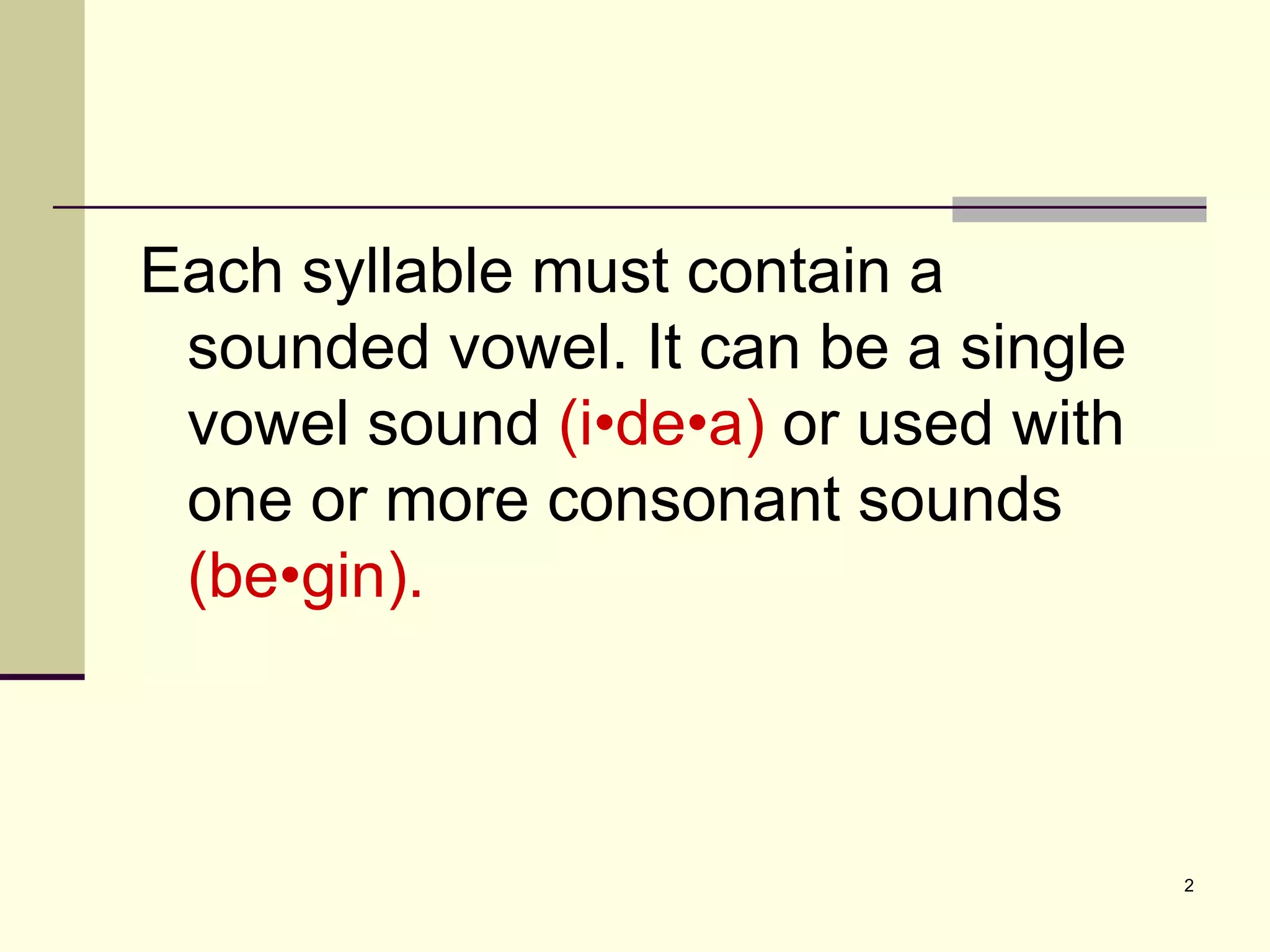
Each syllable must contain a sounded vowel. It can be a single vowel sound  (i•de•a)  or used with one or more consonant sounds  (be•gin).
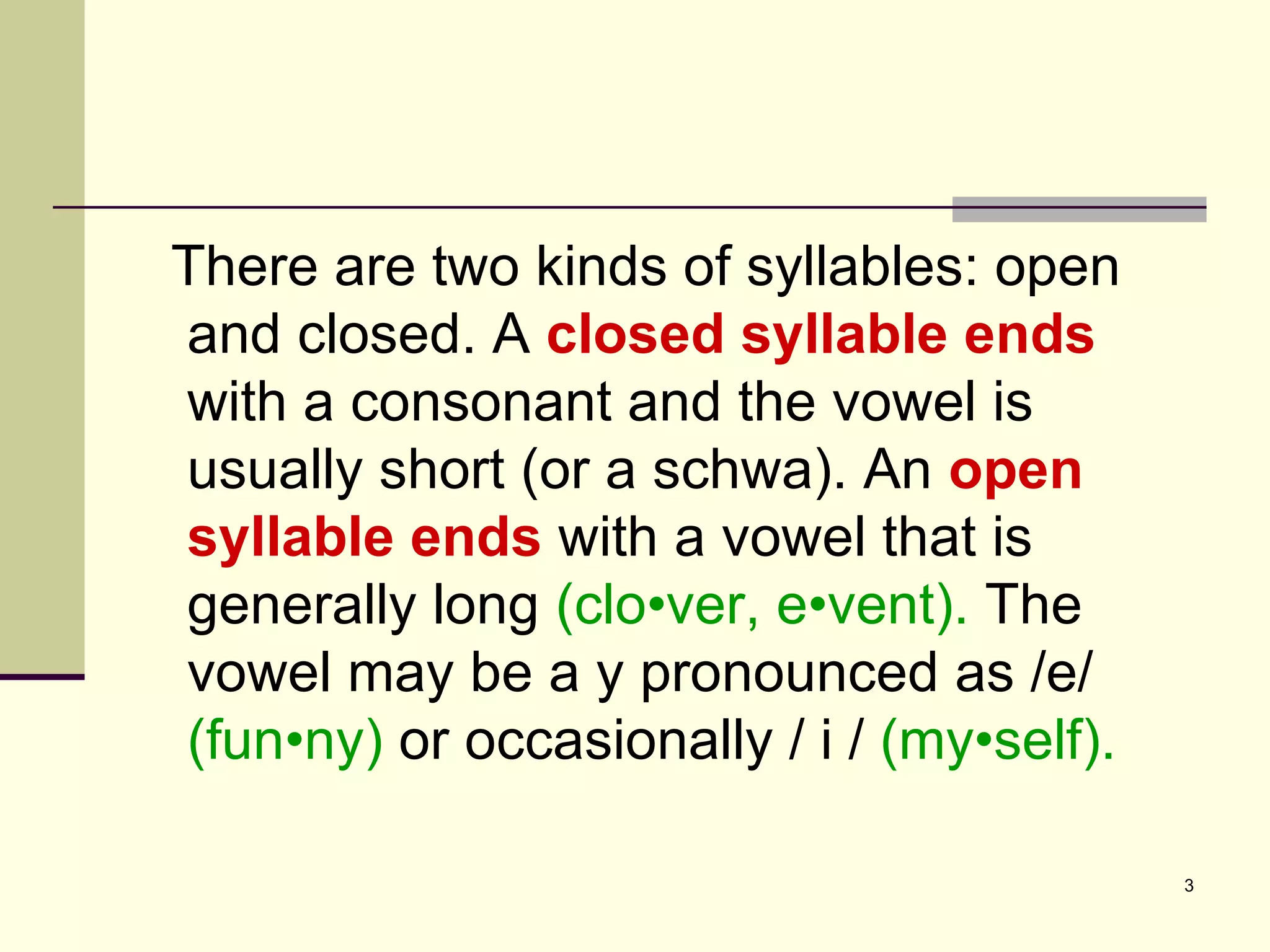
There are two kinds of syllables: open and closed. A  closed syllable ends  with a consonant and the vowel is usually short (or a schwa). An  open syllable ends  with a vowel that is generally long  (clo•ver, e•vent).  The vowel may be a y pronounced as /e/  (fun•ny)  or occasionally / i /  (my•self).
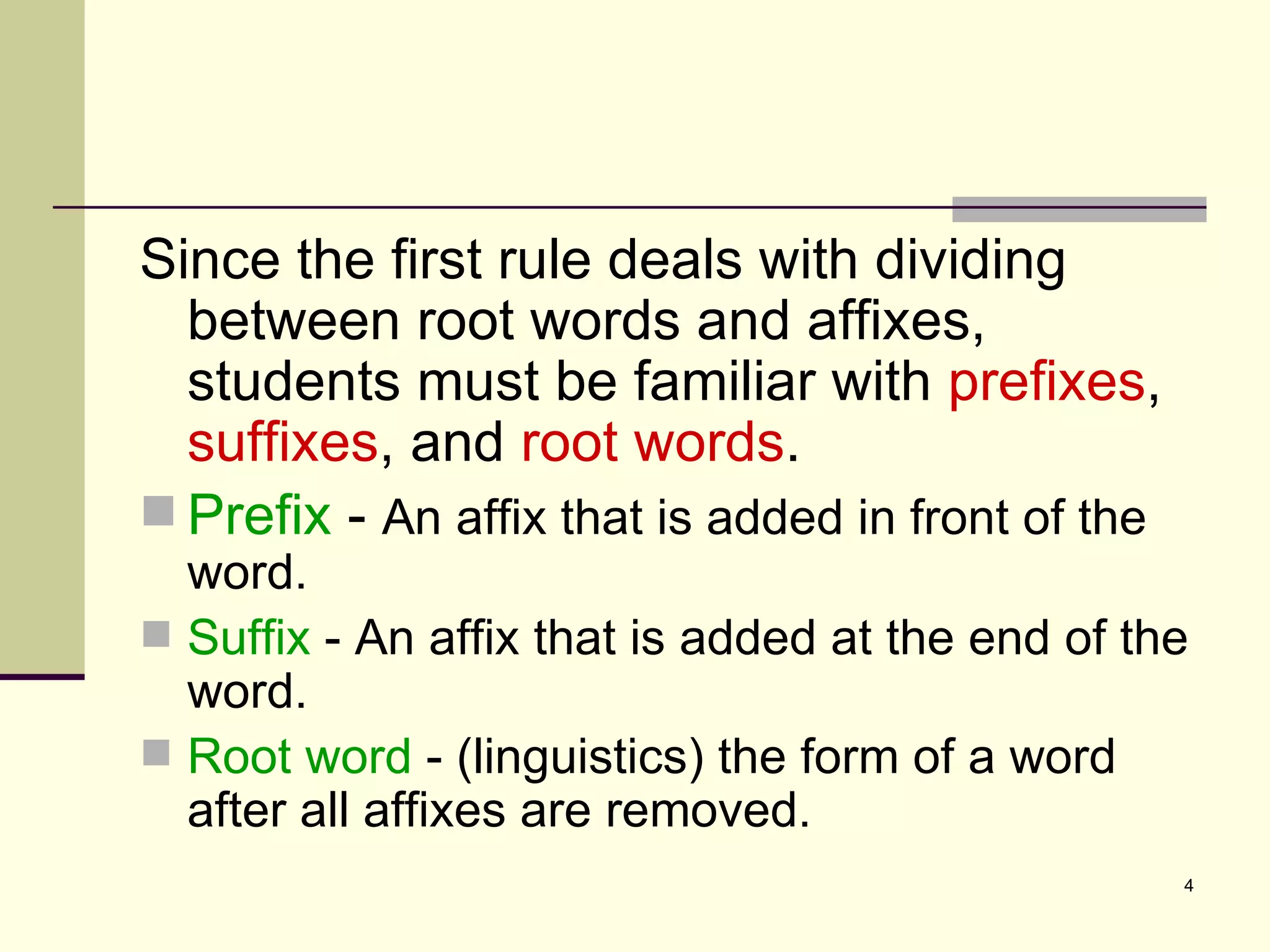
Since the first rule deals with dividing between root words and affixes, students must be familiar with  prefixes ,  suffixes , and  root words . Prefix  -  An affix that is added in front of the word. Suffix  - An affix that is added at the end of the word. Root word  - (linguistics) the form of a word after all affixes are removed.
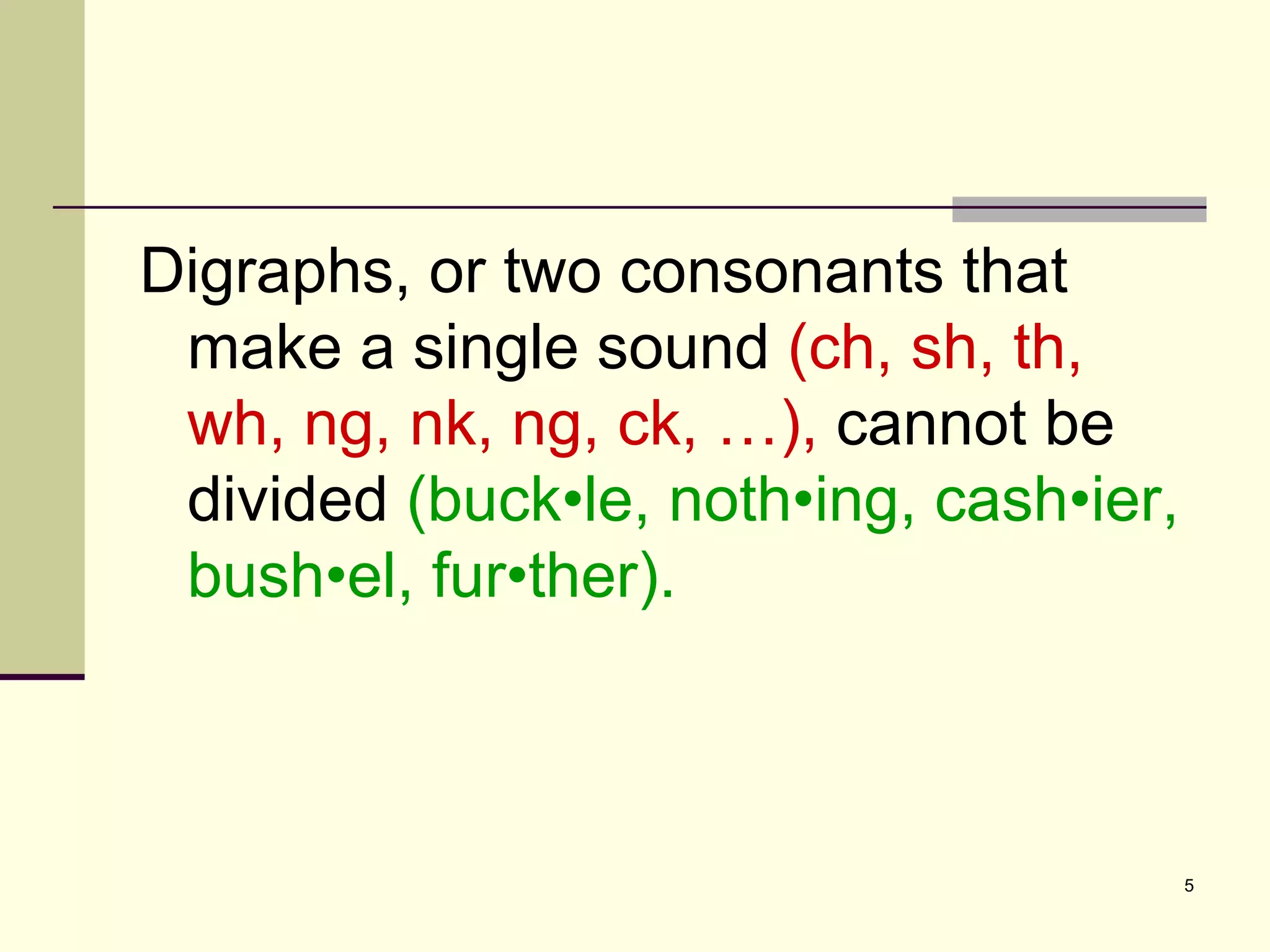
Digraphs, or two consonants that make a single sound  (ch, sh, th, wh, ng, nk, ng, ck, …),  cannot be divided  (buck•le, noth•ing, cash•ier, bush•el, fur•ther).
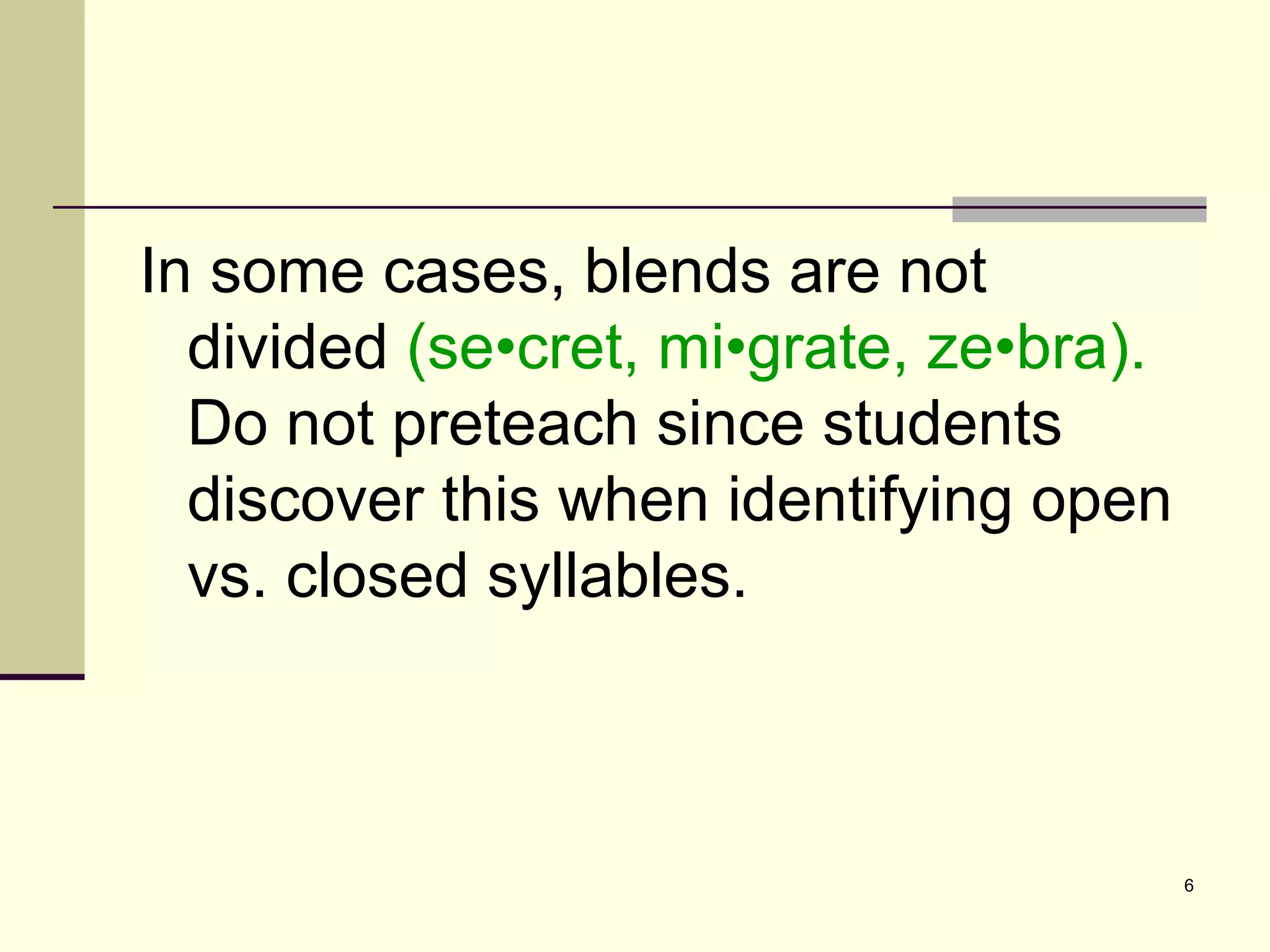
In some cases, blends are not divided  (se•cret, mi•grate, ze•bra).  Do not preteach since students discover this when identifying open vs. closed syllables.
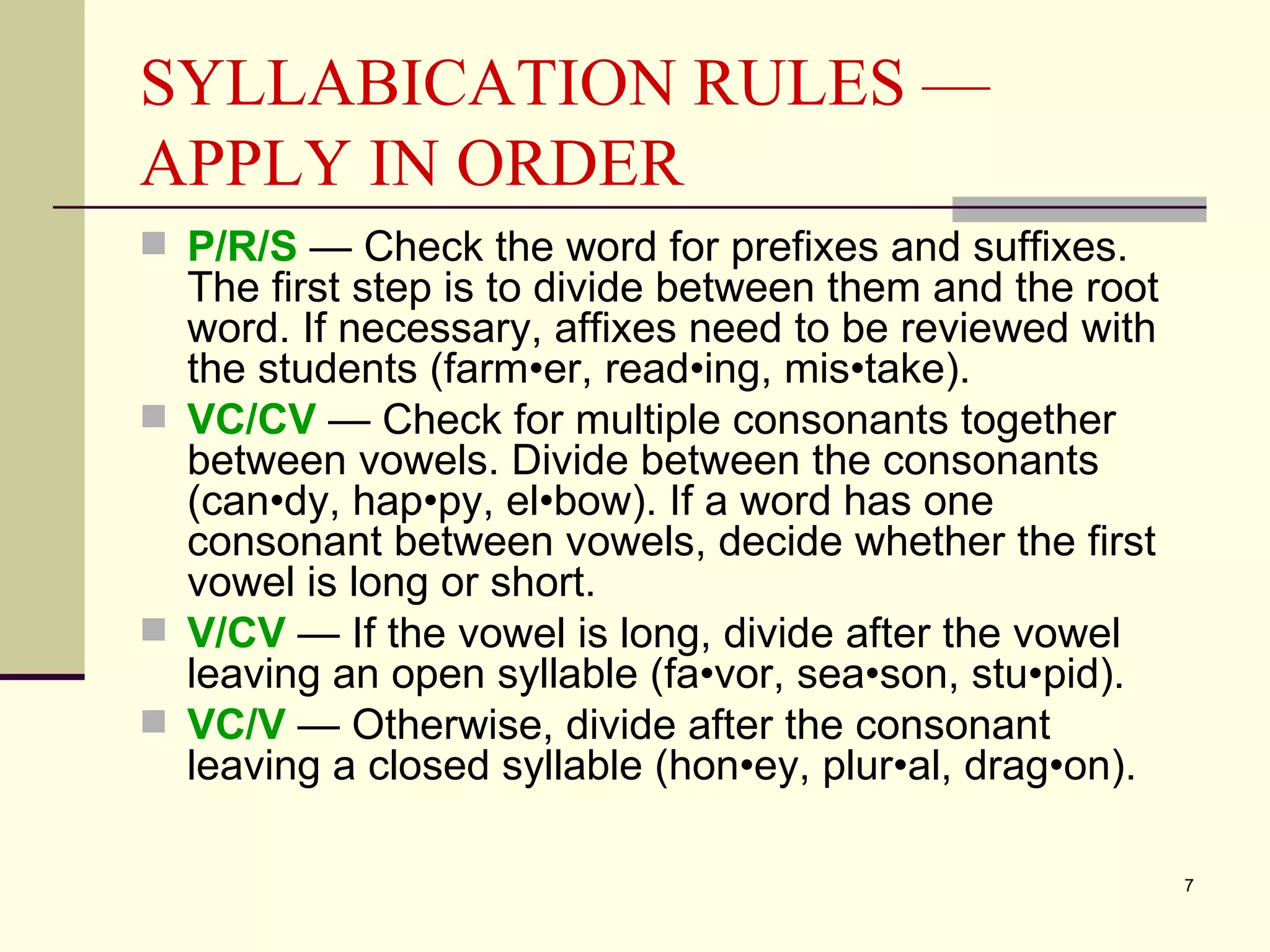
SYLLABICATION RULES — APPLY IN ORDER P/R/S   — Check the word for prefixes and suffixes. The first step is to divide between them and the root word. If necessary, affixes need to be reviewed with the students (farm•er, read•ing, mis•take). VC/CV  — Check for multiple consonants together between vowels. Divide between the consonants (can•dy, hap•py, el•bow). If a word has one consonant between vowels, decide whether the first vowel is long or short. V/CV   — If the vowel is long, divide after the vowel leaving an open syllable (fa•vor, sea•son, stu•pid). VC/V   — Otherwise, divide after the consonant leaving a closed syllable (hon•ey, plur•al, drag•on).

Syllabication Rules

  • 1.
    Syllabication Rules Createdby Jenna for English Sharing Experience
  • 2.
    Each syllable mustcontain a sounded vowel. It can be a single vowel sound (i•de•a) or used with one or more consonant sounds (be•gin).
  • 3.
    There are twokinds of syllables: open and closed. A closed syllable ends with a consonant and the vowel is usually short (or a schwa). An open syllable ends with a vowel that is generally long (clo•ver, e•vent). The vowel may be a y pronounced as /e/ (fun•ny) or occasionally / i / (my•self).
  • 4.
    Since the firstrule deals with dividing between root words and affixes, students must be familiar with prefixes , suffixes , and root words . Prefix - An affix that is added in front of the word. Suffix - An affix that is added at the end of the word. Root word - (linguistics) the form of a word after all affixes are removed.
  • 5.
    Digraphs, or twoconsonants that make a single sound (ch, sh, th, wh, ng, nk, ng, ck, …), cannot be divided (buck•le, noth•ing, cash•ier, bush•el, fur•ther).
  • 6.
    In some cases,blends are not divided (se•cret, mi•grate, ze•bra). Do not preteach since students discover this when identifying open vs. closed syllables.
  • 7.
    SYLLABICATION RULES —APPLY IN ORDER P/R/S — Check the word for prefixes and suffixes. The first step is to divide between them and the root word. If necessary, affixes need to be reviewed with the students (farm•er, read•ing, mis•take). VC/CV — Check for multiple consonants together between vowels. Divide between the consonants (can•dy, hap•py, el•bow). If a word has one consonant between vowels, decide whether the first vowel is long or short. V/CV — If the vowel is long, divide after the vowel leaving an open syllable (fa•vor, sea•son, stu•pid). VC/V — Otherwise, divide after the consonant leaving a closed syllable (hon•ey, plur•al, drag•on).