NCM 109- Care of Mother
and Child at Risk or with
Problems
(Acute and Chronic)-LECTURE
Wesleyan University –Philippines
Cabanatuan City
CONAMS
Jhonee Balmeo
Instructor
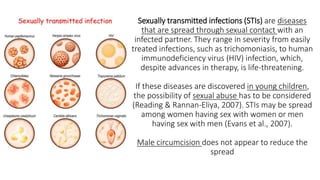
Sexually transmitted infections (STIs) are diseases
that are spread through sexual contact with an
infected partner. They range in severity from easily
treated infections, such as trichomoniasis, to human
immunodeficiency virus (HIV) infection, which,
despite advances in therapy, is life-threatening.
If these diseases are discovered in young children,
the possibility of sexual abuse has to be considered
(Reading & Rannan-Eliya, 2007). STIs may be spread
among women having sex with women or men
having sex with men (Evans et al., 2007).
Male circumcision does not appear to reduce the
spread
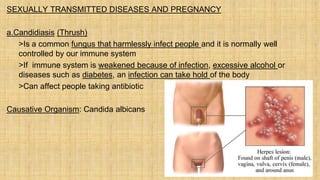
SEXUALLY TRANSMITTED DISEASES AND PREGNANCY
a.Candidiasis (Thrush)
 >Is a common fungus that harmlessly infect people and it is normally well
controlled by our immune system
 >If immune system is weakened because of infection, excessive alcohol or
diseases such as diabetes, an infection can take hold of the body
 >Can affect people taking antibiotic
Causative Organism: Candida albicans
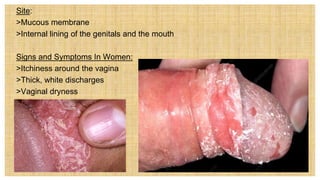
Site:
 >Mucous membrane
 >Internal lining of the genitals and the mouth
Signs and Symptoms In Women:
 >Itchiness around the vagina
 >Thick, white discharges
 >Vaginal dryness
Site:
 >Mucous membrane
 >Internal lining of the genitals and the mouth
Signs and Symptoms In Women:
 >Itchiness around the vagina
 >Thick, white discharges
 >Vaginal dryness
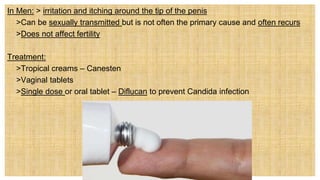
In Men: > irritation and itching around the tip of the penis
• >Can be sexually transmitted but is not often the primary cause and often recurs
• >Does not affect fertility
Treatment:
 >Tropical creams – Canesten
 >Vaginal tablets
 >Single dose or oral tablet – Diflucan to prevent Candida infection
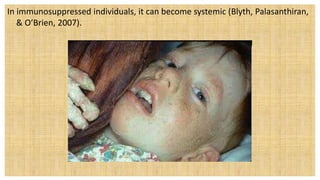
In immunosuppressed individuals, it can become systemic (Blyth, Palasanthiran,
& O’Brien, 2007).
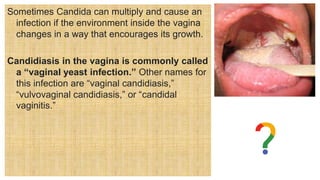
Sometimes Candida can multiply and cause an
infection if the environment inside the vagina
changes in a way that encourages its growth.
Candidiasis in the vagina is commonly called
a “vaginal yeast infection.” Other names for
this infection are “vaginal candidiasis,”
“vulvovaginal candidiasis,” or “candidal
vaginitis.”
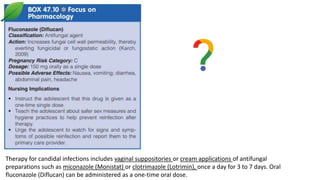
Therapy for candidal infections includes vaginal suppositories or cream applications of antifungal
preparations such as miconazole (Monistat) or clotrimazole (Lotrimin), once a day for 3 to 7 days. Oral
fluconazole (Diflucan) can be administered as a one-time oral dose.
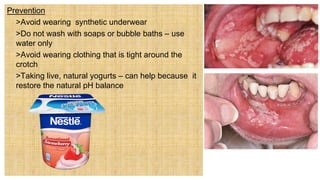
Prevention
 >Avoid wearing synthetic underwear
 >Do not wash with soaps or bubble baths – use
water only
 >Avoid wearing clothing that is tight around the
crotch
 >Taking live, natural yogurts – can help because it
restore the natural pH balance
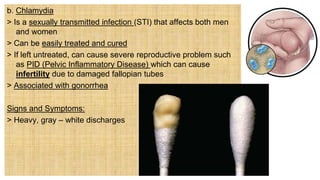
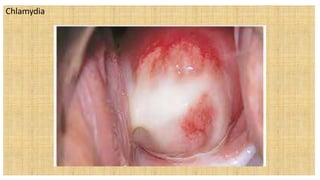
b. Chlamydia
> Is a sexually transmitted infection (STI) that affects both men
and women
> Can be easily treated and cured
> If left untreated, can cause severe reproductive problem such
as PID (Pelvic Inflammatory Disease) which can cause
infertility due to damaged fallopian tubes
> Associated with gonorrhea
Signs and Symptoms:
> Heavy, gray – white discharges
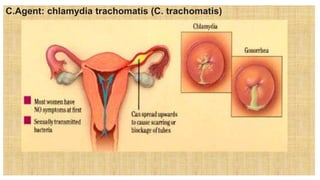
C.Agent: chlamydia trachomatis (C. trachomatis)
Chlamydia
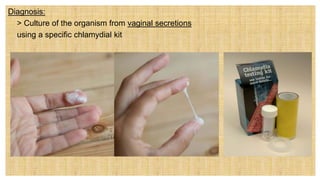
Diagnosis:
 > Culture of the organism from vaginal secretions
 using a specific chlamydial kit
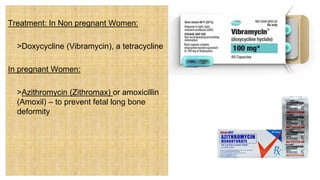
Treatment: In Non pregnant Women:
 >Doxycycline (Vibramycin), a tetracycline
In pregnant Women:
 >Azithromycin (Zithromax) or amoxicillin
(Amoxil) – to prevent fetal long bone
deformity
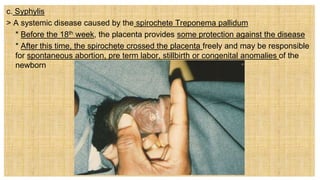
c. Syphylis
> A systemic disease caused by the spirochete Treponema pallidum
 * Before the 18th week, the placenta provides some protection against the disease
 * After this time, the spirochete crossed the placenta freely and may be responsible
for spontaneous abortion, pre term labor, stillbirth or congenital anomalies of the
newborn
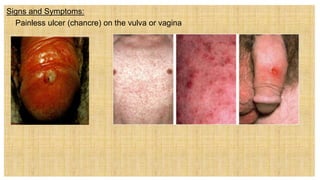
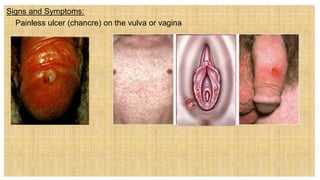
Signs and Symptoms:
 Painless ulcer (chancre) on the vulva or vagina
Signs and Symptoms:
 Painless ulcer (chancre) on the vulva or vagina
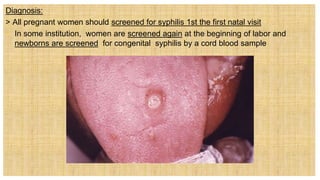
Diagnosis:
> All pregnant women should screened for syphilis 1st the first natal visit
 In some institution, women are screened again at the beginning of labor and
newborns are screened for congenital syphilis by a cord blood sample
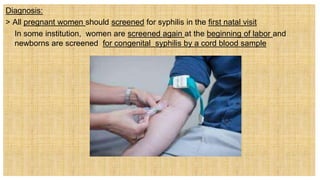
Diagnosis:
> All pregnant women should screened for syphilis in the first natal visit
 In some institution, women are screened again at the beginning of labor and
newborns are screened for congenital syphilis by a cord blood sample
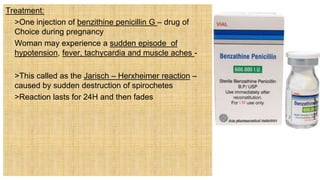
Treatment:
 >One injection of benzithine penicillin G – drug of
Choice during pregnancy
 Woman may experience a sudden episode of
hypotension, fever, tachycardia and muscle aches -
 >This called as the Jarisch – Herxheimer reaction –
caused by sudden destruction of spirochetes
 >Reaction lasts for 24H and then fades
d. Human Pappiloma Virus Infection
 >Fibrous overgrowth on the external vulva
 >Lesions has no effect on the fetus during pregnancy, but if it obstruct the birth
canal, C/S is recommended
 >It is a serious condition for the mother because it can cause cervical cancer later
in life
 >If with one infection, woman should have a yearly Pa test for the rest of her life
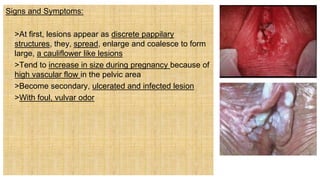
Signs and Symptoms:
 >At first, lesions appear as discrete pappilary
structures, they, spread, enlarge and coalesce to form
large, a cauliflower like lesions
 >Tend to increase in size during pregnancy because of
high vascular flow in the pelvic area
 >Become secondary, ulcerated and infected lesion
 >With foul, vulvar odor
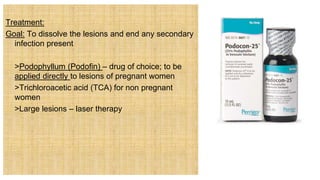
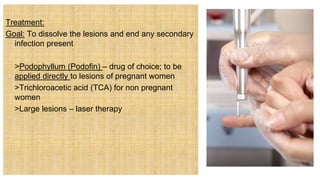
Treatment:
Goal: To dissolve the lesions and end any secondary
infection present
 >Podophyllum (Podofin) – drug of choice; to be
applied directly to lesions of pregnant women
 >Trichloroacetic acid (TCA) for non pregnant
women
 >Large lesions – laser therapy
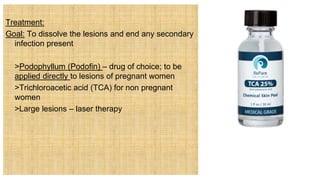
Treatment:
Goal: To dissolve the lesions and end any secondary
infection present
 >Podophyllum (Podofin) – drug of choice; to be
applied directly to lesions of pregnant women
 >Trichloroacetic acid (TCA) for non pregnant
women
 >Large lesions – laser therapy
Treatment:
Goal: To dissolve the lesions and end any secondary
infection present
 >Podophyllum (Podofin) – drug of choice; to be
applied directly to lesions of pregnant women
 >Trichloroacetic acid (TCA) for non pregnant
women
 >Large lesions – laser therapy
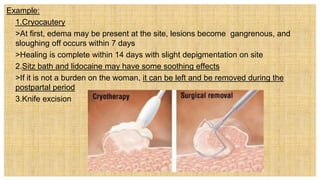
Example:
• 1.Cryocautery
 >At first, edema may be present at the site, lesions become gangrenous, and
sloughing off occurs within 7 days
 >Healing is complete within 14 days with slight depigmentation on site
 2.Sitz bath and lidocaine may have some soothing effects
 >If it is not a burden on the woman, it can be left and be removed during the
postpartal period
 3.Knife excision
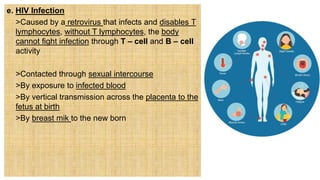
e. HIV Infection
 >Caused by a retrovirus that infects and disables T
lymphocytes, without T lymphocytes, the body
cannot fight infection through T – cell and B – cell
activity
 >Contacted through sexual intercourse
 >By exposure to infected blood
 >By vertical transmission across the placenta to the
fetus at birth
 >By breast mik to the new born
During pregnancy, HIV can pass
through the placenta and infect
the fetus.
During labor and delivery, the baby
may be exposed to the virus from a
woman's blood and other fluids.
When a woman goes into labor, the
amniotic sac breaks (her water
breaks). Once this occurs, the risk of
transmitting HIV to the baby
increases.
https://www.acog.org/womens-health/faqs/hiv-and-pregnancy
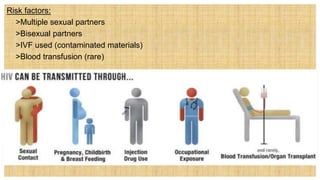
Risk factors:
 >Multiple sexual partners
 >Bisexual partners
 >IVF used (contaminated materials)
 >Blood transfusion (rare)
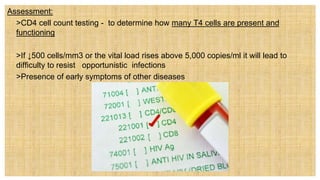
Assessment:
 >CD4 cell count testing - to determine how many T4 cells are present and
functioning
 >If ↓500 cells/mm3 or the vital load rises above 5,000 copies/ml it will lead to
difficulty to resist opportunistic infections
 >Presence of early symptoms of other diseases
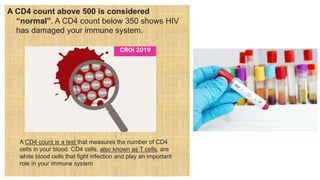
A CD4 count above 500 is considered
“normal”. A CD4 count below 350 shows HIV
has damaged your immune system.
A CD4 count is a test that measures the number of CD4
cells in your blood. CD4 cells, also known as T cells, are
white blood cells that fight infection and play an important
role in your immune system
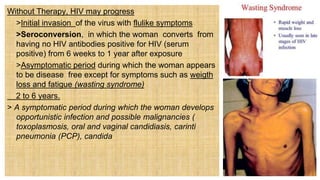
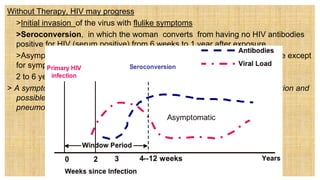
Without Therapy, HIV may progress
 >Initial invasion of the virus with flulike symptoms
 >Seroconversion, in which the woman converts from
having no HIV antibodies positive for HIV (serum
positive) from 6 weeks to 1 year after exposure
 >Asymptomatic period during which the woman appears
to be disease free except for symptoms such as weigth
loss and fatigue (wasting syndrome)
2 to 6 years.
> A symptomatic period during which the woman develops
opportunistic infection and possible malignancies (
toxoplasmosis, oral and vaginal candidiasis, carinti
pneumonia (PCP), candida
Without Therapy, HIV may progress
 >Initial invasion of the virus with flulike symptoms
 >Seroconversion, in which the woman converts from having no HIV antibodies
positive for HIV (serum positive) from 6 weeks to 1 year after exposure
 >Asymptomatic period during which the woman appears to be disease free except
for symptoms such as weigth loss and fatigue ( wasting syndrome)
2 to 6 years.
> A symptomatic period during which the woman develops opportunistic infection and
possible malignancies ( toxoplasmosis, oral and vaginal candidiasis, carinti
pneumonia (PCP), candida
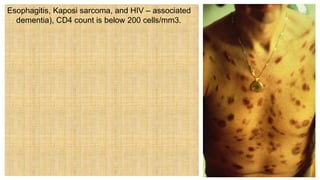
Esophagitis, Kaposi sarcoma, and HIV – associated
dementia), CD4 count is below 200 cells/mm3.
Esophagitis, Kaposi sarcoma, and HIV – associated
dementia), CD4 count is below 200 cells/mm3.
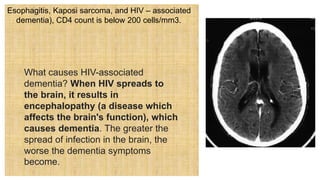
What causes HIV-associated
dementia? When HIV spreads to
the brain, it results in
encephalopathy (a disease which
affects the brain's function), which
causes dementia. The greater the
spread of infection in the brain, the
worse the dementia symptoms
become.
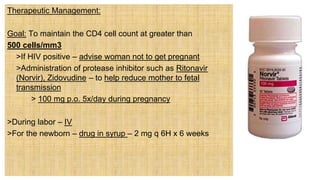
Therapeutic Management:
Goal: To maintain the CD4 cell count at greater than
500 cells/mm3
 >If HIV positive – advise woman not to get pregnant
 >Administration of protease inhibitor such as Ritonavir
(Norvir), Zidovudine – to help reduce mother to fetal
transmission
> 100 mg p.o. 5x/day during pregnancy
>During labor – IV
>For the newborn – drug in syrup – 2 mg q 6H x 6 weeks
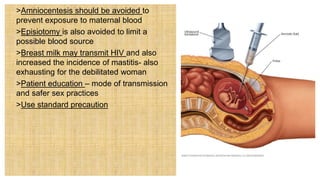
 >Amniocentesis should be avoided to
prevent exposure to maternal blood
 >Episiotomy is also avoided to limit a
possible blood source
 >Breast milk may transmit HIV and also
increased the incidence of mastitis- also
exhausting for the debilitated woman
 >Patient education – mode of transmission
and safer sex practices
 >Use standard precaution
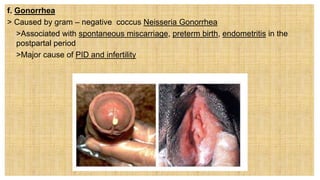
f. Gonorrhea
> Caused by gram – negative coccus Neisseria Gonorrhea
 >Associated with spontaneous miscarriage, preterm birth, endometritis in the
postpartal period
 >Major cause of PID and infertility
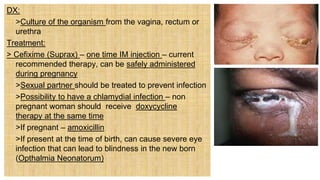
DX:
 >Culture of the organism from the vagina, rectum or
urethra
Treatment:
> Cefixime (Suprax) – one time IM injection – current
recommended therapy, can be safely administered
during pregnancy
 >Sexual partner should be treated to prevent infection
 >Possibility to have a chlamydial infection – non
pregnant woman should receive doxycycline
therapy at the same time
 >If pregnant – amoxicillin
 >If present at the time of birth, can cause severe eye
infection that can lead to blindness in the new born
(Opthalmia Neonatorum)
Signs and Symptoms:
 >Yellow – green vaginal discharge
 >Woman may be asymptomatic
 >Male partner usually has severe symptoms of pain on urination and a purulent
yellow discharge
STIs are most common in which age
group?
• A. Teens and young adults up to age 24
• B. People ages 30 to 45
• C. People 60 and older
• D. All of the above.
As long as a person has no
symptoms of an STI, they:
A. Cannot pass on an STI
B. Don't have an STI
C. A and B
D. None of the above.
Which of these is a health problem that
can be caused by STIs in women?
A. Pelvic inflammatory disease (PID)
B. Ectopic pregnancy
C. Higher risk for cervical cancer
D. All of the above.
Which major organ can be affected by
untreated syphilis?
A. Heart
B. Brain
C. Liver
D. A and B.
Done!

week 11-sexually-transmitted-disease.pptx

  • 1.
    NCM 109- Careof Mother and Child at Risk or with Problems (Acute and Chronic)-LECTURE Wesleyan University –Philippines Cabanatuan City CONAMS Jhonee Balmeo Instructor
  • 3.
    Sexually transmitted infections(STIs) are diseases that are spread through sexual contact with an infected partner. They range in severity from easily treated infections, such as trichomoniasis, to human immunodeficiency virus (HIV) infection, which, despite advances in therapy, is life-threatening. If these diseases are discovered in young children, the possibility of sexual abuse has to be considered (Reading & Rannan-Eliya, 2007). STIs may be spread among women having sex with women or men having sex with men (Evans et al., 2007). Male circumcision does not appear to reduce the spread
  • 4.
    SEXUALLY TRANSMITTED DISEASESAND PREGNANCY a.Candidiasis (Thrush)  >Is a common fungus that harmlessly infect people and it is normally well controlled by our immune system  >If immune system is weakened because of infection, excessive alcohol or diseases such as diabetes, an infection can take hold of the body  >Can affect people taking antibiotic Causative Organism: Candida albicans
  • 5.
    Site:  >Mucous membrane >Internal lining of the genitals and the mouth Signs and Symptoms In Women:  >Itchiness around the vagina  >Thick, white discharges  >Vaginal dryness
  • 6.
    Site:  >Mucous membrane >Internal lining of the genitals and the mouth Signs and Symptoms In Women:  >Itchiness around the vagina  >Thick, white discharges  >Vaginal dryness
  • 7.
    In Men: >irritation and itching around the tip of the penis • >Can be sexually transmitted but is not often the primary cause and often recurs • >Does not affect fertility Treatment:  >Tropical creams – Canesten  >Vaginal tablets  >Single dose or oral tablet – Diflucan to prevent Candida infection
  • 8.
    In immunosuppressed individuals,it can become systemic (Blyth, Palasanthiran, & O’Brien, 2007).
  • 9.
    Sometimes Candida canmultiply and cause an infection if the environment inside the vagina changes in a way that encourages its growth. Candidiasis in the vagina is commonly called a “vaginal yeast infection.” Other names for this infection are “vaginal candidiasis,” “vulvovaginal candidiasis,” or “candidal vaginitis.”
  • 10.
    Therapy for candidalinfections includes vaginal suppositories or cream applications of antifungal preparations such as miconazole (Monistat) or clotrimazole (Lotrimin), once a day for 3 to 7 days. Oral fluconazole (Diflucan) can be administered as a one-time oral dose.
  • 11.
    Prevention  >Avoid wearingsynthetic underwear  >Do not wash with soaps or bubble baths – use water only  >Avoid wearing clothing that is tight around the crotch  >Taking live, natural yogurts – can help because it restore the natural pH balance
  • 12.
    b. Chlamydia > Isa sexually transmitted infection (STI) that affects both men and women > Can be easily treated and cured > If left untreated, can cause severe reproductive problem such as PID (Pelvic Inflammatory Disease) which can cause infertility due to damaged fallopian tubes > Associated with gonorrhea Signs and Symptoms: > Heavy, gray – white discharges
  • 13.
  • 14.
  • 15.
    Diagnosis:  > Cultureof the organism from vaginal secretions  using a specific chlamydial kit
  • 16.
    Treatment: In Nonpregnant Women:  >Doxycycline (Vibramycin), a tetracycline In pregnant Women:  >Azithromycin (Zithromax) or amoxicillin (Amoxil) – to prevent fetal long bone deformity
  • 17.
    c. Syphylis > Asystemic disease caused by the spirochete Treponema pallidum  * Before the 18th week, the placenta provides some protection against the disease  * After this time, the spirochete crossed the placenta freely and may be responsible for spontaneous abortion, pre term labor, stillbirth or congenital anomalies of the newborn
  • 18.
    Signs and Symptoms: Painless ulcer (chancre) on the vulva or vagina
  • 19.
    Signs and Symptoms: Painless ulcer (chancre) on the vulva or vagina
  • 20.
    Diagnosis: > All pregnantwomen should screened for syphilis 1st the first natal visit  In some institution, women are screened again at the beginning of labor and newborns are screened for congenital syphilis by a cord blood sample
  • 21.
    Diagnosis: > All pregnantwomen should screened for syphilis in the first natal visit  In some institution, women are screened again at the beginning of labor and newborns are screened for congenital syphilis by a cord blood sample
  • 22.
    Treatment:  >One injectionof benzithine penicillin G – drug of Choice during pregnancy  Woman may experience a sudden episode of hypotension, fever, tachycardia and muscle aches -  >This called as the Jarisch – Herxheimer reaction – caused by sudden destruction of spirochetes  >Reaction lasts for 24H and then fades
  • 23.
    d. Human PappilomaVirus Infection  >Fibrous overgrowth on the external vulva  >Lesions has no effect on the fetus during pregnancy, but if it obstruct the birth canal, C/S is recommended  >It is a serious condition for the mother because it can cause cervical cancer later in life  >If with one infection, woman should have a yearly Pa test for the rest of her life
  • 24.
    Signs and Symptoms: >At first, lesions appear as discrete pappilary structures, they, spread, enlarge and coalesce to form large, a cauliflower like lesions  >Tend to increase in size during pregnancy because of high vascular flow in the pelvic area  >Become secondary, ulcerated and infected lesion  >With foul, vulvar odor
  • 25.
    Treatment: Goal: To dissolvethe lesions and end any secondary infection present  >Podophyllum (Podofin) – drug of choice; to be applied directly to lesions of pregnant women  >Trichloroacetic acid (TCA) for non pregnant women  >Large lesions – laser therapy
  • 26.
    Treatment: Goal: To dissolvethe lesions and end any secondary infection present  >Podophyllum (Podofin) – drug of choice; to be applied directly to lesions of pregnant women  >Trichloroacetic acid (TCA) for non pregnant women  >Large lesions – laser therapy
  • 27.
    Treatment: Goal: To dissolvethe lesions and end any secondary infection present  >Podophyllum (Podofin) – drug of choice; to be applied directly to lesions of pregnant women  >Trichloroacetic acid (TCA) for non pregnant women  >Large lesions – laser therapy
  • 28.
    Example: • 1.Cryocautery  >Atfirst, edema may be present at the site, lesions become gangrenous, and sloughing off occurs within 7 days  >Healing is complete within 14 days with slight depigmentation on site  2.Sitz bath and lidocaine may have some soothing effects  >If it is not a burden on the woman, it can be left and be removed during the postpartal period  3.Knife excision
  • 29.
    e. HIV Infection >Caused by a retrovirus that infects and disables T lymphocytes, without T lymphocytes, the body cannot fight infection through T – cell and B – cell activity  >Contacted through sexual intercourse  >By exposure to infected blood  >By vertical transmission across the placenta to the fetus at birth  >By breast mik to the new born
  • 30.
    During pregnancy, HIVcan pass through the placenta and infect the fetus. During labor and delivery, the baby may be exposed to the virus from a woman's blood and other fluids. When a woman goes into labor, the amniotic sac breaks (her water breaks). Once this occurs, the risk of transmitting HIV to the baby increases. https://www.acog.org/womens-health/faqs/hiv-and-pregnancy
  • 31.
    Risk factors:  >Multiplesexual partners  >Bisexual partners  >IVF used (contaminated materials)  >Blood transfusion (rare)
  • 32.
    Assessment:  >CD4 cellcount testing - to determine how many T4 cells are present and functioning  >If ↓500 cells/mm3 or the vital load rises above 5,000 copies/ml it will lead to difficulty to resist opportunistic infections  >Presence of early symptoms of other diseases
  • 33.
    A CD4 countabove 500 is considered “normal”. A CD4 count below 350 shows HIV has damaged your immune system. A CD4 count is a test that measures the number of CD4 cells in your blood. CD4 cells, also known as T cells, are white blood cells that fight infection and play an important role in your immune system
  • 34.
    Without Therapy, HIVmay progress  >Initial invasion of the virus with flulike symptoms  >Seroconversion, in which the woman converts from having no HIV antibodies positive for HIV (serum positive) from 6 weeks to 1 year after exposure  >Asymptomatic period during which the woman appears to be disease free except for symptoms such as weigth loss and fatigue (wasting syndrome) 2 to 6 years. > A symptomatic period during which the woman develops opportunistic infection and possible malignancies ( toxoplasmosis, oral and vaginal candidiasis, carinti pneumonia (PCP), candida
  • 35.
    Without Therapy, HIVmay progress  >Initial invasion of the virus with flulike symptoms  >Seroconversion, in which the woman converts from having no HIV antibodies positive for HIV (serum positive) from 6 weeks to 1 year after exposure  >Asymptomatic period during which the woman appears to be disease free except for symptoms such as weigth loss and fatigue ( wasting syndrome) 2 to 6 years. > A symptomatic period during which the woman develops opportunistic infection and possible malignancies ( toxoplasmosis, oral and vaginal candidiasis, carinti pneumonia (PCP), candida
  • 36.
    Esophagitis, Kaposi sarcoma,and HIV – associated dementia), CD4 count is below 200 cells/mm3.
  • 37.
    Esophagitis, Kaposi sarcoma,and HIV – associated dementia), CD4 count is below 200 cells/mm3. What causes HIV-associated dementia? When HIV spreads to the brain, it results in encephalopathy (a disease which affects the brain's function), which causes dementia. The greater the spread of infection in the brain, the worse the dementia symptoms become.
  • 38.
    Therapeutic Management: Goal: Tomaintain the CD4 cell count at greater than 500 cells/mm3  >If HIV positive – advise woman not to get pregnant  >Administration of protease inhibitor such as Ritonavir (Norvir), Zidovudine – to help reduce mother to fetal transmission > 100 mg p.o. 5x/day during pregnancy >During labor – IV >For the newborn – drug in syrup – 2 mg q 6H x 6 weeks
  • 39.
     >Amniocentesis shouldbe avoided to prevent exposure to maternal blood  >Episiotomy is also avoided to limit a possible blood source  >Breast milk may transmit HIV and also increased the incidence of mastitis- also exhausting for the debilitated woman  >Patient education – mode of transmission and safer sex practices  >Use standard precaution
  • 40.
    f. Gonorrhea > Causedby gram – negative coccus Neisseria Gonorrhea  >Associated with spontaneous miscarriage, preterm birth, endometritis in the postpartal period  >Major cause of PID and infertility
  • 41.
    DX:  >Culture ofthe organism from the vagina, rectum or urethra Treatment: > Cefixime (Suprax) – one time IM injection – current recommended therapy, can be safely administered during pregnancy  >Sexual partner should be treated to prevent infection  >Possibility to have a chlamydial infection – non pregnant woman should receive doxycycline therapy at the same time  >If pregnant – amoxicillin  >If present at the time of birth, can cause severe eye infection that can lead to blindness in the new born (Opthalmia Neonatorum)
  • 42.
    Signs and Symptoms: >Yellow – green vaginal discharge  >Woman may be asymptomatic  >Male partner usually has severe symptoms of pain on urination and a purulent yellow discharge
  • 43.
    STIs are mostcommon in which age group? • A. Teens and young adults up to age 24 • B. People ages 30 to 45 • C. People 60 and older • D. All of the above.
  • 44.
    As long asa person has no symptoms of an STI, they: A. Cannot pass on an STI B. Don't have an STI C. A and B D. None of the above.
  • 45.
    Which of theseis a health problem that can be caused by STIs in women? A. Pelvic inflammatory disease (PID) B. Ectopic pregnancy C. Higher risk for cervical cancer D. All of the above.
  • 46.
    Which major organcan be affected by untreated syphilis? A. Heart B. Brain C. Liver D. A and B.
  • 47.

Editor's Notes

  • #22 Syphilis can be diagnosed by testing samples of: Blood. Blood tests can confirm the presence of antibodies that the body produces to fight infection. The antibodies to the syphilis-causing bacteria remain in your body for years, so the test can be used to determine a current or past infection.
  • #23 The reaction occurs within 24 hours of antibiotic treatment of spirochete infections, including syphilis, leptospirosis, Lyme disease, and relapsing fever
  • #24 Papsmear test
  • #35 HIV seroconversion, specifically, is the time from HIV exposure, to infection, and to developing antibodies that can be detected by a test. This can take a few weeks and is sometimes called the window period
  • #36 HIV seroconversion, specifically, is the time from HIV exposure, to infection, and to developing antibodies that can be detected by a test. This can take a few weeks and is sometimes called the window period
  • #43 1% silver nitrate, 0.5% erythromycin ointment, or 1% tetracycline hydrochloride