THE
THORAX
AND THE
LUNGS
( P A R T 2 )
J H O N E E B A L M E O
BREATH SOUNDS
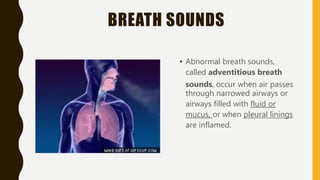
• Abnormal breath sounds,
called adventitious breath
sounds, occur when air passes
through narrowed airways or
airways filled with fluid or
mucus, or when pleural linings
are inflamed.
NORMAL BREATH SOUNDS
• Vesicular
Soft-intensity, low-pitched, “gentle sighing” sounds created by air
through smaller airways (bronchioles and alveoli)
• Broncho-vesicular
Moderate-intensity and moderate-pitched “blowing” sounds created by
air moving through larger airway (bronchi)
• Bronchial (tubular)
High-pitched, loud, “harsh” sounds created by air moving through the
trachea
ADVENTITIOUS BREATH SOUNDS
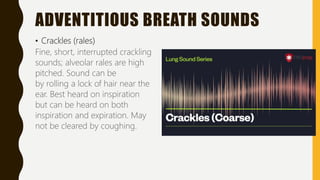
• Crackles (rales)
Fine, short, interrupted crackling
sounds; alveolar rales are high
pitched. Sound can be
by rolling a lock of hair near the
ear. Best heard on inspiration
but can be heard on both
inspiration and expiration. May
not be cleared by coughing.
ADVENTITIOUS BREATH SOUNDS
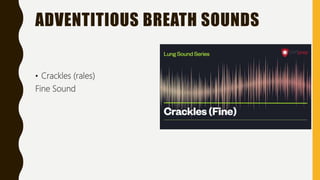
• Crackles (rales)
Fine Sound
ADVENTITIOUS BREATH SOUNDS
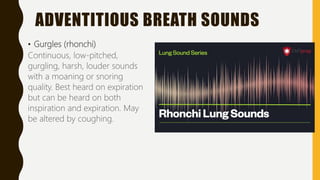
• Gurgles (rhonchi)
Continuous, low-pitched,
gurgling, harsh, louder sounds
with a moaning or snoring
quality. Best heard on expiration
but can be heard on both
inspiration and expiration. May
be altered by coughing.
ADVENTITIOUS BREATH SOUNDS
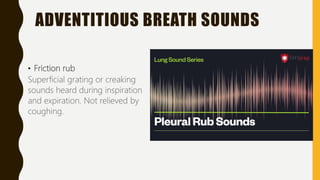
• Friction rub
Superficial grating or creaking
sounds heard during inspiration
and expiration. Not relieved by
coughing.
ADVENTITIOUS BREATH SOUNDS
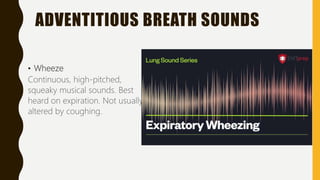
• Wheeze
Continuous, high-pitched,
squeaky musical sounds. Best
heard on expiration. Not usually
altered by coughing.
• References:
• Audrey Berman . . . [et al.]. – 9th ed. (2012) KOZIER & ERB’S Fundamentals of NURSING
Concepts, Process, and Practice.
• EMTprep (2021) Retrieved from
https://www.youtube.com/channel/UCpXn4ToUsD7OmjjH-bmaBjg

Lung assessment part 2 (Lung Sounds)

  • 1.
    THE THORAX AND THE LUNGS ( PA R T 2 ) J H O N E E B A L M E O
  • 2.
    BREATH SOUNDS • Abnormalbreath sounds, called adventitious breath sounds, occur when air passes through narrowed airways or airways filled with fluid or mucus, or when pleural linings are inflamed.
  • 3.
    NORMAL BREATH SOUNDS •Vesicular Soft-intensity, low-pitched, “gentle sighing” sounds created by air through smaller airways (bronchioles and alveoli) • Broncho-vesicular Moderate-intensity and moderate-pitched “blowing” sounds created by air moving through larger airway (bronchi) • Bronchial (tubular) High-pitched, loud, “harsh” sounds created by air moving through the trachea
  • 4.
    ADVENTITIOUS BREATH SOUNDS •Crackles (rales) Fine, short, interrupted crackling sounds; alveolar rales are high pitched. Sound can be by rolling a lock of hair near the ear. Best heard on inspiration but can be heard on both inspiration and expiration. May not be cleared by coughing.
  • 5.
    ADVENTITIOUS BREATH SOUNDS •Crackles (rales) Fine Sound
  • 6.
    ADVENTITIOUS BREATH SOUNDS •Gurgles (rhonchi) Continuous, low-pitched, gurgling, harsh, louder sounds with a moaning or snoring quality. Best heard on expiration but can be heard on both inspiration and expiration. May be altered by coughing.
  • 7.
    ADVENTITIOUS BREATH SOUNDS •Friction rub Superficial grating or creaking sounds heard during inspiration and expiration. Not relieved by coughing.
  • 8.
    ADVENTITIOUS BREATH SOUNDS •Wheeze Continuous, high-pitched, squeaky musical sounds. Best heard on expiration. Not usually altered by coughing.
  • 9.
    • References: • AudreyBerman . . . [et al.]. – 9th ed. (2012) KOZIER & ERB’S Fundamentals of NURSING Concepts, Process, and Practice. • EMTprep (2021) Retrieved from https://www.youtube.com/channel/UCpXn4ToUsD7OmjjH-bmaBjg