Jhonee Balmeo. RN
The THORAX and
The LUNGS
ALLPPT.com _ Free PowerPoint Templates, Diagrams and Charts
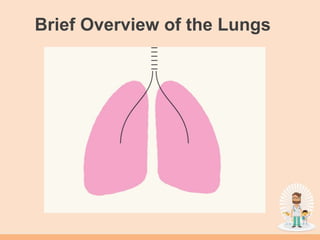
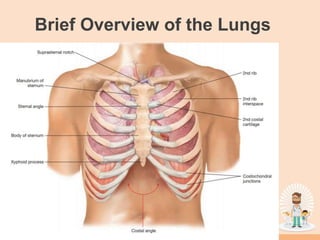
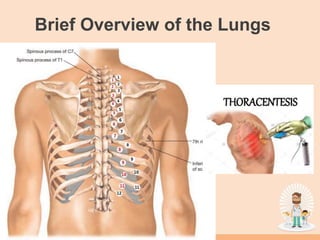
Brief Overview of the Lungs
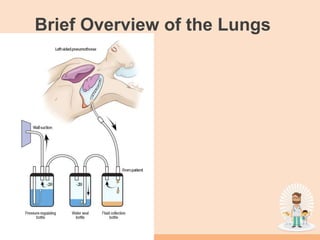
The Chest Thoracostomy tube
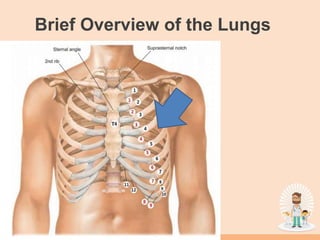
Brief Overview of the Lungs
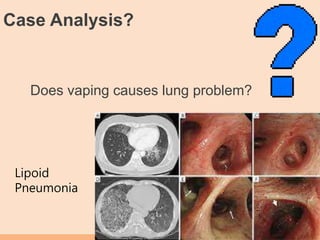
Case Analysis?
Does vaping causes lung problem?
Lipoid
Pneumonia
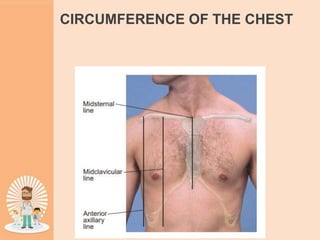
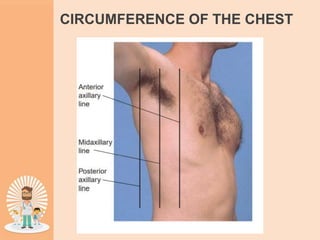
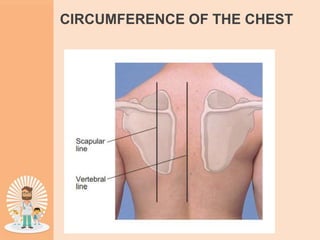
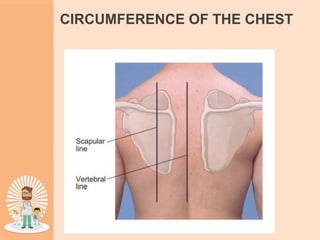
CIRCUMFERENCE OF THE CHEST
The Health History
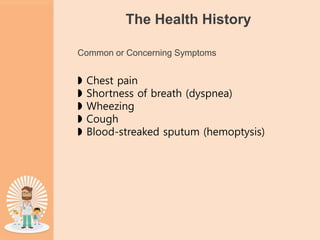
Common or Concerning Symptoms
◗ Chest pain
◗ Shortness of breath (dyspnea)
◗ Wheezing
◗ Cough
◗ Blood-streaked sputum (hemoptysis)
The Health History
Common or Concerning Symptoms
Chest Pain.
Complaints of chest pain or chest discomfort raise
concern about heart disease but often arise from
structures in the thorax and lungs as well.
To assess this symptom, you must pursue a dual
investigation of both thoracic and cardiac causes.
Case Presentation!
Heart attack and lung collapse’ pain?
The Health History
Chest Pain.
• Your initial questions should be as open-ended
as possible.
“Do you have any discomfort or
unpleasant feelings in your chest?”
• Ask the patient to point to location of the pain i
n the chest.
• Watch for any gestures as the patient describes
the pain.
The Health History
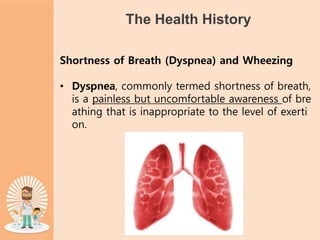
Shortness of Breath (Dyspnea) and Wheezing
• Dyspnea, commonly termed shortness of breath,
is a painless but uncomfortable awareness of bre
athing that is inappropriate to the level of exerti
on.
The Health History
Shortness of Breath (Dyspnea) and Wheezing
• Some Questions we can ask to our client:
• “Have you had any difficulty breathing?”
• Has dyspnea altered the patient’s lifestyle and da
ily activities?
• Carefully elicit the timing and setting, any associ
ated symptoms, and relieving or aggravating fact
ors
The Health History
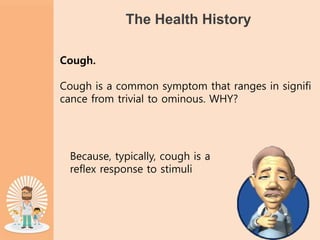
Cough.
Cough is a common symptom that ranges in signifi
cance from trivial to ominous. WHY?
Because, typically, cough is a
reflex response to stimuli
The Health History
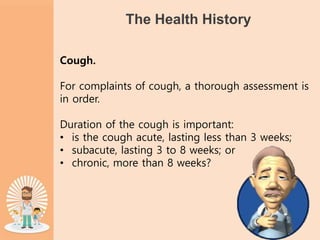
Cough.
For complaints of cough, a thorough assessment is
in order.
Duration of the cough is important:
• is the cough acute, lasting less than 3 weeks;
• subacute, lasting 3 to 8 weeks; or
• chronic, more than 8 weeks?
The Health History
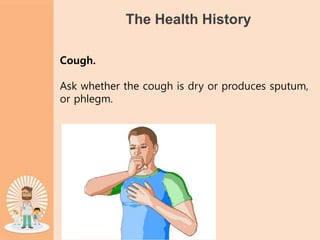
Cough.
Ask whether the cough is dry or produces sputum,
or phlegm.
The Health History
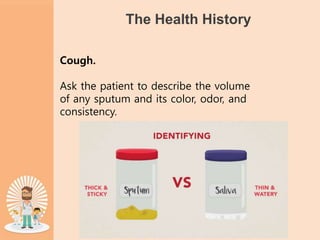
Cough.
Ask the patient to describe the volume
of any sputum and its color, odor, and
consistency.
The Health History
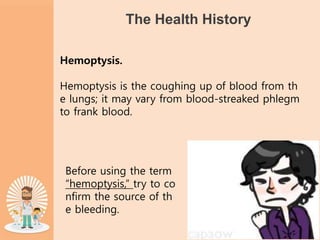
Hemoptysis.
Hemoptysis is the coughing up of blood from th
e lungs; it may vary from blood-streaked phlegm
to frank blood.
Before using the term
“hemoptysis,” try to co
nfirm the source of th
e bleeding.
Techniques of Examination
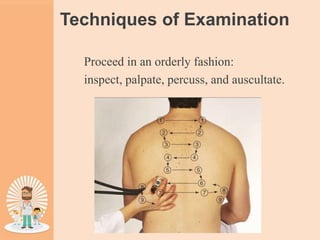
Proceed in an orderly fashion:
inspect, palpate, percuss, and auscultate.
Techniques of Examination
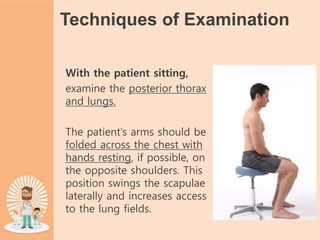
With the patient sitting,
examine the posterior thorax
and lungs.
The patient’s arms should be
folded across the chest with
hands resting, if possible, on
the opposite shoulders. This
position swings the scapulae
laterally and increases access
to the lung fields.
Techniques of Examination
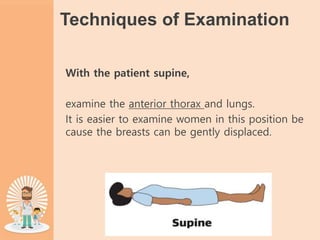
With the patient supine,
examine the anterior thorax and lungs.
It is easier to examine women in this position be
cause the breasts can be gently displaced.
Bacteria, viruses, and chemicals
may cause acute bronchitis.
True or False?
If you have bronchitis,
it is most important to drink
plenty of fluids.
True or False?
Can you assess the client’s
anterior chest even if she’s in
a sitting position?
Yes or No?
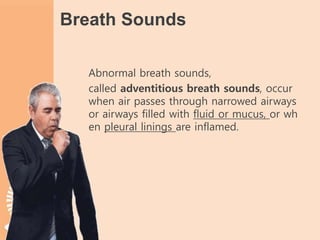
Breath Sounds
Abnormal breath sounds,
called adventitious breath sounds, occur
when air passes through narrowed airways
or airways filled with fluid or mucus, or wh
en pleural linings are inflamed.
End of Part 1
Break for 15mins
Discussion will resume after the break
References:
Audrey Berman . . . [et al.]. – 9th ed. (2012) KOZIER & ER
B’S Fundamentals of NURSING Concepts, Process, and Pra
ctice.
Bickley, Lynn S. -11TH ED. (2013) Bates’ guide to physical e
xamination and history-taking.

Chest and thorax assessment

  • 1.
    Jhonee Balmeo. RN TheTHORAX and The LUNGS ALLPPT.com _ Free PowerPoint Templates, Diagrams and Charts
  • 2.
  • 3.
  • 4.
  • 5.
  • 6.
  • 7.
  • 8.
    Case Analysis? Does vapingcauses lung problem? Lipoid Pneumonia
  • 9.
  • 10.
  • 11.
  • 12.
  • 13.
    The Health History Commonor Concerning Symptoms ◗ Chest pain ◗ Shortness of breath (dyspnea) ◗ Wheezing ◗ Cough ◗ Blood-streaked sputum (hemoptysis)
  • 14.
    The Health History Commonor Concerning Symptoms Chest Pain. Complaints of chest pain or chest discomfort raise concern about heart disease but often arise from structures in the thorax and lungs as well. To assess this symptom, you must pursue a dual investigation of both thoracic and cardiac causes.
  • 15.
    Case Presentation! Heart attackand lung collapse’ pain?
  • 16.
    The Health History ChestPain. • Your initial questions should be as open-ended as possible. “Do you have any discomfort or unpleasant feelings in your chest?” • Ask the patient to point to location of the pain i n the chest. • Watch for any gestures as the patient describes the pain.
  • 17.
    The Health History Shortnessof Breath (Dyspnea) and Wheezing • Dyspnea, commonly termed shortness of breath, is a painless but uncomfortable awareness of bre athing that is inappropriate to the level of exerti on.
  • 18.
    The Health History Shortnessof Breath (Dyspnea) and Wheezing • Some Questions we can ask to our client: • “Have you had any difficulty breathing?” • Has dyspnea altered the patient’s lifestyle and da ily activities? • Carefully elicit the timing and setting, any associ ated symptoms, and relieving or aggravating fact ors
  • 19.
    The Health History Cough. Coughis a common symptom that ranges in signifi cance from trivial to ominous. WHY? Because, typically, cough is a reflex response to stimuli
  • 20.
    The Health History Cough. Forcomplaints of cough, a thorough assessment is in order. Duration of the cough is important: • is the cough acute, lasting less than 3 weeks; • subacute, lasting 3 to 8 weeks; or • chronic, more than 8 weeks?
  • 21.
    The Health History Cough. Askwhether the cough is dry or produces sputum, or phlegm.
  • 22.
    The Health History Cough. Askthe patient to describe the volume of any sputum and its color, odor, and consistency.
  • 23.
    The Health History Hemoptysis. Hemoptysisis the coughing up of blood from th e lungs; it may vary from blood-streaked phlegm to frank blood. Before using the term “hemoptysis,” try to co nfirm the source of th e bleeding.
  • 24.
    Techniques of Examination Proceedin an orderly fashion: inspect, palpate, percuss, and auscultate.
  • 25.
    Techniques of Examination Withthe patient sitting, examine the posterior thorax and lungs. The patient’s arms should be folded across the chest with hands resting, if possible, on the opposite shoulders. This position swings the scapulae laterally and increases access to the lung fields.
  • 26.
    Techniques of Examination Withthe patient supine, examine the anterior thorax and lungs. It is easier to examine women in this position be cause the breasts can be gently displaced.
  • 27.
    Bacteria, viruses, andchemicals may cause acute bronchitis. True or False?
  • 28.
    If you havebronchitis, it is most important to drink plenty of fluids. True or False?
  • 29.
    Can you assessthe client’s anterior chest even if she’s in a sitting position? Yes or No?
  • 30.
    Breath Sounds Abnormal breathsounds, called adventitious breath sounds, occur when air passes through narrowed airways or airways filled with fluid or mucus, or wh en pleural linings are inflamed.
  • 31.
    End of Part1 Break for 15mins Discussion will resume after the break References: Audrey Berman . . . [et al.]. – 9th ed. (2012) KOZIER & ER B’S Fundamentals of NURSING Concepts, Process, and Pra ctice. Bickley, Lynn S. -11TH ED. (2013) Bates’ guide to physical e xamination and history-taking.