Page 1 of 2
Republic of the Philippines
NUEVA ECIJA UNIVERSITY OF SCIENCE AND TECHNOLOGY
General Tinio, Cabanatuan City, Nueva Ecija
ClinicalLearningSkillsLaboratory
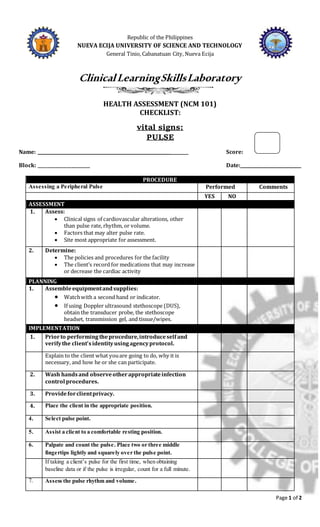
HEALTH ASSESSMENT (NCM 101)
CHECKLIST:
vital signs:
PULSE
Name: ______________________________________________________________ Score:
Block: ________________________ Date:____________________________
PROCEDURE
Assessing a Peripheral Pulse Performed Comments
YES NO
ASSESSMENT
1. Assess:
 Clinical signs of cardiovascular alterations, other
than pulse rate, rhythm, or volume.
 Factors that may alter pulse rate.
 Site most appropriate for assessment.
2. Determine:
 The policies and procedures for the facility
 The client’s record for medications that may increase
or decrease the cardiac activity
PLANNING
1. Assembleequipmentandsupplies:
 Watchwith a second hand or indicator.
 If using Doppler ultrasound stethoscope (DUS),
obtain the transducer probe, the stethoscope
headset, transmission gel, and tissue/wipes.
IMPLEMENTATION
1. Priorto performingtheprocedure,introduceselfand
verifythe client’sidentityusingagencyprotocol.
Explain to the client what youare going to do, why it is
necessary, and how he or she can participate.
2. Wash handsand observeotherappropriateinfection
control procedures.
3. Provideforclientprivacy.
4. Place the client in the appropriate position.
4. Select pulse point.
5. Assist a client to a comfortable resting position.
6. Palpate and count the pulse. Place two or three middle
fingertips lightly and squarely over the pulse point.
If taking a client’s pulse for the first time, when obtaining
baseline data or if the pulse is irregular, count for a full minute.
7. Assess the pulse rhythm and volume.
Page 2 of 2
Remarks:
_________________________________________________________________________________________________________________________
_________________________________________________________________________________________________________________________
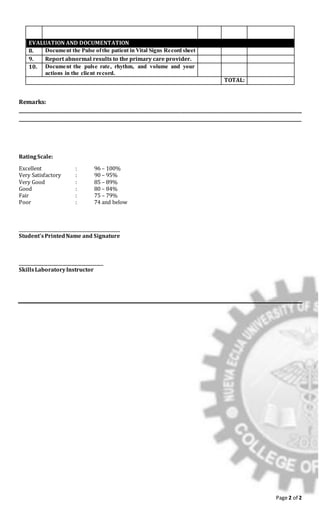
RatingScale:
Excellent : 96 – 100%
Very Satisfactory : 90 – 95%
Very Good : 85 – 89%
Good : 80 – 84%
Fair : 75 – 79%
Poor : 74 and below
_______________________________________________
Student’sPrintedName and Signature
_______________________________________
SkillsLaboratoryInstructor
EVALUATION AND DOCUMENTATION
8. Document the Pulse ofthe patient in Vital Signs Record sheet
9. Report abnormal results to the primary care provider.
10. Document the pulse rate, rhythm, and volume and your
actions in the client record.
TOTAL:

Proc6 measure vs_pulse

  • 1.
    Page 1 of2 Republic of the Philippines NUEVA ECIJA UNIVERSITY OF SCIENCE AND TECHNOLOGY General Tinio, Cabanatuan City, Nueva Ecija ClinicalLearningSkillsLaboratory HEALTH ASSESSMENT (NCM 101) CHECKLIST: vital signs: PULSE Name: ______________________________________________________________ Score: Block: ________________________ Date:____________________________ PROCEDURE Assessing a Peripheral Pulse Performed Comments YES NO ASSESSMENT 1. Assess:  Clinical signs of cardiovascular alterations, other than pulse rate, rhythm, or volume.  Factors that may alter pulse rate.  Site most appropriate for assessment. 2. Determine:  The policies and procedures for the facility  The client’s record for medications that may increase or decrease the cardiac activity PLANNING 1. Assembleequipmentandsupplies:  Watchwith a second hand or indicator.  If using Doppler ultrasound stethoscope (DUS), obtain the transducer probe, the stethoscope headset, transmission gel, and tissue/wipes. IMPLEMENTATION 1. Priorto performingtheprocedure,introduceselfand verifythe client’sidentityusingagencyprotocol. Explain to the client what youare going to do, why it is necessary, and how he or she can participate. 2. Wash handsand observeotherappropriateinfection control procedures. 3. Provideforclientprivacy. 4. Place the client in the appropriate position. 4. Select pulse point. 5. Assist a client to a comfortable resting position. 6. Palpate and count the pulse. Place two or three middle fingertips lightly and squarely over the pulse point. If taking a client’s pulse for the first time, when obtaining baseline data or if the pulse is irregular, count for a full minute. 7. Assess the pulse rhythm and volume.
  • 2.
    Page 2 of2 Remarks: _________________________________________________________________________________________________________________________ _________________________________________________________________________________________________________________________ RatingScale: Excellent : 96 – 100% Very Satisfactory : 90 – 95% Very Good : 85 – 89% Good : 80 – 84% Fair : 75 – 79% Poor : 74 and below _______________________________________________ Student’sPrintedName and Signature _______________________________________ SkillsLaboratoryInstructor EVALUATION AND DOCUMENTATION 8. Document the Pulse ofthe patient in Vital Signs Record sheet 9. Report abnormal results to the primary care provider. 10. Document the pulse rate, rhythm, and volume and your actions in the client record. TOTAL: