Applications of networks: diffusion
Jake Fisher
Social Networks & Health | May 25, 2017
What is diffusion?
Diffusion is the process of social contagions spreading between people
What is diffusion?
Social contagion means anything that people could transmit to one another
Diseases
• HIV (Merli et al. 2006)
Behaviors
• Binge drinking (Kreager & Haynie 2011)
• Obesity (Christakis & Fowler 2007, but see Lyons 2010)
• Exercise (Aral & Nicolaides 2017)
• Use of a new medicine (Coleman, Katz, Menzel 1966) or an innovation generally
(Rogers 1962)
Ideas / Attitudes
• Beliefs about concurrency (Yamanis et al. 2015)
• Beliefs about smoking (Fisher 2017)
Types of diffusion models: epidemic model
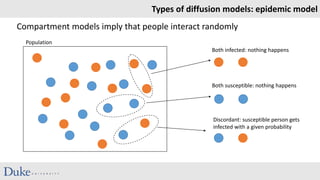
Compartment models imply that people interact randomly
Population
Both infected: nothing happens
Both susceptible: nothing happens
Discordant: susceptible person gets
infected with a given probability
Types of diffusion models: epidemic model
Random mixing models can be represented by a set of differential eqs.
S I
𝛽
R
𝛾
𝑑𝑆
𝑑𝑡
= −𝛽𝑆𝐼
𝑑𝐼
𝑑𝑡
= 𝛽𝑆𝐼 − 𝛾𝐼
𝑑𝑅
𝑑𝑡
= 𝛾𝐼
Types of diffusion models: epidemic model
Disease models lead to a logistic growth curve
Types of diffusion models: epidemic model
Network models generalize by allowing any specific contact pattern
Discordant edge:
susceptible person is
infected with some
probability
Both susceptible:
nothing happens
Types of diffusion models: epidemic model
Network models generalize by allowing any specific contact pattern
Direct transmission
no longer possible!
Relationship timing
Time ordering of ties matters!
Time 1 Time 2
Time 2 Time 1
Relationship timing
The “network” conflates three relevant networks…
Who can “A” reach?
(1) Contact network: A can reach everyone, it is a connected component
Relationship timing
The “network” conflates three relevant networks…
Who can “A” reach?
(2) Exposure network: node “A” could reach up to 8 others
Relationship timing
The “network” conflates three relevant networks…
Who can “A” reach?
(3) Transmission network: upper limit is 8 through the exposure links (dark blue).
Transmission is path dependent: if no transmission to B, then also none to {K,L,O,J,M}
Exposable Link (from A’s p.o.v.)
Contact
Issues in diffusion
Concurrent relationships create more paths in the exposure network…
Issues in diffusion
…and in turn increases the extent of the transmission network
Issues in diffusion
…and in turn increases the extent of the transmission network
Types of diffusion models: threshold models
In threshold models, people behave differently if enough of their friends do
Threshold = 90% of friends
…nothing happens
Types of diffusion models: threshold models
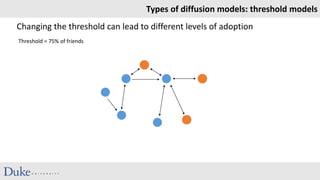
Changing the threshold can lead to different levels of adoption
Threshold = 75% of friends
Types of diffusion models: threshold models
Threshold = 50% of friends
Changing the threshold can lead to different levels of adoption
Types of diffusion models: threshold models
Threshold models can be written as a matrix multiplication problem
𝑌 𝑡+1
= 𝑰 𝑊𝑌 𝑡
> 𝜏 =
0 1 0 0 0 0 0 0
0 0 1 0 0 0 0 0
0 1 0 1 1 0 0 0
0 0 1 0 1 0 0 0
0 0 1 1 0 1 1 1
0 0 0 0 1 0 0 0
0 0 0 0 1 0 0 0
0 0 0 0 1 0 0 0
0
0
0
1
0
0
1
1
Needs to be row-normalized
Types of diffusion models: threshold models
Threshold models can be written as a matrix multiplication problem
𝑌 𝑡+1 = 𝑰 𝑊𝑌 𝑡 > 𝜏 =
𝑰
0 1 0 0 0 0 0 0
0 0 1 0 0 0 0 0
0 1 3 0 1 3 1 3 0 0 0
0 0 1 2 0 1 2 0 0 0
0 0 0 1 4 0 1 4 1 4 1 4
0 0 0 0 1 0 0 0
0 0 0 0 1 0 0 0
0 0 0 0 1 0 0 0
0
0
0
1
0
0
1
1
> 𝜏
Types of diffusion models: threshold models
Threshold models can be written as
a matrix multiplication problem
𝑌 𝑡+1
= 𝑰 𝑊𝑌 𝑡
> 𝜏 =
𝑰
0 1 0 0 0 0 0 0
0 0 1 0 0 0 0 0
0 1 3 0 1 3 1 3 0 0 0
0 0 1 2 0 1 2 0 0 0
0 0 0 1 4 0 1 4 1 4 1 4
0 0 0 0 1 0 0 0
0 0 0 0 1 0 0 0
0 0 0 0 1 0 0 0
0
0
0
1
0
0
1
1
> 𝜏
𝐈
0
0
1 3
0
0
3 4
0
0
> 𝜏 =
0
0
0
0
0
1
0
0
Note the influence of
non-adopters, who are
driving abandonment
Types of diffusion models: threshold models
Threshold models can be written as
a matrix multiplication problem
𝑌 𝑡+1
= 𝑰 𝑊𝑌 𝑡
> 𝜏 =
𝑰
1 1 0 0 0 0 0 0
0 1 1 0 0 0 0 0
0 1 3 1 1 3 1 3 0 0 0
0 0 1 2 1 1 2 0 0 0
0 0 0 1 4 1 1 4 1 4 1 4
0 0 0 0 1 1 0 0
0 0 0 0 1 0 1 0
0 0 0 0 1 0 0 1
0
0
0
1
0
0
1
1
> 𝜏
𝐈
0
0
1 3
1
0
3 4
1
1
> 𝜏 =
0
0
0
1
0
1
1
1
Setting the diagonal to
1 forces adopters to
stay adopted, because 𝜏
is less than 1.
Types of diffusion models: threshold models
The diffusion of innovations has a typology for who adopts when
Types of diffusion models: threshold models
Variation in thresholds can lead to large differences in outcomes
Types of diffusion models: threshold models
Complex contagions require multiple people to convince someone to adopt
Simple contagion:
One friend who has adopted
is enough to convince you to
adopt
Complex contagion:
Two or more friends need to
adopt before you adopt
(costlier activities)
Types of diffusion models: threshold models
Complex contagions spread within denser regions of the network
Simple contagion:
Even a few “shortcuts” can let an
innovation spread across the network
Complex contagion:
Only larger bridges allow innovations to
jump between regions of the network
Types of diffusion models: threshold models
Health studies increasingly think about complex contagions…
Types of diffusion models: threshold models
…although a recent study (exercise contagion) found little support for them
Types of diffusion models: weighted averaging models
Weighted averaging models treat people as the average of their friends
Strongly disagree (1)
A/D: Smoking makes you look cool
Slightly disagree (2)
Strongly agree (5)
Prediction:
(1 + 3 + 5) / 3 = 2.67
(slightly disagree –
neither agree nor
disagree)
Types of diffusion models: weighted averaging models
Weighted averaging models can also be written as matrix multiplication
𝐴 𝑡+1 = 𝑊𝐴 𝑡 =
0 1 3 1 3 1 3
0 0 0 0
0 0 0 0
0 0 0 0
0
1
2
5
Strongly disagree (1)
A/D: Smoking makes you look cool
Slightly disagree (2)
Strongly agree (5)
Types of diffusion models: weighted averaging models
Weighted averaging models can also be written as matrix multiplication
𝐴 𝑡 = 𝛼𝑊𝐴 𝑡−1 + 1 − 𝛼 𝐴 1
Vector of predicted
attitude values
Social influence Person’s existing
beliefs
Scalar between 0 and 1,
which indicates what
percent of the weight to
give to others
Weighted average of
others’ beliefs at
previous time point
Self-weight value
Initial attitudes
Types of diffusion models: weighted averaging models
Weighted averaging models converge to a consensus
Types of diffusion models: weighted averaging models
Weighted averaging models converge to a consensus
Types of diffusion models: weighted averaging models
Weighted averaging models converge to a consensus
Types of diffusion models: weighted averaging models
Weighted averaging models converge to a consensus
Types of diffusion models: weighted averaging models
Weighted averaging models converge to a consensus
Types of diffusion models: weighted averaging models
Weighted averaging models converge to a consensus
Types of diffusion models: weighted averaging models
Weighted averaging models converge to a consensus
Types of diffusion models: weighted averaging models
Weighted averaging models converge to a consensus
Types of diffusion models: weighted averaging models
Weighted averaging models converge to a consensus
Application of the weighted averaging model
Diffusion models underlie the concept of “opinion leaders”
Current issues in diffusion
Influence is very, very hard to distinguish from selection
Current issues in diffusion
Suppose that there are two friends named Ian and Joey, and Ian’s parents ask him the classic hypothetical of
social influence: “If your friend Joey jumped off a bridge, would you jump too?” Why might Ian answer “yes”?
1. because Joey’s example inspired Ian (social contagion/influence);
2. because Joey infected Ian with a parasite that suppresses fear of falling (biological contagion);
3. because Joey and Ian are friends on account of their shared fondness for jumping off bridges (manifest
homophily, on the characteristic of interest);
4. because Joey and Ian became friends through a thrill-seeking club, whose membership rolls are publicly
available (secondary homophily, on a different yet observed characteristic);
5. because Joey and Ian became friends through their shared fondness for roller-coasters, which was caused by
their common thrill-seeking propensity, which also leads them to jump off bridges (latent homophily, on an
unobserved characteristic);
6. because Joey and Ian both happen to be on the Tacoma Narrows Bridge in November 1940, and jumping is
safer than staying on a bridge that is tearing itself apart (common external causation).
The distinctions between these mechanisms—and others that no doubt occur to the reader—are all ones that
make causal differences. In particular, if there is any sort of contagion, then measures that specifically prevent
Joey from jumping off the bridge (e.g., restraining him) will also have the effect of tending to keep Ian from doing
so; this is not the case if contagion is absent. However, the crucial question is whether these distinctions make
differences in the purely observational setting, since we are usually not able to conduct an experiment in which
we push Joey off the bridge and see whether Ian jumps (let alone repeated trials.)
Current issues in diffusion
Experimental designs may alleviate this problem
Exogenously decide peers via natural experiment…
Current issues in diffusion
Experimental designs may alleviate this problem
… or by developing an online world where you can define the ties
Current issues in diffusion
Volunteer science is a new tool for developing online world experiments
Current issues in diffusion
Abandonment of innovations is poorly understood
Is this the diffusion process in reverse?
How does experimentation play in to this?
Current issues in diffusion
Transmission process for non-biological contagions is less well understood
Current issues in diffusion
Transmission process for non-biological contagions is less well understood
Social space diffusion model
The observed network is measured with error, and doesn’t capture all of the social
influence pathways.
• Networks are measured with error. (Paik and
Sanchagrin 2013; Eagle and Proeschold-Bell 2015)
• People are influenced by people that they aren’t
directly connected to. (e.g., Fujimoto and Valente
2012)
• Friendships experience routine churn. (Cairns and
Cairns 1994; Branje et al. 2007)
Solution: smooth the observed network by modeling the predicted probability of a tie
between each pair of people, and simulate diffusion over the model results.
Social space diffusion model
Visually: In symbols:
Latent space models estimate the probability of each tie conditionally independent of the
others, given each person’s position in a latent space.
Person i Person j
Person k
𝑧𝑗 − 𝑧 𝑘
𝑧𝑖 − 𝑧 𝑘
Let 𝑦𝑖𝑗 = 1 if 𝑖 → 𝑗 and 0 otherwise, 𝑖 = 1, … , 𝑛, 𝑗 = 1, … , 𝑛.
Ties (𝑌) are conditionally independent, given positions (𝑍):
Pr 𝑌 Β, 𝑍 =
𝑖≠𝑗
Pr 𝑦𝑖𝑗|𝛽0, 𝑧𝑖, 𝑧𝑗
Ties are modeled in a logistic regression:
logit Pr(𝑦𝑖𝑗 = 1|𝛽0, 𝑧𝑖, 𝑧𝑗 = 𝜂𝑖𝑗 = 𝛽0 − 𝑧𝑖 − 𝑧𝑗
Β and 𝑍 are given minimally informative priors centered at 0
(not shown), pulling vertices towards the center of the latent
space.
𝑧𝑖 − 𝑧𝑗
Social space diffusion model: predicted probabilities
Model people incorporating information from everyone else in the network using the
posterior probabilities of ties as weights.
Steps:
Get the predicted probability of a tie for each of the 𝑘 = 1, … , 𝐾 draws
from the posterior.
𝑝𝑖𝑗
𝑘
= exp 𝜂𝑖𝑗
𝑘
∕ 1 + exp 𝜂𝑖𝑗
𝑘
Set the weight matrix to the predicted probability of a tie:
𝑊 𝑘
= 𝑤𝑖𝑗
𝑘
= 𝑝𝑖𝑗
𝑘
Simulate the diffusion process:
𝐴 𝑘,𝑡+1
= 𝑊 𝑘
𝐴 𝑘,𝑡
For several iterations, starting from the initial values, this becomes:
𝐴 𝑘,𝑡+1 = 𝑊 𝑘 𝑡
𝐴 1
Social space diffusion model: posterior predictive distribution
Model routine churn using the posterior predictive distribution (simulated networks).
Steps:
Get the predicted probability of a tie for each of the 𝑘 = 1, … , 𝐾 draws
from the posterior.
𝑝𝑖𝑗
𝑘
= exp 𝜂𝑖𝑗
𝑘
∕ 1 + exp 𝜂𝑖𝑗
𝑘
Draw a simulated network for each of the posterior draws:
𝑦𝑖𝑗
𝑘,𝑙
∼ 𝐵𝑒𝑟𝑛𝑜𝑢𝑙𝑙𝑖 𝑝𝑖𝑗
𝑘
Set the weight matrix to the simulated network
𝑊 𝑘,𝑙
= 𝑌 𝑘,𝑙
Simulate the diffusion process:
𝐴 𝑘,𝑡+1
= 𝑊 𝑘,𝑙
𝐴 𝑘,𝑡
Draw a new simulated network from the same posterior draw 𝑘 for each
iteration 𝑙 = 1, … , 𝐿:
𝐴 𝑘,𝑡+1 = 𝑊 𝑘,𝐿 … 𝑊 𝑘,2 𝑊 𝑘,1 𝐴 1
Social space diffusion model
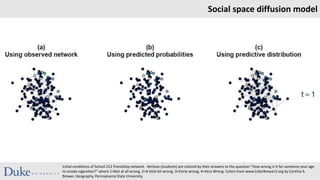
Initial conditions of School 212 friendship network. Vertices (students) are colored by their answers to the question “How wrong is it for someone your age
to smoke cigarettes?” where 1=Not at all wrong, 2=A little bit wrong, 3=Fairly wrong, 4=Very Wrong. Colors from www.ColorBrewer2.org by Cynthia A.
Brewer, Geography, Pennsylvania State University.
Social space diffusion model
Predicted attitudes after one simulated time step. Colors represent attitude rounded to the nearest 0.25; color values are interpolated between color values
from colorbrewer2.org.
Isolated vertices don’t
change attitudes
Nearly completely homogeneous
attitudes after one time step
Isolated vertices reconnected probabilistically;
can influence and be influenced
Still heterogeneous after one step
Social space diffusion model
Isolates still unchanged in
network-only model
Models with smoothing converge
to a single consensus value

07 Applications of Diffusion (2017)

  • 1.
    Applications of networks:diffusion Jake Fisher Social Networks & Health | May 25, 2017
  • 2.
    What is diffusion? Diffusionis the process of social contagions spreading between people
  • 3.
    What is diffusion? Socialcontagion means anything that people could transmit to one another Diseases • HIV (Merli et al. 2006) Behaviors • Binge drinking (Kreager & Haynie 2011) • Obesity (Christakis & Fowler 2007, but see Lyons 2010) • Exercise (Aral & Nicolaides 2017) • Use of a new medicine (Coleman, Katz, Menzel 1966) or an innovation generally (Rogers 1962) Ideas / Attitudes • Beliefs about concurrency (Yamanis et al. 2015) • Beliefs about smoking (Fisher 2017)
  • 4.
    Types of diffusionmodels: epidemic model Compartment models imply that people interact randomly Population Both infected: nothing happens Both susceptible: nothing happens Discordant: susceptible person gets infected with a given probability
  • 5.
    Types of diffusionmodels: epidemic model Random mixing models can be represented by a set of differential eqs. S I 𝛽 R 𝛾 𝑑𝑆 𝑑𝑡 = −𝛽𝑆𝐼 𝑑𝐼 𝑑𝑡 = 𝛽𝑆𝐼 − 𝛾𝐼 𝑑𝑅 𝑑𝑡 = 𝛾𝐼
  • 6.
    Types of diffusionmodels: epidemic model Disease models lead to a logistic growth curve
  • 7.
    Types of diffusionmodels: epidemic model Network models generalize by allowing any specific contact pattern Discordant edge: susceptible person is infected with some probability Both susceptible: nothing happens
  • 8.
    Types of diffusionmodels: epidemic model Network models generalize by allowing any specific contact pattern Direct transmission no longer possible!
  • 9.
    Relationship timing Time orderingof ties matters! Time 1 Time 2 Time 2 Time 1
  • 10.
    Relationship timing The “network”conflates three relevant networks… Who can “A” reach? (1) Contact network: A can reach everyone, it is a connected component
  • 11.
    Relationship timing The “network”conflates three relevant networks… Who can “A” reach? (2) Exposure network: node “A” could reach up to 8 others
  • 12.
    Relationship timing The “network”conflates three relevant networks… Who can “A” reach? (3) Transmission network: upper limit is 8 through the exposure links (dark blue). Transmission is path dependent: if no transmission to B, then also none to {K,L,O,J,M} Exposable Link (from A’s p.o.v.) Contact
  • 13.
    Issues in diffusion Concurrentrelationships create more paths in the exposure network…
  • 14.
    Issues in diffusion …andin turn increases the extent of the transmission network
  • 15.
    Issues in diffusion …andin turn increases the extent of the transmission network
  • 16.
    Types of diffusionmodels: threshold models In threshold models, people behave differently if enough of their friends do Threshold = 90% of friends …nothing happens
  • 17.
    Types of diffusionmodels: threshold models Changing the threshold can lead to different levels of adoption Threshold = 75% of friends
  • 18.
    Types of diffusionmodels: threshold models Threshold = 50% of friends Changing the threshold can lead to different levels of adoption
  • 19.
    Types of diffusionmodels: threshold models Threshold models can be written as a matrix multiplication problem 𝑌 𝑡+1 = 𝑰 𝑊𝑌 𝑡 > 𝜏 = 0 1 0 0 0 0 0 0 0 0 1 0 0 0 0 0 0 1 0 1 1 0 0 0 0 0 1 0 1 0 0 0 0 0 1 1 0 1 1 1 0 0 0 0 1 0 0 0 0 0 0 0 1 0 0 0 0 0 0 0 1 0 0 0 0 0 0 1 0 0 1 1 Needs to be row-normalized
  • 20.
    Types of diffusionmodels: threshold models Threshold models can be written as a matrix multiplication problem 𝑌 𝑡+1 = 𝑰 𝑊𝑌 𝑡 > 𝜏 = 𝑰 0 1 0 0 0 0 0 0 0 0 1 0 0 0 0 0 0 1 3 0 1 3 1 3 0 0 0 0 0 1 2 0 1 2 0 0 0 0 0 0 1 4 0 1 4 1 4 1 4 0 0 0 0 1 0 0 0 0 0 0 0 1 0 0 0 0 0 0 0 1 0 0 0 0 0 0 1 0 0 1 1 > 𝜏
  • 21.
    Types of diffusionmodels: threshold models Threshold models can be written as a matrix multiplication problem 𝑌 𝑡+1 = 𝑰 𝑊𝑌 𝑡 > 𝜏 = 𝑰 0 1 0 0 0 0 0 0 0 0 1 0 0 0 0 0 0 1 3 0 1 3 1 3 0 0 0 0 0 1 2 0 1 2 0 0 0 0 0 0 1 4 0 1 4 1 4 1 4 0 0 0 0 1 0 0 0 0 0 0 0 1 0 0 0 0 0 0 0 1 0 0 0 0 0 0 1 0 0 1 1 > 𝜏 𝐈 0 0 1 3 0 0 3 4 0 0 > 𝜏 = 0 0 0 0 0 1 0 0 Note the influence of non-adopters, who are driving abandonment
  • 22.
    Types of diffusionmodels: threshold models Threshold models can be written as a matrix multiplication problem 𝑌 𝑡+1 = 𝑰 𝑊𝑌 𝑡 > 𝜏 = 𝑰 1 1 0 0 0 0 0 0 0 1 1 0 0 0 0 0 0 1 3 1 1 3 1 3 0 0 0 0 0 1 2 1 1 2 0 0 0 0 0 0 1 4 1 1 4 1 4 1 4 0 0 0 0 1 1 0 0 0 0 0 0 1 0 1 0 0 0 0 0 1 0 0 1 0 0 0 1 0 0 1 1 > 𝜏 𝐈 0 0 1 3 1 0 3 4 1 1 > 𝜏 = 0 0 0 1 0 1 1 1 Setting the diagonal to 1 forces adopters to stay adopted, because 𝜏 is less than 1.
  • 23.
    Types of diffusionmodels: threshold models The diffusion of innovations has a typology for who adopts when
  • 24.
    Types of diffusionmodels: threshold models Variation in thresholds can lead to large differences in outcomes
  • 25.
    Types of diffusionmodels: threshold models Complex contagions require multiple people to convince someone to adopt Simple contagion: One friend who has adopted is enough to convince you to adopt Complex contagion: Two or more friends need to adopt before you adopt (costlier activities)
  • 26.
    Types of diffusionmodels: threshold models Complex contagions spread within denser regions of the network Simple contagion: Even a few “shortcuts” can let an innovation spread across the network Complex contagion: Only larger bridges allow innovations to jump between regions of the network
  • 27.
    Types of diffusionmodels: threshold models Health studies increasingly think about complex contagions…
  • 28.
    Types of diffusionmodels: threshold models …although a recent study (exercise contagion) found little support for them
  • 29.
    Types of diffusionmodels: weighted averaging models Weighted averaging models treat people as the average of their friends Strongly disagree (1) A/D: Smoking makes you look cool Slightly disagree (2) Strongly agree (5) Prediction: (1 + 3 + 5) / 3 = 2.67 (slightly disagree – neither agree nor disagree)
  • 30.
    Types of diffusionmodels: weighted averaging models Weighted averaging models can also be written as matrix multiplication 𝐴 𝑡+1 = 𝑊𝐴 𝑡 = 0 1 3 1 3 1 3 0 0 0 0 0 0 0 0 0 0 0 0 0 1 2 5 Strongly disagree (1) A/D: Smoking makes you look cool Slightly disagree (2) Strongly agree (5)
  • 31.
    Types of diffusionmodels: weighted averaging models Weighted averaging models can also be written as matrix multiplication 𝐴 𝑡 = 𝛼𝑊𝐴 𝑡−1 + 1 − 𝛼 𝐴 1 Vector of predicted attitude values Social influence Person’s existing beliefs Scalar between 0 and 1, which indicates what percent of the weight to give to others Weighted average of others’ beliefs at previous time point Self-weight value Initial attitudes
  • 32.
    Types of diffusionmodels: weighted averaging models Weighted averaging models converge to a consensus
  • 33.
    Types of diffusionmodels: weighted averaging models Weighted averaging models converge to a consensus
  • 34.
    Types of diffusionmodels: weighted averaging models Weighted averaging models converge to a consensus
  • 35.
    Types of diffusionmodels: weighted averaging models Weighted averaging models converge to a consensus
  • 36.
    Types of diffusionmodels: weighted averaging models Weighted averaging models converge to a consensus
  • 37.
    Types of diffusionmodels: weighted averaging models Weighted averaging models converge to a consensus
  • 38.
    Types of diffusionmodels: weighted averaging models Weighted averaging models converge to a consensus
  • 39.
    Types of diffusionmodels: weighted averaging models Weighted averaging models converge to a consensus
  • 40.
    Types of diffusionmodels: weighted averaging models Weighted averaging models converge to a consensus
  • 41.
    Application of theweighted averaging model Diffusion models underlie the concept of “opinion leaders”
  • 42.
    Current issues indiffusion Influence is very, very hard to distinguish from selection
  • 43.
    Current issues indiffusion Suppose that there are two friends named Ian and Joey, and Ian’s parents ask him the classic hypothetical of social influence: “If your friend Joey jumped off a bridge, would you jump too?” Why might Ian answer “yes”? 1. because Joey’s example inspired Ian (social contagion/influence); 2. because Joey infected Ian with a parasite that suppresses fear of falling (biological contagion); 3. because Joey and Ian are friends on account of their shared fondness for jumping off bridges (manifest homophily, on the characteristic of interest); 4. because Joey and Ian became friends through a thrill-seeking club, whose membership rolls are publicly available (secondary homophily, on a different yet observed characteristic); 5. because Joey and Ian became friends through their shared fondness for roller-coasters, which was caused by their common thrill-seeking propensity, which also leads them to jump off bridges (latent homophily, on an unobserved characteristic); 6. because Joey and Ian both happen to be on the Tacoma Narrows Bridge in November 1940, and jumping is safer than staying on a bridge that is tearing itself apart (common external causation). The distinctions between these mechanisms—and others that no doubt occur to the reader—are all ones that make causal differences. In particular, if there is any sort of contagion, then measures that specifically prevent Joey from jumping off the bridge (e.g., restraining him) will also have the effect of tending to keep Ian from doing so; this is not the case if contagion is absent. However, the crucial question is whether these distinctions make differences in the purely observational setting, since we are usually not able to conduct an experiment in which we push Joey off the bridge and see whether Ian jumps (let alone repeated trials.)
  • 44.
    Current issues indiffusion Experimental designs may alleviate this problem Exogenously decide peers via natural experiment…
  • 45.
    Current issues indiffusion Experimental designs may alleviate this problem … or by developing an online world where you can define the ties
  • 46.
    Current issues indiffusion Volunteer science is a new tool for developing online world experiments
  • 47.
    Current issues indiffusion Abandonment of innovations is poorly understood Is this the diffusion process in reverse? How does experimentation play in to this?
  • 48.
    Current issues indiffusion Transmission process for non-biological contagions is less well understood
  • 49.
    Current issues indiffusion Transmission process for non-biological contagions is less well understood
  • 50.
    Social space diffusionmodel The observed network is measured with error, and doesn’t capture all of the social influence pathways. • Networks are measured with error. (Paik and Sanchagrin 2013; Eagle and Proeschold-Bell 2015) • People are influenced by people that they aren’t directly connected to. (e.g., Fujimoto and Valente 2012) • Friendships experience routine churn. (Cairns and Cairns 1994; Branje et al. 2007) Solution: smooth the observed network by modeling the predicted probability of a tie between each pair of people, and simulate diffusion over the model results.
  • 51.
    Social space diffusionmodel Visually: In symbols: Latent space models estimate the probability of each tie conditionally independent of the others, given each person’s position in a latent space. Person i Person j Person k 𝑧𝑗 − 𝑧 𝑘 𝑧𝑖 − 𝑧 𝑘 Let 𝑦𝑖𝑗 = 1 if 𝑖 → 𝑗 and 0 otherwise, 𝑖 = 1, … , 𝑛, 𝑗 = 1, … , 𝑛. Ties (𝑌) are conditionally independent, given positions (𝑍): Pr 𝑌 Β, 𝑍 = 𝑖≠𝑗 Pr 𝑦𝑖𝑗|𝛽0, 𝑧𝑖, 𝑧𝑗 Ties are modeled in a logistic regression: logit Pr(𝑦𝑖𝑗 = 1|𝛽0, 𝑧𝑖, 𝑧𝑗 = 𝜂𝑖𝑗 = 𝛽0 − 𝑧𝑖 − 𝑧𝑗 Β and 𝑍 are given minimally informative priors centered at 0 (not shown), pulling vertices towards the center of the latent space. 𝑧𝑖 − 𝑧𝑗
  • 52.
    Social space diffusionmodel: predicted probabilities Model people incorporating information from everyone else in the network using the posterior probabilities of ties as weights. Steps: Get the predicted probability of a tie for each of the 𝑘 = 1, … , 𝐾 draws from the posterior. 𝑝𝑖𝑗 𝑘 = exp 𝜂𝑖𝑗 𝑘 ∕ 1 + exp 𝜂𝑖𝑗 𝑘 Set the weight matrix to the predicted probability of a tie: 𝑊 𝑘 = 𝑤𝑖𝑗 𝑘 = 𝑝𝑖𝑗 𝑘 Simulate the diffusion process: 𝐴 𝑘,𝑡+1 = 𝑊 𝑘 𝐴 𝑘,𝑡 For several iterations, starting from the initial values, this becomes: 𝐴 𝑘,𝑡+1 = 𝑊 𝑘 𝑡 𝐴 1
  • 53.
    Social space diffusionmodel: posterior predictive distribution Model routine churn using the posterior predictive distribution (simulated networks). Steps: Get the predicted probability of a tie for each of the 𝑘 = 1, … , 𝐾 draws from the posterior. 𝑝𝑖𝑗 𝑘 = exp 𝜂𝑖𝑗 𝑘 ∕ 1 + exp 𝜂𝑖𝑗 𝑘 Draw a simulated network for each of the posterior draws: 𝑦𝑖𝑗 𝑘,𝑙 ∼ 𝐵𝑒𝑟𝑛𝑜𝑢𝑙𝑙𝑖 𝑝𝑖𝑗 𝑘 Set the weight matrix to the simulated network 𝑊 𝑘,𝑙 = 𝑌 𝑘,𝑙 Simulate the diffusion process: 𝐴 𝑘,𝑡+1 = 𝑊 𝑘,𝑙 𝐴 𝑘,𝑡 Draw a new simulated network from the same posterior draw 𝑘 for each iteration 𝑙 = 1, … , 𝐿: 𝐴 𝑘,𝑡+1 = 𝑊 𝑘,𝐿 … 𝑊 𝑘,2 𝑊 𝑘,1 𝐴 1
  • 54.
    Social space diffusionmodel Initial conditions of School 212 friendship network. Vertices (students) are colored by their answers to the question “How wrong is it for someone your age to smoke cigarettes?” where 1=Not at all wrong, 2=A little bit wrong, 3=Fairly wrong, 4=Very Wrong. Colors from www.ColorBrewer2.org by Cynthia A. Brewer, Geography, Pennsylvania State University.
  • 55.
    Social space diffusionmodel Predicted attitudes after one simulated time step. Colors represent attitude rounded to the nearest 0.25; color values are interpolated between color values from colorbrewer2.org. Isolated vertices don’t change attitudes Nearly completely homogeneous attitudes after one time step Isolated vertices reconnected probabilistically; can influence and be influenced Still heterogeneous after one step
  • 56.
    Social space diffusionmodel Isolates still unchanged in network-only model Models with smoothing converge to a single consensus value

Editor's Notes

  • #54 Don’t forget to fix the notation in the paper!