This document summarizes three types of field experiments related to social networks:
1) Peer effects experiments examine whether individual j influences the behaviors or outcomes of individual i. Examples test whether encouraging individual i to vote or buy a product also influences their friend j.
2) Network formation experiments study what factors affect whether individual i forms a network tie with individual j. Examples test how anonymity, search costs, and interactions affect network tie formation.
3) Designing networks experiments evaluate which network structures maximize outcomes at the network level. Examples design peer groups and seed farmers to test how network structure impacts behavior diffusion.
Some interesting examplesof
field experiments with social
networks.
Sharique Hasan
Fuqua School of Business, Duke University
2.
Field: Real people;real meaningful outcomes.
Experiment: Randomization into conditions, done by
experimenter or naturally in field setting.
3.
There are hundredsof questions that we can try to
answer about networks using field experiments.
I will focus on three.
Peer effects: Does j influence the behavior/outcomes of i?
Network Formation: What affects whether i forms a network
tie with j?
Designing networks: Which network structures maximize
network-level outcomes?
4.
There are hundredsof questions that we can try to
answer about networks using field experiments.
Peer effects: Does j influence the behavior/outcomes of i?
5.
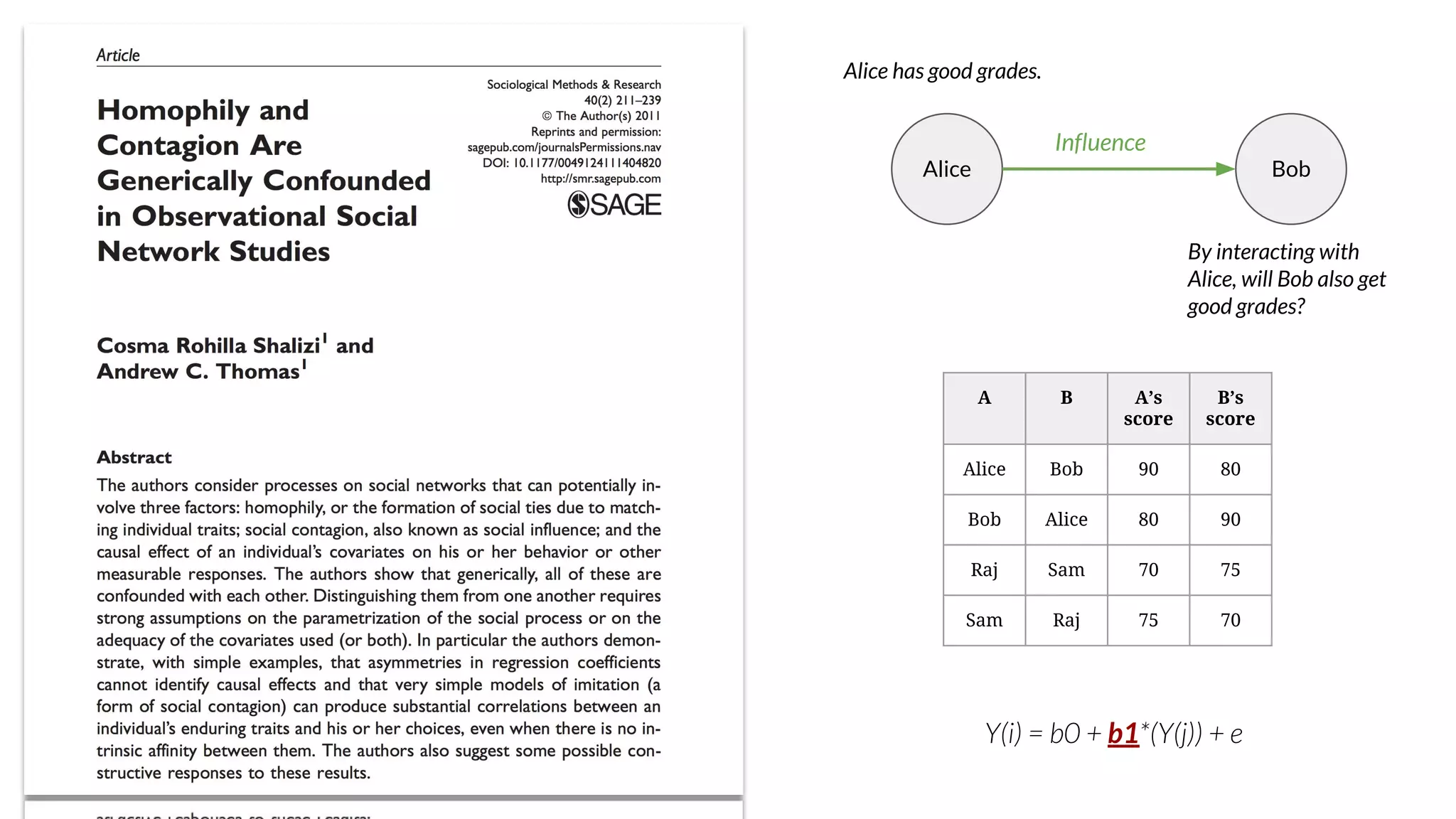
Alice Bob
Alice hasgood grades.
By interacting with
Alice, will Bob also get
good grades?
Influence
A B A’s
score
B’s
score
Alice Bob 90 80
Bob Alice 80 90
Raj Sam 70 75
Sam Raj 75 70
Y(i) = b0 + b1*(Y(j)) + e
6.
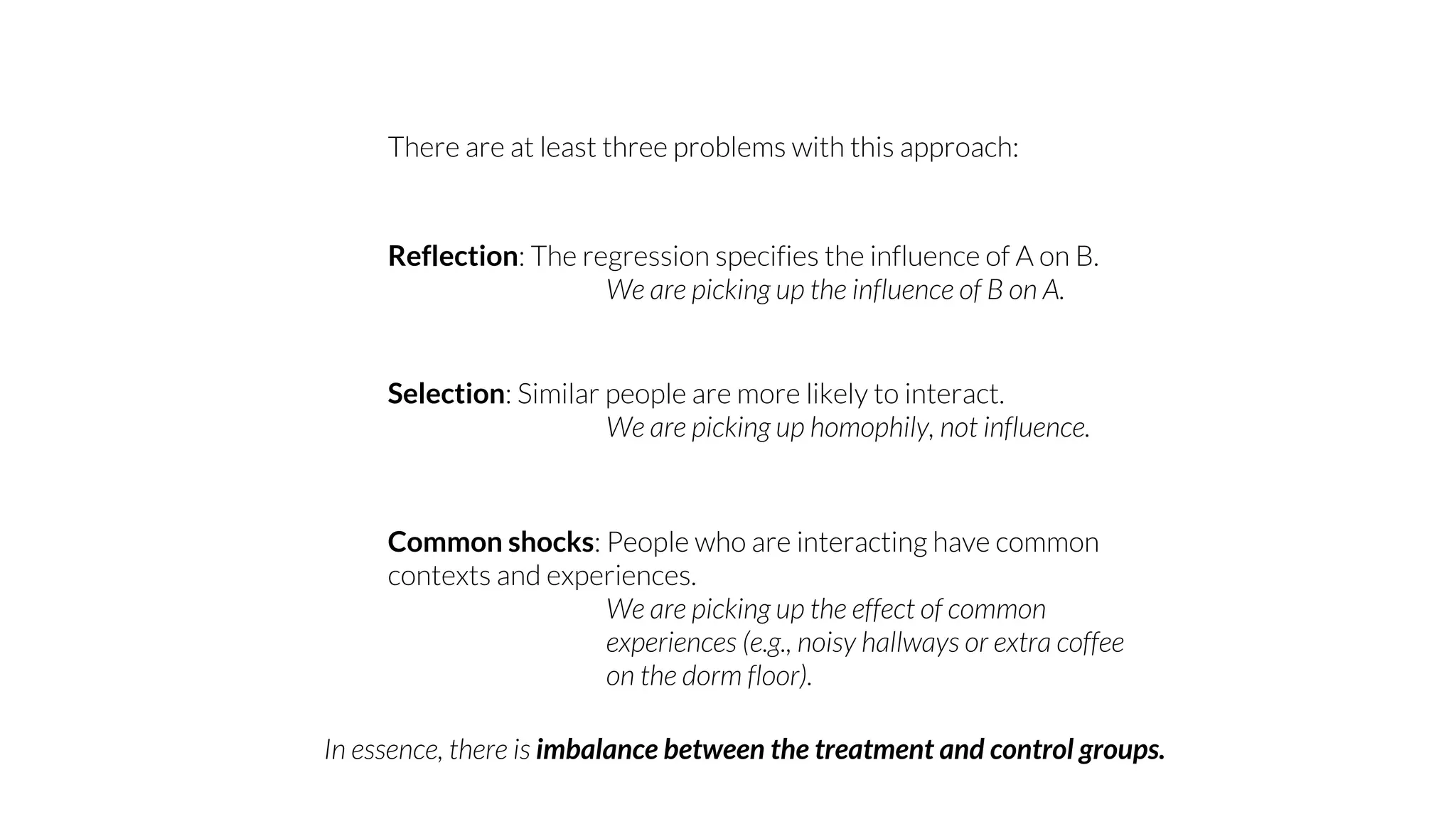
Selection: Similar peopleare more likely to interact.
We are picking up homophily, not influence.
Reflection: The regression specifies the influence of A on B.
We are picking up the influence of B on A.
There are at least three problems with this approach:
Common shocks: People who are interacting have common
contexts and experiences.
We are picking up the effect of common
experiences (e.g., noisy hallways or extra coffee
on the dorm floor).
In essence, there is imbalance between the treatment and control groups.
7.
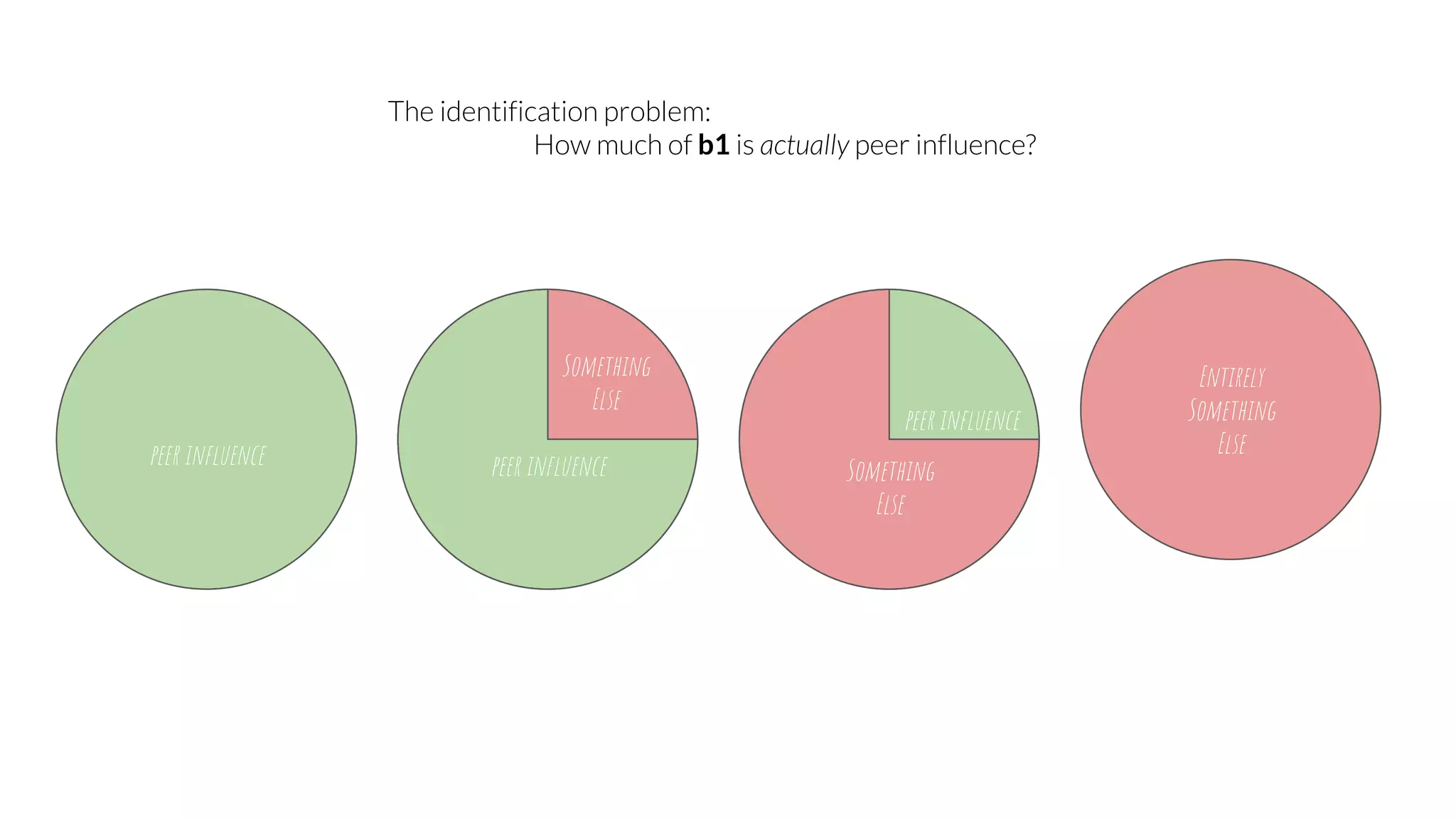
peer influence peerinfluence
peer influence
Something
Else
Entirely
Something
Else
Something
Else
The identification problem:
How much of b1 is actually peer influence?
8.
Selection: Similar peopleare more likely to interact.
Include controls that account for dimensions
on which people may decide to form a
connection.
Reflection: The regression specifies the influence of A on B.
Lag the independent variable.
The standard approach to dealing with this identification
problem:
Common shocks: People who are interacting have common
contexts and experiences.
Include features of the context that may
influence the performance of both A and B.
Y(i,t) = b0 + b1*(Y(j,t-1)) + Controls + e
9.
This seems likea reasonable strategy, but:
How many other factors can you actually account for with “controls?”
Y(i,t) = b0 + b1*(Y(j,t-1)) + e
Why randomization?:
1. Creates balance between treatment and control groups.
2. Reduces the likelihood that unobserved factors of
selection or context are causing the observed effects.
3. This is because, treatment condition and the
characteristics of pairs are now uncorrelated.
10.
Y(i,t) = b0+ b1*(Y(j,t-1)) + Controls + e
No evidence for a causal peer effect.
The coefficient is basically “0.”
Alice Bob
Alice has good grades.
By interacting with
Alice, will Bob also get
good grades?
Influence
11.
Much of thiswas driven by two thing: (1) subject
specific learning; (2) peer effects were driven
primarily by students who actually studied
together.
12.
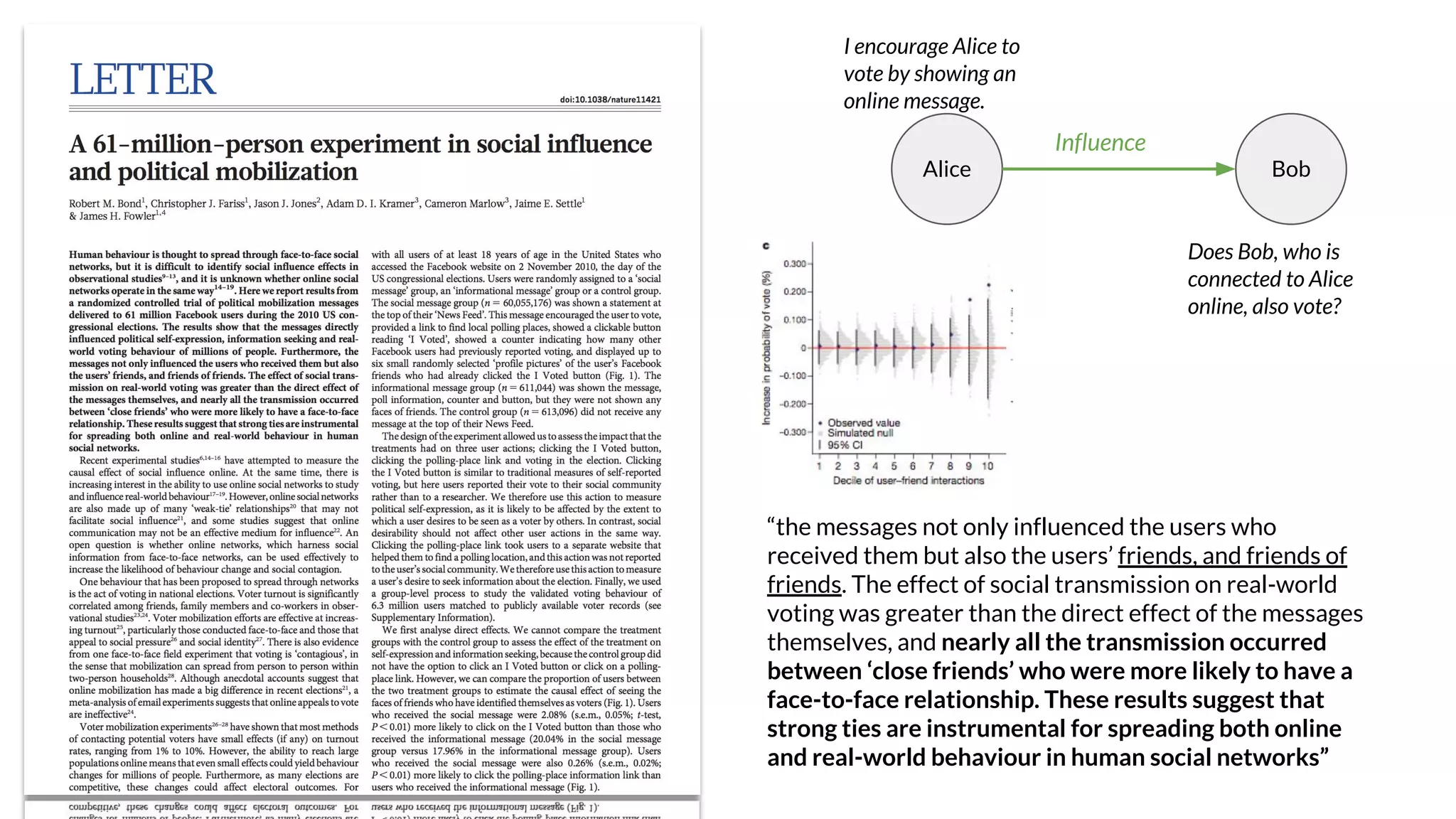
“the messages notonly influenced the users who
received them but also the users’ friends, and friends of
friends. The effect of social transmission on real-world
voting was greater than the direct effect of the messages
themselves, and nearly all the transmission occurred
between ‘close friends’ who were more likely to have a
face-to-face relationship. These results suggest that
strong ties are instrumental for spreading both online
and real-world behaviour in human social networks”
Alice Bob
I encourage Alice to
vote by showing an
online message.
Does Bob, who is
connected to Alice
online, also vote?
Influence
13.
Our estimates showthat peer influence causes
more than a 60% increase in odds of buying the
service due to the influence coming from an
adopting friend. In addition, we find that users
with a smaller number of friends experience
stronger relative increase in the adoption
likelihood due to influence from their peers as
compared to the users with a larger number of
friends.
Alice Bob
I encourage Alice to
buy an online product.
Does Bob, who is
connected to Alice
online, also buy it?
Influence
14.
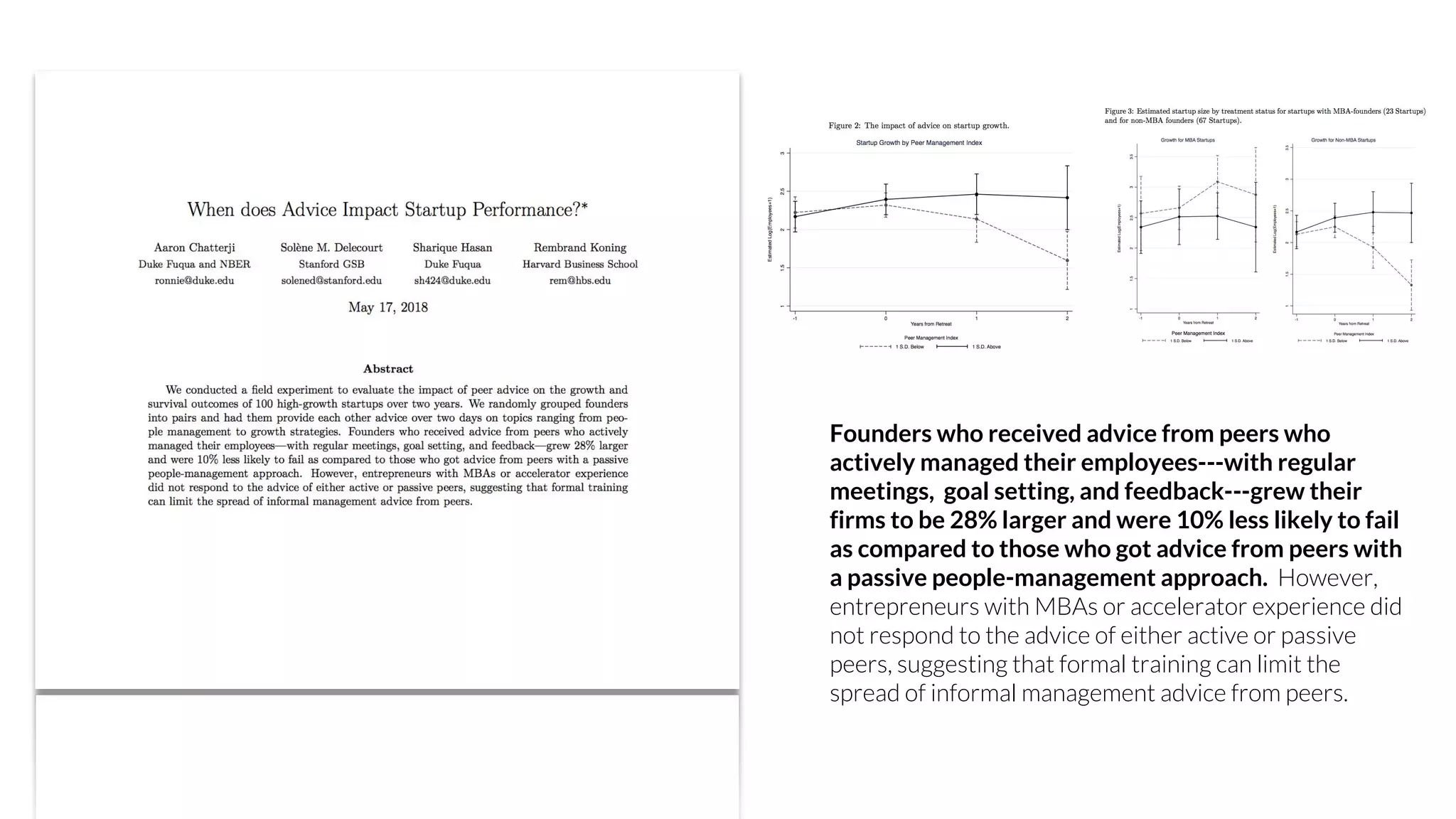
Founders who receivedadvice from peers who
actively managed their employees---with regular
meetings, goal setting, and feedback---grew their
firms to be 28% larger and were 10% less likely to fail
as compared to those who got advice from peers with
a passive people-management approach. However,
entrepreneurs with MBAs or accelerator experience did
not respond to the advice of either active or passive
peers, suggesting that formal training can limit the
spread of informal management advice from peers.
Alice Bob
What encouragesAlice and Bob to
form a tie?
We run a randomized field experiment on a major North American online dating
website, where 50,000 of 100,000 randomly selected new users are gifted the ability
to anonymously view profiles of other users. Compared with the control group, the
users treated with anonymity become disinhibited, in that they view more profiles
and are more likely to view same-sex and interracial mates.
Anonymous users, who lose the ability to leave a weak signal, end
up having fewer matches compared with their nonanonymous
counterparts. This effect of anonymity is particularly strong for
women, who tend not to make the first move and instead rely on
the counterparty to initiate the communication.
“I was looking back to see if you
were looking back at me to see
me looking back at you”
17.
Vary search costsfor pairs of potential
collaborators by randomly assigning individuals
to 90-minute structured information-sharing
sessions as part of a grant funding opportunity.
We estimate that the treatment increases the
probability of grant co-application of a given
pair of researchers by 75%. The findings
suggest that matching between scientists is
subject to considerable friction, even in the
case of geographically proximate scientists
working in the same institutional context.
Alice Bob
Alice Cal
18.
Alice Bob
Cam
Dev
Does Alice’snetwork grow in
proportion to her connections?
We find strong evidence that interacting with
random, but well-connected, roommates causes
significant growth of a focal student’s network.
Further, we find that this growth also implies an
increase in how close an actor moves to a
network’s center and whether that actor is
likely to serve as a network bridge.
“behavior spread fartherand faster across
clustered-lattice networks than across
corresponding random networks.”
22.
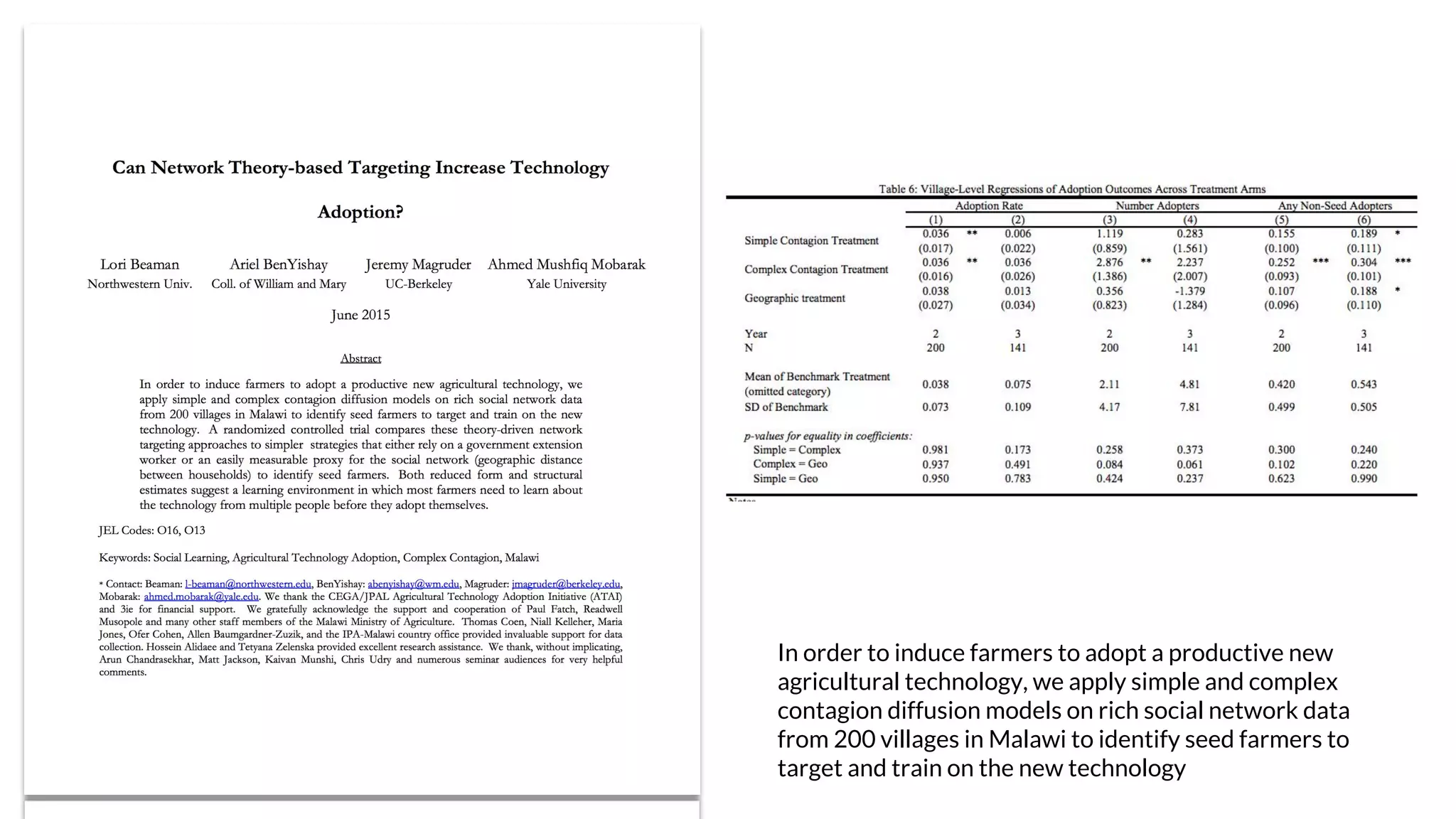
In order toinduce farmers to adopt a productive new
agricultural technology, we apply simple and complex
contagion diffusion models on rich social network data
from 200 villages in Malawi to identify seed farmers to
target and train on the new technology
23.
Alice Bob
Alice hasgood grades.
By interacting with
Alice, will Bob also get
good grades?
Influence
Y(i,t) = b0 + b1*(Y(j,t-1)) + b2*(Y(i,t-1)) +b3*(Y(j,t-1)*Y(i,t-1)) + e
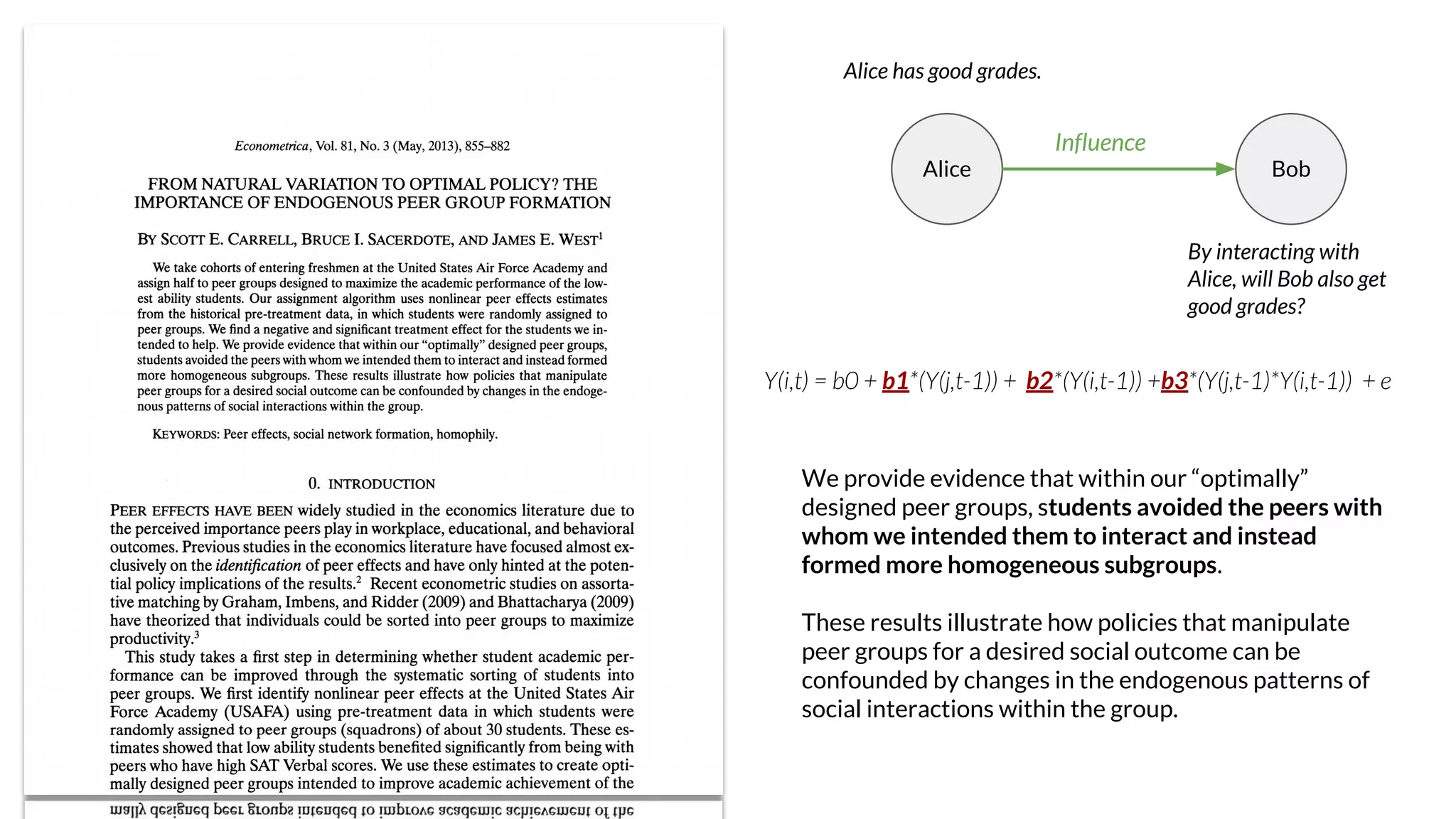
We provide evidence that within our “optimally”
designed peer groups, students avoided the peers with
whom we intended them to interact and instead
formed more homogeneous subgroups.
These results illustrate how policies that manipulate
peer groups for a desired social outcome can be
confounded by changes in the endogenous patterns of
social interactions within the group.
24.
Three types ofnetwork field experiments.
Peer effects: Does j influence the behavior/outcomes of i?
Network Formation: What affects whether i forms a network
tie with j?
Designing networks: Which network structures maximize
network-level outcomes?