How Networks Shape Attitudes and Attitudes Shape Networks Diffusion and Contagion
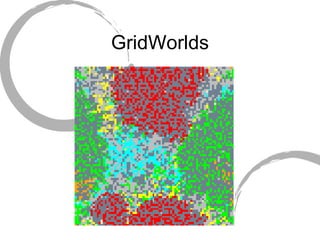
GridWorlds
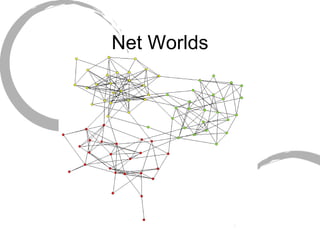
Net Worlds
Contagion and Diffusion We choose our friends, and our friends choose us We learn from them, they learn from us Thus… Formation of networks and formation of attitudes are inextricably linked
Cont… We shall observe two processes that shape dynamic networks: Social contagion = diffusion of attributes shaped by network structure Formation of homophily groups = network structure shaped by attributes
Friedkin Contagion Model Peer influence models assume that individuals’ opinions are formed in a process of interpersonal negotiation and adjustment of opinions. Can result in either consensus or disagreement Looks at interaction among a system of actors Assumption that a network is static, but individuals change
Basic Peer Influence Model Attitudes are a function of two sources: a) Individual characteristics Gender, Age, Race, Education, Etc.  Standard sociology b) Interpersonal influences Actors negotiate opinions with others
Freidkin claims in his  Structural Theory of Social Influence  that the theory has four benefits: Relaxes the simplifying assumption of actors who must either conform or deviate from a fixed consensus of others (public choice model) Does not necessarily result in consensus, but can have a stable pattern of disagreement Is a multi-level theory: micro level: cognitive theory about how people weigh and combine other’s opinions macro level: concerned with how social structural arrangements enter into and constrain the opinion-formation process Allows an analysis of the systemic consequences of social structures Basic Peer Influence Model
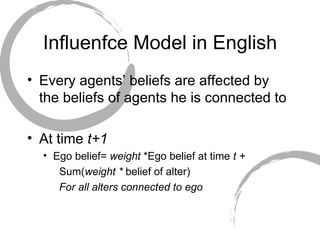
Influenfce Model in English Every agents’ beliefs are affected by the beliefs of agents he is connected to At time  t+1 Ego belief=  weight  *Ego belief at time  t + Sum( weight *  belief of alter) For all alters connected to ego
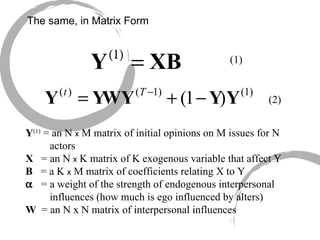
The same, in Matrix Form (1) (2) Y (1)  = an N  x  M matrix of initial opinions on M issues for N actors X   = an N  x  K matrix of K exogenous variable that affect Y B   = a K  x  M matrix of coefficients relating X to Y    = a weight of the strength of endogenous interpersonal influences (how much is ego influenced by alters) W   = an N x N matrix of interpersonal influences
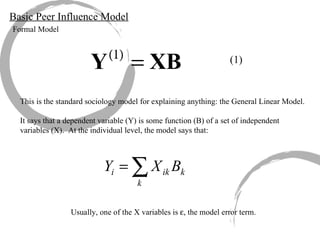
Basic Peer Influence Model Formal Model (1) This is the standard sociology model for explaining anything: the General Linear Model. It says that a dependent variable (Y) is some function (B) of a set of independent variables (X).  At the individual level, the model says that: Usually, one of the X variables is   , the model error term.
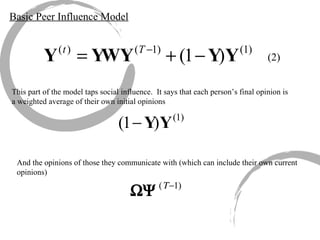
Basic Peer Influence Model (2) This part of the model taps social influence.  It says that each person’s final opinion is a weighted average of their own initial opinions  And the opinions of those they communicate with (which can include their own current opinions)
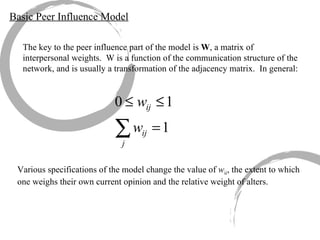
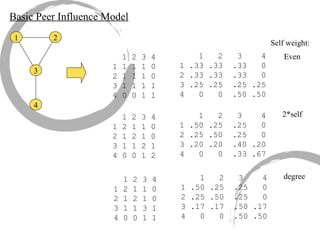
Basic Peer Influence Model The key to the peer influence part of the model is  W , a matrix of interpersonal weights.  W is a function of the communication structure of the network, and is usually a transformation of the adjacency matrix.  In general:  Various specifications of the model change the value of  w ii , the extent to which one weighs their own current opinion and the relative weight of alters.
Basic Peer Influence Model 1 2 3 4 1 2 3 4 1 1 1 1 0 2 1 1 1 0 3 1 1 1 1 4 0 0 1 1 1  2  3  4 1 .33 .33  .33  0 2 .33 .33  .33  0 3 .25 .25  .25 .25 4  0  0  .50 .50 1  2  3  4 1 .50 .25  .25  0 2 .25 .50  .25  0 3 .20 .20  .40 .20 4  0  0  .33 .67 Even 2*self 1  2  3  4 1 .50 .25  .25  0 2 .25 .50  .25  0 3 .17 .17  .50 .17 4  0  0  .50 .50 degree Self weight: 1 2 3 4 1 2 1 1 0 2 1 2 1 0 3 1 1 2 1 4 0 0 1 2 1 2 3 4 1 2 1 1 0 2 1 2 1 0 3 1 1 3 1 4 0 0 1 1
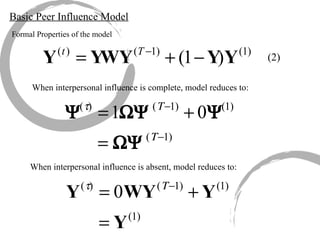
Basic Peer Influence Model Formal Properties of the model When interpersonal influence is complete, model reduces to: When interpersonal influence is absent, model reduces to: (2)
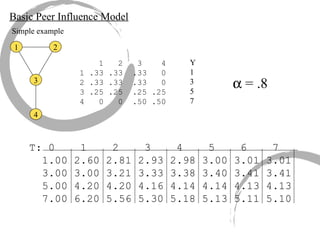
Basic Peer Influence Model Simple example 1 2 3 4 1  2  3  4 1 .33 .33  .33  0 2 .33 .33  .33  0 3 .25 .25  .25 .25 4  0  0  .50 .50 Y 1 3 5 7    = .8 T: 0  1  2  3  4  5  6  7 1.00 2.60 2.81 2.93 2.98 3.00 3.01 3.01  3.00 3.00 3.21 3.33 3.38 3.40 3.41 3.41 5.00 4.20 4.20 4.16 4.14 4.14 4.13 4.13 7.00 6.20 5.56 5.30 5.18 5.13 5.11 5.10
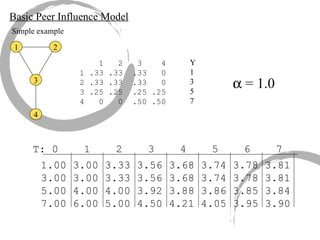
Basic Peer Influence Model Simple example 1 2 3 4 1  2  3  4 1 .33 .33  .33  0 2 .33 .33  .33  0 3 .25 .25  .25 .25 4  0  0  .50 .50 Y 1 3 5 7    = 1.0 1.00 3.00 3.33 3.56 3.68 3.74 3.78 3.81 3.00 3.00 3.33 3.56 3.68 3.74 3.78 3.81 5.00 4.00 4.00 3.92 3.88 3.86 3.85 3.84 7.00 6.00 5.00 4.50 4.21 4.05 3.95 3.90 T: 0  1  2  3  4  5  6  7
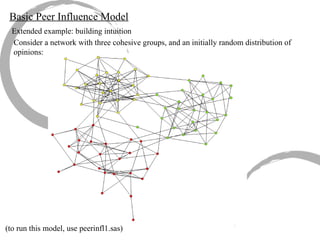
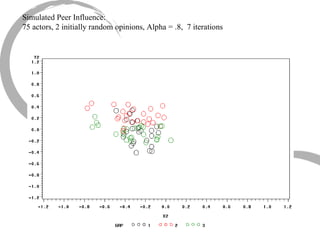
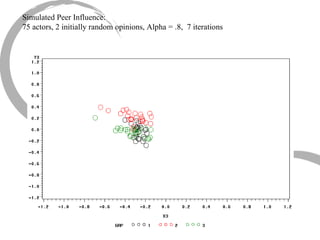
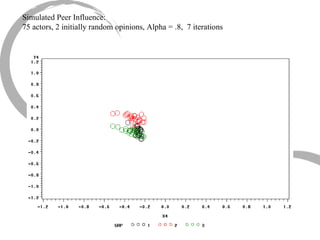
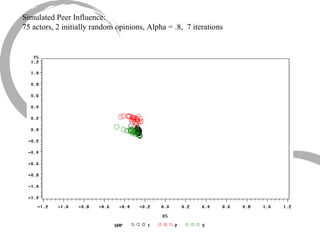
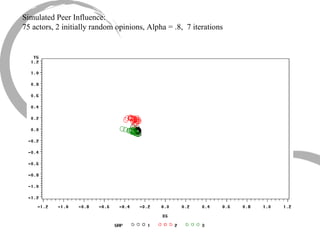
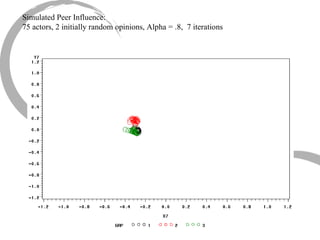
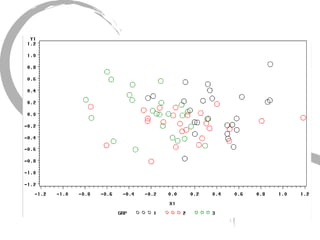
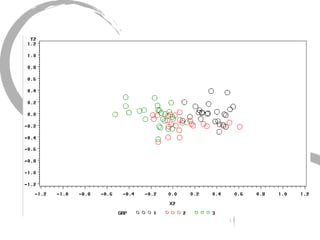
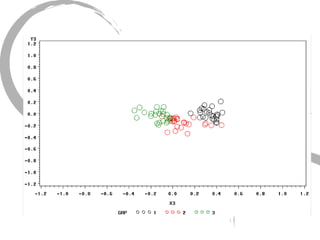
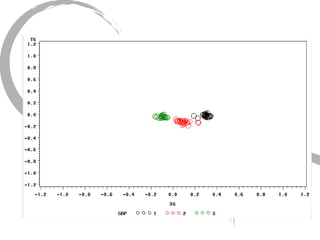
Basic Peer Influence Model Extended example: building intuition Consider a network with three cohesive groups, and an initially random distribution of opinions: (to run this model, use peerinfl1.sas)
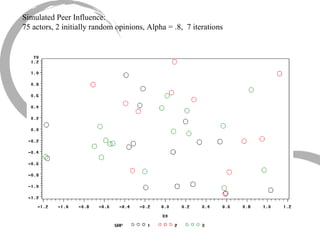
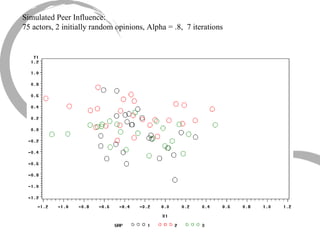
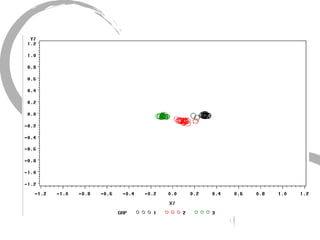
Simulated Peer Influence: 75 actors, 2 initially random opinions, Alpha = .8,  7 iterations
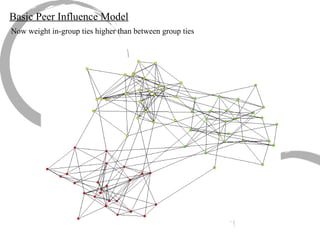
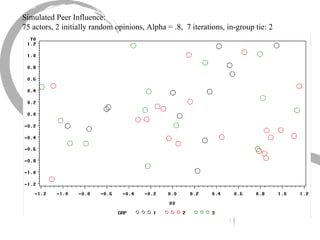
Basic Peer Influence Model Now weight in-group ties higher than between group ties
Simulated Peer Influence: 75 actors, 2 initially random opinions, Alpha = .8,  7 iterations, in-group tie: 2


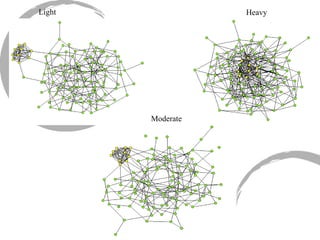
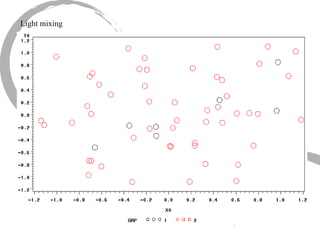
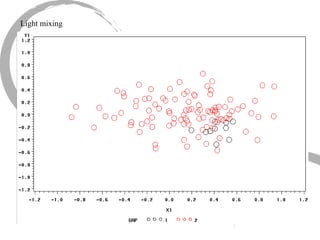
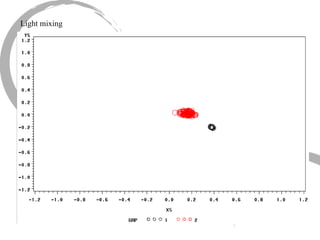
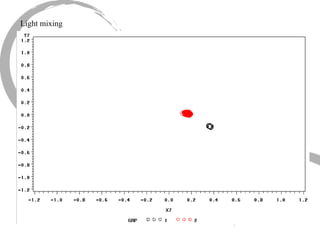
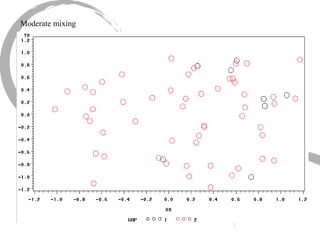
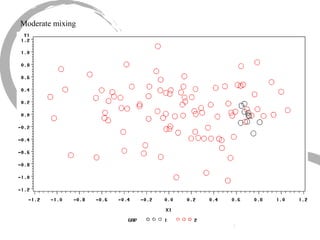
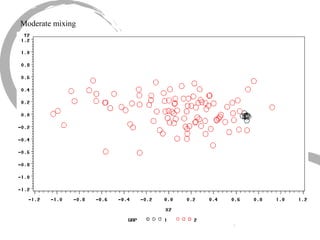
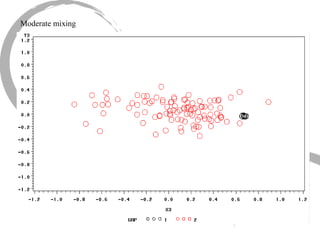
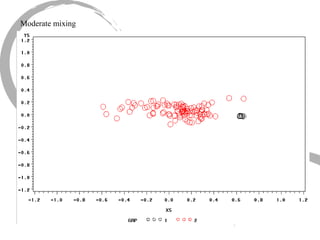
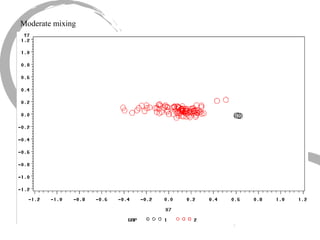
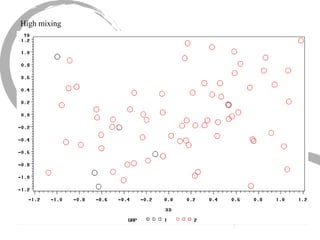
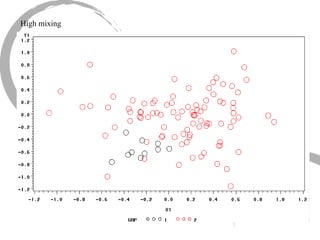
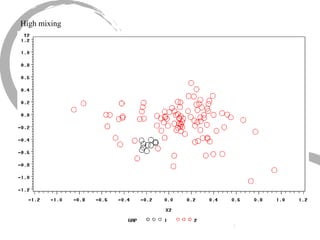
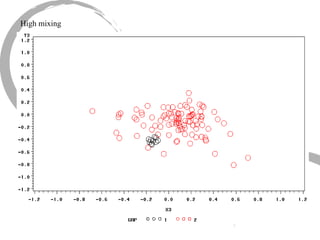
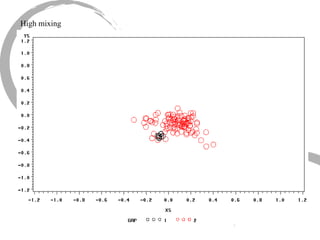
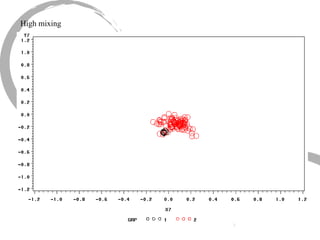
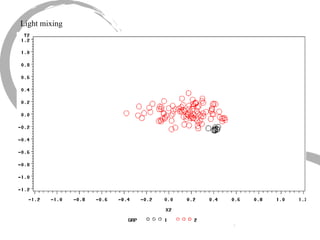
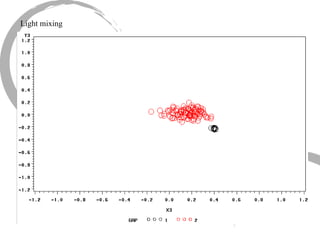
Consider the implications for populations of different structures.  For example, we might have two groups, a large orthodox population and a small heterodox population.  We can imagine the groups mixing in various levels: Heterodox: 10 people Orthodox: 100 People
Light Heavy Moderate
Light mixing
Light mixing
Light mixing
Light mixing
Light mixing
Light mixing
Moderate mixing
Moderate mixing
Moderate mixing
Moderate mixing
Moderate mixing
Moderate mixing
High mixing
High mixing
High mixing
High mixing
High mixing
High mixing
Size Matters In an unbalanced situation (small group vs large group) the extent of contact can easily overwhelm the small group.  Applications of this idea are evident in: Missionary work (Must be certain to send missionaries out into the world with strong in-group contacts) Overcoming deviant culture (I.e. youth gangs vs. adults)
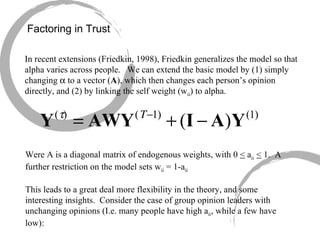
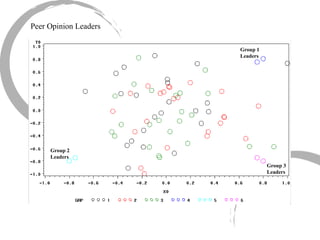
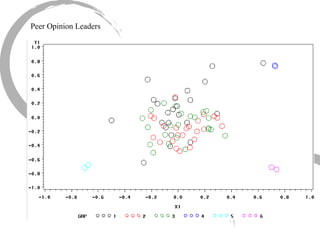
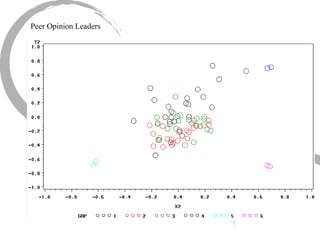
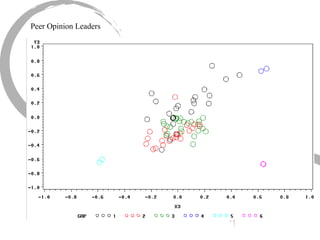
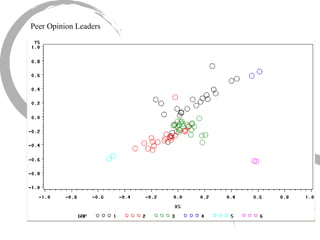
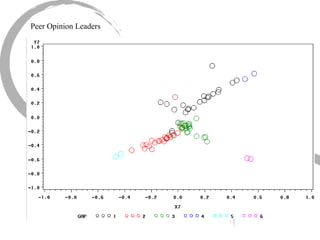
Factoring in Trust In recent extensions (Friedkin, 1998), Friedkin generalizes the model so that alpha varies across people.  We can extend the basic model by (1) simply changing    to a vector ( A ), which then changes each person’s opinion directly, and (2) by linking the self weight (w ii ) to alpha. Were A is a diagonal matrix of endogenous weights, with 0  <  a ii   <  1.  A further restriction on the model sets w ii  = 1-a ii This leads to a great deal more flexibility in the theory, and some interesting insights.  Consider the case of group opinion leaders with unchanging opinions (I.e. many people have high a ii , while a few have low):
Group 1  Leaders Group 2  Leaders Group 3  Leaders Peer Opinion Leaders
Peer Opinion Leaders
Extensions of the Model Time dependent   : people likely value other’s opinions more early than later in a decision context Can be done in context of simulated annealing; Randomization in   Interact   with XB: people’s self weights are a function of their behaviors & attributes
Make  W  dependent on structure of the network (weight transitive ties greater than intransitive ties, for example) Time dependent  W : The network of contacts does not remain constant, but is dynamic, meaning that influence likely moves unevenly through the network Extensions of the Model
Friedkin & Cook One piece in a long standing research program.  Other cites include: Friedkin, N. E. 1984. &quot;Structural Cohesion and Equivalence Explanations of Social Homogeneity.&quot;  Sociological Methods and Research  12:235-61. ——— . 1998.  A Structural Theory of Social Influence . Cambridge: Cambridge. Friedkin, N. E. and E. C. Johnsen. 1990. &quot;Social Influence and Opinions.&quot;  Journal of Mathematical Sociology  15(193-205). ——— . 1997. &quot;Social Positions in Influence Networks.&quot;  Social Networks  19:209-22.
So we know… …  Attitudes and knowledge are affected by the network structure But is the network affected by the attitudes?
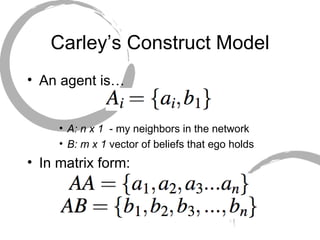
Carley’s Construct Model An agent is… A: n x 1  - my neighbors in the network B: m x 1  vector of beliefs that ego holds In matrix form:
Knowledge Network …or any 2-mode network “People x Attribute” “People x Resource” “People x Organization” …etc
How networks form Agents tend to communicated with either: People similar to them (I.e. with similar observed beliefs or attributes) Or People that can provide useful information
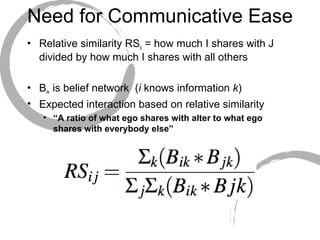
Need for Communicative Ease Relative similarity RS ij  = how much I shares with J divided by how much I shares with all others  B ik  is belief network  ( i  knows information  k ) Expected interaction based on relative similarity “ A ratio of what ego shares with alter to what ego shares with everybody else”
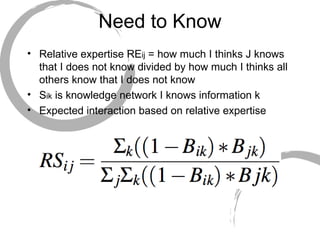
Need to Know Relative expertise RE ij  = how much I thinks J knows that I does not know divided by how much I thinks all others know that I does not know S ik  is knowledge network I knows information k Expected interaction based on relative expertise
What do we get from this… RS and RE are equivalent to probability of interaction At each time, agents get a chance to interact based on the probabilities An interaction=creation of a network tie Ties decay with time if not reactivated
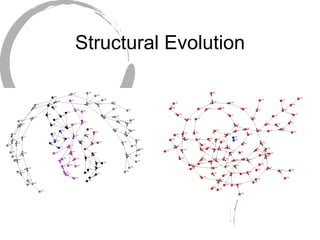
Structural Evolution
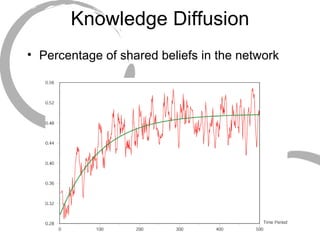
Knowledge Diffusion Percentage of shared beliefs in the network
Summary Friedkin’s Contagion Model derives belief structures from network structures Carley’s Construct Model derives network structures from belief structures Construct allows simultaneous manipulation of beliefs and network structure

11 Contagion

  • 1.
    How Networks ShapeAttitudes and Attitudes Shape Networks Diffusion and Contagion
  • 2.
  • 3.
  • 4.
    Contagion and DiffusionWe choose our friends, and our friends choose us We learn from them, they learn from us Thus… Formation of networks and formation of attitudes are inextricably linked
  • 5.
    Cont… We shallobserve two processes that shape dynamic networks: Social contagion = diffusion of attributes shaped by network structure Formation of homophily groups = network structure shaped by attributes
  • 6.
    Friedkin Contagion ModelPeer influence models assume that individuals’ opinions are formed in a process of interpersonal negotiation and adjustment of opinions. Can result in either consensus or disagreement Looks at interaction among a system of actors Assumption that a network is static, but individuals change
  • 7.
    Basic Peer InfluenceModel Attitudes are a function of two sources: a) Individual characteristics Gender, Age, Race, Education, Etc. Standard sociology b) Interpersonal influences Actors negotiate opinions with others
  • 8.
    Freidkin claims inhis Structural Theory of Social Influence that the theory has four benefits: Relaxes the simplifying assumption of actors who must either conform or deviate from a fixed consensus of others (public choice model) Does not necessarily result in consensus, but can have a stable pattern of disagreement Is a multi-level theory: micro level: cognitive theory about how people weigh and combine other’s opinions macro level: concerned with how social structural arrangements enter into and constrain the opinion-formation process Allows an analysis of the systemic consequences of social structures Basic Peer Influence Model
  • 9.
    Influenfce Model inEnglish Every agents’ beliefs are affected by the beliefs of agents he is connected to At time t+1 Ego belief= weight *Ego belief at time t + Sum( weight * belief of alter) For all alters connected to ego
  • 10.
    The same, inMatrix Form (1) (2) Y (1) = an N x M matrix of initial opinions on M issues for N actors X = an N x K matrix of K exogenous variable that affect Y B = a K x M matrix of coefficients relating X to Y  = a weight of the strength of endogenous interpersonal influences (how much is ego influenced by alters) W = an N x N matrix of interpersonal influences
  • 11.
    Basic Peer InfluenceModel Formal Model (1) This is the standard sociology model for explaining anything: the General Linear Model. It says that a dependent variable (Y) is some function (B) of a set of independent variables (X). At the individual level, the model says that: Usually, one of the X variables is  , the model error term.
  • 12.
    Basic Peer InfluenceModel (2) This part of the model taps social influence. It says that each person’s final opinion is a weighted average of their own initial opinions And the opinions of those they communicate with (which can include their own current opinions)
  • 13.
    Basic Peer InfluenceModel The key to the peer influence part of the model is W , a matrix of interpersonal weights. W is a function of the communication structure of the network, and is usually a transformation of the adjacency matrix. In general: Various specifications of the model change the value of w ii , the extent to which one weighs their own current opinion and the relative weight of alters.
  • 14.
    Basic Peer InfluenceModel 1 2 3 4 1 2 3 4 1 1 1 1 0 2 1 1 1 0 3 1 1 1 1 4 0 0 1 1 1 2 3 4 1 .33 .33 .33 0 2 .33 .33 .33 0 3 .25 .25 .25 .25 4 0 0 .50 .50 1 2 3 4 1 .50 .25 .25 0 2 .25 .50 .25 0 3 .20 .20 .40 .20 4 0 0 .33 .67 Even 2*self 1 2 3 4 1 .50 .25 .25 0 2 .25 .50 .25 0 3 .17 .17 .50 .17 4 0 0 .50 .50 degree Self weight: 1 2 3 4 1 2 1 1 0 2 1 2 1 0 3 1 1 2 1 4 0 0 1 2 1 2 3 4 1 2 1 1 0 2 1 2 1 0 3 1 1 3 1 4 0 0 1 1
  • 15.
    Basic Peer InfluenceModel Formal Properties of the model When interpersonal influence is complete, model reduces to: When interpersonal influence is absent, model reduces to: (2)
  • 16.
    Basic Peer InfluenceModel Simple example 1 2 3 4 1 2 3 4 1 .33 .33 .33 0 2 .33 .33 .33 0 3 .25 .25 .25 .25 4 0 0 .50 .50 Y 1 3 5 7  = .8 T: 0 1 2 3 4 5 6 7 1.00 2.60 2.81 2.93 2.98 3.00 3.01 3.01 3.00 3.00 3.21 3.33 3.38 3.40 3.41 3.41 5.00 4.20 4.20 4.16 4.14 4.14 4.13 4.13 7.00 6.20 5.56 5.30 5.18 5.13 5.11 5.10
  • 17.
    Basic Peer InfluenceModel Simple example 1 2 3 4 1 2 3 4 1 .33 .33 .33 0 2 .33 .33 .33 0 3 .25 .25 .25 .25 4 0 0 .50 .50 Y 1 3 5 7  = 1.0 1.00 3.00 3.33 3.56 3.68 3.74 3.78 3.81 3.00 3.00 3.33 3.56 3.68 3.74 3.78 3.81 5.00 4.00 4.00 3.92 3.88 3.86 3.85 3.84 7.00 6.00 5.00 4.50 4.21 4.05 3.95 3.90 T: 0 1 2 3 4 5 6 7
  • 18.
    Basic Peer InfluenceModel Extended example: building intuition Consider a network with three cohesive groups, and an initially random distribution of opinions: (to run this model, use peerinfl1.sas)
  • 19.
    Simulated Peer Influence:75 actors, 2 initially random opinions, Alpha = .8, 7 iterations
  • 20.
    Simulated Peer Influence:75 actors, 2 initially random opinions, Alpha = .8, 7 iterations
  • 21.
    Simulated Peer Influence:75 actors, 2 initially random opinions, Alpha = .8, 7 iterations
  • 22.
    Simulated Peer Influence:75 actors, 2 initially random opinions, Alpha = .8, 7 iterations
  • 23.
    Simulated Peer Influence:75 actors, 2 initially random opinions, Alpha = .8, 7 iterations
  • 24.
    Simulated Peer Influence:75 actors, 2 initially random opinions, Alpha = .8, 7 iterations
  • 25.
    Simulated Peer Influence:75 actors, 2 initially random opinions, Alpha = .8, 7 iterations
  • 26.
    Simulated Peer Influence:75 actors, 2 initially random opinions, Alpha = .8, 7 iterations
  • 27.
    Basic Peer InfluenceModel Now weight in-group ties higher than between group ties
  • 28.
    Simulated Peer Influence:75 actors, 2 initially random opinions, Alpha = .8, 7 iterations, in-group tie: 2
  • 29.
  • 30.
  • 31.
  • 32.
  • 33.
  • 34.
    Consider the implicationsfor populations of different structures. For example, we might have two groups, a large orthodox population and a small heterodox population. We can imagine the groups mixing in various levels: Heterodox: 10 people Orthodox: 100 People
  • 35.
  • 36.
  • 37.
  • 38.
  • 39.
  • 40.
  • 41.
  • 42.
  • 43.
  • 44.
  • 45.
  • 46.
  • 47.
  • 48.
  • 49.
  • 50.
  • 51.
  • 52.
  • 53.
  • 54.
    Size Matters Inan unbalanced situation (small group vs large group) the extent of contact can easily overwhelm the small group. Applications of this idea are evident in: Missionary work (Must be certain to send missionaries out into the world with strong in-group contacts) Overcoming deviant culture (I.e. youth gangs vs. adults)
  • 55.
    Factoring in TrustIn recent extensions (Friedkin, 1998), Friedkin generalizes the model so that alpha varies across people. We can extend the basic model by (1) simply changing  to a vector ( A ), which then changes each person’s opinion directly, and (2) by linking the self weight (w ii ) to alpha. Were A is a diagonal matrix of endogenous weights, with 0 < a ii < 1. A further restriction on the model sets w ii = 1-a ii This leads to a great deal more flexibility in the theory, and some interesting insights. Consider the case of group opinion leaders with unchanging opinions (I.e. many people have high a ii , while a few have low):
  • 56.
    Group 1 Leaders Group 2 Leaders Group 3 Leaders Peer Opinion Leaders
  • 57.
  • 58.
  • 59.
  • 60.
  • 61.
  • 62.
    Extensions of theModel Time dependent  : people likely value other’s opinions more early than later in a decision context Can be done in context of simulated annealing; Randomization in  Interact  with XB: people’s self weights are a function of their behaviors & attributes
  • 63.
    Make W dependent on structure of the network (weight transitive ties greater than intransitive ties, for example) Time dependent W : The network of contacts does not remain constant, but is dynamic, meaning that influence likely moves unevenly through the network Extensions of the Model
  • 64.
    Friedkin & CookOne piece in a long standing research program. Other cites include: Friedkin, N. E. 1984. &quot;Structural Cohesion and Equivalence Explanations of Social Homogeneity.&quot; Sociological Methods and Research 12:235-61. ——— . 1998. A Structural Theory of Social Influence . Cambridge: Cambridge. Friedkin, N. E. and E. C. Johnsen. 1990. &quot;Social Influence and Opinions.&quot; Journal of Mathematical Sociology 15(193-205). ——— . 1997. &quot;Social Positions in Influence Networks.&quot; Social Networks 19:209-22.
  • 65.
    So we know…… Attitudes and knowledge are affected by the network structure But is the network affected by the attitudes?
  • 66.
    Carley’s Construct ModelAn agent is… A: n x 1 - my neighbors in the network B: m x 1 vector of beliefs that ego holds In matrix form:
  • 67.
    Knowledge Network …orany 2-mode network “People x Attribute” “People x Resource” “People x Organization” …etc
  • 68.
    How networks formAgents tend to communicated with either: People similar to them (I.e. with similar observed beliefs or attributes) Or People that can provide useful information
  • 69.
    Need for CommunicativeEase Relative similarity RS ij = how much I shares with J divided by how much I shares with all others B ik is belief network ( i knows information k ) Expected interaction based on relative similarity “ A ratio of what ego shares with alter to what ego shares with everybody else”
  • 70.
    Need to KnowRelative expertise RE ij = how much I thinks J knows that I does not know divided by how much I thinks all others know that I does not know S ik is knowledge network I knows information k Expected interaction based on relative expertise
  • 71.
    What do weget from this… RS and RE are equivalent to probability of interaction At each time, agents get a chance to interact based on the probabilities An interaction=creation of a network tie Ties decay with time if not reactivated
  • 72.
  • 73.
    Knowledge Diffusion Percentageof shared beliefs in the network
  • 74.
    Summary Friedkin’s ContagionModel derives belief structures from network structures Carley’s Construct Model derives network structures from belief structures Construct allows simultaneous manipulation of beliefs and network structure