
Web-Scale Graph Analytics
with Apache Spark
Tim Hunter, Databricks
#EUds6
2
About Me
• Tim Hunter
• Software engineer @ Databricks
• Ph.D. from UC Berkeley in Machine Learning
• Very early Spark user
• Contributor to MLlib
• Co-author of TensorFrames, GraphFrames, Deep Learning
Pipelines
#EUds6 2
3
Outline
• Why GraphFrames
• Writing scalable graph algorithms with Spark
– Where is my vertex? Indexing data
– Connected Components: implementing complex
algorithms with Spark and GraphFrames
– The Social Network: real-world issues
• Future of GraphFrames
3#EUds6
4
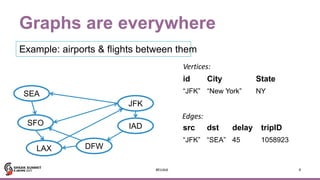
Graphs are everywhere
4#EUds6
JFK
IAD
LAX
SFO
SEA
DFW
Example: airports & flights between them
src dst delay tripID
“JFK” “SEA” 45 1058923
id City State
“JFK” “New York” NY
Vertices:
Edges:
5
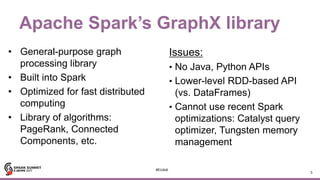
Apache Spark’s GraphX library
• General-purpose graph
processing library
• Built into Spark
• Optimized for fast distributed
computing
• Library of algorithms:
PageRank, Connected
Components, etc.
5
Issues:
• No Java, Python APIs
• Lower-level RDD-based API
(vs. DataFrames)
• Cannot use recent Spark
optimizations: Catalyst query
optimizer, Tungsten memory
management
#EUds6
6
The GraphFrames Spark Package
Brings DataFrames API for Spark
• Simplifies interactive queries
• Benefits from DataFrames optimizations
• Integrates with the rest of Spark ecosystem
Collaboration between Databricks, UC Berkeley & MIT
6
#EUds6
7
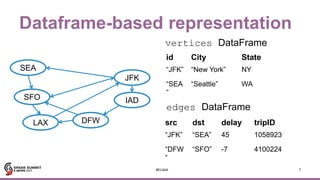
Dataframe-based representation
7#EUds6
JFK
IAD
LAX
SFO
SEA
DFW
id City State
“JFK” “New York” NY
“SEA
”
“Seattle” WA
src dst delay tripID
“JFK” “SEA” 45 1058923
“DFW
”
“SFO” -7 4100224
vertices DataFrame
edges DataFrame
8
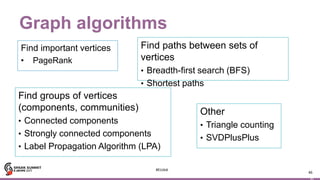
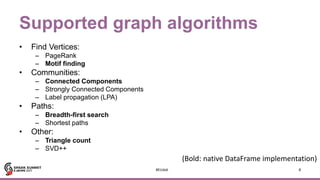
Supported graph algorithms
• Find Vertices:
– PageRank
– Motif finding
• Communities:
– Connected Components
– Strongly Connected Components
– Label propagation (LPA)
• Paths:
– Breadth-first search
– Shortest paths
• Other:
– Triangle count
– SVD++
8#EUds6
(Bold: native DataFrame implementation)
1
Assigning integral vertex IDs
… lessons learned
10#EUds6
1
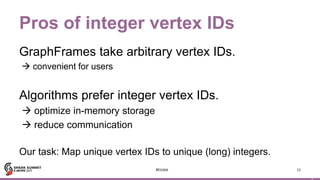
Pros of integer vertex IDs
GraphFrames take arbitrary vertex IDs.
 convenient for users
Algorithms prefer integer vertex IDs.
 optimize in-memory storage
 reduce communication
Our task: Map unique vertex IDs to unique (long) integers.
#EUds6 11
1
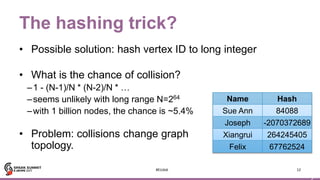
The hashing trick?
• Possible solution: hash vertex ID to long integer
• What is the chance of collision?
–1 - (N-1)/N * (N-2)/N * …
–seems unlikely with long range N=264
–with 1 billion nodes, the chance is ~5.4%
• Problem: collisions change graph
topology.
Name Hash
Sue Ann 84088
Joseph -2070372689
Xiangrui 264245405
Felix 67762524
#EUds6 12
1
Generating unique IDs
Spark has built-in methods to generate unique IDs.
• RDD: zipWithUniqueId(), zipWithIndex()
• DataFrame: monotonically_increasing_id()
Possible solution: just use these methods
#EUds6 13
1
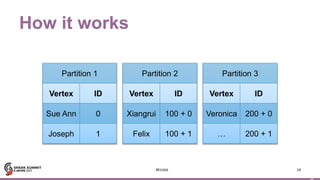
How it works
Partition 1
Vertex ID
Sue Ann 0
Joseph 1
Partition 2
Vertex ID
Xiangrui 100 + 0
Felix 100 + 1
Partition 3
Vertex ID
Veronica 200 + 0
… 200 + 1
#EUds6 14
1
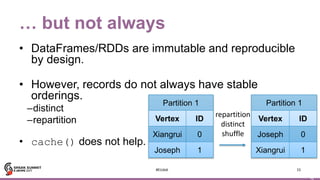
… but not always
• DataFrames/RDDs are immutable and reproducible
by design.
• However, records do not always have stable
orderings.
–distinct
–repartition
• cache() does not help.
Partition 1
Vertex ID
Xiangrui 0
Joseph 1
Partition 1
Vertex ID
Joseph 0
Xiangrui 1
repartition
distinct
shuffle
#EUds6 15
1
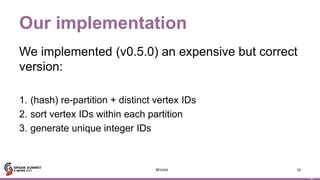
Our implementation
We implemented (v0.5.0) an expensive but correct
version:
1. (hash) re-partition + distinct vertex IDs
2. sort vertex IDs within each partition
3. generate unique integer IDs
#EUds6 16
1
Connected Components
17#EUds6
1
Connected Components
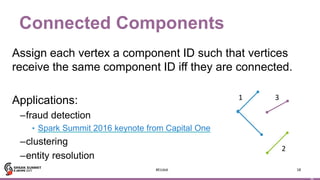
Assign each vertex a component ID such that vertices
receive the same component ID iff they are connected.
Applications:
–fraud detection
• Spark Summit 2016 keynote from Capital One
–clustering
–entity resolution
1 3
2
#EUds6 18
1
Naive implementation (GraphX)
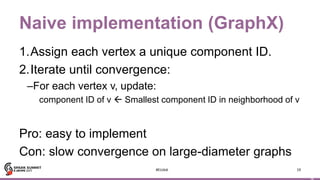
1.Assign each vertex a unique component ID.
2.Iterate until convergence:
–For each vertex v, update:
component ID of v  Smallest component ID in neighborhood of v
Pro: easy to implement
Con: slow convergence on large-diameter graphs
#EUds6 19
2
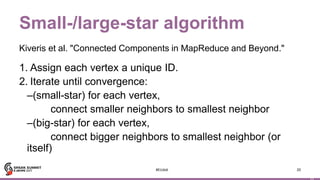
Small-/large-star algorithm
Kiveris et al. "Connected Components in MapReduce and Beyond."
1. Assign each vertex a unique ID.
2. Iterate until convergence:
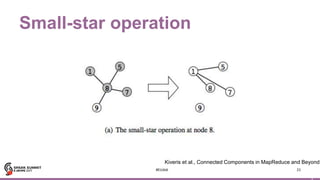
–(small-star) for each vertex,
connect smaller neighbors to smallest neighbor
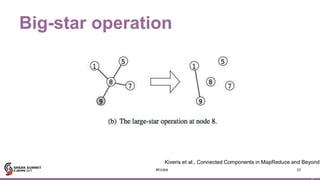
–(big-star) for each vertex,
connect bigger neighbors to smallest neighbor (or
itself)
#EUds6 20
2
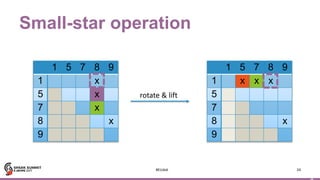
Small-star operation
Kiveris et al., Connected Components in MapReduce and Beyond.
#EUds6 21
2
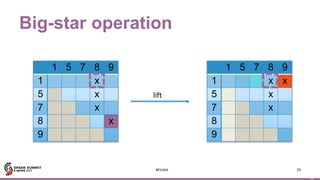
Big-star operation
Kiveris et al., Connected Components in MapReduce and Beyond.
#EUds6 22
2
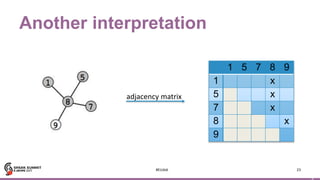
Another interpretation
1 5 7 8 9
1 x
5 x
7 x
8 x
9
adjacency matrix
#EUds6 23
2
Small-star operation
1 5 7 8 9
1 x x x
5
7
8 x
9
1 5 7 8 9
1 x
5 x
7 x
8 x
9
rotate & lift
#EUds6 24
2
Big-star operation
lift
1 5 7 8 9
1 x x
5 x
7 x
8
9
1 5 7 8 9
1 x
5 x
7 x
8 x
9
#EUds6 25
2
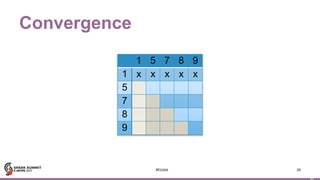
Convergence
1 5 7 8 9
1 x x x x x
5
7
8
9
#EUds6 26
2
Properties of the algorithm
• Small-/big-star operations do not change graph
connectivity.
• Extra edges are pruned during iterations.
• Each connected component converges to a star
graph.
• Converges in log2(#nodes) iterations
#EUds6 27
2
Implementation
Iterate:
• filter
• self-join
Challenge: handle these operations at scale.
#EUds6 28
2
Skewed joins
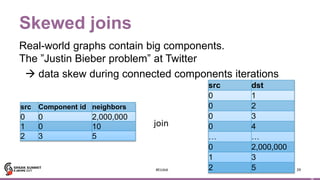
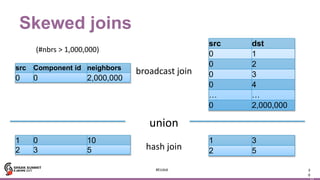
Real-world graphs contain big components.
The ”Justin Bieber problem” at Twitter
 data skew during connected components iterations
src dst
0 1
0 2
0 3
0 4
… …
0 2,000,000
1 3
2 5
src Component id neighbors
0 0 2,000,000
1 0 10
2 3 5
join
#EUds6 29
3
Skewed joins
3
0
src dst
0 1
0 2
0 3
0 4
… …
0 2,000,000
hash join
1 3
2 5
broadcast join
(#nbrs > 1,000,000)
union
src Component id neighbors
0 0 2,000,000
1 0 10
2 3 5
#EUds6
3
Checkpointing
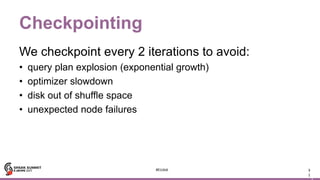
We checkpoint every 2 iterations to avoid:
• query plan explosion (exponential growth)
• optimizer slowdown
• disk out of shuffle space
• unexpected node failures
3
1
#EUds6
3
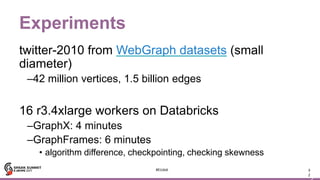
Experiments
twitter-2010 from WebGraph datasets (small
diameter)
–42 million vertices, 1.5 billion edges
16 r3.4xlarge workers on Databricks
–GraphX: 4 minutes
–GraphFrames: 6 minutes
• algorithm difference, checkpointing, checking skewness
3
2
#EUds6
3
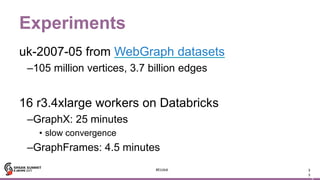
Experiments
uk-2007-05 from WebGraph datasets
–105 million vertices, 3.7 billion edges
16 r3.4xlarge workers on Databricks
–GraphX: 25 minutes
• slow convergence
–GraphFrames: 4.5 minutes
3
3
#EUds6
3
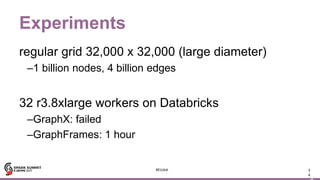
Experiments
regular grid 32,000 x 32,000 (large diameter)
–1 billion nodes, 4 billion edges
32 r3.8xlarge workers on Databricks
–GraphX: failed
–GraphFrames: 1 hour
3
4
#EUds6
3
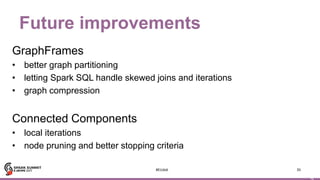
Future improvements
GraphFrames
• better graph partitioning
• letting Spark SQL handle skewed joins and iterations
• graph compression
Connected Components
• local iterations
• node pruning and better stopping criteria
#EUds6 35
Thank you!
• http://graphframes.github.io
• https://docs.databricks.com
36#EUds6
37#EUds6
3
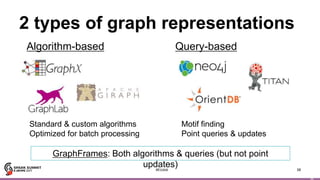
2 types of graph representations
Algorithm-based Query-based
Standard & custom algorithms
Optimized for batch processing
Motif finding
Point queries & updates
GraphFrames: Both algorithms & queries (but not point
updates)#EUds6 38
3
Graph analysis with GraphFrames
Simple queries
Motif finding
Graph algorithms
39
#EUds6
4
Simple queries
SQL queries on vertices & edges
40
Simple graph queries (e.g., vertex degrees)
#EUds6
4
Motif finding
41
JFK
IAD
LAX
SFO
SEA
DFW
Search for structural
patterns within a graph.
val paths: DataFrame =
g.find(“(a)-[e1]->(b);
(b)-[e2]->(c);
!(c)-[]->(a)”)
#EUds6
4
Motif finding
42
JFK
IAD
LAX
SFO
SEA
DFW
(b)
(a)Search for structural
patterns within a graph.
val paths: DataFrame =
g.find(“(a)-[e1]->(b);
(b)-[e2]->(c);
!(c)-[]->(a)”)
#EUds6
4
Motif finding
43
JFK
IAD
LAX
SFO
SEA
DFW
(b)
(a)
(c)
Search for structural
patterns within a graph.
val paths: DataFrame =
g.find(“(a)-[e1]->(b);
(b)-[e2]->(c);
!(c)-[]->(a)”)
#EUds6
4
Motif finding
44
JFK
IAD
LAX
SFO
SEA
DFW
(b)
(a)
(c)
Search for structural
patterns within a graph.
val paths: DataFrame =
g.find(“(a)-[e1]->(b);
(b)-[e2]->(c);
!(c)-[]->(a)”)
#EUds6
4
Motif finding
45
JFK
IAD
LAX
SFO
SEA
DFW
Search for structural
patterns within a graph.
val paths: DataFrame =
g.find(“(a)-[e1]->(b);
(b)-[e2]->(c);
!(c)-[]->(a)”)
(b)
(a)
(c)
Then filter using vertex
& edge data.
paths.filter(“e1.delay > 20”)
#EUds6
4
Graph algorithms
Find important vertices
• PageRank
46
Find paths between sets of
vertices
• Breadth-first search (BFS)
• Shortest paths
Find groups of vertices
(components, communities)
• Connected components
• Strongly connected components
• Label Propagation Algorithm (LPA)
Other
• Triangle counting
• SVDPlusPlus
#EUds6
4
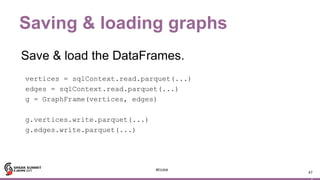
Saving & loading graphs
Save & load the DataFrames.
vertices = sqlContext.read.parquet(...)
edges = sqlContext.read.parquet(...)
g = GraphFrame(vertices, edges)
g.vertices.write.parquet(...)
g.edges.write.parquet(...)
47
#EUds6

Web-Scale Graph Analytics with Apache Spark with Tim Hunter

  • 1.
    Web-Scale Graph Analytics withApache Spark Tim Hunter, Databricks #EUds6
  • 2.
    2 About Me • TimHunter • Software engineer @ Databricks • Ph.D. from UC Berkeley in Machine Learning • Very early Spark user • Contributor to MLlib • Co-author of TensorFrames, GraphFrames, Deep Learning Pipelines #EUds6 2
  • 3.
    3 Outline • Why GraphFrames •Writing scalable graph algorithms with Spark – Where is my vertex? Indexing data – Connected Components: implementing complex algorithms with Spark and GraphFrames – The Social Network: real-world issues • Future of GraphFrames 3#EUds6
  • 4.
    4 Graphs are everywhere 4#EUds6 JFK IAD LAX SFO SEA DFW Example:airports & flights between them src dst delay tripID “JFK” “SEA” 45 1058923 id City State “JFK” “New York” NY Vertices: Edges:
  • 5.
    5 Apache Spark’s GraphXlibrary • General-purpose graph processing library • Built into Spark • Optimized for fast distributed computing • Library of algorithms: PageRank, Connected Components, etc. 5 Issues: • No Java, Python APIs • Lower-level RDD-based API (vs. DataFrames) • Cannot use recent Spark optimizations: Catalyst query optimizer, Tungsten memory management #EUds6
  • 6.
    6 The GraphFrames SparkPackage Brings DataFrames API for Spark • Simplifies interactive queries • Benefits from DataFrames optimizations • Integrates with the rest of Spark ecosystem Collaboration between Databricks, UC Berkeley & MIT 6 #EUds6
  • 7.
    7 Dataframe-based representation 7#EUds6 JFK IAD LAX SFO SEA DFW id CityState “JFK” “New York” NY “SEA ” “Seattle” WA src dst delay tripID “JFK” “SEA” 45 1058923 “DFW ” “SFO” -7 4100224 vertices DataFrame edges DataFrame
  • 8.
    8 Supported graph algorithms •Find Vertices: – PageRank – Motif finding • Communities: – Connected Components – Strongly Connected Components – Label propagation (LPA) • Paths: – Breadth-first search – Shortest paths • Other: – Triangle count – SVD++ 8#EUds6 (Bold: native DataFrame implementation)
  • 9.
    1 Assigning integral vertexIDs … lessons learned 10#EUds6
  • 10.
    1 Pros of integervertex IDs GraphFrames take arbitrary vertex IDs.  convenient for users Algorithms prefer integer vertex IDs.  optimize in-memory storage  reduce communication Our task: Map unique vertex IDs to unique (long) integers. #EUds6 11
  • 11.
    1 The hashing trick? •Possible solution: hash vertex ID to long integer • What is the chance of collision? –1 - (N-1)/N * (N-2)/N * … –seems unlikely with long range N=264 –with 1 billion nodes, the chance is ~5.4% • Problem: collisions change graph topology. Name Hash Sue Ann 84088 Joseph -2070372689 Xiangrui 264245405 Felix 67762524 #EUds6 12
  • 12.
    1 Generating unique IDs Sparkhas built-in methods to generate unique IDs. • RDD: zipWithUniqueId(), zipWithIndex() • DataFrame: monotonically_increasing_id() Possible solution: just use these methods #EUds6 13
  • 13.
    1 How it works Partition1 Vertex ID Sue Ann 0 Joseph 1 Partition 2 Vertex ID Xiangrui 100 + 0 Felix 100 + 1 Partition 3 Vertex ID Veronica 200 + 0 … 200 + 1 #EUds6 14
  • 14.
    1 … but notalways • DataFrames/RDDs are immutable and reproducible by design. • However, records do not always have stable orderings. –distinct –repartition • cache() does not help. Partition 1 Vertex ID Xiangrui 0 Joseph 1 Partition 1 Vertex ID Joseph 0 Xiangrui 1 repartition distinct shuffle #EUds6 15
  • 15.
    1 Our implementation We implemented(v0.5.0) an expensive but correct version: 1. (hash) re-partition + distinct vertex IDs 2. sort vertex IDs within each partition 3. generate unique integer IDs #EUds6 16
  • 16.
  • 17.
    1 Connected Components Assign eachvertex a component ID such that vertices receive the same component ID iff they are connected. Applications: –fraud detection • Spark Summit 2016 keynote from Capital One –clustering –entity resolution 1 3 2 #EUds6 18
  • 18.
    1 Naive implementation (GraphX) 1.Assigneach vertex a unique component ID. 2.Iterate until convergence: –For each vertex v, update: component ID of v  Smallest component ID in neighborhood of v Pro: easy to implement Con: slow convergence on large-diameter graphs #EUds6 19
  • 19.
    2 Small-/large-star algorithm Kiveris etal. "Connected Components in MapReduce and Beyond." 1. Assign each vertex a unique ID. 2. Iterate until convergence: –(small-star) for each vertex, connect smaller neighbors to smallest neighbor –(big-star) for each vertex, connect bigger neighbors to smallest neighbor (or itself) #EUds6 20
  • 20.
    2 Small-star operation Kiveris etal., Connected Components in MapReduce and Beyond. #EUds6 21
  • 21.
    2 Big-star operation Kiveris etal., Connected Components in MapReduce and Beyond. #EUds6 22
  • 22.
    2 Another interpretation 1 57 8 9 1 x 5 x 7 x 8 x 9 adjacency matrix #EUds6 23
  • 23.
    2 Small-star operation 1 57 8 9 1 x x x 5 7 8 x 9 1 5 7 8 9 1 x 5 x 7 x 8 x 9 rotate & lift #EUds6 24
  • 24.
    2 Big-star operation lift 1 57 8 9 1 x x 5 x 7 x 8 9 1 5 7 8 9 1 x 5 x 7 x 8 x 9 #EUds6 25
  • 25.
    2 Convergence 1 5 78 9 1 x x x x x 5 7 8 9 #EUds6 26
  • 26.
    2 Properties of thealgorithm • Small-/big-star operations do not change graph connectivity. • Extra edges are pruned during iterations. • Each connected component converges to a star graph. • Converges in log2(#nodes) iterations #EUds6 27
  • 27.
    2 Implementation Iterate: • filter • self-join Challenge:handle these operations at scale. #EUds6 28
  • 28.
    2 Skewed joins Real-world graphscontain big components. The ”Justin Bieber problem” at Twitter  data skew during connected components iterations src dst 0 1 0 2 0 3 0 4 … … 0 2,000,000 1 3 2 5 src Component id neighbors 0 0 2,000,000 1 0 10 2 3 5 join #EUds6 29
  • 29.
    3 Skewed joins 3 0 src dst 01 0 2 0 3 0 4 … … 0 2,000,000 hash join 1 3 2 5 broadcast join (#nbrs > 1,000,000) union src Component id neighbors 0 0 2,000,000 1 0 10 2 3 5 #EUds6
  • 30.
    3 Checkpointing We checkpoint every2 iterations to avoid: • query plan explosion (exponential growth) • optimizer slowdown • disk out of shuffle space • unexpected node failures 3 1 #EUds6
  • 31.
    3 Experiments twitter-2010 from WebGraphdatasets (small diameter) –42 million vertices, 1.5 billion edges 16 r3.4xlarge workers on Databricks –GraphX: 4 minutes –GraphFrames: 6 minutes • algorithm difference, checkpointing, checking skewness 3 2 #EUds6
  • 32.
    3 Experiments uk-2007-05 from WebGraphdatasets –105 million vertices, 3.7 billion edges 16 r3.4xlarge workers on Databricks –GraphX: 25 minutes • slow convergence –GraphFrames: 4.5 minutes 3 3 #EUds6
  • 33.
    3 Experiments regular grid 32,000x 32,000 (large diameter) –1 billion nodes, 4 billion edges 32 r3.8xlarge workers on Databricks –GraphX: failed –GraphFrames: 1 hour 3 4 #EUds6
  • 34.
    3 Future improvements GraphFrames • bettergraph partitioning • letting Spark SQL handle skewed joins and iterations • graph compression Connected Components • local iterations • node pruning and better stopping criteria #EUds6 35
  • 35.
    Thank you! • http://graphframes.github.io •https://docs.databricks.com 36#EUds6
  • 36.
  • 37.
    3 2 types ofgraph representations Algorithm-based Query-based Standard & custom algorithms Optimized for batch processing Motif finding Point queries & updates GraphFrames: Both algorithms & queries (but not point updates)#EUds6 38
  • 38.
    3 Graph analysis withGraphFrames Simple queries Motif finding Graph algorithms 39 #EUds6
  • 39.
    4 Simple queries SQL querieson vertices & edges 40 Simple graph queries (e.g., vertex degrees) #EUds6
  • 40.
    4 Motif finding 41 JFK IAD LAX SFO SEA DFW Search forstructural patterns within a graph. val paths: DataFrame = g.find(“(a)-[e1]->(b); (b)-[e2]->(c); !(c)-[]->(a)”) #EUds6
  • 41.
    4 Motif finding 42 JFK IAD LAX SFO SEA DFW (b) (a)Search forstructural patterns within a graph. val paths: DataFrame = g.find(“(a)-[e1]->(b); (b)-[e2]->(c); !(c)-[]->(a)”) #EUds6
  • 42.
    4 Motif finding 43 JFK IAD LAX SFO SEA DFW (b) (a) (c) Search forstructural patterns within a graph. val paths: DataFrame = g.find(“(a)-[e1]->(b); (b)-[e2]->(c); !(c)-[]->(a)”) #EUds6
  • 43.
    4 Motif finding 44 JFK IAD LAX SFO SEA DFW (b) (a) (c) Search forstructural patterns within a graph. val paths: DataFrame = g.find(“(a)-[e1]->(b); (b)-[e2]->(c); !(c)-[]->(a)”) #EUds6
  • 44.
    4 Motif finding 45 JFK IAD LAX SFO SEA DFW Search forstructural patterns within a graph. val paths: DataFrame = g.find(“(a)-[e1]->(b); (b)-[e2]->(c); !(c)-[]->(a)”) (b) (a) (c) Then filter using vertex & edge data. paths.filter(“e1.delay > 20”) #EUds6
  • 45.
    4 Graph algorithms Find importantvertices • PageRank 46 Find paths between sets of vertices • Breadth-first search (BFS) • Shortest paths Find groups of vertices (components, communities) • Connected components • Strongly connected components • Label Propagation Algorithm (LPA) Other • Triangle counting • SVDPlusPlus #EUds6
  • 46.
    4 Saving & loadinggraphs Save & load the DataFrames. vertices = sqlContext.read.parquet(...) edges = sqlContext.read.parquet(...) g = GraphFrame(vertices, edges) g.vertices.write.parquet(...) g.edges.write.parquet(...) 47 #EUds6

Editor's Notes

  • #2 Xiangrui’s talk: https://www.youtube.com/watch?v=D2kBcdldNT8&feature=youtu.be Xiangrui’s slides: https://www.slideshare.net/databricks/challenging-webscale-graph-analytics-with-apache-spark-with-xiangrui-meng GraphFrames doc: https://docs.databricks.com/spark/latest/graph-analysis/graphframes/graph-analysis-tutorial.html
  • #21 Raimondas Kiveris