

Kotlin Backend @ Coupang
Spring Camp 2018

debop@coupang.com
Who is @debop
• Since 1993

• Robotics, BPM Solution, Healthcare

• C/C++, Object Pascal (Delphi), C#, Java, Scala, Kotlin

• Use Kotlin since 2016.08 

• Sr. Principle Software Engineer in Coupang (2017~)
Agenda
• Kotlin - The Good, The Bad, The Ugly

• Kotlin Coroutines

• Kotlin Backend 도입 전략 / 사례

• Lesson & Learn

• Resources
Kotlin
The Good, The Bad and The Ugly
Kotlin - The Good (1/3)
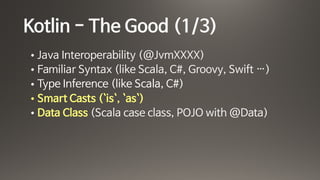
• Java Interoperability (@JvmXXXX)

• Familiar Syntax (like Scala, C#, Groovy, Swift …)

• Type Inference (like Scala, C#)

• Smart Casts (`is`, `as`)

• Data Class (Scala case class, POJO with @Data)
Kotlin - The Good (1/3)
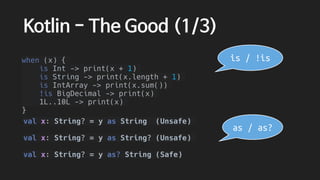
when (x) {
is Int -> print(x + 1)
is String -> print(x.length + 1)
is IntArray -> print(x.sum())
!is BigDecimal -> print(x)
1L..10L -> print(x)
}
val x: String? = y as String (Unsafe)
val x: String? = y as String? (Unsafe)
val x: String? = y as? String (Safe)
is / !is
as / as?
Kotlin - The Good (1/3)
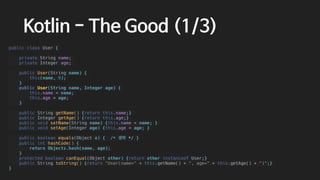
public class User {
private String name;
private Integer age;
public User(String name) {
this(name, 0);
}
public User(String name, Integer age) {
this.name = name;
this.age = age;
}
public String getName() {return this.name;}
public Integer getAge() {return this.age;}
public void setName(String name) {this.name = name; }
public void setAge(Integer age) {this.age = age; }
public boolean equals(Object o) { /* 생략 */ }
public int hashCode() {
return Objects.hash(name, age);
}
protected boolean canEqual(Object other) {return other instanceof User;}
public String toString() {return "User(name=" + this.getName() + ", age=" + this.getAge() + ")";}
}
Kotlin - The Good (1/3)
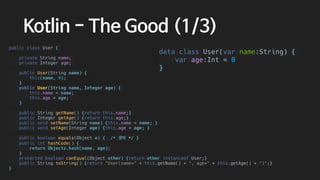
public class User {
private String name;
private Integer age;
public User(String name) {
this(name, 0);
}
public User(String name, Integer age) {
this.name = name;
this.age = age;
}
public String getName() {return this.name;}
public Integer getAge() {return this.age;}
public void setName(String name) {this.name = name; }
public void setAge(Integer age) {this.age = age; }
public boolean equals(Object o) { /* 생략 */ }
public int hashCode() {
return Objects.hash(name, age);
}
protected boolean canEqual(Object other) {return other instanceof User;}
public String toString() {return "User(name=" + this.getName() + ", age=" + this.getAge() + ")";}
}
data class User(var name:String) {
var age:Int = 0
}
Kotlin - The Good (2/3)
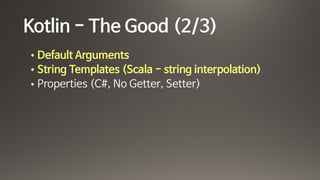
• Default Arguments

• String Templates (Scala - string interpolation)

• Properties (C#, No Getter, Setter)
val tomAge = map["tom"] ?: 0
map["jane"] = 29
val query = """
| CREATE KEYSPACE IF NOT EXISTS $keyspaceName
| WITH replication = { 'class': '$replicationStrategy',
| 'replication_factor':$replicationFactor }
""".trimMargin()
val s = "abc"
val str = "$s.length is ${s.length}" // prints "abc.length is 3"
Kotlin - The Good (2/3)
fun read(b:ByteArray, offset:Int = 0, length:Int = b.size) {
TODO(”Not Implemented”)
}
val tomAge = map["tom"] ?: 0
map["jane"] = 29
val query = """
| CREATE KEYSPACE IF NOT EXISTS $keyspaceName
| WITH replication = { 'class': '$replicationStrategy',
| 'replication_factor':$replicationFactor }
""".trimMargin()
val s = "abc"
val str = "$s.length is ${s.length}" // prints "abc.length is 3"
Kotlin - The Good (2/3)
fun read(b:ByteArray, offset:Int = 0, length:Int = b.size) {
TODO(”Not Implemented”)
}
val tomAge = map["tom"] ?: 0
map["jane"] = 29
val query = """
| CREATE KEYSPACE IF NOT EXISTS $keyspaceName
| WITH replication = { 'class': '$replicationStrategy',
| 'replication_factor':$replicationFactor }
""".trimMargin()
val s = "abc"
val str = "$s.length is ${s.length}" // prints "abc.length is 3"
Kotlin - The Good (2/3)
fun read(b:ByteArray, offset:Int = 0, length:Int = b.size) {
TODO(”Not Implemented”)
}
val tomAge = map["tom"] ?: 0
map["jane"] = 29
val query = """
| CREATE KEYSPACE IF NOT EXISTS $keyspaceName
| WITH replication = { 'class': '$replicationStrategy',
| 'replication_factor':$replicationFactor }
""".trimMargin()
val s = "abc"
val str = "$s.length is ${s.length}" // prints "abc.length is 3"
Kotlin - The Good (2/3)
fun read(b:ByteArray, offset:Int = 0, length:Int = b.size) {
TODO(”Not Implemented”)
}
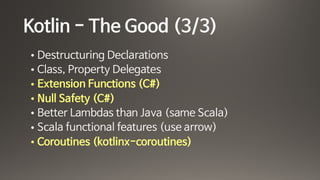
Kotlin - The Good (3/3)
• Destructuring Declarations

• Class, Property Delegates

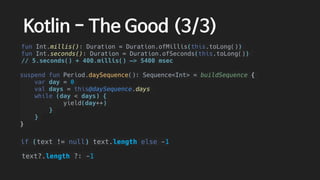
• Extension Functions (C#)

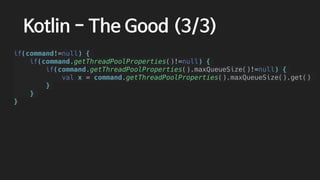
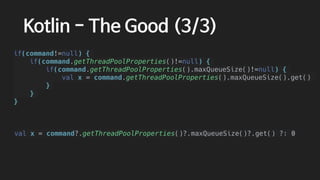
• Null Safety (C#)

• Better Lambdas than Java (same Scala)

• Scala functional features (use arrow)

• Coroutines (kotlinx-coroutines)
Kotlin - The Good (3/3)
fun Int.millis(): Duration = Duration.ofMillis(this.toLong())
fun Int.seconds(): Duration = Duration.ofSeconds(this.toLong())
// 5.seconds() + 400.millis() —> 5400 msec
if (text != null) text.length else -1
text?.length ?: -1
suspend fun Period.daySequence(): Sequence<Int> = buildSequence {
var day = 0
val days = this@daySequence.days
while (day < days) {
yield(day++)
}
}
}
Kotlin - The Good (3/3)
if(command!=null) {
if(command.getThreadPoolProperties()!=null) {
if(command.getThreadPoolProperties().maxQueueSize()!=null) {
val x = command.getThreadPoolProperties().maxQueueSize().get()
}
}
}
val x = command?.getThreadPoolProperties()?.maxQueueSize()?.get() ?: 0
Kotlin - The Good (3/3)
if(command!=null) {
if(command.getThreadPoolProperties()!=null) {
if(command.getThreadPoolProperties().maxQueueSize()!=null) {
val x = command.getThreadPoolProperties().maxQueueSize().get()
}
}
}
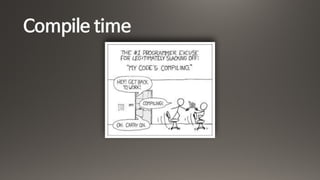
Compile time
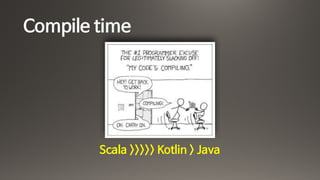
Compile time
Scala >>>>> Kotlin > Java
the bad
Kotlin - The Bad
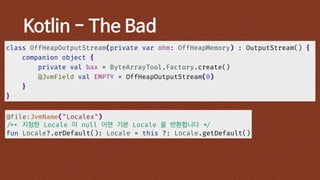
• No namespace (package variable, methods)

• No static modifier (use companion object)
Kotlin - The Bad
class OffHeapOutputStream(private var ohm: OffHeapMemory) : OutputStream() {
companion object {
private val bax = ByteArrayTool.Factory.create()
@JvmField val EMPTY = OffHeapOutputStream(0)
}
}
@file:JvmName("Localex")
/** 지정한 Locale 이 null 이면 기본 Locale 을 반환합니다 */
fun Locale?.orDefault(): Locale = this ?: Locale.getDefault()
the ugly
Kotlin - The Ugly
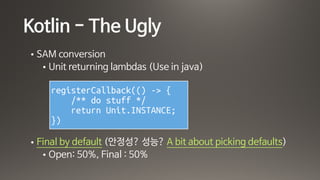
• SAM conversion

• Unit returning lambdas (Use in java)

• Final by default (안정성? 성능? A bit about picking defaults) 

• Open: 50%, Final : 50%
registerCallback(() -> {
/** do stuff */
return Unit.INSTANCE;
})
Killer feature - Coroutines
• Readable, clean code 

• Escape Callback hell

• Imperative programming

• Not exclusive, Cooperative

• Lightweight thread (fiber, goroutines)

• Note: Experimental !!!
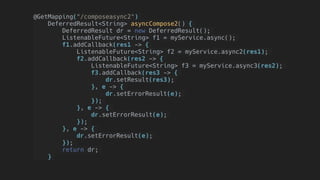
@GetMapping("/composeasync2")
DeferredResult<String> asyncCompose2() {
    DeferredResult dr = new DeferredResult();
ListenableFuture<String> f1 = myService.async();
f1.addCallback(res1 -> {
ListenableFuture<String> f2 = myService.async2(res1);
f2.addCallback(res2 -> {
    ListenableFuture<String> f3 = myService.async3(res2);
     f3.addCallback(res3 -> {
         dr.setResult(res3);
        }, e -> {
         dr.setErrorResult(e);
        });
    }, e -> {
     dr.setErrorResult(e);
    });
}, e -> {
dr.setErrorResult(e);
});
return dr;
}
@GetMapping("/composeasync2")
DeferredResult<String> asyncCompose2() {
    DeferredResult dr = new DeferredResult();
ListenableFuture<String> f1 = myService.async();
f1.addCallback(res1 -> {
ListenableFuture<String> f2 = myService.async2(res1);
f2.addCallback(res2 -> {
    ListenableFuture<String> f3 = myService.async3(res2);
     f3.addCallback(res3 -> {
         dr.setResult(res3);
        }, e -> {
         dr.setErrorResult(e);
        });
    }, e -> {
     dr.setErrorResult(e);
    });
}, e -> {
dr.setErrorResult(e);
});
return dr;
}
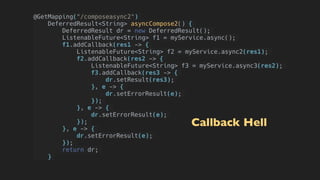
Callback Hell
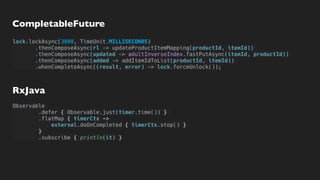
lock.lockAsync(3000, TimeUnit.MILLISECONDS)
.thenComposeAsync(rl -> updateProductItemMapping(productId, itemId))
.thenComposeAsync(updated -> adultInverseIndex.fastPutAsync(itemId, productId))
.thenComposeAsync(added -> addItemIdToList(productId, itemId))
.whenCompleteAsync((result, error) -> lock.forceUnlock());
CompletableFuture
RxJava
Observable
.defer { Observable.just(timer.time()) }
.flatMap { timerCtx ->
external.doOnCompleted { timerCtx.stop() }
}
.subscribe { println(it) }
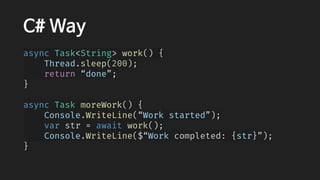
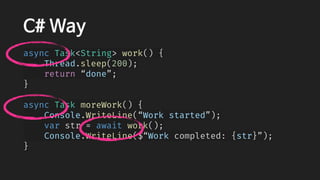
C# Way
async Task<String> work() {
    Thread.sleep(200);
    return “done”;
}
async Task moreWork() {
    Console.WriteLine(“Work started”);
    var str = await work();
    Console.WriteLine($“Work completed: {str}”);
}
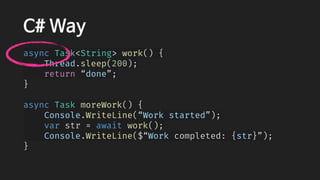
C# Way
async Task<String> work() {
    Thread.sleep(200);
    return “done”;
}
async Task moreWork() {
    Console.WriteLine(“Work started”);
    var str = await work();
    Console.WriteLine($“Work completed: {str}”);
}
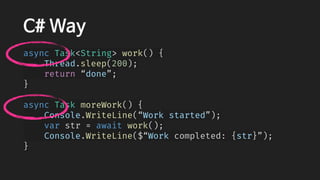
C# Way
async Task<String> work() {
    Thread.sleep(200);
    return “done”;
}
async Task moreWork() {
    Console.WriteLine(“Work started”);
    var str = await work();
    Console.WriteLine($“Work completed: {str}”);
}
C# Way
async Task<String> work() {
    Thread.sleep(200);
    return “done”;
}
async Task moreWork() {
    Console.WriteLine(“Work started”);
    var str = await work();
    Console.WriteLine($“Work completed: {str}”);
}
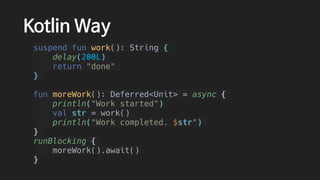
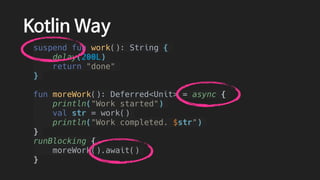
Kotlin Way
suspend fun work(): String {
delay(200L)
return "done"
}
fun moreWork(): Deferred<Unit> = async {
println("Work started")
val str = work()
println("Work completed. $str")
}
runBlocking {
moreWork().await()
}
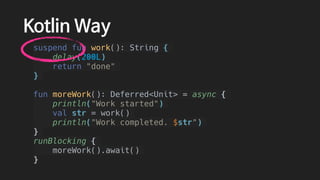
Kotlin Way
suspend fun work(): String {
delay(200L)
return "done"
}
fun moreWork(): Deferred<Unit> = async {
println("Work started")
val str = work()
println("Work completed. $str")
}
runBlocking {
moreWork().await()
}
Kotlin Way
suspend fun work(): String {
delay(200L)
return "done"
}
fun moreWork(): Deferred<Unit> = async {
println("Work started")
val str = work()
println("Work completed. $str")
}
runBlocking {
moreWork().await()
}
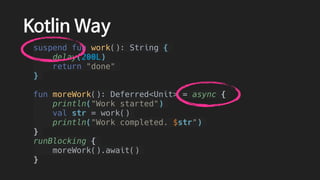
Kotlin Way
suspend fun work(): String {
delay(200L)
return "done"
}
fun moreWork(): Deferred<Unit> = async {
println("Work started")
val str = work()
println("Work completed. $str")
}
runBlocking {
moreWork().await()
}
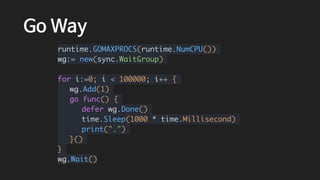
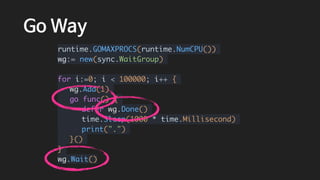
Go Way
runtime.GOMAXPROCS(runtime.NumCPU())
wg:= new(sync.WaitGroup)
for i:=0; i < 100000; i++ {
wg.Add(1)
go func() {
defer wg.Done()
time.Sleep(1000 * time.Millisecond)
print(".")
}()
}
wg.Wait()
Go Way
runtime.GOMAXPROCS(runtime.NumCPU())
wg:= new(sync.WaitGroup)
for i:=0; i < 100000; i++ {
wg.Add(1)
go func() {
defer wg.Done()
time.Sleep(1000 * time.Millisecond)
print(".")
}()
}
wg.Wait()
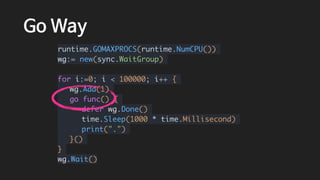
Go Way
runtime.GOMAXPROCS(runtime.NumCPU())
wg:= new(sync.WaitGroup)
for i:=0; i < 100000; i++ {
wg.Add(1)
go func() {
defer wg.Done()
time.Sleep(1000 * time.Millisecond)
print(".")
}()
}
wg.Wait()
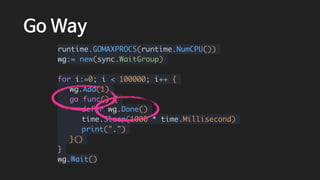
Go Way
runtime.GOMAXPROCS(runtime.NumCPU())
wg:= new(sync.WaitGroup)
for i:=0; i < 100000; i++ {
wg.Add(1)
go func() {
defer wg.Done()
time.Sleep(1000 * time.Millisecond)
print(".")
}()
}
wg.Wait()
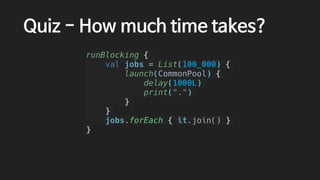
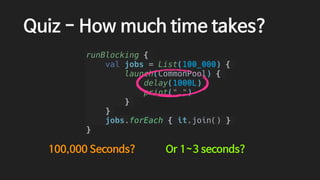
Quiz - How much time takes?
runBlocking {
val jobs = List(100_000) {
launch(CommonPool) {
delay(1000L)
print(".")
}
}
jobs.forEach { it.join() }
}
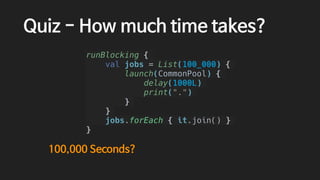
Quiz - How much time takes?
runBlocking {
val jobs = List(100_000) {
launch(CommonPool) {
delay(1000L)
print(".")
}
}
jobs.forEach { it.join() }
}
100,000 Seconds?
Quiz - How much time takes?
runBlocking {
val jobs = List(100_000) {
launch(CommonPool) {
delay(1000L)
print(".")
}
}
jobs.forEach { it.join() }
}
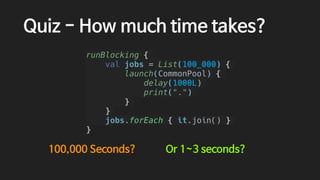
100,000 Seconds? Or 1~3 seconds?
Quiz - How much time takes?
runBlocking {
val jobs = List(100_000) {
launch(CommonPool) {
delay(1000L)
print(".")
}
}
jobs.forEach { it.join() }
}
100,000 Seconds? Or 1~3 seconds?
Kotlin 도입 전략
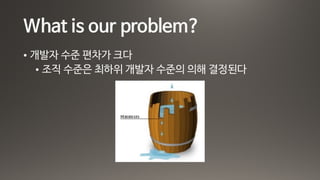
What is our problem?
• 개발자 수준 편차가 크다

• 조직 수준은 최하위 개발자 수준의 의해 결정된다
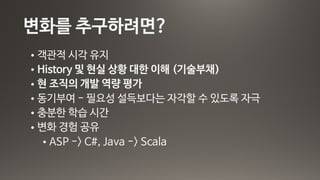
변화를 추구하려면?
• 객관적 시각 유지

• History 및 현실 상황 대한 이해 (기술부채)

• 현 조직의 개발 역량 평가

• 동기부여 - 필요성 설득보다는 자각할 수 있도록 자극

• 충분한 학습 시간

• 변화 경험 공유

• ASP -> C#, Java -> Scala
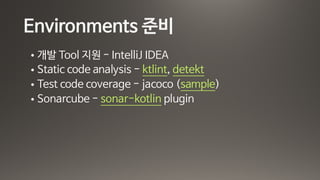
Environments 준비
• 개발 Tool 지원 - IntelliJ IDEA

• Static code analysis - ktlint, detekt

• Test code coverage - jacoco (sample)

• Sonarcube - sonar-kotlin plugin
Kotlin Backend 도입 사례
Use cases
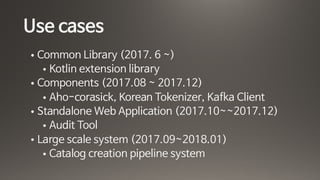
• Common Library (2017. 6 ~)

• Kotlin extension library

• Components (2017.08 ~ 2017.12)

• Aho-corasick, Korean Tokenizer, Kafka Client

• Standalone Web Application (2017.10~~2017.12)

• Audit Tool 

• Large scale system (2017.09~2018.01)

• Catalog creation pipeline system
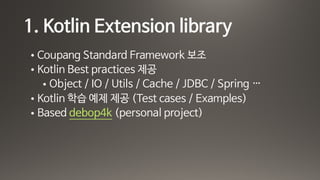
1. Kotlin Extension library
• Coupang Standard Framework 보조 

• Kotlin Best practices 제공

• Object / IO / Utils / Cache / JDBC / Spring …

• Kotlin 학습 예제 제공 (Test cases / Examples)

• Based debop4k (personal project)
2. Korean Tokenizer
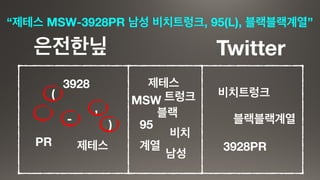
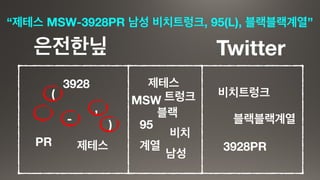
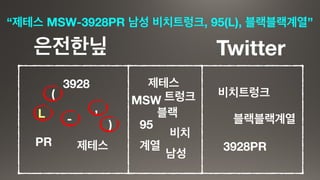
• 중복상품 Merge 위한 Tokenizer 필요 (명사 위주)

• Twitter 에서 개발한 open-korean-text 를 Customizing

• Scala vs Kotlin 성능 비교 

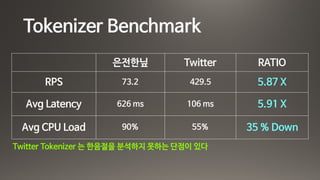
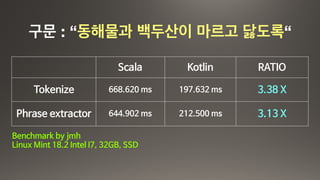
• Kotlin version is 1.5 ~ 3X faster with Coroutines

• 효과

• Full Indexing per Day 부하 감소 : 30%

• Elastic Search 질의 부하 : 80%
“제테스 MSW-3928PR 남성 비치트렁크, 95(L), 블랙블랙계열”
은전한닢 Twitter
블랙
비치
비치트렁크
계열
제테스
3928PR
블랙블랙계열
PR
MSW
,
(
)-
트렁크
3928
95
제테스
남성
“제테스 MSW-3928PR 남성 비치트렁크, 95(L), 블랙블랙계열”
은전한닢 Twitter
블랙
비치
비치트렁크
계열
제테스
3928PR
블랙블랙계열
PR
MSW
,
(
)-
트렁크
3928
95
제테스
남성
“제테스 MSW-3928PR 남성 비치트렁크, 95(L), 블랙블랙계열”
은전한닢 Twitter
블랙
비치
비치트렁크
계열
제테스
3928PR
블랙블랙계열
PR
MSW
,
(
)
L -
트렁크
3928
95
제테스
남성
Tokenizer Benchmark
은전한닢 Twitter RATIO
RPS 73.2 429.5 5.87 X
Avg Latency 626 ms 106 ms 5.91 X
Avg CPU Load 90% 55% 35 % Down
Twitter Tokenizer 는 한음절을 분석하지 못하는 단점이 있다
Scala Kotlin RATIO
Tokenize 668.620 ms 197.632 ms 3.38 X
Phrase extractor 644.902 ms 212.500 ms 3.13 X
구문 : “동해물과 백두산이 마르고 닳도록“
Benchmark by jmh

Linux Mint 18.2 Intel I7, 32GB, SSD
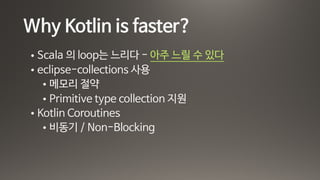
Why Kotlin is faster?
• Scala 의 loop는 느리다 - 아주 느릴 수 있다

• eclipse-collections 사용

• 메모리 절약

• Primitive type collection 지원

• Kotlin Coroutines

• 비동기 / Non-Blocking
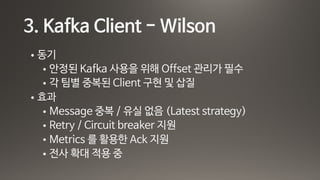
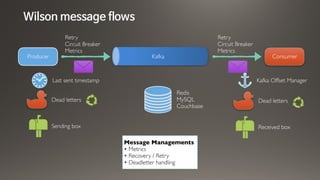
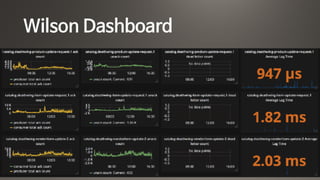
3. Kafka Client - Wilson
• 동기 

• 안정된 Kafka 사용을 위해 Offset 관리가 필수

• 각 팀별 중복된 Client 구현 및 삽질

• 효과

• Message 중복 / 유실 없음 (Latest strategy)

• Retry / Circuit breaker 지원

• Metrics 를 활용한 Ack 지원

• 전사 확대 적용 중
Wilson message flows
Producer ConsumerKafka
Retry
Circuit Breaker
Metrics
Retry
Circuit Breaker
Metrics
Dead letters
Sending box
Redis
MySQL
Couchbase
Dead letters
Received box
Last sent timestamp Kafka Offset Manager
Message Managements
• Metrics
• Recovery / Retry
• Deadletter handling
Wilson Dashboard
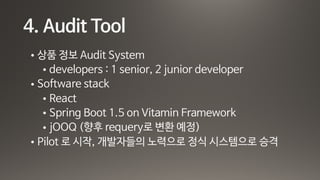
4. Audit Tool
• 상품 정보 Audit System

• developers : 1 senior, 2 junior developer 

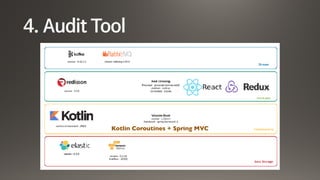
• Software stack

• React 

• Spring Boot 1.5 on Vitamin Framework

• jOOQ (향후 requery로 변환 예정)

• Pilot 로 시작, 개발자들의 노력으로 정식 시스템으로 승격
4. Audit Tool
Kotlin Coroutines + Spring MVC
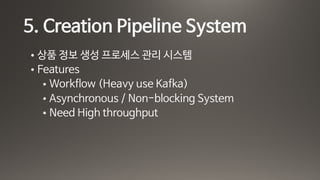
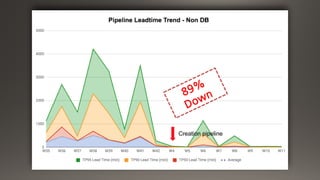
5. Creation Pipeline System
• 상품 정보 생성 프로세스 관리 시스템

• Features

• Workflow (Heavy use Kafka)

• Asynchronous / Non-blocking System

• Need High throughput
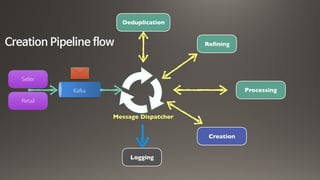
Seller
Retail
Kafka
Deduplication
Refining
Processing
Creation
Logging
Message Dispatcher
Creation Pipeline flow
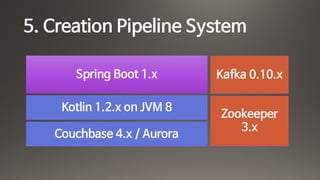
5. Creation Pipeline System
Spring Boot 1.x Kafka 0.10.x
Kotlin 1.2.x on JVM 8
Couchbase 4.x / Aurora
Zookeeper
3.x
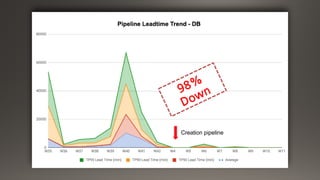
%
%
Lesson & Learns
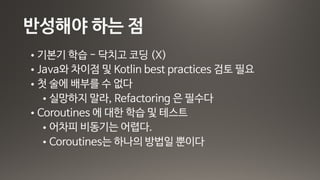
반성해야 하는 점
• 기본기 학습 - 닥치고 코딩 (X) 

• Java와 차이점 및 Kotlin best practices 검토 필요

• 첫 술에 배부를 수 없다 

• 실망하지 말라, Refactoring 은 필수다

• Coroutines 에 대한 학습 및 테스트

• 어차피 비동기는 어렵다. 

• Coroutines는 하나의 방법일 뿐이다
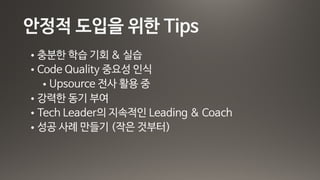
안정적 도입을 위한 Tips
• 충분한 학습 기회 & 실습

• Code Quality 중요성 인식

• Upsource 전사 활용 중

• 강력한 동기 부여

• Tech Leader의 지속적인 Leading & Coach

• 성공 사례 만들기 (작은 것부터)
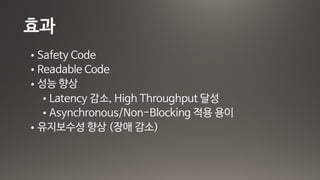
효과
• Safety Code

• Readable Code

• 성능 향상

• Latency 감소, High Throughput 달성 

• Asynchronous/Non-Blocking 적용 용이

• 유지보수성 향상 (장애 감소)
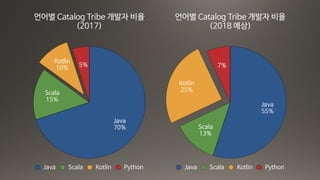
언어별 Catalog Tribe 개발자 비율
(2017)
5%
Kotlin
10%
Scala
15%
Java
70%
Java Scala Kotlin Python
언어별 Catalog Tribe 개발자 비율
(2018 예상)
7%
Kotlin
25%
Scala
13%
Java
55%
Java Scala Kotlin Python
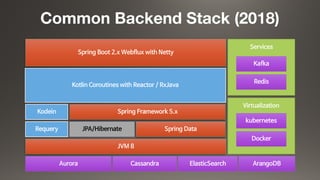
Aurora Cassandra ElasticSearch ArangoDB
JVM 8
Spring DataRequery JPA/Hibernate
Virtualization

kubernetes
Docker
Spring Framework 5.xKodein
Kotlin Coroutines with Reactor / RxJava
Services

Kafka
Redis
Spring Boot 2.x Webflux with Netty
Common Backend Stack (2018)
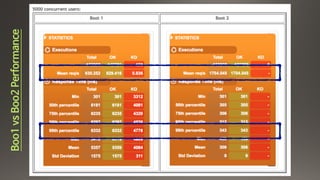
Boo1vsBoo2Performance
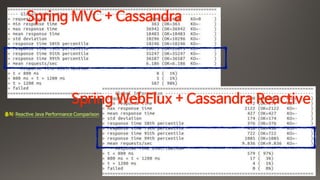
Spring MVC + Cassandra
Spring WebFlux + Cassandra Reactive
출처: Reactive Java Performance Comparison
Resources
• Kotlin Resources

• kotlinx.coroutines

• spring-kotlin-coroutine

• 20 Excellent Resources for learning Kotlin

• Books

• Kotlin in action

• Try Kotlin
Q&A
Thank you!

Kotlin @ Coupang Backend 2017

  • 1.
    Kotlin Backend @Coupang Spring Camp 2018 debop@coupang.com
  • 2.
    Who is @debop •Since 1993 • Robotics, BPM Solution, Healthcare • C/C++, Object Pascal (Delphi), C#, Java, Scala, Kotlin • Use Kotlin since 2016.08 • Sr. Principle Software Engineer in Coupang (2017~)
  • 3.
    Agenda • Kotlin -The Good, The Bad, The Ugly • Kotlin Coroutines • Kotlin Backend 도입 전략 / 사례 • Lesson & Learn • Resources
  • 4.
    Kotlin The Good, TheBad and The Ugly
  • 9.
    Kotlin - TheGood (1/3) • Java Interoperability (@JvmXXXX) • Familiar Syntax (like Scala, C#, Groovy, Swift …) • Type Inference (like Scala, C#) • Smart Casts (`is`, `as`) • Data Class (Scala case class, POJO with @Data)
  • 10.
    Kotlin - TheGood (1/3) when (x) { is Int -> print(x + 1) is String -> print(x.length + 1) is IntArray -> print(x.sum()) !is BigDecimal -> print(x) 1L..10L -> print(x) } val x: String? = y as String (Unsafe) val x: String? = y as String? (Unsafe) val x: String? = y as? String (Safe) is / !is as / as?
  • 11.
    Kotlin - TheGood (1/3) public class User { private String name; private Integer age; public User(String name) { this(name, 0); } public User(String name, Integer age) { this.name = name; this.age = age; } public String getName() {return this.name;} public Integer getAge() {return this.age;} public void setName(String name) {this.name = name; } public void setAge(Integer age) {this.age = age; } public boolean equals(Object o) { /* 생략 */ } public int hashCode() { return Objects.hash(name, age); } protected boolean canEqual(Object other) {return other instanceof User;} public String toString() {return "User(name=" + this.getName() + ", age=" + this.getAge() + ")";} }
  • 12.
    Kotlin - TheGood (1/3) public class User { private String name; private Integer age; public User(String name) { this(name, 0); } public User(String name, Integer age) { this.name = name; this.age = age; } public String getName() {return this.name;} public Integer getAge() {return this.age;} public void setName(String name) {this.name = name; } public void setAge(Integer age) {this.age = age; } public boolean equals(Object o) { /* 생략 */ } public int hashCode() { return Objects.hash(name, age); } protected boolean canEqual(Object other) {return other instanceof User;} public String toString() {return "User(name=" + this.getName() + ", age=" + this.getAge() + ")";} } data class User(var name:String) { var age:Int = 0 }
  • 13.
    Kotlin - TheGood (2/3) • Default Arguments • String Templates (Scala - string interpolation) • Properties (C#, No Getter, Setter)
  • 14.
    val tomAge =map["tom"] ?: 0 map["jane"] = 29 val query = """ | CREATE KEYSPACE IF NOT EXISTS $keyspaceName | WITH replication = { 'class': '$replicationStrategy', | 'replication_factor':$replicationFactor } """.trimMargin() val s = "abc" val str = "$s.length is ${s.length}" // prints "abc.length is 3" Kotlin - The Good (2/3) fun read(b:ByteArray, offset:Int = 0, length:Int = b.size) { TODO(”Not Implemented”) }
  • 15.
    val tomAge =map["tom"] ?: 0 map["jane"] = 29 val query = """ | CREATE KEYSPACE IF NOT EXISTS $keyspaceName | WITH replication = { 'class': '$replicationStrategy', | 'replication_factor':$replicationFactor } """.trimMargin() val s = "abc" val str = "$s.length is ${s.length}" // prints "abc.length is 3" Kotlin - The Good (2/3) fun read(b:ByteArray, offset:Int = 0, length:Int = b.size) { TODO(”Not Implemented”) }
  • 16.
    val tomAge =map["tom"] ?: 0 map["jane"] = 29 val query = """ | CREATE KEYSPACE IF NOT EXISTS $keyspaceName | WITH replication = { 'class': '$replicationStrategy', | 'replication_factor':$replicationFactor } """.trimMargin() val s = "abc" val str = "$s.length is ${s.length}" // prints "abc.length is 3" Kotlin - The Good (2/3) fun read(b:ByteArray, offset:Int = 0, length:Int = b.size) { TODO(”Not Implemented”) }
  • 17.
    val tomAge =map["tom"] ?: 0 map["jane"] = 29 val query = """ | CREATE KEYSPACE IF NOT EXISTS $keyspaceName | WITH replication = { 'class': '$replicationStrategy', | 'replication_factor':$replicationFactor } """.trimMargin() val s = "abc" val str = "$s.length is ${s.length}" // prints "abc.length is 3" Kotlin - The Good (2/3) fun read(b:ByteArray, offset:Int = 0, length:Int = b.size) { TODO(”Not Implemented”) }
  • 18.
    Kotlin - TheGood (3/3) • Destructuring Declarations • Class, Property Delegates • Extension Functions (C#) • Null Safety (C#) • Better Lambdas than Java (same Scala) • Scala functional features (use arrow) • Coroutines (kotlinx-coroutines)
  • 20.
    Kotlin - TheGood (3/3) fun Int.millis(): Duration = Duration.ofMillis(this.toLong()) fun Int.seconds(): Duration = Duration.ofSeconds(this.toLong()) // 5.seconds() + 400.millis() —> 5400 msec if (text != null) text.length else -1 text?.length ?: -1 suspend fun Period.daySequence(): Sequence<Int> = buildSequence { var day = 0 val days = this@daySequence.days while (day < days) { yield(day++) } } }
  • 21.
    Kotlin - TheGood (3/3) if(command!=null) { if(command.getThreadPoolProperties()!=null) { if(command.getThreadPoolProperties().maxQueueSize()!=null) { val x = command.getThreadPoolProperties().maxQueueSize().get() } } }
  • 22.
    val x =command?.getThreadPoolProperties()?.maxQueueSize()?.get() ?: 0 Kotlin - The Good (3/3) if(command!=null) { if(command.getThreadPoolProperties()!=null) { if(command.getThreadPoolProperties().maxQueueSize()!=null) { val x = command.getThreadPoolProperties().maxQueueSize().get() } } }
  • 23.
  • 24.
  • 25.
  • 26.
    Kotlin - TheBad • No namespace (package variable, methods) • No static modifier (use companion object)
  • 27.
    Kotlin - TheBad class OffHeapOutputStream(private var ohm: OffHeapMemory) : OutputStream() { companion object { private val bax = ByteArrayTool.Factory.create() @JvmField val EMPTY = OffHeapOutputStream(0) } } @file:JvmName("Localex") /** 지정한 Locale 이 null 이면 기본 Locale 을 반환합니다 */ fun Locale?.orDefault(): Locale = this ?: Locale.getDefault()
  • 28.
  • 29.
    Kotlin - TheUgly • SAM conversion • Unit returning lambdas (Use in java) • Final by default (안정성? 성능? A bit about picking defaults) • Open: 50%, Final : 50% registerCallback(() -> { /** do stuff */ return Unit.INSTANCE; })
  • 30.
    Killer feature -Coroutines • Readable, clean code • Escape Callback hell • Imperative programming • Not exclusive, Cooperative • Lightweight thread (fiber, goroutines)
 • Note: Experimental !!!
  • 31.
    @GetMapping("/composeasync2") DeferredResult<String> asyncCompose2() {    DeferredResult dr = new DeferredResult(); ListenableFuture<String> f1 = myService.async(); f1.addCallback(res1 -> { ListenableFuture<String> f2 = myService.async2(res1); f2.addCallback(res2 -> {     ListenableFuture<String> f3 = myService.async3(res2);      f3.addCallback(res3 -> {          dr.setResult(res3);         }, e -> {          dr.setErrorResult(e);         });     }, e -> {      dr.setErrorResult(e);     }); }, e -> { dr.setErrorResult(e); }); return dr; }
  • 32.
    @GetMapping("/composeasync2") DeferredResult<String> asyncCompose2() {    DeferredResult dr = new DeferredResult(); ListenableFuture<String> f1 = myService.async(); f1.addCallback(res1 -> { ListenableFuture<String> f2 = myService.async2(res1); f2.addCallback(res2 -> {     ListenableFuture<String> f3 = myService.async3(res2);      f3.addCallback(res3 -> {          dr.setResult(res3);         }, e -> {          dr.setErrorResult(e);         });     }, e -> {      dr.setErrorResult(e);     }); }, e -> { dr.setErrorResult(e); }); return dr; } Callback Hell
  • 33.
    lock.lockAsync(3000, TimeUnit.MILLISECONDS) .thenComposeAsync(rl ->updateProductItemMapping(productId, itemId)) .thenComposeAsync(updated -> adultInverseIndex.fastPutAsync(itemId, productId)) .thenComposeAsync(added -> addItemIdToList(productId, itemId)) .whenCompleteAsync((result, error) -> lock.forceUnlock()); CompletableFuture RxJava Observable .defer { Observable.just(timer.time()) } .flatMap { timerCtx -> external.doOnCompleted { timerCtx.stop() } } .subscribe { println(it) }
  • 34.
    C# Way async Task<String>work() {     Thread.sleep(200);     return “done”; } async Task moreWork() {     Console.WriteLine(“Work started”);     var str = await work();     Console.WriteLine($“Work completed: {str}”); }
  • 35.
    C# Way async Task<String>work() {     Thread.sleep(200);     return “done”; } async Task moreWork() {     Console.WriteLine(“Work started”);     var str = await work();     Console.WriteLine($“Work completed: {str}”); }
  • 36.
    C# Way async Task<String>work() {     Thread.sleep(200);     return “done”; } async Task moreWork() {     Console.WriteLine(“Work started”);     var str = await work();     Console.WriteLine($“Work completed: {str}”); }
  • 37.
    C# Way async Task<String>work() {     Thread.sleep(200);     return “done”; } async Task moreWork() {     Console.WriteLine(“Work started”);     var str = await work();     Console.WriteLine($“Work completed: {str}”); }
  • 38.
    Kotlin Way suspend funwork(): String { delay(200L) return "done" } fun moreWork(): Deferred<Unit> = async { println("Work started") val str = work() println("Work completed. $str") } runBlocking { moreWork().await() }
  • 39.
    Kotlin Way suspend funwork(): String { delay(200L) return "done" } fun moreWork(): Deferred<Unit> = async { println("Work started") val str = work() println("Work completed. $str") } runBlocking { moreWork().await() }
  • 40.
    Kotlin Way suspend funwork(): String { delay(200L) return "done" } fun moreWork(): Deferred<Unit> = async { println("Work started") val str = work() println("Work completed. $str") } runBlocking { moreWork().await() }
  • 41.
    Kotlin Way suspend funwork(): String { delay(200L) return "done" } fun moreWork(): Deferred<Unit> = async { println("Work started") val str = work() println("Work completed. $str") } runBlocking { moreWork().await() }
  • 42.
    Go Way runtime.GOMAXPROCS(runtime.NumCPU()) wg:= new(sync.WaitGroup) fori:=0; i < 100000; i++ { wg.Add(1) go func() { defer wg.Done() time.Sleep(1000 * time.Millisecond) print(".") }() } wg.Wait()
  • 43.
    Go Way runtime.GOMAXPROCS(runtime.NumCPU()) wg:= new(sync.WaitGroup) fori:=0; i < 100000; i++ { wg.Add(1) go func() { defer wg.Done() time.Sleep(1000 * time.Millisecond) print(".") }() } wg.Wait()
  • 44.
    Go Way runtime.GOMAXPROCS(runtime.NumCPU()) wg:= new(sync.WaitGroup) fori:=0; i < 100000; i++ { wg.Add(1) go func() { defer wg.Done() time.Sleep(1000 * time.Millisecond) print(".") }() } wg.Wait()
  • 45.
    Go Way runtime.GOMAXPROCS(runtime.NumCPU()) wg:= new(sync.WaitGroup) fori:=0; i < 100000; i++ { wg.Add(1) go func() { defer wg.Done() time.Sleep(1000 * time.Millisecond) print(".") }() } wg.Wait()
  • 46.
    Quiz - Howmuch time takes? runBlocking { val jobs = List(100_000) { launch(CommonPool) { delay(1000L) print(".") } } jobs.forEach { it.join() } }
  • 47.
    Quiz - Howmuch time takes? runBlocking { val jobs = List(100_000) { launch(CommonPool) { delay(1000L) print(".") } } jobs.forEach { it.join() } } 100,000 Seconds?
  • 48.
    Quiz - Howmuch time takes? runBlocking { val jobs = List(100_000) { launch(CommonPool) { delay(1000L) print(".") } } jobs.forEach { it.join() } } 100,000 Seconds? Or 1~3 seconds?
  • 49.
    Quiz - Howmuch time takes? runBlocking { val jobs = List(100_000) { launch(CommonPool) { delay(1000L) print(".") } } jobs.forEach { it.join() } } 100,000 Seconds? Or 1~3 seconds?
  • 50.
  • 51.
    What is ourproblem? • 개발자 수준 편차가 크다 • 조직 수준은 최하위 개발자 수준의 의해 결정된다
  • 52.
    변화를 추구하려면? • 객관적시각 유지 • History 및 현실 상황 대한 이해 (기술부채) • 현 조직의 개발 역량 평가 • 동기부여 - 필요성 설득보다는 자각할 수 있도록 자극 • 충분한 학습 시간 • 변화 경험 공유 • ASP -> C#, Java -> Scala
  • 53.
    Environments 준비 • 개발Tool 지원 - IntelliJ IDEA • Static code analysis - ktlint, detekt • Test code coverage - jacoco (sample) • Sonarcube - sonar-kotlin plugin
  • 54.
  • 55.
    Use cases • CommonLibrary (2017. 6 ~) • Kotlin extension library • Components (2017.08 ~ 2017.12) • Aho-corasick, Korean Tokenizer, Kafka Client • Standalone Web Application (2017.10~~2017.12) • Audit Tool • Large scale system (2017.09~2018.01) • Catalog creation pipeline system
  • 56.
    1. Kotlin Extensionlibrary • Coupang Standard Framework 보조 • Kotlin Best practices 제공 • Object / IO / Utils / Cache / JDBC / Spring … • Kotlin 학습 예제 제공 (Test cases / Examples) • Based debop4k (personal project)
  • 57.
    2. Korean Tokenizer •중복상품 Merge 위한 Tokenizer 필요 (명사 위주) • Twitter 에서 개발한 open-korean-text 를 Customizing • Scala vs Kotlin 성능 비교 • Kotlin version is 1.5 ~ 3X faster with Coroutines • 효과 • Full Indexing per Day 부하 감소 : 30% • Elastic Search 질의 부하 : 80%
  • 58.
    “제테스 MSW-3928PR 남성비치트렁크, 95(L), 블랙블랙계열” 은전한닢 Twitter 블랙 비치 비치트렁크 계열 제테스 3928PR 블랙블랙계열 PR MSW , ( )- 트렁크 3928 95 제테스 남성
  • 59.
    “제테스 MSW-3928PR 남성비치트렁크, 95(L), 블랙블랙계열” 은전한닢 Twitter 블랙 비치 비치트렁크 계열 제테스 3928PR 블랙블랙계열 PR MSW , ( )- 트렁크 3928 95 제테스 남성
  • 60.
    “제테스 MSW-3928PR 남성비치트렁크, 95(L), 블랙블랙계열” 은전한닢 Twitter 블랙 비치 비치트렁크 계열 제테스 3928PR 블랙블랙계열 PR MSW , ( ) L - 트렁크 3928 95 제테스 남성
  • 61.
    Tokenizer Benchmark 은전한닢 TwitterRATIO RPS 73.2 429.5 5.87 X Avg Latency 626 ms 106 ms 5.91 X Avg CPU Load 90% 55% 35 % Down Twitter Tokenizer 는 한음절을 분석하지 못하는 단점이 있다
  • 62.
    Scala Kotlin RATIO Tokenize668.620 ms 197.632 ms 3.38 X Phrase extractor 644.902 ms 212.500 ms 3.13 X 구문 : “동해물과 백두산이 마르고 닳도록“ Benchmark by jmh Linux Mint 18.2 Intel I7, 32GB, SSD
  • 63.
    Why Kotlin isfaster? • Scala 의 loop는 느리다 - 아주 느릴 수 있다 • eclipse-collections 사용 • 메모리 절약 • Primitive type collection 지원 • Kotlin Coroutines • 비동기 / Non-Blocking
  • 64.
    3. Kafka Client- Wilson • 동기 • 안정된 Kafka 사용을 위해 Offset 관리가 필수 • 각 팀별 중복된 Client 구현 및 삽질 • 효과 • Message 중복 / 유실 없음 (Latest strategy) • Retry / Circuit breaker 지원 • Metrics 를 활용한 Ack 지원 • 전사 확대 적용 중
  • 65.
    Wilson message flows ProducerConsumerKafka Retry Circuit Breaker Metrics Retry Circuit Breaker Metrics Dead letters Sending box Redis MySQL Couchbase Dead letters Received box Last sent timestamp Kafka Offset Manager Message Managements • Metrics • Recovery / Retry • Deadletter handling
  • 66.
  • 67.
    4. Audit Tool •상품 정보 Audit System • developers : 1 senior, 2 junior developer • Software stack • React • Spring Boot 1.5 on Vitamin Framework • jOOQ (향후 requery로 변환 예정) • Pilot 로 시작, 개발자들의 노력으로 정식 시스템으로 승격
  • 68.
    4. Audit Tool KotlinCoroutines + Spring MVC
  • 69.
    5. Creation PipelineSystem • 상품 정보 생성 프로세스 관리 시스템 • Features • Workflow (Heavy use Kafka) • Asynchronous / Non-blocking System • Need High throughput
  • 70.
  • 71.
    5. Creation PipelineSystem Spring Boot 1.x Kafka 0.10.x Kotlin 1.2.x on JVM 8 Couchbase 4.x / Aurora Zookeeper 3.x
  • 72.
  • 73.
  • 74.
  • 75.
    반성해야 하는 점 •기본기 학습 - 닥치고 코딩 (X) • Java와 차이점 및 Kotlin best practices 검토 필요 • 첫 술에 배부를 수 없다 • 실망하지 말라, Refactoring 은 필수다 • Coroutines 에 대한 학습 및 테스트 • 어차피 비동기는 어렵다. • Coroutines는 하나의 방법일 뿐이다
  • 76.
    안정적 도입을 위한Tips • 충분한 학습 기회 & 실습 • Code Quality 중요성 인식 • Upsource 전사 활용 중 • 강력한 동기 부여 • Tech Leader의 지속적인 Leading & Coach • 성공 사례 만들기 (작은 것부터)
  • 77.
    효과 • Safety Code •Readable Code • 성능 향상 • Latency 감소, High Throughput 달성 • Asynchronous/Non-Blocking 적용 용이 • 유지보수성 향상 (장애 감소)
  • 78.
    언어별 Catalog Tribe개발자 비율 (2017) 5% Kotlin 10% Scala 15% Java 70% Java Scala Kotlin Python 언어별 Catalog Tribe 개발자 비율 (2018 예상) 7% Kotlin 25% Scala 13% Java 55% Java Scala Kotlin Python
  • 79.
    Aurora Cassandra ElasticSearchArangoDB JVM 8 Spring DataRequery JPA/Hibernate Virtualization kubernetes Docker Spring Framework 5.xKodein Kotlin Coroutines with Reactor / RxJava Services Kafka Redis Spring Boot 2.x Webflux with Netty Common Backend Stack (2018)
  • 80.
  • 81.
    Spring MVC +Cassandra Spring WebFlux + Cassandra Reactive 출처: Reactive Java Performance Comparison
  • 82.
    Resources • Kotlin Resources •kotlinx.coroutines • spring-kotlin-coroutine • 20 Excellent Resources for learning Kotlin • Books • Kotlin in action • Try Kotlin
  • 84.
  • 85.