Do-It-Yourself (DIY) Fundraising
2
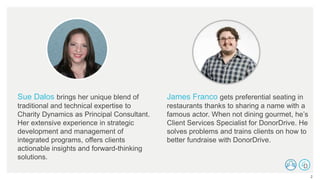
Sue Dalos brings her unique blend of
traditional and technical expertise to
Charity Dynamics as Principal Consultant.
Her extensive experience in strategic
development and management of
integrated programs, offers clients
actionable insights and forward-thinking
solutions.
James Franco gets preferential seating in
restaurants thanks to sharing a name with a
famous actor. When not dining gourmet, he’s
Client Services Specialist for DonorDrive. He
solves problems and trains clients on how to
better fundraise with DonorDrive.
① What is DIY?
② Value of DIY to your organization
③ What to expect after launch
④ Announcing DIY-in-a-Box
Agenda
What is DIY?
How is DIY different from P2P Events?
• Lower cost of entry
• Fundraising on par with endurance
events
• Intrinsically motivated participants
• Acquisition of new donors = new $
• Participant retention = donor
retention
• Opportunity to grow into signature
event
Organization
• No barriers to entry
• They see themselves as fundraisers,
not event participants
• They choose how to represent
you/your brand
• They see their total contribution as a
donation to you.
Fundraiser
5
How is DIY different from Crowdfunding?
6
• High program and transaction fees
• Significant number of fraudulent fundraising campaigns
• Unable to coach or develop an on-going relationship
7
The Value of DIY
Direct Revenue
8
Dorothy Donor
Makes a single donation of $1,000
in memory of her aunt
Influenced Revenue
9
Francis Fundraiser
Raises $1000
Makes $25 donation to herself
Recruits 12 friends to donate $975
Who is worth more?
10
Dorothy Donor Francis Fundraiser
11
The average DIY
campaign
raises 541%
more than the
average event
participant.
12
13
Planning
for your
DIY
15
Body (Title & Content)
16
Ambassador Activation
Organization Buy-In
17
• Most important step
• Calm fears about DIY
• Create fears about not having DIY
Cross-Functional Team
18
Body (Title & Subtitle
Subtitle
19
Benefits of Creating Personas
20
• Allows us to “be in their shoes” to focus on
the goals of each audience group rather than
focusing on what the organization needs to
see
• They help keep user scenarios in mind
during the design process to ensure that the
design, layout and functionality of the site
correspond with the audience
21
• They help avoid the trap of building what
users ask for rather than what they will
actually use
• Communication and design efforts can be
prioritized based on the personas
Benefits of Creating Personas
22
• Fundraisers choice
• One framework that allows for unlimited options
• Generic registration and fundraising messaging
Open
Model
• Fundraisers presented with options
• Customized registration and fundraising
pathways
Hub Model
• A single event type or theme
• Hyper-targeted registration and fundraising
messaging
Campaign
DIY Models
23
The Open Model:
All Do It Yourself.
Program Design:
The Open Model
Program Design: The Hub Model
The Hub Model:
DIY, Community,
Endurance
24
Program Design:
Campaign Model
• Innovative
initiatives from the
organization.
25
Feature (1)
• Subtitle
Contagious Content
The key is to strike a balance between
offering content that is valuable for brand
positioning, and offering content that is fun
and shareable on social channels.
If you can show value to your followers, your
lead generation efforts can have a true
network effect.
Acquisition Coaching Retention Stewardship
Compelling
message
Eye-
catching
visuals
Audience
appeal &
shareability
Strong CTA
Personality
Support Infrastructure
Self Services
Customer
Searchable
Dbase
On
Demand
Chat
Social
Media
Phone
Support
Email
Support
Video
Demos
FAQs
Interactive
Developing
Your DIY
Program
Platform
Selection
Program Design
& Testing
Mar/Com
Strategy
Launch!
Program Milestones
Look for:
• Brand matching
• Power to admirably handle your program scope
• Ease in creating campaigns
• Easy email
• Socially connected (46% more donations)
• Mobile-friendly donations (3 of 5 visitors are mobile)
Platform Selection
• Transition 4
Program Design: The more you put in the more you get out.
• Experienced DIY developer
necessary
• Test it thoroughly yourself
Development and Testing
• The second most important element of
DIY is promoting it.
• Promote it everywhere.
• Promote it to specific groups.
• Promote it during the “off season.”
MarCom Strategy
• Watch for bugs
• Keep notes on what can be
improved
Launch
What To
Expect After
You Launch
• Encourage virality.
• Ask others to follow suit.
Promote Successful Campaigns
Analytics
• # of registrations
• # of donors
• $ of donations
• # of fundraisers to self-pledge
• # of Repeat Fundraisers
• Registration sources
Key Performance Indicators
• # of $0 Fundraisers
• % that don’t update personal
pages
• % that access FR tools
• Actions from coaching e-
communications
• Customer support inquiries
• Types of events registered
Program Optimization Flags
Request a demo of DonorDrive and a you’ll be contacted
by a Charity Dynamics representative to get your own DIY
program up and running.
http://www.donordrive.com/request-a-demo/
Want to jump start your DIY program?
40
Sue Dalos
Principal Consultant
Charity Dynamics
sdalos@charitydynamics.com
James Franco
Client Services Specialist
DonorDrive
jfranco@donordrive.com

Webinar: DIY in-a-Box

  • 1.
  • 2.
    2 Sue Dalos bringsher unique blend of traditional and technical expertise to Charity Dynamics as Principal Consultant. Her extensive experience in strategic development and management of integrated programs, offers clients actionable insights and forward-thinking solutions. James Franco gets preferential seating in restaurants thanks to sharing a name with a famous actor. When not dining gourmet, he’s Client Services Specialist for DonorDrive. He solves problems and trains clients on how to better fundraise with DonorDrive.
  • 3.
    ① What isDIY? ② Value of DIY to your organization ③ What to expect after launch ④ Announcing DIY-in-a-Box Agenda
  • 4.
  • 5.
    How is DIYdifferent from P2P Events? • Lower cost of entry • Fundraising on par with endurance events • Intrinsically motivated participants • Acquisition of new donors = new $ • Participant retention = donor retention • Opportunity to grow into signature event Organization • No barriers to entry • They see themselves as fundraisers, not event participants • They choose how to represent you/your brand • They see their total contribution as a donation to you. Fundraiser 5
  • 6.
    How is DIYdifferent from Crowdfunding? 6 • High program and transaction fees • Significant number of fraudulent fundraising campaigns • Unable to coach or develop an on-going relationship
  • 7.
  • 8.
    Direct Revenue 8 Dorothy Donor Makesa single donation of $1,000 in memory of her aunt
  • 9.
    Influenced Revenue 9 Francis Fundraiser Raises$1000 Makes $25 donation to herself Recruits 12 friends to donate $975
  • 10.
    Who is worthmore? 10 Dorothy Donor Francis Fundraiser
  • 11.
    11 The average DIY campaign raises541% more than the average event participant.
  • 12.
  • 13.
  • 14.
  • 15.
  • 16.
    Body (Title &Content) 16 Ambassador Activation
  • 17.
    Organization Buy-In 17 • Mostimportant step • Calm fears about DIY • Create fears about not having DIY
  • 18.
  • 19.
    Body (Title &Subtitle Subtitle 19
  • 20.
    Benefits of CreatingPersonas 20 • Allows us to “be in their shoes” to focus on the goals of each audience group rather than focusing on what the organization needs to see • They help keep user scenarios in mind during the design process to ensure that the design, layout and functionality of the site correspond with the audience
  • 21.
    21 • They helpavoid the trap of building what users ask for rather than what they will actually use • Communication and design efforts can be prioritized based on the personas Benefits of Creating Personas
  • 22.
    22 • Fundraisers choice •One framework that allows for unlimited options • Generic registration and fundraising messaging Open Model • Fundraisers presented with options • Customized registration and fundraising pathways Hub Model • A single event type or theme • Hyper-targeted registration and fundraising messaging Campaign DIY Models
  • 23.
    23 The Open Model: AllDo It Yourself. Program Design: The Open Model
  • 24.
    Program Design: TheHub Model The Hub Model: DIY, Community, Endurance 24
  • 25.
    Program Design: Campaign Model •Innovative initiatives from the organization. 25
  • 26.
  • 27.
    Contagious Content The keyis to strike a balance between offering content that is valuable for brand positioning, and offering content that is fun and shareable on social channels. If you can show value to your followers, your lead generation efforts can have a true network effect. Acquisition Coaching Retention Stewardship Compelling message Eye- catching visuals Audience appeal & shareability Strong CTA Personality
  • 28.
  • 29.
  • 30.
  • 31.
    Look for: • Brandmatching • Power to admirably handle your program scope • Ease in creating campaigns • Easy email • Socially connected (46% more donations) • Mobile-friendly donations (3 of 5 visitors are mobile) Platform Selection
  • 32.
    • Transition 4 ProgramDesign: The more you put in the more you get out.
  • 33.
    • Experienced DIYdeveloper necessary • Test it thoroughly yourself Development and Testing
  • 34.
    • The secondmost important element of DIY is promoting it. • Promote it everywhere. • Promote it to specific groups. • Promote it during the “off season.” MarCom Strategy
  • 35.
    • Watch forbugs • Keep notes on what can be improved Launch
  • 36.
  • 37.
    • Encourage virality. •Ask others to follow suit. Promote Successful Campaigns
  • 38.
    Analytics • # ofregistrations • # of donors • $ of donations • # of fundraisers to self-pledge • # of Repeat Fundraisers • Registration sources Key Performance Indicators • # of $0 Fundraisers • % that don’t update personal pages • % that access FR tools • Actions from coaching e- communications • Customer support inquiries • Types of events registered Program Optimization Flags
  • 39.
    Request a demoof DonorDrive and a you’ll be contacted by a Charity Dynamics representative to get your own DIY program up and running. http://www.donordrive.com/request-a-demo/ Want to jump start your DIY program?
  • 40.
  • 41.
    Sue Dalos Principal Consultant CharityDynamics sdalos@charitydynamics.com James Franco Client Services Specialist DonorDrive jfranco@donordrive.com

Editor's Notes

  • #4 SUE
  • #5 SUE
  • #6  SUE
  • #7  SUE
  • #8 SUE
  • #9 SUE
  • #10 SUE
  • #11 SUE
  • #12 JAMES
  • #13 JAMES
  • #14 JAMES
  • #15 SUE
  • #16 SUE
  • #17 SUE
  • #18 JAMES
  • #19 JAMES
  • #20 SUE
  • #21 SUE
  • #22 SUE
  • #23 SUE
  • #24 JAMES The basic plan is more hands off for the organization and recommended for nonprofits that don’t have many staff hours to dedicate to it. Under a basic DIY page, your supporters have the complete freedom to fundraise for your organization in whatever creative manner they choose. This guy raised $77K riding his bike across the country.
  • #25 JAMES Organizations with comprehensive third-party programs have raised over a million in their first year through DonorDrive. A Third-Party Program brings all your supporter-based fundraising together. In addition to DIY, there are Endurance programs. These best serve the endurance communities especially Marathoners. They often have high fundraising minimums to cover event bibs, airfare, meals and/or hotels. One of our clients bought 1,500 bibs in a marathon one year. Community programs fit nicely into Third Party. Organizations usually set up these events, since they can raise substantial sums and often involve cross branding. World Vision has even separated out their programs Into Team World Vision for athletic events and and My Cause for DIY.
  • #26 JAMES Paws with a Cause created a unique twist on DIY. Their service dogs are specially trained for each of the individuals they help, but the price tag for training each dog is steep. They got the idea to let individuals speed up the process by fundraising half the money for their own dog. Noah’s mom raised the $10,000 in 19 hours. She then went on to give the $2500 extra she raised to another person in need of a dog.
  • #27 SUE
  • #28 SUE
  • #29 SUE
  • #30 JAMES
  • #31 JAMES
  • #32 JAMES Brand matching Make sure the software can match your brand, not just add your logo to a generic page. If it feels foreign to supporters, they may not trust that it’s really associated with your organization. (One of the pitfalls that crowdfunding had.) At DonorDrive we create custom templates for DIY. Power to admirably handle your program scope DIY can be as simple as DIY fundraising pages. Or it can be as complex as a complete third party program with DIY, an endurance element for marathoners, community fundraisers and innovative initiatives from the organization. Make sure your software is capable of that. Ease in creating campaigns If it’s not easy, you’ll lose potential campaigners. If they can’t be up and taking donations in 15 minutes to a half hour, there’s a problem. Easy email Email will bring in the biggest share of donations. If a supporter can send an email from within the software, they’re much more likely to do it. In DonorDrive supporters have complete access to email, donation tracking (so they know who to email again) And can even import their entire addressbook to send one email to all. Socially connected DIY is very social. About 46% more donations come in from social media for the DIY campaigner compared to an event participant. In DonorDrive we give supporters easy access to social tools on their fundraising dashboard and give everyone the ability to share the fundraising page. Mobile-friendly donations Today 3 out of 5 visitors to a DonorDrive fundraising page first arrive by mobile. If they can’t make a mobile donation on whatever device they’re on at the moment, you can easily lose that donor. DonorDrive has used Google-approved mobile-responsive design since 2012.
  • #33 JAMES Setting up a DIY program is much cheaper than creating a new event. But the level of resources you can invest will vary. What’s consisitent from program to program is that The more you put in the more you get out. get our what you put in. In DonorDrive our clients run the gammut. Some have just turned it on and made it available. Others have a dedicated staff for their DIY program and now it’s a powerful revenue stream.
  • #34 JAMES In DonorDrive DIY is built in, just like events. You just enable the fundraising type, add a few details and Fill in your content. You can literally create your DIY program in 15 minutes. With other software, the development process will vary. If it has to be built on the back end for you, make sure your software company has experience in creating DIY.  Test it thoroughly by creating some DIY campaigns. As a matter of fact, have everyone on your staff and your board create campaigns for a test run to makes sure all is working correctly.
  • #35 JAMES The second most important element of DIY is promoting it. You must let supporters and potential supporters know about it. While DIY can be self service, your supporters must know it exists, understand what it’s about and feel comfortable trying it. Messaging: Talk about how easy it is and promote examples of successful campaigns that your staff and board have conducted. Since DIY is so flexible, it helps to give suggestions on how to use it. Promote it everywhere. Build a campaign around it and: Email your supporters Put it on your site Talk about it in your newsletter. Send it out on social. Your biggest customers will be your staunchest supporters and these channels will get the word out to them. Promote it to specific groups. It’s likely you have supporters who have moved or are geographically distant and would still like to help. DIY is appealing, so you’ll want to figure ways to market regionally where your organization may not have a formal presence. Also promote to churches, school classes, university students, book clubs, neighborhoods etc. Supporters can start a single campaign or multiple campaigns and complete against each other for fundraising. Promote it during the “off season.” You probably do your signature events in the spring and fall, so the rest of the year is great to promote DIY and fill in the gaps. Some ideas: Valentine’s Day June wedding (In lieu of gifts) End of year. Birthdays Anniversaries
  • #36 JAMES If you’ve promoted your program well, launch shouldn’t be a big issue technologically. Once your supporters start using DIY, you’ll want to watch for bugs and keep notes for possible changes to your program’s pages. Little things like better button placement, clearly wording your introduction to the program can mean more sign ups and more successful campaigns.
  • #37 JAMES
  • #38 JAMES Encourage virality. It’s easier to make a successful campaign more successful than to get a non-successful campaign off the ground. If one of your DIY campaigns skyrockets, do everything you can to push it more. Not only will you get more donations, but it’s great promotion for your whole DIY program. Ask others to follow suit. If a campaign is successful it’s a great opportunity to ask other to start their own campaign
  • #39 JAMES
  • #40  JAMES
  • #41 ADMIN