
Peer-to-Peer Fundraising
Back to the Future
Your Charity Dynamics Team
2
Colleen Legge
Sr. Consultant
clegge@charitydynamics.com
Lindsey Rose
Marketing Strategist
lrose@charitydynamics.com
Agenda
1. What is P2P Fundraising?
2. Increased Competition in P2P
3. Digital Acquisition
4. P2P Donor and Participant Conversion
5. Do it Yourself?
3
What is P2P?
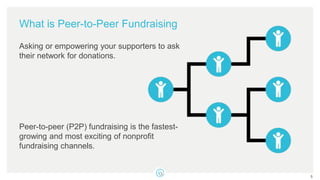
What is Peer-to-Peer Fundraising
Asking or empowering your supporters to ask
their network for donations.
Peer-to-peer (P2P) fundraising is the fastest-
growing and most exciting of nonprofit
fundraising channels.
5
Walk-Run Events
Primary Event Objectives:
• Raise cause and/or organization awareness and facilitate the feeling of
community in designated markets/cities
• Increase organizational revenue through fundraising by utilizing the existing
organization member network and those members’ immediate circle of
influence
• Grow an organizations audience by utilizing a team model – introducing the
cause/organization to potential new supporters
6
Endurance or Third-Party Events
Primary Event Objectives:
• Raise funds for a designated organization or cause through an event or
activity
• Utilize the existing success of a popular event to increase awareness for a
cause or organization
• Grow your organization audience utilizing a team model – introducing the
cause/organization to potential new supporters
7
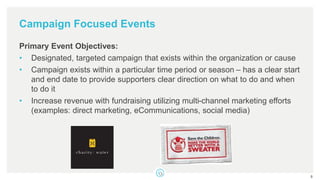
Campaign Focused Events
Primary Event Objectives:
• Designated, targeted campaign that exists within the organization or cause
• Campaign exists within a particular time period or season – has a clear start
and end date to provide supporters clear direction on what to do and when
to do it
• Increase revenue with fundraising utilizing multi-channel marketing efforts
(examples: direct marketing, eCommunications, social media)
8
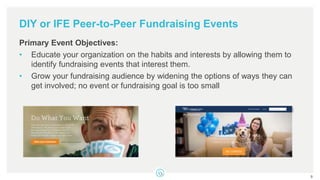
DIY or IFE Peer-to-Peer Fundraising Events
Primary Event Objectives:
• Educate your organization on the habits and interests by allowing them to
identify fundraising events that interest them.
• Grow your fundraising audience by widening the options of ways they can
get involved; no event or fundraising goal is too small
9
Increased
Competition in
Peer-to-Peer
Increased Competition
– P2P programs saturating space –
especially in DIY
– For profit active events such as mud
runs & color runs are innovating
event space but not ‘owned’ by non-
profits
– Many legacy walk programs are
experiencing decline in revenue
year-over-year
What is it?
– Increase acquisition investment
– Innovate within existing programs
– Launch competitive initiatives –
running more than one P2P program
serving different audiences
– Improve your P2P site experience
How to respond
11
For-profit competition
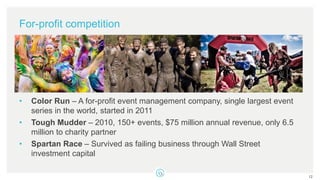
• Color Run – A for-profit event management company, single largest event
series in the world, started in 2011
• Tough Mudder – 2010, 150+ events, $75 million annual revenue, only 6.5
million to charity partner
• Spartan Race – Survived as failing business through Wall Street
investment capital
12
Geo-location
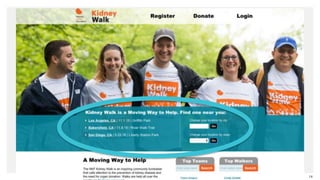
• Let technology do the work for your users
• One less step to get participants registered for the correct event
• Consider possibilities for providing local content on organization websites as
well as events
13
14
Digital Acquisition
15
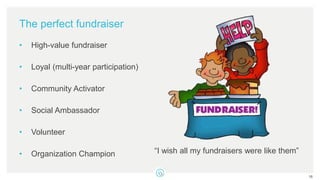
The perfect fundraiser
• High-value fundraiser
• Loyal (multi-year participation)
• Community Activator
• Social Ambassador
• Volunteer
• Organization Champion
16
“I wish all my fundraisers were like them”
17
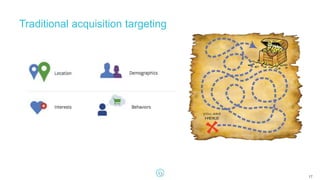
Traditional acquisition targeting
Lookalike audiences
• Targeting algorithm, offered by social
networking sites, providing access to
new audiences that demonstrate
similarities to current high-value
audiences
• These sites create a “lookalike
audience group” specific to your
organization, and provide the ability to
target your advertising to them
What is it?
• Determine your high value
constituents
• Upload audience to create
custom audience
• Develop customized advertising
that speaks directly to these
custom audiences
How to respond
18
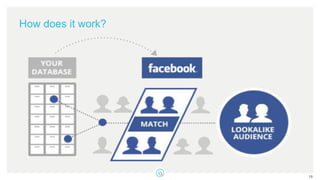
How does it work?
19
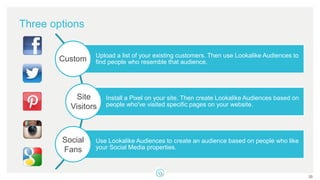
Three options
20
Upload a list of your existing customers. Then use Lookalike Audiences to
find people who resemble that audience.
Install a Pixel on your site. Then create Lookalike Audiences based on
people who've visited specific pages on your website.
Use Lookalike Audiences to create an audience based on people who like
your Social Media properties.
Custom
Site
Visitors
Social
Fans
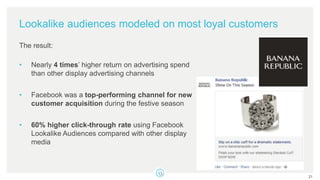
Lookalike audiences modeled on most loyal customers
The result:
• Nearly 4 times’ higher return on advertising spend
than other display advertising channels
• Facebook was a top-performing channel for new
customer acquisition during the festive season
• 60% higher click-through rate using Facebook
Lookalike Audiences compared with other display
media
21
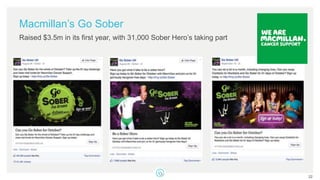
Macmillan’s Go Sober
Raised $3.5m in its first year, with 31,000 Sober Hero’s taking part
22
Take Action
• Ensure your organizations
privacy policy allows for use of
personal information in this way
• Set programs goals and
determine budget (ROI)
• Identify your high value
constituent groups
• Develop contextually relevant
content
Planning
• Upload constituent data to create
your custom audience
• Set-up ad campaign
• Utilize on-site interest categories
to test multiple creative
executions
• Ensure tracking/analytics in
place
• Optimize based on learnings!
Execution
23
P2P Donor &
Participant
Conversion
Is this your organization?
• Event participants and donors are suppressed from direct response
solicitations.
• Do you perform a regular audit of those that are flagged with an erroneous
suppression on their account?
25
Peer to Peer Donor Conversion
• P2P lists are often put into a silo and never
communicated with directly by the
organization
• P2P relationships are left up to participants to
cultivate and solicit each year
• Participants may not renew participation, may
not solicit same contacts
• Lapsed participant and donor lists often go
unused altogether
What is it?
• Cultivate and engage audience throughout
year – supporting participant efforts without
stepping on them
• Engage lapsed donors to make a first time
(non-event) gift
• Test what works for your audience
How to respond
Case Study – Lapsed P2P Donor and Participant Conversion
• National Walk Fundraising Program
• Goals
– Create an email campaign with the goal to re-engage lapsed participants and
donors.
– The primary objective of this test is to maximize action and/or affinity to give.
– Convert lapsed participants and donors into a revenue generating opportunity.
– Develop best practices for ongoing engagement of audience.
27
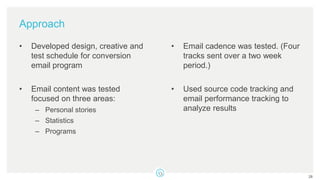
Approach
• Developed design, creative and
test schedule for conversion
email program
• Email content was tested
focused on three areas:
– Personal stories
– Statistics
– Programs
• Email cadence was tested. (Four
tracks sent over a two week
period.)
• Used source code tracking and
email performance tracking to
analyze results
28
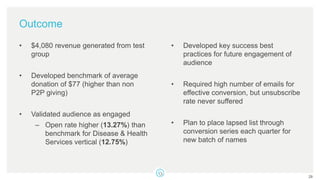
Outcome
• $4,080 revenue generated from test
group
• Developed benchmark of average
donation of $77 (higher than non
P2P giving)
• Validated audience as engaged
– Open rate higher (13.27%) than
benchmark for Disease & Health
Services vertical (12.75%)
• Developed key success best
practices for future engagement of
audience
• Required high number of emails for
effective conversion, but unsubscribe
rate never suffered
• Plan to place lapsed list through
conversion series each quarter for
new batch of names
29
How to respond…
• If your organization isn’t soliciting event donors and participants, you better
believe that another organization will.
• Analyze giving metrics for event-only donors, direct response-only donors,
and donors who give to both direct response and email.
30
DIY- Investment
Required
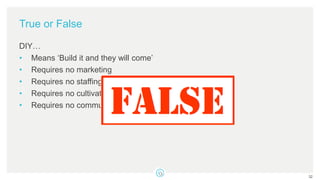
True or False
DIY…
• Means ‘Build it and they will come’
• Requires no marketing
• Requires no staffing
• Requires no cultivation and stewardship
• Requires no communication or coaching plan
32
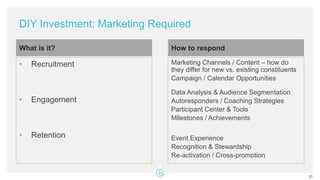
DIY Investment: Marketing Required
• Recruitment
• Engagement
• Retention
What is it?
Marketing Channels / Content – how do
they differ for new vs. existing constituents
Campaign / Calendar Opportunities
Data Analysis & Audience Segmentation
Autoresponders / Coaching Strategies
Participant Center & Tools
Milestones / Achievements
Event Experience
Recognition & Stewardship
Re-activation / Cross-promotion
How to respond
33
34
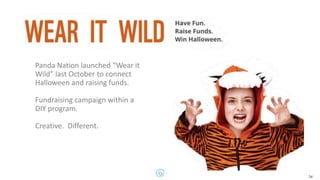
Panda Nation launched “Wear it
Wild” last October to connect
Halloween and raising funds.
Fundraising campaign within a
DIY program.
Creative. Different.
35
Questions?

Peer-to-Peer Fundraising: Back to the Future

  • 1.
  • 2.
    Your Charity DynamicsTeam 2 Colleen Legge Sr. Consultant clegge@charitydynamics.com Lindsey Rose Marketing Strategist lrose@charitydynamics.com
  • 3.
    Agenda 1. What isP2P Fundraising? 2. Increased Competition in P2P 3. Digital Acquisition 4. P2P Donor and Participant Conversion 5. Do it Yourself? 3
  • 4.
  • 5.
    What is Peer-to-PeerFundraising Asking or empowering your supporters to ask their network for donations. Peer-to-peer (P2P) fundraising is the fastest- growing and most exciting of nonprofit fundraising channels. 5
  • 6.
    Walk-Run Events Primary EventObjectives: • Raise cause and/or organization awareness and facilitate the feeling of community in designated markets/cities • Increase organizational revenue through fundraising by utilizing the existing organization member network and those members’ immediate circle of influence • Grow an organizations audience by utilizing a team model – introducing the cause/organization to potential new supporters 6
  • 7.
    Endurance or Third-PartyEvents Primary Event Objectives: • Raise funds for a designated organization or cause through an event or activity • Utilize the existing success of a popular event to increase awareness for a cause or organization • Grow your organization audience utilizing a team model – introducing the cause/organization to potential new supporters 7
  • 8.
    Campaign Focused Events PrimaryEvent Objectives: • Designated, targeted campaign that exists within the organization or cause • Campaign exists within a particular time period or season – has a clear start and end date to provide supporters clear direction on what to do and when to do it • Increase revenue with fundraising utilizing multi-channel marketing efforts (examples: direct marketing, eCommunications, social media) 8
  • 9.
    DIY or IFEPeer-to-Peer Fundraising Events Primary Event Objectives: • Educate your organization on the habits and interests by allowing them to identify fundraising events that interest them. • Grow your fundraising audience by widening the options of ways they can get involved; no event or fundraising goal is too small 9
  • 10.
  • 11.
    Increased Competition – P2Pprograms saturating space – especially in DIY – For profit active events such as mud runs & color runs are innovating event space but not ‘owned’ by non- profits – Many legacy walk programs are experiencing decline in revenue year-over-year What is it? – Increase acquisition investment – Innovate within existing programs – Launch competitive initiatives – running more than one P2P program serving different audiences – Improve your P2P site experience How to respond 11
  • 12.
    For-profit competition • ColorRun – A for-profit event management company, single largest event series in the world, started in 2011 • Tough Mudder – 2010, 150+ events, $75 million annual revenue, only 6.5 million to charity partner • Spartan Race – Survived as failing business through Wall Street investment capital 12
  • 13.
    Geo-location • Let technologydo the work for your users • One less step to get participants registered for the correct event • Consider possibilities for providing local content on organization websites as well as events 13
  • 14.
  • 15.
  • 16.
    The perfect fundraiser •High-value fundraiser • Loyal (multi-year participation) • Community Activator • Social Ambassador • Volunteer • Organization Champion 16 “I wish all my fundraisers were like them”
  • 17.
  • 18.
    Lookalike audiences • Targetingalgorithm, offered by social networking sites, providing access to new audiences that demonstrate similarities to current high-value audiences • These sites create a “lookalike audience group” specific to your organization, and provide the ability to target your advertising to them What is it? • Determine your high value constituents • Upload audience to create custom audience • Develop customized advertising that speaks directly to these custom audiences How to respond 18
  • 19.
    How does itwork? 19
  • 20.
    Three options 20 Upload alist of your existing customers. Then use Lookalike Audiences to find people who resemble that audience. Install a Pixel on your site. Then create Lookalike Audiences based on people who've visited specific pages on your website. Use Lookalike Audiences to create an audience based on people who like your Social Media properties. Custom Site Visitors Social Fans
  • 21.
    Lookalike audiences modeledon most loyal customers The result: • Nearly 4 times’ higher return on advertising spend than other display advertising channels • Facebook was a top-performing channel for new customer acquisition during the festive season • 60% higher click-through rate using Facebook Lookalike Audiences compared with other display media 21
  • 22.
    Macmillan’s Go Sober Raised$3.5m in its first year, with 31,000 Sober Hero’s taking part 22
  • 23.
    Take Action • Ensureyour organizations privacy policy allows for use of personal information in this way • Set programs goals and determine budget (ROI) • Identify your high value constituent groups • Develop contextually relevant content Planning • Upload constituent data to create your custom audience • Set-up ad campaign • Utilize on-site interest categories to test multiple creative executions • Ensure tracking/analytics in place • Optimize based on learnings! Execution 23
  • 24.
  • 25.
    Is this yourorganization? • Event participants and donors are suppressed from direct response solicitations. • Do you perform a regular audit of those that are flagged with an erroneous suppression on their account? 25
  • 26.
    Peer to PeerDonor Conversion • P2P lists are often put into a silo and never communicated with directly by the organization • P2P relationships are left up to participants to cultivate and solicit each year • Participants may not renew participation, may not solicit same contacts • Lapsed participant and donor lists often go unused altogether What is it? • Cultivate and engage audience throughout year – supporting participant efforts without stepping on them • Engage lapsed donors to make a first time (non-event) gift • Test what works for your audience How to respond
  • 27.
    Case Study –Lapsed P2P Donor and Participant Conversion • National Walk Fundraising Program • Goals – Create an email campaign with the goal to re-engage lapsed participants and donors. – The primary objective of this test is to maximize action and/or affinity to give. – Convert lapsed participants and donors into a revenue generating opportunity. – Develop best practices for ongoing engagement of audience. 27
  • 28.
    Approach • Developed design,creative and test schedule for conversion email program • Email content was tested focused on three areas: – Personal stories – Statistics – Programs • Email cadence was tested. (Four tracks sent over a two week period.) • Used source code tracking and email performance tracking to analyze results 28
  • 29.
    Outcome • $4,080 revenuegenerated from test group • Developed benchmark of average donation of $77 (higher than non P2P giving) • Validated audience as engaged – Open rate higher (13.27%) than benchmark for Disease & Health Services vertical (12.75%) • Developed key success best practices for future engagement of audience • Required high number of emails for effective conversion, but unsubscribe rate never suffered • Plan to place lapsed list through conversion series each quarter for new batch of names 29
  • 30.
    How to respond… •If your organization isn’t soliciting event donors and participants, you better believe that another organization will. • Analyze giving metrics for event-only donors, direct response-only donors, and donors who give to both direct response and email. 30
  • 31.
  • 32.
    True or False DIY… •Means ‘Build it and they will come’ • Requires no marketing • Requires no staffing • Requires no cultivation and stewardship • Requires no communication or coaching plan 32
  • 33.
    DIY Investment: MarketingRequired • Recruitment • Engagement • Retention What is it? Marketing Channels / Content – how do they differ for new vs. existing constituents Campaign / Calendar Opportunities Data Analysis & Audience Segmentation Autoresponders / Coaching Strategies Participant Center & Tools Milestones / Achievements Event Experience Recognition & Stewardship Re-activation / Cross-promotion How to respond 33
  • 34.
    34 Panda Nation launched“Wear it Wild” last October to connect Halloween and raising funds. Fundraising campaign within a DIY program. Creative. Different.
  • 35.
  • 36.

Editor's Notes

  • #6 Some give simply because of the person that asked. Some give because of the person and the organization. Before we jump in…let’s take a quick look at P2P in our every day lives We spread ideas with our friends through Facebook. We shop for deals on Instagram We look for movie suggestions on Rotten Tomatoes We browse for the best restaurants on Yelp. We find new music to follow on Spotify. Over the last decade, peer-to-peer has started to permeate every aspect of our lives.
  • #12 Legacy Charity Walks and Runs Are Stumbling, New Report Says - https://philanthropy.com/article/Legacy-Charity-WalksRuns/227893
  • #13 Spartan raises money from Wall Street to keep business open - https://www.mudandadventure.com/spartan-race-success-perserverance-forbes/
  • #26 This means while I should have been receiving email newsletters and program updates, I was getting none. One large, national nonprofit found nearly 2,500 gifts were made by donors with an active Do Not Solicit flag, and a large majority of those gifts were made online.  These donors should be folded back into solicitations to continue building the donor relationship and bringing in subsequent donations.
  • #31 Start a discussion at your organization about the importance of event donors to overall fundraising goals. If possible,