Email: jeff.johnson@todo-solar.com-mx Tele: (+52) 871 722 9522 www.todo-solar.com.mx
Electrical Installation of a PV System
Making the Right Connections…
Dr. Jeffery Lee Johnson
CTO Todo-Solar
Coahuila, Mexico
Agenda
• Resources
• Assumptions and Background
• The DC side of things
– Choosing and Connecting the Panels in Series
– Proper grounding
– String combiners
• Meeting in the Middle
– DC connection to the Inverter
– DC Disconnects, fusing and loading
• The AC side of things
– AC Connection to the Inverter
– AC Disconnects, fusing and safety
– Connecting to the grid
• Summary and questions
Resources
Doc Solstice’s Seasoned Sentiments
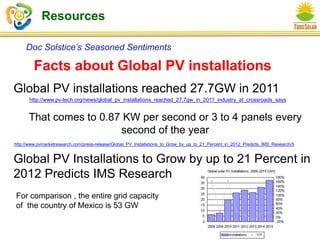
Facts about Global PV installations
http://www.pv-tech.org/news/global_pv_installations_reached_27.7gw_in_2011_industry_at_crossroads_says
Global PV installations reached 27.7GW in 2011
That comes to 0.87 KW per second or 3 to 4 panels every
second of the year
Global PV Installations to Grow by up to 21 Percent in
2012 Predicts IMS Research
http://www.pvmarketresearch.com/press-release/Global_PV_Installations_to_Grow_by_up_to_21_Percent_in_2012_Predicts_IMS_Research/5
For comparison , the entire grid capacity
of the country of Mexico is 53 GW
INTRODUCTION, BACKGROUND AND
ASSUMPTIONS ABOUT THE SYSTEM
Key Concepts and Assumptions
• Follow the typical systematic Installation Procedures
– Assemble and place racks
– Mount and connect panels (DC)
– Install combiner box (DC)
– Connect DC disconnect (may be integrated) (DC)
– Connect DC to inverter (DC)
– Mount and configure inverter (AC/DC)
– Install AC Disconnect (AC)
– Connect inverter to grid via electrical center (AC)
– Commission and test (AC/DC
– Install or activate Monitoring system
• You have an approved wiring diagram meeting specifications and
needs of Locations
– Routing, cable lengths, junction locations, fusing etc a
• You have a complete parts list with prepared components
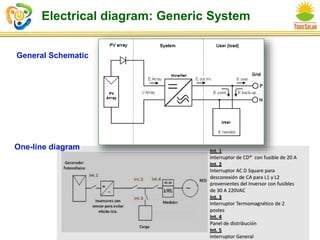
Electrical diagram: Generic System
General Schematic
One-line diagram
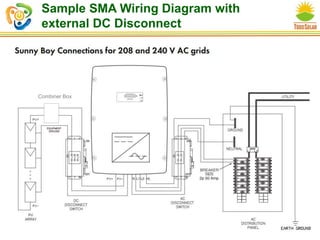
Sample SMA Wiring Diagram with
external DC Disconnect
Combiner Box
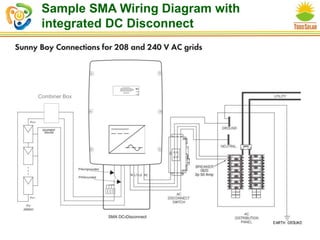
Sample SMA Wiring Diagram with
integrated DC Disconnect
Combiner Box
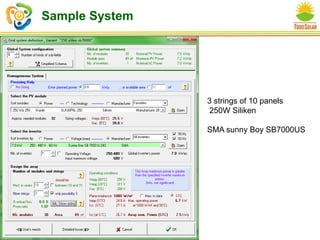
Sample System
3 strings of 10 panels
250W Siliken
SMA sunny Boy SB7000US
THE DC SIDE OF THINGS
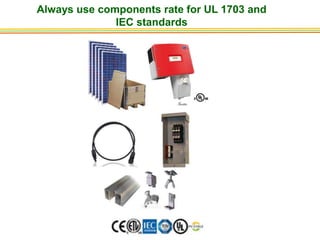
Always use components rate for UL 1703 and
IEC standards
Panel Characteristics
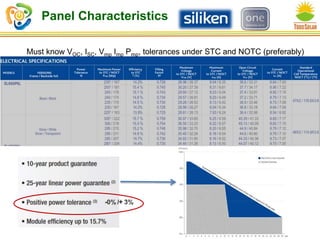
Must know VOC, ISC, Vmp Imp Pmp, tolerances under STC and NOTC (preferably)
Characteristics of Panels in Series
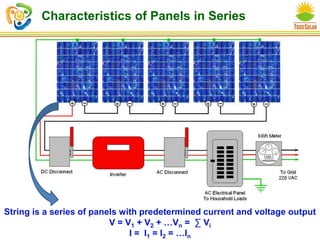
String is a series of panels with predetermined current and voltage output
V = V1 + V2 + …Vn = ∑ Vi
I = I1 = I2 = …In
Choosing Panels for Series layout
Issue
 Voltages for Panels in Series add linearly
 Ideally, every series has the same voltage output – but
generally not true
 When combining series into Parallel Arrays at a
combination node (such as a combiner box or Inverter
input), the voltage at that node is the weighted average of
the series voltages favoring the lowest voltage present
Important to balance your strings by equalizing the
string voltages as best as possible !
Balancing String Voltage
Layout your panels in a similar environment of illumination & temperature
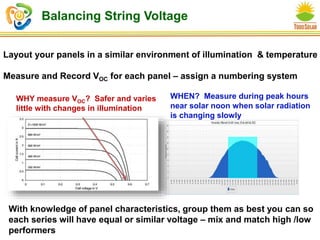
Measure and Record VOC for each panel – assign a numbering system
WHY measure VOC? Safer and varies
little with changes in illumination
WHEN? Measure during peak hours
near solar noon when solar radiation
is changing slowly
With knowledge of panel characteristics, group them as best you can so
each series will have equal or similar voltage – mix and match high /low
performers
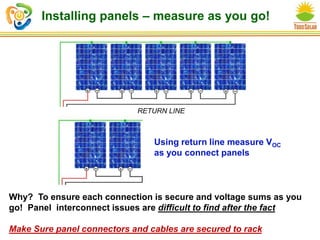
Installing panels – measure as you go!
RETURN LINE
Using return line measure VOC
as you connect panels
Why? To ensure each connection is secure and voltage sums as you
go! Panel interconnect issues are difficult to find after the fact
Make Sure panel connectors and cables are secured to rack
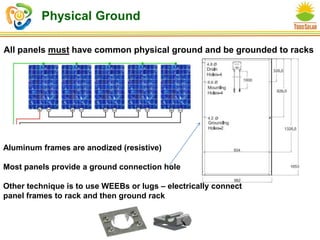
Physical Ground
All panels must have common physical ground and be grounded to racks
Aluminum frames are anodized (resistive)
Most panels provide a ground connection hole
Other technique is to use WEEBs or lugs – electrically connect
panel frames to rack and then ground rack
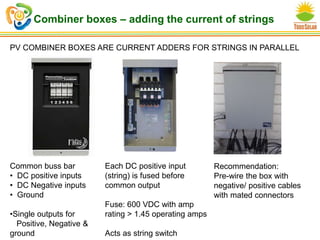
Combiner boxes – adding the current of strings
PV COMBINER BOXES ARE CURRENT ADDERS FOR STRINGS IN PARALLEL
Common buss bar
• DC positive inputs
• DC Negative inputs
• Ground
•Single outputs for
Positive, Negative &
ground
Each DC positive input
(string) is fused before
common output
Fuse: 600 VDC with amp
rating > 1.45 operating amps
Acts as string switch
Recommendation:
Pre-wire the box with
negative/ positive cables
with mated connectors
DC routing
• Have a DC cable routing plan
– DC is on the roof or remote from inverter
• Best solar cables do not need conduit but
bundle them nicely using UV resistant cable ties
• For esthetics and some codes, use metal
conduit to distribute DC cables
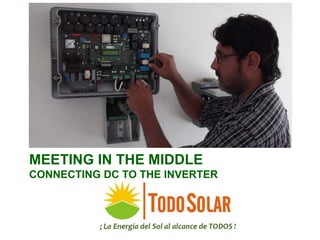
MEETING IN THE MIDDLE
CONNECTING DC TO THE INVERTER
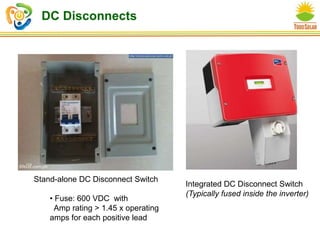
DC Disconnects
Integrated DC Disconnect Switch
(Typically fused inside the inverter)
Stand-alone DC Disconnect Switch
• Fuse: 600 VDC with
Amp rating > 1.45 x operating
amps for each positive lead
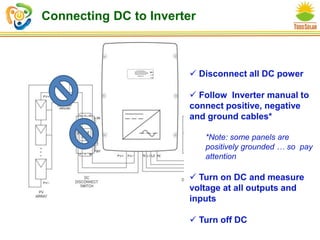
Connecting DC to Inverter
 Disconnect all DC power
 Follow Inverter manual to
connect positive, negative
and ground cables*
*Note: some panels are
positively grounded … so pay
attention
 Turn on DC and measure
voltage at all outputs and
inputs
 Turn off DC
THE AC SIDE OF THINGS
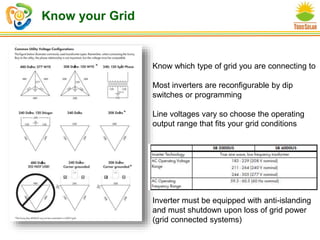
Know your Grid
Know which type of grid you are connecting to
Most inverters are reconfigurable by dip
switches or programming
Line voltages vary so choose the operating
output range that fits your grid conditions
Inverter must be equipped with anti-islanding
and must shutdown upon loss of grid power
(grid connected systems)
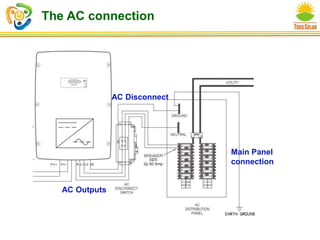
The AC connection
AC Disconnect
Main Panel
connection
AC Outputs
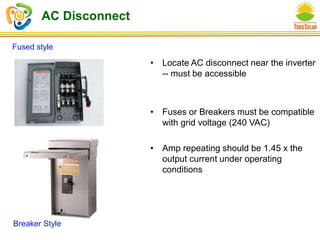
AC Disconnect
• Locate AC disconnect near the inverter
-- must be accessible
• Fuses or Breakers must be compatible
with grid voltage (240 VAC)
• Amp repeating should be 1.45 x the
output current under operating
conditions
Fused style
Breaker Style
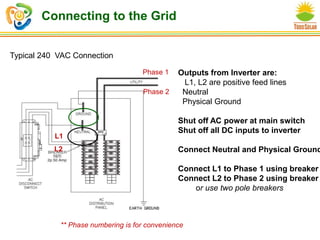
Connecting to the Grid
L1
Phase 2
L2
Phase 1
Typical 240 VAC Connection
Outputs from Inverter are:
L1, L2 are positive feed lines
Neutral
Physical Ground
Shut off AC power at main switch
Shut off all DC inputs to inverter
Connect Neutral and Physical Ground
Connect L1 to Phase 1 using breaker
Connect L2 to Phase 2 using breaker
or use two pole breakers
** Phase numbering is for convenience
Commissioning
• Check all connections
• Follow manual for startup
• Usual procedure is
– For Startup: Turn on AC First then DC
– For Shutdown: Turn off DC first then AC
• After shutdown, ALWAYS wait 5 to 10 minutes
before opening or working on inverter !!!
• Capacitive load needs to discharge
SYSTEM MONITORING
30
Monitoreo de Bluetooth para Internet o iPhone, iPad
(Solar Energy made available to Everyone)
http://www.todo-solar.com.mx
Twitter: @TodoSolarKids
Twitter: @TodoSolar

Webinar 03 electrical installation of pv system

  • 1.
    Email: jeff.johnson@todo-solar.com-mx Tele:(+52) 871 722 9522 www.todo-solar.com.mx Electrical Installation of a PV System Making the Right Connections… Dr. Jeffery Lee Johnson CTO Todo-Solar Coahuila, Mexico
  • 2.
    Agenda • Resources • Assumptionsand Background • The DC side of things – Choosing and Connecting the Panels in Series – Proper grounding – String combiners • Meeting in the Middle – DC connection to the Inverter – DC Disconnects, fusing and loading • The AC side of things – AC Connection to the Inverter – AC Disconnects, fusing and safety – Connecting to the grid • Summary and questions
  • 3.
    Resources Doc Solstice’s SeasonedSentiments Facts about Global PV installations http://www.pv-tech.org/news/global_pv_installations_reached_27.7gw_in_2011_industry_at_crossroads_says Global PV installations reached 27.7GW in 2011 That comes to 0.87 KW per second or 3 to 4 panels every second of the year Global PV Installations to Grow by up to 21 Percent in 2012 Predicts IMS Research http://www.pvmarketresearch.com/press-release/Global_PV_Installations_to_Grow_by_up_to_21_Percent_in_2012_Predicts_IMS_Research/5 For comparison , the entire grid capacity of the country of Mexico is 53 GW
  • 4.
  • 5.
    Key Concepts andAssumptions • Follow the typical systematic Installation Procedures – Assemble and place racks – Mount and connect panels (DC) – Install combiner box (DC) – Connect DC disconnect (may be integrated) (DC) – Connect DC to inverter (DC) – Mount and configure inverter (AC/DC) – Install AC Disconnect (AC) – Connect inverter to grid via electrical center (AC) – Commission and test (AC/DC – Install or activate Monitoring system • You have an approved wiring diagram meeting specifications and needs of Locations – Routing, cable lengths, junction locations, fusing etc a • You have a complete parts list with prepared components
  • 6.
    Electrical diagram: GenericSystem General Schematic One-line diagram
  • 7.
    Sample SMA WiringDiagram with external DC Disconnect Combiner Box
  • 8.
    Sample SMA WiringDiagram with integrated DC Disconnect Combiner Box
  • 9.
    Sample System 3 stringsof 10 panels 250W Siliken SMA sunny Boy SB7000US
  • 10.
    THE DC SIDEOF THINGS
  • 11.
    Always use componentsrate for UL 1703 and IEC standards
  • 12.
    Panel Characteristics Must knowVOC, ISC, Vmp Imp Pmp, tolerances under STC and NOTC (preferably)
  • 13.
    Characteristics of Panelsin Series String is a series of panels with predetermined current and voltage output V = V1 + V2 + …Vn = ∑ Vi I = I1 = I2 = …In
  • 14.
    Choosing Panels forSeries layout Issue  Voltages for Panels in Series add linearly  Ideally, every series has the same voltage output – but generally not true  When combining series into Parallel Arrays at a combination node (such as a combiner box or Inverter input), the voltage at that node is the weighted average of the series voltages favoring the lowest voltage present Important to balance your strings by equalizing the string voltages as best as possible !
  • 15.
    Balancing String Voltage Layoutyour panels in a similar environment of illumination & temperature Measure and Record VOC for each panel – assign a numbering system WHY measure VOC? Safer and varies little with changes in illumination WHEN? Measure during peak hours near solar noon when solar radiation is changing slowly With knowledge of panel characteristics, group them as best you can so each series will have equal or similar voltage – mix and match high /low performers
  • 16.
    Installing panels –measure as you go! RETURN LINE Using return line measure VOC as you connect panels Why? To ensure each connection is secure and voltage sums as you go! Panel interconnect issues are difficult to find after the fact Make Sure panel connectors and cables are secured to rack
  • 17.
    Physical Ground All panelsmust have common physical ground and be grounded to racks Aluminum frames are anodized (resistive) Most panels provide a ground connection hole Other technique is to use WEEBs or lugs – electrically connect panel frames to rack and then ground rack
  • 18.
    Combiner boxes –adding the current of strings PV COMBINER BOXES ARE CURRENT ADDERS FOR STRINGS IN PARALLEL Common buss bar • DC positive inputs • DC Negative inputs • Ground •Single outputs for Positive, Negative & ground Each DC positive input (string) is fused before common output Fuse: 600 VDC with amp rating > 1.45 operating amps Acts as string switch Recommendation: Pre-wire the box with negative/ positive cables with mated connectors
  • 19.
    DC routing • Havea DC cable routing plan – DC is on the roof or remote from inverter • Best solar cables do not need conduit but bundle them nicely using UV resistant cable ties • For esthetics and some codes, use metal conduit to distribute DC cables
  • 20.
    MEETING IN THEMIDDLE CONNECTING DC TO THE INVERTER
  • 21.
    DC Disconnects Integrated DCDisconnect Switch (Typically fused inside the inverter) Stand-alone DC Disconnect Switch • Fuse: 600 VDC with Amp rating > 1.45 x operating amps for each positive lead
  • 22.
    Connecting DC toInverter  Disconnect all DC power  Follow Inverter manual to connect positive, negative and ground cables* *Note: some panels are positively grounded … so pay attention  Turn on DC and measure voltage at all outputs and inputs  Turn off DC
  • 23.
    THE AC SIDEOF THINGS
  • 24.
    Know your Grid Knowwhich type of grid you are connecting to Most inverters are reconfigurable by dip switches or programming Line voltages vary so choose the operating output range that fits your grid conditions Inverter must be equipped with anti-islanding and must shutdown upon loss of grid power (grid connected systems)
  • 25.
    The AC connection ACDisconnect Main Panel connection AC Outputs
  • 26.
    AC Disconnect • LocateAC disconnect near the inverter -- must be accessible • Fuses or Breakers must be compatible with grid voltage (240 VAC) • Amp repeating should be 1.45 x the output current under operating conditions Fused style Breaker Style
  • 27.
    Connecting to theGrid L1 Phase 2 L2 Phase 1 Typical 240 VAC Connection Outputs from Inverter are: L1, L2 are positive feed lines Neutral Physical Ground Shut off AC power at main switch Shut off all DC inputs to inverter Connect Neutral and Physical Ground Connect L1 to Phase 1 using breaker Connect L2 to Phase 2 using breaker or use two pole breakers ** Phase numbering is for convenience
  • 28.
    Commissioning • Check allconnections • Follow manual for startup • Usual procedure is – For Startup: Turn on AC First then DC – For Shutdown: Turn off DC first then AC • After shutdown, ALWAYS wait 5 to 10 minutes before opening or working on inverter !!! • Capacitive load needs to discharge
  • 29.
  • 30.
    30 Monitoreo de Bluetoothpara Internet o iPhone, iPad
  • 31.
    (Solar Energy madeavailable to Everyone) http://www.todo-solar.com.mx Twitter: @TodoSolarKids Twitter: @TodoSolar