Building Services 1
Building Integration of Solar Energy
Group member
Yip Xiaojung
Alwin Ng Kun Ket
Goh Jia Jun
Kenneth Tan Sin Kwang
Ng Sheng Zhe
Introduction
• one of the most useful
renewable energy
• radiant energy emitted by
the sun
• 90 million miles from the
earth
• comes in abundant
• surface of earth receives
120,000 terawatts of solar
radiation
Introduction
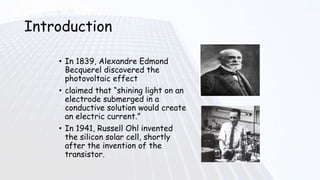
• In 1839, Alexandre Edmond
Becquerel discovered the
photovoltaic effect
• claimed that “shining light on an
electrode submerged in a
conductive solution would create
an electric current.”
• In 1941, Russell Ohl invented
the silicon solar cell, shortly
after the invention of the
transistor.
Introduction
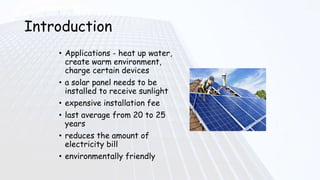
• Applications - heat up water,
create warm environment,
charge certain devices
• a solar panel needs to be
installed to receive sunlight
• expensive installation fee
• last average from 20 to 25
years
• reduces the amount of
electricity bill
• environmentally friendly
Pre-Installation
process
Evaluation Selection
Contract
Evaluation
• suitability of the system
• Suitability of site
• Solar pathfinder
• Set up at 4 corners of the panel
Selection
• Size and weight of roof
• Size and weight of Solar Panel
Contract
• Contract between electrical companies
• Allows there resell of electricity
• Ensures efficient management
Installation
Introduction to Mounts
Flush Mounts
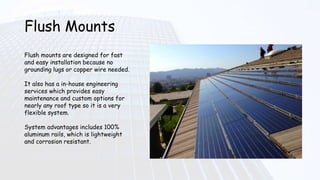
Flush mounts are designed for fast
and easy installation because no
grounding lugs or copper wire needed.
It also has a in-house engineering
services which provides easy
maintenance and custom options for
nearly any roof type so it is a very
flexible system.
System advantages includes 100%
aluminum rails, which is lightweight
and corrosion resistant.
Ground Mount
The advantages of a ground mount
system is high level of pre-
assembly for fast installations
and easily accessible for ground
and system maintenance.
Besides that, the ground mount
system also provides a larger area
and weight load to rest the panels
upon.
Pole Mount
Pole mounts are being distinguished by
how the pole mounts are placed on the pole.
The uppermost part of the pole mounts
contained of a metal rack and rail unit that
is secured to a huge sleeve that rests
ahead of the pole.
The mount will then simply slips over
the top most of the pole, and the solar unit
can be placed into place by welding the
solar panels or bolting them. It is
important to take into account of wind load
as the pole might be less stable when
compared to the flush mount and the
ground mount.
Management
• A few times a year, the
panels should be inspected
for any dirt or debris that
may collect on them. The
dust and debris on the
system may cause the
system to reduce the intake
on sunlight and generate less
electricity. Therefore,
general cleaning may be
important to keep the
system going.
Management
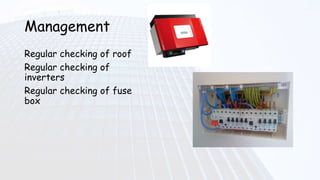
Regular checking of roof
Regular checking of
inverters
Regular checking of fuse
box
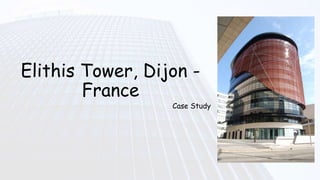
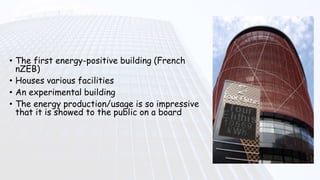
Elithis Tower, Dijon -
France
Case Study
• The first energy-positive building (French
nZEB)
• Houses various facilities
• An experimental building
• The energy production/usage is so impressive
that it is showed to the public on a board
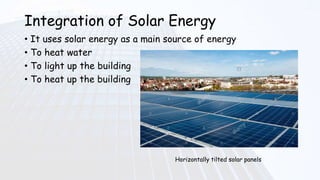
Integration of Solar Energy
• It uses solar energy as a main source of energy
• To heat water
• To light up the building
• To heat up the building
Horizontally tilted solar panels
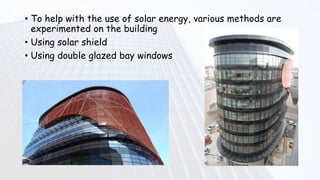
• To help with the use of solar energy, various methods are
experimented on the building
• Using solar shield
• Using double glazed bay windows
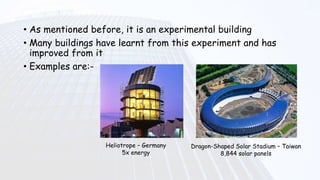
• As mentioned before, it is an experimental building
• Many buildings have learnt from this experiment and has
improved from it
• Examples are:-
Heliotrope – Germany
5x energy
Dragon-Shaped Solar Stadium – Taiwan
8,844 solar panels
Advantages
1.) Renewable Energy Source
- Will not depleted when used
-Can be used without limitation
2.) Low Maintenance Cost
-Because there is no moving parts
in the solar panel
- Average lifespan is 20-25 years
- Requirement: keep clean
Advantages
3.) Diverse Applications
- Can be used to generate electricity
- Used for space heating and
produce hot water.
4.) Does not cause Global Warming
- Solar energy is clean, reliable
and non polluting.
- Does not release toxic gases.
- No storage of radioactive wastes.
Advantages
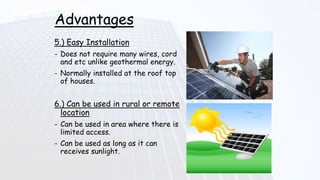
5.) Easy Installation
- Does not require many wires, cord
and etc unlike geothermal energy.
- Normally installed at the roof top
of houses.
6.) Can be used in rural or remote
location
- Can be used in area where there is
limited access.
- Can be used as long as it can
receives sunlight.
Disadvantages
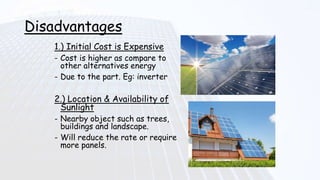
1.) Initial Cost is Expensive
- Cost is higher as compare to
other alternatives energy
- Due to the part. Eg: inverter
2.) Location & Availability of
Sunlight
- Nearby object such as trees,
buildings and landscape.
- Will reduce the rate or require
more panels.
Disadvantages
3.) Installation Area
- Normally installed at the rooftop for normal house
- While for bigger building or industrial, need to be
installed on ground.
- Which can cause obstruction.
Disadvantages
4.) Poor Reliability
- Rely mainly on the local grid
utility to generate power.
- Or solar batteries for storage to
store the excess power.
5.) Polluted Environment can
caused damages to panel
- Photovoltaic panel are made from
mercury and other toxic materials
which are easily damaged.
- As results reduce the efficiency
and quality of the cell.
Possible problems with the system
• Weather-dependant
- It need the sun to generate heat or electricity
- Won’t work effectively in bad weather countries
• Lack of effectiveness
- It is not a 100% efficient
- Only takes a range from 20%-40%
Possible problems with the system
• Problem of the semiconductor
- High temperature will burn the semiconductor
- Decrease the efficiency
- Necessary to repair
• Surface of the solar panel
- Clean
• Solar water heating system
- Antifreeze sensor must be maintained
- Pipe rupture
Recommendations for Future
Improvements
• Use multi-cell gallium arsenide with three-
junction concentrator
• Develop a large energy storage system
• Establish subsidies for solar deployment and
provide subsidies for purchasing solar panel
Conclusion
• Although solar energy is very useful in many applications,
scientists conclude that the sun will be extinct after billions
of years
• Even though the size of the sun is 109 times the diameter
of the earth, its energy will still come to an end in the
future
• humans should appreciate this free source of energy
Conclusion
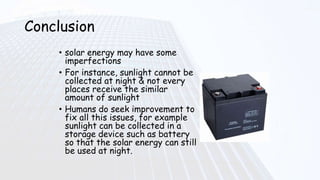
• solar energy may have some
imperfections
• For instance, sunlight cannot be
collected at night & not every
places receive the similar
amount of sunlight
• Humans do seek improvement to
fix all this issues, for example
sunlight can be collected in a
storage device such as battery
so that the solar energy can still
be used at night.
Conclusion
• Even until today, the most efficient solar cell technology is only able
to convert 20% of the sunlight into electricity, but with the increasing
advancement of humans in solar cell technology, the number is likely to
increase in the future.
• all houses in the world will be installing solar panels in their houses and
reduce the amount of electricity
• More people should invest on solar panels to realize its full potential
• humans should depend on solar energy and stop relying on non-
renewable energy
Learning outcome
• benefits and disadvantages
of solar energy
• gained more knowledge by
researching the information
online
• improved our skills in doing
work with my groupmates
• Better communication skill

Bs solar energy presentation

  • 1.
    Building Services 1 BuildingIntegration of Solar Energy Group member Yip Xiaojung Alwin Ng Kun Ket Goh Jia Jun Kenneth Tan Sin Kwang Ng Sheng Zhe
  • 3.
    Introduction • one ofthe most useful renewable energy • radiant energy emitted by the sun • 90 million miles from the earth • comes in abundant • surface of earth receives 120,000 terawatts of solar radiation
  • 4.
    Introduction • In 1839,Alexandre Edmond Becquerel discovered the photovoltaic effect • claimed that “shining light on an electrode submerged in a conductive solution would create an electric current.” • In 1941, Russell Ohl invented the silicon solar cell, shortly after the invention of the transistor.
  • 5.
    Introduction • Applications -heat up water, create warm environment, charge certain devices • a solar panel needs to be installed to receive sunlight • expensive installation fee • last average from 20 to 25 years • reduces the amount of electricity bill • environmentally friendly
  • 6.
  • 7.
    Evaluation • suitability ofthe system • Suitability of site • Solar pathfinder • Set up at 4 corners of the panel
  • 8.
    Selection • Size andweight of roof • Size and weight of Solar Panel
  • 9.
    Contract • Contract betweenelectrical companies • Allows there resell of electricity • Ensures efficient management
  • 10.
  • 11.
  • 12.
    Flush Mounts Flush mountsare designed for fast and easy installation because no grounding lugs or copper wire needed. It also has a in-house engineering services which provides easy maintenance and custom options for nearly any roof type so it is a very flexible system. System advantages includes 100% aluminum rails, which is lightweight and corrosion resistant.
  • 13.
    Ground Mount The advantagesof a ground mount system is high level of pre- assembly for fast installations and easily accessible for ground and system maintenance. Besides that, the ground mount system also provides a larger area and weight load to rest the panels upon.
  • 14.
    Pole Mount Pole mountsare being distinguished by how the pole mounts are placed on the pole. The uppermost part of the pole mounts contained of a metal rack and rail unit that is secured to a huge sleeve that rests ahead of the pole. The mount will then simply slips over the top most of the pole, and the solar unit can be placed into place by welding the solar panels or bolting them. It is important to take into account of wind load as the pole might be less stable when compared to the flush mount and the ground mount.
  • 15.
    Management • A fewtimes a year, the panels should be inspected for any dirt or debris that may collect on them. The dust and debris on the system may cause the system to reduce the intake on sunlight and generate less electricity. Therefore, general cleaning may be important to keep the system going.
  • 16.
    Management Regular checking ofroof Regular checking of inverters Regular checking of fuse box
  • 17.
    Elithis Tower, Dijon- France Case Study
  • 18.
    • The firstenergy-positive building (French nZEB) • Houses various facilities • An experimental building • The energy production/usage is so impressive that it is showed to the public on a board
  • 19.
    Integration of SolarEnergy • It uses solar energy as a main source of energy • To heat water • To light up the building • To heat up the building Horizontally tilted solar panels
  • 20.
    • To helpwith the use of solar energy, various methods are experimented on the building • Using solar shield • Using double glazed bay windows
  • 21.
    • As mentionedbefore, it is an experimental building • Many buildings have learnt from this experiment and has improved from it • Examples are:- Heliotrope – Germany 5x energy Dragon-Shaped Solar Stadium – Taiwan 8,844 solar panels
  • 23.
    Advantages 1.) Renewable EnergySource - Will not depleted when used -Can be used without limitation 2.) Low Maintenance Cost -Because there is no moving parts in the solar panel - Average lifespan is 20-25 years - Requirement: keep clean
  • 24.
    Advantages 3.) Diverse Applications -Can be used to generate electricity - Used for space heating and produce hot water. 4.) Does not cause Global Warming - Solar energy is clean, reliable and non polluting. - Does not release toxic gases. - No storage of radioactive wastes.
  • 25.
    Advantages 5.) Easy Installation -Does not require many wires, cord and etc unlike geothermal energy. - Normally installed at the roof top of houses. 6.) Can be used in rural or remote location - Can be used in area where there is limited access. - Can be used as long as it can receives sunlight.
  • 26.
    Disadvantages 1.) Initial Costis Expensive - Cost is higher as compare to other alternatives energy - Due to the part. Eg: inverter 2.) Location & Availability of Sunlight - Nearby object such as trees, buildings and landscape. - Will reduce the rate or require more panels.
  • 27.
    Disadvantages 3.) Installation Area -Normally installed at the rooftop for normal house - While for bigger building or industrial, need to be installed on ground. - Which can cause obstruction.
  • 28.
    Disadvantages 4.) Poor Reliability -Rely mainly on the local grid utility to generate power. - Or solar batteries for storage to store the excess power. 5.) Polluted Environment can caused damages to panel - Photovoltaic panel are made from mercury and other toxic materials which are easily damaged. - As results reduce the efficiency and quality of the cell.
  • 29.
    Possible problems withthe system • Weather-dependant - It need the sun to generate heat or electricity - Won’t work effectively in bad weather countries • Lack of effectiveness - It is not a 100% efficient - Only takes a range from 20%-40%
  • 30.
    Possible problems withthe system • Problem of the semiconductor - High temperature will burn the semiconductor - Decrease the efficiency - Necessary to repair • Surface of the solar panel - Clean • Solar water heating system - Antifreeze sensor must be maintained - Pipe rupture
  • 31.
    Recommendations for Future Improvements •Use multi-cell gallium arsenide with three- junction concentrator • Develop a large energy storage system • Establish subsidies for solar deployment and provide subsidies for purchasing solar panel
  • 32.
    Conclusion • Although solarenergy is very useful in many applications, scientists conclude that the sun will be extinct after billions of years • Even though the size of the sun is 109 times the diameter of the earth, its energy will still come to an end in the future • humans should appreciate this free source of energy
  • 33.
    Conclusion • solar energymay have some imperfections • For instance, sunlight cannot be collected at night & not every places receive the similar amount of sunlight • Humans do seek improvement to fix all this issues, for example sunlight can be collected in a storage device such as battery so that the solar energy can still be used at night.
  • 34.
    Conclusion • Even untiltoday, the most efficient solar cell technology is only able to convert 20% of the sunlight into electricity, but with the increasing advancement of humans in solar cell technology, the number is likely to increase in the future. • all houses in the world will be installing solar panels in their houses and reduce the amount of electricity • More people should invest on solar panels to realize its full potential • humans should depend on solar energy and stop relying on non- renewable energy
  • 35.
    Learning outcome • benefitsand disadvantages of solar energy • gained more knowledge by researching the information online • improved our skills in doing work with my groupmates • Better communication skill