Solar PV O&M – The Indian Experience

November 12, 2013
Mumbai, India
Solar PV Plants - Built to Last?

“A review of 30,000 installations in Europe by the
German solar monitoring firm Meteocontrol found
80 percent were underperforming. ”
- New York Times, May 28, 2013

Solar O&M

2
What about India?
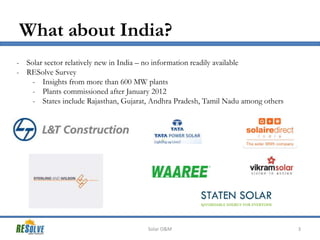
- Solar sector relatively new in India – no information readily available
- RESolve Survey
- Insights from more than 600 MW plants
- Plants commissioned after January 2012
- States include Rajasthan, Gujarat, Andhra Pradesh, Tamil Nadu among others

Solar O&M

3
Agenda
• Criticality of O&M
• O&M – Global insights
• O&M in India – RESolve Survey results

• Takeaways
Solar O&M

4
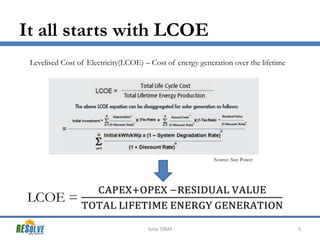
It all starts with LCOE
Levelised Cost of Electricity(LCOE) – Cost of energy generation over the lifetime

Source: Sun Power

Solar O&M

5
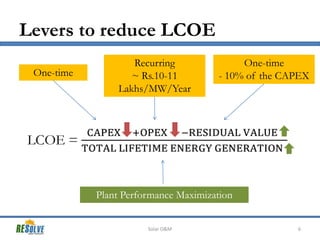
Levers to reduce LCOE
One-time

Recurring
~ Rs.10-11
Lakhs/MW/Year

One-time
- 10% of the CAPEX

Plant Performance Maximization
Solar O&M

6
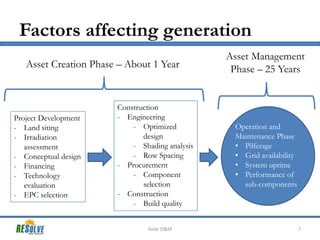
Factors affecting generation
Asset Creation Phase – About 1 Year

Project Development
- Land siting
- Irradiation
assessment
- Conceptual design
- Financing
- Technology
evaluation
- EPC selection

Construction
- Engineering
- Optimized
design
- Shading analysis
- Row Spacing
- Procurement
- Component
selection
- Construction
- Build quality
Solar O&M

Asset Management
Phase – 25 Years

Operation and
Maintenance Phase
• Pilferage
• Grid availability
• System uptime
• Performance of
sub-components

7
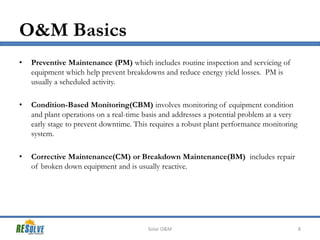
O&M Basics
•

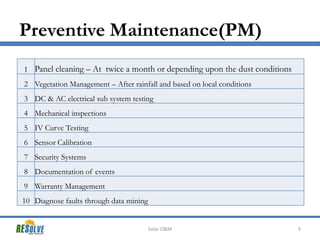
Preventive Maintenance (PM) which includes routine inspection and servicing of
equipment which help prevent breakdowns and reduce energy yield losses. PM is
usually a scheduled activity.

•

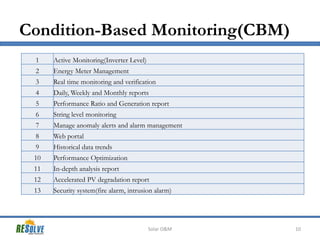
Condition-Based Monitoring(CBM) involves monitoring of equipment condition
and plant operations on a real-time basis and addresses a potential problem at a very
early stage to prevent downtime. This requires a robust plant performance monitoring
system.

•

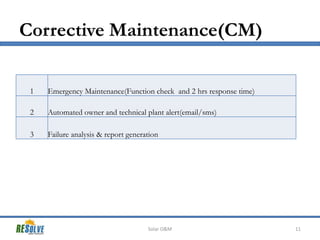
Corrective Maintenance(CM) or Breakdown Maintenance(BM) includes repair
of broken down equipment and is usually reactive.

Solar O&M

8
Preventive Maintenance(PM)
1 Panel cleaning – At twice a month or depending upon the dust conditions
2 Vegetation Management – After rainfall and based on local conditions
3 DC & AC electrical sub system testing
4 Mechanical inspections

5 IV Curve Testing
6 Sensor Calibration
7 Security Systems
8 Documentation of events
9 Warranty Management
10 Diagnose faults through data mining

Solar O&M

9
Condition-Based Monitoring(CBM)
1

Active Monitoring(Inverter Level)

2

Energy Meter Management

3

Real time monitoring and verification

4

Daily, Weekly and Monthly reports

5

Performance Ratio and Generation report

6

String level monitoring

7

Manage anomaly alerts and alarm management

8

Web portal

9

Historical data trends

10

Performance Optimization

11

In-depth analysis report

12

Accelerated PV degradation report

13

Security system(fire alarm, intrusion alarm)

Solar O&M

10
Corrective Maintenance(CM)
1

Emergency Maintenance(Function check and 2 hrs response time)

2

Automated owner and technical plant alert(email/sms)

3

Failure analysis & report generation

Solar O&M

11
Agenda
• Criticality of O&M

• O&M – Global insights
• O&M in India – RESolve Survey results

• Takeaways
Solar O&M

12
Global experience
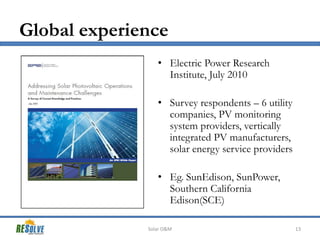
• Electric Power Research
Institute, July 2010
• Survey respondents – 6 utility
companies, PV monitoring
system providers, vertically
integrated PV manufacturers,
solar energy service providers
• Eg. SunEdison, SunPower,
Southern California
Edison(SCE)
Solar O&M

13
EPRI Survey coverage
•
•
•
•
•
•
•

In-House Vs Outsource O&M
Focus of this presentation
Failure analysis
O&M Budgeting
Panel cleaning
Plant Monitoring and information collection
Warranty Management
Lessons learned
Solar O&M

14
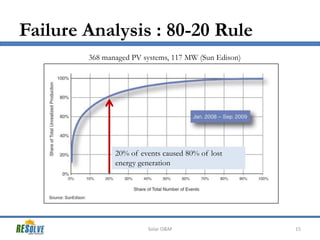
Failure Analysis : 80-20 Rule
368 managed PV systems, 117 MW (Sun Edison)

20% of events caused 80% of lost
energy generation

Solar O&M

15
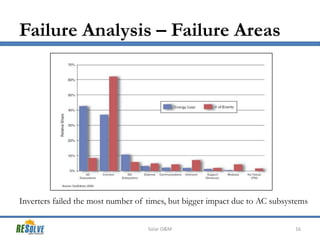
Failure Analysis – Failure Areas

Inverters failed the most number of times, but bigger impact due to AC subsystems
Solar O&M

16
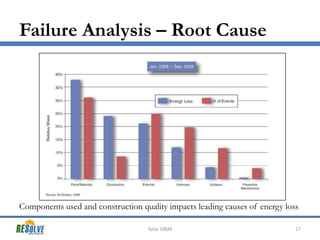
Failure Analysis – Root Cause

Components used and construction quality impacts leading causes of energy loss
Solar O&M

17
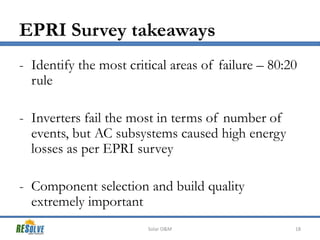
EPRI Survey takeaways
- Identify the most critical areas of failure – 80:20
rule
- Inverters fail the most in terms of number of
events, but AC subsystems caused high energy
losses as per EPRI survey

- Component selection and build quality
extremely important
Solar O&M

18
Agenda
• Criticality of O&M
• O&M – Global insights

• O&M in India – RESolve Survey
results
• Takeaways
Solar O&M

19
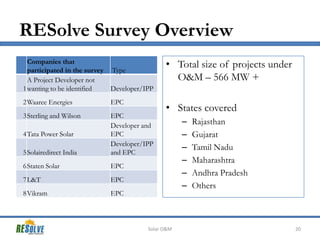
RESolve Survey Overview
Companies that
participated in the survey Type
A Project Developer not
1 wanting to be identified
Developer/IPP

• Total size of projects under
O&M – 566 MW +

2Waaree Energies

EPC

3Sterling and Wilson

5Solairedirect India

EPC
Developer and
EPC
Developer/IPP
and EPC

• States covered

6Staten Solar

EPC

7L&T

EPC

8Vikram

EPC

4Tata Power Solar

Solar O&M

–
–
–
–
–
–

Rajasthan
Gujarat
Tamil Nadu
Maharashtra
Andhra Pradesh
Others

20
RESolve Survey Overview
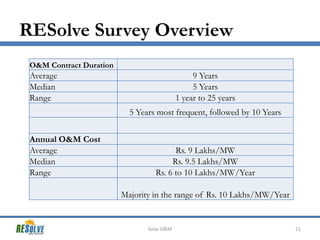
O&M Contract Duration

Average
Median
Range

9 Years
5 Years
1 year to 25 years
5 Years most frequent, followed by 10 Years

Annual O&M Cost
Average
Median
Range

Rs. 9 Lakhs/MW
Rs. 9.5 Lakhs/MW
Rs. 6 to 10 Lakhs/MW/Year
Majority in the range of Rs. 10 Lakhs/MW/Year

Solar O&M

21
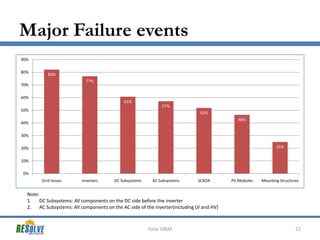
Major Failure events
90%
80%

82%
77%

70%
60%

61%
57%

50%

52%
46%

40%
30%

25%

20%
10%
0%
Grid Issues

Inverters

DC Subsystems

AC Subsystems

SCADA

PV Modules

Mounting Structures

Note:
1. DC Subsystems: All components on the DC side before the inverter
2. AC Subsystems: All components on the AC side of the inverter(including LV and HV)

Solar O&M

22
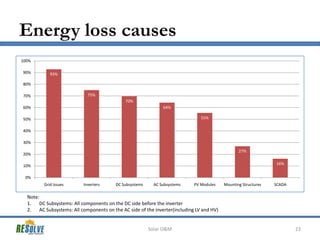
Energy loss causes
100%
90%

93%

80%
75%

70%

70%
64%

60%

55%

50%
40%
30%

27%

20%

16%

10%
0%

Grid Issues

Inverters

DC Subsystems

AC Subsystems

PV Modules

Mounting Structures

SCADA

Note:
1. DC Subsystems: All components on the DC side before the inverter
2. AC Subsystems: All components on the AC side of the inverter(including LV and HV)

Solar O&M

23
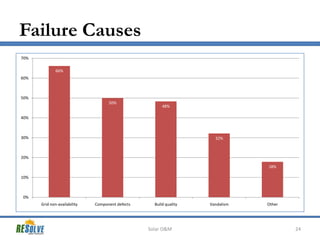
Failure Causes
70%
66%
60%

50%
50%

48%

40%

30%

32%

20%
18%
10%

0%
Grid non-availability

Component defects

Build quality

Solar O&M

Vandalism

Other

24
Some comments from respondents
• “ Absolute energy guarantee should be done away with more
focus on periodic PR measurement and corrective measures
on a regular basis. Emphasis on Training for Engineers and
Technicians at field level.”
• “Major differentiators are 1) Cleaning of Modules 2) Grid
availability. All other losses are very low. Inverter and SMU
losses happens every rarely. Energy loss due to AC
system, Structure, module etc are very, very rare.”
• “Remote sites causing higher O&M cost. Gap between the
projected generation and actual is having a wide gap due to
non availability of radiation data in the initial period.”
Solar O&M

25
Agenda
• Criticality of O&M
• O&M – Global insights
• O&M in India – RESolve Survey results

• Takeaways
Solar O&M

26
Critical areas of failure - 1
• The Grid
– Major bottleneck
– Highest number of failure events and highest loss of
generation
– Unfortunately, this is an external non-controllable cause

• Inverters
– Heart of the PV system
– Biggest internal controllable cause, in line with global
trends

• DC and AC sub-systems also require attention
Solar O&M

27
Critical areas of failure - 2
• PV Modules, SCADA and mounting structures
rank lower
• Failure causes – components used and build
quality
Bottomline – Entire electrical system requires
utmost attention
Solar O&M

28
What could be done? - 1
• The Grid
– Infrastructure problem : push towards improved
grid infrastructure

• Inverters
– Fool-proof technical evaluation before procurement
– Ensure excellent after-sales support from vendor
– Critical spare parts to be maintained at site
– Invest in training of field O&M personnel
Solar O&M

29
What could be done? - 2
• DC and AC sub-systems
– Component selection critical
– Trained manpower in the field can help in up-time

• PV Modules, SCADA and mounting structures
– Though not critical during the initial years, these
components can create head-ache during later years
– Focus to be on component selection and build
quality
Solar O&M

30
Finally,

Excellence in O&M can be the difference
between “good” plant performance and
“great” plant performance!!

Solar O&M

31
Thank you
Madhavan Nampoothiri
Founder and Director
madhavan@re-solve.in
www.re-solve.in
Subscribe to the RESolve blog here.

Solar O&M

32
About RESolve
• Advisory firm with strong capabilities in Strategic, Regulatory
, Commercial and Technical aspects of renewable energy projects
• Founded by professionals from India and Germany with strong global
exposure

• Specific focus on Solar PV and Wind in India
• Offerings in
– Advisory on Concept-to-Commissioning of PV projects
– Policy and Regulatory advice

Solar O&M

33
RESolve Whitepaper
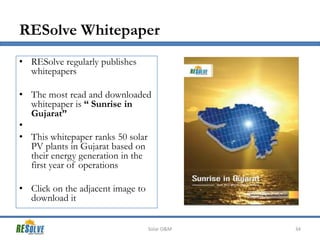
• RESolve regularly publishes
whitepapers
• The most read and downloaded
whitepaper is “ Sunrise in
Gujarat”
•
• This whitepaper ranks 50 solar
PV plants in Gujarat based on
their energy generation in the
first year of operations

• Click on the adjacent image to
download it
Solar O&M

34

Solar O&M Presentation Intersolar 2013

  • 1.
    Solar PV O&M– The Indian Experience November 12, 2013 Mumbai, India
  • 2.
    Solar PV Plants- Built to Last? “A review of 30,000 installations in Europe by the German solar monitoring firm Meteocontrol found 80 percent were underperforming. ” - New York Times, May 28, 2013 Solar O&M 2
  • 3.
    What about India? -Solar sector relatively new in India – no information readily available - RESolve Survey - Insights from more than 600 MW plants - Plants commissioned after January 2012 - States include Rajasthan, Gujarat, Andhra Pradesh, Tamil Nadu among others Solar O&M 3
  • 4.
    Agenda • Criticality ofO&M • O&M – Global insights • O&M in India – RESolve Survey results • Takeaways Solar O&M 4
  • 5.
    It all startswith LCOE Levelised Cost of Electricity(LCOE) – Cost of energy generation over the lifetime Source: Sun Power Solar O&M 5
  • 6.
    Levers to reduceLCOE One-time Recurring ~ Rs.10-11 Lakhs/MW/Year One-time - 10% of the CAPEX Plant Performance Maximization Solar O&M 6
  • 7.
    Factors affecting generation AssetCreation Phase – About 1 Year Project Development - Land siting - Irradiation assessment - Conceptual design - Financing - Technology evaluation - EPC selection Construction - Engineering - Optimized design - Shading analysis - Row Spacing - Procurement - Component selection - Construction - Build quality Solar O&M Asset Management Phase – 25 Years Operation and Maintenance Phase • Pilferage • Grid availability • System uptime • Performance of sub-components 7
  • 8.
    O&M Basics • Preventive Maintenance(PM) which includes routine inspection and servicing of equipment which help prevent breakdowns and reduce energy yield losses. PM is usually a scheduled activity. • Condition-Based Monitoring(CBM) involves monitoring of equipment condition and plant operations on a real-time basis and addresses a potential problem at a very early stage to prevent downtime. This requires a robust plant performance monitoring system. • Corrective Maintenance(CM) or Breakdown Maintenance(BM) includes repair of broken down equipment and is usually reactive. Solar O&M 8
  • 9.
    Preventive Maintenance(PM) 1 Panelcleaning – At twice a month or depending upon the dust conditions 2 Vegetation Management – After rainfall and based on local conditions 3 DC & AC electrical sub system testing 4 Mechanical inspections 5 IV Curve Testing 6 Sensor Calibration 7 Security Systems 8 Documentation of events 9 Warranty Management 10 Diagnose faults through data mining Solar O&M 9
  • 10.
    Condition-Based Monitoring(CBM) 1 Active Monitoring(InverterLevel) 2 Energy Meter Management 3 Real time monitoring and verification 4 Daily, Weekly and Monthly reports 5 Performance Ratio and Generation report 6 String level monitoring 7 Manage anomaly alerts and alarm management 8 Web portal 9 Historical data trends 10 Performance Optimization 11 In-depth analysis report 12 Accelerated PV degradation report 13 Security system(fire alarm, intrusion alarm) Solar O&M 10
  • 11.
    Corrective Maintenance(CM) 1 Emergency Maintenance(Functioncheck and 2 hrs response time) 2 Automated owner and technical plant alert(email/sms) 3 Failure analysis & report generation Solar O&M 11
  • 12.
    Agenda • Criticality ofO&M • O&M – Global insights • O&M in India – RESolve Survey results • Takeaways Solar O&M 12
  • 13.
    Global experience • ElectricPower Research Institute, July 2010 • Survey respondents – 6 utility companies, PV monitoring system providers, vertically integrated PV manufacturers, solar energy service providers • Eg. SunEdison, SunPower, Southern California Edison(SCE) Solar O&M 13
  • 14.
    EPRI Survey coverage • • • • • • • In-HouseVs Outsource O&M Focus of this presentation Failure analysis O&M Budgeting Panel cleaning Plant Monitoring and information collection Warranty Management Lessons learned Solar O&M 14
  • 15.
    Failure Analysis :80-20 Rule 368 managed PV systems, 117 MW (Sun Edison) 20% of events caused 80% of lost energy generation Solar O&M 15
  • 16.
    Failure Analysis –Failure Areas Inverters failed the most number of times, but bigger impact due to AC subsystems Solar O&M 16
  • 17.
    Failure Analysis –Root Cause Components used and construction quality impacts leading causes of energy loss Solar O&M 17
  • 18.
    EPRI Survey takeaways -Identify the most critical areas of failure – 80:20 rule - Inverters fail the most in terms of number of events, but AC subsystems caused high energy losses as per EPRI survey - Component selection and build quality extremely important Solar O&M 18
  • 19.
    Agenda • Criticality ofO&M • O&M – Global insights • O&M in India – RESolve Survey results • Takeaways Solar O&M 19
  • 20.
    RESolve Survey Overview Companiesthat participated in the survey Type A Project Developer not 1 wanting to be identified Developer/IPP • Total size of projects under O&M – 566 MW + 2Waaree Energies EPC 3Sterling and Wilson 5Solairedirect India EPC Developer and EPC Developer/IPP and EPC • States covered 6Staten Solar EPC 7L&T EPC 8Vikram EPC 4Tata Power Solar Solar O&M – – – – – – Rajasthan Gujarat Tamil Nadu Maharashtra Andhra Pradesh Others 20
  • 21.
    RESolve Survey Overview O&MContract Duration Average Median Range 9 Years 5 Years 1 year to 25 years 5 Years most frequent, followed by 10 Years Annual O&M Cost Average Median Range Rs. 9 Lakhs/MW Rs. 9.5 Lakhs/MW Rs. 6 to 10 Lakhs/MW/Year Majority in the range of Rs. 10 Lakhs/MW/Year Solar O&M 21
  • 22.
    Major Failure events 90% 80% 82% 77% 70% 60% 61% 57% 50% 52% 46% 40% 30% 25% 20% 10% 0% GridIssues Inverters DC Subsystems AC Subsystems SCADA PV Modules Mounting Structures Note: 1. DC Subsystems: All components on the DC side before the inverter 2. AC Subsystems: All components on the AC side of the inverter(including LV and HV) Solar O&M 22
  • 23.
    Energy loss causes 100% 90% 93% 80% 75% 70% 70% 64% 60% 55% 50% 40% 30% 27% 20% 16% 10% 0% GridIssues Inverters DC Subsystems AC Subsystems PV Modules Mounting Structures SCADA Note: 1. DC Subsystems: All components on the DC side before the inverter 2. AC Subsystems: All components on the AC side of the inverter(including LV and HV) Solar O&M 23
  • 24.
  • 25.
    Some comments fromrespondents • “ Absolute energy guarantee should be done away with more focus on periodic PR measurement and corrective measures on a regular basis. Emphasis on Training for Engineers and Technicians at field level.” • “Major differentiators are 1) Cleaning of Modules 2) Grid availability. All other losses are very low. Inverter and SMU losses happens every rarely. Energy loss due to AC system, Structure, module etc are very, very rare.” • “Remote sites causing higher O&M cost. Gap between the projected generation and actual is having a wide gap due to non availability of radiation data in the initial period.” Solar O&M 25
  • 26.
    Agenda • Criticality ofO&M • O&M – Global insights • O&M in India – RESolve Survey results • Takeaways Solar O&M 26
  • 27.
    Critical areas offailure - 1 • The Grid – Major bottleneck – Highest number of failure events and highest loss of generation – Unfortunately, this is an external non-controllable cause • Inverters – Heart of the PV system – Biggest internal controllable cause, in line with global trends • DC and AC sub-systems also require attention Solar O&M 27
  • 28.
    Critical areas offailure - 2 • PV Modules, SCADA and mounting structures rank lower • Failure causes – components used and build quality Bottomline – Entire electrical system requires utmost attention Solar O&M 28
  • 29.
    What could bedone? - 1 • The Grid – Infrastructure problem : push towards improved grid infrastructure • Inverters – Fool-proof technical evaluation before procurement – Ensure excellent after-sales support from vendor – Critical spare parts to be maintained at site – Invest in training of field O&M personnel Solar O&M 29
  • 30.
    What could bedone? - 2 • DC and AC sub-systems – Component selection critical – Trained manpower in the field can help in up-time • PV Modules, SCADA and mounting structures – Though not critical during the initial years, these components can create head-ache during later years – Focus to be on component selection and build quality Solar O&M 30
  • 31.
    Finally, Excellence in O&Mcan be the difference between “good” plant performance and “great” plant performance!! Solar O&M 31
  • 32.
    Thank you Madhavan Nampoothiri Founderand Director madhavan@re-solve.in www.re-solve.in Subscribe to the RESolve blog here. Solar O&M 32
  • 33.
    About RESolve • Advisoryfirm with strong capabilities in Strategic, Regulatory , Commercial and Technical aspects of renewable energy projects • Founded by professionals from India and Germany with strong global exposure • Specific focus on Solar PV and Wind in India • Offerings in – Advisory on Concept-to-Commissioning of PV projects – Policy and Regulatory advice Solar O&M 33
  • 34.
    RESolve Whitepaper • RESolveregularly publishes whitepapers • The most read and downloaded whitepaper is “ Sunrise in Gujarat” • • This whitepaper ranks 50 solar PV plants in Gujarat based on their energy generation in the first year of operations • Click on the adjacent image to download it Solar O&M 34