

Physics 110
Fundamentals of
  Electronics
Chapter 2
DC Networks
Review Topics
Scientific Notation
Units of Measure
What is Electricity?
  From the Greek word “elektron”
  that means “amber”
  There are two types of electricity:
  – Static Electricity - no motion of free charges
  – Current Electricity - motion of free charges
     » Direct Current (DC)
     » Alternating Current (AC)
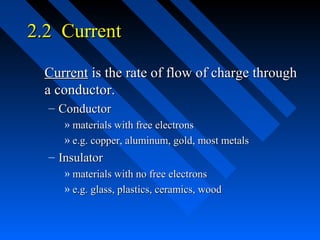
2.2 Current

  Current is the rate of flow of charge through
  a conductor.
  – Conductor
     » materials with free electrons
     » e.g. copper, aluminum, gold, most metals
  – Insulator
     » materials with no free electrons
     » e.g. glass, plastics, ceramics, wood
1
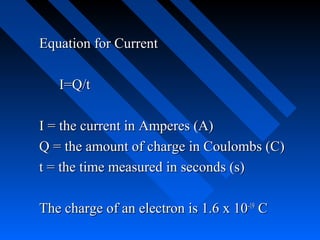
Equation for Current

   I=Q/t

I = the current in Amperes (A)
Q = the amount of charge in Coulombs (C)
t = the time measured in seconds (s)

The charge of an electron is 1.6 x 10⁻¹⁹ C
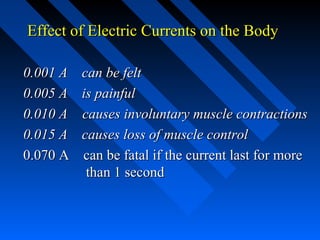
Effect of Electric Currents on the Body

0.001 A   can be felt
0.005 A   is painful
0.010 A   causes involuntary muscle contractions
0.015 A   causes loss of muscle control
0.070 A   can be fatal if the current last for more
           than 1 second
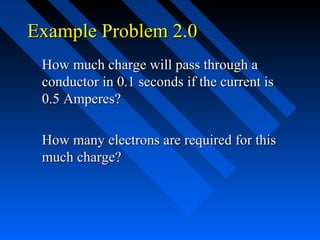
Example Problem 2.0
 How much charge will pass through a
 conductor in 0.1 seconds if the current is
 0.5 Amperes?

 How many electrons are required for this
 much charge?
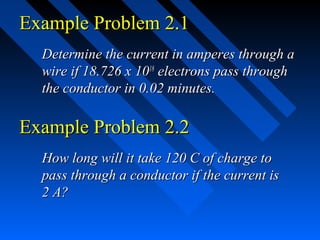
Example Problem 2.1
  Determine the current in amperes through a
  wire if 18.726 x 10¹⁸ electrons pass through
  the conductor in 0.02 minutes.

Example Problem 2.2
  How long will it take 120 C of charge to
  pass through a conductor if the current is
  2 A?
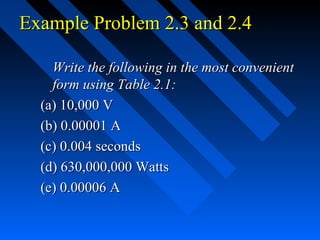
Example Problem 2.3 and 2.4

    Write the following in the most convenient
    form using Table 2.1:
  (a) 10,000 V
  (b) 0.00001 A
  (c) 0.004 seconds
  (d) 630,000,000 Watts
  (e) 0.00006 A
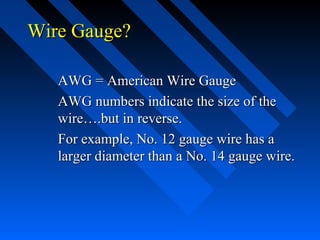
Wire Gauge?

   AWG = American Wire Gauge
   AWG numbers indicate the size of the
   wire….but in reverse.
   For example, No. 12 gauge wire has a
   larger diameter than a No. 14 gauge wire.
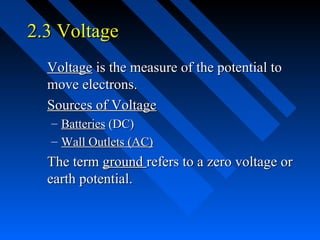
2.3 Voltage
  Voltage is the measure of the potential to
  move electrons.
  Sources of Voltage
  – Batteries (DC)
  – Wall Outlets (AC)
  The term ground refers to a zero voltage or
  earth potential.
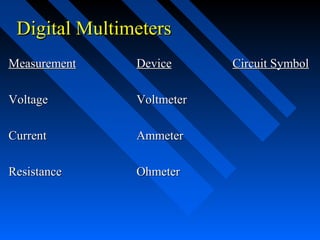
Digital Multimeters
Measurement    Device      Circuit Symbol

Voltage        Voltmeter

Current        Ammeter

Resistance     Ohmeter
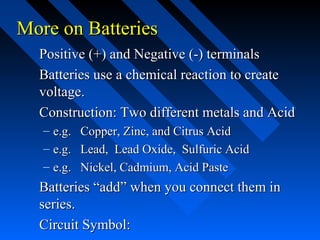
More on Batteries
  Positive (+) and Negative (-) terminals
  Batteries use a chemical reaction to create
  voltage.
  Construction: Two different metals and Acid
   – e.g. Copper, Zinc, and Citrus Acid
   – e.g. Lead, Lead Oxide, Sulfuric Acid
   – e.g. Nickel, Cadmium, Acid Paste
  Batteries “add” when you connect them in
  series.
  Circuit Symbol:
1
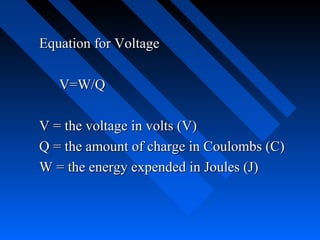
Equation for Voltage

   V=W/Q

V = the voltage in volts (V)
Q = the amount of charge in Coulombs (C)
W = the energy expended in Joules (J)
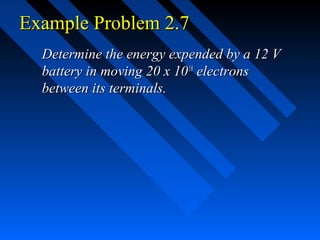
Example Problem 2.7
  Determine the energy expended by a 12 V
  battery in moving 20 x 1018 electrons
  between its terminals.
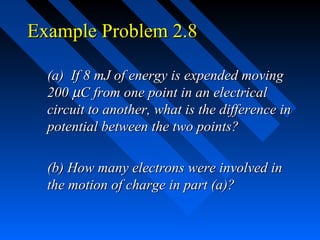
Example Problem 2.8

  (a) If 8 mJ of energy is expended moving
  200 µC from one point in an electrical
  circuit to another, what is the difference in
  potential between the two points?

  (b) How many electrons were involved in
  the motion of charge in part (a)?
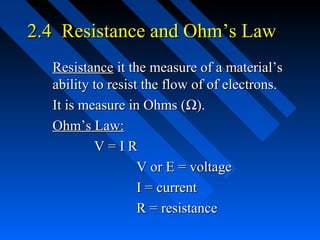
2.4 Resistance and Ohm’s Law
  Resistance it the measure of a material’s
  ability to resist the flow of of electrons.
  It is measure in Ohms (Ω).
  Ohm’s Law:
          V=IR
                   V or E = voltage
                   I = current
                   R = resistance
Example Problem 2.9
  Determine the voltage drop across a 2.2 k Ω
  resistor if the current is 8 mA.


Example Problem 2.10
  Determine the current drawn by a toaster
  having an internal resistance of 22 Ω if the
  applied voltage is 120 V.
Example Problem 2.11
  Determine the internal resistance of an
  alarm clock that draws 20 mA at 120 V.
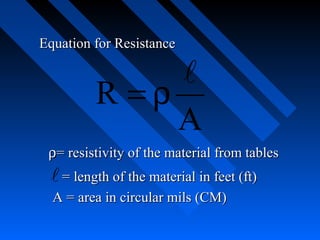
Equation for Resistance

              
         R =ρ
              A
ρ = resistivity of the material from tables
  = length of the material in feet (ft)
  A = area in circular mils (CM)
Example Problem 2.12
  Determine the resistance of 100 yards of
  copper wire having and 1/8 inch diameters.
Concept Questions

 How can you determine the current through
 a resistor if you know the voltage across it?

 How can you change the resistance of a
 resistor?
Temperature dependence of Resistance


  R 2 = R 1 [1 + α1 ( t 2 − t1 )]

R = resistances
 t = temperatures
 α = temperature coefficient from tables
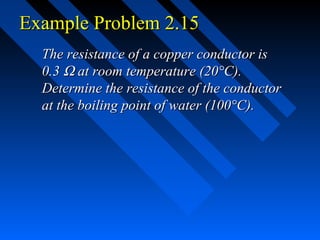
Example Problem 2.15
  The resistance of a copper conductor is
  0.3 Ω at room temperature (20°C).
  Determine the resistance of the conductor
  at the boiling point of water (100°C).
1
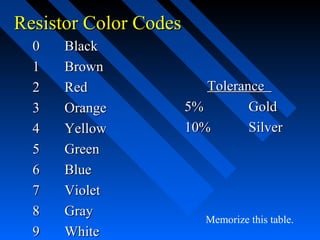
Resistor Color Codes
  0   Black
  1   Brown
  2   Red                 Tolerance
  3   Orange           5%        Gold
  4   Yellow           10%       Silver
  5   Green
  6   Blue
  7   Violet
  8   Gray
                          Memorize this table.
  9   White
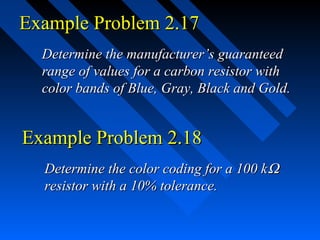
Example Problem 2.17
  Determine the manufacturer’s guaranteed
  range of values for a carbon resistor with
  color bands of Blue, Gray, Black and Gold.


Example Problem 2.18
  Determine the color coding for a 100 k Ω
  resistor with a 10% tolerance.
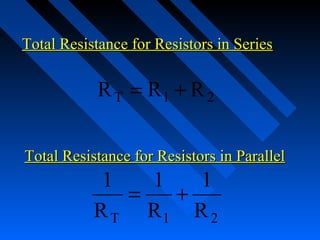
Total Resistance for Resistors in Series

            R T = R1 + R 2

Total Resistance for Resistors in Parallel
            1   1   1
              =   +
           R T R1 R 2
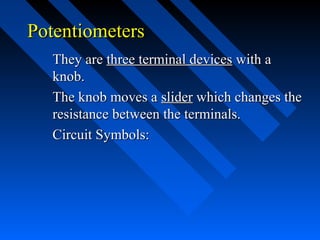
Potentiometers
  They are three terminal devices with a
  knob.
  The knob moves a slider which changes the
  resistance between the terminals.
  Circuit Symbols:
What is the difference between E and V?
    E is the voltage supplied by a battery.
    V is the voltage measured across a resistor.
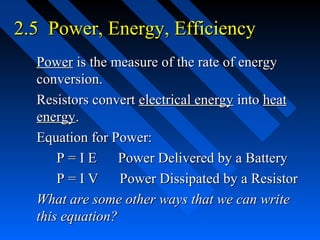
2.5 Power, Energy, Efficiency
  Power is the measure of the rate of energy
  conversion.
  Resistors convert electrical energy into heat
  energy.
  Equation for Power:
      P=IE       Power Delivered by a Battery
      P=IV       Power Dissipated by a Resistor
  What are some other ways that we can write
  this equation?
Example Problem 2.19
  Determine the current drawn by a 180 W
  television set when connected to a 120 V
  outlet.
Simple Circuit Problem
    Using circuit symbols, draw a circuit for a
    9V battery connected to a 10Ω resistor.
    Draw and label the direction of
    conventional current.
    Now include a voltmeter in your sketch that
    will measure the voltage drop across the
    resistors. What will it read?
    Include a ammeter that will measure the
    current through the resistor. What will it
    read?
Simple Circuit Problem
    How much power does the battery deliver?
    How much power does the resistor
    dissipate?
1
Note: Equations will be provided
on the chalk board during the
exam.

However, you must know what
each variable represents and
what units are used for each.
Example Problem 2.20
  Determine the resistance of a 1200W
  toaster that draws 10A.
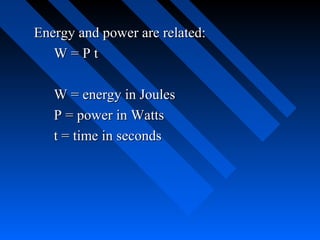
Energy and power are related:
   W=Pt

   W = energy in Joules
   P = power in Watts
   t = time in seconds
Example Problem 2.21
  Determine the cost of using the following
  appliances for the time indicated if the
  average cost is 9 cents/kWh.

  – (a) 1200W iron for 2 hours
  – (b) 160W color TV for 3 hours and 30 minutes
  – (c) Six 60W bulbs for 7 hours.
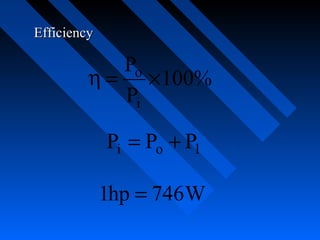
Efficiency

            Po
         η = ×100%
            Pi

             Pi = Po + Pl

             1hp = 746 W
Example Problem 2.22
  Determine the efficiency of operation and
  power lost in a 5hp DC motor that draws
  18A as 230V.
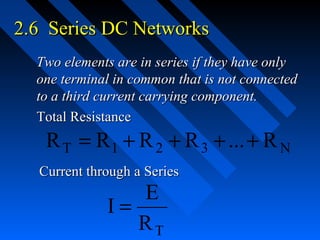
2.6 Series DC Networks
  Two elements are in series if they have only
  one terminal in common that is not connected
  to a third current carrying component.
  Total Resistance
   R T = R 1 + R 2 + R 3 + ... + R N
  Current through a Series
                E
             I=
                RT
Consider Figure 2.29.
   » E=24V, R1=2Ω, R2=4Ω, R3=6Ω

What is RT?
What is I?
What is V1, V2 and V3?
What is P1, P2, P3, and PE?
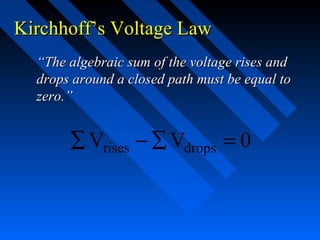
Kirchhoff’s Voltage Law
  “The algebraic sum of the voltage rises and
  drops around a closed path must be equal to
  zero.”


       ∑ Vrises − ∑ Vdrops = 0
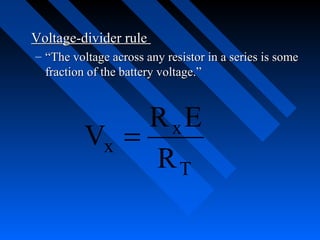
Voltage-divider rule
– “The voltage across any resistor in a series is some
  fraction of the battery voltage.”


               R xE
          Vx =
               RT
1
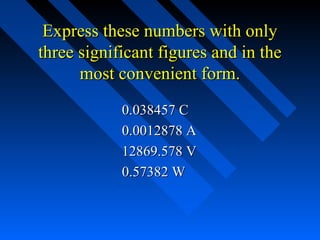
Express these numbers with only
three significant figures and in the
      most convenient form.
            0.038457 C
            0.0012878 A
            12869.578 V
            0.57382 W
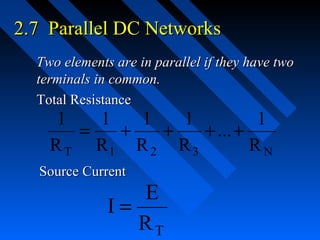
2.7 Parallel DC Networks
  Two elements are in parallel if they have two
  terminals in common.
  Total Resistance
     1   1   1   1          1
       =   +   +   + ... +
    R T R1 R 2 R 3         RN
  Source Current
                 E
              I=
                 RT
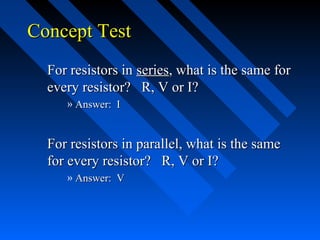
Concept Test
  For resistors in series, what is the same for
  every resistor? R, V or I?
     » Answer: I


  For resistors in parallel, what is the same
  for every resistor? R, V or I?
     » Answer: V
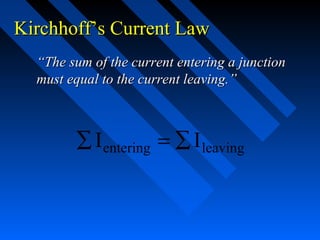
Kirchhoff’s Current Law
  “The sum of the current entering a junction
  must equal to the current leaving.”


        ∑ I entering = ∑ I leaving
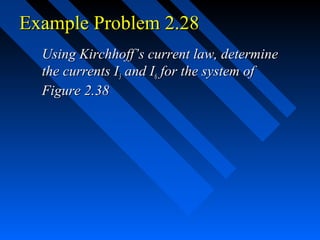
Example Problem 2.28
  Using Kirchhoff’s current law, determine
  the currents I3 and I6 for the system of
  Figure 2.38
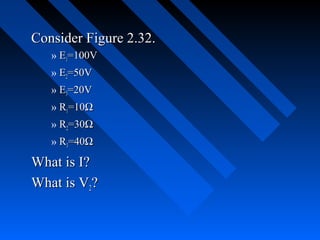
Consider Figure 2.32.
   » E1=100V
   » E2=50V
   » E3=20V
   » R1=10Ω
   » R2=30Ω
   » R3=40Ω

What is I?
What is V2?
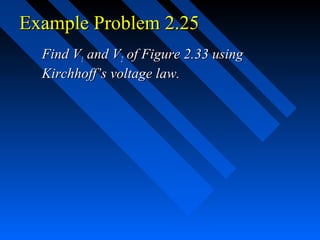
Example Problem 2.25
  Find V1 and V2 of Figure 2.33 using
  Kirchhoff’s voltage law.
Voltage Sources in Series
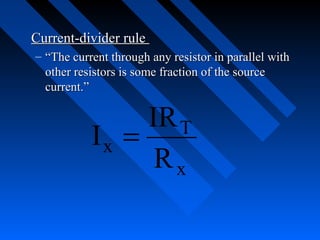
Current-divider rule
– “The current through any resistor in parallel with
  other resistors is some fraction of the source
  current.”

                IR T
           Ix =
                 Rx
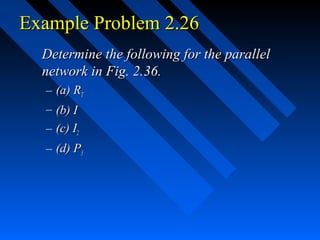
Example Problem 2.26
  Determine the following for the parallel
  network in Fig. 2.36.
  – (a) RT
  – (b) I
  – (c) I2
  – (d) P3
2.8 Series-Parallel Networks
 Example Problem 2.29
     Determine the following for the network in
     Fig. 2.41.
     – (a) RT
     – (b) I
     – (c) I1 and I2
     – (d) V1

What is electronics

  • 1.
  • 2.
  • 3.
  • 4.
    What is Electricity? From the Greek word “elektron” that means “amber” There are two types of electricity: – Static Electricity - no motion of free charges – Current Electricity - motion of free charges » Direct Current (DC) » Alternating Current (AC)
  • 5.
    2.2 Current Current is the rate of flow of charge through a conductor. – Conductor » materials with free electrons » e.g. copper, aluminum, gold, most metals – Insulator » materials with no free electrons » e.g. glass, plastics, ceramics, wood
  • 6.
  • 7.
    Equation for Current I=Q/t I = the current in Amperes (A) Q = the amount of charge in Coulombs (C) t = the time measured in seconds (s) The charge of an electron is 1.6 x 10⁻¹⁹ C
  • 8.
    Effect of ElectricCurrents on the Body 0.001 A can be felt 0.005 A is painful 0.010 A causes involuntary muscle contractions 0.015 A causes loss of muscle control 0.070 A can be fatal if the current last for more than 1 second
  • 9.
    Example Problem 2.0 How much charge will pass through a conductor in 0.1 seconds if the current is 0.5 Amperes? How many electrons are required for this much charge?
  • 10.
    Example Problem 2.1 Determine the current in amperes through a wire if 18.726 x 10¹⁸ electrons pass through the conductor in 0.02 minutes. Example Problem 2.2 How long will it take 120 C of charge to pass through a conductor if the current is 2 A?
  • 11.
    Example Problem 2.3and 2.4 Write the following in the most convenient form using Table 2.1: (a) 10,000 V (b) 0.00001 A (c) 0.004 seconds (d) 630,000,000 Watts (e) 0.00006 A
  • 12.
    Wire Gauge? AWG = American Wire Gauge AWG numbers indicate the size of the wire….but in reverse. For example, No. 12 gauge wire has a larger diameter than a No. 14 gauge wire.
  • 13.
    2.3 Voltage Voltage is the measure of the potential to move electrons. Sources of Voltage – Batteries (DC) – Wall Outlets (AC) The term ground refers to a zero voltage or earth potential.
  • 14.
    Digital Multimeters Measurement Device Circuit Symbol Voltage Voltmeter Current Ammeter Resistance Ohmeter
  • 15.
    More on Batteries Positive (+) and Negative (-) terminals Batteries use a chemical reaction to create voltage. Construction: Two different metals and Acid – e.g. Copper, Zinc, and Citrus Acid – e.g. Lead, Lead Oxide, Sulfuric Acid – e.g. Nickel, Cadmium, Acid Paste Batteries “add” when you connect them in series. Circuit Symbol:
  • 16.
  • 17.
    Equation for Voltage V=W/Q V = the voltage in volts (V) Q = the amount of charge in Coulombs (C) W = the energy expended in Joules (J)
  • 18.
    Example Problem 2.7 Determine the energy expended by a 12 V battery in moving 20 x 1018 electrons between its terminals.
  • 19.
    Example Problem 2.8 (a) If 8 mJ of energy is expended moving 200 µC from one point in an electrical circuit to another, what is the difference in potential between the two points? (b) How many electrons were involved in the motion of charge in part (a)?
  • 20.
    2.4 Resistance andOhm’s Law Resistance it the measure of a material’s ability to resist the flow of of electrons. It is measure in Ohms (Ω). Ohm’s Law: V=IR V or E = voltage I = current R = resistance
  • 21.
    Example Problem 2.9 Determine the voltage drop across a 2.2 k Ω resistor if the current is 8 mA. Example Problem 2.10 Determine the current drawn by a toaster having an internal resistance of 22 Ω if the applied voltage is 120 V.
  • 22.
    Example Problem 2.11 Determine the internal resistance of an alarm clock that draws 20 mA at 120 V.
  • 23.
    Equation for Resistance  R =ρ A ρ = resistivity of the material from tables  = length of the material in feet (ft) A = area in circular mils (CM)
  • 24.
    Example Problem 2.12 Determine the resistance of 100 yards of copper wire having and 1/8 inch diameters.
  • 25.
    Concept Questions Howcan you determine the current through a resistor if you know the voltage across it? How can you change the resistance of a resistor?
  • 26.
    Temperature dependence ofResistance R 2 = R 1 [1 + α1 ( t 2 − t1 )] R = resistances t = temperatures α = temperature coefficient from tables
  • 27.
    Example Problem 2.15 The resistance of a copper conductor is 0.3 Ω at room temperature (20°C). Determine the resistance of the conductor at the boiling point of water (100°C).
  • 28.
  • 29.
    Resistor Color Codes 0 Black 1 Brown 2 Red Tolerance 3 Orange 5% Gold 4 Yellow 10% Silver 5 Green 6 Blue 7 Violet 8 Gray Memorize this table. 9 White
  • 30.
    Example Problem 2.17 Determine the manufacturer’s guaranteed range of values for a carbon resistor with color bands of Blue, Gray, Black and Gold. Example Problem 2.18 Determine the color coding for a 100 k Ω resistor with a 10% tolerance.
  • 31.
    Total Resistance forResistors in Series R T = R1 + R 2 Total Resistance for Resistors in Parallel 1 1 1 = + R T R1 R 2
  • 32.
    Potentiometers Theyare three terminal devices with a knob. The knob moves a slider which changes the resistance between the terminals. Circuit Symbols:
  • 33.
    What is thedifference between E and V? E is the voltage supplied by a battery. V is the voltage measured across a resistor.
  • 34.
    2.5 Power, Energy,Efficiency Power is the measure of the rate of energy conversion. Resistors convert electrical energy into heat energy. Equation for Power: P=IE Power Delivered by a Battery P=IV Power Dissipated by a Resistor What are some other ways that we can write this equation?
  • 35.
    Example Problem 2.19 Determine the current drawn by a 180 W television set when connected to a 120 V outlet.
  • 36.
    Simple Circuit Problem Using circuit symbols, draw a circuit for a 9V battery connected to a 10Ω resistor. Draw and label the direction of conventional current. Now include a voltmeter in your sketch that will measure the voltage drop across the resistors. What will it read? Include a ammeter that will measure the current through the resistor. What will it read?
  • 37.
    Simple Circuit Problem How much power does the battery deliver? How much power does the resistor dissipate?
  • 38.
  • 39.
    Note: Equations willbe provided on the chalk board during the exam. However, you must know what each variable represents and what units are used for each.
  • 40.
    Example Problem 2.20 Determine the resistance of a 1200W toaster that draws 10A.
  • 41.
    Energy and powerare related: W=Pt W = energy in Joules P = power in Watts t = time in seconds
  • 42.
    Example Problem 2.21 Determine the cost of using the following appliances for the time indicated if the average cost is 9 cents/kWh. – (a) 1200W iron for 2 hours – (b) 160W color TV for 3 hours and 30 minutes – (c) Six 60W bulbs for 7 hours.
  • 43.
    Efficiency Po η = ×100% Pi Pi = Po + Pl 1hp = 746 W
  • 44.
    Example Problem 2.22 Determine the efficiency of operation and power lost in a 5hp DC motor that draws 18A as 230V.
  • 45.
    2.6 Series DCNetworks Two elements are in series if they have only one terminal in common that is not connected to a third current carrying component. Total Resistance R T = R 1 + R 2 + R 3 + ... + R N Current through a Series E I= RT
  • 46.
    Consider Figure 2.29. » E=24V, R1=2Ω, R2=4Ω, R3=6Ω What is RT? What is I? What is V1, V2 and V3? What is P1, P2, P3, and PE?
  • 47.
    Kirchhoff’s Voltage Law “The algebraic sum of the voltage rises and drops around a closed path must be equal to zero.” ∑ Vrises − ∑ Vdrops = 0
  • 48.
    Voltage-divider rule – “Thevoltage across any resistor in a series is some fraction of the battery voltage.” R xE Vx = RT
  • 49.
  • 50.
    Express these numberswith only three significant figures and in the most convenient form. 0.038457 C 0.0012878 A 12869.578 V 0.57382 W
  • 51.
    2.7 Parallel DCNetworks Two elements are in parallel if they have two terminals in common. Total Resistance 1 1 1 1 1 = + + + ... + R T R1 R 2 R 3 RN Source Current E I= RT
  • 52.
    Concept Test For resistors in series, what is the same for every resistor? R, V or I? » Answer: I For resistors in parallel, what is the same for every resistor? R, V or I? » Answer: V
  • 53.
    Kirchhoff’s Current Law “The sum of the current entering a junction must equal to the current leaving.” ∑ I entering = ∑ I leaving
  • 54.
    Example Problem 2.28 Using Kirchhoff’s current law, determine the currents I3 and I6 for the system of Figure 2.38
  • 55.
    Consider Figure 2.32. » E1=100V » E2=50V » E3=20V » R1=10Ω » R2=30Ω » R3=40Ω What is I? What is V2?
  • 56.
    Example Problem 2.25 Find V1 and V2 of Figure 2.33 using Kirchhoff’s voltage law.
  • 57.
  • 58.
    Current-divider rule – “Thecurrent through any resistor in parallel with other resistors is some fraction of the source current.” IR T Ix = Rx
  • 59.
    Example Problem 2.26 Determine the following for the parallel network in Fig. 2.36. – (a) RT – (b) I – (c) I2 – (d) P3
  • 60.
    2.8 Series-Parallel Networks Example Problem 2.29 Determine the following for the network in Fig. 2.41. – (a) RT – (b) I – (c) I1 and I2 – (d) V1