 Electricity is all around us--powering technology like ….
 Cell phones, computers, lights, soldering irons, and air conditioners.
 It's tough to escape it in our modern world. Even
when you try to escape electricity, it's still at work
throughout nature, from the lightning in a
thunderstorm to the synapses inside our body.
 Electricity is a natural phenomenon that occurs
throughout nature and takes many different forms.
In this tutorial we'll focus on current electricity: the
stuff that powers our electronic gadgets.
‘Electricity' refers to the presence and flow of an Electric charge.
The most common form is that which is used to Power Appliances,
machines and devices by the flow of electrons through Conductors
such as Copper wires.
To buildings/structures
 This can be as simple as a flashlight
cells connected through two wires to a light bulb
 A utility that provides electricity
a facility composed of one or more pieces of equipment connected
to or part of a structure and designed to provide a service
 Electricity is a secondary energy source
 is the flow of electrical power or charge.
 Both a basic part of nature and one of the most
widely used forms of energy.
 produced by converting primary sources of energy
such as coal, natural gas, nuclear energy, solar
energy, and wind energy, into electrical power.
 also referred to as an energy carrier, which means
it can be converted to other forms of energy such
as mechanical energy or heat.
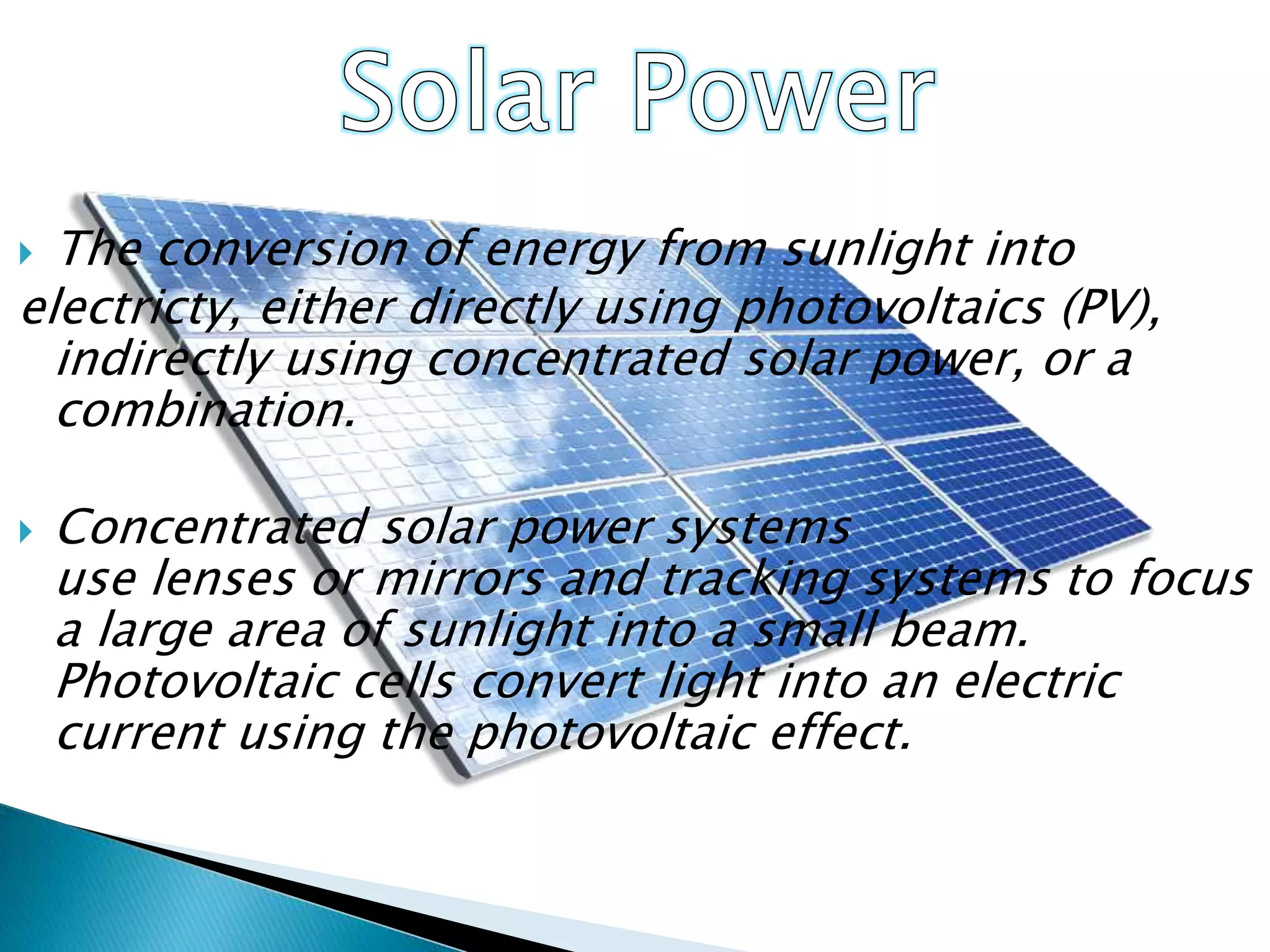
 The conversion of energy from sunlight into
electricty, either directly using photovoltaics (PV),
indirectly using concentrated solar power, or a
combination.
 Concentrated solar power systems
use lenses or mirrors and tracking systems to focus
a large area of sunlight into a small beam.
Photovoltaic cells convert light into an electric
current using the photovoltaic effect.
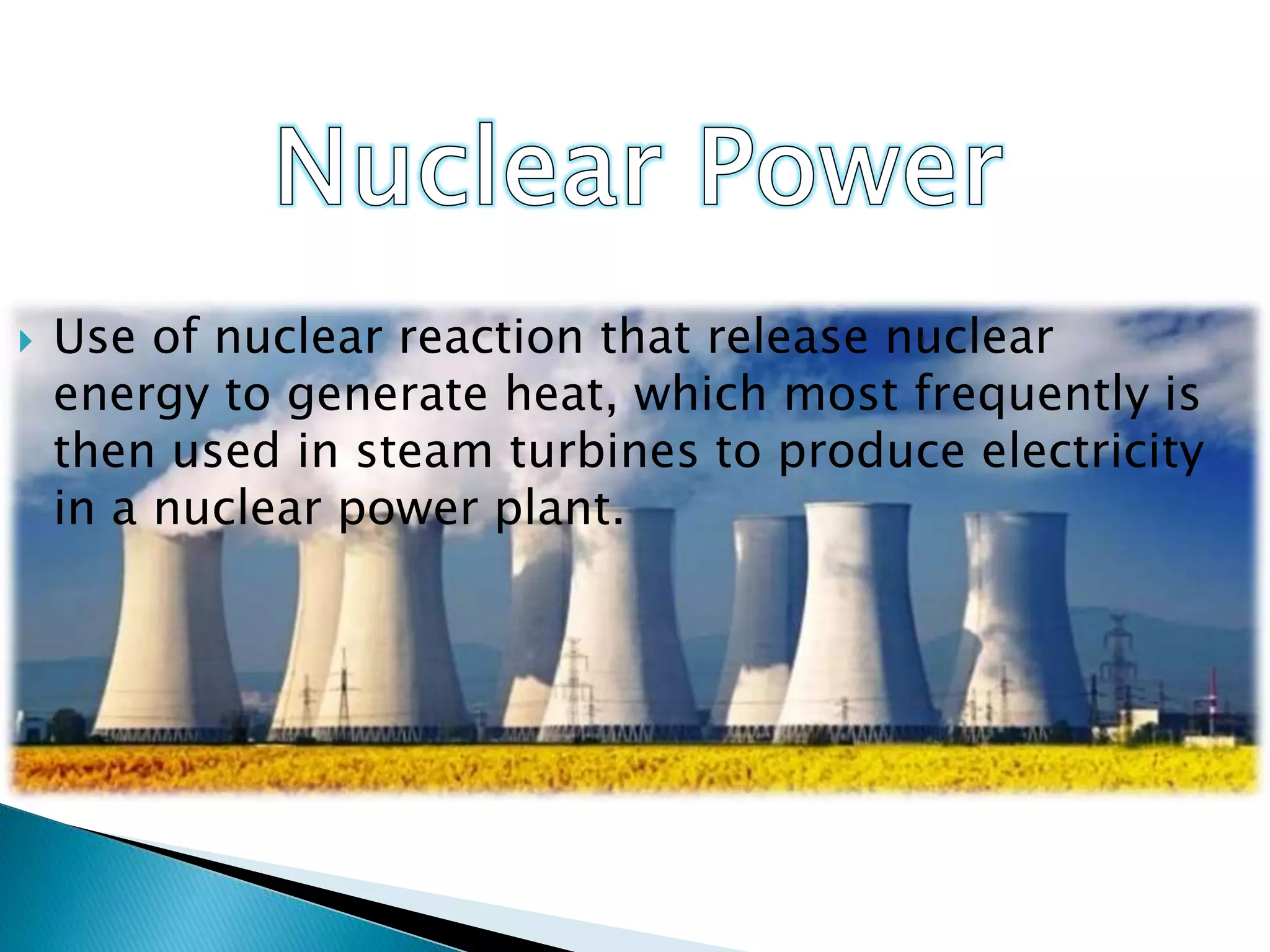
 Use of nuclear reaction that release nuclear
energy to generate heat, which most frequently is
then used in steam turbines to produce electricity
in a nuclear power plant.
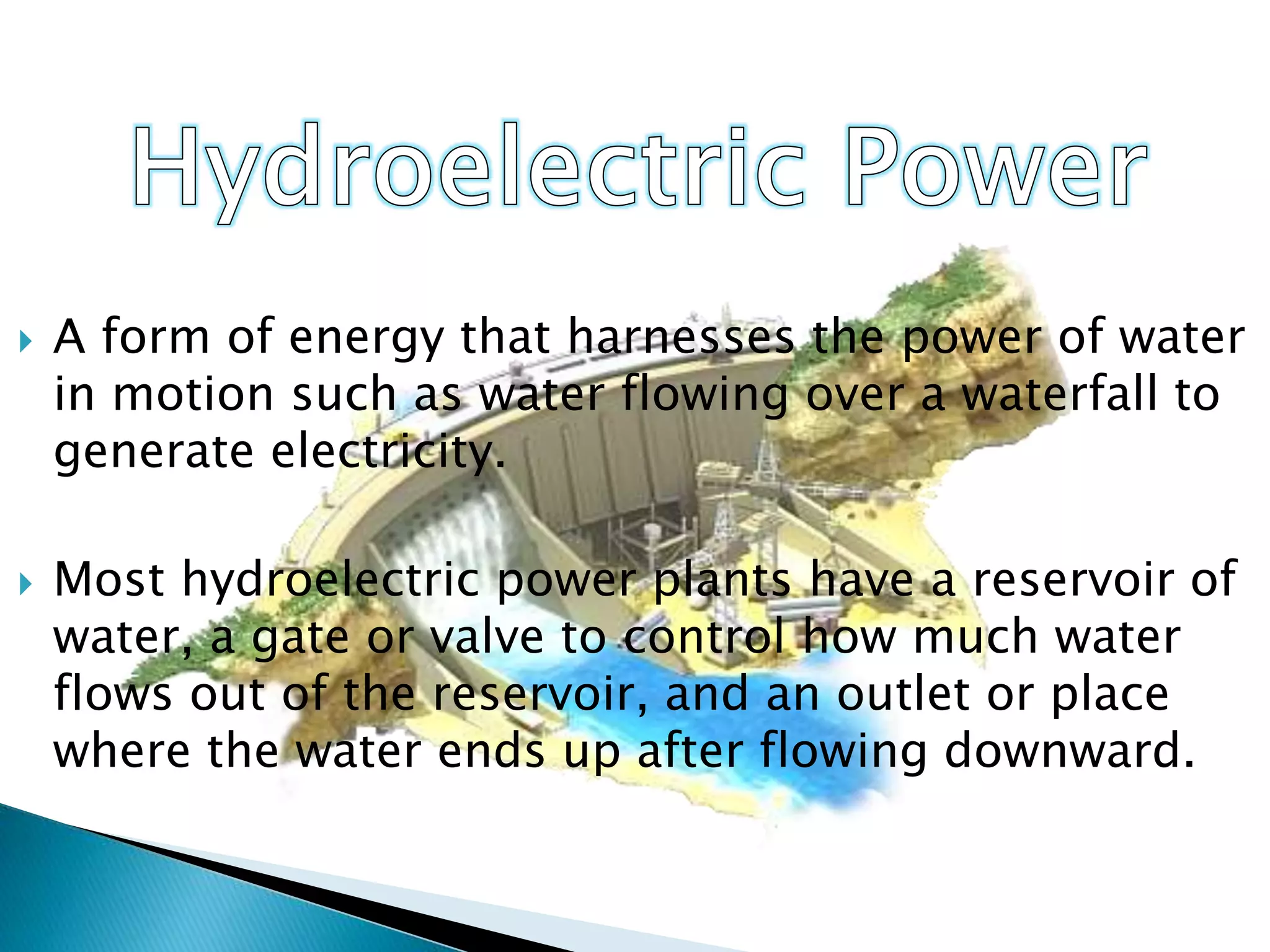
 A form of energy that harnesses the power of water
in motion such as water flowing over a waterfall to
generate electricity.
 Most hydroelectric power plants have a reservoir of
water, a gate or valve to control how much water
flows out of the reservoir, and an outlet or place
where the water ends up after flowing downward.
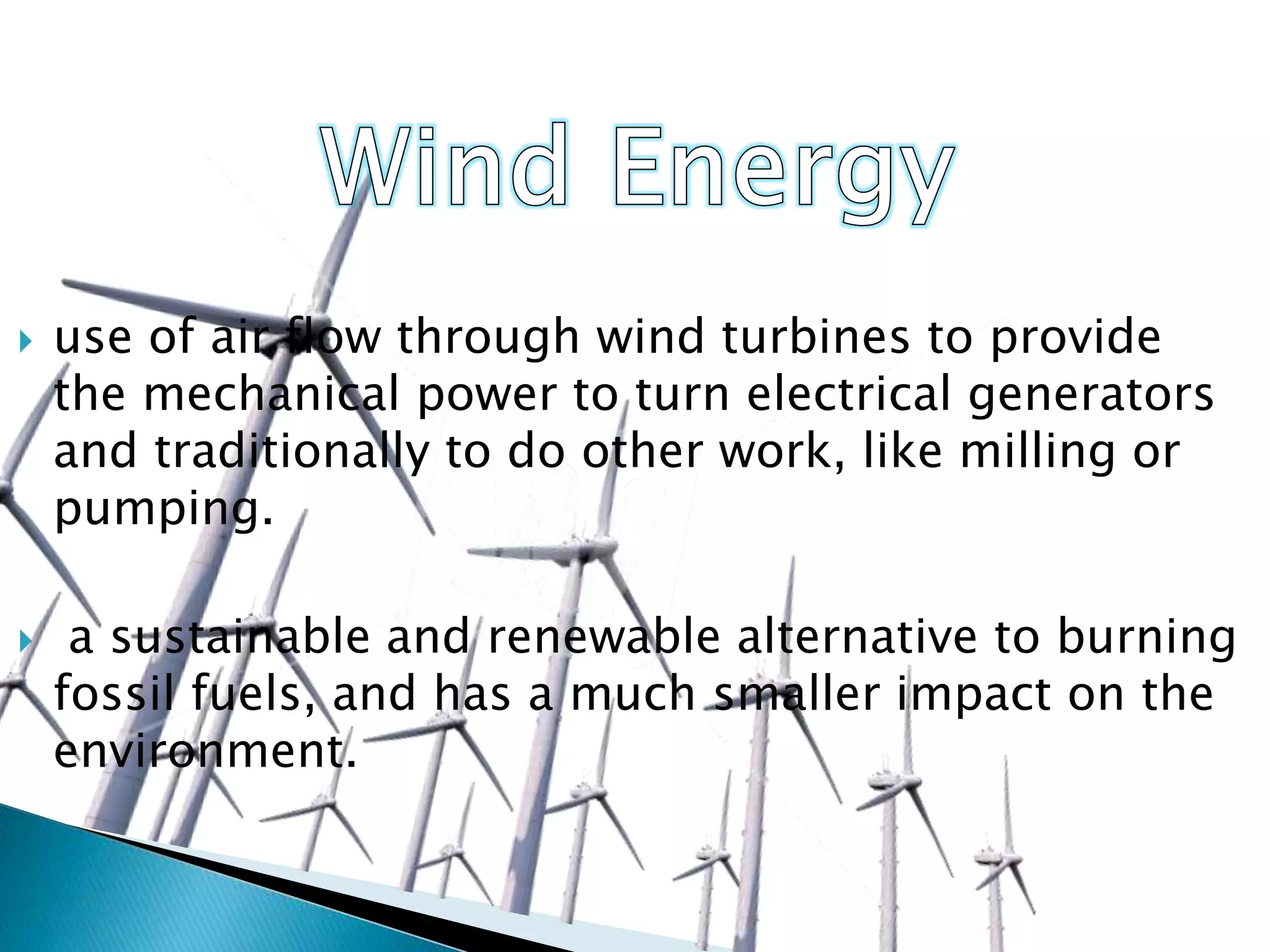
 use of air flow through wind turbines to provide
the mechanical power to turn electrical generators
and traditionally to do other work, like milling or
pumping.
 a sustainable and renewable alternative to burning
fossil fuels, and has a much smaller impact on the
environment.
 Alternating Current (AC) — An electric current that reverses its
direction many times a second at regular intervals.
 Ampere-Hour (Ah) — A unit of measure for battery capacity. It is
obtained by multiplying the current (in amperes) by the time (in
hours) during which current flows.
 Ampere (A) — A unit of measure for the intensity of an electric
current flowing in a circuit. One ampere is equal to a current flow of
one coulomb per second.
 Capacitor — A device used to store an electric charge, consisting of
one or more pairs of conductors separated by an insulator.
 Circuit — A closed path in which electrons from a voltage or current
source flow. Circuits can be in series, parallel, or in any combination
of the two.
 Circuit Breaker — An automatic device for stopping the flow of
current in an electric circuit.
 Conductor — Any material where electric current can flow freely. Conductive
materials, such as metals, have a relatively low resistance. Copper and
aluminum wire are the most common conductors.
 Current (I) — The flow of an electric charge through a conductor. An
electric current can be compared to the flow of water in a pipe.
Measured in amperes.
 Direct Current (DC) — An electric current that flows in only one
direction.
 Dielectric strength — The maximum electric field that a pure
material can withstand under ideal conditions without breaking
down.
 Demand — The average value of power or related quantity over a
specified period of time.
 Frequency — The number of cycles per second. Measured in Hertz. If
a current completes one cycle per second, then the frequency is 1
Hz; 60 cycles per second equals 60 Hz.
 Fuse — A circuit interrupting device consisting of a strip of wire that melts and breaks
an electric circuit if the current exceeds a safe level.
 Generator — A device which converts mechanical energy into electrical
energy.
 Ground — The reference point in an electrical circuit from which voltages are
measured, a common return path for electric current, or a direct physical
connection to the Earth.
 Ground Fault Circuit Interrupters (GFCI) — A device intended for the
protection of personnel that functions to de-energize a circuit or portion
thereof within an established period of time when a current to ground
exceeds some predetermined value that is less than that required to operate
the over current protective device of the supply circuit.
 Henry — A unit of measure for inductance. If the rate of change of current in
a circuit is one ampere per second and the resulting electromotive force is
one volt, then the inductance of the circuit is one henry.
 Hertz — A unit of measure for frequency. Replacing the earlier term of cycle
per second (cps).
 Inductor — A coil of wire wrapped around an iron core. The inductance is
directly proportional to the number of turns in the coil.
 Insulator — Any material where electric current does not flow freely.
Insulative materials, such as glass, rubber, air, and many plastics
have a relatively high resistance. Insulators protect equipment and
life from electric shock.
 Inverter — An apparatus that converts direct current into alternating
current.
 Kilowatt-hour (kWh) — The product of power in kW and time in
hours. Equal to 1000 Watt-hours. For example, if a 100W light bulb
is used for 4 hours, 0.4kWhs of energy will be used (100W x 1kW /
1000 Watts x 4 hours). Electrical energy is sold in units of kWh.
 Kilowatt-hour Meter — A device used to measure electrical energy
use.
 Kilowatt (kW) — Equal to 1000 watts.
 Load — Anything which consumes electrical energy, such as lights,
transformers, heaters and electric motors.
 Load Rejection — The condition in which there is a sudden load loss in the system which
causes the generating equipment to be over-frequency.
 Mutual Induction — Occurs when changing current in one coil induces voltage in a
second coil.
 Ohm — (Ω) A unit of measure of resistance. One ohm is equivilant to the resistance in a
circuit transmitting a current of one ampere when subjected to a potential difference of
one volt.
 Ohmmeter — An instrument for measuring the resistance in ohms of an
electrical circuit.
 Open Circuit — An open or open circuit occurs when a circuit is broken, such
as by a broken wire or open switch, interrupting the flow of current through
the circuit. It is analogous to a closed valve in a water system.
 Parallel Circuit — A circuit in which there are multiple paths for electricity to
flow.
 Polarity — A collective term applied to the positive (+) and negative ( - ) ends
of a magnet or electrical mechanism such as a coil or battery.
 Power — The rate at which electrical energy is transferred by an electric
circuit. Measured in Watts.
 Power Factor — The ratio of the actual electrical power dissipated by an AC
circuit to the product of the r.m.s. values of current and voltage.
 Reactive Power — The portion of electricity that establishes and sustains the
electric and magnetic fields of AC equipment. Exists in an AC circuit when
the current and voltage are not in phase.
 Reluctance — The resistance that a magnetic circuit offers to lines of force in
a magnetic field.
 Resistance — The opposition to the passage of an electric current.
 Resistor — A device usually made of wire or carbon which presents a
resistance to current flow.
 Rotor — The rotating part of an electrical machine such as a generator,
motor, or alternator.
 Self Induction — Voltage which occurs in a coil when there is a change of
current.
 Semiconductor — A solid substance that has a conductivity between that of an insulator
and that of most metals, either due to the addition of an impurity or because of
temperature effects.
 Series Circuit — A circuit in which there is only one path for electricity to
flow.
 Service — The conductors and equipment used to deliver energy from the
electrical supply system to the system being served.
 Short Circuit — When one part of an electric circuit comes in contact with
another part of the same circuit, diverting the flow of current from its desired
path.
 Transistor — A semiconductor device with three connections, capable of
amplification in addition to rectification
 VARS — A unit of measure of reactive power. Vars may be considered as
either the imaginary part of apparent power, or the power flowing into a
reactive load, where voltage and current are specified in volts and amperes.
 Volt-Ampere (VA) — A unit of measure of apparent power. It is the product
of the rms voltage and the rms current.
 Volt (V) — A unit measure of voltage. One volt is equal to the difference of
potential that would drive one ampere of current against one ohm resistance.
 Voltage — An electromotive force or "pressure" that causes electrons
to flow and can be compared to water pressure which causes water
to flow in a pipe. Measured in volts.
 Watt-hour (Wh) — A unit of electrical energy equivalent to a power
consumption of one watt for one hour.
 Watt (W) — A unit of electrical power. One watt is equivalent to one
joule per second, corresponding to the power in an electric circuit in
which the potential difference is one volt and the current one
ampere.
 Wattmeter — The wattmeter is an instrument for measuring the
electric power (or the supply rate of electrical energy) in watts of any
given circuit.
 Waveform — A graphical representation ofelectrical cycles which
shows the amount of variation in amplitude over some period of
time.
 The law was named after the German
physicist Georg Ohm, who, in a treatise
published in 1827, described measurements
of applied voltage and current through simple
electrical circuits containing various lengths
of wire.
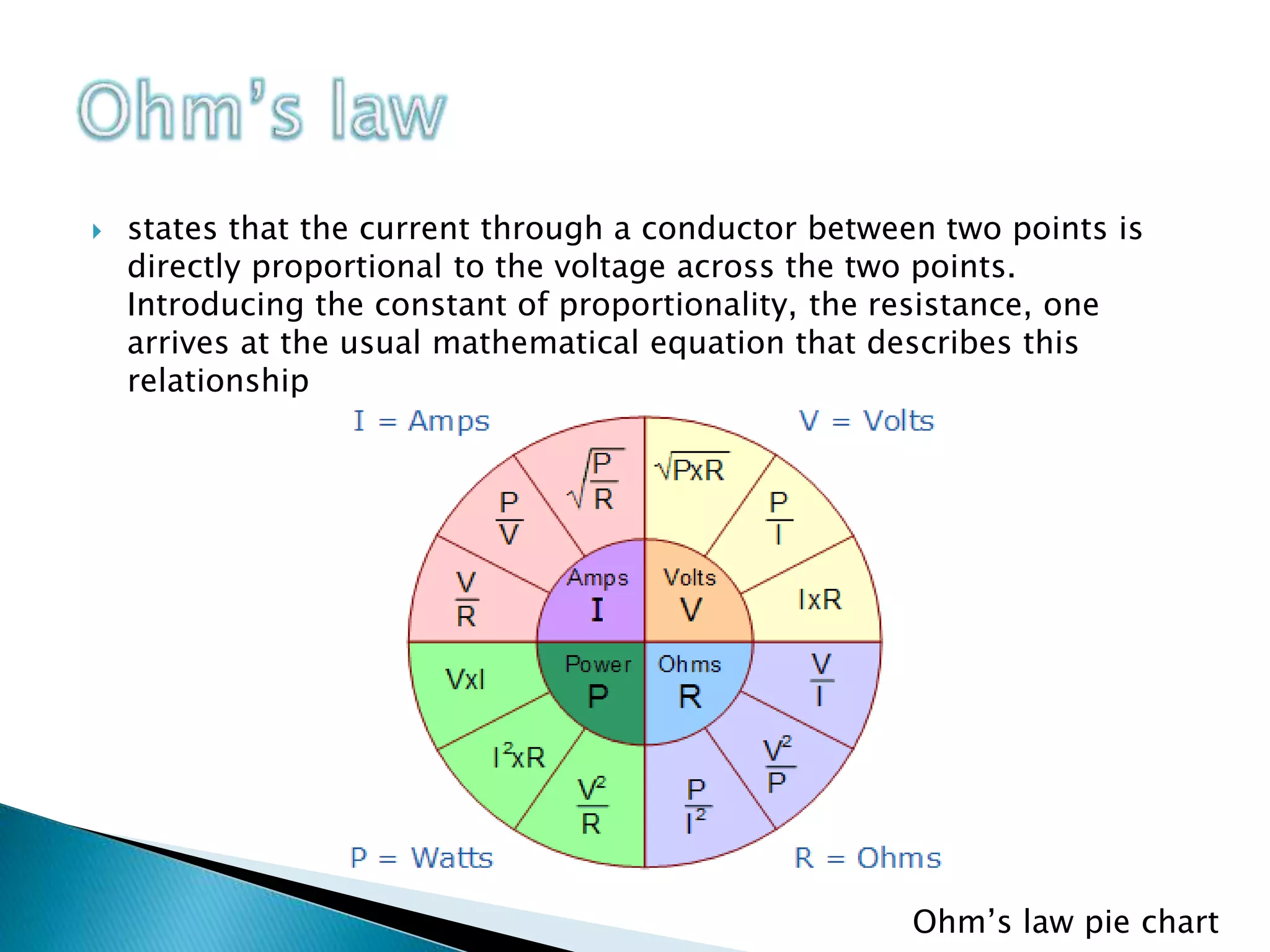
 states that the current through a conductor between two points is
directly proportional to the voltage across the two points.
Introducing the constant of proportionality, the resistance, one
arrives at the usual mathematical equation that describes this
relationship
Ohm’s law pie chart
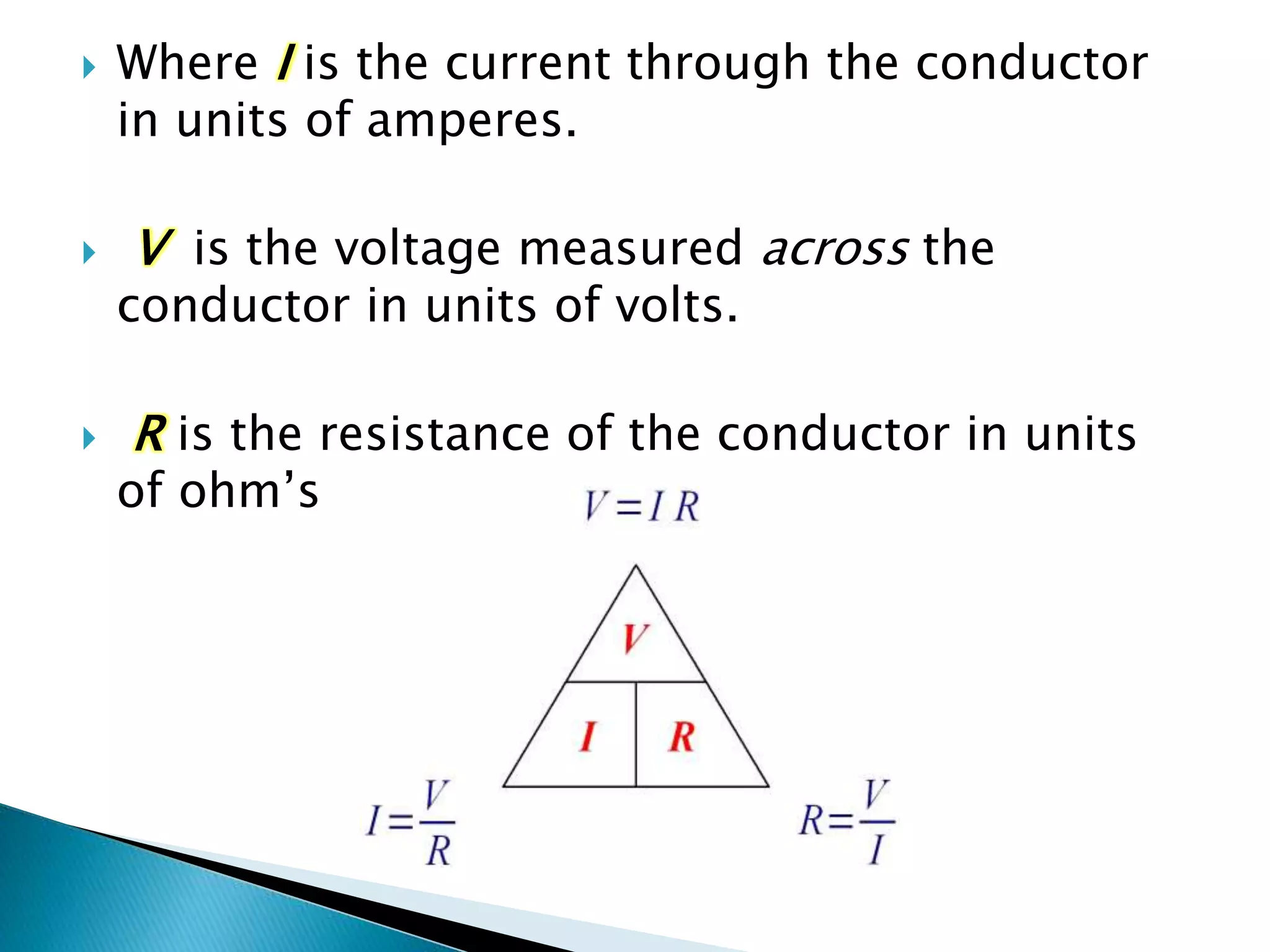
 Where I is the current through the conductor
in units of amperes.
 V is the voltage measured across the
conductor in units of volts.
 R is the resistance of the conductor in units
of ohm’s
Building Utilities 2

Building Utilities 2

  • 3.
     Electricity isall around us--powering technology like ….  Cell phones, computers, lights, soldering irons, and air conditioners.  It's tough to escape it in our modern world. Even when you try to escape electricity, it's still at work throughout nature, from the lightning in a thunderstorm to the synapses inside our body.  Electricity is a natural phenomenon that occurs throughout nature and takes many different forms. In this tutorial we'll focus on current electricity: the stuff that powers our electronic gadgets.
  • 4.
    ‘Electricity' refers tothe presence and flow of an Electric charge. The most common form is that which is used to Power Appliances, machines and devices by the flow of electrons through Conductors such as Copper wires. To buildings/structures
  • 5.
     This canbe as simple as a flashlight cells connected through two wires to a light bulb  A utility that provides electricity a facility composed of one or more pieces of equipment connected to or part of a structure and designed to provide a service
  • 6.
     Electricity isa secondary energy source  is the flow of electrical power or charge.  Both a basic part of nature and one of the most widely used forms of energy.  produced by converting primary sources of energy such as coal, natural gas, nuclear energy, solar energy, and wind energy, into electrical power.  also referred to as an energy carrier, which means it can be converted to other forms of energy such as mechanical energy or heat.
  • 8.
     The conversionof energy from sunlight into electricty, either directly using photovoltaics (PV), indirectly using concentrated solar power, or a combination.  Concentrated solar power systems use lenses or mirrors and tracking systems to focus a large area of sunlight into a small beam. Photovoltaic cells convert light into an electric current using the photovoltaic effect.
  • 9.
     Use ofnuclear reaction that release nuclear energy to generate heat, which most frequently is then used in steam turbines to produce electricity in a nuclear power plant.
  • 10.
     A formof energy that harnesses the power of water in motion such as water flowing over a waterfall to generate electricity.  Most hydroelectric power plants have a reservoir of water, a gate or valve to control how much water flows out of the reservoir, and an outlet or place where the water ends up after flowing downward.
  • 11.
     use ofair flow through wind turbines to provide the mechanical power to turn electrical generators and traditionally to do other work, like milling or pumping.  a sustainable and renewable alternative to burning fossil fuels, and has a much smaller impact on the environment.
  • 13.
     Alternating Current(AC) — An electric current that reverses its direction many times a second at regular intervals.  Ampere-Hour (Ah) — A unit of measure for battery capacity. It is obtained by multiplying the current (in amperes) by the time (in hours) during which current flows.  Ampere (A) — A unit of measure for the intensity of an electric current flowing in a circuit. One ampere is equal to a current flow of one coulomb per second.  Capacitor — A device used to store an electric charge, consisting of one or more pairs of conductors separated by an insulator.  Circuit — A closed path in which electrons from a voltage or current source flow. Circuits can be in series, parallel, or in any combination of the two.  Circuit Breaker — An automatic device for stopping the flow of current in an electric circuit.
  • 14.
     Conductor —Any material where electric current can flow freely. Conductive materials, such as metals, have a relatively low resistance. Copper and aluminum wire are the most common conductors.  Current (I) — The flow of an electric charge through a conductor. An electric current can be compared to the flow of water in a pipe. Measured in amperes.  Direct Current (DC) — An electric current that flows in only one direction.  Dielectric strength — The maximum electric field that a pure material can withstand under ideal conditions without breaking down.  Demand — The average value of power or related quantity over a specified period of time.  Frequency — The number of cycles per second. Measured in Hertz. If a current completes one cycle per second, then the frequency is 1 Hz; 60 cycles per second equals 60 Hz.
  • 15.
     Fuse —A circuit interrupting device consisting of a strip of wire that melts and breaks an electric circuit if the current exceeds a safe level.  Generator — A device which converts mechanical energy into electrical energy.  Ground — The reference point in an electrical circuit from which voltages are measured, a common return path for electric current, or a direct physical connection to the Earth.  Ground Fault Circuit Interrupters (GFCI) — A device intended for the protection of personnel that functions to de-energize a circuit or portion thereof within an established period of time when a current to ground exceeds some predetermined value that is less than that required to operate the over current protective device of the supply circuit.  Henry — A unit of measure for inductance. If the rate of change of current in a circuit is one ampere per second and the resulting electromotive force is one volt, then the inductance of the circuit is one henry.  Hertz — A unit of measure for frequency. Replacing the earlier term of cycle per second (cps).
  • 16.
     Inductor —A coil of wire wrapped around an iron core. The inductance is directly proportional to the number of turns in the coil.  Insulator — Any material where electric current does not flow freely. Insulative materials, such as glass, rubber, air, and many plastics have a relatively high resistance. Insulators protect equipment and life from electric shock.  Inverter — An apparatus that converts direct current into alternating current.  Kilowatt-hour (kWh) — The product of power in kW and time in hours. Equal to 1000 Watt-hours. For example, if a 100W light bulb is used for 4 hours, 0.4kWhs of energy will be used (100W x 1kW / 1000 Watts x 4 hours). Electrical energy is sold in units of kWh.  Kilowatt-hour Meter — A device used to measure electrical energy use.  Kilowatt (kW) — Equal to 1000 watts.  Load — Anything which consumes electrical energy, such as lights, transformers, heaters and electric motors.
  • 17.
     Load Rejection— The condition in which there is a sudden load loss in the system which causes the generating equipment to be over-frequency.  Mutual Induction — Occurs when changing current in one coil induces voltage in a second coil.  Ohm — (Ω) A unit of measure of resistance. One ohm is equivilant to the resistance in a circuit transmitting a current of one ampere when subjected to a potential difference of one volt.  Ohmmeter — An instrument for measuring the resistance in ohms of an electrical circuit.  Open Circuit — An open or open circuit occurs when a circuit is broken, such as by a broken wire or open switch, interrupting the flow of current through the circuit. It is analogous to a closed valve in a water system.  Parallel Circuit — A circuit in which there are multiple paths for electricity to flow.  Polarity — A collective term applied to the positive (+) and negative ( - ) ends of a magnet or electrical mechanism such as a coil or battery.
  • 18.
     Power —The rate at which electrical energy is transferred by an electric circuit. Measured in Watts.  Power Factor — The ratio of the actual electrical power dissipated by an AC circuit to the product of the r.m.s. values of current and voltage.  Reactive Power — The portion of electricity that establishes and sustains the electric and magnetic fields of AC equipment. Exists in an AC circuit when the current and voltage are not in phase.  Reluctance — The resistance that a magnetic circuit offers to lines of force in a magnetic field.  Resistance — The opposition to the passage of an electric current.  Resistor — A device usually made of wire or carbon which presents a resistance to current flow.  Rotor — The rotating part of an electrical machine such as a generator, motor, or alternator.  Self Induction — Voltage which occurs in a coil when there is a change of current.
  • 19.
     Semiconductor —A solid substance that has a conductivity between that of an insulator and that of most metals, either due to the addition of an impurity or because of temperature effects.  Series Circuit — A circuit in which there is only one path for electricity to flow.  Service — The conductors and equipment used to deliver energy from the electrical supply system to the system being served.  Short Circuit — When one part of an electric circuit comes in contact with another part of the same circuit, diverting the flow of current from its desired path.  Transistor — A semiconductor device with three connections, capable of amplification in addition to rectification  VARS — A unit of measure of reactive power. Vars may be considered as either the imaginary part of apparent power, or the power flowing into a reactive load, where voltage and current are specified in volts and amperes.  Volt-Ampere (VA) — A unit of measure of apparent power. It is the product of the rms voltage and the rms current.
  • 20.
     Volt (V)— A unit measure of voltage. One volt is equal to the difference of potential that would drive one ampere of current against one ohm resistance.  Voltage — An electromotive force or "pressure" that causes electrons to flow and can be compared to water pressure which causes water to flow in a pipe. Measured in volts.  Watt-hour (Wh) — A unit of electrical energy equivalent to a power consumption of one watt for one hour.  Watt (W) — A unit of electrical power. One watt is equivalent to one joule per second, corresponding to the power in an electric circuit in which the potential difference is one volt and the current one ampere.  Wattmeter — The wattmeter is an instrument for measuring the electric power (or the supply rate of electrical energy) in watts of any given circuit.  Waveform — A graphical representation ofelectrical cycles which shows the amount of variation in amplitude over some period of time.
  • 22.
     The lawwas named after the German physicist Georg Ohm, who, in a treatise published in 1827, described measurements of applied voltage and current through simple electrical circuits containing various lengths of wire.
  • 23.
     states thatthe current through a conductor between two points is directly proportional to the voltage across the two points. Introducing the constant of proportionality, the resistance, one arrives at the usual mathematical equation that describes this relationship Ohm’s law pie chart
  • 24.
     Where Iis the current through the conductor in units of amperes.  V is the voltage measured across the conductor in units of volts.  R is the resistance of the conductor in units of ohm’s