Nitec in Social Media & Web Development   IT2031PA


                   Web Authoring

                     Topic 2 –
            HyperText Markup Language
Objectives
Students should able to:
1. Explain what is HTML.

2. Use tools (Notepad) to create a
   simple webpage with HTML Tags.
3. Explain structure of an HTML
   document
What is Markup Language?

In traditional publishing, the manuscript
is annotated with layout instructions for
the typesetter.

These hand-written annotations are
called markup.
What is Markup Language?

A Markup language describes the layout
or structure of a document using
instructions embedded within it.
Hyper Text Markup Language
HTML is the backbone of the web, the
skeleton of your web page.
Like the bones in your body, it is the
structure and substance of the Internet,
although it is usually unseen except by
the web designer.

Without it, the web would not exist.
Hyper Text Markup Language

You only need a simple text editor,
notepad to create HTML documents.

The default file extension is .html
XML/XHTML

XML is used to create structured data.

XHTML is written in XML syntax

XHTML lets you check quickly that a
web page is correctly formed and does
not contain any coding errors.
HTML5

HTML5, the fifth edition of HTML, is
currently in draft form and is expected to
remain so for several years while the
final details are worked out.

HTML5 is distinguished in two main
categories: structure and media
HTML5

HTML 5 offers specific <header> and
<footer> tags, as well as ones for
content such as <article> and
<summary>.

HTML5 contains numerous other
structural elements for handling figures,
forms and navigation as well.
HTML5

HTML5 includes native support for
playing video and audio through the
<video> and <audio> tags
respectively, as well as static and
animated vector graphics via the
<canvas> tag.
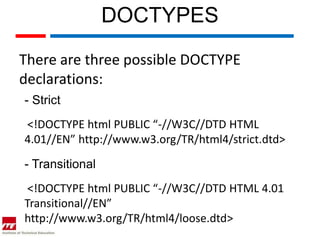
DOCTYPES
There are three possible DOCTYPE
declarations:
- Strict
<!DOCTYPE html PUBLIC “-//W3C//DTD HTML
4.01//EN” http://www.w3.org/TR/html4/strict.dtd>

- Transitional
 <!DOCTYPE html PUBLIC “-//W3C//DTD HTML 4.01
Transitional//EN”
http://www.w3.org/TR/html4/loose.dtd>
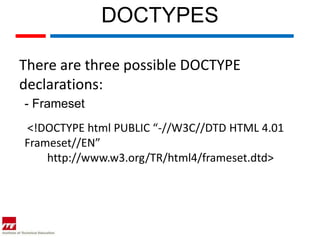
DOCTYPES

There are three possible DOCTYPE
declarations:
- Frameset
<!DOCTYPE html PUBLIC “-//W3C//DTD HTML 4.01
Frameset//EN”
    http://www.w3.org/TR/html4/frameset.dtd>
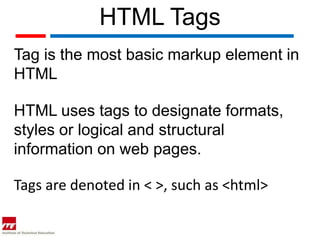
HTML Tags
Tag is the most basic markup element in
HTML

HTML uses tags to designate formats,
styles or logical and structural
information on web pages.

Tags are denoted in < >, such as <html>
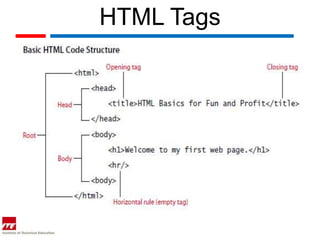
HTML Tags
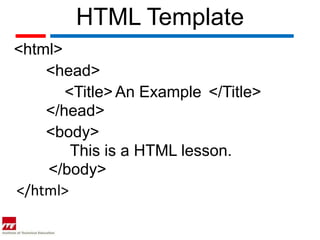
HTML Template
<html>
    <head>
       <Title> An Example </Title>
    </head>
    <body>
        This is a HTML lesson.
    </body>
</html>
Tag Attribute
Tag can takes attributes that define
properties or special information about
the tag.
<H1 style="text-align:center">
Heading 1
</H1>
Attributes can only appear in the
opening tag of a tag pair.
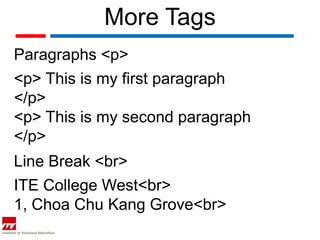
More Tags
Paragraphs <p>
<p> This is my first paragraph
</p>
<p> This is my second paragraph
</p>
Line Break <br>
ITE College West<br>
1, Choa Chu Kang Grove<br>
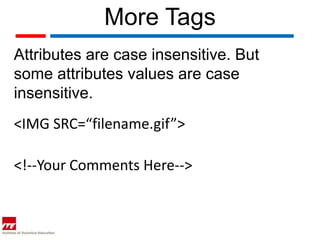
More Tags
Attributes are case insensitive. But
some attributes values are case
insensitive.
<IMG SRC=“filename.gif”>

<!--Your Comments Here-->
Review Questions

1. What programs can open HTML files?


HTML is a plain-text language that can
be opened and edited in any
               text editor
and viewed in any
             web browser.
Review Questions

2. What does a markup language do?


It places tags contained within brackets
< > around plain-text content to pass
information concerning structure and
formatting from one application to
another.
Review Questions

3. HTML is comprised of how many
code elements?

Less than 100 codes are defined in the
HTML specifications.
Review Questions
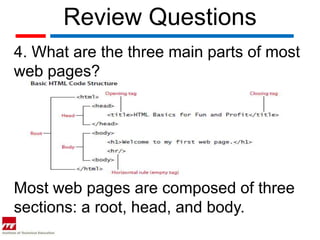
4. What are the three main parts of most
web pages?


Most web pages are composed of three
sections: a root, head, and body.
Review Questions
5. What’s the difference between a
block and inline element?


A block element creates a stand-alone
element. An inline element can exist
within another element.

Web topic 2 html

  • 1.
    Nitec in SocialMedia & Web Development IT2031PA Web Authoring Topic 2 – HyperText Markup Language
  • 2.
    Objectives Students should ableto: 1. Explain what is HTML. 2. Use tools (Notepad) to create a simple webpage with HTML Tags. 3. Explain structure of an HTML document
  • 3.
    What is MarkupLanguage? In traditional publishing, the manuscript is annotated with layout instructions for the typesetter. These hand-written annotations are called markup.
  • 4.
    What is MarkupLanguage? A Markup language describes the layout or structure of a document using instructions embedded within it.
  • 5.
    Hyper Text MarkupLanguage HTML is the backbone of the web, the skeleton of your web page. Like the bones in your body, it is the structure and substance of the Internet, although it is usually unseen except by the web designer. Without it, the web would not exist.
  • 6.
    Hyper Text MarkupLanguage You only need a simple text editor, notepad to create HTML documents. The default file extension is .html
  • 7.
    XML/XHTML XML is usedto create structured data. XHTML is written in XML syntax XHTML lets you check quickly that a web page is correctly formed and does not contain any coding errors.
  • 8.
    HTML5 HTML5, the fifthedition of HTML, is currently in draft form and is expected to remain so for several years while the final details are worked out. HTML5 is distinguished in two main categories: structure and media
  • 9.
    HTML5 HTML 5 offersspecific <header> and <footer> tags, as well as ones for content such as <article> and <summary>. HTML5 contains numerous other structural elements for handling figures, forms and navigation as well.
  • 10.
    HTML5 HTML5 includes nativesupport for playing video and audio through the <video> and <audio> tags respectively, as well as static and animated vector graphics via the <canvas> tag.
  • 11.
    DOCTYPES There are threepossible DOCTYPE declarations: - Strict <!DOCTYPE html PUBLIC “-//W3C//DTD HTML 4.01//EN” http://www.w3.org/TR/html4/strict.dtd> - Transitional <!DOCTYPE html PUBLIC “-//W3C//DTD HTML 4.01 Transitional//EN” http://www.w3.org/TR/html4/loose.dtd>
  • 12.
    DOCTYPES There are threepossible DOCTYPE declarations: - Frameset <!DOCTYPE html PUBLIC “-//W3C//DTD HTML 4.01 Frameset//EN” http://www.w3.org/TR/html4/frameset.dtd>
  • 13.
    HTML Tags Tag isthe most basic markup element in HTML HTML uses tags to designate formats, styles or logical and structural information on web pages. Tags are denoted in < >, such as <html>
  • 14.
  • 15.
    HTML Template <html> <head> <Title> An Example </Title> </head> <body> This is a HTML lesson. </body> </html>
  • 16.
    Tag Attribute Tag cantakes attributes that define properties or special information about the tag. <H1 style="text-align:center"> Heading 1 </H1> Attributes can only appear in the opening tag of a tag pair.
  • 17.
    More Tags Paragraphs <p> <p>This is my first paragraph </p> <p> This is my second paragraph </p> Line Break <br> ITE College West<br> 1, Choa Chu Kang Grove<br>
  • 18.
    More Tags Attributes arecase insensitive. But some attributes values are case insensitive. <IMG SRC=“filename.gif”> <!--Your Comments Here-->
  • 19.
    Review Questions 1. Whatprograms can open HTML files? HTML is a plain-text language that can be opened and edited in any text editor and viewed in any web browser.
  • 20.
    Review Questions 2. Whatdoes a markup language do? It places tags contained within brackets < > around plain-text content to pass information concerning structure and formatting from one application to another.
  • 21.
    Review Questions 3. HTMLis comprised of how many code elements? Less than 100 codes are defined in the HTML specifications.
  • 22.
    Review Questions 4. Whatare the three main parts of most web pages? Most web pages are composed of three sections: a root, head, and body.
  • 23.
    Review Questions 5. What’sthe difference between a block and inline element? A block element creates a stand-alone element. An inline element can exist within another element.