Web Authoring

     Topic 14 –
Cascading Style Sheets
Objectives
Students should able to:
1   Explain Cascading Style Sheets.
2   Identify the basic syntax and use
    Cascading Style Sheets.
     ATTRIBUTE NAME and VALUE pair(s)
          <STYLE> Tag
     <LINK> Tag
          <LINK REL >
3   Use Cascading Style Sheets to
    create two or more HTML pages
Cascading Style Sheet
Gives complete control over the layout of
the Web page and the appearance of its
content.

You only need to specify presentational
preferences once, and the style can be
applied to an entire site.
Advantages of CSS
The presentation of an entire website can be
updated at a moment’s notice - standardising
the look and feel of a website.
Users of a website can compose style sheets
of their own.
Browsers are beginning to support multiple
style sheets.
Advantages of CSS
Style sheets allow content to be optimized for
more than one type of device.
Style sheets download much more quickly
because web documents using CSS take up
less hard disk space and consume less
bandwidth.
CSS Rules
A style sheet can be broken down into
progressively smaller bits. From large to
small, it goes like this:
       • Style sheet
       • Rule
       • Selector
       • Declaration
       • Property
       • Value
CSS Rules
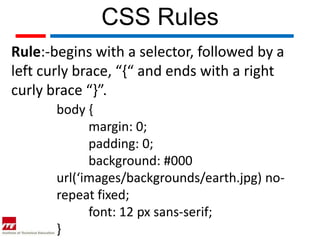
Rule:-begins with a selector, followed by a
left curly brace, “{“ and ends with a right
curly brace “}”.
       body {
             margin: 0;
             padding: 0;
             background: #000
       url(‘images/backgrounds/earth.jpg) no-
       repeat fixed;
             font: 12 px sans-serif;
       }
CSS Rules
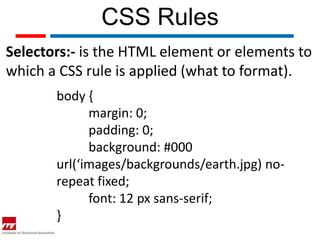
Selectors:- is the HTML element or elements to
which a CSS rule is applied (what to format).
       body {
             margin: 0;
             padding: 0;
             background: #000
       url(‘images/backgrounds/earth.jpg) no-
       repeat fixed;
             font: 12 px sans-serif;
       }
CSS Rules
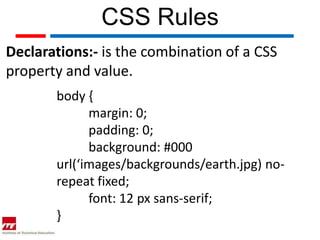
Declarations:- is the combination of a CSS
property and value.
       body {
             margin: 0;
             padding: 0;
             background: #000
       url(‘images/backgrounds/earth.jpg) no-
       repeat fixed;
             font: 12 px sans-serif;
       }
CSS Rules
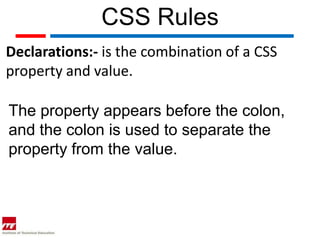
Declarations:- is the combination of a CSS
property and value.

The property appears before the colon,
and the colon is used to separate the
property from the value.
CSS Rules
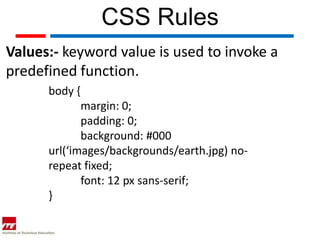
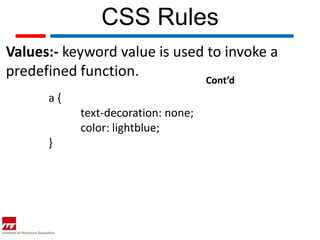
Values:- keyword value is used to invoke a
predefined function.
      body {
             margin: 0;
             padding: 0;
             background: #000
      url(‘images/backgrounds/earth.jpg) no-
      repeat fixed;
             font: 12 px sans-serif;
      }
CSS Rules
Values:- keyword value is used to invoke a
predefined function.           Cont’d
      a{
           text-decoration: none;
           color: lightblue;
      }
CSS Rules
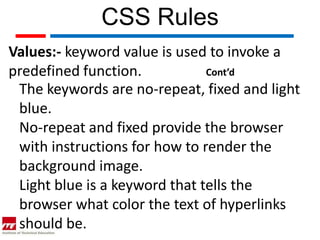
Values:- keyword value is used to invoke a
predefined function.           Cont’d
 The keywords are no-repeat, fixed and light
 blue.
 No-repeat and fixed provide the browser
 with instructions for how to render the
 background image.
 Light blue is a keyword that tells the
 browser what color the text of hyperlinks
 should be.
Basic Syntax of CSS
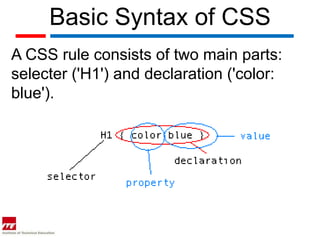
A CSS rule consists of two main parts:
selecter ('H1') and declaration ('color:
blue').
Cascading Style Sheet
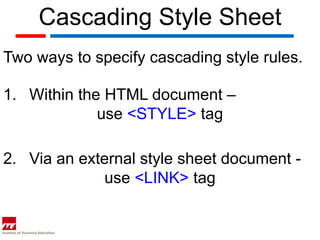
Two ways to specify cascading style rules.

1. Within the HTML document –
             use <STYLE> tag

2. Via an external style sheet document -
             use <LINK> tag
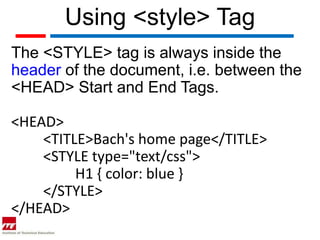
Using <style> Tag
The <STYLE> tag is always inside the
header of the document, i.e. between the
<HEAD> Start and End Tags.

<HEAD>
    <TITLE>Bach's home page</TITLE>
    <STYLE type="text/css">
         H1 { color: blue }
    </STYLE>
</HEAD>
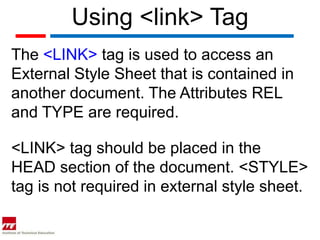
Using <link> Tag
The <LINK> tag is used to access an
External Style Sheet that is contained in
another document. The Attributes REL
and TYPE are required.

<LINK> tag should be placed in the
HEAD section of the document. <STYLE>
tag is not required in external style sheet.
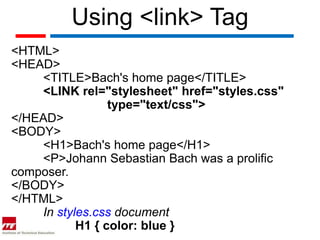
Using <link> Tag
<HTML>
<HEAD>
    <TITLE>Bach's home page</TITLE>
    <LINK rel="stylesheet" href="styles.css"
                 type="text/css">
</HEAD>
<BODY>
    <H1>Bach's home page</H1>
    <P>Johann Sebastian Bach was a prolific
composer.
</BODY>
</HTML>
    In styles.css document
           H1 { color: blue }
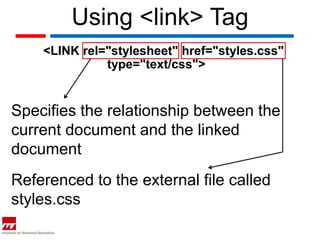
Using <link> Tag
    <LINK rel="stylesheet" href="styles.css"
              type="text/css">


Specifies the relationship between the
current document and the linked
document
Referenced to the external file called
styles.css
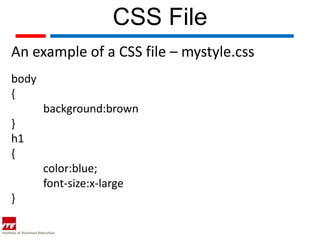
CSS File
An example of a CSS file – mystyle.css
body
{
       background:brown
}
h1
{
       color:blue;
       font-size:x-large
}

Web topic 14 cascading style sheets

  • 1.
    Web Authoring Topic 14 – Cascading Style Sheets
  • 2.
    Objectives Students should ableto: 1 Explain Cascading Style Sheets. 2 Identify the basic syntax and use Cascading Style Sheets. ATTRIBUTE NAME and VALUE pair(s) <STYLE> Tag <LINK> Tag <LINK REL > 3 Use Cascading Style Sheets to create two or more HTML pages
  • 3.
    Cascading Style Sheet Givescomplete control over the layout of the Web page and the appearance of its content. You only need to specify presentational preferences once, and the style can be applied to an entire site.
  • 4.
    Advantages of CSS Thepresentation of an entire website can be updated at a moment’s notice - standardising the look and feel of a website. Users of a website can compose style sheets of their own. Browsers are beginning to support multiple style sheets.
  • 5.
    Advantages of CSS Stylesheets allow content to be optimized for more than one type of device. Style sheets download much more quickly because web documents using CSS take up less hard disk space and consume less bandwidth.
  • 6.
    CSS Rules A stylesheet can be broken down into progressively smaller bits. From large to small, it goes like this: • Style sheet • Rule • Selector • Declaration • Property • Value
  • 7.
    CSS Rules Rule:-begins witha selector, followed by a left curly brace, “{“ and ends with a right curly brace “}”. body { margin: 0; padding: 0; background: #000 url(‘images/backgrounds/earth.jpg) no- repeat fixed; font: 12 px sans-serif; }
  • 8.
    CSS Rules Selectors:- isthe HTML element or elements to which a CSS rule is applied (what to format). body { margin: 0; padding: 0; background: #000 url(‘images/backgrounds/earth.jpg) no- repeat fixed; font: 12 px sans-serif; }
  • 9.
    CSS Rules Declarations:- isthe combination of a CSS property and value. body { margin: 0; padding: 0; background: #000 url(‘images/backgrounds/earth.jpg) no- repeat fixed; font: 12 px sans-serif; }
  • 10.
    CSS Rules Declarations:- isthe combination of a CSS property and value. The property appears before the colon, and the colon is used to separate the property from the value.
  • 11.
    CSS Rules Values:- keywordvalue is used to invoke a predefined function. body { margin: 0; padding: 0; background: #000 url(‘images/backgrounds/earth.jpg) no- repeat fixed; font: 12 px sans-serif; }
  • 12.
    CSS Rules Values:- keywordvalue is used to invoke a predefined function. Cont’d a{ text-decoration: none; color: lightblue; }
  • 13.
    CSS Rules Values:- keywordvalue is used to invoke a predefined function. Cont’d The keywords are no-repeat, fixed and light blue. No-repeat and fixed provide the browser with instructions for how to render the background image. Light blue is a keyword that tells the browser what color the text of hyperlinks should be.
  • 14.
    Basic Syntax ofCSS A CSS rule consists of two main parts: selecter ('H1') and declaration ('color: blue').
  • 15.
    Cascading Style Sheet Twoways to specify cascading style rules. 1. Within the HTML document – use <STYLE> tag 2. Via an external style sheet document - use <LINK> tag
  • 16.
    Using <style> Tag The<STYLE> tag is always inside the header of the document, i.e. between the <HEAD> Start and End Tags. <HEAD> <TITLE>Bach's home page</TITLE> <STYLE type="text/css"> H1 { color: blue } </STYLE> </HEAD>
  • 17.
    Using <link> Tag The<LINK> tag is used to access an External Style Sheet that is contained in another document. The Attributes REL and TYPE are required. <LINK> tag should be placed in the HEAD section of the document. <STYLE> tag is not required in external style sheet.
  • 18.
    Using <link> Tag <HTML> <HEAD> <TITLE>Bach's home page</TITLE> <LINK rel="stylesheet" href="styles.css" type="text/css"> </HEAD> <BODY> <H1>Bach's home page</H1> <P>Johann Sebastian Bach was a prolific composer. </BODY> </HTML> In styles.css document H1 { color: blue }
  • 19.
    Using <link> Tag <LINK rel="stylesheet" href="styles.css" type="text/css"> Specifies the relationship between the current document and the linked document Referenced to the external file called styles.css
  • 20.
    CSS File An exampleof a CSS file – mystyle.css body { background:brown } h1 { color:blue; font-size:x-large }