Data Mining:
Concepts and Techniques
Mining Text Data
Mining Text and Web Data


Text mining, natural language processing and
information extraction: An Introduction



Text categorization methods
Mining Text Data: An Introduction
Data Mining / Knowledge Discovery

Structured Data

omeLoan (
oanee: Frank Rizzo
ender: MWF
gency: Lake View
mount: $200,000
erm: 15 years

Multimedia

Free Text

Hypertext

Frank Rizzo bought
his home from Lake
View Real Estate in
1992.
He paid $200,000
under a15-year loan
Loans($200K,[map],...) from MW Financial.

<a href>Frank Rizzo
</a> Bought
<a hef>this home</a>
from <a href>Lake
View Real Estate</a>
In <b>1992</b>.
<p>...
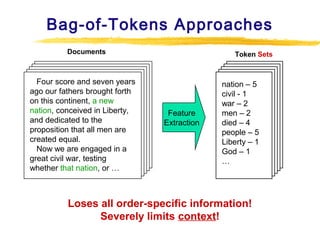
Bag-of-Tokens Approaches
Documents

Four score and seven years
ago our fathers brought forth
on this continent, a new
nation, conceived in Liberty,
and dedicated to the
proposition that all men are
created equal.
Now we are engaged in a
great civil war, testing
whether that nation, or …

Token Sets

Feature
Extraction

nation – 5
civil - 1
war – 2
men – 2
died – 4
people – 5
Liberty – 1
God – 1
…

Loses all order-specific information!
Severely limits context!
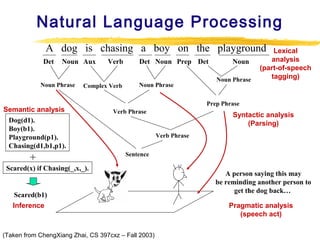
Natural Language Processing
A dog is chasing a boy on the playground
Det

Noun Aux

Noun Phrase

Verb

Complex Verb

Semantic analysis
Dog(d1).
Boy(b1).
Playground(p1).
Chasing(d1,b1,p1).

+

Det Noun Prep Det
Noun Phrase

Noun
Noun Phrase

Lexical
analysis
(part-of-speech
tagging)

Prep Phrase
Verb Phrase

Syntactic analysis
(Parsing)
Verb Phrase

Sentence

Scared(x) if Chasing(_,x,_).

Scared(b1)
Inference

(Taken from ChengXiang Zhai, CS 397cxz – Fall 2003)

A person saying this may
be reminding another person to
get the dog back…
Pragmatic analysis
(speech act)
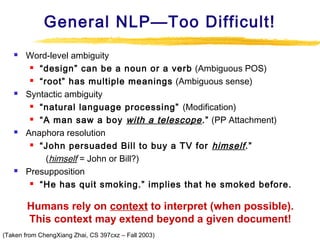
General NLP—Too Difficult!








Word-level ambiguity
 “design” can be a noun or a verb (Ambiguous POS)
 “root” has multiple meanings (Ambiguous sense)
Syntactic ambiguity
 “natural language processing” (Modification)
 “A man saw a boy with a telescope .” (PP Attachment)
Anaphora resolution
 “John persuaded Bill to buy a TV for himself .”
(himself = John or Bill?)
Presupposition
 “He has quit smoking.” implies that he smoked before.

Humans rely on context to interpret (when possible).
This context may extend beyond a given document!
(Taken from ChengXiang Zhai, CS 397cxz – Fall 2003)
Shallow Linguistics
Progress on Useful Sub-Goals:
• English Lexicon
• Part-of-Speech Tagging
• Word Sense Disambiguation
• Phrase Detection / Parsing
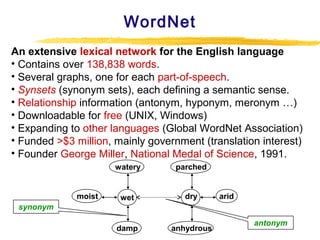
WordNet
An extensive lexical network for the English language
• Contains over 138,838 words.
• Several graphs, one for each part-of-speech.
• Synsets (synonym sets), each defining a semantic sense.
• Relationship information (antonym, hyponym, meronym …)
• Downloadable for free (UNIX, Windows)
• Expanding to other languages (Global WordNet Association)
• Funded >$3 million, mainly government (translation interest)
• Founder George Miller, National Medal of Science, 1991.
watery

moist

parched

wet

dry

damp

anhydrous

arid

synonym
antonym
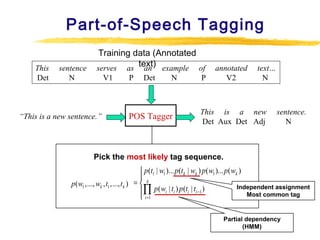
Part-of-Speech Tagging
This
Det

sentence
N

Training data (Annotated
text)
serves as an example of
V1

“This is a new sentence.”

P

Det

N

POS Tagger

P

annotated
V2

text…
N

This is a new
Det Aux Det Adj

sentence.
N

Pick the most1 likely ttag tsequence.
p ( w ,..., wk , 1 ,..., k )

 p (t1 | w1 )... p(tk | wk ) p( w1 )... p( wk )

p ( w1 ,..., wk , t1 ,..., t k ) =  k
Independent assignment
∏ p ( wi | ti ) p (ti | ti −1 )
Most common tag
 =1
 p (t1 | w1 )... p(tk | wk ) p(iw1 )... p ( wk )

= k
∏ p ( wi | ti ) p (ti | ti −1 )
Partial dependency
 i =1
(HMM)
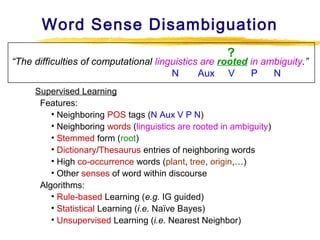
Word Sense Disambiguation
?

“The difficulties of computational linguistics are rooted in ambiguity.”
N
Aux V
P
N
Supervised Learning
Features:
• Neighboring POS tags (N Aux V P N)
• Neighboring words (linguistics are rooted in ambiguity)
• Stemmed form (root)
• Dictionary/Thesaurus entries of neighboring words
• High co-occurrence words (plant, tree, origin,…)
• Other senses of word within discourse
Algorithms:
• Rule-based Learning (e.g. IG guided)
• Statistical Learning (i.e. Naïve Bayes)
• Unsupervised Learning (i.e. Nearest Neighbor)
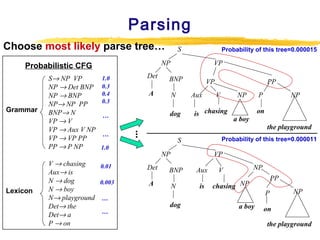
Parsing
Choose most likely parse tree…

Grammar

Lexicon

V → chasing
Aux→ is
N → dog
N → boy
N→ playground
Det→ the
Det→ a
P → on

Probability of this tree=0.000015

NP

Probabilistic CFG
S→ NP VP
NP → Det BNP
NP → BNP
NP→ NP PP
BNP→ N
VP → V
VP → Aux V NP
VP → VP PP
PP → P NP

S

Det

BNP

A

1.0
0.3
0.4
0.3

N

.
.
.

V

NP

is chasing

P

NP

on
a boy

Probability of this tree=0.000011

S
NP

0.01

Det

0.003

A

…

PP

the playground

1.0

…

VP
Aux

dog

…
…

VP

VP

BNP
N
dog

Aux
is

NP

V
chasing NP

a boy

PP
P

NP

on
the playground
Mining Text and Web Data


Text mining, natural language processing and
information extraction: An Introduction



Text information system and information
retrieval



Text categorization methods



Mining Web linkage structures



Summary
Text Databases and IR




Text databases (document databases)
 Large collections of documents from various sources:
news articles, research papers, books, digital libraries,
e-mail messages, and Web pages, library database, etc.
 Data stored is usually semi-structured
 Traditional information retrieval techniques become
inadequate for the increasingly vast amounts of text
data
Information retrieval
 A field developed in parallel with database systems
 Information is organized into (a large number of)
documents
 Information retrieval problem: locating relevant
documents based on user input, such as keywords or
example documents
Information Retrieval


Typical IR systems





Online library catalogs
Online document management systems

Information retrieval vs. database systems


Some DB problems are not present in IR, e.g., update,
transaction management, complex objects



Some IR problems are not addressed well in DBMS,
e.g., unstructured documents, approximate search
using keywords and relevance
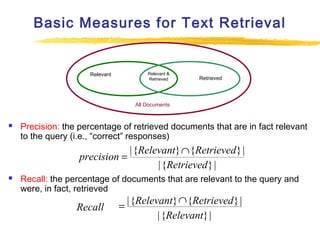
Basic Measures for Text Retrieval

Relevant

Relevant &
Retrieved

Retrieved

All Documents



Precision: the percentage of retrieved documents that are in fact relevant
to the query (i.e., “correct” responses)

| {Relevant} ∩ {Retrieved } |
precision =
| {Retrieved } |


Recall: the percentage of documents that are relevant to the query and
were, in fact, retrieved

Recall

∩
= | {Relevant} {Retrieved } |
| {Relevant} |
Information Retrieval Techniques




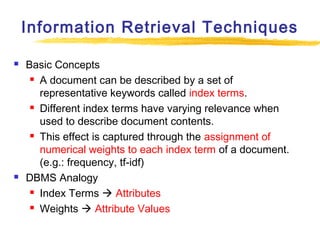
Basic Concepts
 A document can be described by a set of
representative keywords called index terms.
 Different index terms have varying relevance when
used to describe document contents.
 This effect is captured through the assignment of
numerical weights to each index term of a document.
(e.g.: frequency, tf-idf)
DBMS Analogy
 Index Terms  Attributes
 Weights  Attribute Values
Information Retrieval Techniques





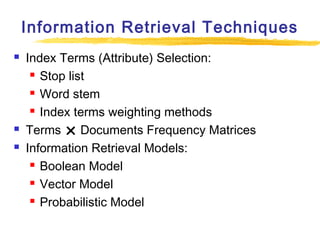
Index Terms (Attribute) Selection:
 Stop list
 Word stem
 Index terms weighting methods
Terms  Documents Frequency Matrices
Information Retrieval Models:
 Boolean Model
 Vector Model
 Probabilistic Model
Boolean Model






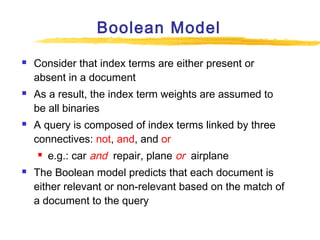
Consider that index terms are either present or
absent in a document
As a result, the index term weights are assumed to
be all binaries
A query is composed of index terms linked by three
connectives: not, and, and or




e.g.: car and repair, plane or airplane

The Boolean model predicts that each document is
either relevant or non-relevant based on the match of
a document to the query
Keyword-Based Retrieval






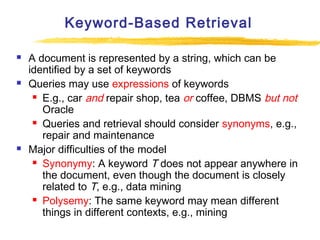
A document is represented by a string, which can be
identified by a set of keywords
Queries may use expressions of keywords
 E.g., car and repair shop, tea or coffee, DBMS but not
Oracle
 Queries and retrieval should consider synonyms, e.g.,
repair and maintenance
Major difficulties of the model
 Synonymy: A keyword T does not appear anywhere in
the document, even though the document is closely
related to T, e.g., data mining
 Polysemy: The same keyword may mean different
things in different contexts, e.g., mining
Similarity-Based Retrieval in Text
Data







Finds similar documents based on a set of common
keywords
Answer should be based on the degree of relevance
based on the nearness of the keywords, relative frequency
of the keywords, etc.
Basic techniques
Stop list
 Set of words that are deemed “irrelevant”, even
though they may appear frequently
 E.g., a, the, of, for, to, with , etc.
 Stop lists may vary when document set varies
Similarity-Based Retrieval in Text
Data






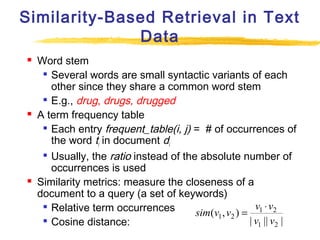
Word stem
 Several words are small syntactic variants of each
other since they share a common word stem
 E.g., drug, drugs, drugged
A term frequency table
 Each entry frequent_table(i, j) = # of occurrences of
the word ti in document di

Usually, the ratio instead of the absolute number of
occurrences is used
Similarity metrics: measure the closeness of a
document to a query (a set of keywords)

v1 ⋅ v2
Relative term occurrences
sim(v1 , v2 ) =

| v1 || v2 |
Cosine distance:
Indexing Techniques




Inverted index
 Maintains two hash- or B+-tree indexed tables:

document_table: a set of document records <doc_id,
postings_list>
 term_table: a set of term records, <term, postings_list>
 Answer query: Find all docs associated with one or a set of terms
 + easy to implement
 – do not handle well synonymy and polysemy, and posting lists could
be too long (storage could be very large)
Signature file
 Associate a signature with each document
 A signature is a representation of an ordered list of terms that
describe the document
 Order is obtained by frequency analysis, stemming and stop lists
Types of Text Data
Mining










Keyword-based association analysis
Automatic document classification
Similarity detection
 Cluster documents by a common author
 Cluster documents containing information from a
common source
Link analysis: unusual correlation between entities
Sequence analysis: predicting a recurring event
Anomaly detection: find information that violates usual
patterns
Hypertext analysis
 Patterns in anchors/links
 Anchor text correlations with linked objects
Keyword-Based Association
Analysis


Motivation




Collect sets of keywords or terms that occur frequently together and
then find the association or correlation relationships among them

Association Analysis Process




Preprocess the text data by parsing, stemming, removing stop
words, etc.
Evoke association mining algorithms





Consider each document as a transaction
View a set of keywords in the document as a set of items in the
transaction

Term level association mining



No need for human effort in tagging documents
The number of meaningless results and the execution time is greatly
reduced
Text Classification






Motivation
 Automatic classification for the large number of on-line text
documents (Web pages, e-mails, corporate intranets, etc.)
Classification Process
 Data preprocessing
 Definition of training set and test sets
 Creation of the classification model using the selected
classification algorithm
 Classification model validation
 Classification of new/unknown text documents
Text document classification differs from the classification of
relational data
 Document databases are not structured according to attributevalue pairs
Text Classification(2)


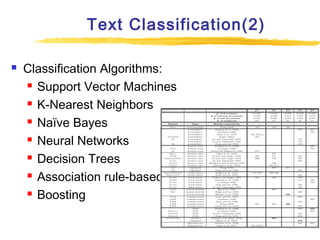
Classification Algorithms:
 Support Vector Machines
 K-Nearest Neighbors
 Naïve Bayes
 Neural Networks
 Decision Trees
 Association rule-based
 Boosting
Document Clustering




Motivation
 Automatically group related documents based on their
contents
 No predetermined training sets or taxonomies
 Generate a taxonomy at runtime
Clustering Process
 Data preprocessing: remove stop words, stem, feature
extraction, lexical analysis, etc.
 Hierarchical clustering: compute similarities applying
clustering algorithms.
 Model-Based clustering (Neural Network Approach):
clusters are represented by “exemplars”. (e.g.: SOM)
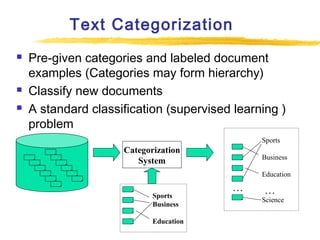
Text Categorization





Pre-given categories and labeled document
examples (Categories may form hierarchy)
Classify new documents
A standard classification (supervised learning )
problem
Sports

Categorization
System

Business
Education

Sports
Business
Education

…

…

Science
Applications






News article classification
Automatic email filtering
Webpage classification
Word sense disambiguation
……
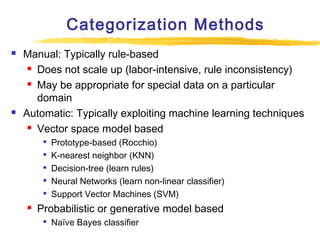
Categorization Methods




Manual: Typically rule-based
 Does not scale up (labor-intensive, rule inconsistency)
 May be appropriate for special data on a particular
domain
Automatic: Typically exploiting machine learning techniques
 Vector space model based








Prototype-based (Rocchio)
K-nearest neighbor (KNN)
Decision-tree (learn rules)
Neural Networks (learn non-linear classifier)
Support Vector Machines (SVM)

Probabilistic or generative model based


Naïve Bayes classifier
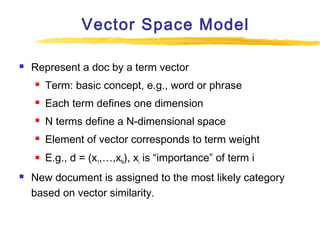
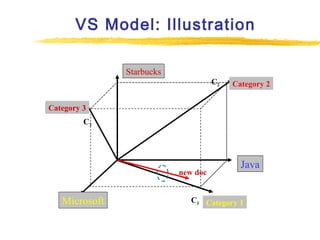
Vector Space Model


Represent a doc by a term vector



Each term defines one dimension



N terms define a N-dimensional space



Element of vector corresponds to term weight





Term: basic concept, e.g., word or phrase

E.g., d = (x1,…,xN), xi is “importance” of term i

New document is assigned to the most likely category
based on vector similarity.
VS Model: Illustration
Starbucks
C2

Category 2

Category 3
C3

new doc

Microsoft

Java

C1 Category 1
What VS Model Does Not
Specify






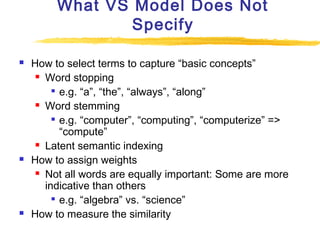
How to select terms to capture “basic concepts”
 Word stopping

e.g. “a”, “the”, “always”, “along”
 Word stemming
 e.g. “computer”, “computing”, “computerize” =>
“compute”
 Latent semantic indexing
How to assign weights
 Not all words are equally important: Some are more
indicative than others
 e.g. “algebra” vs. “science”
How to measure the similarity
How to Assign Weights


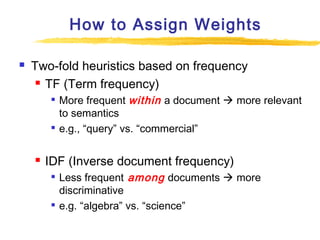
Two-fold heuristics based on frequency
 TF (Term frequency)






More frequent within a document  more relevant
to semantics
e.g., “query” vs. “commercial”

IDF (Inverse document frequency)




Less frequent among documents  more
discriminative
e.g. “algebra” vs. “science”
TF Weighting


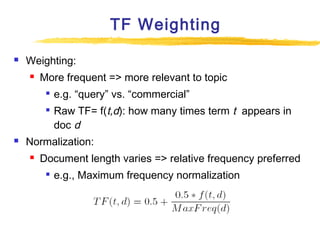
Weighting:


More frequent => more relevant to topic





e.g. “query” vs. “commercial”
Raw TF= f(t,d): how many times term t appears in
doc d

Normalization:


Document length varies => relative frequency preferred


e.g., Maximum frequency normalization
How to Measure Similarity?




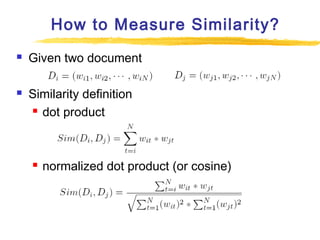
Given two document
Similarity definition
 dot product



normalized dot product (or cosine)
Illustrative Example
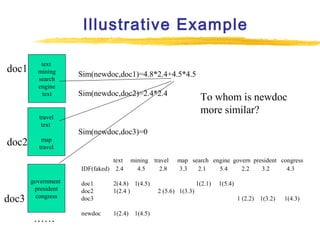
doc1

text
mining
search
engine
text

travel
text

doc2

Sim(newdoc,doc1)=4.8*2.4+4.5*4.5
Sim(newdoc,doc2)=2.4*2.4

Sim(newdoc,doc3)=0

map
travel
text
IDF(faked) 2.4

doc3

To whom is newdoc
more similar?

government
president
congress

……

mining travel
4.5
2.8

doc1
doc2
doc3

2(4.8) 1(4.5)
1(2.4 )

newdoc

1(2.4) 1(4.5)

map search engine govern president congress
3.3
2.1
5.4
2.2
3.2
4.3
1(2.1)

1(5.4)

2 (5.6) 1(3.3)
1 (2.2) 1(3.2)

1(4.3)

Web and text

  • 1.
    Data Mining: Concepts andTechniques Mining Text Data
  • 2.
    Mining Text andWeb Data  Text mining, natural language processing and information extraction: An Introduction  Text categorization methods
  • 3.
    Mining Text Data:An Introduction Data Mining / Knowledge Discovery Structured Data omeLoan ( oanee: Frank Rizzo ender: MWF gency: Lake View mount: $200,000 erm: 15 years Multimedia Free Text Hypertext Frank Rizzo bought his home from Lake View Real Estate in 1992. He paid $200,000 under a15-year loan Loans($200K,[map],...) from MW Financial. <a href>Frank Rizzo </a> Bought <a hef>this home</a> from <a href>Lake View Real Estate</a> In <b>1992</b>. <p>...
  • 4.
    Bag-of-Tokens Approaches Documents Four scoreand seven years ago our fathers brought forth on this continent, a new nation, conceived in Liberty, and dedicated to the proposition that all men are created equal. Now we are engaged in a great civil war, testing whether that nation, or … Token Sets Feature Extraction nation – 5 civil - 1 war – 2 men – 2 died – 4 people – 5 Liberty – 1 God – 1 … Loses all order-specific information! Severely limits context!
  • 5.
    Natural Language Processing Adog is chasing a boy on the playground Det Noun Aux Noun Phrase Verb Complex Verb Semantic analysis Dog(d1). Boy(b1). Playground(p1). Chasing(d1,b1,p1). + Det Noun Prep Det Noun Phrase Noun Noun Phrase Lexical analysis (part-of-speech tagging) Prep Phrase Verb Phrase Syntactic analysis (Parsing) Verb Phrase Sentence Scared(x) if Chasing(_,x,_). Scared(b1) Inference (Taken from ChengXiang Zhai, CS 397cxz – Fall 2003) A person saying this may be reminding another person to get the dog back… Pragmatic analysis (speech act)
  • 6.
    General NLP—Too Difficult!     Word-levelambiguity  “design” can be a noun or a verb (Ambiguous POS)  “root” has multiple meanings (Ambiguous sense) Syntactic ambiguity  “natural language processing” (Modification)  “A man saw a boy with a telescope .” (PP Attachment) Anaphora resolution  “John persuaded Bill to buy a TV for himself .” (himself = John or Bill?) Presupposition  “He has quit smoking.” implies that he smoked before. Humans rely on context to interpret (when possible). This context may extend beyond a given document! (Taken from ChengXiang Zhai, CS 397cxz – Fall 2003)
  • 7.
    Shallow Linguistics Progress onUseful Sub-Goals: • English Lexicon • Part-of-Speech Tagging • Word Sense Disambiguation • Phrase Detection / Parsing
  • 8.
    WordNet An extensive lexicalnetwork for the English language • Contains over 138,838 words. • Several graphs, one for each part-of-speech. • Synsets (synonym sets), each defining a semantic sense. • Relationship information (antonym, hyponym, meronym …) • Downloadable for free (UNIX, Windows) • Expanding to other languages (Global WordNet Association) • Funded >$3 million, mainly government (translation interest) • Founder George Miller, National Medal of Science, 1991. watery moist parched wet dry damp anhydrous arid synonym antonym
  • 9.
    Part-of-Speech Tagging This Det sentence N Training data(Annotated text) serves as an example of V1 “This is a new sentence.” P Det N POS Tagger P annotated V2 text… N This is a new Det Aux Det Adj sentence. N Pick the most1 likely ttag tsequence. p ( w ,..., wk , 1 ,..., k )  p (t1 | w1 )... p(tk | wk ) p( w1 )... p( wk )  p ( w1 ,..., wk , t1 ,..., t k ) =  k Independent assignment ∏ p ( wi | ti ) p (ti | ti −1 ) Most common tag  =1  p (t1 | w1 )... p(tk | wk ) p(iw1 )... p ( wk )  = k ∏ p ( wi | ti ) p (ti | ti −1 ) Partial dependency  i =1 (HMM)
  • 10.
    Word Sense Disambiguation ? “Thedifficulties of computational linguistics are rooted in ambiguity.” N Aux V P N Supervised Learning Features: • Neighboring POS tags (N Aux V P N) • Neighboring words (linguistics are rooted in ambiguity) • Stemmed form (root) • Dictionary/Thesaurus entries of neighboring words • High co-occurrence words (plant, tree, origin,…) • Other senses of word within discourse Algorithms: • Rule-based Learning (e.g. IG guided) • Statistical Learning (i.e. Naïve Bayes) • Unsupervised Learning (i.e. Nearest Neighbor)
  • 11.
    Parsing Choose most likelyparse tree… Grammar Lexicon V → chasing Aux→ is N → dog N → boy N→ playground Det→ the Det→ a P → on Probability of this tree=0.000015 NP Probabilistic CFG S→ NP VP NP → Det BNP NP → BNP NP→ NP PP BNP→ N VP → V VP → Aux V NP VP → VP PP PP → P NP S Det BNP A 1.0 0.3 0.4 0.3 N . . . V NP is chasing P NP on a boy Probability of this tree=0.000011 S NP 0.01 Det 0.003 A … PP the playground 1.0 … VP Aux dog … … VP VP BNP N dog Aux is NP V chasing NP a boy PP P NP on the playground
  • 12.
    Mining Text andWeb Data  Text mining, natural language processing and information extraction: An Introduction  Text information system and information retrieval  Text categorization methods  Mining Web linkage structures  Summary
  • 13.
    Text Databases andIR   Text databases (document databases)  Large collections of documents from various sources: news articles, research papers, books, digital libraries, e-mail messages, and Web pages, library database, etc.  Data stored is usually semi-structured  Traditional information retrieval techniques become inadequate for the increasingly vast amounts of text data Information retrieval  A field developed in parallel with database systems  Information is organized into (a large number of) documents  Information retrieval problem: locating relevant documents based on user input, such as keywords or example documents
  • 14.
    Information Retrieval  Typical IRsystems    Online library catalogs Online document management systems Information retrieval vs. database systems  Some DB problems are not present in IR, e.g., update, transaction management, complex objects  Some IR problems are not addressed well in DBMS, e.g., unstructured documents, approximate search using keywords and relevance
  • 15.
    Basic Measures forText Retrieval Relevant Relevant & Retrieved Retrieved All Documents  Precision: the percentage of retrieved documents that are in fact relevant to the query (i.e., “correct” responses) | {Relevant} ∩ {Retrieved } | precision = | {Retrieved } |  Recall: the percentage of documents that are relevant to the query and were, in fact, retrieved Recall ∩ = | {Relevant} {Retrieved } | | {Relevant} |
  • 16.
    Information Retrieval Techniques   BasicConcepts  A document can be described by a set of representative keywords called index terms.  Different index terms have varying relevance when used to describe document contents.  This effect is captured through the assignment of numerical weights to each index term of a document. (e.g.: frequency, tf-idf) DBMS Analogy  Index Terms  Attributes  Weights  Attribute Values
  • 17.
    Information Retrieval Techniques    IndexTerms (Attribute) Selection:  Stop list  Word stem  Index terms weighting methods Terms  Documents Frequency Matrices Information Retrieval Models:  Boolean Model  Vector Model  Probabilistic Model
  • 18.
    Boolean Model    Consider thatindex terms are either present or absent in a document As a result, the index term weights are assumed to be all binaries A query is composed of index terms linked by three connectives: not, and, and or   e.g.: car and repair, plane or airplane The Boolean model predicts that each document is either relevant or non-relevant based on the match of a document to the query
  • 19.
    Keyword-Based Retrieval    A documentis represented by a string, which can be identified by a set of keywords Queries may use expressions of keywords  E.g., car and repair shop, tea or coffee, DBMS but not Oracle  Queries and retrieval should consider synonyms, e.g., repair and maintenance Major difficulties of the model  Synonymy: A keyword T does not appear anywhere in the document, even though the document is closely related to T, e.g., data mining  Polysemy: The same keyword may mean different things in different contexts, e.g., mining
  • 20.
    Similarity-Based Retrieval inText Data     Finds similar documents based on a set of common keywords Answer should be based on the degree of relevance based on the nearness of the keywords, relative frequency of the keywords, etc. Basic techniques Stop list  Set of words that are deemed “irrelevant”, even though they may appear frequently  E.g., a, the, of, for, to, with , etc.  Stop lists may vary when document set varies
  • 21.
    Similarity-Based Retrieval inText Data    Word stem  Several words are small syntactic variants of each other since they share a common word stem  E.g., drug, drugs, drugged A term frequency table  Each entry frequent_table(i, j) = # of occurrences of the word ti in document di  Usually, the ratio instead of the absolute number of occurrences is used Similarity metrics: measure the closeness of a document to a query (a set of keywords)  v1 ⋅ v2 Relative term occurrences sim(v1 , v2 ) =  | v1 || v2 | Cosine distance:
  • 22.
    Indexing Techniques   Inverted index Maintains two hash- or B+-tree indexed tables:  document_table: a set of document records <doc_id, postings_list>  term_table: a set of term records, <term, postings_list>  Answer query: Find all docs associated with one or a set of terms  + easy to implement  – do not handle well synonymy and polysemy, and posting lists could be too long (storage could be very large) Signature file  Associate a signature with each document  A signature is a representation of an ordered list of terms that describe the document  Order is obtained by frequency analysis, stemming and stop lists
  • 23.
    Types of TextData Mining        Keyword-based association analysis Automatic document classification Similarity detection  Cluster documents by a common author  Cluster documents containing information from a common source Link analysis: unusual correlation between entities Sequence analysis: predicting a recurring event Anomaly detection: find information that violates usual patterns Hypertext analysis  Patterns in anchors/links  Anchor text correlations with linked objects
  • 24.
    Keyword-Based Association Analysis  Motivation   Collect setsof keywords or terms that occur frequently together and then find the association or correlation relationships among them Association Analysis Process   Preprocess the text data by parsing, stemming, removing stop words, etc. Evoke association mining algorithms    Consider each document as a transaction View a set of keywords in the document as a set of items in the transaction Term level association mining   No need for human effort in tagging documents The number of meaningless results and the execution time is greatly reduced
  • 25.
    Text Classification    Motivation  Automaticclassification for the large number of on-line text documents (Web pages, e-mails, corporate intranets, etc.) Classification Process  Data preprocessing  Definition of training set and test sets  Creation of the classification model using the selected classification algorithm  Classification model validation  Classification of new/unknown text documents Text document classification differs from the classification of relational data  Document databases are not structured according to attributevalue pairs
  • 26.
    Text Classification(2)  Classification Algorithms: Support Vector Machines  K-Nearest Neighbors  Naïve Bayes  Neural Networks  Decision Trees  Association rule-based  Boosting
  • 27.
    Document Clustering   Motivation  Automaticallygroup related documents based on their contents  No predetermined training sets or taxonomies  Generate a taxonomy at runtime Clustering Process  Data preprocessing: remove stop words, stem, feature extraction, lexical analysis, etc.  Hierarchical clustering: compute similarities applying clustering algorithms.  Model-Based clustering (Neural Network Approach): clusters are represented by “exemplars”. (e.g.: SOM)
  • 28.
    Text Categorization    Pre-given categoriesand labeled document examples (Categories may form hierarchy) Classify new documents A standard classification (supervised learning ) problem Sports Categorization System Business Education Sports Business Education … … Science
  • 29.
    Applications      News article classification Automaticemail filtering Webpage classification Word sense disambiguation ……
  • 30.
    Categorization Methods   Manual: Typicallyrule-based  Does not scale up (labor-intensive, rule inconsistency)  May be appropriate for special data on a particular domain Automatic: Typically exploiting machine learning techniques  Vector space model based       Prototype-based (Rocchio) K-nearest neighbor (KNN) Decision-tree (learn rules) Neural Networks (learn non-linear classifier) Support Vector Machines (SVM) Probabilistic or generative model based  Naïve Bayes classifier
  • 31.
    Vector Space Model  Representa doc by a term vector   Each term defines one dimension  N terms define a N-dimensional space  Element of vector corresponds to term weight   Term: basic concept, e.g., word or phrase E.g., d = (x1,…,xN), xi is “importance” of term i New document is assigned to the most likely category based on vector similarity.
  • 32.
    VS Model: Illustration Starbucks C2 Category2 Category 3 C3 new doc Microsoft Java C1 Category 1
  • 33.
    What VS ModelDoes Not Specify    How to select terms to capture “basic concepts”  Word stopping  e.g. “a”, “the”, “always”, “along”  Word stemming  e.g. “computer”, “computing”, “computerize” => “compute”  Latent semantic indexing How to assign weights  Not all words are equally important: Some are more indicative than others  e.g. “algebra” vs. “science” How to measure the similarity
  • 34.
    How to AssignWeights  Two-fold heuristics based on frequency  TF (Term frequency)    More frequent within a document  more relevant to semantics e.g., “query” vs. “commercial” IDF (Inverse document frequency)   Less frequent among documents  more discriminative e.g. “algebra” vs. “science”
  • 35.
    TF Weighting  Weighting:  More frequent=> more relevant to topic    e.g. “query” vs. “commercial” Raw TF= f(t,d): how many times term t appears in doc d Normalization:  Document length varies => relative frequency preferred  e.g., Maximum frequency normalization
  • 36.
    How to MeasureSimilarity?   Given two document Similarity definition  dot product  normalized dot product (or cosine)
  • 37.
    Illustrative Example doc1 text mining search engine text travel text doc2 Sim(newdoc,doc1)=4.8*2.4+4.5*4.5 Sim(newdoc,doc2)=2.4*2.4 Sim(newdoc,doc3)=0 map travel text IDF(faked) 2.4 doc3 Towhom is newdoc more similar? government president congress …… mining travel 4.5 2.8 doc1 doc2 doc3 2(4.8) 1(4.5) 1(2.4 ) newdoc 1(2.4) 1(4.5) map search engine govern president congress 3.3 2.1 5.4 2.2 3.2 4.3 1(2.1) 1(5.4) 2 (5.6) 1(3.3) 1 (2.2) 1(3.2) 1(4.3)

Editor's Notes

  • #4 &lt;number&gt; Throughout this course we have been discussing Data Mining over a variety of data types. Two former types we covered were Structured Data (relational) and multimedia data. Today and in the last class we have been discussing Data Mining over free text, and our next section will cover hypertext, such as web pages. Text mining is well motivated, due to the fact that much of the world’s data can be found in free text form (newspaper articles, emails, literature, etc.). There is a lot of information available to mine. While mining free text has the same goals as data mining in general (extracting useful knowledge/stats/trends), text mining must overcome a major difficulty – there is no explicit structure. Machines can reason will relational data well since schemas are explicitly available. Free text, however, encodes all semantic information within natural language. Our text mining algorithms, then, must make some sense out of this natural language representation. Humans are great at doing this, but this has proved to be a problem for machines.
  • #5 &lt;number&gt; The previous text mining presentations “made sense” out of free text by viewing text as a bag-of-tokens (words, n-grams). This is the same approach as IR. Under that model we can already summarize, classify, cluster, and compute co-occurrence stats over free text. These are quite useful for mining and managing large volumes of free text. However, there is a potential to do much more. The BOT approach loses a LOT of information contained in text, such as word order, sentence structure, and context. These are precisely the features that humans use to interpret text. Thus the natural question is can we do better?
  • #6 &lt;number&gt; NLP, or Computational Linguistics, is an entire field dedicated to the study of automatically understanding free text. This field has been active since the 50’s. General NLP attempts to understand document completely (at the level of a human reader). There are several steps involved in NLP. …Blah…
  • #7 &lt;number&gt; General NLP has proven to be too difficult. It is dubbed “AI-Complete”, meaning that such a program would basically have to have near-human intelligence (i.e. solve AI). The reason NLP in general is so difficult is that text is highly ambiguous. NL is meant for human consumption and often contains ambiguities under the assumption that humans will be able to develop context and interpret the intended meaning. For instance [rewind], in this example the sentence could mean that either the dog, or the boy, or both are on the playground. As a human we know that it is probably both, but that is due to our knowledge that a dog is probably chasing close behind the boy, playgrounds are large, they are probably playing, and a playground is a place to play. This background knowledge probably is not contained in a document containing this sentence. Despite such obstacles, computational linguists have made great progress on several subproblems. We will now talk about four of these subproblems.
  • #8 &lt;number&gt; Several subgoals to NLP have been addressed to derive more info than just bag-of-tokens view. English lexicon, POS Tagging, WSD, Parsing Even with imperfect performance, these solutions already open the door for more intelligent text processing.
  • #9 &lt;number&gt; WordNet is an extensive lexical network for the human language. Consists of a graph of synsets for each part of speech. Contains synonym and antonym relationships. (hyponym=isa/subset, maple is a tree -&gt; maple is a hyponym of tree) (meronym=hasa, tree has a leaf -&gt; leaf is a meronym of tree) As will see, this is useful throughout NLP/ShallowLinguistics. This encodes some of the lexicon that humans carry with them when interpreting text.
  • #10 &lt;number&gt; POS Tagging attempts to label each word with the appropriate part of speech. Past approaches were rule-based (manual, then learned). Current trend, however, is toward statistical approaches (HMM). This shift is common throughout NLP, due to the ability of statistical approaches to robustly handle noise and/or unexpected events. Conceptually statistical approaches are more fitting due to the fact that uncertainty is sometimes unavoidable (ambiguity). Current algorithms (Brill’s Tagger, CLAWS taggers) report accuracy in the 97% range.
  • #11 &lt;number&gt; WSD attempts to resolve ambiguity by labeling each word with a precise sense, as intended in the document. This is typically performed after POS tagging, since POS tags are quite useful for WSD. Current approaches address this as a supervised learning problem. Features include neighboring words w/ POS tags, stemmed form of word, high co-occurrence words (with stem). Quite a few supervised learning algorithms have been applied (rule-lists, bayesian, NN). Performance depends heavily upon the particular text, but from what I’ve read 90%+ accuracy is common.
  • #12 &lt;number&gt; Parsing attempts to infer the precise grammatical relationships between different words in a given sentence. For example, POS are grouped into phrases and phrases are combined into sentences. Approaches include parsing with probabilistic CFG’s, “link dictionaries”, and tree adjoining techniques (super-tagging). Current techniques can only parse at the sentence level, in some cases reporting accuracy in the 90% range. Again, the performance heavily depends upon the grammatical correctness and the degree of ambiguity of the text.