Do science and religion need
each other?
People ask questions
• Why does the sun rise and set?
• When will it rain?
• Why isn‟t it raining?
• How can we make it rain?
• Why is there a universe?
• Why do people suffer?
“Happy is he who gets to know
the reasons for things.” (Virgil)
Trying to make sense of the world
• Religion, science, philoso
phy developed to answer
such questions
• Originally they were not
divided
– The first astronomers were
priests
– Medicine men were also
prophets and physicians
• They strove for a
integrated explanation
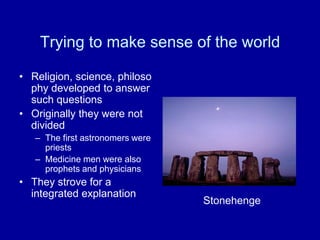
Stonehenge
Usual relationship - cooperation
and interaction
• Aquinas - Combined Christianity with Aristotle
• Benedictines, Domininicans, Franciscans, an
d Jesuits were scientific leaders
• Scientists were supported by the Church
• Many great scientists were also believers -
Galileo, Kelper, Newton and Maxwell
Quotes of great scientists
• “Mathematics is the language in which God
has written the universe.” (Galileo)
• "Science brings men nearer to God.” (Louis
Pasteur)
• "It is evident that an acquaintance with
natural laws means no less than
an
acquaintance with the mind of God therein
expressed.” (Joule)
What is science?
• Human endeavour to discover the structure of
the world and the laws that govern its working
• Science is a spiritual adventure
– “The joy of discovery is certainly the liveliest that
the mind of man can ever feel.” Claude Bernard
(1813-78) French physiologist.
• Science is a communal enterprise
– Peer review
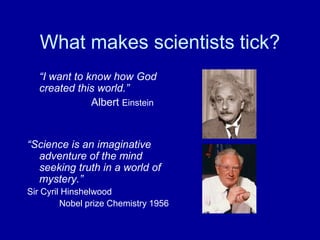
What makes scientists tick?
“I want to know how God
created this world.”
Albert Einstein
“Science is an imaginative
adventure of the mind
seeking truth in a world of
mystery.”
Sir Cyril Hinshelwood
Nobel prize Chemistry 1956
What is the scientific method?
• Search for patterns and laws to explain the
hidden order underlying the natural world
• Notice something unusual or puzzling
– Develop hypothesis
– Experiment
– Accumulate evidence
– Develop a theory
– Test and try to disprove the theory
– Use models to explain the phenomena
What is the status of scientific
knowledge?
• Tentative not certain
• Theories are approximations to the truth
• Scientific theories cannot be proven
• What we know is much less than what we
don‟t know
Limitations of science
Which of the following questions can be
answered by the natural sciences?
– How are atom bombs made?
– Should we make atom bombs?
– How does the human organism function?
– What is the meaning of human existence?
– How does a compact disc work?
– Is playing a CD of Coldplay enjoyable?
– Why are the laws of nature mathematical?
– Why do the laws of nature exist?
What is religion?
• Quest to understand life‟s mysteries and
discover the true way of life
– What is the purpose of life?
– What is right and wrong?
• Spiritual adventure into the heart of God
– Prayer, meditation
• A communal activity
– Church, ummah, sangha, councils
What are religious practices?
• Religious knowledge based on
experience and reason
– Revelations - Insights from profound
encounters with the Divine
– Reflections on life‟s experiences
• At the heart of reality is mystery
– Use metaphors and similies to describe it
Science and religion are
different
"The goal of science is understanding
lawful relations among natural
phenomena. Religion is a way of life
within a larger framework of meaning.”
Ian Barbour (Professor of Physics and Professor of
Religion)
Different areas of competence
• Science focuses on
explaining physical
dimension of reality:
How?
• Religion focuses on
explaining spiritual
dimension: Why?
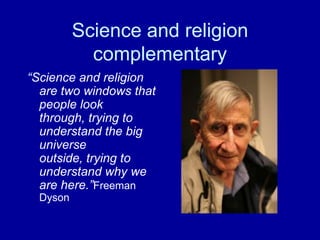
Science and religion
complementary
“Science and religion
are two windows that
people look
through, trying to
understand the big
universe
outside, trying to
understand why we
are here.”Freeman
Dyson
What‟s the problem then?
“Trouble arises when either science or
religion claims universal
jurisdiction, when either religious dogma
or scientific dogma claims to be
infallible. Religious creationists and
scientific materialists are equally
dogmatic and insensitive.”
Freeman Dyson
Conflicts between science and
religion
• Religious imperialism
– Galileo affair - Church rejected facts that
conflicted with theology and tried to
supress scientific theories
• Scientific imperialism
– Neo-Darwinism - Some people claim that
evolution disproves the existence of God
Need for cooperation
“Science can purify religion from error and
superstition, and religion can purify science
from idolatry and false absolutes.”
Pope John Paul II
"Science without religion is lame, religion
without science is blind."
Albert Einstein
Unification view
For humanity to completely overcome
the two aspects of ignorance . . . There
must emerge a new truth which can
reconcile religion and science and
resolve their problems in an integrated
understanding. EDP, 6-7
Science and values
“Science can only ascertain what is, but not
what should be, and outside of its domain
value judgments of all kinds remain
necessary.”Albert Einstein
• Religion and philosophy necessary to provide
ethical framework for science and its
application
– Genetic engineering
– Uses of technology
– Environment
God and the origin of the
universe
Has the universe always existed?
• If the universe has always existed we
do not need to explain its existence
• If it has not always existed we may ask
– When did the universe begin?
– How did the universe begin?
– Why does the universe exist?
Has the universe always existed?
• Judaism
– God created the universe ex nihilo
• Plato
– Prime matter always existed because „nothing can
come from nothing‟
• Aristotle
– God is eternal and unchanging so the world is
eternal and uncreated
• Ultimate hyle, ultimate eidos
The discovery of the beginning
Edwin Hubble discovered galaxies are
moving away from each other (1920s)
– The universe is expanding
– Like a balloon inflating, all the parts are
moving away from each other
– Therefore they must originally have started
from the same place
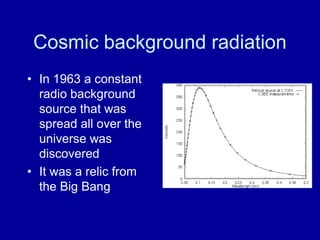
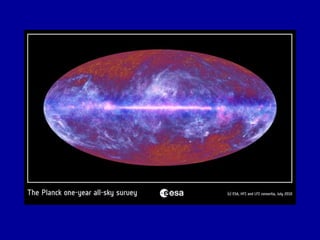
Cosmic background radiation
• In 1963 a constant
radio background
source that was
spread all over the
universe was
discovered
• It was a relic from
the Big Bang
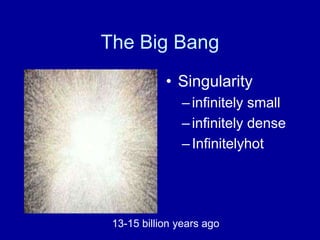
The Big Bang
13-15 billion years ago
• Singularity
–infinitely small
–infinitely dense
–Infinitelyhot
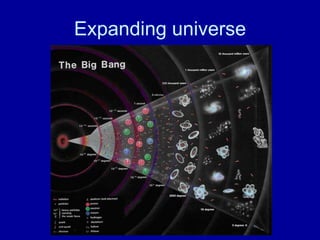
Expanding universe
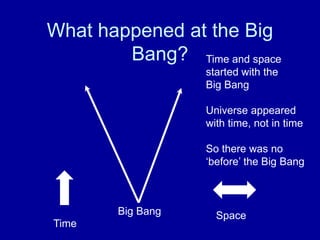
What happened at the Big
Bang?
Time
Space
Time and space
started with the
Big Bang
Universe appeared
with time, not in time
So there was no
„before‟ the Big Bang
Big Bang
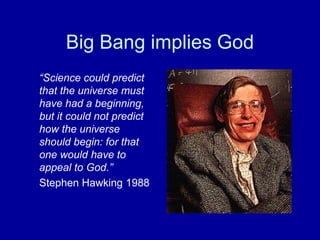
Big Bang implies God
“Science could predict
that the universe must
have had a beginning,
but it could not predict
how the universe
should begin: for that
one would have to
appeal to God.”
Stephen Hawking 1988
What would you expect from a Big Bang?
• Chaos
• Disorder
• Randomness
• Ugliness
What is the universe like?
• Cosmos
• Orderly
• Complexity
• Beauty
What were the initial conditions at the
Big Bang?
• It was smooth - If the Big Bang was too ragged the
result would have been turbulence and a cosmos of
black holes. Richard Penrose calculated the chance
of a smooth beginning at 1 in 1010 123
• Expansion problem: To avoid not recollapsing
within a fraction of a second or expanding so fast that
galaxies never condensed, R.H. Dicke calculated that
a 1 part in a million speed decrease when Big Bang
was 1 second old would have led to a recollapse
before the temperature fell below 10,000K. A similar
increase and the stars would never have formed.
• Weak nuclear force controls proton-proton fusion. If
it was a bit stronger all matter would have become
helium and heavier elements. There would be no
water etc. and the sun would explode instead of
burning. If it was a bit weaker there would be only
helium since the weak nuclear force makes neutrons
decay into protons.
• Strong nuclear force: A 2% increase and quarks
would not turn into protons and there would be no
hydrogen etc. A 5% weakening would unbind the
deuteron (Proton+Neutron) and there would be no
elements heavier than hydrogen.
• Electromagnetism: A change of just one part in 1040
would affect star formation. Slightly stronger and they
would be red stars and too cold. Slightly weaker and
they would be blue, very hot, radioactive and short
lived. A doubled strength would mean 1062 years
would be needed for life to evolve by which time all
protons would have decayed.
• Gravity: Gravity is 1039 times weaker than
electromagnetism. A slight change in this proportion
would be prevent the formation of stars. At its actual
strength it was possible for clouds to form stable
stars which do not fragment.
How can we explain this?
• Gravity created the universe
“Because there is a law such as gravity, the Universe
can and will create itself from nothing. Spontaneous
creation is the reason there is something rather than
nothing, why the Universe exists, why we exist.”
Stephen Hawking, The Grand Design, 2011
• But why is there gravity?
• Why is there a law of gravity?
• Is gravity God?
• Or is gravity an expression of the Universal
Prime Force of God?
How can we explain this?
• Laws of science created the universe
“The question is: is the way the universe began
chosen by God for reasons we can't understand, or
was it determined by a law of science? I believe the
second. If you like, you can call the laws of science
'God', but it wouldn't be a personal God that you
could meet, and ask questions.” Stephen
Hawking, Channel Four, 2011
• Can‟t we know why God created the universe?
• How does he know God is not personal?
• So he admits to “God” but not a personal God with
whom one can form a relationship and who loves us
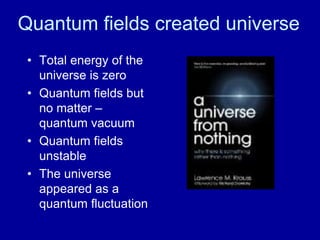
Quantum fields created universe
• Total energy of the
universe is zero
• Quantum fields but
no matter –
quantum vacuum
• Quantum fields
unstable
• The universe
appeared as a
quantum fluctuation
But . . .
• A quantum vacuum is not “nothing” as it
assumes the existence of quantum
fields which create matter
• True “nothing” is no fields
• Otherwise where did the fields come
from? Are they eternal? Are they God?
• Fields are an expression of the
Universal Prime Energy
How can we explain this?
• Multiple universes exist and ours just
happens to support life
• There is no evidence for the existence of
other universes. If there were they would be
in our universe
• Occam‟s razor - among competing
hypotheses, the one that makes the fewest
assumptions should be selected
• Even if there are multiple universes still
doesn‟t explain why they exist
How can we explain this?
• An intelligent Creator designed the
initial conditions to support the
development of complexity, life and
consciousness
Which is more believable?
“When I see all the glories of the cosmos, I can’t
help but believe that there is a divine hand
behind it all.”
Einstein
God or chance?
Unification thought
. . . the direction of the development of the
universe was determined through the function
of reason on the basis of the operation of
laws . . . [which] . . . already existed within
God's inner hyungsang, even prior to God's
creation of the universe . . . In other
words, law had been prepared, from the very
beginning, for the realization of the purpose.
God versus Darwin?
The Six Days of Creation
Fact, fiction or something else?
How can we understand
the Bible?
• Literalism
– The Bible is the inerrant word of God
– The Bible is literally true
• Contextually
– The meaning of the text depends on its
context
– Text should be examined rationally
– The Bible contains metaphors and symbols
Traditional perspective
“The Bible itself speaks to us of the
origin of the universe and its
makeup, not in order to provide us with
a scientific treatise, but in order to state
the correct relationships of man with
God and with the universe.”
Pope John Paul II
The first day
• The word “day” in Hebrew means “age”
• So one “age” or day could be millions or
billions of years
• Bible - “Let there be light”
• Science - Big Bang - an explosion of
light
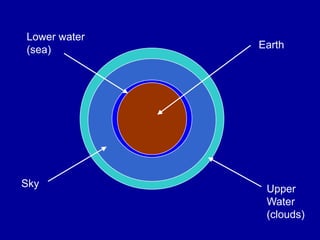
The second day
• Bible - Let the upper and lower waters
be separated
• Science - The earth was very hot and
so water evaporating forming dense
clouds filling the sky
Earth
Lower water
(sea)
Sky
Upper
Water
(clouds)
The third day
• Bible - Let land appear and the land be
separated from the sea and let plants
appear
• Science - The earth was shrinking as it
cooled and bubble of land appeared
• Plants were first living organisms
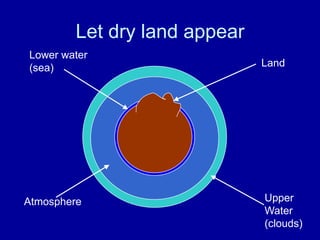
Land
Lower water
(sea)
Atmosphere Upper
Water
(clouds)
Let dry land appear
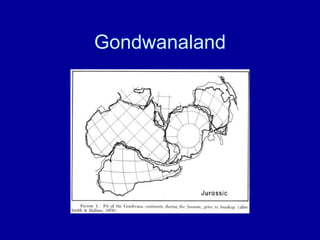
Gondwanaland
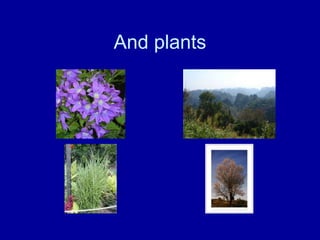
And plants
The fourth day
• Bible - Let the sun and the moon and
the stars appear
• Science - What seems to be wrong
here?
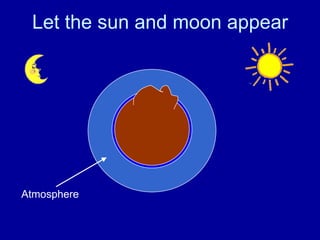
• As the earth cooled and plants
generated oxygen the atmosphere
changed. The sky became visible
Let the sun and moon appear
Atmosphere
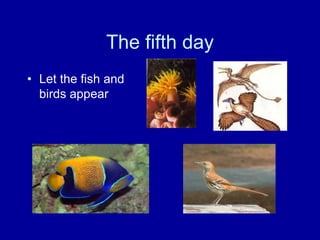
The fifth day
• Let the fish and
birds appear
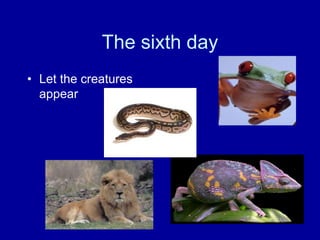
The sixth day
• Let the creatures
appear
And finally
What is remarkable is that the
order of creation in Genesis is
very similar to that proposed by
modern science
How did all these living
creatures appear?
• Each kind separately created by God
– Creationism
Or,
• They evolved from each other
– Darwinism
Darwin and God
• As a young man Darwin believed in traditional
Christianity and was studying to be a priest
• Later he lost his faith in Christian doctrines
• “I cannot persuade myself that a beneficent
and omnipotent God would have designedly
created parasitic wasps with the express
intention of their feeding within the living
bodies of caterpillars.”
Darwinism and Creationism
• Darwin argued in favour of evolution
and against separate creation
• Darwin denied separate creation but
was not an atheist
• It is possible to argue that evolution was
the process God worked through
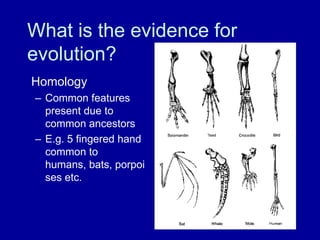
What is the evidence for
evolution?
Homology
– Common features
present due to
common ancestors
– E.g. 5 fingered hand
common to
humans, bats, porpoi
ses etc.
Vehicle design
How many wheels have motor vehicles got?
Cars - 4
Trucks - 6
Lorries - 14
Tanks - 2 tracks
Motorbike - 2
Tricycle - 3
Have number that is best for purpose
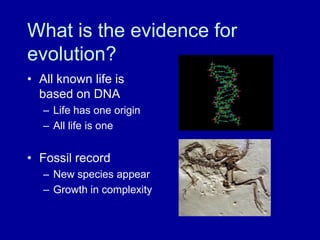
What is the evidence for
evolution?
• All known life is
based on DNA
– Life has one origin
– All life is one
• Fossil record
– New species appear
– Growth in complexity
Is complexity proof
of design?
“Nature contains every manifestation of
design . . . Design must have a designer
. . . That designer must have been a
person. That person is God.”
William Paley, Natural Theology
Can order and complexity
come about naturally?
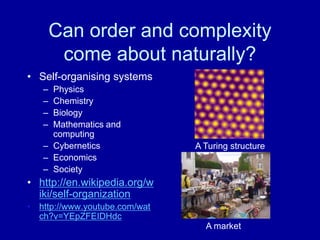
• Self-organising systems
– Physics
– Chemistry
– Biology
– Mathematics and
computing
– Cybernetics
– Economics
– Society
• http://en.wikipedia.org/w
iki/self-organization
• http://www.youtube.com/wat
ch?v=YEpZFEIDHdc
A Turing structure
A market
How about the human eye?
A classic example for both
creationists and Darwin
The human eye was designed
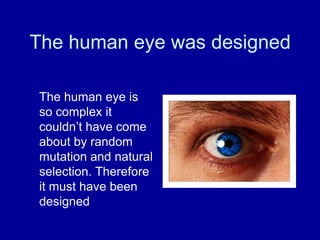
The human eye is
so complex it
couldn‟t have come
about by random
mutation and natural
selection. Therefore
it must have been
designed
The human eye evolved
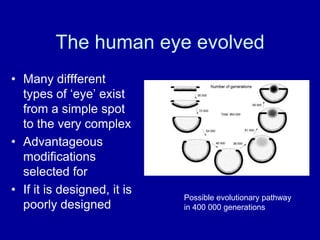
• Many diffferent
types of „eye‟ exist
from a simple spot
to the very complex
• Advantageous
modifications
selected for
• If it is designed, it is
poorly designed
Possible evolutionary pathway
in 400 000 generations
The mechanism of evolution
Natural selection
– Random variation
• Many differences between individuals
– The struggle for survival
• Only a minority of offspring survive and reproduce
• They are the ones best adapted to the
local ecology
– Survival of the fittest
• Advantageous adaptations passed on to the next
generation
Darwinism is a research program
with many unsolved problems
• What is the source of variations and
improvements?
– Random mutation or something else?
• How does speciation occur?
– Problem of macroevolution
• Lack of intermediaries in the fossil record
• How did DNA appear?
Is Darwinism compatible with
belief in God?
It depends what you think God is
like
How was Darwinism received?
In the 19th century, “with a few exceptions the
leading Christian thinkers in Great Britain and
America came to terms quite readily with
Darwinism and evolution.”
James Moore The Post-Darwinian Controversies Cambridge, 1979
“It is just as noble a conception of Deity to
believe that he created primal forms capable
of self-development . . . as to believe that He
required a fresh act of intervention to supply
the gaps which He himself had made.”
Reverend Charles Kingsley
God is only immanent
• God is the universe; the universe is God
• Einstein was a pantheist
• Spinoza was a pantheist
• Naturalist poets (Coleridge, Wordsworth)
• Evolution is the natural process through
which development occurs
• There is no soul or spiritual world
God is only transcendent
• God exists separate from the universe
• God creates the universe
• Matter is inert
• Soul and body different
• God is necessary to create living things
• Plato‟s demiurge imposing forms upon dull
hyle
• Everything that happens is God‟s will
God is immanent and
transcendent
• God created the world
• God acts in the world through natural
processes (Indirect dominion)
• Everything has an internal and external
dimension
• Matter has an inherent directive nature
• There is order in chaos
• Matter has a tendency to order and
complexity
God‟s Hyungsang
• God‟s Hyungsang or Prime Force is
basis of forces of nature
• God is immanent acting in and through
natural processes
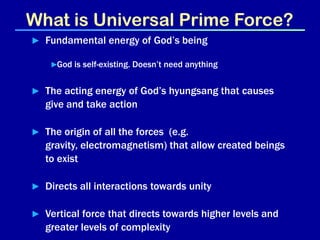
What is Universal Prime Force?
► Fundamental energy of God’s being
►God is self-existing. Doesn’t need anything
► The acting energy of God’s hyungsang that causes
give and take action
► The origin of all the forces (e.g.
gravity, electromagnetism) that allow created beings
to exist
► Directs all interactions towards unity
► Vertical force that directs towards higher levels and
greater levels of complexity
“For in Him we live and move
and have our being.”
Acts 17:28
God: origin of all existence and activity
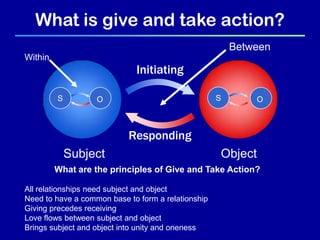
What is give and take action?
Initiating
Responding
What are the principles of Give and Take Action?
All relationships need subject and object
Need to have a common base to form a relationship
Giving precedes receiving
Love flows between subject and object
Brings subject and object into unity and oneness
Subject Object
S SO O
Within
Between
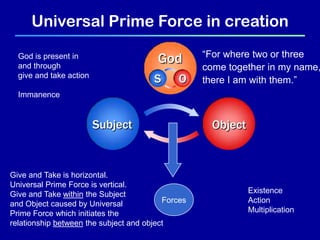
Universal Prime Force in creation
S
God
O
Subject Object
Forces
Existence
Action
Multiplication
Give and Take is horizontal.
Universal Prime Force is vertical.
Give and Take within the Subject
and Object caused by Universal
Prime Force which initiates the
relationship between the subject and object
“For where two or three
come together in my name,
there I am with them.”
God is present in
and through
give and take action
Immanence
Universal Prime Force
• the force that acts among correlative
elements in the created world; it is also the
force that is generated by the give and take
action between them
• The Universal Prime Force acting between
the subject and object is caused directly by
the Universal Prime Force acting within the
subject and object.
Unification Thought
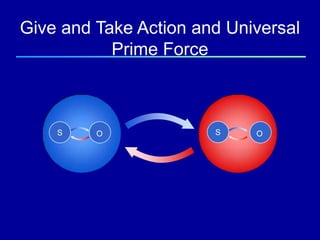
Give and Take Action and Universal
Prime Force
Initiating
Responding
Subject Object
S SO O
. . . the Creation is harmonious in its myriad
forms, regardless of the countless types of
Give and Take Action initiated by the
Universal Prime Force. In other
words, through Universal Prime Force, give
and take action is directed by a unifying
purpose, and through its organic
relationships, generates the forces necessary
for existence, reproduction, and action of all
things, from the smallest to the largest.
Unification Thought
The direction and goal of all give and take
actions are controlled by Universal Prime
Force. Give and take action exists not only so
that a subject and object can fulfil their
individual purposes, but also for the greater
purpose of unifying all things. The ultimate
purpose of give and take action is to have
subject and object unite and develop to a
greater and higher dimension.
Unification Thought
Reading list
• Ian Barbour
– Religion and Science
– Issues in Science and Religion
• Paul Davies
– The Mind of God: Science and the Search for
Ultimate Meaning
– The Goldilocks Enigma: Why is the Universe Just
Right for Life?
• John Polkinhorne
– Belief in God in an Age of Science

Science and religion 100622120615-phpapp01

  • 1.
    Do science andreligion need each other?
  • 2.
    People ask questions •Why does the sun rise and set? • When will it rain? • Why isn‟t it raining? • How can we make it rain? • Why is there a universe? • Why do people suffer? “Happy is he who gets to know the reasons for things.” (Virgil)
  • 3.
    Trying to makesense of the world • Religion, science, philoso phy developed to answer such questions • Originally they were not divided – The first astronomers were priests – Medicine men were also prophets and physicians • They strove for a integrated explanation Stonehenge
  • 4.
    Usual relationship -cooperation and interaction • Aquinas - Combined Christianity with Aristotle • Benedictines, Domininicans, Franciscans, an d Jesuits were scientific leaders • Scientists were supported by the Church • Many great scientists were also believers - Galileo, Kelper, Newton and Maxwell
  • 5.
    Quotes of greatscientists • “Mathematics is the language in which God has written the universe.” (Galileo) • "Science brings men nearer to God.” (Louis Pasteur) • "It is evident that an acquaintance with natural laws means no less than
an acquaintance with the mind of God therein expressed.” (Joule)
  • 6.
    What is science? •Human endeavour to discover the structure of the world and the laws that govern its working • Science is a spiritual adventure – “The joy of discovery is certainly the liveliest that the mind of man can ever feel.” Claude Bernard (1813-78) French physiologist. • Science is a communal enterprise – Peer review
  • 7.
    What makes scientiststick? “I want to know how God created this world.” Albert Einstein “Science is an imaginative adventure of the mind seeking truth in a world of mystery.” Sir Cyril Hinshelwood Nobel prize Chemistry 1956
  • 8.
    What is thescientific method? • Search for patterns and laws to explain the hidden order underlying the natural world • Notice something unusual or puzzling – Develop hypothesis – Experiment – Accumulate evidence – Develop a theory – Test and try to disprove the theory – Use models to explain the phenomena
  • 9.
    What is thestatus of scientific knowledge? • Tentative not certain • Theories are approximations to the truth • Scientific theories cannot be proven • What we know is much less than what we don‟t know
  • 10.
    Limitations of science Whichof the following questions can be answered by the natural sciences? – How are atom bombs made? – Should we make atom bombs? – How does the human organism function? – What is the meaning of human existence? – How does a compact disc work? – Is playing a CD of Coldplay enjoyable? – Why are the laws of nature mathematical? – Why do the laws of nature exist?
  • 11.
    What is religion? •Quest to understand life‟s mysteries and discover the true way of life – What is the purpose of life? – What is right and wrong? • Spiritual adventure into the heart of God – Prayer, meditation • A communal activity – Church, ummah, sangha, councils
  • 12.
    What are religiouspractices? • Religious knowledge based on experience and reason – Revelations - Insights from profound encounters with the Divine – Reflections on life‟s experiences • At the heart of reality is mystery – Use metaphors and similies to describe it
  • 13.
    Science and religionare different "The goal of science is understanding lawful relations among natural phenomena. Religion is a way of life within a larger framework of meaning.” Ian Barbour (Professor of Physics and Professor of Religion)
  • 14.
    Different areas ofcompetence • Science focuses on explaining physical dimension of reality: How? • Religion focuses on explaining spiritual dimension: Why?
  • 15.
    Science and religion complementary “Scienceand religion are two windows that people look through, trying to understand the big universe outside, trying to understand why we are here.”Freeman Dyson
  • 16.
    What‟s the problemthen? “Trouble arises when either science or religion claims universal jurisdiction, when either religious dogma or scientific dogma claims to be infallible. Religious creationists and scientific materialists are equally dogmatic and insensitive.” Freeman Dyson
  • 17.
    Conflicts between scienceand religion • Religious imperialism – Galileo affair - Church rejected facts that conflicted with theology and tried to supress scientific theories • Scientific imperialism – Neo-Darwinism - Some people claim that evolution disproves the existence of God
  • 18.
    Need for cooperation “Sciencecan purify religion from error and superstition, and religion can purify science from idolatry and false absolutes.” Pope John Paul II "Science without religion is lame, religion without science is blind." Albert Einstein
  • 19.
    Unification view For humanityto completely overcome the two aspects of ignorance . . . There must emerge a new truth which can reconcile religion and science and resolve their problems in an integrated understanding. EDP, 6-7
  • 20.
    Science and values “Sciencecan only ascertain what is, but not what should be, and outside of its domain value judgments of all kinds remain necessary.”Albert Einstein • Religion and philosophy necessary to provide ethical framework for science and its application – Genetic engineering – Uses of technology – Environment
  • 21.
    God and theorigin of the universe
  • 22.
    Has the universealways existed? • If the universe has always existed we do not need to explain its existence • If it has not always existed we may ask – When did the universe begin? – How did the universe begin? – Why does the universe exist?
  • 23.
    Has the universealways existed? • Judaism – God created the universe ex nihilo • Plato – Prime matter always existed because „nothing can come from nothing‟ • Aristotle – God is eternal and unchanging so the world is eternal and uncreated • Ultimate hyle, ultimate eidos
  • 24.
    The discovery ofthe beginning Edwin Hubble discovered galaxies are moving away from each other (1920s) – The universe is expanding – Like a balloon inflating, all the parts are moving away from each other – Therefore they must originally have started from the same place
  • 25.
    Cosmic background radiation •In 1963 a constant radio background source that was spread all over the universe was discovered • It was a relic from the Big Bang
  • 27.
    The Big Bang 13-15billion years ago • Singularity –infinitely small –infinitely dense –Infinitelyhot
  • 28.
  • 29.
    What happened atthe Big Bang? Time Space Time and space started with the Big Bang Universe appeared with time, not in time So there was no „before‟ the Big Bang Big Bang
  • 30.
    Big Bang impliesGod “Science could predict that the universe must have had a beginning, but it could not predict how the universe should begin: for that one would have to appeal to God.” Stephen Hawking 1988
  • 31.
    What would youexpect from a Big Bang? • Chaos • Disorder • Randomness • Ugliness What is the universe like? • Cosmos • Orderly • Complexity • Beauty
  • 32.
    What were theinitial conditions at the Big Bang? • It was smooth - If the Big Bang was too ragged the result would have been turbulence and a cosmos of black holes. Richard Penrose calculated the chance of a smooth beginning at 1 in 1010 123 • Expansion problem: To avoid not recollapsing within a fraction of a second or expanding so fast that galaxies never condensed, R.H. Dicke calculated that a 1 part in a million speed decrease when Big Bang was 1 second old would have led to a recollapse before the temperature fell below 10,000K. A similar increase and the stars would never have formed.
  • 33.
    • Weak nuclearforce controls proton-proton fusion. If it was a bit stronger all matter would have become helium and heavier elements. There would be no water etc. and the sun would explode instead of burning. If it was a bit weaker there would be only helium since the weak nuclear force makes neutrons decay into protons. • Strong nuclear force: A 2% increase and quarks would not turn into protons and there would be no hydrogen etc. A 5% weakening would unbind the deuteron (Proton+Neutron) and there would be no elements heavier than hydrogen.
  • 34.
    • Electromagnetism: Achange of just one part in 1040 would affect star formation. Slightly stronger and they would be red stars and too cold. Slightly weaker and they would be blue, very hot, radioactive and short lived. A doubled strength would mean 1062 years would be needed for life to evolve by which time all protons would have decayed. • Gravity: Gravity is 1039 times weaker than electromagnetism. A slight change in this proportion would be prevent the formation of stars. At its actual strength it was possible for clouds to form stable stars which do not fragment.
  • 35.
    How can weexplain this? • Gravity created the universe “Because there is a law such as gravity, the Universe can and will create itself from nothing. Spontaneous creation is the reason there is something rather than nothing, why the Universe exists, why we exist.” Stephen Hawking, The Grand Design, 2011 • But why is there gravity? • Why is there a law of gravity? • Is gravity God? • Or is gravity an expression of the Universal Prime Force of God?
  • 36.
    How can weexplain this? • Laws of science created the universe “The question is: is the way the universe began chosen by God for reasons we can't understand, or was it determined by a law of science? I believe the second. If you like, you can call the laws of science 'God', but it wouldn't be a personal God that you could meet, and ask questions.” Stephen Hawking, Channel Four, 2011 • Can‟t we know why God created the universe? • How does he know God is not personal? • So he admits to “God” but not a personal God with whom one can form a relationship and who loves us
  • 37.
    Quantum fields createduniverse • Total energy of the universe is zero • Quantum fields but no matter – quantum vacuum • Quantum fields unstable • The universe appeared as a quantum fluctuation
  • 38.
    But . .. • A quantum vacuum is not “nothing” as it assumes the existence of quantum fields which create matter • True “nothing” is no fields • Otherwise where did the fields come from? Are they eternal? Are they God? • Fields are an expression of the Universal Prime Energy
  • 39.
    How can weexplain this? • Multiple universes exist and ours just happens to support life • There is no evidence for the existence of other universes. If there were they would be in our universe • Occam‟s razor - among competing hypotheses, the one that makes the fewest assumptions should be selected • Even if there are multiple universes still doesn‟t explain why they exist
  • 40.
    How can weexplain this? • An intelligent Creator designed the initial conditions to support the development of complexity, life and consciousness
  • 41.
    Which is morebelievable? “When I see all the glories of the cosmos, I can’t help but believe that there is a divine hand behind it all.” Einstein God or chance?
  • 42.
    Unification thought . .. the direction of the development of the universe was determined through the function of reason on the basis of the operation of laws . . . [which] . . . already existed within God's inner hyungsang, even prior to God's creation of the universe . . . In other words, law had been prepared, from the very beginning, for the realization of the purpose.
  • 43.
  • 44.
    The Six Daysof Creation Fact, fiction or something else?
  • 45.
    How can weunderstand the Bible? • Literalism – The Bible is the inerrant word of God – The Bible is literally true • Contextually – The meaning of the text depends on its context – Text should be examined rationally – The Bible contains metaphors and symbols
  • 46.
    Traditional perspective “The Bibleitself speaks to us of the origin of the universe and its makeup, not in order to provide us with a scientific treatise, but in order to state the correct relationships of man with God and with the universe.” Pope John Paul II
  • 47.
    The first day •The word “day” in Hebrew means “age” • So one “age” or day could be millions or billions of years • Bible - “Let there be light” • Science - Big Bang - an explosion of light
  • 48.
    The second day •Bible - Let the upper and lower waters be separated • Science - The earth was very hot and so water evaporating forming dense clouds filling the sky
  • 49.
  • 50.
    The third day •Bible - Let land appear and the land be separated from the sea and let plants appear • Science - The earth was shrinking as it cooled and bubble of land appeared • Plants were first living organisms
  • 51.
  • 52.
  • 53.
  • 54.
    The fourth day •Bible - Let the sun and the moon and the stars appear • Science - What seems to be wrong here? • As the earth cooled and plants generated oxygen the atmosphere changed. The sky became visible
  • 55.
    Let the sunand moon appear Atmosphere
  • 56.
    The fifth day •Let the fish and birds appear
  • 57.
    The sixth day •Let the creatures appear
  • 58.
  • 59.
    What is remarkableis that the order of creation in Genesis is very similar to that proposed by modern science
  • 60.
    How did allthese living creatures appear? • Each kind separately created by God – Creationism Or, • They evolved from each other – Darwinism
  • 61.
    Darwin and God •As a young man Darwin believed in traditional Christianity and was studying to be a priest • Later he lost his faith in Christian doctrines • “I cannot persuade myself that a beneficent and omnipotent God would have designedly created parasitic wasps with the express intention of their feeding within the living bodies of caterpillars.”
  • 62.
    Darwinism and Creationism •Darwin argued in favour of evolution and against separate creation • Darwin denied separate creation but was not an atheist • It is possible to argue that evolution was the process God worked through
  • 63.
    What is theevidence for evolution? Homology – Common features present due to common ancestors – E.g. 5 fingered hand common to humans, bats, porpoi ses etc.
  • 64.
    Vehicle design How manywheels have motor vehicles got? Cars - 4 Trucks - 6 Lorries - 14 Tanks - 2 tracks Motorbike - 2 Tricycle - 3 Have number that is best for purpose
  • 65.
    What is theevidence for evolution? • All known life is based on DNA – Life has one origin – All life is one • Fossil record – New species appear – Growth in complexity
  • 66.
    Is complexity proof ofdesign? “Nature contains every manifestation of design . . . Design must have a designer . . . That designer must have been a person. That person is God.” William Paley, Natural Theology
  • 67.
    Can order andcomplexity come about naturally? • Self-organising systems – Physics – Chemistry – Biology – Mathematics and computing – Cybernetics – Economics – Society • http://en.wikipedia.org/w iki/self-organization • http://www.youtube.com/wat ch?v=YEpZFEIDHdc A Turing structure A market
  • 68.
    How about thehuman eye? A classic example for both creationists and Darwin
  • 69.
    The human eyewas designed The human eye is so complex it couldn‟t have come about by random mutation and natural selection. Therefore it must have been designed
  • 70.
    The human eyeevolved • Many diffferent types of „eye‟ exist from a simple spot to the very complex • Advantageous modifications selected for • If it is designed, it is poorly designed Possible evolutionary pathway in 400 000 generations
  • 71.
    The mechanism ofevolution Natural selection – Random variation • Many differences between individuals – The struggle for survival • Only a minority of offspring survive and reproduce • They are the ones best adapted to the local ecology – Survival of the fittest • Advantageous adaptations passed on to the next generation
  • 72.
    Darwinism is aresearch program with many unsolved problems • What is the source of variations and improvements? – Random mutation or something else? • How does speciation occur? – Problem of macroevolution • Lack of intermediaries in the fossil record • How did DNA appear?
  • 73.
    Is Darwinism compatiblewith belief in God? It depends what you think God is like
  • 74.
    How was Darwinismreceived? In the 19th century, “with a few exceptions the leading Christian thinkers in Great Britain and America came to terms quite readily with Darwinism and evolution.” James Moore The Post-Darwinian Controversies Cambridge, 1979 “It is just as noble a conception of Deity to believe that he created primal forms capable of self-development . . . as to believe that He required a fresh act of intervention to supply the gaps which He himself had made.” Reverend Charles Kingsley
  • 75.
    God is onlyimmanent • God is the universe; the universe is God • Einstein was a pantheist • Spinoza was a pantheist • Naturalist poets (Coleridge, Wordsworth) • Evolution is the natural process through which development occurs • There is no soul or spiritual world
  • 76.
    God is onlytranscendent • God exists separate from the universe • God creates the universe • Matter is inert • Soul and body different • God is necessary to create living things • Plato‟s demiurge imposing forms upon dull hyle • Everything that happens is God‟s will
  • 77.
    God is immanentand transcendent • God created the world • God acts in the world through natural processes (Indirect dominion) • Everything has an internal and external dimension • Matter has an inherent directive nature • There is order in chaos • Matter has a tendency to order and complexity
  • 78.
    God‟s Hyungsang • God‟sHyungsang or Prime Force is basis of forces of nature • God is immanent acting in and through natural processes
  • 79.
    What is UniversalPrime Force? ► Fundamental energy of God’s being ►God is self-existing. Doesn’t need anything ► The acting energy of God’s hyungsang that causes give and take action ► The origin of all the forces (e.g. gravity, electromagnetism) that allow created beings to exist ► Directs all interactions towards unity ► Vertical force that directs towards higher levels and greater levels of complexity
  • 80.
    “For in Himwe live and move and have our being.” Acts 17:28 God: origin of all existence and activity
  • 81.
    What is giveand take action? Initiating Responding What are the principles of Give and Take Action? All relationships need subject and object Need to have a common base to form a relationship Giving precedes receiving Love flows between subject and object Brings subject and object into unity and oneness Subject Object S SO O Within Between
  • 82.
    Universal Prime Forcein creation S God O Subject Object Forces Existence Action Multiplication Give and Take is horizontal. Universal Prime Force is vertical. Give and Take within the Subject and Object caused by Universal Prime Force which initiates the relationship between the subject and object “For where two or three come together in my name, there I am with them.” God is present in and through give and take action Immanence
  • 83.
    Universal Prime Force •the force that acts among correlative elements in the created world; it is also the force that is generated by the give and take action between them • The Universal Prime Force acting between the subject and object is caused directly by the Universal Prime Force acting within the subject and object. Unification Thought
  • 84.
    Give and TakeAction and Universal Prime Force Initiating Responding Subject Object S SO O
  • 85.
    . . .the Creation is harmonious in its myriad forms, regardless of the countless types of Give and Take Action initiated by the Universal Prime Force. In other words, through Universal Prime Force, give and take action is directed by a unifying purpose, and through its organic relationships, generates the forces necessary for existence, reproduction, and action of all things, from the smallest to the largest. Unification Thought
  • 86.
    The direction andgoal of all give and take actions are controlled by Universal Prime Force. Give and take action exists not only so that a subject and object can fulfil their individual purposes, but also for the greater purpose of unifying all things. The ultimate purpose of give and take action is to have subject and object unite and develop to a greater and higher dimension. Unification Thought
  • 87.
    Reading list • IanBarbour – Religion and Science – Issues in Science and Religion • Paul Davies – The Mind of God: Science and the Search for Ultimate Meaning – The Goldilocks Enigma: Why is the Universe Just Right for Life? • John Polkinhorne – Belief in God in an Age of Science