Entropy, Order Parameters,
and Complexity
Incorporating the last 50 years into the
statistical mechanics curriculum
James P. Sethna, Cornell University, 2007
http://www.physics.cornell.edu/sethna/StatMech/
The purview of science grows rapidly with time. It is the
responsibility of each generation to join new insights to old
wisdom, and to distill the key ideas for the next generation.
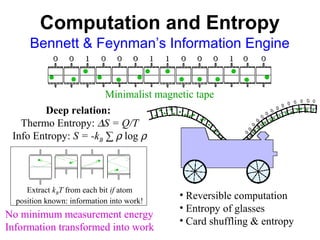
Computation and Entropy
Bennett & Feynman’s Information Engine
Deep relation:
Thermo Entropy: ∆S = Q/T
Info Entropy: S = -kB ∑ ρ log ρ
No minimum measurement energy
Information transformed into work
Minimalist magnetic tape
• Reversible computation
• Entropy of glasses
• Card shuffling & entropy
Extract kBT from each bit if atom
position known: information into work!
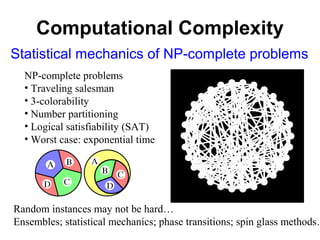
Computational Complexity
Statistical mechanics of NP-complete problems
NP-complete problems
• Traveling salesman
• 3-colorability
• Number partitioning
• Logical satisfiability (SAT)
• Worst case: exponential time
Random instances may not be hard…
Ensembles; statistical mechanics; phase transitions; spin glass methods…
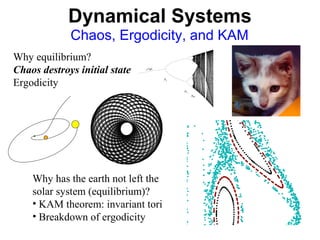
Dynamical Systems
Chaos, Ergodicity, and KAM
Why equilibrium?
Chaos destroys initial state
Ergodicity
Why has the earth not left the
solar system (equilibrium)?
• KAM theorem: invariant tori
• Breakdown of ergodicity
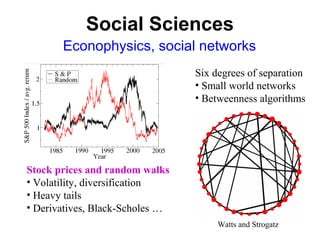
Social Sciences
Econophysics, social networks
Stock prices and random walks
• Volatility, diversification
• Heavy tails
• Derivatives, Black-Scholes …
Six degrees of separation
• Small world networks
• Betweenness algorithms
Watts and Strogatz
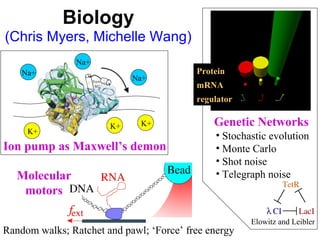
Biology
(Chris Myers, Michelle Wang)
Random walks; Ratchet and pawl; ‘Force’ free energy
Molecular
motors
Ion pump as Maxwell’s demon
Na+
Na+
Na+
K+
K+
K+ Genetic Networks
• Stochastic evolution
• Monte Carlo
• Shot noise
• Telegraph noise
Protein
mRNA
regulator
Elowitz and Leibler
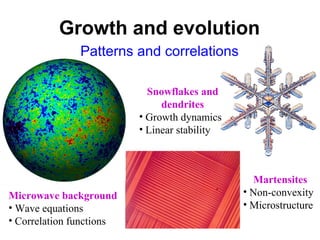
Growth and evolution
Patterns and correlations
Microwave background
• Wave equations
• Correlation functions
Snowflakes and
dendrites
• Growth dynamics
• Linear stability
Martensites
• Non-convexity
• Microstructure
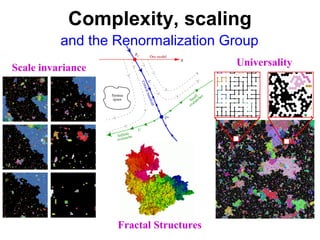
Complexity, scaling
and the Renormalization Group
Scale invariance
Fractal Structures
Universality
Entropy, Order Parameters,
and Complexity
Incorporating the last 50 years into the
statistical mechanics curriculum
Statistical mechanics is important to students and
researchers in mathematics, biology, engineering,
computer science and the social sciences. It will be taught
in all of these fields of science in the next generation,
either in physics departments or piecemeal in each field.
By teaching statistical mechanics to a variety of fields, we
enrich the subject for those with backgrounds in physics.
Entropy, Order Parameters,
and Complexity
Incorporating the last 50 years into the
statistical mechanics curriculum
Statistical mechanics is important to students and
researchers in mathematics, biology, engineering,
computer science and the social sciences. It will be taught
in all of these fields of science in the next generation,
either in physics departments or piecemeal in each field.
By teaching statistical mechanics to a variety of fields, we
enrich the subject for those with backgrounds in physics.

Econopysics

  • 1.
    Entropy, Order Parameters, andComplexity Incorporating the last 50 years into the statistical mechanics curriculum James P. Sethna, Cornell University, 2007 http://www.physics.cornell.edu/sethna/StatMech/ The purview of science grows rapidly with time. It is the responsibility of each generation to join new insights to old wisdom, and to distill the key ideas for the next generation.
  • 2.
    Computation and Entropy Bennett& Feynman’s Information Engine Deep relation: Thermo Entropy: ∆S = Q/T Info Entropy: S = -kB ∑ ρ log ρ No minimum measurement energy Information transformed into work Minimalist magnetic tape • Reversible computation • Entropy of glasses • Card shuffling & entropy Extract kBT from each bit if atom position known: information into work!
  • 3.
    Computational Complexity Statistical mechanicsof NP-complete problems NP-complete problems • Traveling salesman • 3-colorability • Number partitioning • Logical satisfiability (SAT) • Worst case: exponential time Random instances may not be hard… Ensembles; statistical mechanics; phase transitions; spin glass methods…
  • 4.
    Dynamical Systems Chaos, Ergodicity,and KAM Why equilibrium? Chaos destroys initial state Ergodicity Why has the earth not left the solar system (equilibrium)? • KAM theorem: invariant tori • Breakdown of ergodicity
  • 5.
    Social Sciences Econophysics, socialnetworks Stock prices and random walks • Volatility, diversification • Heavy tails • Derivatives, Black-Scholes … Six degrees of separation • Small world networks • Betweenness algorithms Watts and Strogatz
  • 6.
    Biology (Chris Myers, MichelleWang) Random walks; Ratchet and pawl; ‘Force’ free energy Molecular motors Ion pump as Maxwell’s demon Na+ Na+ Na+ K+ K+ K+ Genetic Networks • Stochastic evolution • Monte Carlo • Shot noise • Telegraph noise Protein mRNA regulator Elowitz and Leibler
  • 7.
    Growth and evolution Patternsand correlations Microwave background • Wave equations • Correlation functions Snowflakes and dendrites • Growth dynamics • Linear stability Martensites • Non-convexity • Microstructure
  • 8.
    Complexity, scaling and theRenormalization Group Scale invariance Fractal Structures Universality
  • 9.
    Entropy, Order Parameters, andComplexity Incorporating the last 50 years into the statistical mechanics curriculum Statistical mechanics is important to students and researchers in mathematics, biology, engineering, computer science and the social sciences. It will be taught in all of these fields of science in the next generation, either in physics departments or piecemeal in each field. By teaching statistical mechanics to a variety of fields, we enrich the subject for those with backgrounds in physics.
  • 10.
    Entropy, Order Parameters, andComplexity Incorporating the last 50 years into the statistical mechanics curriculum Statistical mechanics is important to students and researchers in mathematics, biology, engineering, computer science and the social sciences. It will be taught in all of these fields of science in the next generation, either in physics departments or piecemeal in each field. By teaching statistical mechanics to a variety of fields, we enrich the subject for those with backgrounds in physics.