WEB 2.0
 Web 2.0 describes World Wide Web sites that
use technology beyond the static pages of
earlier Web sites. The term was coined in 1999
by Darcy DiNucci and was popularized by Tim O’
Rilley at the O’Reilly Media Web 2.0 conference
in late 2004
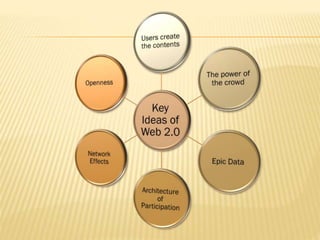
USER CONTENT
 Movement towards allowing users to create
their own contents for publications.
 They intend in media and music.
 Who has the authority ‘to say’ and ‘to know’?
 Contain a lot of advantages and disadvantages
POWER OF THE CROWD
 More heads than the crowd shows that they
can decide the best for them
 This idea is supported or refined by concepts
such as crowd-sourcing, SETI and folksonomy.
ARCHITECTURE OF PARTICIPATION
 Web 2.0 encourages community, collaboration
and sharing.
 Example is slideshare, twitter and facebook.
 People will share and at the same time they will
learn something new from that.
NETWORK EFFECTS
 Network effects – the more people use a Web
2.0 tool, the more its value.
 People will going to use it everyday as a daily
routine
 This will boost up the economy of the web
 People can search everything will unlimited
access
OPENNESS
 Related to epic data and participation.
 People will share anything they want through
the web.
The Technology
•The browser is the main access for the Web
2.0
•A quiet revolution towards open source and
independent methodologies and tools.
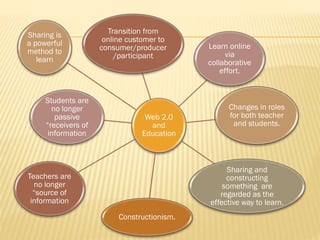
Web 2.0
and
Education
Transition from
online customer to
consumer/producer
/participant
Learn online
via
collaborative
effort.
Changes in roles
for both teacher
and students.
Sharing and
constructing
something are
regarded as the
effective way to learn.
Constructionism.
Teachers are
no longer
“source of
information
Students are
no longer
passive
“receivers of
information
Sharing is
a powerful
method to
learn

Web 2.0

  • 1.
  • 2.
     Web 2.0describes World Wide Web sites that use technology beyond the static pages of earlier Web sites. The term was coined in 1999 by Darcy DiNucci and was popularized by Tim O’ Rilley at the O’Reilly Media Web 2.0 conference in late 2004
  • 4.
    USER CONTENT  Movementtowards allowing users to create their own contents for publications.  They intend in media and music.  Who has the authority ‘to say’ and ‘to know’?  Contain a lot of advantages and disadvantages
  • 5.
    POWER OF THECROWD  More heads than the crowd shows that they can decide the best for them  This idea is supported or refined by concepts such as crowd-sourcing, SETI and folksonomy.
  • 6.
    ARCHITECTURE OF PARTICIPATION Web 2.0 encourages community, collaboration and sharing.  Example is slideshare, twitter and facebook.  People will share and at the same time they will learn something new from that.
  • 7.
    NETWORK EFFECTS  Networkeffects – the more people use a Web 2.0 tool, the more its value.  People will going to use it everyday as a daily routine  This will boost up the economy of the web  People can search everything will unlimited access
  • 8.
    OPENNESS  Related toepic data and participation.  People will share anything they want through the web. The Technology •The browser is the main access for the Web 2.0 •A quiet revolution towards open source and independent methodologies and tools.
  • 9.
    Web 2.0 and Education Transition from onlinecustomer to consumer/producer /participant Learn online via collaborative effort. Changes in roles for both teacher and students. Sharing and constructing something are regarded as the effective way to learn. Constructionism. Teachers are no longer “source of information Students are no longer passive “receivers of information Sharing is a powerful method to learn