Fossils
How to tell time with rocks
Looking at Fossils
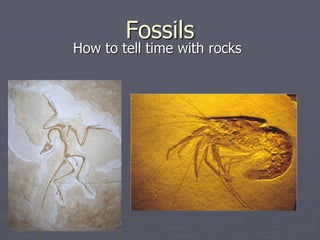
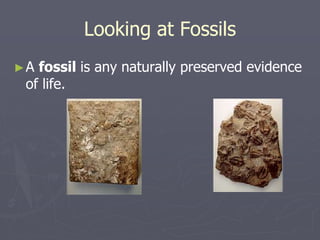
►A fossil is any naturally preserved evidence
of life.
Mineralization / Petrification
Fossil
►Organisms can also
be preserved by
mineralization
(petrified), a
process in which
minerals fill in pore
spaces of an
organism’s tissues.
Fossils in Amber
►When tree sap hardens, an insect may be
preserved inside. Hardened tree sap is
called amber. Some of our best insect fossils
are found in amber.
Mummification
►When organisms die in dry places (such as
deserts), they can sometimes dry out so
fast that there isn’t enough time for their
soft parts to decay.
Frozen Fossils
►Frozen
specimens
►Found in
ancient
glaciers.
Trace Fossils
►Any naturally preserved evidence of an
animal’s activity is called a trace fossil.
Molds and Casts
►A mold is a cavity in the ground or rock
where a plant or animal was buried.
►A cast is an object created when sediment
fills a mold and becomes rock.
Fossils Show
Changes in Environments
►Fossils can reveal changes that have
occurred in parts of the Earth.
►How did sea creatures
end up on dry land?
Fossils Show
Changes in Life
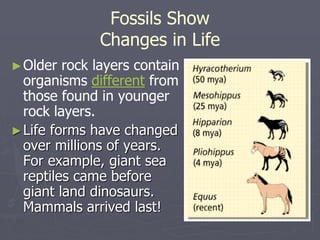
►Older rock layers contain
organisms different from
those found in younger
rock layers.
►Life forms have changed
over millions of years.
For example, giant sea
reptiles came before
giant land dinosaurs.
Mammals arrived last!
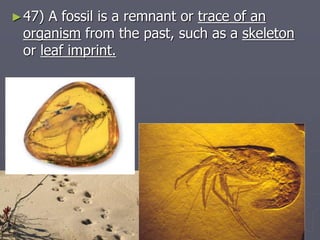
►47) A fossil is a remnant or trace of an
organism from the past, such as a skeleton
or leaf imprint.
►48) Fossils are embedded and preserved in
the earth's crust.
►49) A Trace Fossil is a fossil of a footprint,
trail, burrow, or other trace of an animal
rather than of the animal itself
► 50) A footprint of an ancient animal in a
rock is called a trace fossil.
►51) Large animals occasionally became
trapped in tar and become a fossil.
►52) Fossils, the
remains of
organisms
preserved in
sedimentary
rocks, are part of
the evidence
scientists use to
infer changing
conditions at the
Earth’s surface
through time.
►53) Oil and Natural Gas are formed from
ocean plankton that died millions of years
ago.
►54) Coal, Natural Gas, and Oil are all
examples of fossil fuels.
►55) Petrified wood is a fossil.
►
►56) Petrified wood forms when water with
natural minerals slowly fills the pores of
wood. Over thousands of years the wood
slowly decomposes leaving behind the
minerals from the water. The minerals
harden and form a rock that looks exactly
like the original wood.
► 57) How much wood is actually located in
petrified wood? 0%.
►58) The
geologic
column is how
geologists
have
organized the
entire history
of the Earth in
chronological
order.
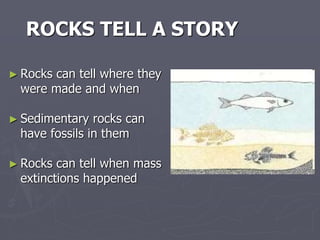
ROCKS TELL A STORY
► Rocks can tell where they
were made and when
► Sedimentary rocks can
have fossils in them
► Rocks can tell when mass
extinctions happened
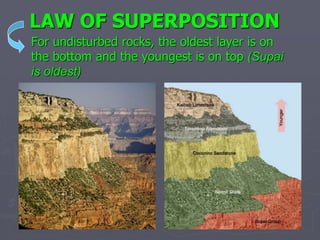
LAW OF SUPERPOSITION
For undisturbed rocks, the oldest layer is on
the bottom and the youngest is on top (Supai
is oldest)
►59) Superposition states that older layers of
rock are below younger layers of rock.
LAW OF SUCCESSION
► Fossils are found in a predictable sequence
► Fossils in rock B are older then fossils in rock A
RELATIVE DATING & AGE
► Relative Dating:
putting rocks and
geological events in
correct chronological
order
► Relative Age: how old
something is in
comparison to
something else
► HOW?
 Use of sedimentary rocks
 Use of fossils
 Study of strata
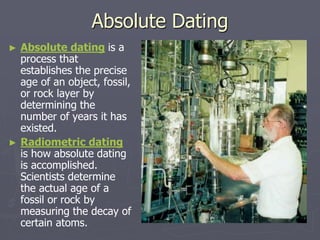
Absolute Dating
► Absolute dating is a
process that
establishes the precise
age of an object, fossil,
or rock layer by
determining the
number of years it has
existed.
► Radiometric dating
is how absolute dating
is accomplished.
Scientists determine
the actual age of a
fossil or rock by
measuring the decay of
certain atoms.
►60) Radiometric dating is how geologists
determine the age of rocks by measuring
the decay of atoms.
►61) Radiometric dating is the most accurate
way to date rocks and fossils.
What kind of rocks
are these fossils in?
Which layer is oldest?
Which layer is
youngest?
How do you know?

PPT Fossils.ppt

  • 1.
    Fossils How to telltime with rocks
  • 3.
    Looking at Fossils ►Afossil is any naturally preserved evidence of life.
  • 4.
    Mineralization / Petrification Fossil ►Organismscan also be preserved by mineralization (petrified), a process in which minerals fill in pore spaces of an organism’s tissues.
  • 5.
    Fossils in Amber ►Whentree sap hardens, an insect may be preserved inside. Hardened tree sap is called amber. Some of our best insect fossils are found in amber.
  • 6.
    Mummification ►When organisms diein dry places (such as deserts), they can sometimes dry out so fast that there isn’t enough time for their soft parts to decay.
  • 7.
  • 8.
    Trace Fossils ►Any naturallypreserved evidence of an animal’s activity is called a trace fossil.
  • 9.
    Molds and Casts ►Amold is a cavity in the ground or rock where a plant or animal was buried. ►A cast is an object created when sediment fills a mold and becomes rock.
  • 10.
    Fossils Show Changes inEnvironments ►Fossils can reveal changes that have occurred in parts of the Earth. ►How did sea creatures end up on dry land?
  • 11.
    Fossils Show Changes inLife ►Older rock layers contain organisms different from those found in younger rock layers. ►Life forms have changed over millions of years. For example, giant sea reptiles came before giant land dinosaurs. Mammals arrived last!
  • 12.
    ►47) A fossilis a remnant or trace of an organism from the past, such as a skeleton or leaf imprint.
  • 13.
    ►48) Fossils areembedded and preserved in the earth's crust.
  • 14.
    ►49) A TraceFossil is a fossil of a footprint, trail, burrow, or other trace of an animal rather than of the animal itself
  • 15.
    ► 50) Afootprint of an ancient animal in a rock is called a trace fossil.
  • 16.
    ►51) Large animalsoccasionally became trapped in tar and become a fossil.
  • 17.
    ►52) Fossils, the remainsof organisms preserved in sedimentary rocks, are part of the evidence scientists use to infer changing conditions at the Earth’s surface through time.
  • 18.
    ►53) Oil andNatural Gas are formed from ocean plankton that died millions of years ago.
  • 19.
    ►54) Coal, NaturalGas, and Oil are all examples of fossil fuels.
  • 20.
    ►55) Petrified woodis a fossil. ► ►56) Petrified wood forms when water with natural minerals slowly fills the pores of wood. Over thousands of years the wood slowly decomposes leaving behind the minerals from the water. The minerals harden and form a rock that looks exactly like the original wood.
  • 21.
    ► 57) Howmuch wood is actually located in petrified wood? 0%.
  • 22.
    ►58) The geologic column ishow geologists have organized the entire history of the Earth in chronological order.
  • 24.
    ROCKS TELL ASTORY ► Rocks can tell where they were made and when ► Sedimentary rocks can have fossils in them ► Rocks can tell when mass extinctions happened
  • 25.
    LAW OF SUPERPOSITION Forundisturbed rocks, the oldest layer is on the bottom and the youngest is on top (Supai is oldest)
  • 26.
    ►59) Superposition statesthat older layers of rock are below younger layers of rock.
  • 27.
    LAW OF SUCCESSION ►Fossils are found in a predictable sequence ► Fossils in rock B are older then fossils in rock A
  • 31.
    RELATIVE DATING &AGE ► Relative Dating: putting rocks and geological events in correct chronological order ► Relative Age: how old something is in comparison to something else ► HOW?  Use of sedimentary rocks  Use of fossils  Study of strata
  • 32.
    Absolute Dating ► Absolutedating is a process that establishes the precise age of an object, fossil, or rock layer by determining the number of years it has existed. ► Radiometric dating is how absolute dating is accomplished. Scientists determine the actual age of a fossil or rock by measuring the decay of certain atoms.
  • 33.
    ►60) Radiometric datingis how geologists determine the age of rocks by measuring the decay of atoms.
  • 34.
    ►61) Radiometric datingis the most accurate way to date rocks and fossils.
  • 35.
    What kind ofrocks are these fossils in? Which layer is oldest? Which layer is youngest? How do you know?

Editor's Notes