
Priti Punia
Mtech CSA (First yr)
601103012
Thapar University
• Introduction to Ubiquitous Computing-Definition
• History of Ubiquitous Computing-Evolution
• Generic Features
• Challenges and Requirements
• Software Requirements Issues
• Vision for the Future -2020
Definitions
Ubiquitous computing is the method of enhancing
computer use by making many computers available
throughout the physical environment, but making them
effectively invisible to the user
– Mark Weiser(Father of Ubicomp)
Ubiquitous computing, or calm technology, is a
paradigm shift where technology becomes virtually
invisible in our lives.
-- Marcia Riley
(Georgia Institute of Technology, Atlanta.)
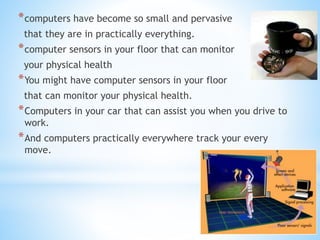
*computers have become so small and pervasive
that they are in practically everything.
*computer sensors in your floor that can monitor
your physical health
*You might have computer sensors in your floor
that can monitor your physical health.
*Computers in your car that can assist you when you drive to
work.
*And computers practically everywhere track your every
move.
Evolution
Constraint:
- best way to serve the user community is not clear.
Approach:
- Prototype the solution
- Acquire feedback from users.
- Modify the application
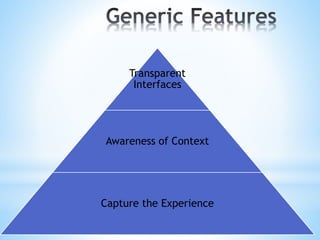
Transparent
Interfaces
Awareness of Context
Capture the Experience
Generic Features – TRANSPARENT
INTERFACES
- hide their presence from user
- Provide interaction between user and application
Examples:
Gesture recognition
speech recognition
free form pen interaction
computational perception etc.
Generic Features – TRANSPARENT
INTERFACES
Keyboard and mouse are still the
most commonly used interfaces !!!
Need:
- flexible interfaces
- Varied interfaces that can provide similar functionality
Generic Features – CONTEXT
AWARENESS
Context aware application:
- is one which can capture the context
- assign meaning to it
- change behavior accordingly
The sensory perception (e.g. visual matching of buildings and places you
know based on your eyesight) is different in a familiar place and a new
place.
Need:
Applications that are context aware and
allow rapid personalization of their services.
Challenge-finding the balance between visibility and transparency.
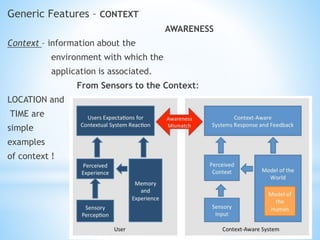
Generic Features – CONTEXT
AWARENESS
Context – information about the
environment with which the
application is associated.
From Sensors to the Context:
LOCATION and
TIME are
simple
examples
of context !
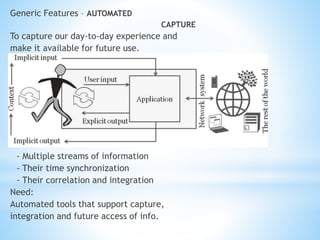
Generic Features – AUTOMATED
CAPTURE
To capture our day-to-day experience and
make it available for future use.
Constraints:
- Multiple streams of information
- Their time synchronization
- Their correlation and integration
Need:
Automated tools that support capture,
integration and future access of info.
• TOOLKIT
• DESIGN
• ISSUES
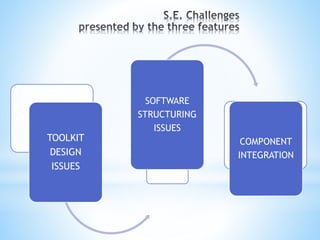
TOOLKIT
DESIGN
ISSUES
SOFTWARE
STRUCTURING
ISSUES
COMPONENT
INTEGRATION
Toolkit design issues
- be able to treat all types of I/P as easily as keyboard or mouse
(e.g.: freeform pen based interaction)
- need for clustering techniques that can associate various forms of
data
- Context aware applications need TILE interface
(Time, Identity, Location, Entities)
Toolkit design issues
Open challenges
‘Scalable Interfaces’
-variety of devices with different size and interaction
techniques
Rewriting of Applications !!
Abstract Interface toolkits
(another open area of research)
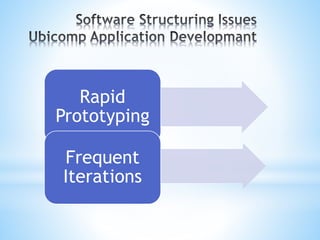
Rapid
Prototyping
Frequent
Iterations
Component Integration
-not all portions of every application are developed
-many times we rely on COTS software
Constraint:
-COTS software are not available for various types of
devices / OS
Need:
Standard methods to communicate and
control wide array of devices and OS.
need to have an awareness of their context:
a combination of several factors
-including the current location
- the current user
- if there are any other Ubicomp devices present in
the near surroundings
*The multitude of different Ubicomp devices
with their different sizes of displays and
interaction capabilities represents another
challenge
Mouse
keyboard
Pen
Gesture recognition
…
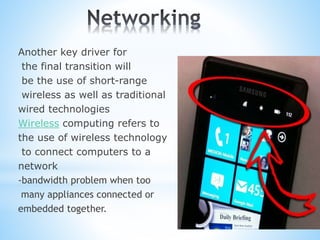
Another key driver for
the final transition will
be the use of short-range
wireless as well as traditional
wired technologies
Wireless computing refers to
the use of wireless technology
to connect computers to a
network
-bandwidth problem when too
many appliances connected or
embedded together.
Mobility is made possible through wireless
communication technologies
Problem of disconnectivity!!!
-This behaviour is an inherent property of the ubicomp
concept and it should not be treated as a failure
-mismatch of awareness in context aware.
-In a ubiquitous computing environment where possibly
thousands and thousands of devices are part of
scalability of the whole system is a key requirement
-All the devices are autonomous and must be able to
operate independently a decentralized management will
most likely be most suitable
-Thus the reliability of ubiquitous services and devices
is a crucial requirement
-In order to construct reliable systems self-monitoring,
self-regulating and self-healing features like they are
found in biology might be a solution
-Not only does the world change (and thus so should our
computational understanding of it, as alluded to above), but so
the set of users, devices and software components in an
environment change over time—far more frequently in ubicomp
systems than in conventional distributed systems.
-Respond needed-- Adaptability
-Utility computing can help realize the
ubiquitous computing vision by providing large-
scale and long-lived storage and processing
resources for personal ubicomp applications
-While utility computing in the cloud can provide
important backend resources for ubicomp
applications, it cannot provide all the necessary
infrastructure.
In a fully networked world with ubiquitous, sensor-
equipped devices several privacy and security issues
arise
• the people in this environment will be worried about
their privacy since there is the potential of total
monitoring
• must be understandable by the user and it must be
modelled into the system architecture
-by 2020 computers will b everywhere.
-Computers already exist in our watches, phones , dishwashers,
cars , TV sets.
-production of the microchips will be very cheap.
-From dishwashers to the cars, everywhere.
-Traffic accidents, traffic jams will disappear.
-An invisible intelligent networks will be hidden in our walls ,
furniture and even in our clothes!!!
-In the future ,computers will be there in every fabric of our
lives!!!

Ubiquitous computing

  • 1.
    Priti Punia Mtech CSA(First yr) 601103012 Thapar University
  • 2.
    • Introduction toUbiquitous Computing-Definition • History of Ubiquitous Computing-Evolution • Generic Features • Challenges and Requirements • Software Requirements Issues • Vision for the Future -2020
  • 3.
    Definitions Ubiquitous computing isthe method of enhancing computer use by making many computers available throughout the physical environment, but making them effectively invisible to the user – Mark Weiser(Father of Ubicomp) Ubiquitous computing, or calm technology, is a paradigm shift where technology becomes virtually invisible in our lives. -- Marcia Riley (Georgia Institute of Technology, Atlanta.)
  • 4.
    *computers have becomeso small and pervasive that they are in practically everything. *computer sensors in your floor that can monitor your physical health *You might have computer sensors in your floor that can monitor your physical health. *Computers in your car that can assist you when you drive to work. *And computers practically everywhere track your every move.
  • 5.
    Evolution Constraint: - best wayto serve the user community is not clear. Approach: - Prototype the solution - Acquire feedback from users. - Modify the application
  • 6.
  • 7.
    Generic Features –TRANSPARENT INTERFACES - hide their presence from user - Provide interaction between user and application Examples: Gesture recognition speech recognition free form pen interaction computational perception etc.
  • 8.
    Generic Features –TRANSPARENT INTERFACES Keyboard and mouse are still the most commonly used interfaces !!! Need: - flexible interfaces - Varied interfaces that can provide similar functionality
  • 9.
    Generic Features –CONTEXT AWARENESS Context aware application: - is one which can capture the context - assign meaning to it - change behavior accordingly The sensory perception (e.g. visual matching of buildings and places you know based on your eyesight) is different in a familiar place and a new place. Need: Applications that are context aware and allow rapid personalization of their services. Challenge-finding the balance between visibility and transparency.
  • 10.
    Generic Features –CONTEXT AWARENESS Context – information about the environment with which the application is associated. From Sensors to the Context: LOCATION and TIME are simple examples of context !
  • 11.
    Generic Features –AUTOMATED CAPTURE To capture our day-to-day experience and make it available for future use. Constraints: - Multiple streams of information - Their time synchronization - Their correlation and integration Need: Automated tools that support capture, integration and future access of info.
  • 12.
    • TOOLKIT • DESIGN •ISSUES TOOLKIT DESIGN ISSUES SOFTWARE STRUCTURING ISSUES COMPONENT INTEGRATION
  • 13.
    Toolkit design issues -be able to treat all types of I/P as easily as keyboard or mouse (e.g.: freeform pen based interaction) - need for clustering techniques that can associate various forms of data - Context aware applications need TILE interface (Time, Identity, Location, Entities)
  • 14.
    Toolkit design issues Openchallenges ‘Scalable Interfaces’ -variety of devices with different size and interaction techniques Rewriting of Applications !! Abstract Interface toolkits (another open area of research)
  • 15.
  • 16.
    Component Integration -not allportions of every application are developed -many times we rely on COTS software Constraint: -COTS software are not available for various types of devices / OS Need: Standard methods to communicate and control wide array of devices and OS.
  • 17.
    need to havean awareness of their context: a combination of several factors -including the current location - the current user - if there are any other Ubicomp devices present in the near surroundings
  • 19.
    *The multitude ofdifferent Ubicomp devices with their different sizes of displays and interaction capabilities represents another challenge Mouse keyboard Pen Gesture recognition …
  • 20.
    Another key driverfor the final transition will be the use of short-range wireless as well as traditional wired technologies Wireless computing refers to the use of wireless technology to connect computers to a network -bandwidth problem when too many appliances connected or embedded together.
  • 21.
    Mobility is madepossible through wireless communication technologies Problem of disconnectivity!!! -This behaviour is an inherent property of the ubicomp concept and it should not be treated as a failure -mismatch of awareness in context aware.
  • 22.
    -In a ubiquitouscomputing environment where possibly thousands and thousands of devices are part of scalability of the whole system is a key requirement -All the devices are autonomous and must be able to operate independently a decentralized management will most likely be most suitable
  • 23.
    -Thus the reliabilityof ubiquitous services and devices is a crucial requirement -In order to construct reliable systems self-monitoring, self-regulating and self-healing features like they are found in biology might be a solution
  • 24.
    -Not only doesthe world change (and thus so should our computational understanding of it, as alluded to above), but so the set of users, devices and software components in an environment change over time—far more frequently in ubicomp systems than in conventional distributed systems. -Respond needed-- Adaptability
  • 25.
    -Utility computing canhelp realize the ubiquitous computing vision by providing large- scale and long-lived storage and processing resources for personal ubicomp applications -While utility computing in the cloud can provide important backend resources for ubicomp applications, it cannot provide all the necessary infrastructure.
  • 26.
    In a fullynetworked world with ubiquitous, sensor- equipped devices several privacy and security issues arise • the people in this environment will be worried about their privacy since there is the potential of total monitoring • must be understandable by the user and it must be modelled into the system architecture
  • 27.
    -by 2020 computerswill b everywhere. -Computers already exist in our watches, phones , dishwashers, cars , TV sets. -production of the microchips will be very cheap. -From dishwashers to the cars, everywhere. -Traffic accidents, traffic jams will disappear. -An invisible intelligent networks will be hidden in our walls , furniture and even in our clothes!!! -In the future ,computers will be there in every fabric of our lives!!!

Editor's Notes