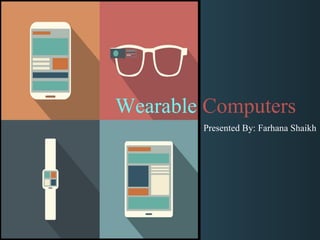
Wearable Computers
Presented By: Farhana Shaikh
Wearable computers, as the name
suggests,
are computers that can be worn on a
person.
Wearable technology is enabling people to
become more accountable for their own
personal fitness and live healthier lives.
W e a r a b l e C o m p u t e r s
• Wearable devices can
help save lives through
vital sign monitors for the
sick or injured.
• Also through devices that
contain Bluetooth
connectivity that enable
hands-free talking.
Vital signs* body
temperature, blood
pressure, pulse heart
rate, and breathing rate.
Where They Use ?
*Features of Wearable Computers*
Consistency
There is always a constant interaction between the
computer and the user and hence there is no need to
turn the device on or off.
Multi-Tasking
Wearable computer provides computational support even
when the user’s hands, voice, eyes, or attention is
actively engaged with the physical environment.
Mobility
Wearable computers must go where the wearer goes.
They are always on and their wearer can access them
anytime.
*Advantages Of Wearable Computers*
 User friendly, easy to
learn.
 Computer moves with
you.
 Patients data easily
obtained online.
 Eliminates unnecessary
charting
Disadvantages Of Wearable Commputers
 Small display.
 Smaller keyboard.
 Different ways to enter data.
 Need to enter data while
interacting.
 Devices like Google Glass
presenting the worry that
confidential information
transferred outside the
network.
*An Example Of Wearable Computer*
A Shirt that can calculate body tempreture and
cool or heat itself accordingly.
Wearable Computers
*Another Example*
A sensor that is embedded into the sole of my
shoe that wirelessly charges the smartphone in my
pocket with every step I take.
*Another Examples*
1. A sleep band that measures
brain activity while sleeping.
2. Bus stop screen to choose the
destination.
3. Nike fuel band allows its
wearers to track thier physical
activities, step taken daily and
amount of energy burned.
4. Fitbit are activity trackers that
measures data such as the
number of steps, quality of
sleep, step climbed.
Wearable Computers
Any query...

Wearable computers

  • 1.
  • 2.
    Wearable computers, asthe name suggests, are computers that can be worn on a person. Wearable technology is enabling people to become more accountable for their own personal fitness and live healthier lives. W e a r a b l e C o m p u t e r s
  • 3.
    • Wearable devicescan help save lives through vital sign monitors for the sick or injured. • Also through devices that contain Bluetooth connectivity that enable hands-free talking. Vital signs* body temperature, blood pressure, pulse heart rate, and breathing rate. Where They Use ?
  • 4.
    *Features of WearableComputers* Consistency There is always a constant interaction between the computer and the user and hence there is no need to turn the device on or off. Multi-Tasking Wearable computer provides computational support even when the user’s hands, voice, eyes, or attention is actively engaged with the physical environment. Mobility Wearable computers must go where the wearer goes. They are always on and their wearer can access them anytime.
  • 5.
    *Advantages Of WearableComputers*  User friendly, easy to learn.  Computer moves with you.  Patients data easily obtained online.  Eliminates unnecessary charting
  • 6.
    Disadvantages Of WearableCommputers  Small display.  Smaller keyboard.  Different ways to enter data.  Need to enter data while interacting.  Devices like Google Glass presenting the worry that confidential information transferred outside the network.
  • 7.
    *An Example OfWearable Computer* A Shirt that can calculate body tempreture and cool or heat itself accordingly.
  • 8.
    Wearable Computers *Another Example* Asensor that is embedded into the sole of my shoe that wirelessly charges the smartphone in my pocket with every step I take.
  • 9.
    *Another Examples* 1. Asleep band that measures brain activity while sleeping. 2. Bus stop screen to choose the destination. 3. Nike fuel band allows its wearers to track thier physical activities, step taken daily and amount of energy burned. 4. Fitbit are activity trackers that measures data such as the number of steps, quality of sleep, step climbed.
  • 10.