Dr Isha Deshmukh
Asst Prof
Pediatrics, BJGMC , Pune
ļ‚” Respiratory failures are important conditions
for pediatric mortalities and morbidities.
ļ‚” It constitutes an important cause of pediatric
mortality in hospitals worldwide.
ļ‚” There is abrupt respiratory failure due to
intra-parenchymal lung damage or sequential
signs ofVentilation perfusion mismatch in
case of partially treated LRTI.
ļ‚” Respiratory failure happens when the respiratory
system fails to maintain gas exchange and is classified
into type 1 and type 2 according to blood gases
abnormalities.
ļ‚” In type 1 (hypoxemic) respiratory failure, the partial
pressure of arterial oxygen (PaO2) is less than 60
millimeters of mercury (mmHg), and the partial
pressure of arterial carbon dioxide (PaCO2) may be
either normal or low.
ļ‚” In type 2 (hypercapnic) respiratory failure, the PaCO2
is greater than 50 mmHg, and PaO2 may be normal
or, in the event of respiratory pump failure, low
ļ‚” The major intervention to prevent morbidity
and death due to respiratory failure is
mechanical ventilation (MV).
ļ‚” It can be associated with complications such
as ventilator-induced lung injury and
nosocomial pneumonia.
ļ‚” Therefore, it is important that MV be
discontinued as soon as the patient is capable
of sustaining spontaneous breathing.
ļ‚” Although expeditious weaning and
extubation are the goal, premature
extubation can be lethal.
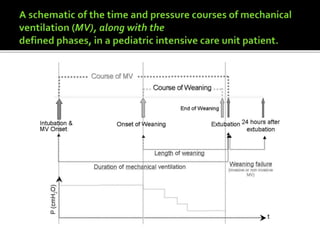
ļ‚” Weaning is the transition from ventilatory
support to completely spontaneous
breathing, during which time the patient
assumes the responsibility for effective gas
exchange while positive pressure support is
withdrawn.
ļ‚” Note that spontaneous breathing is a
prerequisite for weaning to begin and
decreasing ventilator support is not the sole
criterion of successful weaning
ļ‚” Extubation is the removal of the endotracheal tube.
ļ‚” Criteria for extubation include spontaneous
ventilation, hemodynamic stability, intact airway
reflexes, and manageable airway secretions.
ļ‚” Success is defined as 48 hrs of spontaneous breathing
without positive pressure support.
ļ‚” Early extubation failure is defined as that which
occurs within 6 hrs of extubation; intermediate
extubation failure is that which occurs from 6 to 24 hrs
of extubation; and late extubation failure is defined as
that which occurs from 24 to 48 hrs of extubation
Spontaneous breathing test is a subjective
determination of whether the underlying
disease process necessitating mechanical
ventilation has improved sufficiently to allow
the patient adequate gas exchange with
spontaneous breathing.
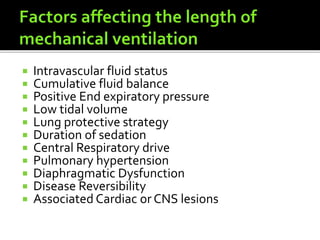
ļ‚” Intravascular fluid status
ļ‚” Cumulative fluid balance
ļ‚” Positive End expiratory pressure
ļ‚” Low tidal volume
ļ‚” Lung protective strategy
ļ‚” Duration of sedation
ļ‚” Central Respiratory drive
ļ‚” Pulmonary hypertension
ļ‚” Diaphragmatic Dysfunction
ļ‚” Disease Reversibility
ļ‚” Associated Cardiac or CNS lesions
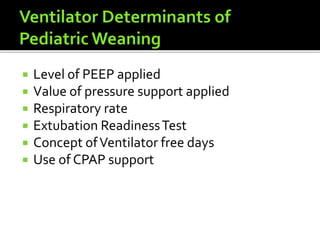
ļ‚” Level of PEEP applied
ļ‚” Value of pressure support applied
ļ‚” Respiratory rate
ļ‚” Extubation ReadinessTest
ļ‚” Concept ofVentilator free days
ļ‚” Use of CPAP support
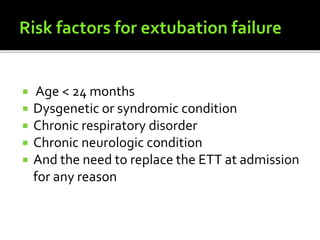
ļ‚” Age < 24 months
ļ‚” Dysgenetic or syndromic condition
ļ‚” Chronic respiratory disorder
ļ‚” Chronic neurologic condition
ļ‚” And the need to replace the ETT at admission
for any reason
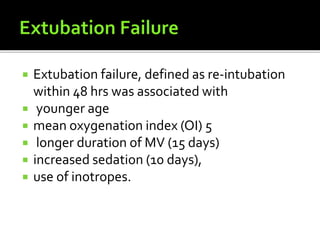
ļ‚” Extubation failure, defined as re-intubation
within 48 hrs was associated with
ļ‚” younger age
ļ‚” mean oxygenation index (OI) 5
ļ‚” longer duration of MV (15 days)
ļ‚” increased sedation (10 days),
ļ‚” use of inotropes.
ļ‚” Proposed criteria for failure during 2 hrs on Continuous
positive airway pressure 5 cm H2O orT-piece (zero end-
expiratory pressure)
Clinical criteria
ļ‚” Diaphoresis
ļ‚” Nasal flaring
ļ‚” Increasing respiratory effort
ļ‚” Tachycardia (increase in HR 40 bpm)
ļ‚” Cardiac arrhythmias
ļ‚” Hypotension
ļ‚” Apnea
Laboratory criteria
ļ‚” Increase of PETCO2 10 mm Hg
ļ‚” Decrease of arterial pH 7.32
ļ‚” Decline in arterial pH 0.07
ļ‚” PaO2 60 mm Hg with an FIO2 0.40 (P/F O2 ratio 150)
ļ‚” SpO2 declines 5%
ļ‚” Good respiratory muscular efforts
ļ‚” Leak test around ETT
ļ‚” Negative inspiratory force
ļ‚” Use of Non Invasive MV
ļ‚” Low lung volume
ļ‚” Intra-abdominal hypertension
ļ‚” Cerebral perfusion pressure
ļ‚” Good lung expansion on CXR
ļ‚” Normal cardiac function
ļ‚” Good sensorium
ļ‚” Good kidney and hepatic function
ļ‚” Off inotropes
ļ‚” Off sedation
ļ‚” No fever
ļ‚” Improved abdominal pathology if any
ļ‚” Individual prototypes for weaning of
paediatric patients depends upon clinical
evaluation and knowledge of treating
consultants along-with radiological and
laboratory collaboration.
Weaning in pediatrics

Weaning in pediatrics

  • 1.
    Dr Isha Deshmukh AsstProf Pediatrics, BJGMC , Pune
  • 2.
    ļ‚” Respiratory failuresare important conditions for pediatric mortalities and morbidities. ļ‚” It constitutes an important cause of pediatric mortality in hospitals worldwide. ļ‚” There is abrupt respiratory failure due to intra-parenchymal lung damage or sequential signs ofVentilation perfusion mismatch in case of partially treated LRTI.
  • 3.
    ļ‚” Respiratory failurehappens when the respiratory system fails to maintain gas exchange and is classified into type 1 and type 2 according to blood gases abnormalities. ļ‚” In type 1 (hypoxemic) respiratory failure, the partial pressure of arterial oxygen (PaO2) is less than 60 millimeters of mercury (mmHg), and the partial pressure of arterial carbon dioxide (PaCO2) may be either normal or low. ļ‚” In type 2 (hypercapnic) respiratory failure, the PaCO2 is greater than 50 mmHg, and PaO2 may be normal or, in the event of respiratory pump failure, low
  • 4.
    ļ‚” The majorintervention to prevent morbidity and death due to respiratory failure is mechanical ventilation (MV). ļ‚” It can be associated with complications such as ventilator-induced lung injury and nosocomial pneumonia. ļ‚” Therefore, it is important that MV be discontinued as soon as the patient is capable of sustaining spontaneous breathing.
  • 5.
    ļ‚” Although expeditiousweaning and extubation are the goal, premature extubation can be lethal.
  • 6.
    ļ‚” Weaning isthe transition from ventilatory support to completely spontaneous breathing, during which time the patient assumes the responsibility for effective gas exchange while positive pressure support is withdrawn. ļ‚” Note that spontaneous breathing is a prerequisite for weaning to begin and decreasing ventilator support is not the sole criterion of successful weaning
  • 7.
    ļ‚” Extubation isthe removal of the endotracheal tube. ļ‚” Criteria for extubation include spontaneous ventilation, hemodynamic stability, intact airway reflexes, and manageable airway secretions. ļ‚” Success is defined as 48 hrs of spontaneous breathing without positive pressure support. ļ‚” Early extubation failure is defined as that which occurs within 6 hrs of extubation; intermediate extubation failure is that which occurs from 6 to 24 hrs of extubation; and late extubation failure is defined as that which occurs from 24 to 48 hrs of extubation
  • 8.
    Spontaneous breathing testis a subjective determination of whether the underlying disease process necessitating mechanical ventilation has improved sufficiently to allow the patient adequate gas exchange with spontaneous breathing.
  • 10.
    ļ‚” Intravascular fluidstatus ļ‚” Cumulative fluid balance ļ‚” Positive End expiratory pressure ļ‚” Low tidal volume ļ‚” Lung protective strategy ļ‚” Duration of sedation ļ‚” Central Respiratory drive ļ‚” Pulmonary hypertension ļ‚” Diaphragmatic Dysfunction ļ‚” Disease Reversibility ļ‚” Associated Cardiac or CNS lesions
  • 11.
    ļ‚” Level ofPEEP applied ļ‚” Value of pressure support applied ļ‚” Respiratory rate ļ‚” Extubation ReadinessTest ļ‚” Concept ofVentilator free days ļ‚” Use of CPAP support
  • 12.
    ļ‚” Age <24 months ļ‚” Dysgenetic or syndromic condition ļ‚” Chronic respiratory disorder ļ‚” Chronic neurologic condition ļ‚” And the need to replace the ETT at admission for any reason
  • 13.
    ļ‚” Extubation failure,defined as re-intubation within 48 hrs was associated with ļ‚” younger age ļ‚” mean oxygenation index (OI) 5 ļ‚” longer duration of MV (15 days) ļ‚” increased sedation (10 days), ļ‚” use of inotropes.
  • 14.
    ļ‚” Proposed criteriafor failure during 2 hrs on Continuous positive airway pressure 5 cm H2O orT-piece (zero end- expiratory pressure) Clinical criteria ļ‚” Diaphoresis ļ‚” Nasal flaring ļ‚” Increasing respiratory effort ļ‚” Tachycardia (increase in HR 40 bpm) ļ‚” Cardiac arrhythmias ļ‚” Hypotension ļ‚” Apnea Laboratory criteria ļ‚” Increase of PETCO2 10 mm Hg ļ‚” Decrease of arterial pH 7.32 ļ‚” Decline in arterial pH 0.07 ļ‚” PaO2 60 mm Hg with an FIO2 0.40 (P/F O2 ratio 150) ļ‚” SpO2 declines 5%
  • 15.
    ļ‚” Good respiratorymuscular efforts ļ‚” Leak test around ETT ļ‚” Negative inspiratory force ļ‚” Use of Non Invasive MV ļ‚” Low lung volume ļ‚” Intra-abdominal hypertension ļ‚” Cerebral perfusion pressure
  • 16.
    ļ‚” Good lungexpansion on CXR ļ‚” Normal cardiac function ļ‚” Good sensorium ļ‚” Good kidney and hepatic function ļ‚” Off inotropes ļ‚” Off sedation ļ‚” No fever ļ‚” Improved abdominal pathology if any
  • 17.
    ļ‚” Individual prototypesfor weaning of paediatric patients depends upon clinical evaluation and knowledge of treating consultants along-with radiological and laboratory collaboration.