Evaluation of Newborn
Dr Isha Deshmukh
Assistant Professor
BJGMC , Pune
12/06/2021
Definitions
Definitions of Newborn
1. Newborn: The infant from Day 0 to 28
days of life
2. Early Neonatal Period: First 7 days of
life
3. Late neonatal Period: From 7th to less
than 28 days of life
4. Newly born: Infant in the first few
minutes to few hours after birth
5. Still Birth: A fetal death at a gestation
age of 20 weeks or more or weighing
more than 500 grams.
Catagorization by Birth Weight
 Neonates are classified according to
weight.
 Low Birth Weight – BW < 2.5 kg
 Very Low birth weight – BW <1.5 kg
 Extremely Low Birth weight – BW <1
kg
These classifications help in
establishing the risk level for neonatal
mortality, morbidity, and long term
developmental problems.
Categorization by weight for
Gestational Age
 Small for Gestational age – BW <10th
centile for GA
 Large for Gestational age – BW > 90th
centile for GA
 Appropriate for Gestational age – BW
between 10th to 90th centile for GA
Timings of Newborn
Assessment
1. At birth to assess need for resuscitation
2. Assessment as the newborn completes
transition from fetal to neonatal
circulation
3.Determination of gestational age
4. General health assessment at 24 to 48
hours after birth
5. Before discharge
6. Evaluation of sick neonate at any time
7. Evaluation of neonate with
dysmorphism or congenital anomalies
Anticipation of a Congenital
Anomaly
1. Family history of congenital anomalies
2. Maternal illness in first trimester
3. Maternal GDM
4. Alcohol intake during Antenatal period
5. Maternal drugs in first trimester
6. Maternal age >35 years
7. Polyhydramnios
8. Oligohydramnios
9. Breech presentation
10. Identical twins
General Health Assessment
 Temperature stability
 Vital signs
 HR, Perfusion, murmur, pulses, CRT
 Ability of BF – by weight change since
birth, duration of breast feeding,
effective suckling, proper attachment
and positioning.
 Colour- cyanosis,pallor, plethora,
jaundice
Danger Signs
• Respiratory distress
• Lethargy
• Poor feeding/ sucking
• Icterus till soles
• Seizures/ abnormal movements
• Repeated vomiting
• Diarrhoea
• Bleeding from any site
Components of Neonatal History
 Maternal, paternal and family history
 History of antenatal events
 Details of birth
 History of immediate post natal events
 History of feeding, activity and weight
gain
 Specific complaints if any
Paternal history
• Fathers age
• Blood group
• Consanguinity
• Presence of any current infections
• Chronic illness in father
• Socio-economic history
• Inherited genetic disorders
• Any illness in siblings
Past Neonatal history
 Details of previous pregnancies
(number, abortions, stillbirths, live
births, any previous infant or child
deaths
 Delivery details
 Birth weight
 Problems encountered during
deliveries
 This defines High Risk Neonate
History of Antenatal Events
 LMP, EDD, MBG, Hb level
 Platelet count , WBC count
 Exposure to teratogens
 PIH, Eclampsia, GDM
 Maternal Immune status
 Duration of labour
 State of fetal heart during labour
History of antenatal events
• Duration of rupture of membranes
• Presentation of fetus
• Operative delivery
• Drugs or anaesthetics used
• Polyhydramnios
• Abnormalities of placenta
• Abnormal presentation
• Multiple gestation
Sequence of Examination
• Before touching observe spontaneous movements, eye
opening and respiratory rate
• Feel the AF and sutures
• Auscultate HS
• Touch or cold stress
• Palpate abdomen for liver , spleen and any mass
• Complete examination for head to toe evaluation
• Systemic evaluation: RS and CVS
• Genitals , anus and femoral pulses
• Back and spine
• Neurological Assessment
• Moro’s reflex
• Hip assessment
• Anthropometry
Normal Vital Signs in a
Newborn
 1. Temperature 36.5 to 37.5 degree
Celsius axillary/ rectal
 2. Heart Rate : 120 to 160 beats per
minute
 3. RR – 40 to 60 per minute
 4. BP – Systolic 65 to 95 mmHg
 Diastolic 30 to 60 mmHg
 Both feet and abdomen are warm to
touch , baby is at thermal comfort
 Feet cold and abdomen warm – cold
stress
 Both feet and abdomen cold –
hypothermia
 Cold stress – 36.0 to 36.4 degree
Celcius
 Moderate hypothermia – 32.0 to 35.9
degree C
 Severe hypothermia - <32.0 degree C
Colour Guide for Newborn
• 1. Red – plethoric – Send Hct, Hb, Plt
• 2. Blue – (cyanosis)
Only hands and feet – peripheral
cyanosis
Lips and mucus membranes-
Central cyanosis
3. Pallor – anemia
4. Grey ashen – asphyxia or septicemia
5. Jaundice – NNH, Send Serum
bilirubin
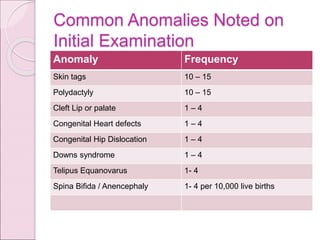
Common Anomalies Noted on
Initial Examination
Anomaly Frequency
Skin tags 10 – 15
Polydactyly 10 – 15
Cleft Lip or palate 1 – 4
Congenital Heart defects 1 – 4
Congenital Hip Dislocation 1 – 4
Downs syndrome 1 – 4
Telipus Equanovarus 1- 4
Spina Bifida / Anencephaly 1- 4 per 10,000 live births
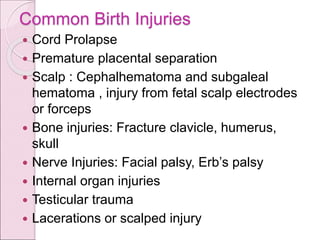
Common Birth Injuries
 Cord Prolapse
 Premature placental separation
 Scalp : Cephalhematoma and subgaleal
hematoma , injury from fetal scalp electrodes
or forceps
 Bone injuries: Fracture clavicle, humerus,
skull
 Nerve Injuries: Facial palsy, Erb’s palsy
 Internal organ injuries
 Testicular trauma
 Lacerations or scalped injury
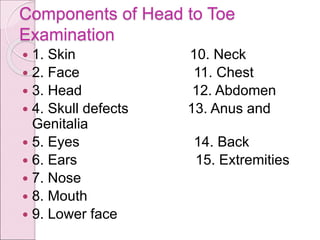
Components of Head to Toe
Examination
 1. Skin 10. Neck
 2. Face 11. Chest
 3. Head 12. Abdomen
 4. Skull defects 13. Anus and
Genitalia
 5. Eyes 14. Back
 6. Ears 15. Extremities
 7. Nose
 8. Mouth
 9. Lower face
Thank you...!!

Evaluation of newborn

  • 1.
    Evaluation of Newborn DrIsha Deshmukh Assistant Professor BJGMC , Pune 12/06/2021
  • 2.
    Definitions Definitions of Newborn 1.Newborn: The infant from Day 0 to 28 days of life 2. Early Neonatal Period: First 7 days of life 3. Late neonatal Period: From 7th to less than 28 days of life 4. Newly born: Infant in the first few minutes to few hours after birth 5. Still Birth: A fetal death at a gestation age of 20 weeks or more or weighing more than 500 grams.
  • 3.
    Catagorization by BirthWeight  Neonates are classified according to weight.  Low Birth Weight – BW < 2.5 kg  Very Low birth weight – BW <1.5 kg  Extremely Low Birth weight – BW <1 kg These classifications help in establishing the risk level for neonatal mortality, morbidity, and long term developmental problems.
  • 4.
    Categorization by weightfor Gestational Age  Small for Gestational age – BW <10th centile for GA  Large for Gestational age – BW > 90th centile for GA  Appropriate for Gestational age – BW between 10th to 90th centile for GA
  • 5.
    Timings of Newborn Assessment 1.At birth to assess need for resuscitation 2. Assessment as the newborn completes transition from fetal to neonatal circulation 3.Determination of gestational age 4. General health assessment at 24 to 48 hours after birth 5. Before discharge 6. Evaluation of sick neonate at any time 7. Evaluation of neonate with dysmorphism or congenital anomalies
  • 6.
    Anticipation of aCongenital Anomaly 1. Family history of congenital anomalies 2. Maternal illness in first trimester 3. Maternal GDM 4. Alcohol intake during Antenatal period 5. Maternal drugs in first trimester 6. Maternal age >35 years 7. Polyhydramnios 8. Oligohydramnios 9. Breech presentation 10. Identical twins
  • 7.
    General Health Assessment Temperature stability  Vital signs  HR, Perfusion, murmur, pulses, CRT  Ability of BF – by weight change since birth, duration of breast feeding, effective suckling, proper attachment and positioning.  Colour- cyanosis,pallor, plethora, jaundice
  • 8.
    Danger Signs • Respiratorydistress • Lethargy • Poor feeding/ sucking • Icterus till soles • Seizures/ abnormal movements • Repeated vomiting • Diarrhoea • Bleeding from any site
  • 9.
    Components of NeonatalHistory  Maternal, paternal and family history  History of antenatal events  Details of birth  History of immediate post natal events  History of feeding, activity and weight gain  Specific complaints if any
  • 10.
    Paternal history • Fathersage • Blood group • Consanguinity • Presence of any current infections • Chronic illness in father • Socio-economic history • Inherited genetic disorders • Any illness in siblings
  • 11.
    Past Neonatal history Details of previous pregnancies (number, abortions, stillbirths, live births, any previous infant or child deaths  Delivery details  Birth weight  Problems encountered during deliveries  This defines High Risk Neonate
  • 12.
    History of AntenatalEvents  LMP, EDD, MBG, Hb level  Platelet count , WBC count  Exposure to teratogens  PIH, Eclampsia, GDM  Maternal Immune status  Duration of labour  State of fetal heart during labour
  • 13.
    History of antenatalevents • Duration of rupture of membranes • Presentation of fetus • Operative delivery • Drugs or anaesthetics used • Polyhydramnios • Abnormalities of placenta • Abnormal presentation • Multiple gestation
  • 14.
    Sequence of Examination •Before touching observe spontaneous movements, eye opening and respiratory rate • Feel the AF and sutures • Auscultate HS • Touch or cold stress • Palpate abdomen for liver , spleen and any mass • Complete examination for head to toe evaluation • Systemic evaluation: RS and CVS • Genitals , anus and femoral pulses • Back and spine • Neurological Assessment • Moro’s reflex • Hip assessment • Anthropometry
  • 15.
    Normal Vital Signsin a Newborn  1. Temperature 36.5 to 37.5 degree Celsius axillary/ rectal  2. Heart Rate : 120 to 160 beats per minute  3. RR – 40 to 60 per minute  4. BP – Systolic 65 to 95 mmHg  Diastolic 30 to 60 mmHg
  • 16.
     Both feetand abdomen are warm to touch , baby is at thermal comfort  Feet cold and abdomen warm – cold stress  Both feet and abdomen cold – hypothermia  Cold stress – 36.0 to 36.4 degree Celcius  Moderate hypothermia – 32.0 to 35.9 degree C  Severe hypothermia - <32.0 degree C
  • 17.
    Colour Guide forNewborn • 1. Red – plethoric – Send Hct, Hb, Plt • 2. Blue – (cyanosis) Only hands and feet – peripheral cyanosis Lips and mucus membranes- Central cyanosis 3. Pallor – anemia 4. Grey ashen – asphyxia or septicemia 5. Jaundice – NNH, Send Serum bilirubin
  • 18.
    Common Anomalies Notedon Initial Examination Anomaly Frequency Skin tags 10 – 15 Polydactyly 10 – 15 Cleft Lip or palate 1 – 4 Congenital Heart defects 1 – 4 Congenital Hip Dislocation 1 – 4 Downs syndrome 1 – 4 Telipus Equanovarus 1- 4 Spina Bifida / Anencephaly 1- 4 per 10,000 live births
  • 19.
    Common Birth Injuries Cord Prolapse  Premature placental separation  Scalp : Cephalhematoma and subgaleal hematoma , injury from fetal scalp electrodes or forceps  Bone injuries: Fracture clavicle, humerus, skull  Nerve Injuries: Facial palsy, Erb’s palsy  Internal organ injuries  Testicular trauma  Lacerations or scalped injury
  • 20.
    Components of Headto Toe Examination  1. Skin 10. Neck  2. Face 11. Chest  3. Head 12. Abdomen  4. Skull defects 13. Anus and Genitalia  5. Eyes 14. Back  6. Ears 15. Extremities  7. Nose  8. Mouth  9. Lower face
  • 21.