PALS : Approach to Emergency
Assessment and Management
Dr C. Abhiram kumar
Fellow in PICU
Aster CMI Hospital
Objectives
Recognize a seriously ill child by using a systematic approach
Proper Triage and allocation of Resources
High quality cardiopulmonary resuscitation
Stabilizing a seriously ill or injured child
INTRODUCTION
• Each year millions of children around the world die from
potentially preventable and treatable causes
• Majority of them could be prevented by paying attention to
public health measures and living conditions
• However improvement in early recognition of serious illnesses
and delivery of initial medication can undoubtedly save lives
• If basic principles of resuscitation are adhered to, it is possible
to improve the outcome of serious illnesses with modest
resources available
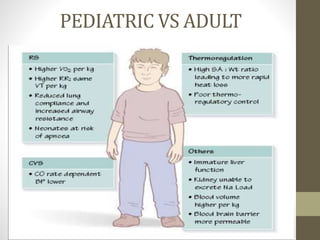
Children are not miniature adults……
PEDIATRIC VS ADULT
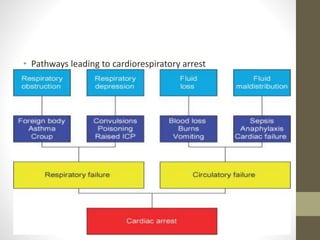
• Pathways leading to cardiorespiratory arrest
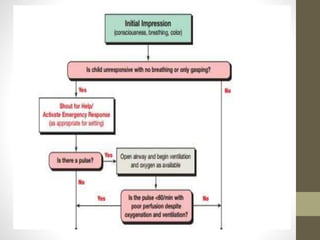
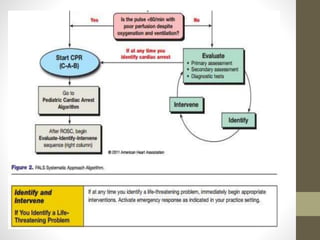
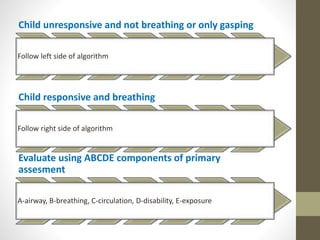
Child unresponsive and not breathing or only gasping
Follow left side of algorithm
Child responsive and breathing
Follow right side of algorithm
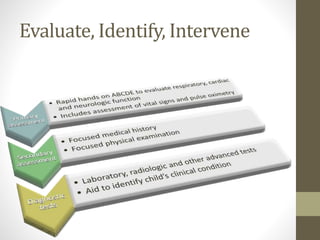
Evaluate using ABCDE components of primary
assesment
A-airway, B-breathing, C-circulation, D-disability, E-exposure
THE PAT TRIANGLE
• First impression
• Rapid assesment
• Visual and auditory
Evaluate, Identify, Intervene
• .
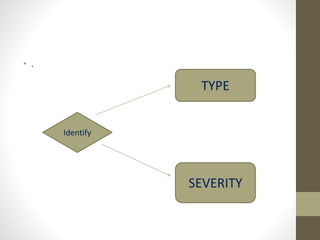
Identify
TYPE
SEVERITY
• INTERVENE- After identifying child’s condition, intervene with
appropriate actions which may include:
• giving a fluid bolus
• supplying oxygen
• positioning the child etc…..
EVALUATE
•AIRWAY:
Clear
Maintainable or non maintainable
• BREATHING:
Respiratory rate and pattern
Respiratory effort
Chest expansion and air movement
Abnormal lung and airway sounds
Oxygen saturation by pulse oximetry
• CIRCULATION:
Heart rate
Pulses
Capillary refill time
Skin color and temperature
Blood pressure
• DISABILITY:
AVPU response scale
Pupil size
Blood glucose
• EXPOSURE:
Temperature
Skin
IDENTIFY
RESPIRATORY PROBLEMS
• TYPE:
Upper airway obstruction
Lower airway obstruction
Lung tissue disease
Disordered control of breathing
• SEVERITY:
Mild respiratory distress
Severe respiratory distress
CIRCULATORY EMERGENCIES
• TYPE:
Hypovolemic shock
Cardiogenic shock
Distributive shock
Obstructive shock
• SEVERITY:
Compensated shock
Hypotensive shock
INTERVENE
• MANAGEMENT OF RESPIRATORY PROBLEMS
• RESPIRATORY ARREST: A child in respiratory arrest is not
breathing or breathing ineffectively but has palpable central
pulse.
• Provide rescue breathing to prevent cardiac arrest
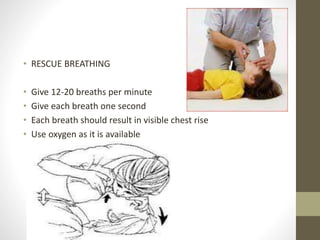
• RESCUE BREATHING
• Give 12-20 breaths per minute
• Give each breath one second
• Each breath should result in visible chest rise
• Use oxygen as it is available
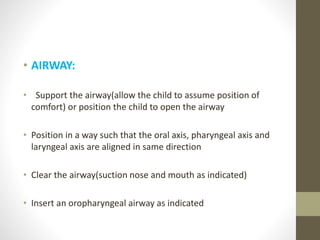
• AIRWAY:
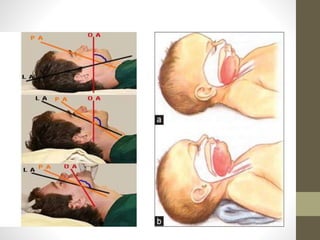
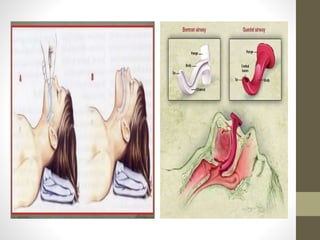
• Support the airway(allow the child to assume position of
comfort) or position the child to open the airway
• Position in a way such that the oral axis, pharyngeal axis and
laryngeal axis are aligned in same direction
• Clear the airway(suction nose and mouth as indicated)
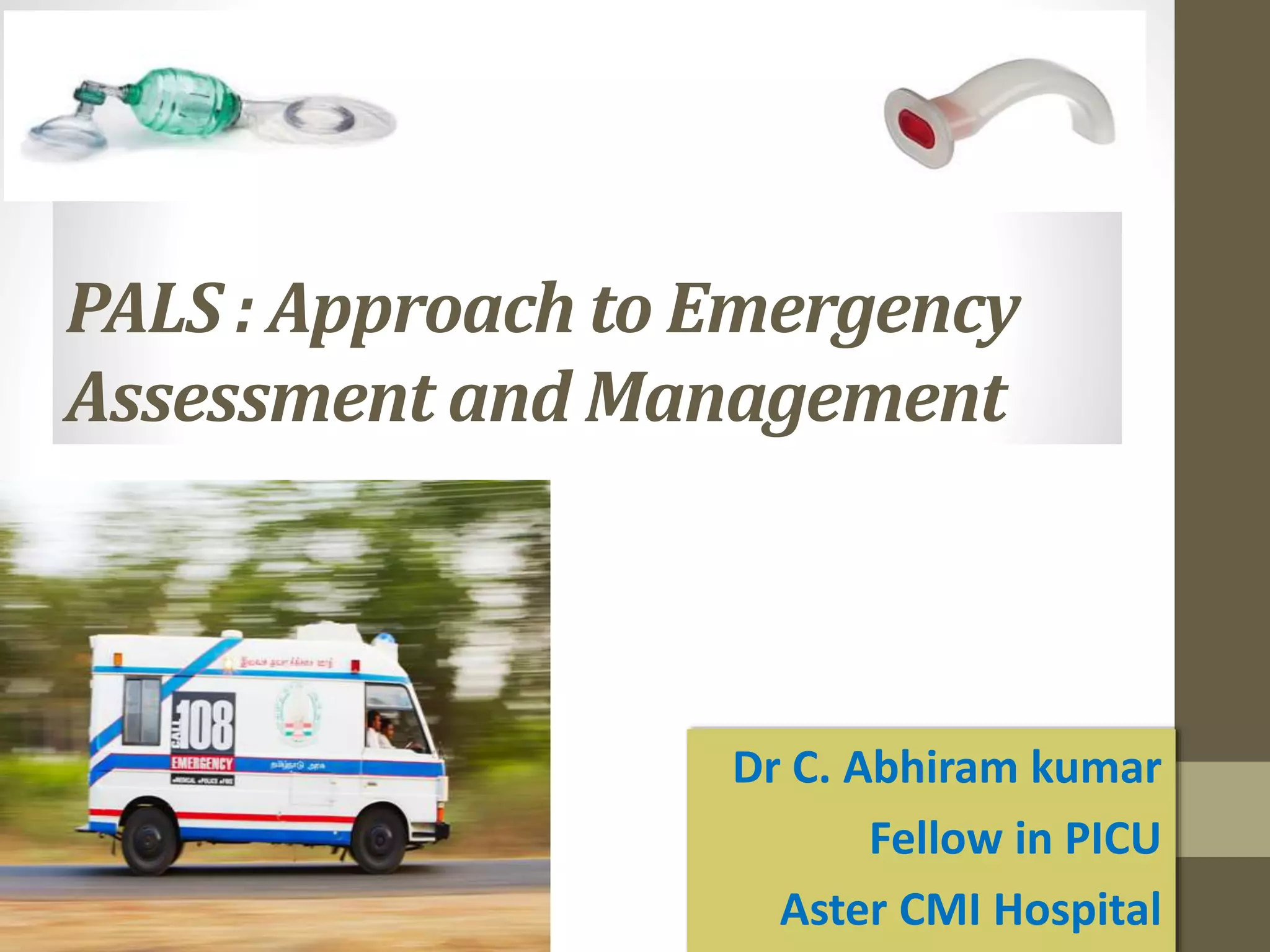
• Insert an oropharyngeal airway as indicated
.
• .
.
• BREATHING:
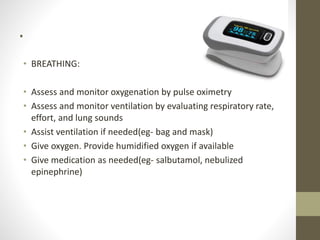
• Assess and monitor oxygenation by pulse oximetry
• Assess and monitor ventilation by evaluating respiratory rate,
effort, and lung sounds
• Assist ventilation if needed(eg- bag and mask)
• Give oxygen. Provide humidified oxygen if available
• Give medication as needed(eg- salbutamol, nebulized
epinephrine)
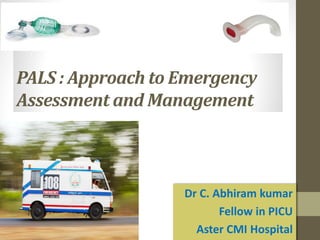
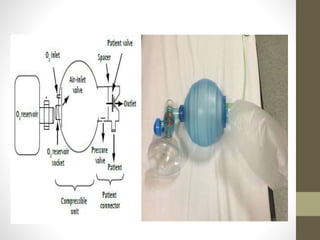
• BAG AND MASK VENTILATION
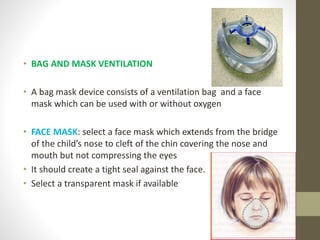
• A bag mask device consists of a ventilation bag and a face
mask which can be used with or without oxygen
• FACE MASK: select a face mask which extends from the bridge
of the child’s nose to cleft of the chin covering the nose and
mouth but not compressing the eyes
• It should create a tight seal against the face.
• Select a transparent mask if available
.• VENTILATION BAGS:
• They are mainly self inflating or flow inflating
• They can be used with or without oxygen supplementation
• To deliver near 100% oxygen concentration attach the bag and
mask device with a reservoir to an oxygen source
• Maintain oxygen flow of 10- 15 litres/minute
• Titrate oxygen saturation to maintain saturation between 94-
99%
Cont….
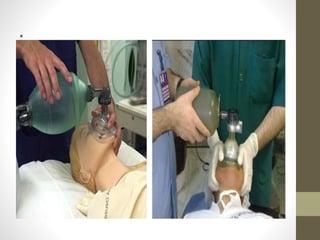
BAG MASK VENTILATION TECHNIQUE:
• Open the airway by tilting the head back
• Use E-C clamp technique to lift the jaw against the mask ,
pressing and sealing the mask on the face
• With other hand, squeeze the ventilation bag until the chest
rises
• Deliver each breath over one second making sure there is
adequate chest rise with each breath
• In two person bag and mask one person opens the airway and
seals the mask to the child’s face and other provider squeezes
the bag
.
PULSE OXIMETRY:
• Oxygen saturation is measured using the pulse oximeter
• It is based on the Beer-Lambert’s law
• It requires pulsatile blood flow to determine oxygen saturation
• Check the accuracy by clinically correlating or with the cardiac
monitor
• Immediately evaluate the child if the oximeter fails to detect a
signal or has inconsistent heart rate or there is a fall in
saturation
.
• Pulse oximetry may be inaccurate in the following settings:
• Cardiac arrest
• Shock or hypothermia
• Motion, shivering or bright overhead lighting
• Problem with skin probe interface
• Misalignement of sensor with light source
• Cardiac arrhythmias with low cardiac output
• MANAGEMENT OF CIRCULATORY PROBLEMS
Goals of shock management:
 Improve oxygen content of blood
 Improve blood flow to the tissues
 Reduce tissue demand for oxygen
 Support organ function
 Prevent cardiac arrest
GENERAL PRINCIPLE
• Get help
• Position the child
• Give high flow oxygen
• Support the airway and ventilation as needed
• Ensure vascular access
• Begin fluid boluses therapy
• Monitor vitals
• Identify response to therapy and intervene accordingly
INTRAOSSEOUS ACCESS
• First alternative to difficult or delayed intravenous access
Intraosseous tray:
Sand bag
Gauze
Sterile gloves
Bone marrow needle (16 or 18 gauze)
10 or 20 ml syringes
Dynoplast
• Procedure:
• place the sand bag under the knee
• slightly abduct and rotate the knee externally
• clean the site of insertion with betadine soaked gauze
• identify the tibial tubercle
• introduce the bone marrow needle with trocar one cm
below and medial to the landmark
• with screwing movements introduce the needle into the
tibia perpendicular to the shaft until a ‘give’ is felt
• remove the trocar and push fluid with the syringe
• encircle the needle with gauze and fix with dynoplast
• can be retained for 24 hours
FLUID BOLUSES:
 In case of hypovolemic or distributive shock 20 ml/kg of
isotonic crystalloids is rapidly infused over 5-10 minutes
 In case of cardiogenic shock smaller boluses such as 5-10
ml/kg should be infused more slowly over 10-20 minutes
 Adjust fluid therapy for conditions such as diabetic
ketoacidosis and burns
 Do not use fluid containing dextrose as boluses
 Reassess the child after boluses for further management
CARDIAC ARREST
• Cardiac arrest is absent or ineffective heart activity
• With cardiac arrest, blood flow stops and signs of circulation
are absent
• Child becomes unresponsive and is not breathing
• Death may occur if high quality CPR Is not provided
• Two main types of cardiac arrest
Hypoxic/asphyxial arrest
Sudden cardiac arrest
• Identification:
unresponsiveness
no breathing or only gasping
no pulse(assess for no more than 10 seconds)
• Palpate central pulses (carotid or femoral in a child and
brachial in an infant)
• If there is no pulse then start CPR, beginning with chest
compressions
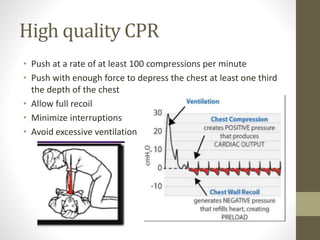
High quality CPR
• Push at a rate of at least 100 compressions per minute
• Push with enough force to depress the chest at least one third
the depth of the chest
• Allow full recoil
• Minimize interruptions
• Avoid excessive ventilation
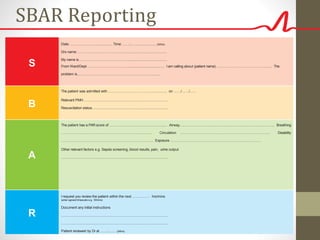
SBAR Reporting
S
Date: …………………................. Time: ……:…….................. (24hrs)
Drs name: ……………………………..................................................
My name is ……………………………………......................................
From Ward/Dept ……………………………...................................... I am calling about (patient name) …..………………………………....... The
problem is...……………………………………………………….....
B
The patient was admitted with ………………………………................ on ……/……/…..
Relevant PMH....................................................................................
Resuscitation status ...........................................................................
A
The patient has a PAR score of ……………........................................ Airway……………………………………………………………………... Breathing
………………………………………………………………..... Circulation ……………………………………………………………….... Disability
…………………………………………………………………... Exposure…………………………………………………………………..
Other relevant factors e.g. Sepsis screening, blood results, pain, urine output
...........................................................................................................
R
I request you review the patient within the next …………… hrs/mins
(enter agreed timescale e.g. 30mins)
Document any initial instructions
...........................................................................................................
...........................................................................................................
Patient reviewed by Dr at ……:…… (24hrs)
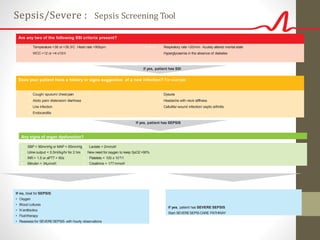
Are any two of the following SSI criteria present?
n n n Temperature <36 or >38.30C Heart rate >90bpm
WCC >12 or <4 x10⁹/l
n n n Respiratory rate >20/min Acutely altered mental state
Hyperglycaemia in the absence of diabetes
If no, treat for SEPSIS:
• Oxygen
• Blood cultures
• IVantibiotics
• Fluidtherapy
• Reassess for SEVERESEPSIS with hourly observations
Sepsis/Severe : Sepsis Screening Tool
Does your patient have a history or signs suggestive of a new infection? For example:
n Cough/ sputum/ chest pain n Dysuria
n Abdo pain/ distension/ diarrhoea n Headache with neck stiffness
n Line infection n Cellulitis/ wound infection/ septic arthritis
n Endocarditis
if yes, patient has SSI
n SBP < 90mmHg or MAP < 65mmHg n Lactate > 2mmol/l
n Urine output < 0.5ml/kg/hr for 2 hrs n New need for oxygen to keep SpO2 >90%
n INR > 1.5 or aPTT > 60s n Platelets < 100 x 10 9/1
n Bilirubin > 34µmol/l n Creatinine > 177mmol/l
Any signs of organ dysfunction?
If yes, patient has SEPSIS
If yes, patient has SEVERE SEPSIS
Start SEVERESEPISCARE PATHWAY
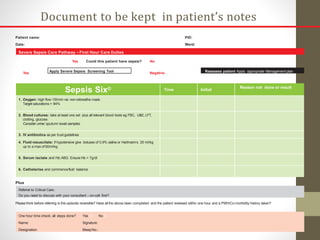
Patient name:
Date:
PID:
Ward:
Sepsis Six© Time Initial
Reason not done or result
1. Oxygen: high flow 15l/min via non-rebreathe mask.
Target saturations > 94%
2. Blood cultures: take at least one set plus all relevant blood tests eg FBC, U&E, LFT,
clotting, glucose.
Consider urine/ sputum/ swab samples.
3. IV antibiotics as per trust guidelines
4. Fluid resuscitate: if hypotensive give boluses of 0.9% saline or Hartmann’s 20 ml/kg
up to a max of 60ml/kg
5. Serum lactate and Hb:ABG Ensure Hb > 7g/dl
6. Catheterise and commencefluid balance
Plus
Referral to Critical Care.
Do you need to discuss with your consultant – on-call first?
Please think before referring is this episode reversible? Have all the above been completed and the patient reviewed within one hour and a PMH/Co-morbidity history taken?
One hour time check: all steps done? Yes n No n
Name: Signature:
Designation: BleepNo.:
Severe Sepsis Care Pathway – First Hour Care Duties
Document to be kept in patient’s notes
Yes Could this patient have sepsis? No
Apply Severe Sepsis Screening Tool Reassess patient Apply appropriate Management plan
Yes Negative
Take Home Message…..
• Early Identification and timely interventions are pivotal in
preventing mortality in pediatric ER.
• Systemic approach to Pediatric assesment is key to recognise
potential life threatening emergencies.
• Call for Help whenever in doubt.
• Adequate preparation is essential for ensuring patient safety.
• Effective team dynamics help in better success rates
Pals approach to sick child

Pals approach to sick child

  • 1.
    PALS : Approachto Emergency Assessment and Management Dr C. Abhiram kumar Fellow in PICU Aster CMI Hospital
  • 2.
    Objectives Recognize a seriouslyill child by using a systematic approach Proper Triage and allocation of Resources High quality cardiopulmonary resuscitation Stabilizing a seriously ill or injured child
  • 3.
    INTRODUCTION • Each yearmillions of children around the world die from potentially preventable and treatable causes • Majority of them could be prevented by paying attention to public health measures and living conditions • However improvement in early recognition of serious illnesses and delivery of initial medication can undoubtedly save lives • If basic principles of resuscitation are adhered to, it is possible to improve the outcome of serious illnesses with modest resources available
  • 4.
    Children are notminiature adults……
  • 5.
  • 6.
    • Pathways leadingto cardiorespiratory arrest
  • 9.
    Child unresponsive andnot breathing or only gasping Follow left side of algorithm Child responsive and breathing Follow right side of algorithm Evaluate using ABCDE components of primary assesment A-airway, B-breathing, C-circulation, D-disability, E-exposure
  • 10.
    THE PAT TRIANGLE •First impression • Rapid assesment • Visual and auditory
  • 11.
  • 12.
  • 13.
    • INTERVENE- Afteridentifying child’s condition, intervene with appropriate actions which may include: • giving a fluid bolus • supplying oxygen • positioning the child etc…..
  • 14.
  • 15.
    • BREATHING: Respiratory rateand pattern Respiratory effort Chest expansion and air movement Abnormal lung and airway sounds Oxygen saturation by pulse oximetry
  • 16.
    • CIRCULATION: Heart rate Pulses Capillaryrefill time Skin color and temperature Blood pressure
  • 17.
    • DISABILITY: AVPU responsescale Pupil size Blood glucose • EXPOSURE: Temperature Skin
  • 18.
    IDENTIFY RESPIRATORY PROBLEMS • TYPE: Upperairway obstruction Lower airway obstruction Lung tissue disease Disordered control of breathing • SEVERITY: Mild respiratory distress Severe respiratory distress
  • 19.
    CIRCULATORY EMERGENCIES • TYPE: Hypovolemicshock Cardiogenic shock Distributive shock Obstructive shock • SEVERITY: Compensated shock Hypotensive shock
  • 20.
    INTERVENE • MANAGEMENT OFRESPIRATORY PROBLEMS • RESPIRATORY ARREST: A child in respiratory arrest is not breathing or breathing ineffectively but has palpable central pulse. • Provide rescue breathing to prevent cardiac arrest
  • 21.
    • RESCUE BREATHING •Give 12-20 breaths per minute • Give each breath one second • Each breath should result in visible chest rise • Use oxygen as it is available
  • 22.
    • AIRWAY: • Supportthe airway(allow the child to assume position of comfort) or position the child to open the airway • Position in a way such that the oral axis, pharyngeal axis and laryngeal axis are aligned in same direction • Clear the airway(suction nose and mouth as indicated) • Insert an oropharyngeal airway as indicated
  • 23.
  • 25.
    . • BREATHING: • Assessand monitor oxygenation by pulse oximetry • Assess and monitor ventilation by evaluating respiratory rate, effort, and lung sounds • Assist ventilation if needed(eg- bag and mask) • Give oxygen. Provide humidified oxygen if available • Give medication as needed(eg- salbutamol, nebulized epinephrine)
  • 26.
    • BAG ANDMASK VENTILATION • A bag mask device consists of a ventilation bag and a face mask which can be used with or without oxygen • FACE MASK: select a face mask which extends from the bridge of the child’s nose to cleft of the chin covering the nose and mouth but not compressing the eyes • It should create a tight seal against the face. • Select a transparent mask if available
  • 27.
    .• VENTILATION BAGS: •They are mainly self inflating or flow inflating • They can be used with or without oxygen supplementation • To deliver near 100% oxygen concentration attach the bag and mask device with a reservoir to an oxygen source • Maintain oxygen flow of 10- 15 litres/minute • Titrate oxygen saturation to maintain saturation between 94- 99%
  • 29.
    Cont…. BAG MASK VENTILATIONTECHNIQUE: • Open the airway by tilting the head back • Use E-C clamp technique to lift the jaw against the mask , pressing and sealing the mask on the face • With other hand, squeeze the ventilation bag until the chest rises • Deliver each breath over one second making sure there is adequate chest rise with each breath • In two person bag and mask one person opens the airway and seals the mask to the child’s face and other provider squeezes the bag
  • 30.
  • 31.
    PULSE OXIMETRY: • Oxygensaturation is measured using the pulse oximeter • It is based on the Beer-Lambert’s law • It requires pulsatile blood flow to determine oxygen saturation • Check the accuracy by clinically correlating or with the cardiac monitor • Immediately evaluate the child if the oximeter fails to detect a signal or has inconsistent heart rate or there is a fall in saturation
  • 32.
    . • Pulse oximetrymay be inaccurate in the following settings: • Cardiac arrest • Shock or hypothermia • Motion, shivering or bright overhead lighting • Problem with skin probe interface • Misalignement of sensor with light source • Cardiac arrhythmias with low cardiac output
  • 33.
    • MANAGEMENT OFCIRCULATORY PROBLEMS Goals of shock management:  Improve oxygen content of blood  Improve blood flow to the tissues  Reduce tissue demand for oxygen  Support organ function  Prevent cardiac arrest
  • 34.
    GENERAL PRINCIPLE • Gethelp • Position the child • Give high flow oxygen • Support the airway and ventilation as needed • Ensure vascular access • Begin fluid boluses therapy • Monitor vitals • Identify response to therapy and intervene accordingly
  • 35.
    INTRAOSSEOUS ACCESS • Firstalternative to difficult or delayed intravenous access Intraosseous tray: Sand bag Gauze Sterile gloves Bone marrow needle (16 or 18 gauze) 10 or 20 ml syringes Dynoplast
  • 36.
    • Procedure: • placethe sand bag under the knee • slightly abduct and rotate the knee externally • clean the site of insertion with betadine soaked gauze • identify the tibial tubercle • introduce the bone marrow needle with trocar one cm below and medial to the landmark • with screwing movements introduce the needle into the tibia perpendicular to the shaft until a ‘give’ is felt • remove the trocar and push fluid with the syringe • encircle the needle with gauze and fix with dynoplast • can be retained for 24 hours
  • 37.
    FLUID BOLUSES:  Incase of hypovolemic or distributive shock 20 ml/kg of isotonic crystalloids is rapidly infused over 5-10 minutes  In case of cardiogenic shock smaller boluses such as 5-10 ml/kg should be infused more slowly over 10-20 minutes  Adjust fluid therapy for conditions such as diabetic ketoacidosis and burns  Do not use fluid containing dextrose as boluses  Reassess the child after boluses for further management
  • 38.
    CARDIAC ARREST • Cardiacarrest is absent or ineffective heart activity • With cardiac arrest, blood flow stops and signs of circulation are absent • Child becomes unresponsive and is not breathing • Death may occur if high quality CPR Is not provided • Two main types of cardiac arrest Hypoxic/asphyxial arrest Sudden cardiac arrest
  • 39.
    • Identification: unresponsiveness no breathingor only gasping no pulse(assess for no more than 10 seconds) • Palpate central pulses (carotid or femoral in a child and brachial in an infant) • If there is no pulse then start CPR, beginning with chest compressions
  • 41.
    High quality CPR •Push at a rate of at least 100 compressions per minute • Push with enough force to depress the chest at least one third the depth of the chest • Allow full recoil • Minimize interruptions • Avoid excessive ventilation
  • 42.
    SBAR Reporting S Date: ………………….................Time: ……:…….................. (24hrs) Drs name: …………………………….................................................. My name is ……………………………………...................................... From Ward/Dept ……………………………...................................... I am calling about (patient name) …..………………………………....... The problem is...………………………………………………………..... B The patient was admitted with ………………………………................ on ……/……/….. Relevant PMH.................................................................................... Resuscitation status ........................................................................... A The patient has a PAR score of ……………........................................ Airway……………………………………………………………………... Breathing ………………………………………………………………..... Circulation ……………………………………………………………….... Disability …………………………………………………………………... Exposure………………………………………………………………….. Other relevant factors e.g. Sepsis screening, blood results, pain, urine output ........................................................................................................... R I request you review the patient within the next …………… hrs/mins (enter agreed timescale e.g. 30mins) Document any initial instructions ........................................................................................................... ........................................................................................................... Patient reviewed by Dr at ……:…… (24hrs)
  • 43.
    Are any twoof the following SSI criteria present? n n n Temperature <36 or >38.30C Heart rate >90bpm WCC >12 or <4 x10⁹/l n n n Respiratory rate >20/min Acutely altered mental state Hyperglycaemia in the absence of diabetes If no, treat for SEPSIS: • Oxygen • Blood cultures • IVantibiotics • Fluidtherapy • Reassess for SEVERESEPSIS with hourly observations Sepsis/Severe : Sepsis Screening Tool Does your patient have a history or signs suggestive of a new infection? For example: n Cough/ sputum/ chest pain n Dysuria n Abdo pain/ distension/ diarrhoea n Headache with neck stiffness n Line infection n Cellulitis/ wound infection/ septic arthritis n Endocarditis if yes, patient has SSI n SBP < 90mmHg or MAP < 65mmHg n Lactate > 2mmol/l n Urine output < 0.5ml/kg/hr for 2 hrs n New need for oxygen to keep SpO2 >90% n INR > 1.5 or aPTT > 60s n Platelets < 100 x 10 9/1 n Bilirubin > 34µmol/l n Creatinine > 177mmol/l Any signs of organ dysfunction? If yes, patient has SEPSIS If yes, patient has SEVERE SEPSIS Start SEVERESEPISCARE PATHWAY
  • 44.
    Patient name: Date: PID: Ward: Sepsis Six©Time Initial Reason not done or result 1. Oxygen: high flow 15l/min via non-rebreathe mask. Target saturations > 94% 2. Blood cultures: take at least one set plus all relevant blood tests eg FBC, U&E, LFT, clotting, glucose. Consider urine/ sputum/ swab samples. 3. IV antibiotics as per trust guidelines 4. Fluid resuscitate: if hypotensive give boluses of 0.9% saline or Hartmann’s 20 ml/kg up to a max of 60ml/kg 5. Serum lactate and Hb:ABG Ensure Hb > 7g/dl 6. Catheterise and commencefluid balance Plus Referral to Critical Care. Do you need to discuss with your consultant – on-call first? Please think before referring is this episode reversible? Have all the above been completed and the patient reviewed within one hour and a PMH/Co-morbidity history taken? One hour time check: all steps done? Yes n No n Name: Signature: Designation: BleepNo.: Severe Sepsis Care Pathway – First Hour Care Duties Document to be kept in patient’s notes Yes Could this patient have sepsis? No Apply Severe Sepsis Screening Tool Reassess patient Apply appropriate Management plan Yes Negative
  • 46.
    Take Home Message….. •Early Identification and timely interventions are pivotal in preventing mortality in pediatric ER. • Systemic approach to Pediatric assesment is key to recognise potential life threatening emergencies. • Call for Help whenever in doubt. • Adequate preparation is essential for ensuring patient safety. • Effective team dynamics help in better success rates

Editor's Notes

  • #12 Level of consciousness- responsive, unresponsive, less responsive or alert Breathing- initial impression evaluate without steth. Look for respiratory effort and abnormal breathing sounds Color- skin color- mottling, pallor, cyanosis. Hemmorhage-obvious significant bleeding or bleeding within the skin like petechiae and purpura