Wave Guide & Component
(a) Define the terms w.r.t waveguide:
(i) Cut-off frequency
(ii) Cut-off wavelength Ans:
(each correct definition – 1 marks, formula 1 marks each)
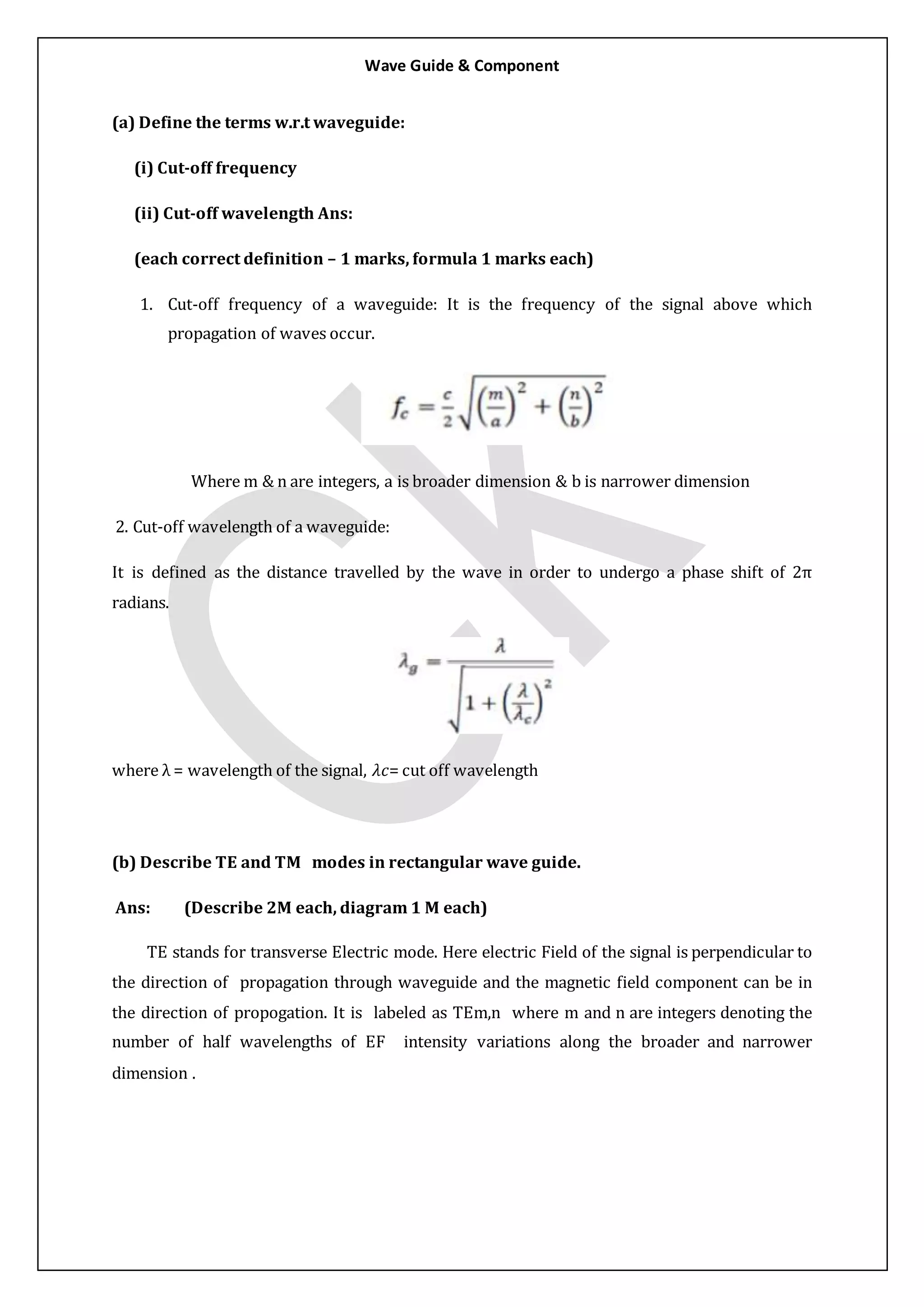
1. Cut-off frequency of a waveguide: It is the frequency of the signal above which
propagation of waves occur.
Where m & n are integers, a is broader dimension & b is narrower dimension
2. Cut-off wavelength of a waveguide:
It is defined as the distance travelled by the wave in order to undergo a phase shift of 2π
radians.
where λ = wavelength of the signal, 𝜆𝑐= cut off wavelength
(b) Describe TE and TM modes in rectangular wave guide.
Ans: (Describe 2M each, diagram 1 M each)
TE stands for transverse Electric mode. Here electric Field of the signal is perpendicular to
the direction of propagation through waveguide and the magnetic field component can be in
the direction of propogation. It is labeled as TEm,n where m and n are integers denoting the
number of half wavelengths of EF intensity variations along the broader and narrower
dimension .
Wave Guide & Component
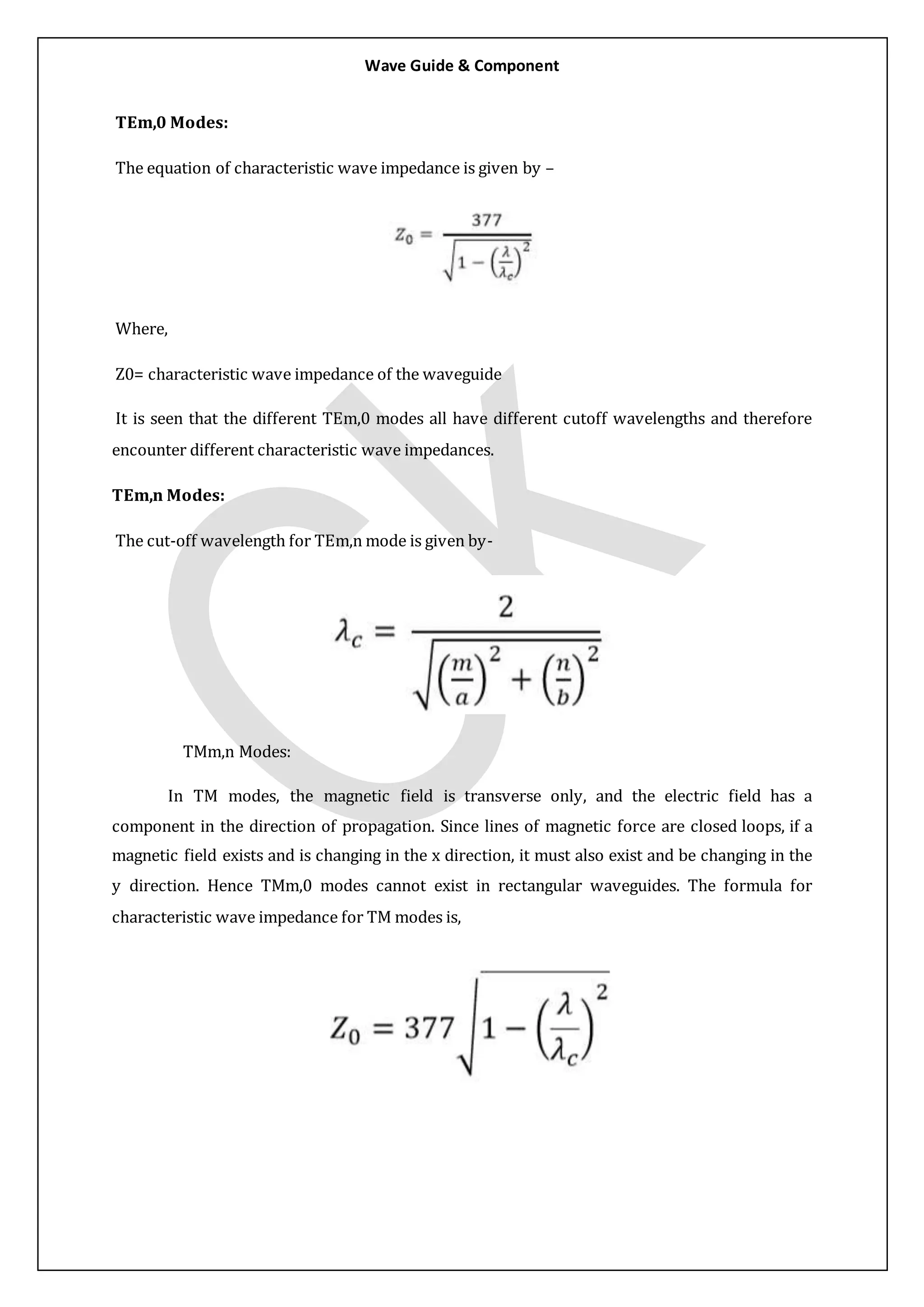
TEm,0 Modes:
The equation of characteristic wave impedance is given by –
Where,
Z0= characteristic wave impedance of the waveguide
It is seen that the different TEm,0 modes all have different cutoff wavelengths and therefore
encounter different characteristic wave impedances.
TEm,n Modes:
The cut-off wavelength for TEm,n mode is given by-
TMm,n Modes:
In TM modes, the magnetic field is transverse only, and the electric field has a
component in the direction of propagation. Since lines of magnetic force are closed loops, if a
magnetic field exists and is changing in the x direction, it must also exist and be changing in the
y direction. Hence TMm,0 modes cannot exist in rectangular waveguides. The formula for
characteristic wave impedance for TM modes is,
Wave Guide & Component
(C) Differentiatebetweenwaveguideandtwo-wiretransmissionline.
(D) State the advantages and application of circular waveguide (2 points each).
Ans: (Advantages- 2M, Applications-2M)
1. The circular waveguide are easier to manufacture than rectangular waveguides and are easier
to join.
2. The TM01 modes are rotationally symmetrical and hence rotation of polarization can be
overcome.
3. TE01 mode in circular for long distance waveguide transmission.
Applications
1. It is used where the transmission or reception is in the range of microwave frequencies.
2. It is also used for handling the high power of energy.
3. It is mostly used in the airborne radar.
4. The circular waveguide is mostly used in the ground radar to transmit or receive the energy
from antenna. This revolves in 360 degree bearing continuously.
5. The waveguide is also used in communication system.
6. It can also use in the devices of navigation aids.
7. The circular waveguides are also used with the cavity resonators to carry the input and
output signals
Wave Guide & Component
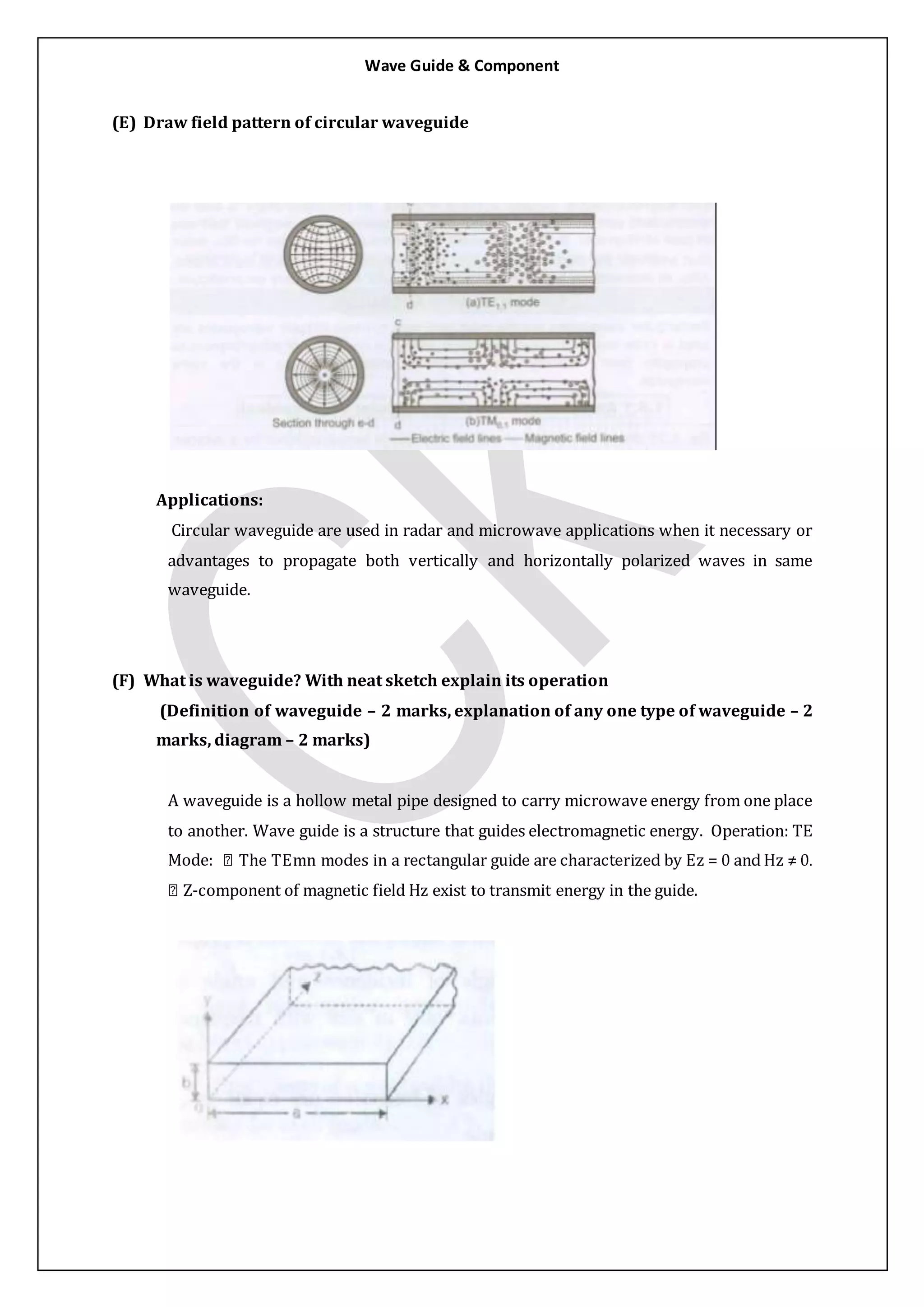
(E) Draw field pattern of circular waveguide
Applications:
Circular waveguide are used in radar and microwave applications when it necessary or
advantages to propagate both vertically and horizontally polarized waves in same
waveguide.
(F) What is waveguide? With neat sketch explain its operation
(Definition of waveguide – 2 marks, explanation of any one type of waveguide – 2
marks, diagram – 2 marks)
A waveguide is a hollow metal pipe designed to carry microwave energy from one place
to another. Wave guide is a structure that guides electromagnetic energy. Operation: TE
Mode:
-component of magnetic field Hz exist to transmit energy in the guide.
Wave Guide & Component
For rectangular waveguide:
electric fields are transverse to the
direction of propagation and not longitudinal electric field is present.
longitudinal component of magnetic field and so TEmn waves are also called Hmn waves
1. Above Graph shows the field variations in a waveguide for TE10, TE20, mode.
2. The electric field exists only at right angles to the direction of propagation.
3. The electric field is maximum at the centre of the waveguide and drops off
sinusoidal to zero intensity at the walls.
4. TEmn mode : m - indicates the number of half wave loops across the width of the
guide, n – indicates the number of loops across the height of the guide or no E-field
patterns across „b‟ dimension. In above graphs value of n is 0.
5. Choose the dimension of a guide in such a way that for a given input signal, only
energy of the dominant mode can be transmitted through the guide.
magnetic field caused by half-sine E field.
6. In figure, the magnetic field is in the form of (closed) loops. Which lie in planes
normal to electric field i.e. parallel to the top and bottom of the guide.
7. The magnitude of the magnetic field varies in a sine wave pattern down the center of
the waveguide in „time phase‟with the electric field.
Wave Guide & Component
8. Time phase means that the peak H lines and peak E lines occur at the same instant
in time.
9. Whenever two or more modes are having same cut-off frequency, they are said to
be degenerate modes.
10. In rectangular guide TEmn and TMmn are always degenerate modes. TM Mode in
Rectangular Waveguide
11. Transverse magnetic mode in rectangular waveguide is characterized by the Hz=0
transmit energy in the
guide.
12. Fields exists in discrete patterns.
13. All field components have sinusoidal amplitude variations in X and Y directions.
14. In TMmn, subscripts m and n represent number of half sinusoidal cycles of the field
amplitude in X and Y directions respectively.
15.For the existence of TM mode both indices M and N have to be non-zero.
16.So TMmo and TMon modes cannot exist.
17.On the waveguide walls the tangential components of the electric field is zero and
the tangential component of the magnetic field is maximum.
Wave Guide & Component
(E) Differentiate between circular and rectangular waveguide.
(G) Distinguish between circular wavegauide and rectangular waveguide
Ans: (any four
correct points – 1
mark each)
Wave Guide & Component
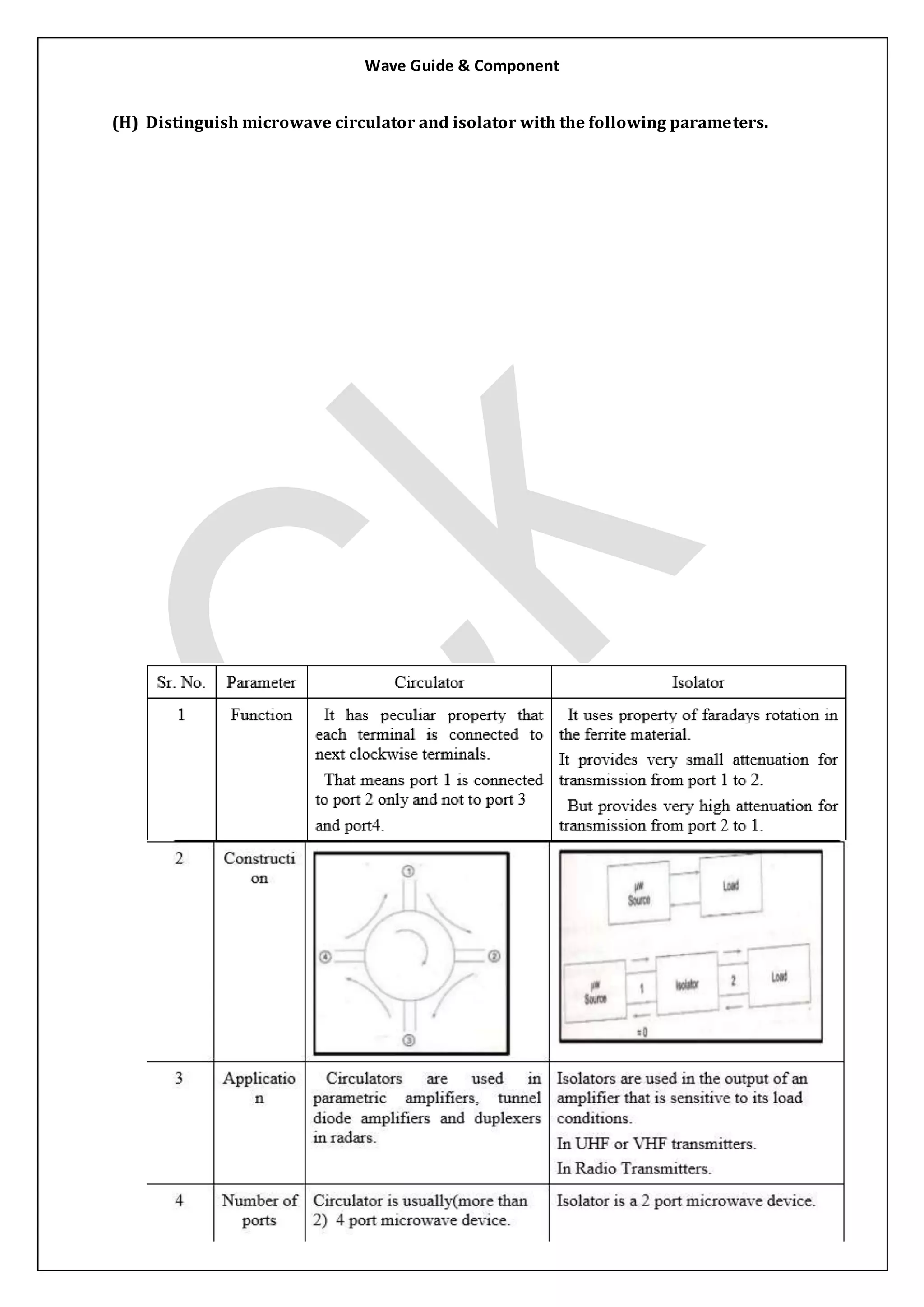
(H) Distinguish microwave circulator and isolator with the following parameters.

Wavegauide

  • 1.
    Wave Guide &Component (a) Define the terms w.r.t waveguide: (i) Cut-off frequency (ii) Cut-off wavelength Ans: (each correct definition – 1 marks, formula 1 marks each) 1. Cut-off frequency of a waveguide: It is the frequency of the signal above which propagation of waves occur. Where m & n are integers, a is broader dimension & b is narrower dimension 2. Cut-off wavelength of a waveguide: It is defined as the distance travelled by the wave in order to undergo a phase shift of 2π radians. where λ = wavelength of the signal, 𝜆𝑐= cut off wavelength (b) Describe TE and TM modes in rectangular wave guide. Ans: (Describe 2M each, diagram 1 M each) TE stands for transverse Electric mode. Here electric Field of the signal is perpendicular to the direction of propagation through waveguide and the magnetic field component can be in the direction of propogation. It is labeled as TEm,n where m and n are integers denoting the number of half wavelengths of EF intensity variations along the broader and narrower dimension .
  • 2.
    Wave Guide &Component TEm,0 Modes: The equation of characteristic wave impedance is given by – Where, Z0= characteristic wave impedance of the waveguide It is seen that the different TEm,0 modes all have different cutoff wavelengths and therefore encounter different characteristic wave impedances. TEm,n Modes: The cut-off wavelength for TEm,n mode is given by- TMm,n Modes: In TM modes, the magnetic field is transverse only, and the electric field has a component in the direction of propagation. Since lines of magnetic force are closed loops, if a magnetic field exists and is changing in the x direction, it must also exist and be changing in the y direction. Hence TMm,0 modes cannot exist in rectangular waveguides. The formula for characteristic wave impedance for TM modes is,
  • 3.
    Wave Guide &Component (C) Differentiatebetweenwaveguideandtwo-wiretransmissionline. (D) State the advantages and application of circular waveguide (2 points each). Ans: (Advantages- 2M, Applications-2M) 1. The circular waveguide are easier to manufacture than rectangular waveguides and are easier to join. 2. The TM01 modes are rotationally symmetrical and hence rotation of polarization can be overcome. 3. TE01 mode in circular for long distance waveguide transmission. Applications 1. It is used where the transmission or reception is in the range of microwave frequencies. 2. It is also used for handling the high power of energy. 3. It is mostly used in the airborne radar. 4. The circular waveguide is mostly used in the ground radar to transmit or receive the energy from antenna. This revolves in 360 degree bearing continuously. 5. The waveguide is also used in communication system. 6. It can also use in the devices of navigation aids. 7. The circular waveguides are also used with the cavity resonators to carry the input and output signals
  • 4.
    Wave Guide &Component (E) Draw field pattern of circular waveguide Applications: Circular waveguide are used in radar and microwave applications when it necessary or advantages to propagate both vertically and horizontally polarized waves in same waveguide. (F) What is waveguide? With neat sketch explain its operation (Definition of waveguide – 2 marks, explanation of any one type of waveguide – 2 marks, diagram – 2 marks) A waveguide is a hollow metal pipe designed to carry microwave energy from one place to another. Wave guide is a structure that guides electromagnetic energy. Operation: TE Mode: -component of magnetic field Hz exist to transmit energy in the guide.
  • 5.
    Wave Guide &Component For rectangular waveguide: electric fields are transverse to the direction of propagation and not longitudinal electric field is present. longitudinal component of magnetic field and so TEmn waves are also called Hmn waves 1. Above Graph shows the field variations in a waveguide for TE10, TE20, mode. 2. The electric field exists only at right angles to the direction of propagation. 3. The electric field is maximum at the centre of the waveguide and drops off sinusoidal to zero intensity at the walls. 4. TEmn mode : m - indicates the number of half wave loops across the width of the guide, n – indicates the number of loops across the height of the guide or no E-field patterns across „b‟ dimension. In above graphs value of n is 0. 5. Choose the dimension of a guide in such a way that for a given input signal, only energy of the dominant mode can be transmitted through the guide. magnetic field caused by half-sine E field. 6. In figure, the magnetic field is in the form of (closed) loops. Which lie in planes normal to electric field i.e. parallel to the top and bottom of the guide. 7. The magnitude of the magnetic field varies in a sine wave pattern down the center of the waveguide in „time phase‟with the electric field.
  • 6.
    Wave Guide &Component 8. Time phase means that the peak H lines and peak E lines occur at the same instant in time. 9. Whenever two or more modes are having same cut-off frequency, they are said to be degenerate modes. 10. In rectangular guide TEmn and TMmn are always degenerate modes. TM Mode in Rectangular Waveguide 11. Transverse magnetic mode in rectangular waveguide is characterized by the Hz=0 transmit energy in the guide. 12. Fields exists in discrete patterns. 13. All field components have sinusoidal amplitude variations in X and Y directions. 14. In TMmn, subscripts m and n represent number of half sinusoidal cycles of the field amplitude in X and Y directions respectively. 15.For the existence of TM mode both indices M and N have to be non-zero. 16.So TMmo and TMon modes cannot exist. 17.On the waveguide walls the tangential components of the electric field is zero and the tangential component of the magnetic field is maximum.
  • 7.
    Wave Guide &Component (E) Differentiate between circular and rectangular waveguide. (G) Distinguish between circular wavegauide and rectangular waveguide Ans: (any four correct points – 1 mark each)
  • 8.
    Wave Guide &Component (H) Distinguish microwave circulator and isolator with the following parameters.