Prepared by:
A. V. MODI
Civil Engg. Department
Merchant Engineering College, Basna
IRRIGATION
• Irrigation is defined as the process of artificially
supplying water to soil for raising crops.
• A crop requires a certain amount of water at some
fixed time interval throughout its period of growth.
• If the water requirement of crop is met by natural
rainfall during the growth period, there is no need of
irrigation.
NECESSITY OF IRRIGATION
1. Inadequate rainfall.
2. Non-uniform rainfall.
3. Growing a number of crops during a year.
4. Growing perennial crops.
5. Growing superior crops.
6. Increasing the yield of crops.
7. Insurance against drought.
Surface
irrigation
IRRIGATION METHODS
Sub-surface
irrigation
Sprinkler
irrigation
Flooding
method
Furrow
method
Contour
farming
Wild
flooding
Controlled
flooding
Free
flooding
Contour
laterals
Border
strips
Basin
flooding
Check
flooding
Zig-zag
method
Drip
irrigation
FACTORS
1. Soil characteristics of the land to be irrigated
2. Topography of the area
3. The available water supply
4. Type of crop and its requirements
5. Size of the stream supplying irrigation water
6. Amount of water required in each irrigation
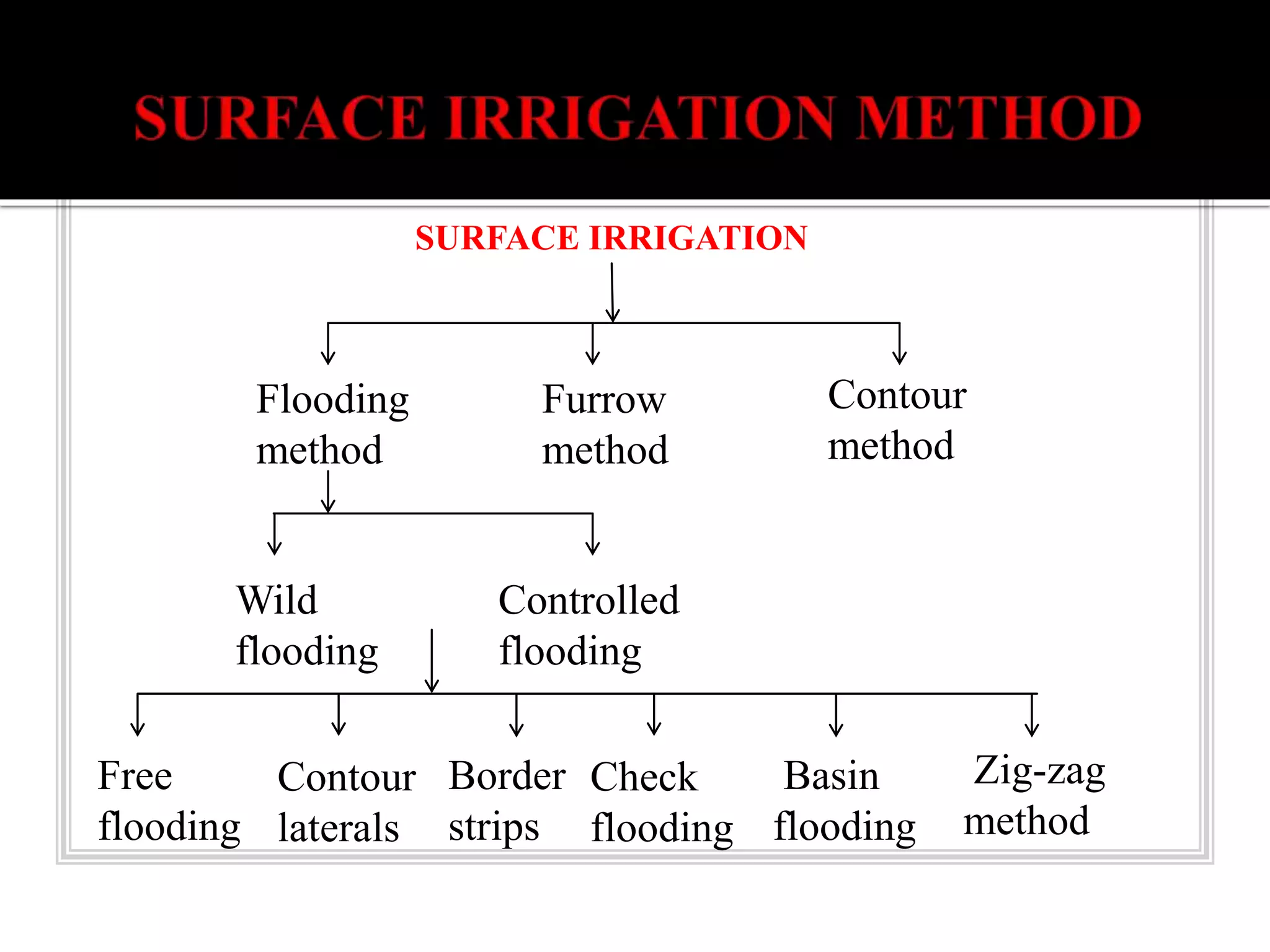
SURFACE IRRIGATION
Flooding
method
Furrow
method
Contour
method
Wild
flooding
Controlled
flooding
Free
flooding
Contour
laterals
Border
strips
Basin
flooding
Check
flooding
Zig-zag
method
SURFACE IRRIGATION METHOD
• In surface irrigation methods, the irrigation water is
applied by spreading in the form of sheet or small
streams on the lands to be irrigated.
• The surface irrigation is further divided as follows:
1. Flooding method
2. Furrow method
3. Contour farming
WILD FLOODING METHOD
• Wild flooding method is the earliest and the primitive
method of application of water to the land.
• In this method the water is applied by spreading it
over the land prior to the application of water, no land
preparations is done in the form of border or field
ditches.
• The water is allowed to flow the natural slope of the
land.
CONTROLLED FLOODING
• In controlled flooding methods irrigation water is
applied by spreading it over the land to be irrigated
with proper control on the flow of water as well as the
quantity of water applied.
• All the methods of control flooding require prior
preparation of the land.
• The land is properly graded & agricultural fields are
divided into small units by levees .
CONTROLLED FLOODING
• The various methods of controlled flooding are:
1. Free flooding
2. Contour laterals
3. Border strips
4. Check basins
5. Basin flooding
6. Zig - zag method
FREE FLOODING
• Free flooding consists of dividing the entire land to be
irrigated into small strips by a number of field
channels or levees known as laterals.
• These laterals may be either at right angles to the sides
of the field or at right angles to the contour lines .
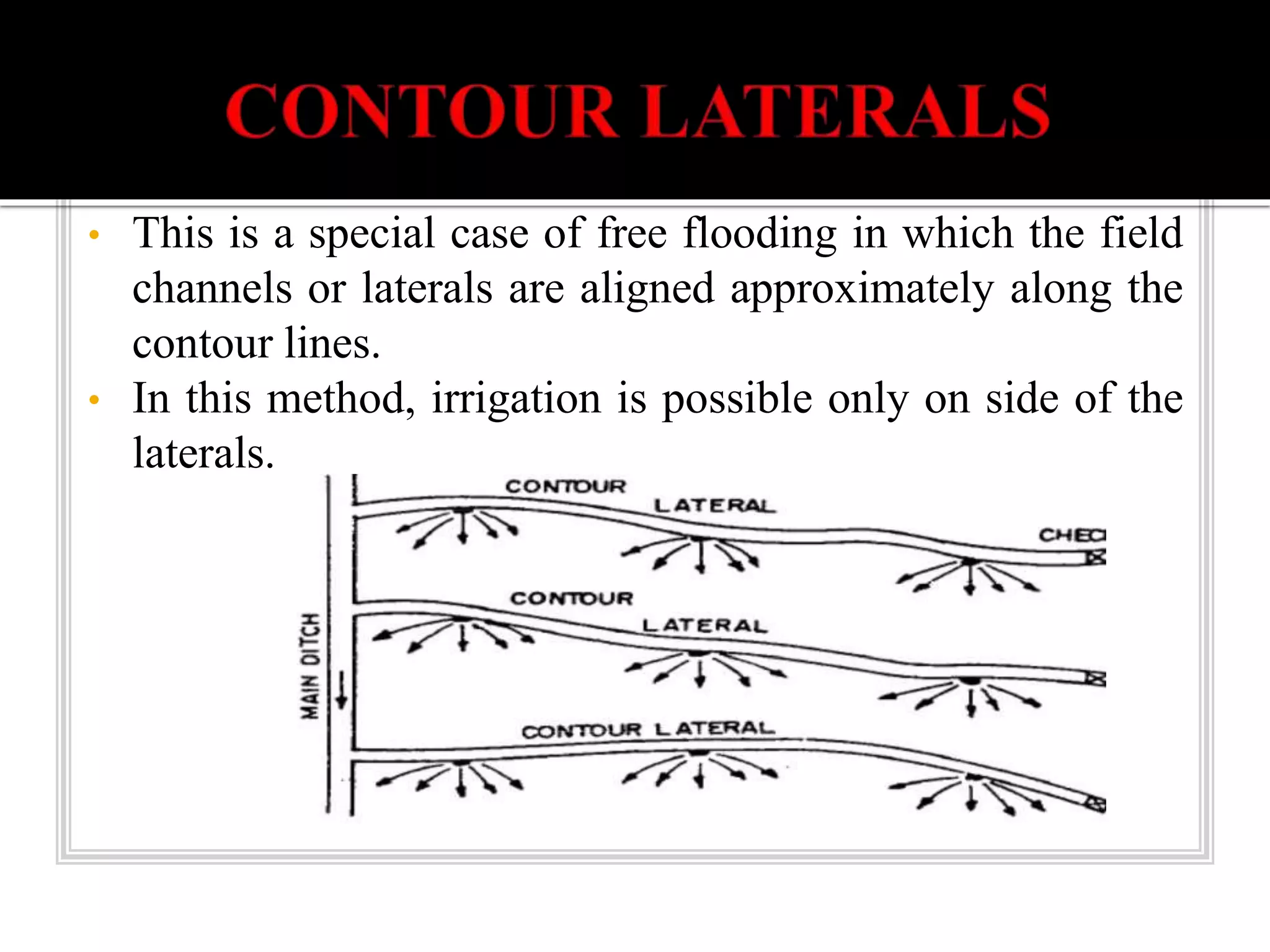
• This is a special case of free flooding in which the field
channels or laterals are aligned approximately along the
contour lines.
• In this method, irrigation is possible only on side of the
laterals.
• In this method, the agricultural area is divided into series
of long narrow strips known as border strips by levees,
small bunds.
• This method is suitable when the area is at level with
gentle slope.
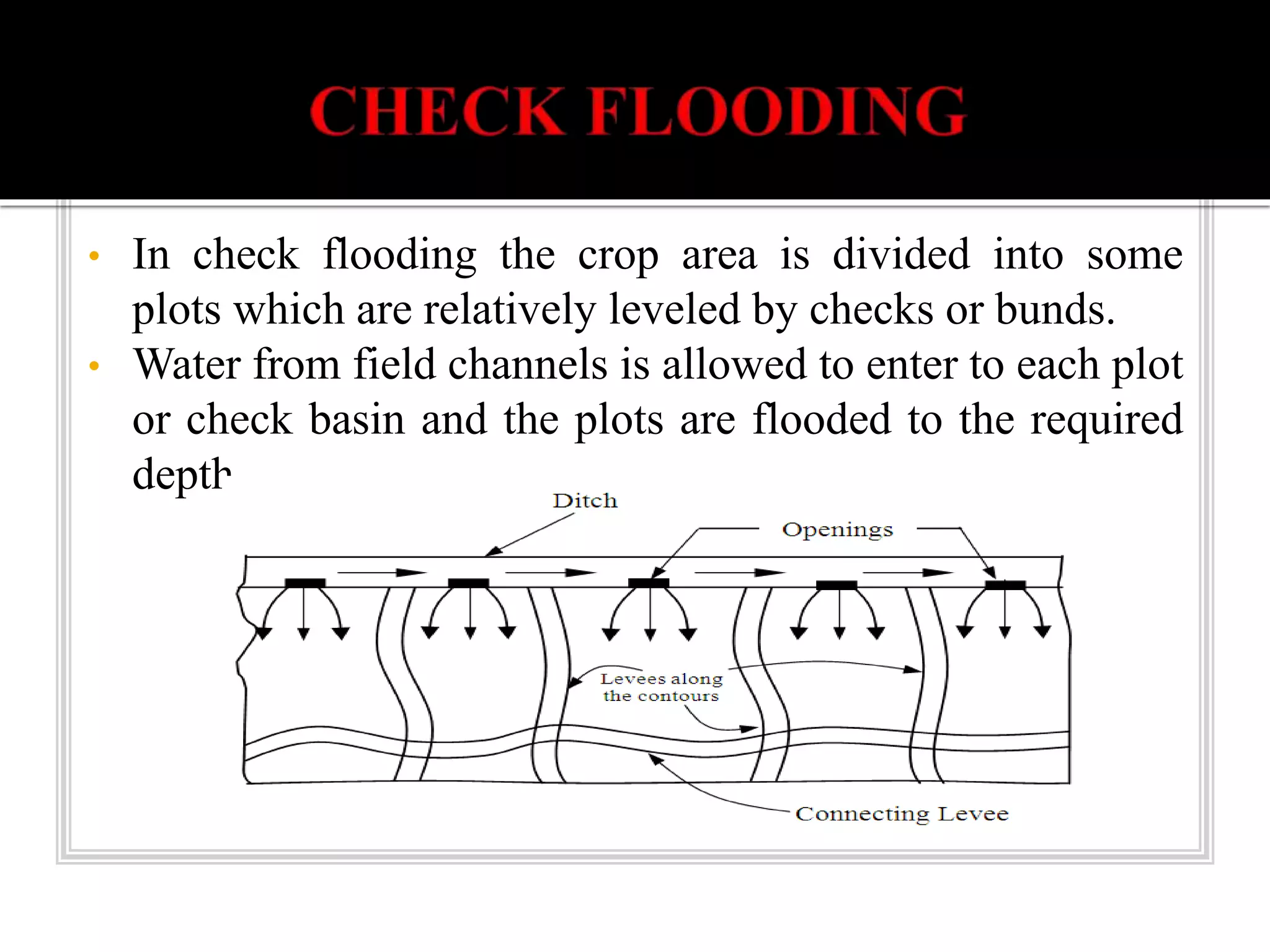
• In check flooding the crop area is divided into some
plots which are relatively leveled by checks or bunds.
• Water from field channels is allowed to enter to each plot
or check basin and the plots are flooded to the required
depth.
• This method is used frequently to irrigate the plantations.
It is a special type of check flooding method.
• Each plant is enclosed by circular channels which is
called basin. Basins are connected to small field ditches.
• Ditches are fed from the main supply channel.
• In this method, the agricultural area is sub-divided into
small plots by low bunds in a zig-zag manner.
• The water is supplied to the plots from the field channel
through the openings.
• The water flows in a zig-zag way to cover the entire area.
When the desired depth is attained, the openings are
closed.
• Furrow irrigation avoids flooding the entire field
surface by channeling the flow along the primary
direction of the field using ‘furrows,’ ‘grooves’,
‘lines’. Water infiltrates through the wetted perimeter
and spreads vertically and horizontally to refill the
soil reservoir.
• Furrows necessitate the wetting of only about half to
one-fifth of the field surface. This reduces the
evaporation loss considerably.
• Furrows provide better on-farm water management
capabilities for most of the surface irrigation
conditions, and variable and severe topographical
conditions.
• Furrow irrigation requires more labour than any
other surface irrigation method.
• Contour farming is practiced in hilly areas with slopes
and with falling contour.
• The land is divided into series of horizontal strips called
terraces.
• Small bunds are constructed at the end of each terrace to
hold water up to equal height.
SUB-SURFACE IRRIGATION
METHOD
• Subsurface drip irrigation (SDI) is the irrigation of
crops through buried plastic tubes containing embedded
emitters located at regular spacing.
• The sub surface irrigation method consists of supplying
water directly to the root zone of the plants.
• The favourable conditions for sub surface irrigation:
1. Moderate slope
2. Uniform topographic condition
3. Good quality of irrigation water
4. Impervious sub-soil at reasonable depth
• Sprinkler irrigation is a method of applying irrigation water
which is similar to natural rainfall.
• Water is distributed through a system of pipes usually by
pumping. It is then sprayed into the air through sprinklers so
that it breaks up into small water drops which fall to the
ground. Rotating sprinkler-head systems are commonly used
for sprinkler irrigation.
• Each rotating sprinkler head applies water to a given area, size
of which is governed by the nozzle size and the water pressure.
Alternatively, perforated pipe can be used to deliver water
through very small holes which are drilled at close intervals
along a segment of the circumference of a pipe.
• Sprinklers have been used on all types of soils on lands of
different topography and slopes, and for many crops. The
following conditions are favorable for sprinkler irrigation:
• Lands which have steep slopes and easily erodible soils,
• Irrigation channels which are too small to distribute water
efficiently by surface irrigation, and
• Lands with shallow soils and undulating lands which prevent
proper leveling required for surface methods of irrigation
ADVANTAGES
1. Low water loss
2. Saving in fertilizer, Suitable for any topography
3. No soil erosion
4. Better seed germination, free aeration of root zone
5. Uniform application of water
DISADVANTAGES
1. High initial cost, cannot adopt by ordinary farmers
2. Poor application efficiency in windy weather and high temperature
3. High evaporation losses
4. Water should be free of debris
5. Physical damage to crops by application of high intensity spray
DRIP IRRIGATION
• Drip irrigation is also known as trickle irrigation . It is one of the latest
developed methods of irrigation which is more popular in the regions
facing scarcity of water.
• This method was first introduced in Israel. In India this method is more
useful in areas in Gujarat, Maharashtra, Kerala, & Karnataka.
• Trickle irrigation system comprises main line, sub mains, laterals, valves
(to control the flow), drippers or emitters , pressure gauges, water
meters, filters , pumps, fertilizer tanks, vacuum breakers, and pressure
regulators.
• The drippers are designed to supply water at the desired rate (1 to 10
liters per hour) directly to the soil. Low pressure heads at the emitters
are considered adequate as the soil capillary forces causes the emitted
water to spread laterally and vertically.
DRIP IRRIGATION
ADVANTAGES
1. Low water loss and hence saves water
2. Enhances plant growth and plant yield
3. Saves labor and energy
4. Control weed growth
5. No soil erosion
6. Improves fertilizer application efficiency
DISADVANTAGES
1. High skill in design, installation, and subsequent operation
2. Clogging of small conduits and openings in emitters due to sand,
clay particles, debris, chemical precipitates and organic growth
3. Not suitable for closely planted crops such as wheat and other
cereal grains
26

METHODS OF IRRIGATION BY AKASH V. MODI

  • 1.
    Prepared by: A. V.MODI Civil Engg. Department Merchant Engineering College, Basna
  • 2.
    IRRIGATION • Irrigation isdefined as the process of artificially supplying water to soil for raising crops. • A crop requires a certain amount of water at some fixed time interval throughout its period of growth. • If the water requirement of crop is met by natural rainfall during the growth period, there is no need of irrigation.
  • 3.
    NECESSITY OF IRRIGATION 1.Inadequate rainfall. 2. Non-uniform rainfall. 3. Growing a number of crops during a year. 4. Growing perennial crops. 5. Growing superior crops. 6. Increasing the yield of crops. 7. Insurance against drought.
  • 4.
  • 5.
    FACTORS 1. Soil characteristicsof the land to be irrigated 2. Topography of the area 3. The available water supply 4. Type of crop and its requirements 5. Size of the stream supplying irrigation water 6. Amount of water required in each irrigation
  • 6.
  • 7.
    SURFACE IRRIGATION METHOD •In surface irrigation methods, the irrigation water is applied by spreading in the form of sheet or small streams on the lands to be irrigated. • The surface irrigation is further divided as follows: 1. Flooding method 2. Furrow method 3. Contour farming
  • 8.
    WILD FLOODING METHOD •Wild flooding method is the earliest and the primitive method of application of water to the land. • In this method the water is applied by spreading it over the land prior to the application of water, no land preparations is done in the form of border or field ditches. • The water is allowed to flow the natural slope of the land.
  • 9.
    CONTROLLED FLOODING • Incontrolled flooding methods irrigation water is applied by spreading it over the land to be irrigated with proper control on the flow of water as well as the quantity of water applied. • All the methods of control flooding require prior preparation of the land. • The land is properly graded & agricultural fields are divided into small units by levees .
  • 10.
    CONTROLLED FLOODING • Thevarious methods of controlled flooding are: 1. Free flooding 2. Contour laterals 3. Border strips 4. Check basins 5. Basin flooding 6. Zig - zag method
  • 11.
    FREE FLOODING • Freeflooding consists of dividing the entire land to be irrigated into small strips by a number of field channels or levees known as laterals. • These laterals may be either at right angles to the sides of the field or at right angles to the contour lines .
  • 12.
    • This isa special case of free flooding in which the field channels or laterals are aligned approximately along the contour lines. • In this method, irrigation is possible only on side of the laterals.
  • 13.
    • In thismethod, the agricultural area is divided into series of long narrow strips known as border strips by levees, small bunds. • This method is suitable when the area is at level with gentle slope.
  • 14.
    • In checkflooding the crop area is divided into some plots which are relatively leveled by checks or bunds. • Water from field channels is allowed to enter to each plot or check basin and the plots are flooded to the required depth.
  • 15.
    • This methodis used frequently to irrigate the plantations. It is a special type of check flooding method. • Each plant is enclosed by circular channels which is called basin. Basins are connected to small field ditches. • Ditches are fed from the main supply channel.
  • 16.
    • In thismethod, the agricultural area is sub-divided into small plots by low bunds in a zig-zag manner. • The water is supplied to the plots from the field channel through the openings. • The water flows in a zig-zag way to cover the entire area. When the desired depth is attained, the openings are closed.
  • 17.
    • Furrow irrigationavoids flooding the entire field surface by channeling the flow along the primary direction of the field using ‘furrows,’ ‘grooves’, ‘lines’. Water infiltrates through the wetted perimeter and spreads vertically and horizontally to refill the soil reservoir. • Furrows necessitate the wetting of only about half to one-fifth of the field surface. This reduces the evaporation loss considerably. • Furrows provide better on-farm water management capabilities for most of the surface irrigation conditions, and variable and severe topographical conditions. • Furrow irrigation requires more labour than any other surface irrigation method.
  • 18.
    • Contour farmingis practiced in hilly areas with slopes and with falling contour. • The land is divided into series of horizontal strips called terraces. • Small bunds are constructed at the end of each terrace to hold water up to equal height.
  • 19.
    SUB-SURFACE IRRIGATION METHOD • Subsurfacedrip irrigation (SDI) is the irrigation of crops through buried plastic tubes containing embedded emitters located at regular spacing. • The sub surface irrigation method consists of supplying water directly to the root zone of the plants. • The favourable conditions for sub surface irrigation: 1. Moderate slope 2. Uniform topographic condition 3. Good quality of irrigation water 4. Impervious sub-soil at reasonable depth
  • 20.
    • Sprinkler irrigationis a method of applying irrigation water which is similar to natural rainfall. • Water is distributed through a system of pipes usually by pumping. It is then sprayed into the air through sprinklers so that it breaks up into small water drops which fall to the ground. Rotating sprinkler-head systems are commonly used for sprinkler irrigation. • Each rotating sprinkler head applies water to a given area, size of which is governed by the nozzle size and the water pressure. Alternatively, perforated pipe can be used to deliver water through very small holes which are drilled at close intervals along a segment of the circumference of a pipe.
  • 21.
    • Sprinklers havebeen used on all types of soils on lands of different topography and slopes, and for many crops. The following conditions are favorable for sprinkler irrigation: • Lands which have steep slopes and easily erodible soils, • Irrigation channels which are too small to distribute water efficiently by surface irrigation, and • Lands with shallow soils and undulating lands which prevent proper leveling required for surface methods of irrigation
  • 22.
    ADVANTAGES 1. Low waterloss 2. Saving in fertilizer, Suitable for any topography 3. No soil erosion 4. Better seed germination, free aeration of root zone 5. Uniform application of water DISADVANTAGES 1. High initial cost, cannot adopt by ordinary farmers 2. Poor application efficiency in windy weather and high temperature 3. High evaporation losses 4. Water should be free of debris 5. Physical damage to crops by application of high intensity spray
  • 23.
    DRIP IRRIGATION • Dripirrigation is also known as trickle irrigation . It is one of the latest developed methods of irrigation which is more popular in the regions facing scarcity of water. • This method was first introduced in Israel. In India this method is more useful in areas in Gujarat, Maharashtra, Kerala, & Karnataka. • Trickle irrigation system comprises main line, sub mains, laterals, valves (to control the flow), drippers or emitters , pressure gauges, water meters, filters , pumps, fertilizer tanks, vacuum breakers, and pressure regulators. • The drippers are designed to supply water at the desired rate (1 to 10 liters per hour) directly to the soil. Low pressure heads at the emitters are considered adequate as the soil capillary forces causes the emitted water to spread laterally and vertically.
  • 25.
  • 26.
    ADVANTAGES 1. Low waterloss and hence saves water 2. Enhances plant growth and plant yield 3. Saves labor and energy 4. Control weed growth 5. No soil erosion 6. Improves fertilizer application efficiency DISADVANTAGES 1. High skill in design, installation, and subsequent operation 2. Clogging of small conduits and openings in emitters due to sand, clay particles, debris, chemical precipitates and organic growth 3. Not suitable for closely planted crops such as wheat and other cereal grains 26