
• Dynamic way to collect and analyze data about a
client, the first step in delivering nursing care.
Assessment includes not only physiological data, but
also psychological, sociocultural, spiritual, economic,
and life-style factors as well.
•When you perform a physical assessment, you'll use
four techniques: inspection, palpation, percussion, and
auscultation
• Inspection. Inspect each body system using vision,
smell, and hearing to assess normal conditions and
deviations.
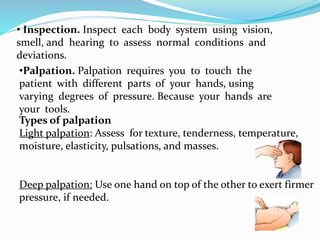
•Palpation. Palpation requires you to touch the
patient with different parts of your hands, using
varying degrees of pressure. Because your hands are
your tools.
Types of palpation
Light palpation: Assess for texture, tenderness, temperature,
moisture, elasticity, pulsations, and masses.
Deep palpation: Use one hand on top of the other to exert firmer
pressure, if needed.
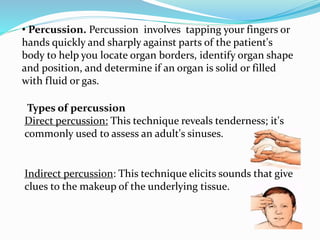
• Percussion. Percussion involves tapping your fingers or
hands quickly and sharply against parts of the patient's
body to help you locate organ borders, identify organ shape
and position, and determine if an organ is solid or filled
with fluid or gas.
Types of percussion
Direct percussion: This technique reveals tenderness; it's
commonly used to assess an adult's sinuses.
Indirect percussion: This technique elicits sounds that give
clues to the makeup of the underlying tissue.
• Auscultation. Auscultation involves
listening : lungs, heart, and bowel sounds
with a stethoscope. Can be call wall to wall
Sternocleidomastoid muscle: It serves as a
primary muscular landmark of the neck
during an extra oral examination of a patient;
to help define the location of structures,
such as the lymph nodes for the head and
neck. The function of this muscle is to rotate
the head to the opposite side or obliquely
rotate the head.
•Appendicular Coordination:
Fine movements of the hands and
feet are used for general motor
exam. The most popular test of
coordination, is the finger-nose-
finger test
• Range of motion: The full movement potential of a joint,
usually its range of flexion and extension.
• Confrontation: Is the application of a direct approach by
which feelings are communicated forthrightly and clearly
• Kernig's and Brudzinski test. Kernig's sign and Brudzinski
sign show the presence of meningitis
• The nurse’s clinical judgment about the client’s response
to actual or potential health conditions or needs. The
diagnosis reflects not only that the patient is in pain, but
that the pain has caused other problems such as anxiety,
poor nutrition, and conflict within the family, or has the
potential to cause complications
•The nurse sets measurable and achievable short- and
long-range goals for this patient that might include
moving from bed to chair at least three times per day;
maintaining adequate nutrition by eating smaller, more
frequent meals; resolving conflict through counseling, or
managing pain through adequate medication.
Nursing care is implemented according to the care plan, so
continuity of care for the patient during hospitalization and
in preparation for discharge needs to be assured. Care is
documented in the patient’s record.
Before every intervention process nurses must implement
some steps to have a safe practice of this part of the process:
Hand washing
Gloving
Gowning
The Intervention process is composed by many steps:
•Patient Identification
•Skin preparation
•Side Rails-up
•Oxygenation
•Suctioning
•Hyper oxygenation
•IM. Intra Muscular Injection
•Cardio-Pulmonary Resuscitation
•Defibrillation
•Bad-Valve Mask-Ventilator
•Lubrication en Insertion
•Catheterization
•Rule of 7
•I.E. Internal Exam
•Bearing down
•Vaccination
•Sterilization
• The patient’s status and the effectiveness of the nursing
care must be continuously evaluated, and the care plan
modified as needed. This requires nursing rounds and
surveillance monitoring
Nursing Process

Nursing Process

  • 4.
    • Dynamic wayto collect and analyze data about a client, the first step in delivering nursing care. Assessment includes not only physiological data, but also psychological, sociocultural, spiritual, economic, and life-style factors as well. •When you perform a physical assessment, you'll use four techniques: inspection, palpation, percussion, and auscultation
  • 6.
    • Inspection. Inspecteach body system using vision, smell, and hearing to assess normal conditions and deviations. •Palpation. Palpation requires you to touch the patient with different parts of your hands, using varying degrees of pressure. Because your hands are your tools. Types of palpation Light palpation: Assess for texture, tenderness, temperature, moisture, elasticity, pulsations, and masses. Deep palpation: Use one hand on top of the other to exert firmer pressure, if needed.
  • 7.
    • Percussion. Percussioninvolves tapping your fingers or hands quickly and sharply against parts of the patient's body to help you locate organ borders, identify organ shape and position, and determine if an organ is solid or filled with fluid or gas. Types of percussion Direct percussion: This technique reveals tenderness; it's commonly used to assess an adult's sinuses. Indirect percussion: This technique elicits sounds that give clues to the makeup of the underlying tissue.
  • 8.
    • Auscultation. Auscultationinvolves listening : lungs, heart, and bowel sounds with a stethoscope. Can be call wall to wall Sternocleidomastoid muscle: It serves as a primary muscular landmark of the neck during an extra oral examination of a patient; to help define the location of structures, such as the lymph nodes for the head and neck. The function of this muscle is to rotate the head to the opposite side or obliquely rotate the head.
  • 9.
    •Appendicular Coordination: Fine movementsof the hands and feet are used for general motor exam. The most popular test of coordination, is the finger-nose- finger test • Range of motion: The full movement potential of a joint, usually its range of flexion and extension.
  • 10.
    • Confrontation: Isthe application of a direct approach by which feelings are communicated forthrightly and clearly • Kernig's and Brudzinski test. Kernig's sign and Brudzinski sign show the presence of meningitis
  • 11.
    • The nurse’sclinical judgment about the client’s response to actual or potential health conditions or needs. The diagnosis reflects not only that the patient is in pain, but that the pain has caused other problems such as anxiety, poor nutrition, and conflict within the family, or has the potential to cause complications •The nurse sets measurable and achievable short- and long-range goals for this patient that might include moving from bed to chair at least three times per day; maintaining adequate nutrition by eating smaller, more frequent meals; resolving conflict through counseling, or managing pain through adequate medication.
  • 12.
    Nursing care isimplemented according to the care plan, so continuity of care for the patient during hospitalization and in preparation for discharge needs to be assured. Care is documented in the patient’s record. Before every intervention process nurses must implement some steps to have a safe practice of this part of the process: Hand washing Gloving Gowning
  • 13.
    The Intervention processis composed by many steps: •Patient Identification •Skin preparation •Side Rails-up •Oxygenation •Suctioning •Hyper oxygenation •IM. Intra Muscular Injection •Cardio-Pulmonary Resuscitation •Defibrillation •Bad-Valve Mask-Ventilator •Lubrication en Insertion •Catheterization •Rule of 7 •I.E. Internal Exam •Bearing down •Vaccination •Sterilization
  • 14.
    • The patient’sstatus and the effectiveness of the nursing care must be continuously evaluated, and the care plan modified as needed. This requires nursing rounds and surveillance monitoring