ENGLISH-POLISH-SPANISH WATER
GLOSSARY
Acid deposition: the falling of acids and acid-forming
compounds from the atmosphere to the earth’s surface. It is
commonly known as acid rain.
Depozycja kwasów
Deposición ácida
Acid solution: any water solution that has more hydrogen
ions (H+) than hydroxide ions (OH-); any water solution with a
pH less than 7.
Solución es ácida
Roztwór kwasu
Accumulation: the process in which water pools in large
bodies (such as oceans, seas and lakes).
Acumulación
Akumulacja
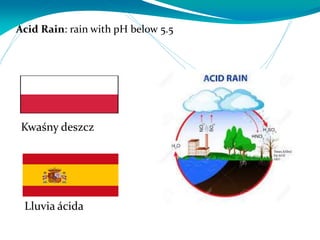
Acid Rain: rain with pH below 5.5
Lluvia ácida
Kwaśny deszcz
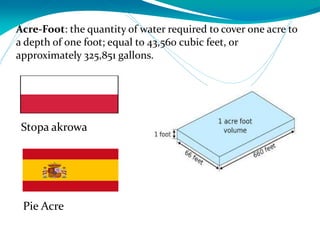
Acre-Foot: the quantity of water required to cover one acre to
a depth of one foot; equal to 43,560 cubic feet, or
approximately 325,851 gallons.
Pie Acre
Stopa akrowa
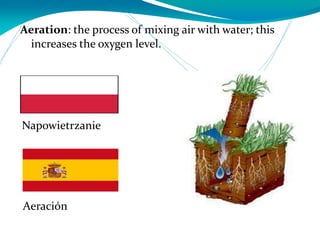
Aeration: the process of mixing air with water; this
increases the oxygen level.
Aeración
Napowietrzanie
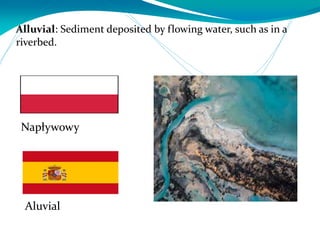
Alluvial: Sediment deposited by flowing water, such as in a
riverbed.
Aluvial
Napływowy
Alum: a very sticky substance added to water during
treatment that causes particles in the water to stick together.
Alumbre
Ałun
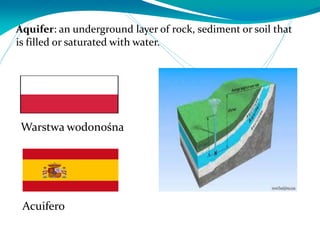
Aquifer: an underground layer of rock, sediment or soil that
is filled or saturated with water.
Acuifero
Warstwa wodonośna
Aquitard: A layer of rock over an aquifer through which water
cannot soak.
Aquitard
Półprzepuszczalna warstwa
wzdłuż warstwy wodonośnej.
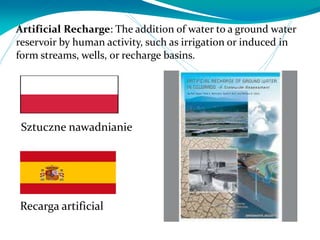
Artificial Recharge: The addition of water to a ground water
reservoir by human activity, such as irrigation or induced in
form streams, wells, or recharge basins.
Recarga artificial
Sztuczne nawadnianie
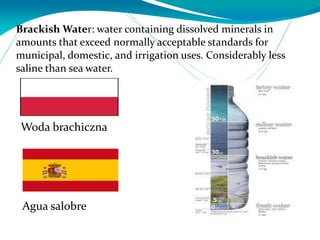
Brackish Water: water containing dissolved minerals in
amounts that exceed normally acceptable standards for
municipal, domestic, and irrigation uses. Considerably less
saline than sea water.
Agua salobre
Woda brachiczna
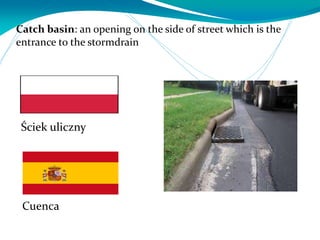
Catch basin: an opening on the side of street which is the
entrance to the stormdrain
Cuenca
Ściek uliczny
Coagulation: caused by adding alum to water, coagulation
occurs when small particles cling together, creating particles
large enough to be filtered out.
Coagulación
Koagulacja
Condensation: the process of water changing from a vapor
(gas state) to a liquid state.
Condensación
Skraplanie
Contamination: the addition of an undesirable and
potentially harmful material; pollution.
Contaminación
Zanieczyszczenie,
skażenie
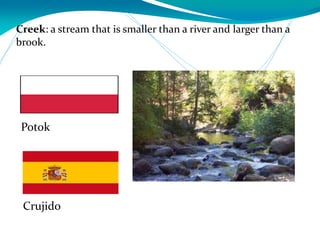
Creek: a stream that is smaller than a river and larger than a
brook.
Crujido
Potok
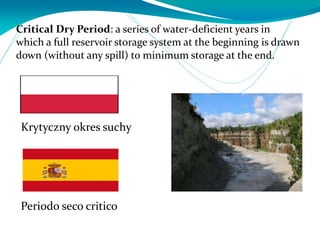
Critical Dry Period: a series of water-deficient years in
which a full reservoir storage system at the beginning is drawn
down (without any spill) to minimum storage at the end.
Periodo seco critico
Krytyczny okres suchy
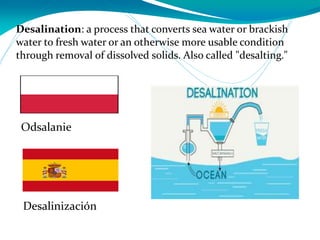
Desalination: a process that converts sea water or brackish
water to fresh water or an otherwise more usable condition
through removal of dissolved solids. Also called "desalting."
Desalinización
Odsalanie
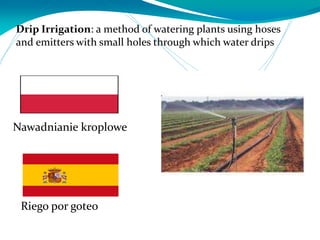
Drip Irrigation: a method of watering plants using hoses
and emitters with small holes through which water drips
Riego por goteo
Nawadnianie kroplowe
Drought: An extended period of limited or no precipitation
(rain or snow)
Borrador
Susza
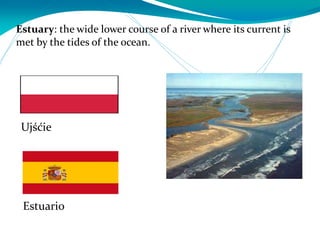
Estuary: the wide lower course of a river where its current is
met by the tides of the ocean.
Estuario
Ujśćie
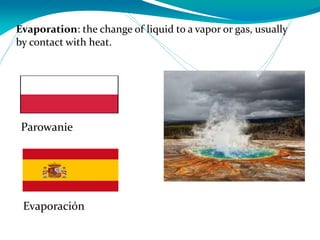
Evaporation: the change of liquid to a vapor or gas, usually
by contact with heat.
Evaporación
Parowanie
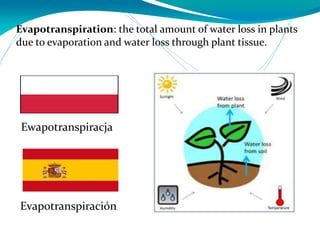
Evapotranspiration: the total amount of water loss in plants
due to evaporation and water loss through plant tissue.
Evapotranspiración
Ewapotranspiracja
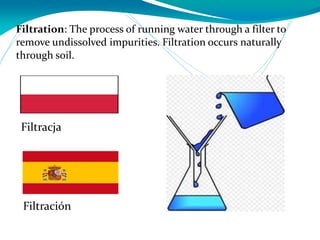
Filtration: The process of running water through a filter to
remove undissolved impurities. Filtration occurs naturally
through soil.
Filtración
Filtracja
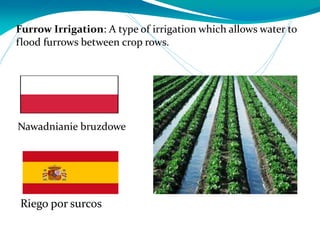
Furrow Irrigation: A type of irrigation which allows water to
flood furrows between crop rows.
Riego por surcos
Nawadnianie bruzdowe
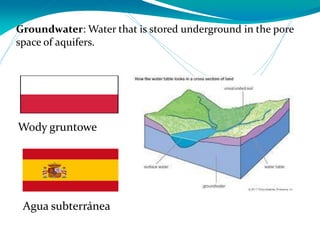
Groundwater: Water that is stored underground in the pore
space of aquifers.
Agua subterránea
Wody gruntowe
Groundwater Basin: A groundwater reservoir, together with
all the overlying land surface and underlying aquifers that
contribute water to the reservoir.
Tanque de agua subterráneas
Zbiornik wód podziemnych
Groundwater Mining: The withdrawal of water from an aquifer greatly in
excess of replenishment; if continued, the underground supply will
eventually be exhausted or the water table will drop below economically
feasible pumping lifts.
Mineria de aguas subterráneas
Wydobycie wód podziemnych
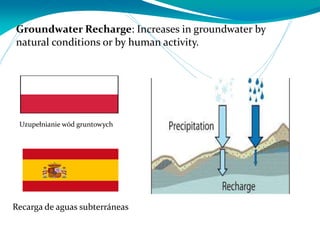
Groundwater Recharge: Increases in groundwater by
natural conditions or by human activity.
Recarga de aguas subterráneas
Uzupełnianie wód gruntowych
Hydrology: The scientific study of the properties,
distribution and effects of water in the atmosphere, on the
earth's surface and in soil and rocks.
Hidrología
Hydrologia
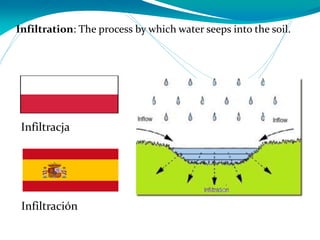
Infiltration: The process by which water seeps into the soil.
Infiltración
Infiltracja
Overdraft: Withdrawal of groundwater in excess of a basin's
perennial yield
Sobregiro
Nadmierna ekploatacja wód
gruntowych
Percolate / Infiltrate: To ooze or trickle through a
permeable substance.
Filtrarse
Przenikać
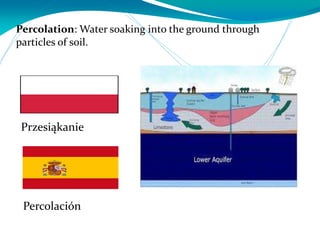
Percolation: Water soaking into the ground through
particles of soil.
Percolación
Przesiąkanie
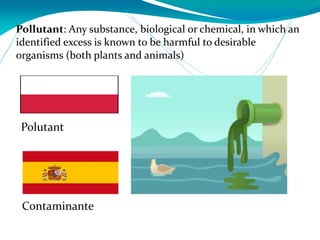
Pollutant: Any substance, biological or chemical, in which an
identified excess is known to be harmful to desirable
organisms (both plants and animals)
Contaminante
Polutant
Pollution: Items and chemicals that endanger the quality of
life and life itself.
Contaminación
Zanieczyszczenie
Potable: Water that is safe to drink.
Potable
Zdatny do picia
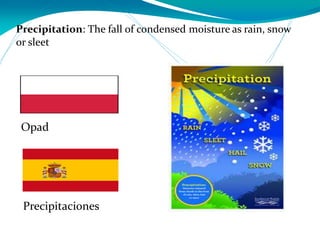
Precipitation: The fall of condensed moisture as rain, snow
or sleet
Precipitaciones
Opad
Primary Treatment: The first stage of wastewater treatment;
involves passing through a comminutor, grit chamber, and
sedimentation
Basica comportamiento
Wstępne uzdatnianie wody
Recharge: The process of water seeping through soil into an
aquifer or groundwater basin.
Recarga
Zasilanie
Recharge Basin: A surface facility, often a large pond, used to
increase the infiltration of water into a groundwater basin.
Recarga artificial
Zbiornik zasilający
Reclaimed Water: Water that is treated at a treatment plant
after is was used once, and is now safe to use again for certain
purposes.
Agua regenerada
Odzyskana woda
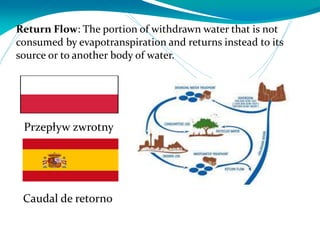
Return Flow: The portion of withdrawn water that is not
consumed by evapotranspiration and returns instead to its
source or to another body of water.
Caudal de retorno
Przepływ zwrotny
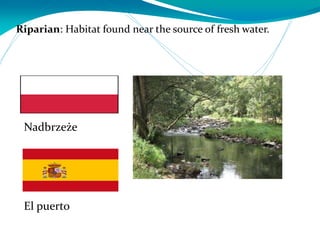
Riparian: Habitat found near the source of fresh water.
El puerto
Nadbrzeże
Riverbed: the bed or channel in which a river flows.
El lecho
Koryto rzeczne
Runoff: Rain that is not absorbed by the soil, and flows into
the surface of the soil.
Escorrentía
Odpływ
Safe Yield: The amount of water that can be taken from a
water storage that will be replaced naturally.
Rendimiento seguro
Bezpieczne wydobycie
Salinity: The concentration of mineral salts dissolved in
water.
Salinidad
Zasolenie
Secondary Treatment: The second stage of wastewater
treatment during which the water goes through aeration,
followed by the addition of aerobic bacteria.
Un tratamiento
secundario
Oczyszczanie ścieków
drugiego stopnia
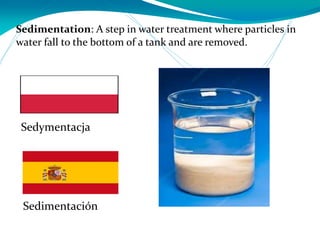
Sedimentation: A step in water treatment where particles in
water fall to the bottom of a tank and are removed.
Sedimentación
Sedymentacja
Silt: Sediments which are removed from water at a treatment
plant.
Cieno
Osad wodny
Sludge: Sediments which are removed from water at a
treatment plant.
El lodo
Szlam, osad.
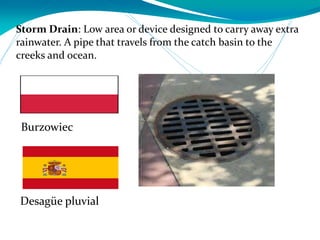
Storm Drain: Low area or device designed to carry away extra
rainwater. A pipe that travels from the catch basin to the
creeks and ocean.
Desagüe pluvial
Burzowiec
Stream: A current of water; a small river.
Riachuelo
Strumień
Surface Water: Water which is found on the earth's surface:
lakes, streams, rivers, reservoirs, etc.
Aguas superficiales
Wody powierzchniowe
Tertiary Treatment: The third stage of wastewater treatment
where water goes through coagulation, sedimentation,
filtration, and the addition of chlorine.
El tratamiento
terciario
Trzeci stopień
oczyszczania ścieków
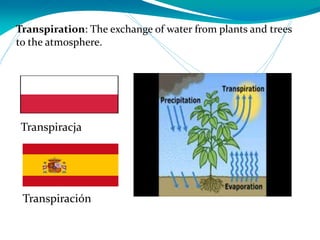
Transpiration: The exchange of water from plants and trees
to the atmosphere.
Transpiración
Transpiracja
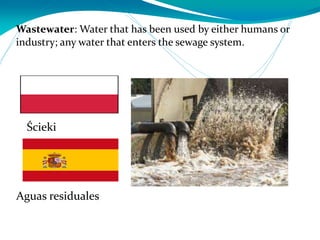
Wastewater: Water that has been used by either humans or
industry; any water that enters the sewage system.
Aguas residuales
Ścieki
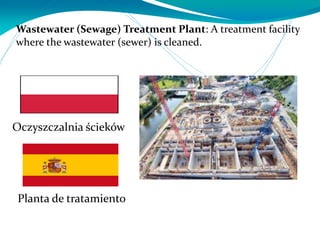
Wastewater (Sewage) Treatment Plant: A treatment facility
where the wastewater (sewer) is cleaned.
Planta de tratamiento
Oczyszczalnia ścieków
Water Cycle: The continuous cycle of evaporation,
condensation, and precipitation in which water is continually
being recycled.
El ciclo del agua
Cykl hydrologiczny
Water Table: The surface of underground, gravity-controlled
water.
Capa freática
Zwierciadło wód
gruntowych
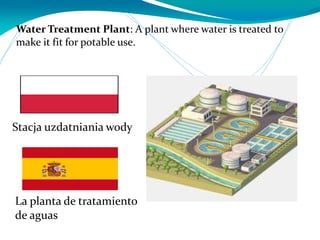
Water Treatment Plant: A plant where water is treated to
make it fit for potable use.
La planta de tratamiento
de aguas
Stacja uzdatniania wody
Water Vapor: Water in an invisible gaseous state or in a
visible liquid state consisting of extremely small particles
suspended in the air.
El vapor de agua
Para wodna

Water glossary

  • 1.
  • 2.
    Acid deposition: thefalling of acids and acid-forming compounds from the atmosphere to the earth’s surface. It is commonly known as acid rain. Depozycja kwasów Deposición ácida
  • 3.
    Acid solution: anywater solution that has more hydrogen ions (H+) than hydroxide ions (OH-); any water solution with a pH less than 7. Solución es ácida Roztwór kwasu
  • 4.
    Accumulation: the processin which water pools in large bodies (such as oceans, seas and lakes). Acumulación Akumulacja
  • 5.
    Acid Rain: rainwith pH below 5.5 Lluvia ácida Kwaśny deszcz
  • 6.
    Acre-Foot: the quantityof water required to cover one acre to a depth of one foot; equal to 43,560 cubic feet, or approximately 325,851 gallons. Pie Acre Stopa akrowa
  • 7.
    Aeration: the processof mixing air with water; this increases the oxygen level. Aeración Napowietrzanie
  • 8.
    Alluvial: Sediment depositedby flowing water, such as in a riverbed. Aluvial Napływowy
  • 9.
    Alum: a verysticky substance added to water during treatment that causes particles in the water to stick together. Alumbre Ałun
  • 10.
    Aquifer: an undergroundlayer of rock, sediment or soil that is filled or saturated with water. Acuifero Warstwa wodonośna
  • 11.
    Aquitard: A layerof rock over an aquifer through which water cannot soak. Aquitard Półprzepuszczalna warstwa wzdłuż warstwy wodonośnej.
  • 12.
    Artificial Recharge: Theaddition of water to a ground water reservoir by human activity, such as irrigation or induced in form streams, wells, or recharge basins. Recarga artificial Sztuczne nawadnianie
  • 13.
    Brackish Water: watercontaining dissolved minerals in amounts that exceed normally acceptable standards for municipal, domestic, and irrigation uses. Considerably less saline than sea water. Agua salobre Woda brachiczna
  • 14.
    Catch basin: anopening on the side of street which is the entrance to the stormdrain Cuenca Ściek uliczny
  • 15.
    Coagulation: caused byadding alum to water, coagulation occurs when small particles cling together, creating particles large enough to be filtered out. Coagulación Koagulacja
  • 16.
    Condensation: the processof water changing from a vapor (gas state) to a liquid state. Condensación Skraplanie
  • 17.
    Contamination: the additionof an undesirable and potentially harmful material; pollution. Contaminación Zanieczyszczenie, skażenie
  • 18.
    Creek: a streamthat is smaller than a river and larger than a brook. Crujido Potok
  • 19.
    Critical Dry Period:a series of water-deficient years in which a full reservoir storage system at the beginning is drawn down (without any spill) to minimum storage at the end. Periodo seco critico Krytyczny okres suchy
  • 20.
    Desalination: a processthat converts sea water or brackish water to fresh water or an otherwise more usable condition through removal of dissolved solids. Also called "desalting." Desalinización Odsalanie
  • 21.
    Drip Irrigation: amethod of watering plants using hoses and emitters with small holes through which water drips Riego por goteo Nawadnianie kroplowe
  • 22.
    Drought: An extendedperiod of limited or no precipitation (rain or snow) Borrador Susza
  • 23.
    Estuary: the widelower course of a river where its current is met by the tides of the ocean. Estuario Ujśćie
  • 24.
    Evaporation: the changeof liquid to a vapor or gas, usually by contact with heat. Evaporación Parowanie
  • 25.
    Evapotranspiration: the totalamount of water loss in plants due to evaporation and water loss through plant tissue. Evapotranspiración Ewapotranspiracja
  • 26.
    Filtration: The processof running water through a filter to remove undissolved impurities. Filtration occurs naturally through soil. Filtración Filtracja
  • 27.
    Furrow Irrigation: Atype of irrigation which allows water to flood furrows between crop rows. Riego por surcos Nawadnianie bruzdowe
  • 28.
    Groundwater: Water thatis stored underground in the pore space of aquifers. Agua subterránea Wody gruntowe
  • 29.
    Groundwater Basin: Agroundwater reservoir, together with all the overlying land surface and underlying aquifers that contribute water to the reservoir. Tanque de agua subterráneas Zbiornik wód podziemnych
  • 30.
    Groundwater Mining: Thewithdrawal of water from an aquifer greatly in excess of replenishment; if continued, the underground supply will eventually be exhausted or the water table will drop below economically feasible pumping lifts. Mineria de aguas subterráneas Wydobycie wód podziemnych
  • 31.
    Groundwater Recharge: Increasesin groundwater by natural conditions or by human activity. Recarga de aguas subterráneas Uzupełnianie wód gruntowych
  • 32.
    Hydrology: The scientificstudy of the properties, distribution and effects of water in the atmosphere, on the earth's surface and in soil and rocks. Hidrología Hydrologia
  • 33.
    Infiltration: The processby which water seeps into the soil. Infiltración Infiltracja
  • 34.
    Overdraft: Withdrawal ofgroundwater in excess of a basin's perennial yield Sobregiro Nadmierna ekploatacja wód gruntowych
  • 35.
    Percolate / Infiltrate:To ooze or trickle through a permeable substance. Filtrarse Przenikać
  • 36.
    Percolation: Water soakinginto the ground through particles of soil. Percolación Przesiąkanie
  • 37.
    Pollutant: Any substance,biological or chemical, in which an identified excess is known to be harmful to desirable organisms (both plants and animals) Contaminante Polutant
  • 38.
    Pollution: Items andchemicals that endanger the quality of life and life itself. Contaminación Zanieczyszczenie
  • 39.
    Potable: Water thatis safe to drink. Potable Zdatny do picia
  • 40.
    Precipitation: The fallof condensed moisture as rain, snow or sleet Precipitaciones Opad
  • 41.
    Primary Treatment: Thefirst stage of wastewater treatment; involves passing through a comminutor, grit chamber, and sedimentation Basica comportamiento Wstępne uzdatnianie wody
  • 42.
    Recharge: The processof water seeping through soil into an aquifer or groundwater basin. Recarga Zasilanie
  • 43.
    Recharge Basin: Asurface facility, often a large pond, used to increase the infiltration of water into a groundwater basin. Recarga artificial Zbiornik zasilający
  • 44.
    Reclaimed Water: Waterthat is treated at a treatment plant after is was used once, and is now safe to use again for certain purposes. Agua regenerada Odzyskana woda
  • 45.
    Return Flow: Theportion of withdrawn water that is not consumed by evapotranspiration and returns instead to its source or to another body of water. Caudal de retorno Przepływ zwrotny
  • 46.
    Riparian: Habitat foundnear the source of fresh water. El puerto Nadbrzeże
  • 47.
    Riverbed: the bedor channel in which a river flows. El lecho Koryto rzeczne
  • 48.
    Runoff: Rain thatis not absorbed by the soil, and flows into the surface of the soil. Escorrentía Odpływ
  • 49.
    Safe Yield: Theamount of water that can be taken from a water storage that will be replaced naturally. Rendimiento seguro Bezpieczne wydobycie
  • 50.
    Salinity: The concentrationof mineral salts dissolved in water. Salinidad Zasolenie
  • 51.
    Secondary Treatment: Thesecond stage of wastewater treatment during which the water goes through aeration, followed by the addition of aerobic bacteria. Un tratamiento secundario Oczyszczanie ścieków drugiego stopnia
  • 52.
    Sedimentation: A stepin water treatment where particles in water fall to the bottom of a tank and are removed. Sedimentación Sedymentacja
  • 53.
    Silt: Sediments whichare removed from water at a treatment plant. Cieno Osad wodny
  • 54.
    Sludge: Sediments whichare removed from water at a treatment plant. El lodo Szlam, osad.
  • 55.
    Storm Drain: Lowarea or device designed to carry away extra rainwater. A pipe that travels from the catch basin to the creeks and ocean. Desagüe pluvial Burzowiec
  • 56.
    Stream: A currentof water; a small river. Riachuelo Strumień
  • 57.
    Surface Water: Waterwhich is found on the earth's surface: lakes, streams, rivers, reservoirs, etc. Aguas superficiales Wody powierzchniowe
  • 58.
    Tertiary Treatment: Thethird stage of wastewater treatment where water goes through coagulation, sedimentation, filtration, and the addition of chlorine. El tratamiento terciario Trzeci stopień oczyszczania ścieków
  • 59.
    Transpiration: The exchangeof water from plants and trees to the atmosphere. Transpiración Transpiracja
  • 60.
    Wastewater: Water thathas been used by either humans or industry; any water that enters the sewage system. Aguas residuales Ścieki
  • 61.
    Wastewater (Sewage) TreatmentPlant: A treatment facility where the wastewater (sewer) is cleaned. Planta de tratamiento Oczyszczalnia ścieków
  • 62.
    Water Cycle: Thecontinuous cycle of evaporation, condensation, and precipitation in which water is continually being recycled. El ciclo del agua Cykl hydrologiczny
  • 63.
    Water Table: Thesurface of underground, gravity-controlled water. Capa freática Zwierciadło wód gruntowych
  • 64.
    Water Treatment Plant:A plant where water is treated to make it fit for potable use. La planta de tratamiento de aguas Stacja uzdatniania wody
  • 65.
    Water Vapor: Waterin an invisible gaseous state or in a visible liquid state consisting of extremely small particles suspended in the air. El vapor de agua Para wodna